Posted in Essay, Terri Stewart

Christine de Pizan, Part 3 of 3

This series is an academic article that I wrote on the life of Christine de Pizan, an extraordinary woman of the medieval era. This is part 3. Part 1 is here. Part 2 is here.
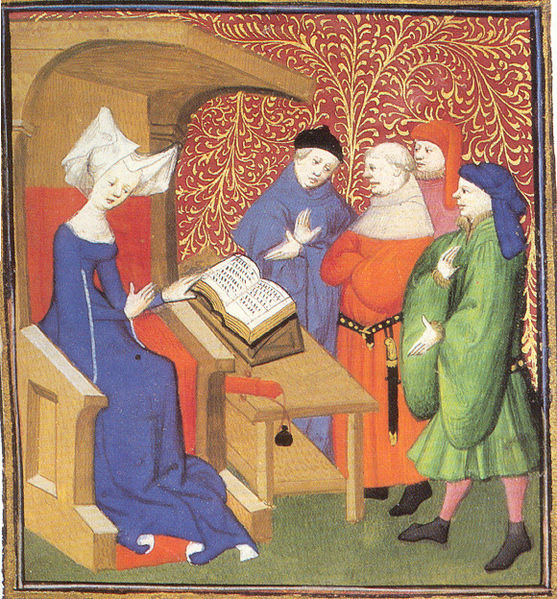
Christine de Pizan lecturing men Image from Wikimedia Commons
Christine de Pizan lecturing men
Image from Wikimedia Commons

In her poems on courtly love, she was able to express her deeply held conviction that “society obliged a woman to pay far too high a price for any momentary pleasure experienced from love outside marriage.”[1] So begins her championship of women aptly captured in “Cupid’s Letter.” During this time of growth for Christine, misogynistic attitudes abounded in the Universities, in court, and in the clergy. Aristotle’s influence held sway over the common understanding of what it was to be female. Every ill of the world was laid at the feet of women. As Christine aptly said in “Cupid’s Letter,”

There are women vilely named,

And often without cause are blamed,

And even those of noble race,

However fair and full of grace.

Lord, what company, what talk—

Women’s honor they freely mock.[2]

“Cupid’s Letter” enjoyed immediate success and was translated into English by Chaucer’s disciple, Thomas Hoccleve.[3] Her work of defending women and removing the tarnish that had been applied to their honor continued in other works including “The Debate of Two Lovers” which showed that true love is joyful, not deceitful or jealous, The Book of the City of Ladies that showed women’s contributions to history through time, The Book of the Three Virtues that sought to inculcate feminine virtues to counteract the misogyny of the time, and concluded with a eulogy poem in honor of Joan of Arc, “Ditie de Jehanne dArc.”

Throughout the time of her writing of poems and books, Christine became embroiled in a literary feud with Jean de Meun who wrote the second half of “The Romance of the Rose.” This became the “first recorded literary quarrel in France.”[4] Christine was inclined to blame the deceit and trickery of the men of her day at the feet of Jean de Meun.[5] “The Romance of the Rose” encouraged men to use whatever means necessary to acquire the woman they wanted in whatever way they wanted.  Jean de Meun belonged to another generation, another social world (not the courtly world of Christine de Pizan), and was primarily a philosopher.[6] He is crude and rude in his references to women and their body parts and advises “opportunism in relations with women, who are seldom virtuous, debauchery being the least of their crimes. The fine clothes of women do not really enhance them, for a dungheap covered with a silken cloth is still a dungheap.”[7] It is with this man and his very popular poem that Christine feels compelled to specifically defend womankind. Interestingly, she counters both in a poetic literary form, written letters, and politically through the official circle of Tignonville and the queen.[8] The chancellor of the University of Paris, Jean Gerson eventually entered the fray, siding with Christine de Pizan.[9]  Eventually, he wrote a treatise against “The Romance of the Rose.”[10] Chancellor Gerson and Christine de Pizan as literary allies were unbeatable and the argument ended (although it was not resolved.)[11] Christine was able to, for the first time, remove the discussion of women “from intellectual circles and [make] it possible for a lay-person, and a woman at that, to take part.”[12] From this point on, she leveraged her fantastic intellect, writing skill, and fame to continue writing about her major concern-“the defense of women against…unjust slander and…hypocrisies of contemporary society.”[13]

Christine de Pizan was a child and woman of privilege. She moved in circles that most people could not enter. She was affected by Petrarch, the University of Bologna, the University of Paris, and by the French Court of Charles V. Typically, a woman of her lifestyle would marry a man, have children, and live on. If her husband died, her task would be to re-marry. Christine did not do this. She educated herself, honed her literary skills and became an unlikely champion of women.

© 2013, post, Terri Stewart, All rights reserved

Terri StewartTERRI STEWART is Into the Bardo’s chaplain, senior content editor, and site co-administrator. You can expect a special post from her each week. She comes from an eclectic background and considers herself to be grounded in contemplation and justice. She is the Director and Founder of the Youth Chaplaincy Coalition that serves youth affected by the justice system. As a recent graduate of Seattle University’s School of Theology and Ministry, she earned her Master’s of Divinity and a Post-Master’s Certificate in Spiritual Direction with honors and is a rare United Methodist student in the Jesuit Honor Society, Alpha Sigma Nu. She is a contributing author to the Abingdon Worship Annual.

Her online presence is “Cloaked Monk.” This speaks to her grounding in contemplative arts (photography, mandala, poetry) and the need to live it out in the world. The cloak is the disguise of normalcy as she advocates for justice and peace. You can find her at www.cloakedmonk.com, www.twitter.com/cloakedmonk, and www.facebook.com/cloakedmonk.  To reach her for conversation, send a note to cloakedmonk@outlook.com.

[1] Willard, Christine de Pizan: Her Life and Works, 61.
[2] Ibid, 62.
[3] Ibid 63-64.
[4] Ibid, 73.
[5] Ibid, 63.
[6] Ibid, 75.
[7] Ibid, 75-76.
[8] Ibid, 77.
[9] Ibid, 80.
[10] Ibid, 84.
[11] Ibid, 86.
[12] Ibid.
[13] Ibid.


Posted in Essay, Terri Stewart

Christine de Pizan, Part 2 of 3

This series is an academic article that I wrote on the life of Christine de Pizan, an extraordinary woman of the medieval era. This is part 2. Part 1 is here.

Christine Presenting Her Book to Queen Isabeau, WikiCommons Images

Christine married Etienne de Castel, a son of a court official, in 1380.[1] It was a love match. Then things took a turn for Christine and her family. Charles V died and the crown’s close association with the academic world came to a close.[2] Tommaso became embroiled in a controversial cure that he had prescribed that “went awry.”[3] This caused the de Pizan family’s economic situation to deteriorate. Tommaso died in 1387.[4] Then in 1390, Christine’s husband died in an epidemic.[5] Christine became the head of a family with three children (one would die in childhood), a widowed mother, and a niece that was living with them. Furthermore, when she tried to settle the estate of her husband, she was met with deception, dishonesty, and lawsuits trying to strip her of her property.[6] Adding to her grief, money that had been reserved for her children’s future and invested was stolen.[7]To make matters worse, she became very ill, describing it as succumbing “like Job.”[8]

Given that Christine was now the head of her family, in France away from other relatives, without income, she had to create a way to support her household. Christine was still welcome at court and witnessed the frivolity of the court of Queen Isabeau and Louis of Orleans.[9] Here, poetry was one of the “principal social accomplishments”[10] and Christine turned her hand to poetry that reflected the Parisian social scene in its glory and ugliness. She proceeded to write poetry that reflected that scene, the grief she was still experiencing, and fond reminiscing of the reign of Charles V. Slowly, her poetry began to gather attention in the rarefied air of the court. Her fortunes began to turn when she was able to meet the earl of Salisbury in 1398.[11] They formed a bond based on love of poetry and he took her son into his own home to raise him with his own son. Then, in 1397, through Charles VI’s aunt, Marie de Bourbon, she was able to secure a place for her daughter at the Abbey of Poissy.[12]

Christine started writing poetry as early as 1394, but speaks of her literary career starting in 1399 after several years spent on self-education.[13] She studied ancient history, sciences, and the books of poets.[14] When she started studying the poets, she said to herself, “Child, be consoled, for you have found the thing that is your natural aspiration.”[15] She found her place. However, she did not take her early poetry very seriously. Her early poetry consisted of ballades, rondeaus, and the virelay.[16] These were well respected forms during her day. In addition, she started growing her own library of books by copying books in her own hand.[17] Christine also started writing letters purely for literary purposes.[18] She was becoming skilled at poetry, letter writing, and at common rhetorical devices used among the educated and courtly elite. Leaning on Plato’s view of women, Christine wrote in “The Mutation of Fortune,” that her change in status caused her to “become a man.”[19] It is this educated, courtly-adept woman that became a powerful voice for the fair and honorable treatment of women.

Christine’s poetry began to be known beyond the French court by approximately the year 1400.[20] She claims that it was because she was such a novelty—being a woman poet—that her work spread widely and rapidly.[21] However, it was probably because she wrote from her own point-of-view, a widowed woman. Her early poems used the court and its characters for the basis of her stories. She discovered that she had a particular talent for working with words and fitting them into poetic forms.[22] But her most striking skill was in expressing her own emotions and experience via literary devices.[23] The theme of grief and widowhood arises frequently in her writing.

© 2013, post, Terri Stewart, All rights reserved

Terri StewartTERRI STEWART is Into the Bardo’s  Sunday chaplain, senior content editor, and site co-administrator. She comes from an eclectic background and considers herself to be grounded in contemplation and justice. She is the Director and Founder of the Youth Chaplaincy Coalition that serves youth affected by the justice system. As a recent graduate of Seattle University’s School of Theology and Ministry, she earned her Master’s of Divinity and a Post-Master’s Certificate in Spiritual Direction with honors and is a rare United Methodist student in the Jesuit Honor Society, Alpha Sigma Nu. She is a contributing author to the Abingdon Worship Annual.

Her online presence is “Cloaked Monk.” This speaks to her grounding in contemplative arts (photography, mandala, poetry) and the need to live it out in the world. The cloak is the disguise of normalcy as she advocates for justice and peace. You can find her at www.cloakedmonk.com, www.twitter.com/cloakedmonk, and www.facebook.com/cloakedmonk.  To reach her for conversation, send a note to cloakedmonk@outlook.com.


[1] Willard, Christine de Pizan: Her Life and Works, 34-35.
[2] Ibid.
[3] Ibid, 38.
[4] Ibid, 39.
[5] Ibid.
[6] Ibid.
[7] Ibid, 40.
[8] Ibid.
[9] Ibid, 42.
[10] Ibid.
[11] Ibid.
[12] Ibid, 43.
[13] Ibid, 44.
[14] Ibid.
[15] Ibid.
[16] Ibid.
[17] Ibid, 45.
[18] Ibid.
[19] Ibid, 48.
[20] Ibid, 51.
[21] Ibid.
[22] Ibid, 53.
[23] Ibid.

Posted in Essay, Terri Stewart

Christine de Pizan, Part 1 of 3

This series is an academic article that I wrote on the life of Christine de Pizan, an extraordinary woman of the medieval era.

Christine de Pizan from Wikispaces.com
Christine de Pizan
from Wikispaces.com

During the lifetime of Christine de Pizan (1364-1430),[1] women were not well respected.[2] However, Christine managed to carve out a unique spot for herself among authors of poetry and rhetorical letters. Along her journey, she also became an unlikely champion of women, women’s roles, and the honorable treatment of women. Unlikely champion because Christine came from a privileged, comfortable background and was discouraged from stepping outside of traditional female roles by her mother.[3] I am going to show that Christine’s background peculiarly gave her the gifts to become not only a gifted author, but the unlikely champion of women. Then, a brief exploration of the misogynistic attitudes present during her lifetime that called forth a response and thrust her into the role of France’s first woman of letters.[4]

Christine de Pizan was born in Venice, Italy.[5] At the time she was born, the city was just recovering from two horrific events – an earthquake followed by the first outbreak of the bubonic plague in 1348.[6] It was thought that these events were punishments from God for Venice’s wickedness at warring with its neighbors and with Genoa.[7] Venice was a port city that was among the first cities hit by the plague due to its status as a maritime trader.[8] As the downfall of Venice was seen to be attributable to the movement of the planets and stars (earthquake), astronomy and astrology were respected and revered sciences.[9] The potential for ad4vanced study in these fields is what drew Tommaso da Pizzano to Venice.

Tommaso da Pizzano arrived in Venice in 1357 from Bologna. He had been studying there towards his degree of doctor in medical studies which would have included studying astrology.[10] Bologna had a reputation as an intellectual center of Europe, a book production center, and a center of secular thought.[11] That is the rarified air that Christine de Pizan’s father came from. Here, Tommaso met Christine’s mother, they married and soon had Christine. It is also in Venice that Tommaso became acquainted with Petrarch, one of the most influential poets[12] of his day.[13] Here the thoughts of Bologna-based on Aristotle’s writings-collided with Petrarch’s thoughts that were grounded in Plato.[14] Plato believed that women had a place in society—they had strengths that differed from men, but strengths none-the-less. Aristotle, however, had a much more subservient view of women.

In the Republic, Plato argues that women must be assigned social roles in the ideal state equal to those of men. Only one generation later, Aristotle, in his Politics, returns women to their traditional roles in the home, subserving men. Plato’s position in the Republic is based upon his view that “women and men have the same nature in respect to the guardianship of the state, save insofar as the one is weaker and the other is stronger.” Nature provides no such equality in Aristotle; in the Politics he flatly declares, “as regards the sexes, the male is by nature superior and the female inferior, the male ruler and the female subject.”[15]

I must say that Plato was not perfect on women, but he was more charitable in his views that Aristotle. Women, for Plato, degenerated from perfection while for Aristotle, they were inferior by nature.[16] Christine de Pizan was born into an environment more influenced by Petrarch and Platonic thought than by the University center’s reliance upon Aristotelian thoughts on women.

Tommaso soon re-established his family in Bologna because of the prestige that being at University brought him.[17] However, he was soon invited to join the courts of both Paris and Hungary. He chose Paris.[18] He left his family for two years in Bologna while he established himself at the French court of Charles V. This allowed him to have the prestige of being at court and being near the University of Paris. In December 1368, Charles V “received at the Louvre the newly arrived family of Tommaso, now transformed into Thomas de Pizan.”[19]

In the courts of Charles V, Christine was given quite a lot of freedom. Charles V has a propensity for intellectual interests.  He cultivated contacts with the University of Paris and built an impressive library. He contracted Nicole Oresme to translate the entire works of Aristotle into French.[20] Christine had access to the king’s library and to his personal study.[21] She later recalled the king with fondness saying, “In my youth and childhood, with my parents, I was nourished by his hand.”[22] Christine was enthralled with intellectual pursuits from a young age.[23] Her father encouraged her in her studies (he had very liberal views on the education of women) while her mother was more traditional.[24] Christine managed to walk a line between her two parents—tending to her traditional roles as a female and pursuing intellectual curiosities at every opportunity.

© 2013, post, Terri Stewart, All rights reserved

Terri StewartTERRI STEWART is Into the Bardo’s  Sunday chaplain, senior content editor, and site co-administrator. She comes from an eclectic background and considers herself to be grounded in contemplation and justice. She is the Director and Founder of the Youth Chaplaincy Coalition that serves youth affected by the justice system. As a recent graduate of Seattle University’s School of Theology and Ministry, she earned her Master’s of Divinity and a Post-Master’s Certificate in Spiritual Direction with honors and is a rare United Methodist student in the Jesuit Honor Society, Alpha Sigma Nu. She is a contributing author to the Abingdon Worship Annual.

Her online presence is “Cloaked Monk.” This speaks to her grounding in contemplative arts (photography, mandala, poetry) and the need to live it out in the world. The cloak is the disguise of normalcy as she advocates for justice and peace. You can find her at www.cloakedmonk.com, www.twitter.com/cloakedmonk, and www.facebook.com/cloakedmonk.  To reach her for conversation, send a note to cloakedmonk@outlook.com.

[1] Danuta Bois, “Christine de Pisan,” Distinguished Women of Past and Present, http://www.distinguishedwomen.com/biographies/pisan.html (accessed March 12, 2013).
[2] Charity Cannon Willard, Christine de Pizan: Her Life and Works (NY, Persea Books, 1984), 15.
[3] Willard, Christine de Pizan: Her Life and Works, 33.
[4] Ibid, 15.
[5] Ibid, 16.
[6] Ibid.
[7] Ibid.
[8] Cara Murphy, “The Bubonic Plague and the Impact on Venice,” FluTrackers, http://www.flutrackers.com/forum/showthread.php?t=23196 (accessed March 12, 2013).
[9] Willard, Christine de Pizan: Her Life and Works, 17-18.
[10] Ibid, 17.
[11] Ibid.
[12] Petrarch was an Italian humanist.
[13] Willard, Christine de Pizan: Her Life and Works, 19.
[14] Ibid.
[15] Nicholas D. Smith, “Plato and Aristotle on the Nature of Women,” Journal of the History of Philosophy 21.4 (1983): 467-478. Project MUSE. http://muse.jhu.edu/ (accessed March 13, 2013).
[16] John Wijngaards, “Greek Philosophy on the Inferiority of Women,WomenPriests.org, http://www.womenpriests.org/traditio/infe_gre.asp (accessed March 13, 2013).
[17] Willard, Christine de Pizan: Her Life and Works, 20.
[18] Ibid.
[19] Ibid.
[20] Ibid, 21.
[21] Ibid, 28-29.
[22] Ibid, 23.
[23] Ibid, 33.
[24] Ibid.

Posted in Spiritual Practice, Terri Stewart, Uncategorized

Locked Away

locked-away
Locked Away

I read a brief article about potential, gifts, talents, and how we can use those things to actually make a living! Embedded in the exercise that they walked the reader through is a wonderful contemplative exercise. So here we go!

Need:  Paper and writing utensil, timer

Often, as an ice-breaker, when I first meet youth in detention, I ask them to tell me the three best things about themselves. They always come up with one thing. Then most come up with a second thing. The third one is always a struggle. It is often a struggle to recognize the greatness in ourselves…in our own story. We so often lock our gifts away and don’t let other people see the precious gift that we are. We hide our greatness under a bushel, so to speak!

Recently, NBA player, Jason Collins, came out and told the world he was gay. Some would say that is a great act of heroism. I think it is especially interesting that he came out so recently after the Jackie Robinson movie, 42, released. Both are great efforts put forth by African-American men to combat hatred. I also find greatness in the gay youth that shows up to school every day to face bullying or ridicule. One is greatness on a national scale. The other is greatness measured in every day strides.

Now, get comfortable, create a space where your feet are grounded. Put your paper before you and hold your preferred writing utensil(s) in your hand. Hold in your mind a comfortable sense of yourself. Where is your greatness today? Where has it been in the past? What is your yardstick that measures greatness? How will you claim your greatness and let it shine?

Take 5 minutes and write down things that you think are great about yourself! Talents, gifts, actions. Even going back to childhood. Yes, 5 minutes.

Now, take that paper and fold it up. Tuck it away in an accessible location–a purse or a wallet would be great. From now until next Sunday, keep a greatness log! I wonder if we can recognize the greatness in the everyday acts of living. Like yesterday, maybe it was “great” that I gave a homeless man all my change so he could get food. Some days greatness, for me, can be measured by the ability to get out of bed! Perhaps the trick is not to compare your greatness to other people.

Have a great week!

Shalom,

Chaplain Terri
CloakedMonk

© 2013, post and photos, Terri Stewart, All rights reserved

Terri StewartTERRI STEWART is Into the Bardo’s  Sunday chaplain, Senior Content Editor and Site Co-Administrator.  She comes from an eclectic background and considers herself to be grounded in contemplation and justice. She is the Director and Founder of the Youth Chaplaincy Coalition that serves youth affected by the justice system. As a recent graduate of Seattle University’s School of Theology and Ministry, she earned her Master’s of Divinity and a Post-Master’s Certificate in Spiritual Direction with honors and is a rare United Methodist student in the Jesuit Honor Society, Alpha Sigma Nu. She is a contributing author to the Abingdon Worship Annual.

Her online presence is “Cloaked Monk.” This speaks to her grounding in contemplative arts (photography, mandala, poetry) and the need to live it out in the world. The cloak is the disguise of normalcy as she advocates for justice and peace. You can find her at www.cloakedmonk.com, www.twitter.com/cloakedmonk, and www.facebook.com/cloakedmonk.  To reach her for conversation, send a note to cloakedmonk@outlook.com.
Posted in Meditation, Spiritual Practice, story, Terri Stewart

Candle Gazing and a Contemplative Tale

Today’s practice is two tales set to a video recording of three candles. I will confess that this was done in my living room and, well, the candles are not as flickery on the video as they were in my living room. I would suggest getting a candle and looking at it instead of the video screen! Or simply closing your eyes and listening.

Candle gazing is a contemplative meditation technique. In this manner, instead of closing your eyes, you let your eyes rest on the flame of a candle. Let your gaze rest softly, neither focusing too hard or letting the candle leave your gaze. Stay with the candle as it dances and let your mind be free.

This video is about 4 1/2 minutes long. There are a couple of brief moments of silence. Stay with the silence and get through to the other side.

The stories are from one of my favorite books, “Peace Tales: World Folktales to Talk About” by Margaret Read MacDonald. This book found us when my kids were in elementary school. (My youngest is graduating this year! Yikes!!)

Sit back. Relax. Get comfortable. Become grounded. Now listen with your heart.


Namaste, salām, shalom.


© 2013, post and video, Terri Stewart, All rights reserved

Terri StewartTERRI STEWART is Into the Bardo’s  Sunday evening chaplain. You can expect a special post from her each week. She comes from an eclectic background and considers herself to be grounded in contemplation and justice. She is the Director and Founder of the Youth Chaplaincy Coalition that serves youth affected by the justice system. As a recent graduate of Seattle University’s School of Theology and Ministry, she earned her Master’s of Divinity and a Post-Master’s Certificate in Spiritual Direction with honors and is a rare United Methodist student in the Jesuit Honor Society, Alpha Sigma Nu. She is a contributing author to the Abingdon Worship Annual.

Her online presence is “Cloaked Monk.” This speaks to her grounding in contemplative arts (photography, mandala, poetry) and the need to live it out in the world. The cloak is the disguise of normalcy as she advocates for justice and peace. You can find her at www.cloakedmonk.com,www.twitter.com/cloakedmonk, and www.facebook.com/cloakedmonk.  To reach her for conversation, send a note to cloakedmonk@outlook.com.
Posted in Photography/Photographer, Spiritual Practice, Terri Stewart

Contemplative Photography: Listen with the Eye of the Heart

Contemplative photography is a practice I try to observe. So often, I end up reserving it for vacation times. However, with the advent of phone cameras and the increased capabilities they have, contemplative photography is at my fingertips every day! I am reading a book on contemplative photography and would like to share some of the thoughts it is stirring in me and the information it has. The book is Eyes of the Heart: Photography as a Christian Contemplative Practice by Christine Valters Paintner. You can find her at Abbey of the Arts.

Contemplative seeing is described by Carmelite William McNamara as a “long loving look at the real.” Let’s think about what each one of these words means.

  • Long – to see, we need to slow down and notice our surroundings, immerse ourselves into the moment
  • Loving – to see clearly, we need to have a compassion filter that sees beauty in all things, the horrible and the joyful
  • Look at the real – to see things as they are, not how we want them to be

Contemplative seeing also requires a journey from the head down into the heart.

In Buddhism, there is a practice of contemplative photography called Miksang. This is Tibetan for “good eye.” Miksang has the goal of looking at the real without judgement or distinctions like “beautiful” or “ugly.” The goal is to see things as they are without attaching value judgments and to appreciate it. This opens up a third space, seeing things in a creative new way. I am reminded of a visit I made to the women’s prison. It was a spectacular Pacific Northwest day. Brilliant blue skies. Inside the prison, walking across the grounds, I looked up and saw the razor wire. At the same time it was incredibly beautiful and incredibly repulsive. That is the tension that the “good eye” brings.

freedom in the penitentiary

robin sitting still
between barbs of sharpened steel
her spirit will soar

In Christianity, this “good eye” is termed the “third eye” by Richard Rohr. He describes it as the moment when “our heart space, our mind space, and our body awareness are all simultaneously open and non-resistant. I like to call it presence. It is experienced as a moment of deep inner connection, and it always pulls you, intensely satisfied, into the naked and undefended now, which can involve both profound joy and profound sadness. At that point, you either want to write poetry, pray, or be utterly silent.”

The monk, Thomas Merton, started practicing contemplative photography and he said, “How the blank side of a frame house can be so completely beautiful I cannot imagine. A completely miraculous achievement of forms.” Perhaps the good eye or the third eye is simply seeing the miracle.

All this is quite a lead up to the offering I have today of a contemplative photograph. I am going to offer an image and then I encourage you to visit one from Thomas Merton he titled “Sky Hook” and described as the “Only known photograph of God.”

After entering the photograph(s), please consider sitting with the feeling that is created when you shift from head seeing to heart seeing. Gaze lightly into the distance without focusing on any one thing. Be present to the real. After you have considered these photographic offerings, perhaps you would consider gazing around you, holding compassion in your heart and seeing something beautiful. If you have your camera, great! If not, consider the magical moment of holding the image in your heart and then releasing it.

Community
Community

Reflection: What, if anything, has changed? How was the journey from head to heart?

Shalom and Amen.

Chaplain Terri

© 2013, post and photographs, Terri Stewart, All rights reserved

Terri Stewart
Terri Stewart

TERRI STEWART is Into the Bardo’s  Sunday evening chaplain. You can expect a special post from her each week. She comes from an eclectic background and considers herself to be grounded in contemplation and justice. She is the Director and Founder of the Youth Chaplaincy Coalition that serves youth affected by the justice system. As a recent graduate of Seattle University’s School of Theology and Ministry, she earned her Master’s of Divinity and a Post-Master’s Certificate in Spiritual Direction with honors and is a rare United Methodist student in the Jesuit Honor Society, Alpha Sigma Nu. She is a contributing author to the Abingdon Worship Annual.

Her online presence is “Cloaked Monk.” This speaks to her grounding in contemplative arts (photography, mandala, poetry) and the need to live it out in the world. The cloak is the disguise of normalcy as she advocates for justice and peace. You can find her at www.cloakedmonk.com,www.twitter.com/cloakedmonk, and www.facebook.com/cloakedmonk.  To reach her for conversation, send a note to cloakedmonk@outlook.com.
Posted in Spiritual Practice, Terri Stewart

Yom Hashoah

April 7th marked Yom Hashoah, the Holocaust Remembrance of Judaism (and thank you to Dr. Erica Martin for bringing this to my attention).  I have participated in several Yom Hashoah services over the years during my time as Ecumenical Liturgy Graduate Assistant at Seattle University. You will be brought to your knees acknowledging the atrocities that can be (and continue to be) committed in the name of humanity. And then further humbled by the acknowledgment of hope and transcendence that exists in the human spirit. A particular phrase that marks the worship service is, “We will never forget.” Let it be so.

Let us never forget that all it takes for evil to prosper is for good people to be silent.

Let us never forget that we are capable of unspeakable atrocities in the name of nationalism and in patriotism.

Let us never forget that by having a desire to punish at all costs, we create the monsters that haunt us.

Let us never forget that innocents pay the price of our decisions to turn away from caring for one another.

Let us never forget that holocausts continue and that genocide is still experienced.

Let us never forget the evil that haunts humanity.

But,

Let us never forget that a caterpillar is transformed into a butterfly.

Let us never forget that caring for the widow, the orphan, and the stranger among us is a call to compassion at all costs.

Let us never forget that when we offer our neighbor care, we offer our care to the entire world.

Let us never forget that the peacemakers are blessed.

Let us never forget that those who are last among us, will be first.

Let us never forget that love overcomes evil.

And,

Let us never forget that no matter how small the light, it cannot and will not be overcome.

Link to GenocideWatch.org

© 2013, post, Terri Stewart, All rights reserved

Posted in Spiritual Practice, Terri Stewart, Uncategorized

I am the one who…

There is a spiritual practice called SoulCollage®. The main focus of this practice is to put together a collage that represents various things to you… your inner committee, your community, world archetypes, or totems and chakras. Below is an example of a card I created that represents various voices on my inner committee.

One of My Committee Cards

It isn’t simply the making of the card that is the point, but it is exploring the card. If I look at the card and the various images, I can settle into one (or more) of the images and complete the following sentence.  I am the one who….

  • I am the one who dreams
  • I am the one who prophesies
  • I am the one who walks towards a voice that calls
  • I am the one who is grounded
  • I am the one who flies

I could continue on. What became clear to me after I put these images together is that the holy and the worldly are held together in one place for me. That I need the child-like dreamer to be the one who confronts injustice and demands change. That the holy ferris wheel in my head holds together joy and the sacred. That being grounded allows me to fly. And I could still continue on!

Now it is your turn! I have taken a few photos of various situations, people, animals, things. I am presenting them here. I ask you to locate one photo (maybe more), and enter it and complete the statement:  “I am the one who ___________________ .”

What did you discover?

How was the process for you?

“The greatest hazard of all, losing one’s self, can occur very quietly in the world, as if it were nothing at all. No other loss can occur so quietly; any other loss – an arm, a leg, five dollars, a wife, etc. – is sure to be noticed.”
― Søren Kierkegaard, The Sickness Unto Death

“You are — your life, and nothing else.”
― Jean-Paul Sartre, No Exit

Posted in Contributing Writer, find yourself, Spiritual Practice, Terri Stewart

FINDING YOURSELF Part 2: What Story Do You Have to Tell?

What experience of the presence of the divine can you speak to?

Where has grace moved in your life?

Every time I meet with youth in detention, I am interested in hearing their story. Monday, I heard the story of a young man who is extremely disappointed in himself. So we read the Tales of the Pointless People by Dan Ehrlander. Here we explored that the keeping score, comparing, ourselves to other, leads to spiritual death. Holding yourself responsible and bearing guilt beyond your capacity are two separate things.

“Write your story as it needs to be written. Write it honestly and tell it as best you can. I’m not sure that there are any other rules. Not ones that matter.” ― Neil Gaiman

What story do you have to tell?

sailboat

“It doesn’t interest me what you do for a living. I want to know what you ache for, and if you dare to dream of meeting your heart’s longing.

It doesn’t interest me how old you are. I want to know if you will risk looking like a fool for love, for your dream, for the adventure of being alive.

It doesn’t interest me what planets are squaring your moon. I want to know if you have touched the center of your own sorrow, if you have been opened by life’s betrayals or have become shriveled and closed from fear of further pain! I want to know if you can sit with pain, mine or your own, without moving to hide it or fade it, or fix it.

I want to know if you can be with joy, mine or your own, if you can dance with wildness and let the ecstasy fill you to the tips of your fingers and toes without cautioning us to be careful, to be realistic, to remember the limitations of being human.

It doesn’t interest me if the story you are telling me is true. I want to know if you can disappoint another to be true to yourself; if you can bear the accusation of betrayal and not betray your own soul; if you can be faithless and therefore trustworthy.

I want to know if you can see beauty even when it’s not pretty, every day, and if you can source your own life from its presence.
.
I want to know if you can live with failure, yours and mine, and still stand on the edge of the lake and shout to the silver of the full moon, “Yes!”

It doesn’t interest me to know where you live or how much money you have. I want to know if you can get up, after the night of grief and despair, weary and bruised to the bone, and do what needs to be done to feed the children.

It doesn’t interest me who you know or how you came to be here. I want to know if you will stand in the center of the fire with me and not shrink back.

It doesn’t interest me where or what or with whom you have studied. I want to know what sustains you, from the inside, when all else falls away.

I want to know if you can be alone with yourself and if you truly like the company you keep in the empty moments.”

Oriah Mountain Dreamer*

Shalom,
Terri

* Oriah Mountain Dreamer is the author of several best-selling books: The Invitation (now translated into more than fifteen languages), The Dance, and The Call: Discovering Why You Are Here. Her book, What We Ache For: Creativity and the Unfolding of Your Soul, explores the challenges, rewards, and necessity of doing our creative work. 

mailTERRI STEWART is Into the Bardo’s Sunday Chaplain. You can expect a special post from her each week. She comes from an eclectic background and considers herself to be grounded in contemplation and justice. She is the Director and Founder of the Youth Chaplaincy Coalition that serves youth affected by the justice system. As a recent graduate of Seattle University’s School of Theology and Ministry, she earned her Master’s of Divinity and a Post-Master’s Certificate in Spiritual Direction with honors and is a rare United Methodist student in the Jesuit Honor Society, Alpha Sigma Nu. She is a contributing author to the Abingdon Worship Annual.
.
Her online presence is Cloaked Monk.This speaks to her grounding in contemplative arts (photography, mandala, poetry) and the need to live it out in the world. The cloak is the disguise of normalcy as she advocates for justice and peace. You can find her at www.cloakedmonk.com,www.twitter.com/cloakedmonk, and www.facebook.com/cloakedmonk.  To reach her for conversation, send a note to cloakedmonk@outlook.com.
Posted in Spiritual Practice, Terri Stewart

Listen with the Ear of Your Heart

The phrase “listen with the ear of your heart” comes to us from St. Benedict and the Rule that he developed for his monks. He begins the prologue this way,

“Listen carefully, my son, to the master’s instructions, and attend to them with the ear of your heart.”

Summarizing Jane Tomaine, author of St. Benedict’s Toolbox: The Nuts and Bolts of Everyday Benedictine Living, the divine is before us and within us waiting to be seen. Our challenge is that our busy lives leave us hurrying from task to task. Is it possible to do our work and connect to our heart, mind, and awareness of eternal transcendence? Is it possible to allow ordinary, every-day tasks to reveal to us the divine?

Yes! It is possible

Today, I am offering to you a journey with the idea of listening with the ear of the heart and apply it to an adaptation of lectio divina. Lectio divina is a way of reading that is sacred. It involves four movements. (1) lectio (read), (2) meditation (meditate), (3) oratio (pray), and (4) contemplation (contemplate). However, I am offering a practice with music.  Audio divina, if you will.

This is a piece of music called “Shadows” from the “Diaspora” album by Ibrahim Maalouf. Ibrahim Maalouf is a trumpet player and teacher, composer and arranger. He was born in Beirut, Lebanon, and now lives in Paris, France. His style is uniquely his own. A blend of Arabic tonality and jazz.

The complete movement of audio divina should take approximately 30 minutes to an hour. Feel free to adapt the practice to suit your busy lifestyle (allow the ordinary to be infused with the extraordinary!)

Audio

Please listen.

Now, take a moment to pause. Breathe. In. Out. In. Out. (allow time for the music to echo within you)

What is echoing?

Meditatio

Please play the video again.

Again, take a moment to pause. Breathe. In. Out. In. Out. (allow time for the music to begin resonating within you)

What part is pulling you? What part is pushing you? Is there a particular movement or instrument that is creating energy within?

Oratio

Please play the video again.

Again, take a moment to pause. Breathe. In. Out. In. Out. (allow time for the music to begin pulling you)

Often, prayer is about opening up to possibilities. Do you hear new possibilities? Is there an invitation? Is the energy beginning to coalesce?

Contemplatio

Please play the video again.

Again, take a moment to pause. Breathe. In. Out. In. Out. (allow time for the music to energize you)

Contemplation should lead to action. You have heard the music, entered it’s space, begun to feel it’s pull, now, where is that pull leading you? What is your response?

Shalom,

Terri

© 2013, post and photographs, Terri Stewart, All rights reserved

mailTERRI STEWART is Into the Bardo’s ne Sunday evening chaplain. You can expect a special post from her each week. She comes from an eclectic background and considers herself to be grounded in contemplation and justice. She is the Director and Founder of the Youth Chaplaincy Coalition that serves youth affected by the justice system. As a recent graduate of Seattle University’s School of Theology and Ministry, she earned her Master’s of Divinity and a Post-Master’s Certificate in Spiritual Direction with honors and is a rare United Methodist student in the Jesuit Honor Society, Alpha Sigma Nu. She is a contributing author to the Abingdon Worship Annual.
Her online presence is “Cloaked Monk.” This speaks to her grounding in contemplative arts (photography, mandala, poetry) and the need to live it out in the world. The cloak is the disguise of normalcy as she advocates for justice and peace. You can find her at www.cloakedmonk.com,www.twitter.com/cloakedmonk, and www.facebook.com/cloakedmonk.  To reach her for conversation, send a note to cloakedmonk@outlook.com.
Posted in Spiritual Practice, Terri Stewart

The Bridge

BridgeDuvall, WA
Bridge
Duvall, WA

In my driving to and from the youth detention center, I have discovered that I cross many bridges. I do, after all, live in the Pacific Northwest where it rains and rains and rains. Rarely are the bridges as interesting as the one pictured here. I began to wonder about the nature of bridges. When I look at this one, I see strength, shadow, radiance, and more.

If you took a few moments to enter this photo, what is calling out to you? Where is energy stirring within you? What is shimmering in your body?

Going deeper, now that you are stirring, do you hear an invitation? Seeing anything? Is there a question?

Finally, now that you have felt energy, heard a question, what are you going to do about it? Is there action growing out of your contemplation? Is the action, the act of stillness? An act of justice? An act of compassion for yourself or others? Is the bridge leading you somewhere? Or returning you home?

Random Observation-This particular bridge is found at a round-about. A circular spot in the road that both leads and returns. What if going forward is returning home?

“Sometimes, if you stand on the bottom rail of a bridge and lean over to watch the river slipping slowly away beneath you, you will suddenly know everything there is to be known.” -A. A. Milne

Shalom,
Terri

P.S. For a photo of a round-about, go HERE.

mailTERRI STEWART is Into the Bardo’s new Sunday evening chaplain. You can expect a special post from her each week. She comes from an eclectic background and considers herself to be grounded in contemplation and justice. She is the Director and Founder of the Youth Chaplaincy Coalition that serves youth affected by the justice system. As a recent graduate of Seattle University’s School of Theology and Ministry, she earned her Master’s of Divinity and a Post-Master’s Certificate in Spiritual Direction with honors and is a rare United Methodist student in the Jesuit Honor Society, Alpha Sigma Nu. She is a contributing author to the Abingdon Worship Annual.
Her online presence is “Cloaked Monk.” This speaks to her grounding in contemplative arts (photography, mandala, poetry) and the need to live it out in the world. The cloak is the disguise of normalcy as she advocates for justice and peace. You can find her at www.cloakedmonk.com,www.twitter.com/cloakedmonk, and www.facebook.com/cloakedmonk.  To reach her for conversation, send a note to cloakedmonk@outlook.com.