Peace in the Desert

English: Leaving traces on soft sand dunes in ...

Peace reigns in this treeless desert of quiet.
Here I don’t worry about the philosophical
or metaphysical question of a falling oak,
redwood, or even a palm if I don’t wish to.
Many will never understand my affinity
for the neatness of the seemingly
dust-cursed and barren wastes of alone.
I don’t mind. The desert protects its own.
Always shifting, always the winds of time
giving me new geography to chronicle
and erasing the needless old steps,
always the sound of my own voice
when I wish to listen to it.

And there are plenty of others here.
Just very, very far apart.

My wanderings have crossed paths
with some of these nomads
and I have fallen in with another.
Sometimes we go off, each of us alone,
to listen to the desert,
take comfort in its cleanliness
of thought and deed and spirit.
We always seem to come back
to share our discoveries
and keep one another warm on cold nights
of what once was just one voice,
one heartbeat wandering
in that wind and the blessed quiet.

© 2017, Joseph Hesch; photo credit – Luca Galuzzi under CC BY-SA 2.5 license

genome for survival


full social justice
unending humanity
merging to form peace


© 2017, poem and illustration, Charles W. Martin

:: submarine ::

dive below,       breathe beneath the surface.
rise &              wonder who defines standard.
 
present tense.
often reduced.
 
we have water here & float yet not as pretty
as you.
 
do.
 
many poets died this day.
 
some prefer substandard.
 
© 2017, Sonia Benskin Mesher

:: reimagine the world ::


:: reimagine the world::

leave your ideas at home.
on the hatstand. forget all
that you have learned, things
may not be so.

all people have thoughts, so
yours is not so precious now,
elder.

she told me that even things
at home have changed.

looking round we see they have.

reimagine the world, forget
the learning, start again,
then we may understand, or not.

king david.

© 2017, Sonia Benskin Mesher

:: the burning ::

he said the flames

came over the trees.

behind the buildings.

bombed the buildings.

so do not wonder why

i don’t play soldiers,

lay them down to die.

he says that i will not battle,

i am no good at it.

too peaceful. i can play

hospitals.

© 2017, poem and illustration, Sonja Benskin Mesher

Building Freedom

Liberty stands still with welcoming arms open
a vision of freedom that’s endured worldwide
she’s taken Irish famine victims, Germans,
Dutch, and Jews escaping Hitler’s camps
and brave prospectors seeking Klondike gold.

All have made it to the melting pot, stirred
added with the spice of First People, those
who lived in forest, prairie and mountain
before Italian Columbus sailed from Cadiz,

or the slaves were freed to add Africa’s dance
to the music that calls “freedom” and America
the call and greatness of welcoming U.S.A.
that’s echoed to the poor since it became power.

In the last year She weeps upon her island
watching the world’s poor die upon sea and land.
No longer ships and planes pass her open arms
filled with those seeking a better life, fleeing
war, famine, the hatred of the despot for

even in this land of freedom a goose step
demands that only those who march to
a tune we thought defeated are welcome
men embolden by the promise of support;

but has Gaia responded with a warning,
hurling winds across the Caribbean
to devastate not only the islands but
the retreats of the wealthy, who thought
themselves immune in their castles

not even the President’s Mar-a-Largo is safe
from her wrath. Is she asking “why”?
Should we not reply with friendship,
welcome the poor, refugee and worker
whatever their race or religion to the mix?

For they are the people who will build
nations, care for us as doctors, and nurses
carve the future as scientists, engineers.
They have talents that we, every nation needs.

© 2017, Carolyn O’Connell

Another Note in an Endless Melody

On March 18, 2013, a decade after the Iraq invasion, The Columbus Herald Ledger printed soldiers’ recollections of their first Iraq tours. These accounts are loosely based on those recollections. All three voluntarily returned for a second tour.


Digital art by Phillip T. Stephens Background texture by Billy Alexander
Digital art by Phillip T. Stephens
Background texture by Billy Alexander

Afghanistan’s Just Another Note
in an Endless Melody

(An American haibun [1] )

Security

Palmer and I drive 24 hours straight. On dusty roads. Grit crusts our crotches, cracks, armpits, teeth. The minute we report, they dispatch us to highway patrol. No time for coffee, cigarette or a piss. Grab gear and go. We’re on patrol maybe fifteen minutes, a toothless haji staggers down the center of the highway. No shirt, holes in his pants, one sandal hanging by a strap, hands empty. Raised like white flags. Palmer steps onto the shoulder; I can’t pull him back. Haji drops. An RPG follows his path, flips Palmer. A six-foot arc. Toothless rolls to the far shoulder, leaps up and scrams. Bullets swarm the squad like hornets from a burning nest. I duck behind an abandoned car. A second grenade punches into the gas tank. I dive into the sand beating the fireball by a second. Wake in the hospital, bathed in sunlight, my leg in a cast from ankle to hip. An officer shows up. Doesn’t even look in my file for my name. “You’re flying home, soldier. Recovery leave.” I asked about Palmer. “He’s flying too.” No eye contact. I knew then that they’d be sending Palmer cargo.

In a village graveyard, in the steaming

summer rain, a priest consoled

a widow weeping at her

husband’s stone. A tear because

he perished, a flower for her love.

Her face in pain. He touched her arm

to share a word of tenderness.


First Wave

Our M113 crossed the Iraqi border at midnight. HQ deployed us as the invasion’s first pawns. The Republican Guard scattered like spider monkeys during the firefights. One night, while our tracers chased the cowards across the sand, I pumped my fist, poked Baker in the ribs. “At this rate, we’ll be in Iraq by Sunday,” I shouted over the noise of the explosions. Baker didn’t answer. Couldn’t answer. He couldn’t answer because he had no head to answer with. He stood perfectly straight, a mess of gristle and spine sticking above his shoulders. After a couple of months, in the Red Zone, Johny Jihad learned how to lure convoys down narrow streets and pick them off. So, it was August, like six months after they said the war would end in shock and awe and we’d be back home polishing off six-packs in our porch swings, and our convoy’s front track lifted its nose, like a horse rearing on hind legs. Six maybe seven bodies spilled into the fleeing crowd. The Bradley at the tail went next, a rocket through the engine block tipping it onto the sidewalk. Cash, our driver, plowed through the wreckage, the rest of us crouching close to the floor and firing over the side. Norton fired the top gun at anything moving. Back at the base, I couldn’t light my Camel, my hand shook the lighter so hard. That was when I started thinking of my college engineering classes as weekends at Disneyland.

“He died in a noble cause.

He gave his life for you and me.”

She seized his words,

spit in mud, cursed such

generosity.

“Your petty wars are not

the will of God. He gave no

sanction. Nor is there need.

And if you want to tell me

otherwise, please offer

your excuses to the dead.”


Sand gets in your eyes

One hundred twenty degrees with the breeze. On that first day in April, I had no way of knowing we’d suffer in the heat so long. I spent three-months suffering with heat and bug bites before I’d feel air conditioning. They gave me a cushy post. I coordinated battlefield positions. That cushy job didn’t keep me out of combat. One time a sandstorm trapped our convoy. We were three miles outside a sinkhole called As Samawa, sixteen vehicles on a highway that had so many pockmarks it could have been a teenager’s face. The advance slowed until we creeped along at an inch and hour. We couldn’t even see to the shoulder. LT dispatched Parker and Dial to scout. They wrestled with the wind, and disappeared into the brown sky. When they didn’t report back I looked for them. I fought the wind for an hour. Even with a muffler the storm sandblasted the skin on my face. I finally sat on a sandbag for a smoke and a snack. A chocolate bar. The storm faded as quickly as it started. I glanced down, discovered my sandbag was Parker’s body.

You priests of a jealous God,

you prophets of Democracy,

do you ever take a moment

to explain that corpses do not

drink Christ’s blood, corpses

do not vote. They turn to mud

beneath the earth and rain.


©2017 Phillip T. Stephens


[1] The Japanese haibun combines a paragraph with a poem (in its strictest form, haiku). Each haibun requires a title and the paragraph must be composed in first person. The poetry and paragraphs can be combined in any variation.

the places between

it’s this
wavering time

she said

                 i see the fine
membranes
trembling /
               / the thin
reflections of
twisted orders

a free disguise
             when nothing’s
on offer

                  even

& the swollen bellies
of empty

i don’t want to
watch the greasy rivers

                            she said

where plagues
come in buckets

©2017 Reuben Woolley

virginia’s move

who said
the town was burning

                         she saw
the smoke
from every side of it
& the faces

the screaming mouths.we’ll have
a taste of it

                       & every difference
is marked for onslaught

it’s time
                she said
for removal /
                  /
                / for a stirring
from the alleys

©2017 Reuben Woolley

knucklebone excess

i don’t go

scattering bones &
raising dead armies

                    just this

combing snakes
a styled

                protection

come
you mirror-bound heroes
the weak remains
of lost battles

feed my hunger
that i haven’t 

eaten

since some god’s supper

©2017 Reuben Woolley

Eclipsed

Nearly a year ago, when we first learned of the solar eclipse, most motels in the Northwest Totality Zone were either booked, or charging up to $750 for a room.  So we reserved a B&B in the Eastern Oregon town of Moro, a forty minute drive to Totality. As the day approached, epic traffic jams of eclipse chasers were reported.  We left a day earlier than we’d planned, taking two days to travel 270 miles, with emergency gear: food, water, sleeping bags, gas can, a read-aloud book and our Kingston Trio CDs.

Traffic on I-5 was heavy, but we traveled east over the Cascades, cruising the speed limit, and sighting only the occasional RV heading to the Totality Zone from Yakima.

All the guests at our B&B were eclipse chasers.  There were two couples, first-time viewers up from California, and a German couple, first-time visitors to the US, who had crossed an ocean and a continent for a ninety second peek at a natural phenomenon they’d seen many times before.  I took that as a good sign.

Moro’s population is 316.  Its only cafe had gone belly up, and the market closes early on Sundays, but the local history museum was open.  We picnicked and were playing board games in our room when Thom discovered on Facebook that college friends were also staying in Moro at the only other accommodation in town, just a five minute walk away. Lona and Scott were as enthusiastic about the eclipse as you’d expect a science teacher and a librarian to be, and they had spent the last two days scouting out the best view spots. They invited us over, pulled out their maps and notes, and suggested a place just south of Shaniko, for its off-road parking and territorial views.

Taking no chances, we allowed four hours to travel the 38 miles into the Totality Zone. Rising at 5AM, we learned that the other guests were long gone. But the roads were clear and we were halfway there before the sun rose.  At least sixty people were camped at our viewpoint, with more arriving all the time. The buzz of excitement filled the air, though the eclipse was still two hours away.  One youngster kept a faithful watch, but I dozed, catching snatches of conversation between friendly strangers.

Finally the moon’s shadow began to pass over the face of the sun. Through protective glasses it looked like a sky cookie, with a bite taken out of it.

There was a drop in temperature and a subtle change of light.  We couldn’t tell over the noise of the crowd whether the birds stopped singing, but the people-watching was superb compensation.  For an hour, the moonshadow inched across the sun, its effect hardly noticeable, except through protective glasses. Without them, even with just a sliver of the sun peeking out from behind the moon, its light was blinding.

All at once, darkness eclipsed the world.  It was as if a one-eyed sleeping giant had suddenly awakened, and the sky was staring back at us.

The crowd erupted into wild cheers, and Thom and I shared their exhilaration.

I’d seen it depicted on canvas, demonstrated in planetariums and National Geographic specials. But seeing a total solar eclipse with my own eyes was like hearing ‘Ode to Joy” sung by a heavenly choir after seeing only the musical notation on paper.

(Ivan Generalić: Solar Eclipse, 1961, CMNA )

Our dear Sol had pulled off his glasses and shirt to reveal his Superman costume. Ninety seconds later–it felt like the blink of an eye–the sun emerged from the shadow.
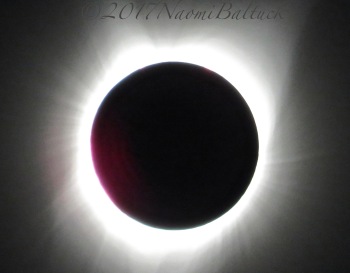
We took a deep breath, hugged each other, and hit the road, hoping to beat the crush of outbound traffic. We were elated as we drove north, verbally processing the experience. We both questioned whether we’d used our few precious seconds wisely. Ironically, Thom regretted not taking a single photo, while I wondered if I’d made a mistake by placing a lens between myself and an awesome once-in-a-lifetime-celestial event.  Thom knew just what to say.  “Argentina in 2019.”  Yes, please!

A friend asked, half joking, if the eclipse had changed my life. Maybe. Especially if we go chasing the next one, which will appear in the Argentine sky in 2019.  Meanwhile, there is a whole lot of Awesomeness right here on the mother planet.

I’ve read that awe is the emotion created by an extraordinary encounter that drastically affects one’s assumptions of the world.  Experiencing this emotion can make us feel small, yet connected to something larger outside of ourselves, especially when the experience is shared by others. This was borne out in Shaniko, where traffic bottlenecked at the crossroads with the only stop sign in town. Traffic on the big road had the right of way. I feared we’d be at a standstill for hours waiting for an opening.

Then some generous soul hit the brakes and gave cuts to a person who was stuck at the stop sign, before continuing on.  The next person with the right of way also stopped to allow a car through.  They were still graciously taking turns when we reached the intersection, and were also waved on.  There was a mile of backup, but not a single horn honked, no one hollered, everyone was patient and polite, and we all moved forward together.  It was an awesome display of human nature.


There are other kinds of Awesome that sneak up on you.

Again.

And again.

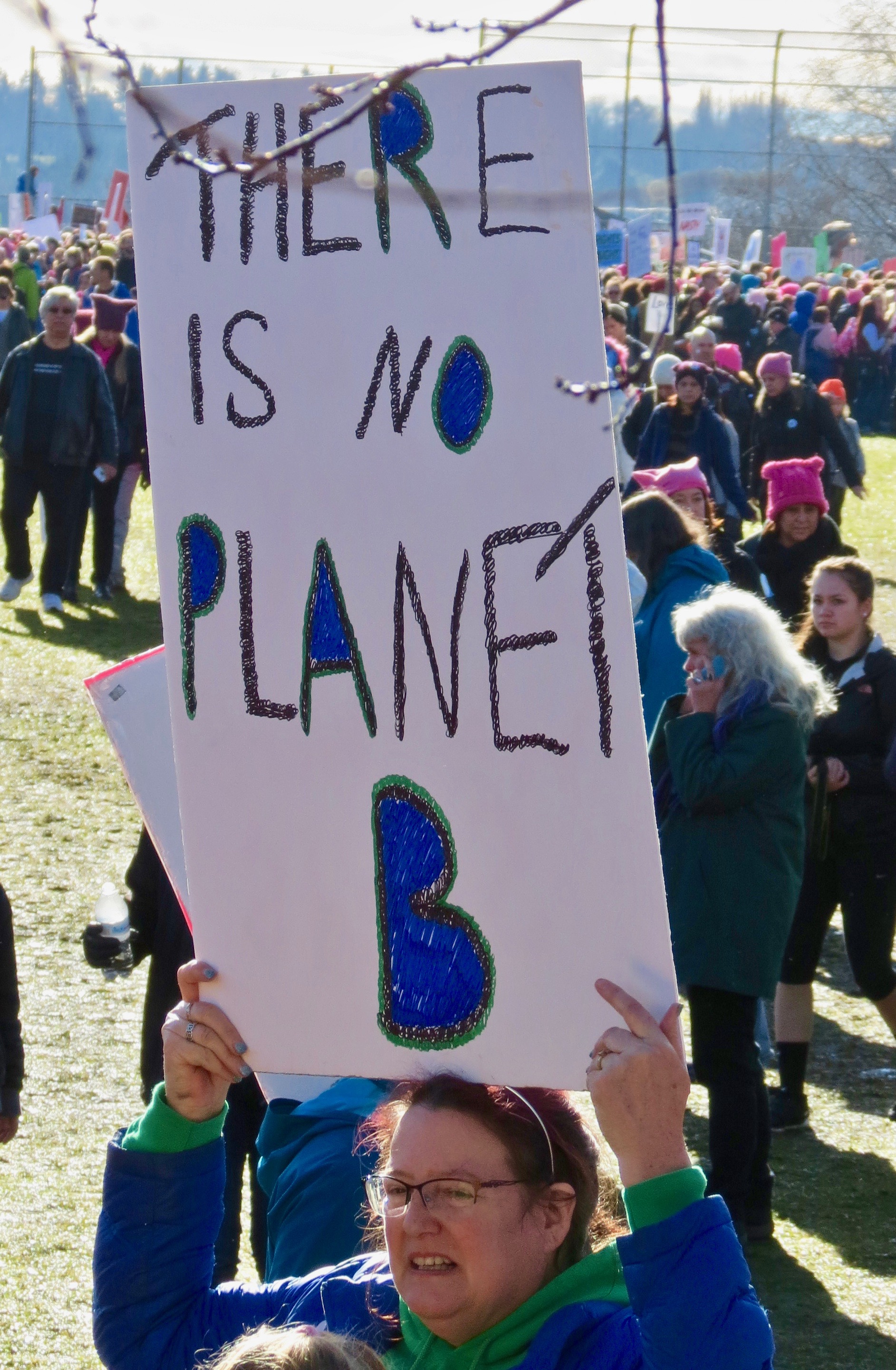
These days we live under a dark shadow that has eclipsed our country, and the planet too.  Instead of chasing shadows, it feels like we’re trapped in the dark, fumbling for the light switch. I found the light when I accompanied family and friends to the Women’s March in Seattle last January.

I was awestruck.

 And I was not alone.

The solar eclipse did not move me to tears.  But I couldn’t hold back tears of relief and wonder at the sight of 135,000 people speaking up for equality and compassion, and speaking out against oppression, bigotry and hatred.

Tears flowed again.

And again.

And again.

If it’s a Solar Eclipse that fills you with awe and purpose, you need only wait a year or two, and somewhere on this planet there will be a next time, another chance. But in the United States, if you’re looking for an extraordinary encounter, or want to feel a part of something larger than yourself, if you want to be more than an observer, you’d better start now.  Because in a year or two, who knows what will be left to save.

We can’t sit on our hands hoping no one will get sick, or disenfranchised, arrested, abused, deported, or thrown into a concentration camp for no good reason. Our national parks, our environmental protections, our healthcare and social safety nets are being systematically carved up and sold to the highest bidder. Our politicians and our elections seem to be for sale as well. Our civil rights, our human rights, our right to protest in our own defense–these too are endangered by the deranged sociopath in the White House. We can only hope he won’t get into a pissing match with another tyrant and launch us into nuclear war.

We have no special protective glasses for this unnatural phenomenon, but we can’t afford to look away.  It’s time to tear off our glasses and invoke our inner superheroes. Our superpowers will be to speak for those who have no voice. To protect those who cannot protect themselves. To organize, educate, donate, speak out, rally and march.

Again.

And again.

And again.

And again.

And again!

This isn’t a solar eclipse; there are no do-overs.  I’m keeping the glasses, because I want to be prepared for the next big event.  2019 will be here before we know it.

And so will 2020.  

All images and text ©2017 Naomi Baltuck


~ Gen X Musings ~

It’s time again for the 100TPC (One Hundred Thousand Poets For Change) here at The BeZine, and all over the world. It’s a chance for artists, musicians, poets, peace-keepers, activists, and anyone else who desires lasting change in the world to speak out about issues affecting all of us. I invite you to join us in a celebration of the spirit of resistance, as we try to make the world a better place. 🙂

© 2017, Corina Ravenscraft


Waiting on the World to Change | singer/songwriter John Clayton Mayer

One, two, one, two, three
Me and all my friends
We’re all misunderstood
They say we stand for nothing and
There’s no way we ever could
Now we see everything that’s going wrong
With the world and those who lead it
We just feel like we don’t have the means
To rise above and beat it
So we keep waiting (waiting)
Waiting on the world to change
We keep on waiting (waiting)
Waiting on the world to change
It’s hard to beat the system
When we’re standing at a distance
So we keep waiting (waiting)
Waiting on the world to change
Now if we had the power
To bring our neighbors home from war
They would have never missed a Christmas
No more ribbons on their door
And when you trust your television
What you get is what you got
Cause when they own the information, oh
They can bend it all they want
That’s why we’re waiting (waiting)
Waiting on the world to change
We keep on waiting (waiting)
Waiting on the world to change
It’s not that we don’t care
We just know that the fight ain’t fair
So we keep on waiting (waiting)
Waiting on the world to change
And we’re still waiting (waiting)
Waiting on the world to change
We keep on waiting (waiting)
Waiting on the world to change
One day our generation
Is gonna rule the population
So we keep on waiting (waiting)
Waiting on the world to change
No we keep on waiting (waiting)
Waiting on the world to change
We keep on waiting (waiting)
Waiting on the world to change
Waiting on the world to change.

© Songwriter: John Clayton Mayer

John Mayer’s official music video for ‘Waiting On The World To Change’. Click to listen to John Mayer on Spotify: http://smarturl.it/JMayerSpotify?IQid…

Musical Interlude for Change

Some musical messages from the past—c’mon people, smile on your [siblings of any gender], everybody get together, try to love one another right now because what the world needs now is love, sweet love, the only thing we’ve got too little of…

The Youngbloods, Get Together


Dionne Warwick and Burt Bacharach, What the World Needs Now is Love

Theater Lessons

What has Theater taught me? Ego indulgence and humility. Confidence and neurosis. Teamwork and competition. Empathy and retreat. Deception and honesty. The story of humanity in a microcosm. My story.

When I was a little kid, I learned that I could entertain and amuse my parents and my older sisters and get positive attention. As the youngest of four daughters, I was eager to exercise this talent to my advantage whenever my ego felt bereft. This helped me compensate for having fewer general skills and powers than my seniors. I couldn’t win at games or read or figure or run better than the rest, but I could sing and mime and look cute. I also was the only blonde, which helped.

When I was in second grade, I was very good at reading aloud “with expression”. I remember (and still have a written report about) my behavior when the class did a Reader’s Theater story about a snake. I told the teacher that I had a toy snake the class could use…provided that I got to read the lead role. Mrs. Richie declined my offer.

When I was in third grade, Miss White selected me to play Captain Hook in the musical Peter Pan. I was stunned. “I’m not a boy!” I protested. She told me privately that she thought I’d do a better job than any of the boys in the class. She could tell that I was a ham and would take risks to win attention and applause. And I did. In the final week of rehearsal, she gave me a monologue, a poem in rhyme that she would put into a particular scene if I could memorize it. I worked on it very hard. In the final performance, though, I skipped it altogether because I forgot where it was supposed to be inserted. To this day, I can rattle it off by heart. “Methinks I hear a spark, a gleam, a glimmer of a plan….”

The pirate theme lives on in my legacy.

When I was in seventh grade, I was double-cast as the lead in our pre-Bicentennial musical. I was the Spirit of ’75 for two performances (why the Music teacher and the Home Ec teacher chose this theme a year early is anyone’s guess). So was Kevin Bry. Yes, I played a man. Again. I vividly remember being in performance and feeling sort of bored with the dialogue the teachers had written to link together the songs the school chorus had rehearsed. So I decided to overact. “The sun still rises in the East….doesn’t it????!!” The audience roared. I think they were pretty bored, too.

When I was in High School, I took real Drama classes. I learned to dance, and I gained some confidence singing solos in the Concert Choir and the Jazz Choir. I became a lot more aware of my own vulnerability, too. I will never forget the Talent Show in my Junior year. I was in a leotard and character shoes, posed and ready to dance when the curtain went up. I was listening for our taped music to begin. And I heard nothing…until the audience started to howl and whistle. Suddenly, I felt naked and taunted. Then the music started, and I couldn’t concentrate on it. I was humiliated. My father and mother and boyfriend (who became my husband) were in the audience, hearing those students jeering at me. We all went out for ice cream afterward, and they tried to convince me that the performance wasn’t bad and the audience wasn’t being critical, but I just wanted to block the whole thing out of my memory forever. Obviously, I haven’t.

When I was in college, I was a Music major with Voice Performance as my Senior thesis. I auditioned for a part in a Gilbert and Sullivan operetta as a Junior. I hate auditions. I tend to choke when I know that someone is out there in those dark seats judging me. I am awesome in rehearsal – prepared, alert, willing and tireless. I was working hard, getting better at performance in my Master Classes and feeling more and more that my teachers and colleagues were actually rooting for me. But not at an audition. I was nervous, my mouth was dry, and my voice wavered. I could see my choir teacher in the house, talking with the casting director. I am sure that Prof. Lamkin was telling him that I was a very good soprano despite my weak scale runs in Mabel’s aria. I managed to land a part in the chorus.

That’s me, third lady on the left.

After graduating Phi Beta Kappa with my B.A. in Music, I auditioned for the Los Angeles Master Chorale. Worst audition EVER! Oh well. I found out that I was already pregnant. Got the role of Mother at age 22…and 24…and 26…and 28, and stayed off the stage for years. Meanwhile, my husband performed all over the country with a competitive Barbershop quartet and once at Carnegie Hall with the Robert Shaw Chorale Workshop. My children were on stage quite a bit, too. I was their coach. They were in all the school concerts and plays, took dance and music classes, and I watched and cheered and videotaped my heart out.

Then some neighbors invited me to help them start a Community Theater. I was tired of being in the background. I stepped up, and brought my oldest daughter with me. The next summer, I brought three of my children, my husband, and my mother-in-law as rehearsal accompanist. The next summer, it was just me, and my husband told me that he wouldn’t be able to solo parent while I was at rehearsal after this. Meanwhile, he was performing with the Chicago Master Singers and rehearsing every week. A few years later, my youngest daughter started taking theater classes with a group called CYT. The next summer, they did a community theater production, and I auditioned again and got cast. My oldest daughter played in the pit band. One of the performances was on my birthday, and the director brought me out on stage for the audience to sing for me during intermission. * shucks, folks! *

I ended up working for CYT and becoming their Operations Supervisor full time. In addition, I taught Voice classes and Musical Theater classes and Show Choir classes to kids aged 8-18 after work. All of my children and my husband participated at some point in the seven years I was employed there. I watched kids grow up in the theater, auditioning three times a year, growing in confidence and artistry, and questioning their identity every time.

“Who am I, anyway? Am I my résumé? That is a picture of a person I don’t know.” A Chorus Line 

Accessing emotions, improvising with another person’s energy – initiation, response, vulnerability, defense. Mime, mimicry, mannerisms, artifice and accents. Playing in the muck of human behavior. This is Theater. It can be devastating and edifying. You can lose yourself and find yourself or never know the difference.

I wonder if I should regret raising up a bunch of performers and encouraging them in this charade or if I should be proud to have modeled survival in the arena. I don’t know. It’s complex. We’re complex. And maybe that’s the entire lesson.

© 2017, words and photographs, Priscilla Galasso

theatrical backsliding

wait for the applause
as the stage lights become bright
once again a child
wanting parent approval
for a performance well done

a mere masquerade

life’s tribulations
cast of characters on stage
words heard resonate
with our lives often bringing
real tears and fears into view

an allegorical drama

shout upon the stage
show them how much you’re outraged
march on washington
enter stage right scream your lines
despite deaf politicians