A Natural Talent

I’ve sat here since Wednesday
watching a story unfold
on that snowy, tree-margined page.
Each new track a sentence scribed
by rabbit, deer or squirrel.
Each trail another chapter.
Today, an editor strode
from the north and scribbled
blue-penciled shadows across the hill.
With a great howl, as some editors
are accustomed to speaking,
this one deleted three days work,
scouring that page into
right-from-the-ream
immaculate readiness.
I just saw a squirrel plop
into the snow with a powdery The.
That’s where I differ from Nature.
She doesn’t fear rejection
and never gets writers block.

– Joseph Hesch

© 2015, poem, Joseph Hesch, All rights reserved

Warrior In a Place of Ghosts

b2ba34a662dd199f2a63457422a47fa8

Plenty Horses

The fickle winds swirled me around, like I was
a snowflake dashing among the bullets
and over the frozen dead at Wounded Knee.
I, who could read the spirit of The People
and also read the books of the Wasi’chu.
I, who was shunned as neither Brulé nor white.
I, a ghost in the land of the Ghost Dance.

After I shot the yellow leg leader
of the Šahíyena scouts who hunted and
drove us to that place where the winter winds
tossed away our life and lives like dried leaves,
I once again became one of The People,
not a murderer as the Whites said.
I was a warrior, only now one in a place of ghosts.

On December 29, 1890, a detachment of the U.S. Army’s 7th Cavalry Regiment entered a camp of about 350 Miniconjou and Hunkpapa Lakota people at Wounded Knee Creek to disarm them before returning them to the Pine Ridge Reservation. But then a shot rang out, and some 300 Lakota men, women and children were gunned down. The Wounded Knee Massacre is viewed as the end point of the so-called “Indian Wars” between Native and European American people.

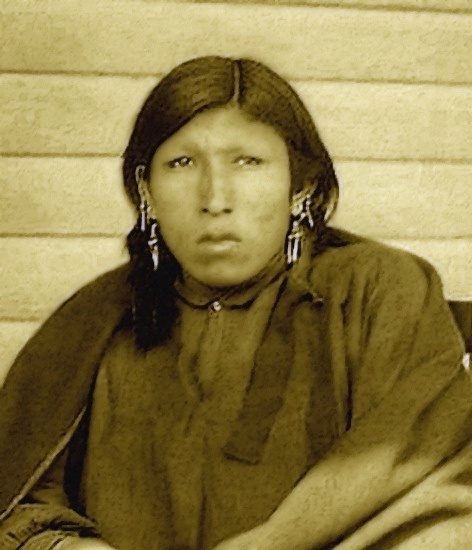
But a week later, a young Brulé man named Plenty Horses, recently returned to the Rosebud Reservation from the Carlisle Indian School in Pennsylvania, shunned by his people for being like a White and by the Whites for being Indian, shot and killed Lt. Edward W. Casey, commandant of the 8th Cavalry’s Cheyenne Scouts. By doing so, he hoped to regain standing among his people as a warrior.

Charged with murder, Plenty Horses was eventually acquitted based upon his need to be regarded as an enemy combatant in order to provide a validation of the Army’s massacre at Wounded Knee. It was indeed, a time and place buffeted by winds of hatred, confusion and tragedy. I hoped to somehow express that “world turned upside down” state of Plenty Horses’ unique situation on the anniversary of the Wounded Knee Massacre with this piece.

– Joseph Hesch

© 2015, poem, Joseph Hesch, All rights reserved; photograph of Plenty Horses (1890) by  John C.H. Grabill, from the Grabill Library of Congress, LC-DIG ppmsc 02524, public domain

Tears for Icarus

IMG_0201
The Lament for Icarus by H. J. Draper

Spiral cloud mountains build in the sky, towering to 20,000 feet, I’d guess. Below, is the town of Douai, where we know Bloody Richtofen’s Jasta 11 calls home this month.

The golden disk to the west is setting and the Albatros scout planes rise to meet us. This is going to be a ripping scrap, I can tell. And then we are in a whirlwind of brown machines and red machines, red-white-blue cockades and black Iron Crosses all flashing by so fast that sometimes you can hardly keep your bearings. Like so many of these recent fights, everyone gets scattered across the sky. But I can’t look out for everyone when I have to do my other job, kill Germans and come home to Flora.

A red aeroplane with a yellow nose and tail whips past Cecil Lewis, and I take chase. I will get to 50 victories. I will get to 50. I must get to 50. He twists and dives and heads into the clouds and I know he can’t shake me. My attention is solely on his tail. I recognize the flash of the setting sun on his goggles as he glances fearfully over his shoulder at me, as I’ve seen that look hundreds of times before. I know it as sure as I know the booming of my own heartbeat in times like this.

I fire burst after burst into him, a drum of bullets from the Lewis on the top wing and 60 or 70 rounds from the Vickers gun in front of me.

I see him drop below me and I know he’s done. I see it all so plainly. The craziness and blood lust that overtakes me at such times ebbs away. And I think of my Flora, my Bobs again.

Then I break through the clouds, seeing from my altimeter that we’ve dove to only 200 feet. But the clouds are in the wrong place.

“Flora,” I cough, “why are the clouds below me and the church steeple above me?”

“Rest, Albert, lie back and rest.”

I fight the urge to rest, I have to get back to the squadron, get back to England, get back to Bobbsy. The glowing disk in front of me fades away. It’s not the disk of the sun, or my identity badge, it’s my spinning propeller. It stops and then I only see its top, hanging vertically like that stalactite church steeple in front of me.

And then that great noise.

“What’s going on, Bobs? Can I come home to you now? General Trenchard promised me I could come home now.”

“Yes, Albert, you can come home. You don’t have to hurry, though. We’re waiting.”

I see her face above me again, so beautiful, so young. Even now when I see her I can barely catch my breath. Yet her eyes are so very sad as I lay my head back in her lap. I feel raindrops on my face.

“Don’t cry Bobs,” I say.

****

Fifteen year old Cecille Deloffre had lived amid the sounds of war for a quarter of her life. She’d learned to sleep to the thunder of the big guns as if they were a summer rainstorm. She ignored the buzzing drone of the aeroplanes as they flew west-to-east and east-to-west each day, often punctuating their passage with the very unmilitary staccato drumbeat of their machine guns.

Cecille had seen some of these machines fall from the sky, glowing and tumbling like a cigarette tossed by one of those German soldiers hidden in the steeple of the nearby church in the village of Annoeulin.

This evening during dinner she had heard the fight above her home, sounding so much like someone had struck a hornet nest and the swarms spreading across the sky.

Then Cecille heard the sound of what could have been two aeroplanes directly above. Her mother crossed herself and tried dragging Cecille from the table to the root cellar beneath the kitchen floor.

She broke from her mother’s grasp and ran into the small fenced yard in front of their farmhouse just as one machine spit a tongue of fire back from its yellow shark-like nose, engine sputtering, gliding to a crash landing on the other side of the village.

She heard another aeroplane’s engine sputter and stop, just as it whooshed, upside-down, from the low storm clouds not 300 metres up the road. Its pilot wore no helmet and she could see his eyes but not his face in the growing dark.

Then the aeroplane just fell, like an old leather-bound book dropped from a table.

Cecille stood frozen for a second to see if this machine would catch fire. But it only lay crushed on its side like a coffee-colored bird knocked from the sky by a kestrel. The pilot’s head move and she ran toward the aeroplane, unsure why, with her mother screaming after her.

As she came up to the crash site, the young man within the broken machine released his buckle and fell from the cockpit with a thud, a moan, and a faint rasping wheeze.

Cecille reached for the boy and pulled him a few metres away from his machine. She rested his head in her lap and he slowly opened his eyes, looking up at her with such longing that she couldn’t keep from crying.

“Don’t cry Bobs, Bobs, Bosshh…” she heard him barely whisper. Then stillness.

From behind them came the pounding sound of the jackbooted soldiers from the steeple. They chattered with delight, so sure they shot down a British flyer. But they hadn’t. Cecille noticed the boy had no wounds on his body.

Her eyes red with tears, Cecille looked down at the boy again and saw but a small bruise beneath his eye where his goggles had been. In her lap, the face of 20 year-old Capt. Albert Ball, MC, DSO, VC lay in silent repose. The sooty stain on it was variegated in white by the tracks of tears, like the half-smiling black marble bust of a saint. They were his tears and that of a beautiful young girl he briefly saw and was sure was the one he loved.

Cecille looked up at the surrounding soldiers and spat out, “Il est mort, Boche. C’est fini.”

But Albert couldn’t hear her. He had just won his 50th and he was flying home.

– Joseph Hesch

© 2015, fiction, Joseph Hesch, All rights reserved; painting, public domain

Swann in the City

When I was a boy, probably long before you were born, I would deliver newspapers in the west end of Albany’s Arbor Hill.

Before I retired from tossing news to writing it, I suffered not much more than bruises and a knife scratch in conducting mobile commerce with the inhabitants of that eroding neighborhood. Needless to say, the tenor of business changed during and since my times there.

So many days now, I read or hear of another young guy, young like I was then, falling to a gunshot wound in my old streets. Some die. Most don’t. I sometimes worry that I don’t wonder much about it, though. I felt it coming.

I felt it in the steel of a razor on my chest. I could sense the momentum of it like I’d smell the miasma of cabbage and weed and spongy diapers in the hallways of Third Street and Livingston Avenue. Later in life, in my newspaper days, I’d recognize its cousin aroma in jails and prisons, the one with a soupçon or so of filthy bodies. It’s not an aroma you ever forget. Some of my old neighbors carry it on them like their tattoos to this day.

Every now and then, I’ll catch a whiff of it, and with a Proustian flash stronger than any almond cake, I’ll be whisked back to those times, a bag of newspapers over one shoulder and half my attention over the other. Today, the memories were dredged up by a request for a city poem. Maybe I’ll write another.

I’ve written plenty of them about my Albany, the city older than any of you live in across this vast land. It’s a small city, often with big city people moving through it on their way to even bigger ones. A lot of us came back here like salmon to spawn.

But there’s some things all cities have in common. We all have histories written in blood and sweat, which continue to drop on the concrete every day. We all know that young men catch bullets as easily in Albany as they do in New York, Detroit or Los Angeles.

I don’t know if that’s ever going to stop. But I understand where it comes from. I saw the snowball become an avalanche. I left only my bloody initials on the declaration of interdependence we call a street, a neighborhood, a city. I just hate to keep reading whole stories written that way.

– Joseph Hesch

© 2014, essay, Joseph Hesch, All rights reserved

Beneath the Surface

Look up and see the sun,
brilliant and refracted
as only winter can
shatter
d~a~y~t~i~m~e.
The chill surrounds you,
urging you to doze
like the trout,
suspended in three dimensions
to drift aimlessly
around that calm wash.
But you can’t.
You must stalk and capture
those
bubbles
you see
against the sky,
each their own
SUN,
providing light and life
in the cold below the cold.
That’s where life exists
as it does above,
just slower and without escape
unless someone breaks
the white glaring firmament
to reach
for
your
hand,
if they know what goes on
there
beneath the surface.

– Joseph Hesch

Who Cries for Icarus?

IMG_0201
The Lament for Icarus by H. J. Draper

Spiral cloud mountains build in the sky, towering to 20,000 feet, I’d guess. Below, is the town of Douai, where we know Bloody Richtofen’s Jasta 11 calls home this month.

The golden disk to the west is setting and the Albatros scout planes rise to meet us. This is going to be a ripping scrap, I can tell. And then we are in a whirlwind of brown machines and red machines, red-white-blue cockades and black Iron Crosses all flashing by so fast that sometimes you can hardly keep your bearings. Like so many of these recent fights, everyone gets scattered across the sky. But I can’t look out for everyone when I have to do my other job, kill Germans and come home to Flora.

A red aeroplane with a yellow nose and tail whips past Cecil Lewis, and I take chase. I will get to 50 victories. I will get to 50. I must get to 50. He twists and dives and heads into the clouds and I know he can’t shake me. My attention is solely on his tail. I recognize the flash of the setting sun on his goggles as he glances fearfully over his shoulder at me, as I’ve seen that look hundreds of times before. I know it as sure as I know the booming of my own heartbeat in times like this.

I fire burst after burst into him, a drum of bullets from the Lewis on the top wing and 60 or 70 rounds from the Vickers gun in front of me.

I see him drop below me and I know he’s done. I see it all so plainly. The craziness and blood lust that overtakes me at such times ebbs away. And I think of my Flora, my Bobs again.

Then I break through the clouds, seeing from my altimeter that we’ve dove to only 200 feet. But the clouds are in the wrong place.
“Flora,” I cough, “why are the clouds below me and the church steeple above me?”

“Rest, Albert, lay back and rest.”

I fight the urge to rest, I have to get back to the squadron, get back to England, get back to Bobbsy. The glowing disk in front of me fades away. It’s not the disk of the sun, or my identity badge, it’s my spinning propeller. It stops and then I only see its top, hanging vertically like that stalactite church steeple in front of me.

And then that great noise.

“What’s going on, Bobs? Can I come home to you now? General Trenchard promised me I could come home now.”

“Yes, Albert, you can come home. You don’t have to hurry, though. We’re waiting.”

I see her face above me again, so beautiful, so young. Even now when I see her I can barely catch my breath. Yet her eyes are so very sad as I lay my head back in her lap. I feel raindrops on my face.

“Don’t cry Bobs,” I say.

****

Fifteen year old Cecille Deloffre had lived amid the sounds of war for a quarter of her life. She’d learned to sleep to the thunder of the big guns as if they were a summer rainstorm. She ignored the buzzing drone of the aeroplanes as they flew west-to-east and east-to-west each day, often punctuating their passage with the very unmilitary staccato drumbeat of their machine guns.

Cecille had seen some of these machines fall from the sky, glowing and tumbling like a cigarette tossed by one of those German soldiers hidden in the steeple of the nearby church in the village of Annoeulin.

This evening during dinner she had heard the fight above her home, sounding so much like someone had struck a hornet nest and the swarms spreading across the sky.

Then Cecille heard the sound of what could have been two aeroplanes directly above. Her mother crossed herself and tried dragging Cecille from the table to the root cellar beneath the kitchen floor.
She broke from her mother’s grasp and ran into the small fenced yard in front of their farmhouse just as one machine spit a tongue of fire back from its yellow shark-like nose, engine sputtering, gliding to a crash landing on the other side of the village.

She heard another aeroplane’s engine sputter and stop, just as it whooshed, upside-down, from the low storm clouds not 300 metres up the road. Its pilot wore no helmet and she could see his eyes but not his face in the growing dark.

Then the aeroplane just fell, like a an old leather-bound book dropped from a table.

Cecille stood frozen for a second to see if this machine would catch fire. But it only lay crushed on its side like a coffee-colored bird knocked from the sky by a kestrel. The pilot’s head move and she ran toward the aeroplane, unsure why, with her mother screaming after her.

As she came up to the crash site, the young man within the broken machine released his buckle and fell from the cockpit with a thud, a moan, and a faint rasping wheeze.

Cecille reached for the boy and pulled him a few metres away from his machine. She rested his head in her lap and he slowly opened his eyes, looking up at her with such longing that she couldn’t keep from crying.

“Don’t cry Bobs, Bobs, Bosshh…” she heard him barely whisper. Then stillness.

From behind them came the pounding sound of the jackbooted German soldiers from the steeple. They jabbered with delight, so sure they shot down a British flyer. But they hadn’t. Cecille noticed the boy had no wounds on his body.

Her eyes red with tears, Cecille looked down at the boy again and saw but a small bruise beneath his eye where his goggles had been. In her lap, the face of 20 year-old Capt. Albert Ball, MC, DSO, VC lay in silent repose. The sooty stain on it was variegated in white by the tracks of tears, like the half-smiling black marble bust of a saint. They were his tears and that of a beautiful young girl he briefly saw and was sure was the one he loved.

Cecille looked up at the surrounding soldiers and spat out, “Il est mort, Boche. C’est fini.”

But Albert couldn’t hear her. He had just won his 50th victory and he was flying home.

I guess this story shows when even a “hero” dies in war, he dies alone just like any other soldier. And who cries for him?

Joseph Hesch (A Think for Words)

© 2014, story, Joseph Hesch, All rights reserved 

A Morning’s Work

IMG_0169.JPG

At dawn, fog sleeping in the trees
holds captive dimming street lights,
fireflies caught in its ethereal web.
Gaping new moon yawns her stars to bed
beneath the creeping blanket of day.

Commuters still haven’t grumbled
from their beds, but we began our job
an hour ago. The river never sleeps,
not even under winter’s ice, so we dutifully set
our paper sails upon its whispering rills.

We know breezy shadows will deliver
bright thoughts of day, of love, of life,
upon our harboring doorstep.
This is our time, my mind’s pen and I,
and our workday is almost over.

– Joseph Hesch (A Thing for Words)

© 2014, poem and photograph, Joseph Hesch, All rights reserved

The Sons of Shem

image

The Arapaho boys came across the dead body of the Rev. Linus Quimby wrapped in a wool blanket at the bottom of a buffalo wallow, a thick book clutched in his frozen hands and an expression of joy upon his face.

“It is already the Moon When the Buffalo Calves’ Noses Turn Brown and the first snow came last night, so to find a man, even a foolish white man, traveling without a horse or even a dog to carry his provisions shows he was as crazy as he looks,” said the younger boy, taking the blanket from the would-be missionary.

“Look at the useless fire he made of these white skins with markings, not the leavings of the buffalo or even a stick from the trees on the banks of the Niinéniiniicíihéhe’,,” said the older boy, as he relieved his brother of the blanket and Rev. Quimby of a knife and a piece of flint.

After riding east until the sun had almost reached its highest point, the boys found the remains of Rev. Quimby’s horse being picked clean by coyotes and birds, stripped of its saddle by a roaming band of Cheyenne hunters and with more of those marked skins scattered on the yellow grass in the melting snow.

If the boys could read, they might notice one that was dated two days before, November 20, 1830, and it said:Last night I burned all my maps, Psalm 23 and First Thessalonians from my Bible, my Lord God, because where I am going in Your name, I have faith You shall guide me, help me lead the sons of Shem back to you, and we shall never be lost again.

A story of unrelenting faith.

Joseph Hesch (A Thing for Words)

© 2014, story and photograph, Joseph Hesch, All rights reserved