I am almost back perhaps. The long summer ordeal
of stress, rockets, war, death, killing has moved off
into Syria and Iraq and left us barren for a moment.
A bit of rain falling today hints at winter being
wet. We need water. We always need water. So thirsty.
The brown hills will green again, and the dry beds
recently run with blood water will wash thoroughly
so flowers may wave their red-yellow-white-purple
cacophony of emotions in winter’s permissive grace.
We need the water. We always need water. So thirsty.
Since between last-summer’s war and the next,
whenever it might fall upon us, this brief moment
flickers—a satellite-pretense of being a star gliding
across black night—a mere reflection of sunlight.
We want water, we always need more water. So thirsty.
The desert will preserve these battles, mummify
the narratives, and wait as scorpions and seeds wait.
And to this I return. Almost. Maybe. Turned back
from the sea and step-by-step making my way to sweet
water. Always water. Like the night sky, I am so thirsty.
—Michael Dickel
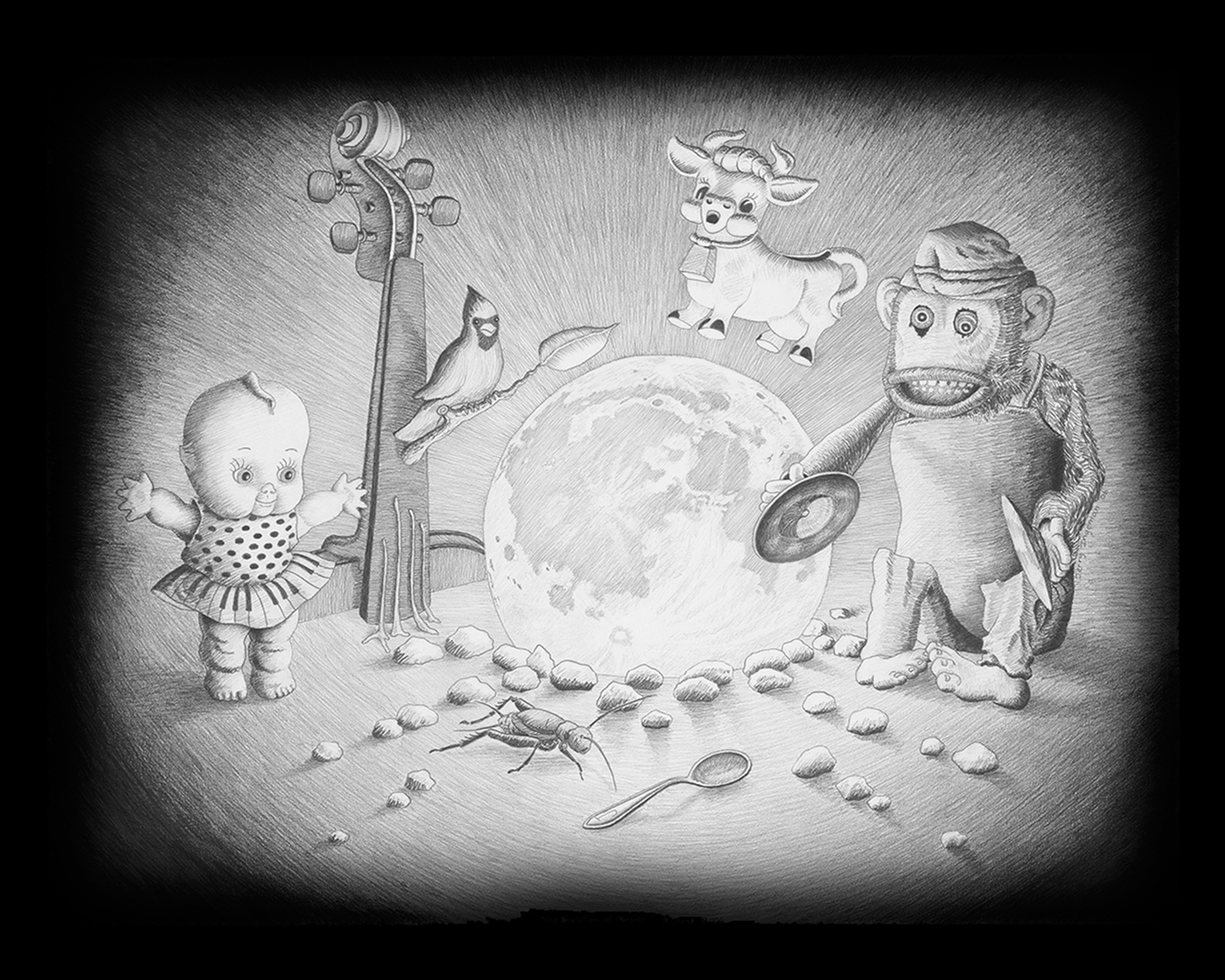
The Evolution of Music by Jerry Ingeman
This poem will be read at Baltimore’s Writers Resist event (Jan 15 2017) by Maryland poet Laura Shovan, author of The Last Fifth Grade of Emerson Elementary, a novel in poem form. Michael wrote this poem a while after the 2014 Hamas-Israel War—other poems, from the war, appear in his book War Surrounds Us.
“…the New Economy as convention is language itself, language as means of production and circulation of goods.”
—Christian Marazzi, qtd. by Joshua Clover
An unrealized hunger chews against ribcages of ravens in flight
as flash floods erode history in the Wadi, flushing it to the Salt Sea.
There is no food on the table and the poet goes unpaid.
These words fill an empty plate, overflowing commerce,
an exchange rated for evaporation and condensation, loss
and replacement. This moment transforms nothing into labor.
Rising water drives thirstiness to drought even as it races forward
to parched bitterness that holds ordered tourists on its surfaces.
Order falls away with things, things lost in dreams, dreams
foretelling futures past. Electrons drove the Philosopher’s Stone,
golden silicone in bits and bytes flying past geographies of object,
flowing with subject, absent verb. What is it we pay for in this life?
Red anemones contradict drenched grasses. A small blue iris sways.
Hot dust storms coat the machinery that has frozen to our city streets
as the poet peels potatoes and pauses to reevaluate golden hues.
Sentences collapse under the weight of real prisons, unfolding
the crusty earth’s constant over-turning—geological composting
as surfaces rise up and bury themselves back into the hot mantel.
Potato skins skim vodka from decay; hungers twist into shadows.
Too many dimensions in set space reduce everything again.
Orbits drop toward gravity, the strength of the iron fist clamping
down on tomorrow. Poets remain unpaid; still words overflow
into nothingness with no value placed upon added desire or its
lack. Well-written banknotes are not poems;
poems are not without a price.
“Rather, there is before us the flight to a new capital, the brutal work of tearing apart and reassembling the great gears of accumulation and setting them in motion once again—if such a thing is still possible…Or there is the flight to something else entirely.”
—Joshua Clover
—Michael Dickel
Quotes from: Clover, Joshua. “Value | Theory | Crisis.” Publication of the Modern Language Association of America. 127.1 (January 2012). 107-114.
First appeared: Dickel, M. (2013). Circulation Language Manifesto. Diogen pro kultura magazin / pro culture magazine. No. 32 (February). Print and Online. p. 96.
After the election I find it difficult to write (just, justly) about (love, loving kindness, grace). Followed, as the election was, by the death of Leonard Cohen whose songs and as described (by those who knew him), whose personal life embodied grace, the task has become more difficult. I have lost my balance. I have fallen into (judgment, in this case, harsh judgment). Beauty seems cut off from the Crown, (Understanding and Wisdom) disconnected from (love and judgment). All balance has left me, I stumble up and down stairs as though falling, red faced, my prophetic legs unstable, my right knee (eternally) in sharp pain, my left leg (splendidly) leaning against a wall.
by Michael Dickel
And if these words confuse you, then they have communicated an aspect of my state, some limbs of the tree that sustains me. I will not explain. These fragments may not hold. I will try to find some pieces of the puzzle and lay them on the floor, without hope of putting the image together again. For the image shatters, overfull of signification. Its pieces slide into sounds, letters, words, phrases, a life sentence of confusion.
We may discern that the tree grows. We may figure out most or all of how it grows. However, ask the tree why it grows and it will simply rustle in the air of your breath.
Under the Palm Tree, Devorah sat in judgment. She was a warrior and a leader, yet her judgment was not harsh. She led because her judgment was seen as righteous and fair. My family name as I was born to it, Dickel, does not transliterate into the Hebrew aleph-bet very well. However, Dekel does work in Hebrew letters, דקל, and is a common enough family name in Hebrew. So when my wife and I registered our marriage in Israel, we changed our family name to Dekel. Dekel means (date) palm. I (am) a palm tree. I cannot explain.
——————
In the 16th C., Moses Cordevero “discovered” or “wrote down” ancient (oral) texts, or simply wrote them as new texts. These are prominent among the received texts, part of the basis of Kabbalah (which means Reception, Received, but idiomatically, Revelation). One book is The Palm Tree of Devorah. At once it seems a text about how to be a good judge, like Devorah, and how to transcend our lives of judgment to obtain a Oneness with Keter, the Crown of Creation. Some excerpts, from Daniel Matt’s book, The Essential Kabbalah: The Heart of Jewish Mysticism (including his notes / commentary after the boldface text):
Your face should always be shining. Welcome each person with a friendly countenance. For with regard to Keter Elyon, the supernal crown, it is said: “In the light of the king’s face is life.” No redness or harsh judgment gains entrance there. So, too, the light of your face should never change; whoever looks at you will find only joy and a friendly expression. Nothing should disturb you. (85 from Moses Cordevero Tomer Devorah original 16th C., Warsaw: Joel Levensohn 1873)
“In the light of the king’s face is life.” Proverbs 16:15. CF Mishnah, Avot 1:15: “Welcome each person with a friendly countenance.”
redness The color of harsh judgment. (192)
Your mouth should produce nothing but good. The words you speak should be Torah and an expression of goodwill. Never generate angry or ugly words, curses, or nonsense. Let our mouth resemble the upper mouth, which is never closed, never silent, never withholding the good. Speak positively, always, with benevolent words.
All of these good qualities gather under the banner of humility, each one constituting a limb in Keter above…
It is impossible, of course, to conduct yourself according to these qualities constantly. Accustom yourself to them little by little. The essential quality to attain, the key to them all, is humility, for this is the very first aspect of Keter, under which all of the rest are subsumed. (85–86 from Moses Cordevero Tomer Devorah original 16th C., Warsaw: Joel Levensohn 1873)
So should your wisdom be accessible to all. Teach people what will be useful to them, according to each one’s capacity, pouring out to each as much wisdom as you can. Don’t let anything deter you.…Be careful not to give more than the mind of the recipient can hold, to prevent any mishap…
As Binah, Understanding, sweetens all powers of judgment, neutralizing their bitterness, so should you return to God and correct each flaw. If you meditate on returning every day, you stimulate Binah to illuminate each day.… (87 from Moses Cordevero Tomer Devorah original 16th C., Warsaw: Joel Levensohn 1873)
power of judgment Hebrew, dinim (דינים), powers of the sefirah of Din, harsh judgment. (192)
Do not say that returning is good only for the holy portion within you; the evil portion, too, is sweetened, in the manner of this quality. Do not think that because you incline toward evil there is no remedy. This is false. If you do well, rooting yourself in Returning, you can ascend there through the goodness rooted there. For the root of every supernal bitterness is sweet; you can enter through this root and make yourself good; your intentional sins turn into merits. The misdeeds you committed have been accusing you from the Left Side. Once you return completely, you raise those deeds and root them above. Those accusers are not annihilated but ameliorated, rooted in holiness. (88 from Moses Cordevero Tomer Devorah original 16th C., Warsaw: Joel Levensohn 1873)
the Left Side The demonic dimension, which branches out from the sefirah of Din, harsh judgment, located on the left side of the sefirotic tree. (192)
How should you train yourself in the quality of Hesed, Love? The basic way you enter the mystery of Hesed is by loving God to the extreme, not abandoning devotion for any reason at all, since nothing attracts you in the least, compared to loving God. (88 from Moses Cordevero Tomer Devorah original 16th C., Warsaw: Joel Levensohn 1873)
——————
The Ten Sefirot
The sefirot (plural, singular sefirah), according to Jewish Mysticism, could be thought of as a series of vessels through which the energy of Creation / Creator (Keter) flow
from Ayin, אין, Nothingness, through Keter, the Crown (Head) of (Divine) Will
through the Point-Beginning of Wisdom (Hokhmah) and the Palace or Womb of Understanding (Binah)
into the Right Arm of (Hesed) Love (loving kindness, Grace) and the Left Arm of Power-Judgment (Din, Gevurah)
converging into (Tiferet) Beauty-Compassion-Mercy (Heaven, Sun, Harmony, Blessed Holy One)
into the right leg of Eternity-Prophecy (Nezah) and the Left Leg of Splendor-Prophecy (Hod)
converging once again into (Yesod) Foundation-Righteous One-Covenant (Phallus symbolic) and
flowing into the Presence as the Divine Feminine Aspect of God, the Shekhinah, from where it flows into the world / people.
The sefirot of convergences make up a central column, also.
These all make up a (symbolic) body, Adam (mankind, human) that is gender fluid (womb, phallus, Shekhinah all together). They comprise The Tree of Life. “The tree grows upside down,” its roots in the top, “an image familiar to us from many myths” (Scholem 42). “…Its trunk embraces the central and thereby conciliating forces; while the branches or limbs which grow out of it as various points encompass the contradictory forces of divine activity in Hesed and Din” (Scholem 42). The sefira of Hesed is love. The sefira of Din is judgment.
The sefirot could be a galaxy of stars, if you wish. The flow of this energy is two way. Jacob, when he dreamed of the ladder, saw messengers / angels going up and down the ladder (Gen. 28:12). (Not down and up.) The sefirot can also reveal themselves to our awareness as a ladder. The energy of Creation Returns in emanations toward Creator, Ayin,אין, Nothingness, and flows back down. Messengers going up and down, and up again. Hesed and Din must be in a dynamic balance to reach the convergence that is beauty-compassion-mercy in one direction or the duality (in triadic-balance with Keter) of understanding and wisdom in another.
Perhaps the emanations resemble particles falling into a Black Hole. As they hit the event horizon, they double, one continuing, one reflecting out, but as entangled entities. As below, so above; as above, so below. Perhaps the emanations resemble a Big Bang where time flows in both directions—beginning to end, end to beginning. Probably I don’t understand anything and do not have the wisdom to convey ( nothing(ness) ) אין.
However we might choose or be able to imagine them, the sefirot must be in balance. They are fractal—at all levels of the universe from quantum bits to macrocosmic, identical at all magnifications. They are Chaos. Ordered. Theory. The Shape. Everything.
And the opposite of love is not hate. It is harsh judgment. From harsh judgment flows, from us flows, the demonic dimension. For we are nothing but sefirot, energy, emanations of the Big Bang. For all I know.
A glimpse behind the curtain.
Pay no attention to the man behind the keyboard.
——————
It doesn’t matter which you heard,
the holy or the broken Hallelujah…
——————
It is taught in the Mystery of Mysteries: The king’s head is arranged according to Hesed and Gevurah [another term for the sefiraDin]. Hairs are suspended from his head, waves upon waves, which are all an extension, and which serve to support the upper and lower worlds: princes of princes, masters of truth, masters of balance, masters of howling, masters of screaming, secrets of Torah, cleannesses and uncleannesses—all of them are called “hairs of the king,” that is to say, the extension that proceeds from the holy king, and it all descends from Atika Kadisha [Ancient Holiness].
The forehead of the kin is the visitation of the wicked. When they are called to account because of their deeds, and when their sins are revealed, then is it called “the forehead of the king,” that is to say, Gevurah [Din]. It strengthens itself with its judgments, and extends itself to its extremities.… (Zohar, II, 122b–123a, cited in Scholem 53)
In the next three Sefiroth, we find Hesed (grace or love), Din or Gevurah (severity or judgment), and Rahamim or Tif’ereth (mercy, also known as splendor or beauty), in which the extremes are united and conciliated.Again, it is no coincidence that this sphere is defined by moral forces. (Scholem 42–43)
——————
Hate is not the opposite of love.
Harsh judgment is the opposite of love. Out of the imbalance of harsh judgment (as opposed to judgment per se) and love comes hate. From hate comes the demonic dimension. The demons come from within. This is true for one. It is true for society. It is true of our human world right now, many nationalities, many Nationalisms.
They sit in judgment of us. We sit in judgment of them.
Out of the raised left arm of harsh judgment comes the demonic dimension.
Do not confuse this notion of left or right as anything to do with political camps or spatial dimensions as we know them. They are convenient and familiar shorthand for this side and another side that pull against each other. The image of Adam in the sefirot is a mirror image of the viewer. We see ourselves in everything. The tree is more complex, three dimensional, a series of branchings and series of branchings from those branchings.
The tree is an inadequately simple image because we know it. We see trees. We think we understand.
I don’t understand.
The purpose of all of the rhetoric. The flow of all of the hate. The riling noisy din of social media. Servers flickering. Serving up harsh judgments. All of us. Count me in…I’ll share that meme.
This carries. Comments. Brings. Back. Returns to. A beginning of sorts of bringing. Together or apart, I don’t know.
A furrowed red forehead with notable hair flying loose. “Hairs are suspended from his head, waves upon waves, which are all an extension.” In a weave over skin, the redness spouted its harsh judgments, a forehead extended to the extremities of the. Beast.
We called it hate, but he used harsh judgment of immigrants, of minorities, of liberals, of Hillary Clinton. He called up the judgmental. Yes. KKK. Yes. NAZIs. Yes. Bigots.
But. Also. And. Yes. Us.
Those who cried out against him and his followers. With harsh judgment. In harsh judgment. Becoming harsh. Judgment.
And the social media full of Din, the din, the noise, The Judgment. Without looking with love at the followers and asking, “how can I love them?”
Did you think Judgment Day meant someone else’s judgment? Something else’s Judgment? Perhaps it means the day that harsh judgment won. The election. No matter which person won, harsh. Judgment. Reigned.
I don’t love them. I judge them.
Don’t mistake me for saying we need to accept these harsh judgments of others that cast them as enemies—not immigrants, not those who are not “mainstream,” not those who are not “white,” an empty and meaningless category without inscription, a blank page signifying emptiness.
Please understand that the power (Gevurah) he wielded was not only over his followers. He triggered us. He caused us to judge. We answered. Off balance. We fell. Into hate. Fed by (our own) harsh judgment (of ourselves? our darker reflections? our shadows?). Which fed harsh judgment. The demonic dimension. Our demons.
We became part of the fire storm. Redness. Smoke. Mirrors reflecting our fears of who we really are back at us. And we became what we feared.
As did his supporters. They fell off balance into harsh judgment.
Trump fueled and fanned those flames. But so did all of the detractors on all other sides. A raging firestorm of harsh judgment—of Clinton. Of Obama. Of the Right. Of the Left. Of the alt-Right. Of Progressives. Of Boomers. Of Millennials. Clinton of Trump. (Some) progressives of Clinton. Of media. Media of anyone who sold viewers to their advertisers. Of those who voted for third party candidates. Those who voted for third parties of we who voted in the lie of the two-party system. Of those who didn’t judge. Of those who didn’t vote. Of others who judged.
——————
There is room for judgment, to be sure. But it must be balanced by Hesed—grace and love.
I did not have that balance. I did not see that balance.
If we want to counter the redness of the demon with wild strands of hair, we must not join with “masters of howling, masters of screaming.”
I must find in myself Hesed, (love, loving kindness, grace).
We must find. Hesed. We must spread it outward. Emanate it up. And down. And up. We must remember that the opposite of love is not hate, that hate begets hate but arises from harsh judgments (being judgmental).
We must be less harsh in our judgments and more loving in our responses.
I must be less harsh in my judgments. Of you. Of me.
This is not to go to the other extreme. Hesed out of balance lacks boundaries, leaves us open and vulnerable, without defenses of any kind. Ready to be eaten.
We must judge, but justly, with love. And find solutions for people, not attack people as though they are problems.
We must call out the demonic dimensions with Hesed and send them back into Din. We must call out in love, to balance the mess we are in.
But we must also hold ourselves and others accountable for our (mis)judgments out of feelings of superiority.
We are all human. We all live in the world. We have divine potential, each and every one, even the orange redness with the wild hair.
And we all have demonic potential, each and every one, even the orange redness with the wild hair.
We must judge which is prevalent. With Hesed, love and grace.
And love is not the opposite of hate. But it brings a balance of judgment that leads from hate to beauty-compassion-mercy in one direction and to understanding and wisdom in the other.
Love must balance our judgment and guide our actions. Good must be on our tongues.
I don’t know how. I am angry. I am hurting. I am full of harsh judgments. I want to find a balance, though. And I want to remember that
…love is not a victory march
It’s a cold and it’s a broken Hallelujah…
I pick up my guitar and fall as much as sit down. My right knee screams in pain. My left knee sags. My right arm tingles, as fingers pluck the six strings. My left fingers press the notes, jarring my left arm to life as I make the chords: C – Am – C – Am -F – G – C – G – C – F – G -Am – F – G – Em – Am
I’ve heard there was a secret chord
That David played and it pleased the Lord
But you don’t really care for music, do you?
Well it goes like this:
The fourth, the fifth, the minor fall and the major lift
The baffled king composing Hallelujah
I’ve read this past week that Leonard Cohen wanted Hallelujah to convey all of the possible moments, good and bad, when praise might come to our lips—the cold, the broken, the holy…
Hallelujah
Hallelujah
Hallelujah
Hallelujah
“Rabbi Tarphon taught us that while it is not our responsibility to finish the work of perfecting the world, we are not free to desist from it either.” —Rabbi Marcia A. Zimmerman, Alvin & June Perlman Senior Rabbinic Chair, Temple Israel, Minneapolis, MN in a letter to her congregation after the election.
——————
Matt, Daniel C. The Essential Kabbalah: The Heart of Jewish Mysticism. San Francisco: Harper Collins. 1995. Citations from the 1997 Castle Books edition.
A dirty argument for sustainability, social justice, and peace
In the late 1980s, one of my guests on a community radio program I hosted came from a soil conservation group. She discussed the importance of soil—healthy, living soil, not chemically-supported but dead soil. She emphasized the importance of developing organic farming and turning back the trend of agribusiness mass farming that depleted soils and then added chemicals back to support the plants—but did nothing for the living soil.
She admitted that “talking about dirt isn’t sexy,” and that her group had a lot of work to do to get people’s attention. A friend of mine told me after the show, which he had listened to, that she was right. Dirt isn’t sexy.
Soil may not be sexy but treating it well could help solve climate change.
Ignoring it could lead to our extinction.
Do I have your attention?
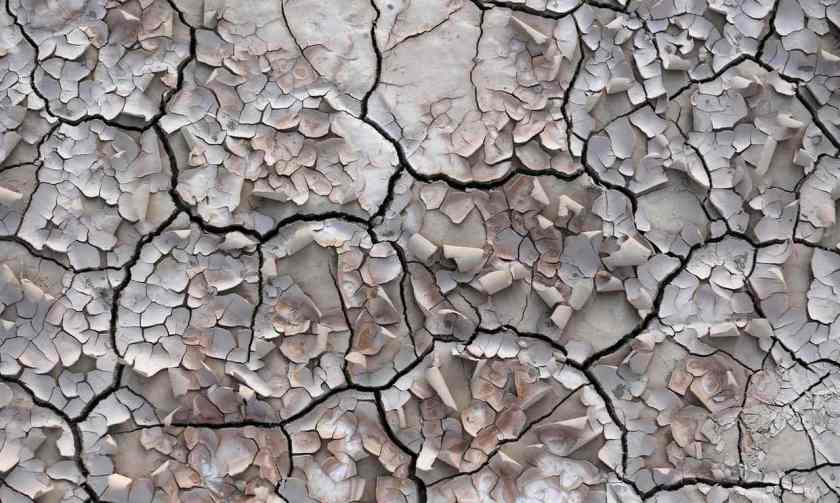
Cracked soil by a village in Iran abandoned by farmers because water reserves ran dry due to overuse. Photograph: Atta Kenare/AFP/Getty Images
Now, 30 years later, The Guardian has run an article about soil as “the best shot at cooling the planet.” In it, Jason Hickel discusses an overlooked, “… simpler, less glamorous solution…” to climate change:
“It has to do with soil…40% of agricultural soil is classed as ‘degraded’ or ‘seriously degraded.’ In fact, industrial farming has so damaged our soils that a third of the world’s farmland has been destroyed in the past four decades.”
Industrialized forestry and agricultural practices have largely depleted organic material from the soil. The organic materials give the soil life. They also lock in carbon dioxide—second only to the oceans in its ability to do so. Hickel writes that soil “holds four times more carbon than all the plants and trees in the world.”
While dirt is not sexy, it is incredibly important.
Hickel goes so far as to say the science about regenerating soil is exciting:
“Scientists and farmers around the world are pointing out that we can regenerate degraded soils by switching from intensive industrial farming to more ecological methods – not just organic fertiliser, but also no-tillage, composting, and crop rotation. Here’s the brilliant part: as the soils recover, they not only regain their capacity to hold CO2, they begin to actively pull additional CO2 out of the atmosphere.”
A few years after the radio show, the Somalian novelist Nurrudin Farrah and I listened to a National Public Radio program while driving somewhere in the Twin Cities. The man being interviewed spoke extensively about economic colonization of farming in “underdeveloped” countries. He argued that hunger and poverty in the “Third World” was not about a lack of capacity to produce food or other necessities, but about multi-national corporations paying for crops they could sell for maximum profits in the “Developed World” and a system that then sold the farmers food they could have grown instead.
Farrah, a “post-colonial” author exiled at the time from Somalia, turned to me and said, “This man knows what he’s talking about.” The “development” that the U.S. and Europe pushes is an economic colonization of the so-called “under-developed” countries, he explained. The process of “Globalization” serves to develop pipelines of resources to multinational corporations, to develop markets to sell back those resources in the form of those corporations’ products (the push for “open markets”)—and simultaneously to develop cheap-labor markets to do the processing.
It is all about profits, not about providing for the economic needs of the people living there. Or anywhere. It is not about developing the countries into stronger systems for their citizens. It is about taking. Depleting. Degrading. As we are doing with the soil.
Agribusinesses push large corporate farming (and de-forestation) in order to profit share-holders—they have little interest in food production or sustainability per se. Farmers around the world who could grow food for their families and neighbors are pushed to grow cash crops—sugar cane and pineapple are two prominent examples. Beef cattle are grown on deforested lands, with the meat going to developed countries’ groceries and restaurants, with the fast food industry a huge consumer. Cotton is a major crop in some Middle Eastern countries. Cotton fields do not produce food, and do not produce cotton for local clothing needs but for high-thread count sheets and other luxury items sold in other countries.
If the farmers want food and clothing, they need to buy it from other multinational corporations.
This story is well known. It is not unlike the trade triangle England set up between itself, its Caribbean colonies, and its North American colonies. It is run by capitalists now, not governments, but the capitalists often control the local governments. Increasingly, the capitalists influence and control the national governments globally, in both the “developed” and “developing” countries.
This influence includes fighting against environmental regulations.
The “regenerative” farming practices Hickel writes about will not be easy to implement, especially against the will of corporate interests. They could lead to more economic justice globally, deriving from local farmers producing agricultural products for local consumers. This change won’t come about without a fight, though.
That’s half the story. A major effect of the economic displacement that this “development” has on the citizens of the country has been displacement of people.
More and more people move to urban centers, seeking income with which to pay their way into the system. There are increasing social and economic pressures as people press into the cities, increased competition that often fractures along ethnic, racial, and religious division. And increased armed conflict.
The other half of the story of the degradation of healthy soils is war. War results from it. War causes it. And right now, the world is at war.
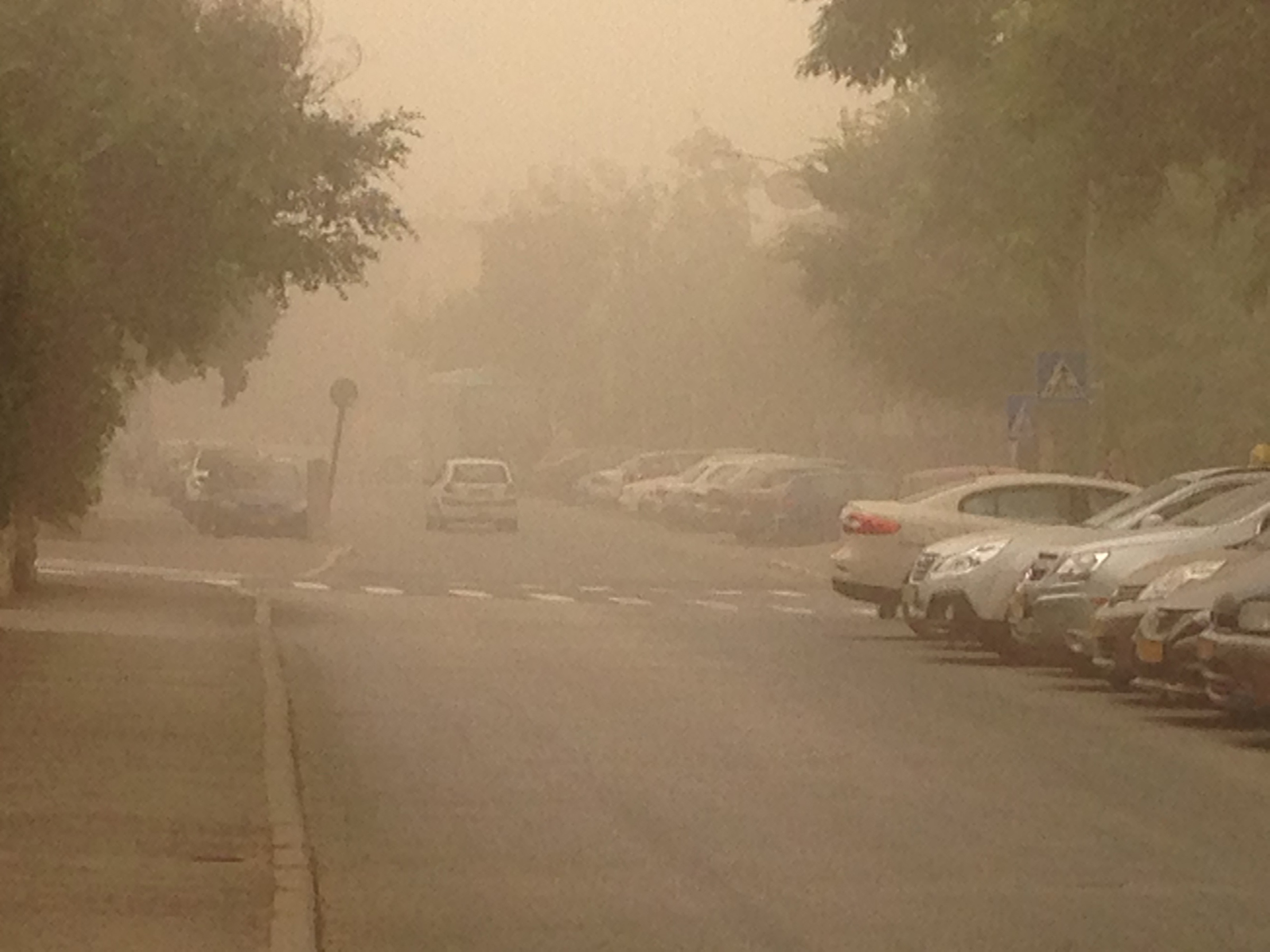
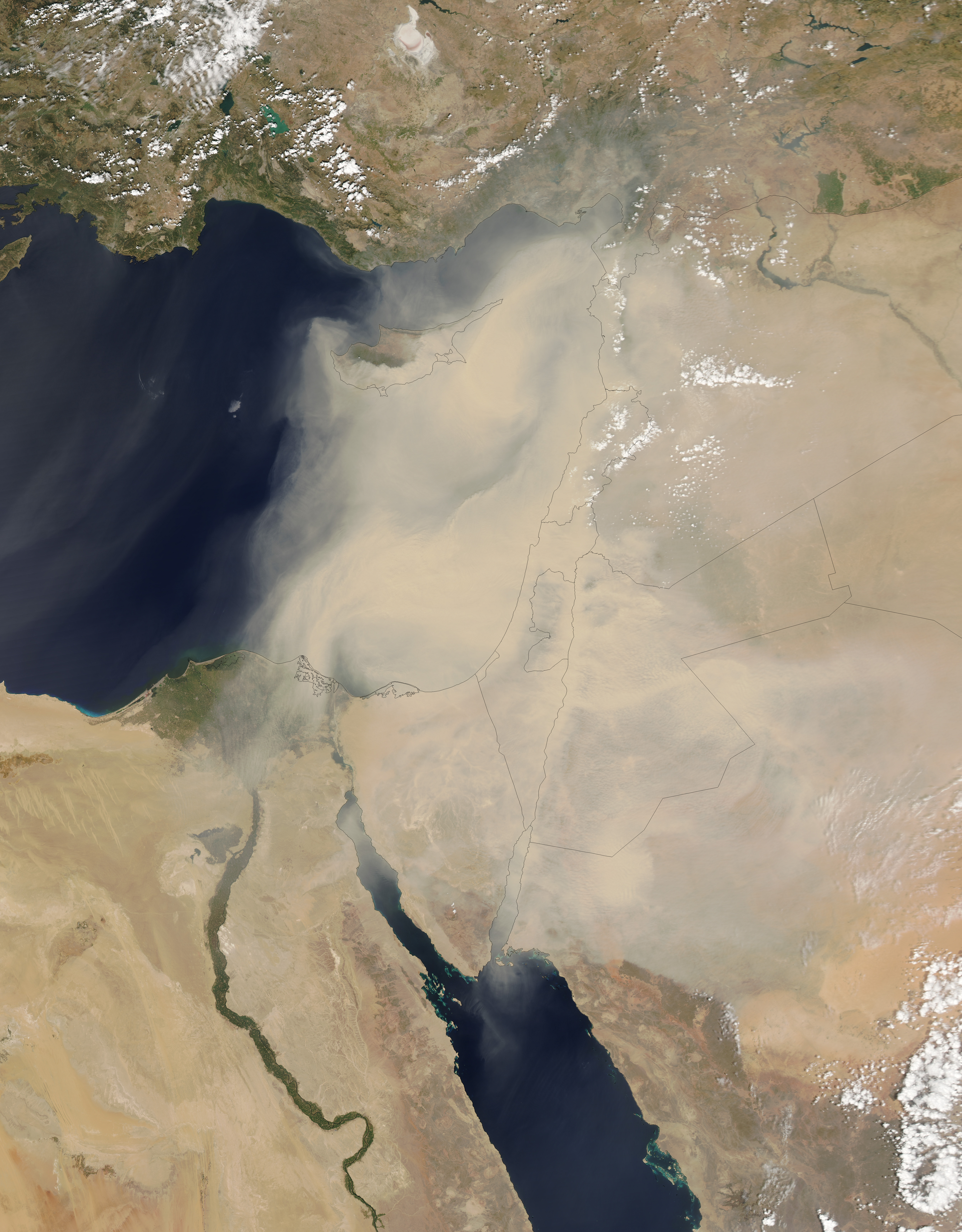
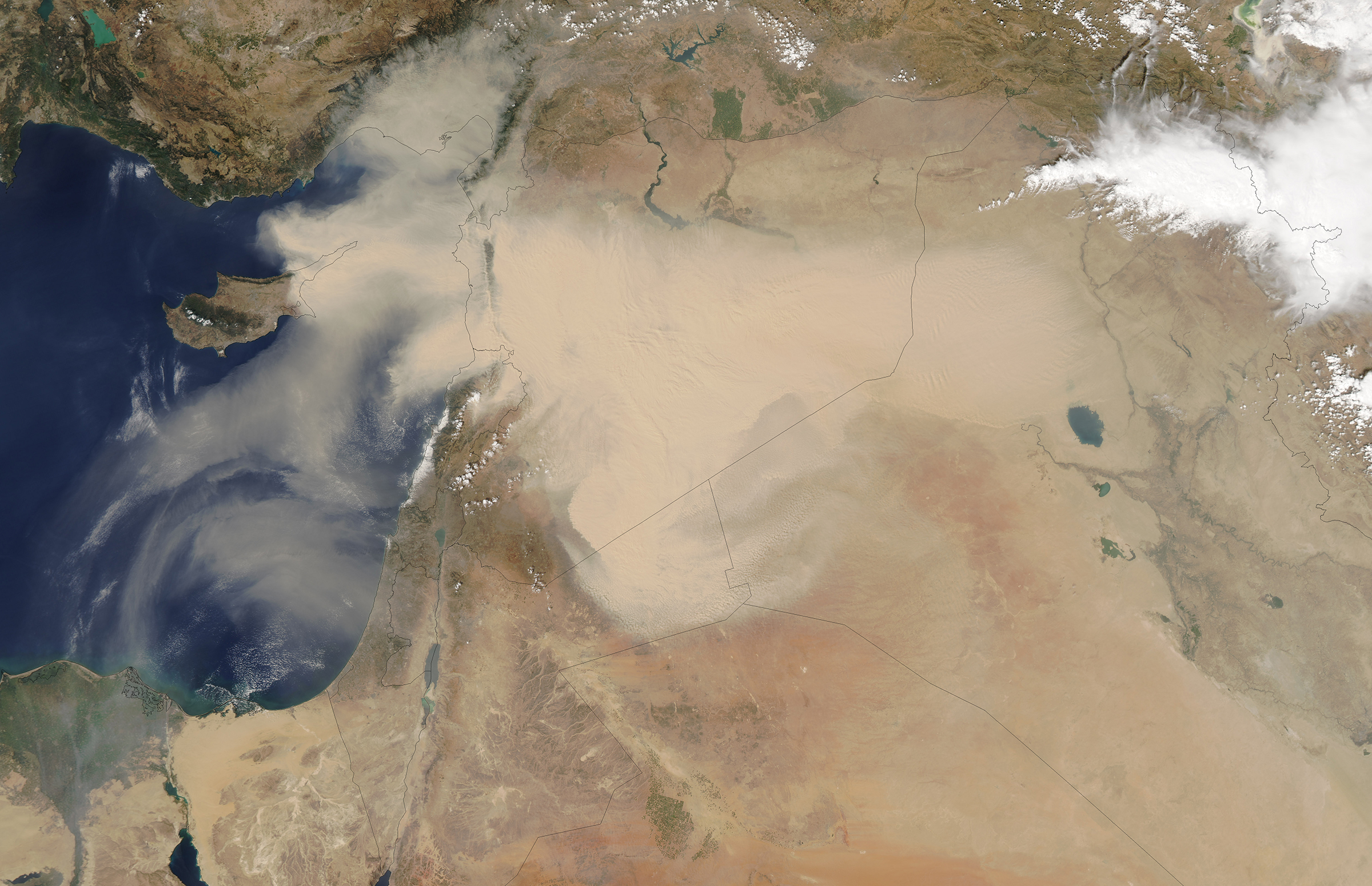
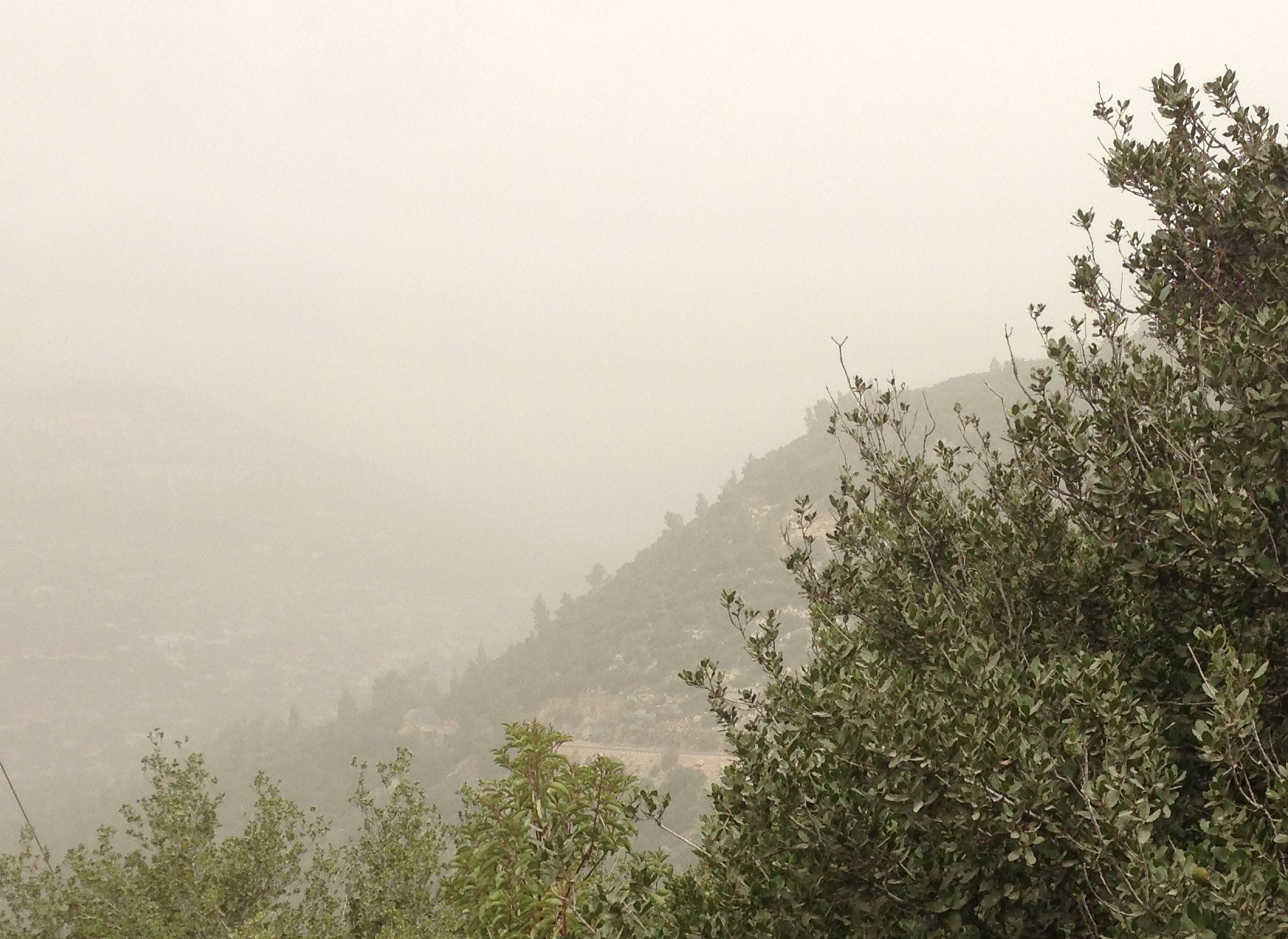
Last year, almost to the day as I write this, the Middle East and North Africa choked on dust from September 6th to the 9th. An “unusual” storm disrupted normal living, even shutting down the Syrian air force. “The influx of dust triggered a rash of canceled flights, closed ports, and a suspension of daily activities for many people,” according to “Dust Storm,” an article on NASA’s Earth Observatory website.
The street where I live, Sept. 8, 2015
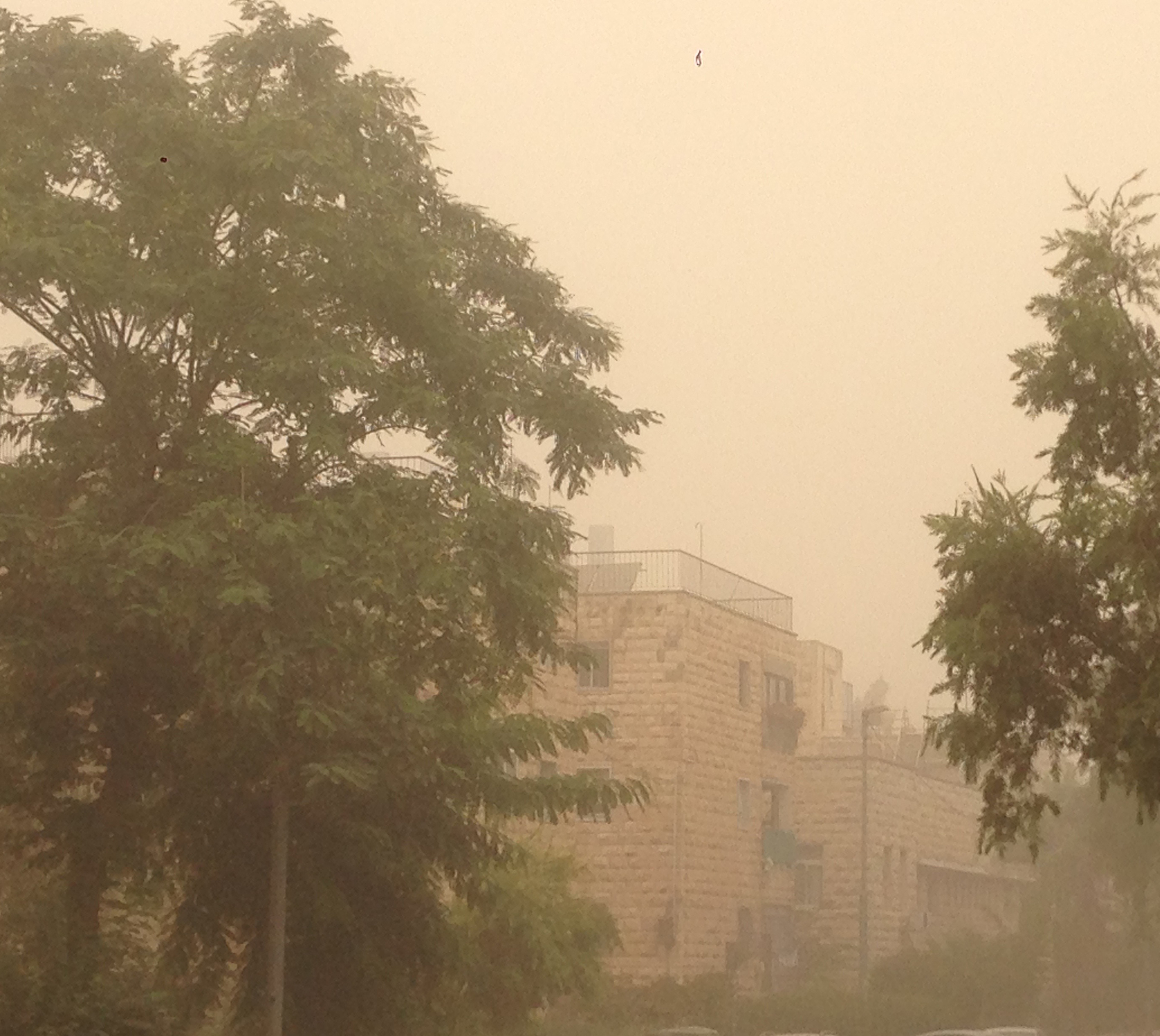
People died. The pollution count for Jerusalem was 173 times normal, and the Environmental Protection Ministry in Israel advised everybody to stay inside, according to an article in The Times of Israel. Temperatures also rose to higher than normal, over 100 in Jerusalem in September.
Out my apartment window
If you don’t know the Middle East, you might imagine that dust storms like this occur daily, weekly, or at least monthly. They don’t. Not like this. I’ve lived in Jerusalem almost ten years now, and I have experienced dust storms. None was this intense. And dust storms are more common in the Spring.
This 2015 storm was unusual for many reasons—scale, intensity, timing, and accompanying heat.
NASA Satellite image Sept. 8, 2015
And, as it turns out, its roots likely were in degraded farming lands related to both climate change and war. And all of this is instigating not only dust storms, but quite possibly the humanitarian crisis of the displaced refugees.
Six month before this particular storm, in March 2015, Craig Welch wrote Climate Change Helped Spark Syrian War, Study Says, for the National Geographic website. It opens with this paragraph, which should give us all pause:
“A severe drought, worsened by a warming climate, drove Syrian farmers to abandon their crops and flock to cities, helping trigger a civil war that has killed hundreds of thousands of people, according to a new study published Monday.”
The authors of the study from The Proceedings of the National Academy of Sciences recognize that many social and political factors contributed to the civil war, of course. However, they “compiled statistics showing that water shortages in the Fertile Crescent in Syria, Iraq, and Turkey killed livestock, drove up food prices, sickened children, and forced 1.5 million rural residents to the outskirts of Syria’s jam-packed cities—just as that country was exploding with immigrants from the Iraq war,” according to Welch.
The severity of the drought and other weather conditions, according to their data, was outside the normal variability of weather in the region.
The social and economic pressures of the urban influx caused by soil degradation likely related to climate change, was probably a major contributing factor to the conflict that has been going on for years now, displacing millions of refugees.
While there are limits to the study, and perhaps the civil war would have erupted had there been no drought—the fact remains that the drought, at the least, increased tensions and the numbers of refugees.
This complicates the arguments about whether the refugees are economic, political, or war refugees. Depending where they come from, they could be all three.
And the three are interwoven—from the economic system that encourages farming practices that degrade the soil, to climate change-drive droughts, to the political climate in the region, there are many lines of connection and interconnection.
The need for sustainability, social justice, and peace weaves throughout this story of soil.
NASA Satellite image Sept. 7, 2015
Some called the September 6–9, 2015, sandstorm “unprecedented.” It was.
A month after the storm, Zafrir Rinat reported in Haaretz, an Israeli newspaper, that “Israeli scientists this week confirmed that one factor behind the heavy dust storm that hit the Middle East recently is changes in the use of land in northern Iraq and Syria.”
Two factors were identified—a decrease in farming in Northern Syria, which had preceded even the recent drought, and “military activity, which has caused harm to the soil crust in Syria.” In other words, the already drought-hardened soil was further degraded by tanks, artillery, trucks, bombs pulverizing it.
Instruments recorded the largest dust particles for a storm in that twenty-year time period since they have been in use.
Winds picked up the violated soil. And as they moved along, a dust storm of unprecedented proportions hit the region.
The storm of soil degradation could wipe us all out.
This is not a sexy story. It is, though, an important one.
—a long drought in Syria
depletes soil and farmers
(those lower classes) migrate
to cities as their fields fail.
Amid the oppression
repression
degradation—
discontent and hopelessness
burn across the region.
Arab Spring and the Syrian Civil War
mobilize war machines—
climate change of another sort—
tanks, artillery, armored vehicles, bombs—
crushing the soil,
crushing the crust.
And the bombs bursting
in air, scattering dust.
What farmers remain are killed,
driven out by ISIS, Syrian Army, or Rebels,
driven out by inability to farm and raise food
and what they scratch from the soil
gets stolen by the armies—
driving the refugee crisis,
driving across the old fields,
driving further depletion,
destruction of top soil.
And a year ago,
winds picked up the dust,
created a widely destructive
work of art, a dust storm
to end all dust storms,
a world war of dust storm
from Syria to Cypress out in the sea.
The effects of climate change
multiplying, driving more refugees
into more widespread urban areas
amid the oppression
repression
degradation—
discontent and hopelessness
across the ever-widening region.
Before, no sand swept through, no water splashed—a beach at driving distance, yes, but a long, long walk away. Before the three-year old’s stories, which I only half listened to: he was born in clouds before dinosaurs were alive; he died; “But now,” he said, “I’m becoming alive again.”
I thought a story he told me one morning came from his dreams.
He knew a dinosaur, he told me, with bright blue feathers in the day. At night it turned wooly and gray, to keep warm. The dinosaur had a name, Pollaydowen.
I thought, what an amazing imagination my three-year old son has, what colorful dreams.
He had other stories, about his house in space and all of the animals that lived there with him, a farm he had at this house. He went on and on with details—listing every animal we saw at the zoo, on farm visits, in books, on videos, on the internet; listing all of the plants and flowers he had heard of; listing creatures great and small in his lakes and seas.
How did he know all of them?
He insisted we should visit his house in space.
Then changes came suddenly, not slowly, as even the most pessimistic predictions had held. One day, news report said the sea covered beaches even at the lowest tides. The next week, waves washed across roads. Houses washed away. Whole neighborhoods of people could barely evacuate before the surf swallowed the land and their belongings.
The water washed sand over everything. The ozone layer shredded. Paint bubbled and peeled on cars, houses, government buildings. Everything and everyone aged.
Soon, sand dunes blew across the road in front of our house. The house looked like fifty years of neglect had settled in on it over the past few weeks.
That last day, my wife and I heard my son speaking in his room. And we heard another voice.
We went in. A bright blue flash turned toward us.
“We have to go,” my three-year old calmly explained, “now.”
“These sands end time here, the last to flow through the hour-glass,” the blue lizard-creature, Pollaydowen, added.
As we left the house, we trekked through hills of sand.
We returned once, to see what had happened.
I left this note for you who might find it, scratched in the walls, just in case anyone remains. We have an ark.
Where the heat of the day rises to meet the cool of the evening,
sometimes a layer of fog forms above hay stubble.
An oak that survived the great Hinckley fire
over a hundred years ago waits
while white mist diffuses behind it,
stretches up and over the corn, curls down to grasses
on the other side of the field, slides out to meet the beaver pond.
Fog erases so much as it echoes the remainder of day:
the red-tail that hunted rodents this afternoon,
a garter snake that sunned in the short stubble,
rolls of hay that dot the field,
my daughter
who walked out to sit and read
—all disappear in its cool insistence.
Hints of sunset still remain in the west—
where mist has not yet covered water,
bits of color reflect back from the clogged creek.
The dog and I stand still, listen to fog.
We scent the air. In the brush, a crashing sound.
A man walking along a field where new corn
dots the soil grasps a bit
of stone, skimming it to the furrows
as though to skip across water—
but it punches up a small dust cloud
and sinks. A father and son walk a fence,
ready to repair rents in the barbed-wire.
Soon the corn will outreach the man;
then the combines come and tear it down.
The repairs will rust; then a poplar
drops across the fence one windy day.
Still, the men walk; the corn waits—
this is what they do.
Up by Lake Superior one day
a man tosses a smooth stone;
and it flits across the water
out to where blazing waves blind him
as he stands there gazing. Then, he speaks.
“Tacit” originally appeared in Blue Earth Review, @2004 Michael Dickel.
Called to faith
A man stands over the culvert on the gravel road onto the farm.
The stone he hefts in his hand—igneous remnants from before time,
bits of crystal cooled across history mingled with impurities beyond memory.
He lofts this shard of the past in a slow arc ending in the dark pool of standing water.
Sometimes he wishes he could follow it down through the water as surface tension
erases its faint traces; he wishes sometimes that he could fall through the cold numbness
to sink into the soft, welcoming mud—to sleep among layers of last year’s rotting leaves
and the year’s before and the year’s before and years’ before—layers of organic memory that,
still,
do not reach the stone’s most recent memory. The stone takes no notice.
And the man does not sink with the stone into murkiness. The morning calls
him to his desire, so he chooses to return to the work at hand. There is a garden
to plow and disk. There is corn to plant and tend. There are nettles to uproot and remove.
Despite the threat of frost or hail or rabbit or deer, he trusts
that in August there will be sweet corn and tomatoes and beans.
He will gather some in and eat. He will gather some in to store. And
he will gather and save the best for next year’s seeds. These are the act of love.
Author’s note: I recently read this poem at a poetry event billed as an Interfaith Eco Poetry Slam at Tmol Shilshom, a well-known literary cafe in Jerusalem. This is a hybrid between non-fiction, found poetry, and performance poetry. The unfortunately unseen connections between hunger, stress, climate change, and war lead to a desire for the equally unfortunately unseen hope for peace and harmony. Read it rhythmically, fast. Hear the sounds at play as well as the words at play.
a feeling of (migrant) discomfort or
(human) weakness caused by lack
of food coupled with (commodified) desire
to (not) eat of or at a fairly or comfortably
high (low) temperature
Climate change
threatens to put the fight against
hunger back by decades
(Guardian 2 September 2014)
balmy heated hot lukewarm cold-blooded
mild pleasant sunny sweltering beached
(whale) temperate tepid broiling close
flushed glowing melting perspiring
roasting scorching sizzling sweating
clement snug summery sweaty
thermal toasty warmish having
a color in the red-orange-yellow
part of the visible electromagnetic
(organic) spectrum feel or suffer hunger
through lack of food (distribution) craving
desire famine greed longing /dis/satisfaction
lust starvation yearning ache war appetenceappetency emptiness famine
esuriencefamishment greed gluttony
mania ravenousness vacancy void
voracity want yen a stomach
for appetition big eyes
bottomless pit eyes for munchies
sweet tooth close often used
in the context of a game
in which “warm” and “cold”
indicate nearness to the goal
you can’t take it with you
but if you try sometime
In Wild Winter Warm North Pole
Storm Chills U.S. Forecast
as Flooding Threatens Levees
(NYT Weather 30 December 2015)
a lack of food that can cause war
illness or death especially war
among large numbers of people war
have a strong desire or craving for peace
for having showing or expressive peace
of enthusiasm affection or kindness peace
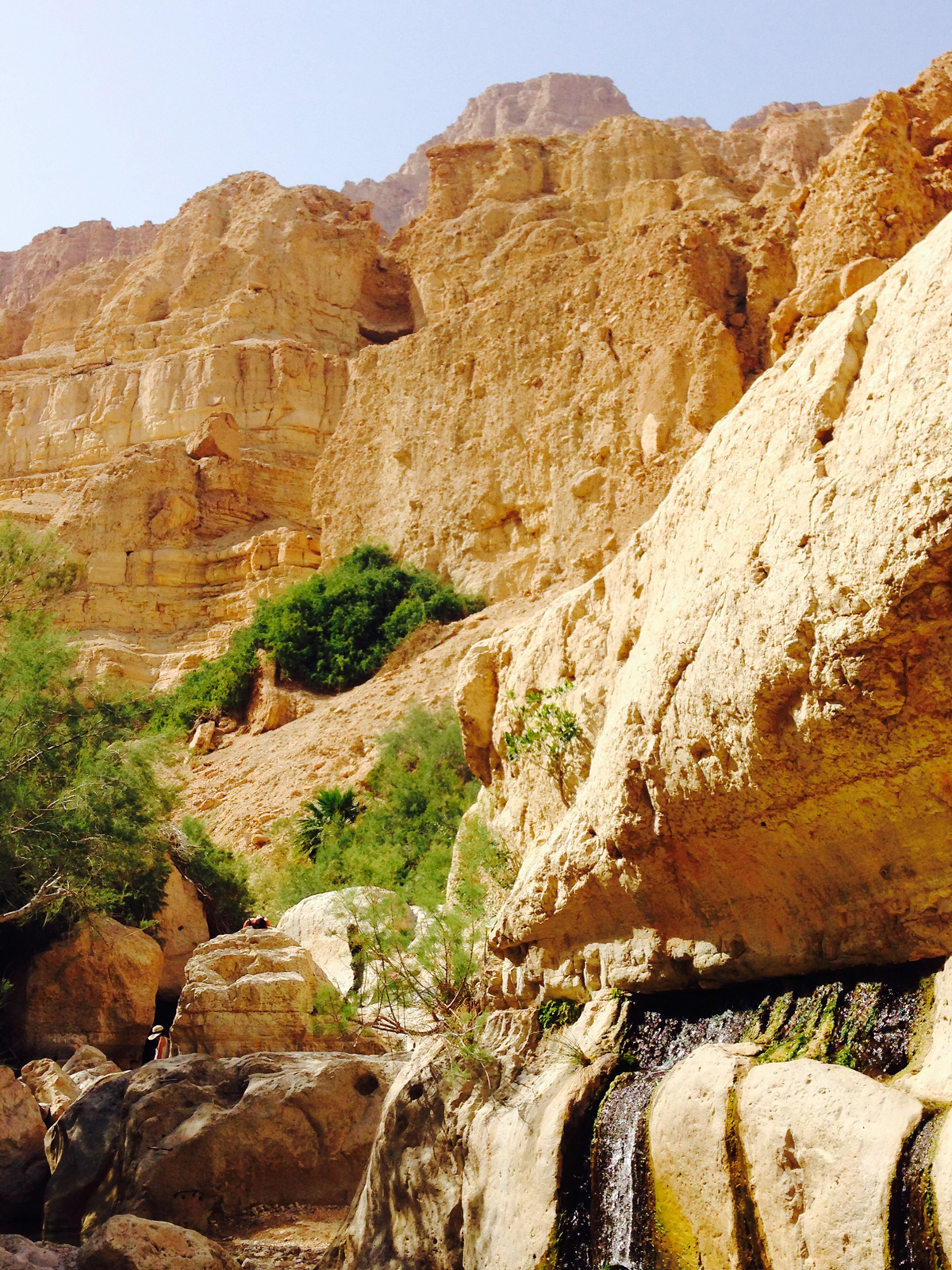
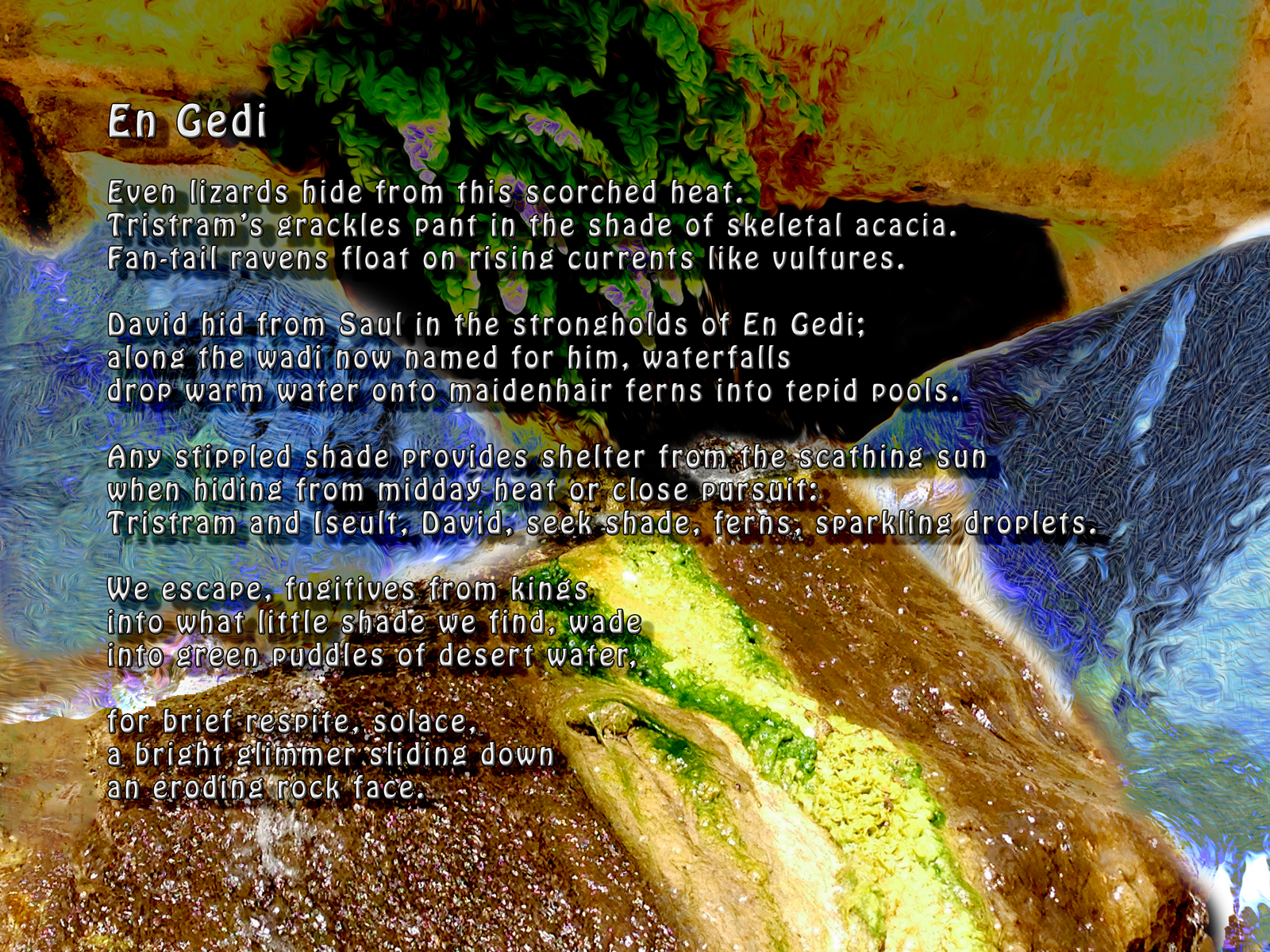
Even lizards hide from this scorched heat.
Tristram’s grackles pant in the shade of skeletal acacia.
Fan-tail ravens float on rising currents like vultures.
David hid from Saul in the strongholds of En Gedi;
along the wadi now named for him, waterfalls
drop warm water onto maidenhair ferns into tepid pools.
Any stippled shade provides shelter from the scathing sun
when hiding from midday heat or close pursuit:
Tristram and Iseult, David, seek shade, ferns, sparkling droplets.
We escape, fugitives from kings
into what little shade we find, wade
into green puddles of desert water,
for brief respite, solace,
a bright glimmer sliding down
an eroding rock face.
Milton thought that the readers of poetry were “a few,” while Baudelaire spoke of the democratization of the poet; scholars have identified both prose poetry and free verse as “democratizing” influences in poems. Slam poetry—which originated in Chicago in the 1980s as a white, working-class scene and expanded with the Nuyorican Poets Cafe slams—has more convincingly been regarded as a democratic poetry. Poetry slams have spread internationally, propelled in part by social media. Social media itself, however, has created perhaps the greatest shift in poetry production and readership that may herald a democratic poetry and poetics. What does that mean to “poetry” in its various definitions? That is not at all clear.
Poetry now thrives across the World Wide Web. In addition to social media, there are online journals, some refereed through an editorial process (many with longer histories, having migrated from, or as a complement to, print journals). And affordable self-publishing through online print-on-demand services, such as Lulu.com and CreateSpace.com, make it possible for almost anyone with access to a computer and the internet to produce their own book, and for small publishers to proliferate. Established publishers and editors who select work—and have long been accused of undemocratic elitism, cronyism, regionalism, racism, sexism and of generally being part of the white patriarchal power structure in the West—no longer control the gates to publication.
Those gates today stand wide open. Anyone can post a poem on social media. People like and share poetry on Facebook, post poems and images on Instagram. They tweet and re-Tweet links to poems on Twitter, as well as Tweet entire poems of 140 or fewer characters (a new genre). Bloggers post poems, and poets have blogs. All around the Internet, poetry pours forth—and not only in English. People who call themselves poets, and make their poetry available online, do not require an editor’s approval for the publication of a single poem.
Many people read these online poems, too. Some readers comment on and critique the poetry. Some share links to the posted poems. Many sites and online forums promote voting, with the most popular poems (often the best promoted on social media) granted higher placement in listings, awards, and even print publication. The readers have more say about the poetry, its reception and acceptance, than editors.
This democratic approach to poetry may well have roots in slam poetry. Susan B. A. Somers-Willett, in her book, The Cultural Politics of Slam Poetry: Race, Identity, and the Performance of Popular Verse in America (U MI Pr 2009), writes:
…Miguel Algarín, a former Rutgers University professor and cofounder of the Nuyorican Poets Café, dubbed the practice of poetry slams “the democratization of verse.” As an open venue, the poetry slam is continually welcoming new audiences and practitioners into it ranks, all of whom can have a say in what is rewarded at the slam and where the art form is going. Poetry slams create communities of poets and poetry lovers in which verse is not only disseminated but discussed, critiqued, debated, and even reinvented. (p, 137)
This description of slam poetry, which began before the Internet spread its Web around the world, fits social media poetry and online poetry forums. While online journals that still require an editorial process do not demonstrate the same democratic process, even those sites often allow for comments and response, which, whether moderated or not, provide for immediate feedback and direct dialog between writer and reader. And some online and print journals have sprung up that select poems for inclusion through voting by readers, a parallel to slam-audience voting.
While this all speaks to the existence of “democratic” poetry online, I want to raise two questions here about social media poetry. The first comes from Paul Kameen, in his book, Writing/teaching: Essays toward a rhetoric of pedagogy (U of Pittsburgh Pr, 2000): “Has the democratization of poetry created a genuinely democratic poetry, or just a much larger number of writers writing for each other?” (p. 105). The critique that poetry from the Modernists to the present largely consists of poems written for other poets comes up often. Usually, the point seeks to puncture the balloon of the most recent rising-generation of poets. Recently, this critique has been aimed at creative writing workshops and MFA programs in particular.
Yet, the question remains relevant—even if many or possibly most of the writers posting poetry on social media did not attend a university writing program or workshop: Do social media writers write mostly for other social media writers?
A large number of my Facebook friends write, edit, or teach writing. However, in my own un-systematic observations, fewer of the likes or comments come from my academic life. More comments and critiques come from other writers. A lot of writers I meet on Facebook came to writing as readers, and experimented with posting their own work, only to discover that others liked to read it. Some have learned from what gets liked and what doesn’t, from how people comment, and from critiques online. A few have requestedme (and others, I’m sure) to comment on a draft before posting it. So, in this way, social media forms communities of writers.
In my own experience, a lot of readers (at least of my work), are in fact other writers. Does that mean I’m writing for other writers? Possibly. I like it when other writers comment favorably on my work. When someone else comments it thrills me, especially if the comment resembles that of an architect friend who does not write, who posted a comment about my writing “…scrubbing out the inside of [her] brain…” I try to write for readers like her, who like what happens to them when they read my work.
All of this brings me to the second question: What effect does democratic poetry have on poets and poetics? Having a few engaged readers satisfies me (and of course I would enjoy having lots of readers), but should I strive for the most readers? Should I change how and what I write to suit this world-wide audience and what it wants to read? Should I let the majority determine my own poetics?
I don’t like rhyming poetry and rarely use obvious end-rhyme schemes. I don’t like writing inspirational poetry full of vague generalities and “wisdom” sayings. Yet, from my impressions, the most popular poems on social media strain for just such effects. I prefer to disrupt the reading, to disturb concepts we too easily think true. I prefer to raise questions and to question my own ideas—especially those in the poem. I fear that if I really want a large audience, I would need to write something more like greeting-card poetry.
This view of online poetry could reveal my own elitist attitude, I admit. Rather than a winner-take-all desire for a large audience, though, participants in democratic poetry could value a poem not for how many likes it gets on Facebook or Retweets on Twitter. Money earned won’t provide a measurement of the value of the poetry, either. I hope that whoever measures this elusive value will measure my poetry by how many readers feel that my poems “scrubbed” their brains (in a positive sense). And those readers may not be the majority of online readers.
However, this idea may in fact reveal the most democratic aspect of social media poetry—that I don’t need the majority of an audience’s approval in order to continue participating, unlike slam competitions. My poetry can reach those readers who will value it, without the gatekeepers or a majority vote, through pluralistic democratic values that allow any one poet to post any one poem.
Michael Dickel, Ph.D., associate editor of The Woven Tale Press
Originally published in print: “Foreword: (Social Media) (Democratic) Poetry,” The Art of Being Human. Vol. 14. 2015, pp. 7–11.
For Poetry Month of April 2013, Michael Dickelposted on his blog two poems published five years ago (now, in 2016) in a small anthology. Are poems like omelets? What is inspiration?
A r s p o e t i c a
Water drops in hot oil disappear instantaneously
like meaning in conversation between two
who do not speak. Steam and sizzle, pop, sound
out a string-theory rhythm. Eggs separated, whites
beaten stiff, yolk to lemon yellow, make the best omelets, if you fold together the parts again.
“Eggs separated, whites/ beaten stiff, yolk to lemon yellow, make the best/ omelets…”
The pan is not enough, by itself. After the eggs
brown and float on the oil, they need the oven.
Heat the filling, well cut and mixed, spiced
with pepper and garlic. No one will taste such
a breakfast; no feast leaves these pages—
cooking with pleasure and love, seeking
“The pan is not enough, by itself.”
nourishment. There is no universal way to
cook eggs; there are many. And which eggs?
What filling? Who graces the table to join
this morning repast, a slip of a tongue
on the garlic clove, a red pepper bite,
the silvery cool of basil sliding down—
“After the eggs/ brown and float on the oil, they need the oven.”
don’t sing this song, or repeat this recipe,
it will only get you in trouble. Serve with
salad, cheese, orange juice and hot coffee.
Eat well, in silence if need be, for this may
be the last meal. Or the first. Or none.
Dance like water turning to steam in the skillet.
“Eat well, in silence if need be…”
I n s p i r a t i o n
Of course, they say a dollop of sweet in a pot of salt:
ten-percent inspiration, ninety sweat. Perhaps the bank
clerk Eliot spoke of daily work, practice like the firefighter,
preparing for the poet Eliot’s hot blaze.
Outside this balcony a road curves, down
toward the shipyards at the bay,
containers suited for rail, truck and ship
lined up along the stunning sea.
“Ah, to be carried off by fire or water,/ dreaming of reaching another’s shore…”
Ah, to be carried off by fire or water,
dreaming of reaching another’s shore,
words an emanation up, down, up—
but how do we know if nothing received
or sent the silence just before the big bang?
“words an emanation up, down, up—”
Both poems originally published in print:
Dickel, M. (2009). Ars Poetica. Listening to the Voice Inside: Poetry from the Voices Israel Workshop, Haifa, 30.6.2009. Jerusalem: Voices Israel. Print. p. 61.
Dickel, M. (2009). Inspiration. Listening to the Voice Inside: Poetry from the Voices Israel Workshop, Haifa, 30.6.2009. Jerusalem: Voices Israel. Print. p. 24.
View Contributing Editor Michael Dickel’s bio HERE
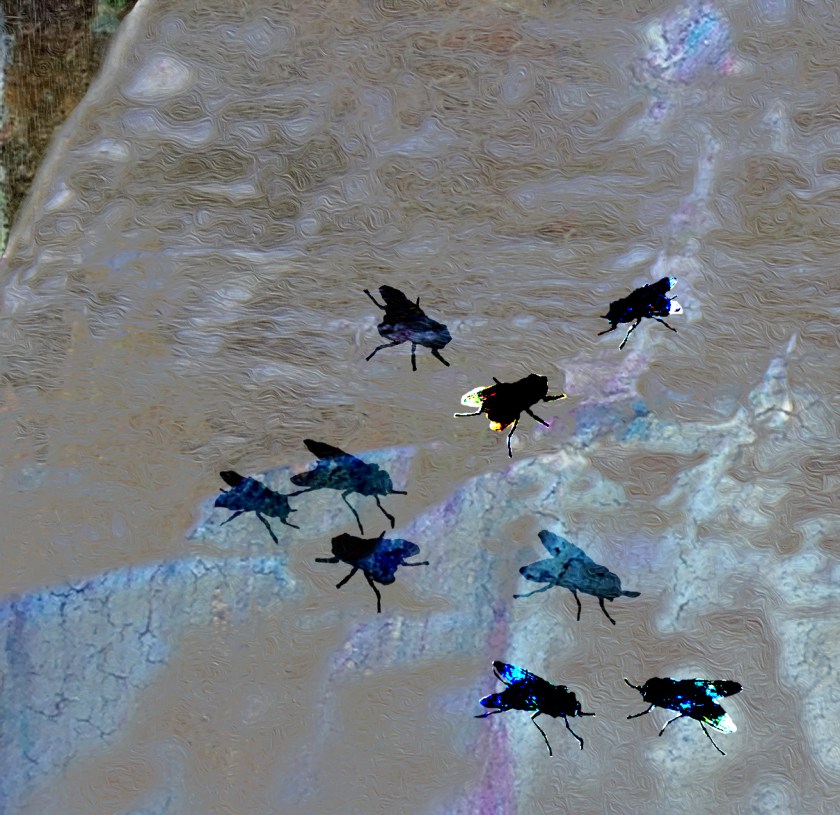
July, the air outside thick with biting flies. The house alive with more docile creatures, black and buzzing. Even in mid-December this farm house fills with them. They come from nowhere.
Several houseflies clamber for escape with busy wings against the screen. Up and down they search, yet only find the upper storm window — daylight feeding a frenzy of scientific discovery — and the lower screen, a shadow lattice that will not stop the air.
Like a lover who relies on faith, these true-believers come to worship at the altar of thought — each fly some forgotten moment, some decision not taken, an ounce of regret.
I could close the inner window and trap them; then they would not buzz around my bed at night, reminding me of my failures butting their heads into a reading lamp suspended above my pillow.
Oh, they’d still get their precious light, the wind would come through for them, even a bit of water on a rainy night. They might not die, even without food.
Perhaps I leave the window open for the breeze. Or maybe because I would still see them there, hear them call — even louder than the fan, even at night, even while I slept.
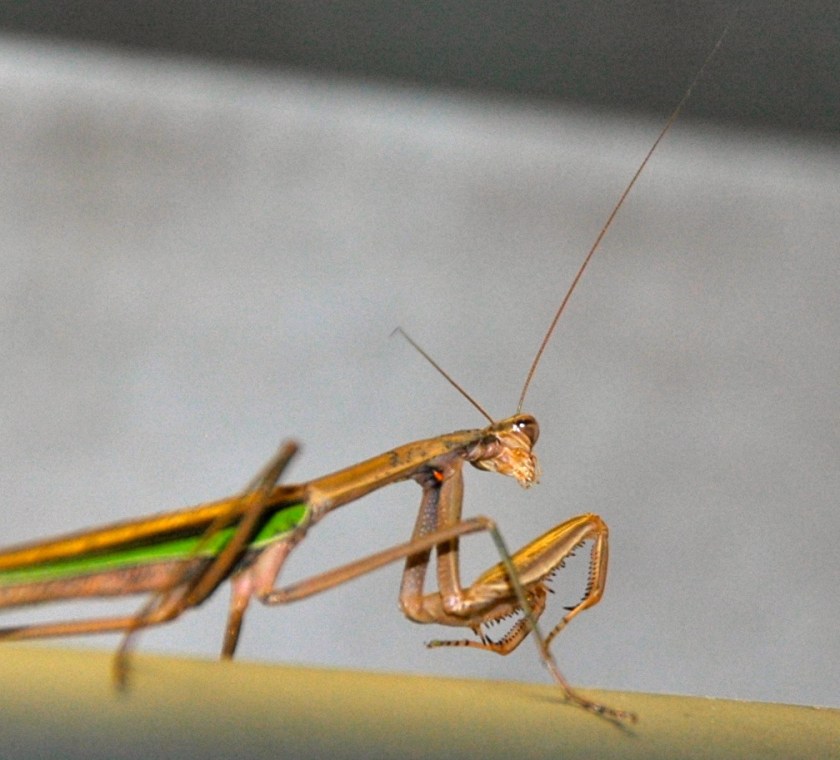
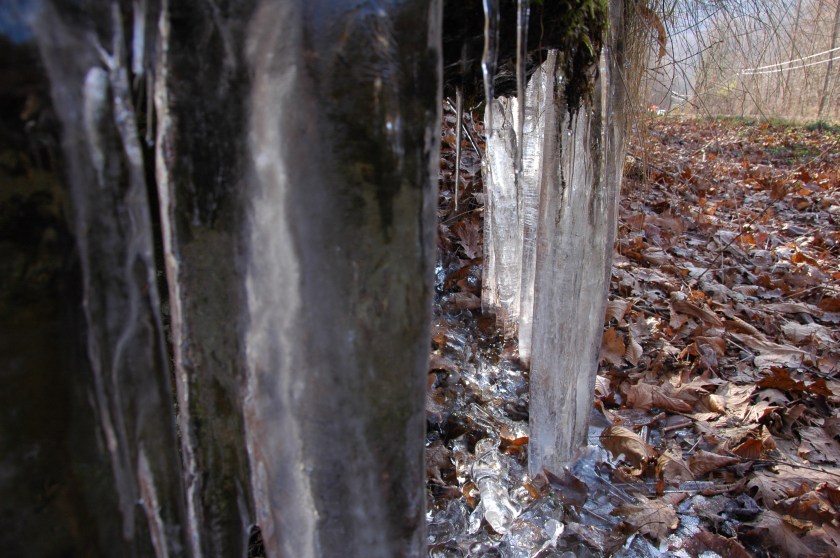
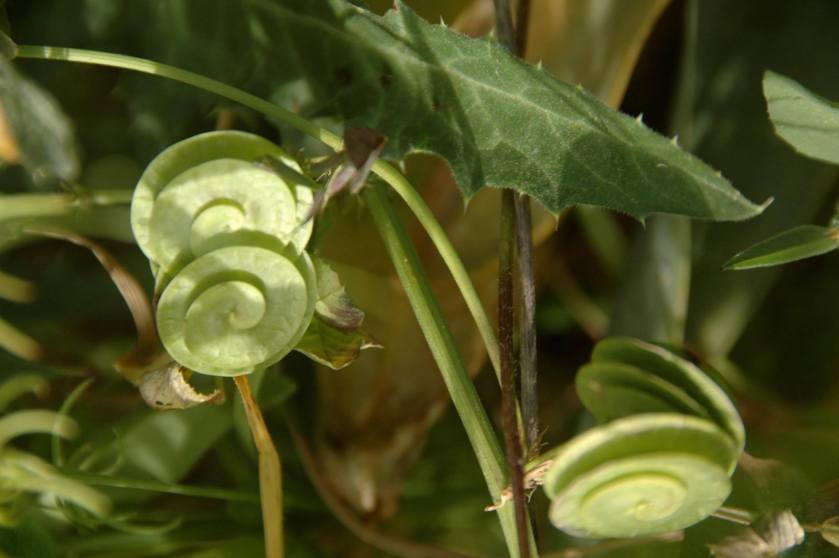
Light reflects into our eyes. Sometimes, it passes through the transparent or translucent, which transforms the light. Objects remove color and reflect or “tint” the light as it flows along its quantum path. The eyes respond to this light, but the mind interprets it. In this way, human’s “catch the light,” the image, interpret it, and see “things.” Sometimes, we then try to capture our interpretations of those things through art and photography, and writing, as well. Here are just a few images where I feel my photography has caught something beyond representation of an object (or objects).
Morning Glories Basking
Morning Glory Singing Praise
Praying Mantis on the Train
Iced Light (New York)
For a comprehensive discussion of how humans have caught light; understood light, color and the world; and interpreted the world along the way, I highly recommend quantum optician Arthur Zajonc’s very accessible book, Catching the Light: The Entwined History of Light and Mind. Zajonc makes it very clear how much the mind matters to how we “see” in the world. He also makes some startling connections between ancient understanding of light and current quantum understandings. The book is part history of human understanding of light and part explanation of current understandings of light, in a mind-opening and jaw-dropping account of the mysteries of light.
All photos taken with a Nikon D-70 digital SLR, which the photographer unfortunately lost during recent travels. All photos on this page / post taken by Michael Dickel, who retains copyright. Used with permission.
Many people associate Israel with desert and war. Both desert and war do color the land. Some people express surprise when they also learn about the nature here—flora and fauna. I spoke with a travel editor once who said he had no idea there would be nature trails, flowers, or Ibex wandering the hills in Israel.
Ibex visit the field school
In the desert, the ibex (a species of goat and symbol of Israel’s nature preserves) often cross a hiker’s path. Especially in the nature preserves, they tend to be reasonably brave. One time, while staying in a field school in the Negev, a herd came to visit in the morning. Some of the small kids climbed acacia trees to get at the leaves. I encountered the kid standing on the rocks on a nature trail above the Dead Sea.
And there are trees, too
And we do have trees in Israel, too. As these pictures show, I am fascinated by the textures and colors of bark on the trees. Some of these trees grow near the Mediterranean. The red-barked katlav I usually see growing along valleys and gulches in the Jerusalem hills. We don’t actually have squirrels. I haven’t seen any, at least. The gray squirrel in the tree lives in Minneapolis. Or, at least, that’s where I took that picture.
Water reflections
Israel does have water. The t-shirt tells you so: Med Sea, Red Sea, Dead Sea. And there is the “sea” of Galilee (really a large lake). The pictures here come from a fish farm, freshwater springs that flow over the salty Dead Sea aquifers, a river, and the Mediterranean. There aren’t many lakes—there are some rivers. The Jordan River, most famous and religious of them, unfortunately has greatly diminished due to human use and misuse of water. It is no longer “mighty and cold,” although sometimes parts of it are cold.
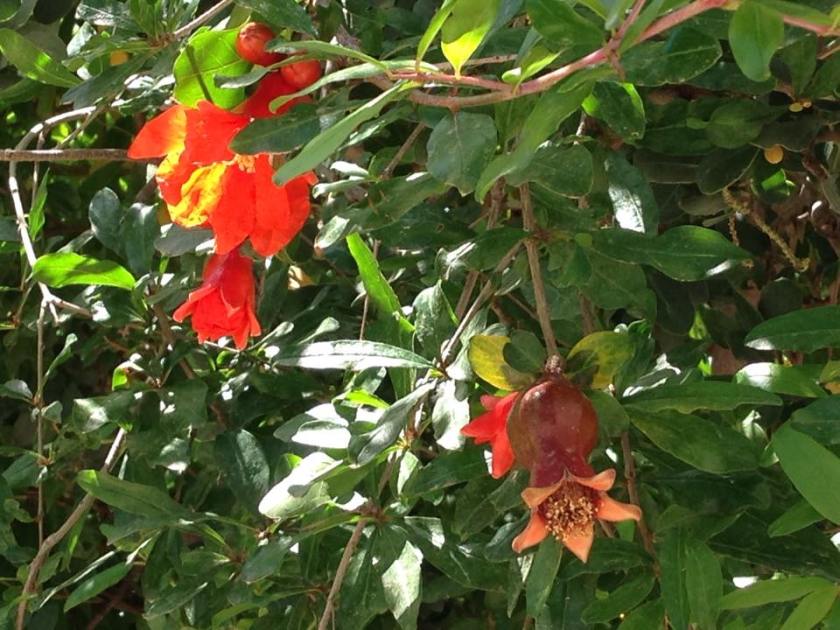
Of course, we have desert and beautifully barren-looking landscapes. We have rocky ruins (some of them along the nature trails). And not all of the anemones are red, although the other colored ones seem to grow mostly in the north (where there are incredible wild irises, rare wild peonies, and amazing narcissus that blooms with other wildflowers on some of the beaches. There are tiny narcissus flowers that bloom in the forests of the Jerusalem hills, too.
Purple anemone
The best time to see the flowers is late-winter to mid-spring. After that, it does turn hot, and most of the flowers die down. The trees remain. And the ibex roam the rocks, still. The nature trails are open all year. Although in winter, which is the rainy season, be sure to check for flash flood warnings—rain far enough away that the clouds are out of site could fill that dry gulch you’re hiking through with raging waters.
Pomegranate bush, growing wild.
All photographs were taken by Michael Dickel, who retains the copyright for them. Used with permission. The photos were taken with a Nikon D-70 digital SLR camera, which Michael unfortunately lost in recent travels. All light effects in the photos were done “in camera,” using manual settings, except the black and white tree, which was changed from color in Apple’s iPhoto app.
I had the pleasure of meeting Michael in Salerno, Italy, last summer when we both participated in the 100Thousand Poets for Change Conference. Michael joined me, along with Laura Shovan and Debby Rippey, my travel companions, in sharing a gourmet Salerno lunch in a wonderful ristorante. Michael also served as the emcee for one of our poetry nights. His work speaks of struggle and peace, and he is committed to using the arts for social change.
Ann:Welcome, Michael.
Does teaching have to contribute to the status quo? Must it be dominated by business models that value efficiency over humanity and greed over compassion?
MICHAEL: Yes and no. But, it doesn’t have to be this way.
This is my story. It just happened. And it’s been happening for years.
Michael Dickel
I’m letting go of teaching. I’m kicking and screaming, hanging on with my fingernails, letting go.
I’m sixty. I’m “outside faculty” (literally translated from the Hebrew, adjunct in plain English). One of my bread-and-butter teaching gigs will evaporate with a just-launched Ministry of Education, free, online, self-study English reading course.
And things are not working so well at a new gig this semester, where an administrator seems to have taken a dislike for me. I don’t want this constant battle in my life anymore, the struggle to make a living doing something I believe should have value.
After three months teaching, a group of us who are “hourly” teachers this semester saw a contract for the first time. It was dated Monday, the 18th of January. It begins three months before, 18th October. And, the contract expires this Friday, the 22nd. Four-days after they presented it to us. That’s, not coincidentally, the last day of classes for the semester.
One of the many problems with this end date is that we had been told to be present at the final exams on Monday, the 25th. Please note, that is after the contract ends. And, in addition to the paragraph that say, “you are hired from this date to that date,” paragraph seven also says something that loosely translates as: to be very clear, after the end date above, you are no longer an employee of the university, unless you are explicitly given an extension in writing. There is no extension of the dates.
This attitude toward those of us who teach is as destructive to education (and, by extension, society) as almost any other force other than war.
I hate having to fight for employment rights, like getting paid. The constant battling leaves me feeling like a failure. I am letting go of this work, which is no longer teaching, but a form of war.
I am hanging on to a lot of anger. I felt it as I left campus today. Boiling under the virus, feeding its fever. I am seething. And I need to find something else to hold on to.
I teach English as a Foreign Language reading comprehension to international students, Israelis, and Palestinians, in a post-high school prep program, called in Hebrew a mechina. (Yes, these students study together in the same classroom.) I love my students. I want to hold on to those marvelous relationships with students we teachers have the honor of sharing with them, where we learn together.
Today was our last regular meeting as a class. As I often do, I invited them to keep in touch—they have my email. Use it, I said. I’m on Facebook, I added. Three have already sent friend requests. Two of them are Palestinian students.
And just before supper, a student sent me an email (uncorrected and shared with permission of the student):
Hi Michael, this is __________, from English.
I want to tell you that you are a awesome teacher. Since the first lesson, I want to stay in your class. When I heard that we have to redo the [placement] exam. It’s my first time that I started to worry about if I can still be in a specific class.
I love the way you teaching, although sometime it is a little bit boring. I still remember that you played guitar and singing with us. And you told us that the purpose of teaching us is teach us how to think, about critical thinking. Since that, I knew that I was in the right class.
This particular student comes from China. He wants to study in Israel. He knows English already, and has been learning Hebrew. He also takes math, history, physics…a full load of prep-courses that has most of the students studying from 8:30 to 5 or later.
What he wrote at the end of his email, I will hold onto forever:
And I mentioned that I have something to share with you, the topic is that the relationship between war and education.
I found that, if a country want to get strong, it must have to good education in the nation. And the way to show others that you are strong, is to show them you have high tech and strong military. I would like to say high tech in some way is for high tech weapons. So who will provide the nation researchers and scientists to make weapons? Education do.
So in this way. I can say education make this world worse not better. And it get worse after every year. I believe that one day this world will get destroyed by those weapons and war. So who cause this? Education.
What do you think about this?
We had a unit on comparative education. The students spent a couple of classes online, looking at websites for places like Summerhill School (Democratic education), reading articles about Tiger Mom’s and Finland’s education system, and listening to TED Talks on the need for more creativity in education.
We did not discuss war, or its connection to education. That came from an amazing student. It didn’t come from me. Yet, providing students a chance to think such thoughts and to ask such questions—that is why I teach. And a successful teacher is someone to whom a student could write: I have something to share with you…What do you think?
I will hang on to the memory of this email. And hanging on to it will allow me to let go of frustrations with the difficulties and unfairness of a system that is stacked against him more than it is me. Hanging on to what matters will help me let go of what doesn’t matter.
It will also help me let go of this form of the work.
I wrote this student a long reply, which allowed me to hang on to what I really value. And, paradoxically perhaps, to let go of the job. The end of what I wrote went something like this:
If education doesn’t ask the questions that need to be asked, or, more importantly, teach how to ask important and critical questions, then you are right, education is part of the problem. It becomes an accomplice, helping to build the structures of dominance and power. Then, it feeds the cycles of greed. All of these things threaten our world today. If education is about training workers and obedience to authority, if it teaches accepted facts and does not challenge students to think for themselves, we are in trouble.
I think that this is one of the reasons why the Humanities are under attack, politically and economically, in much of the world today. It is why many politicians attack education—not because it is “failing,” but because it challenges. And why “reforms” are regularly introduced that use over-simplified models of “manufacturing knowledge,” teaching doctrinal facts (in whatever discipline or doctrine)—serving a purpose of producing workers and even leaders who “fit,” but not inspiring thinkers who question.
We need to find ways to inspire students to think—as I see you have been doing—about our world, about how to make it better, about how to find reasonable and well-reasoned approaches to fixing the problems we see and providing a sustainable, healthy, and worthwhile future for our species.
I don’t have the answers. I hope that we will find the right approaches, or at least, good enough approaches. And I hope that education does not end up only serving the powerful, the military, and the greedy.
However, it is always about possibilities. We must look for and welcome new possibilities into our lives.
From the Jewish tradition, we have this teaching, too: “You are not obligated to complete the task, but neither are you free to desist from it” (Pirke Avot 2:21).
I believe that we can stop the destruction you fear. I hope that we can. May we not desist (stop) from trying. May we continue to seek forms of truth, practice heartfelt communication, and learn compassion for each other. May we cooperate and share with each other solutions as we find them. And may we always look to improving the world, not simply existing, or, worse,“using up” the world.
I believe that you could be someone who makes a difference. Start with your questions. And then, look for those possible solutions. That is all I know to say to you as an answer to your question about whether education is causing the destruction of the world. Yes and no. And, it doesn’t have to be this way.
With respect and hope for your generation, Michael Dickel


 In the 16th C., Moses Cordevero “discovered” or “wrote down” ancient (oral) texts, or simply wrote them as new texts. These are prominent among the received texts, part of the basis of Kabbalah (which means Reception, Received, but idiomatically, Revelation). One book is The Palm Tree of Devorah. At once it seems a text about how to be a good judge, like Devorah, and how to transcend our lives of judgment to obtain a Oneness with Keter, the Crown of Creation. Some excerpts, from Daniel Matt’s book, The Essential Kabbalah: The Heart of Jewish Mysticism (including his notes / commentary after the boldface text):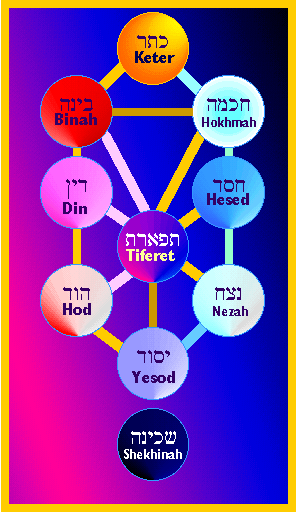













 The BeZine