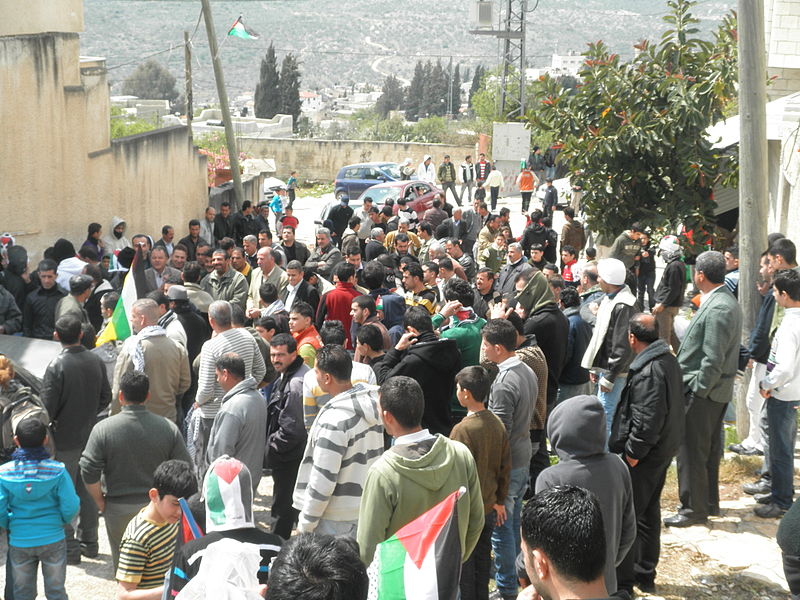
Demonstration against road block, Kafr Qaddum, March 2012
Here on the slopes of hills, facing the dusk and the cannon of time
Close to the gardens of broken shadows,
We do what prisoners do,
And what the jobless do:
We cultivate hope.
A country preparing for dawn. We grow less intelligent
For we closely watch the hour of victory:
No night in our night lit up by the shelling
Our enemies are watchful and light the light for us
In the darkness of cellars.
Here there is no “I”.
Here Adam remembers the dust of his clay.
On the verge of death, he says:
I have no trace left to lose:
Free I am so close to my liberty. My future lies in my own hand.
Soon I shall penetrate my life,
I shall be born free and parentless,
And as my name I shall choose azure letters…
You who stand in the doorway, come in,
Drink Arabic coffee with us
And you will sense that you are men like us
You who stand in the doorways of houses
Come out of our morningtimes,
We shall feel reassured to be
Men like you!
When the planes disappear, the white, white doves
Fly off and wash the cheeks of heaven
With unbound wings taking radiance back again, taking possession
Of the ether and of play. Higher, higher still, the white, white doves
Fly off. Ah, if only the sky
Were real [a man passing between two bombs said to me].
Cypresses behind the soldiers, minarets protecting
The sky from collapse. Behind the hedge of steel
Soldiers piss—under the watchful eye of a tank—
And the autumnal day ends its golden wandering in
A street as wide as a church after Sunday mass…
[To a killer] If you had contemplated the victim’s face
And thought it through, you would have remembered your mother in the
Gas chamber, you would have been freed from the reason for the rifle
And you would have changed your mind: this is not the way
to find one’s identity again.
The siege is a waiting period
Waiting on the tilted ladder in the middle of the storm.
Alone, we are alone as far down as the sediment
Were it not for the visits of the rainbows.
We have brothers behind this expanse.
Excellent brothers. They love us. They watch us and weep.
Then, in secret, they tell each other:
“Ah! if this siege had been declared…” They do not finish their sentence:
“Don’t abandon us, don’t leave us.”
Our losses: between two and eight martyrs each day.
And ten wounded.
And twenty homes.
And fifty olive trees…
Added to this the structural flaw that
Will arrive at the poem, the play, and the unfinished canvas.
A woman told the cloud: cover my beloved
For my clothing is drenched with his blood.
If you are not rain, my love
Be tree
Sated with fertility, be tree
If you are not tree, my love
Be stone
Saturated with humidity, be stone
If you are not stone, my love
Be moon
In the dream of the beloved woman, be moon
[So spoke a woman
to her son at his funeral]
Oh watchmen! Are you not weary
Of lying in wait for the light in our salt
And of the incandescence of the rose in our wound
Are you not weary, oh watchmen?
A little of this absolute and blue infinity
Would be enough
To lighten the burden of these times
And to cleanse the mire of this place.
It is up to the soul to come down from its mount
And on its silken feet walk
By my side, hand in hand, like two longtime
Friends who share the ancient bread
And the antique glass of wine
May we walk this road together
And then our days will take different directions:
I, beyond nature, which in turn
Will choose to squat on a high-up rock.
On my rubble the shadow grows green,
And the wolf is dozing on the skin of my goat
He dreams as I do, as the angel does
That life is here…not over there.
In the state of siege, time becomes space
Transfixed in its eternity
In the state of siege, space becomes time
That has missed its yesterday and its tomorrow.
The martyr encircles me every time I live a new day
And questions me: Where were you? Take every word
You have given me back to the dictionaries
And relieve the sleepers from the echo’s buzz.
The martyr enlightens me: beyond the expanse
I did not look
For the virgins of immortality for I love life
On earth, amid fig trees and pines,
But I cannot reach it, and then, too, I took aim at it
With my last possession: the blood in the body of azure.
The martyr warned me: Do not believe their ululations
Believe my father when, weeping, he looks at my photograph
How did we trade roles, my son, how did you precede me.
I first, I the first one!
The martyr encircles me: my place and my crude furniture are all that I have changed.
I put a gazelle on my bed,
And a crescent of moon on my finger
To appease my sorrow.
The siege will last in order to convince us we must choose an enslavement that does no harm, in fullest liberty!
Resisting means assuring oneself of the heart’s health,
The health of the testicles and of your tenacious disease:
The disease of hope.
And in what remains of the dawn, I walk toward my exterior
And in what remains of the night, I hear the sound of footsteps inside me.
Greetings to the one who shares with me an attention to
The drunkenness of light, the light of the butterfly, in the
Blackness of this tunnel!
Greetings to the one who shares my glass with me
In the denseness of a night outflanking the two spaces:
Greetings to my apparition.
My friends are always preparing a farewell feast for me,
A soothing grave in the shade of oak trees
A marble epitaph of time
And always I anticipate them at the funeral:
Who then has died…who?
Writing is a puppy biting nothingness
Writing wounds without a trace of blood.
Our cups of coffee. Birds green trees
In the blue shade, the sun gambols from one wall
To another like a gazelle
The water in the clouds has the unlimited shape of what is left to us
Of the sky. And other things of suspended memories
Reveal that this morning is powerful and splendid,
And that we are the guests of eternity.
“As Democracy is perfected, the office of the President represents, more and more closely, the inner soul of the people. On some great and glorious day, the plain folk of the land will reach their heart’s desire at last, and the White House will be occupied by a downright fool and a complete narcissistic moron.” H.L. Mencken, The Baltimore Evening Sun, July 16, 1920
gone mad, gone mad
but for the flautist in shaman’s headdress and
the first violinist wearing a necklace of skulls,
praise the intuitive, the holy, the gentle chanting
of the faithful …
defy the bassoonist blowing brazen notes over Syria
and the cellists hidden in caves; succour the sad sweet
violins of Aleppo, Palestine, Kashmire crying salt tears
for their lost lands, pulses weakening, and there’s
that drummer who down-beats from North Korea
China harps on the fumes of its discontents,
the Ukraine is loud with crashing cymbals
and the snap pizzicato of Russian preying,
while the angel of Germany hosts a symphony,
or tries to, & here in America parties are discordant
[the price of order is dictatorship the price of democracy is chaos]
politicians out of tune, sections out-of-sync,
oligarchs charge themselves with theatre management
poor acoustics preclude hearing the chorus … . . . and all the world’s a stage,
the men and women are not mere players
The configurations of cruelty have changed since I wrote this poem in 2013 but the cruelty is still with us and often seems worse than ever. And, it certainly turns out that Mencken (quoted above) was prescient.
“Here I am alive, and it’s not my fault, so I have to try and get by as best I can without hurting anybody until death takes over.” Leo Tolstoy, War and Peace
There are open spaces in the plotting of a story
I print out for edit during the work hours
In the silence of creativity, a sweet lavender
lends its fragrance, color and calm
Outside squirrels skip, toddlers play
Grandmothers stand-watch in doorways,
chili stewing and stacks of tortillas, warm and
soft, rest and wait under clean kitchen towels
Spring is moving into summer and neighbors
tend their herb and vegetable gardens
They imagine the yield dressed in salads
They’re willing to share the harvest with friends
A world away soldiers download ordnance
synchronized to the hum and click of my printer
Bodies fall, hearts stop, eyes water and
the manuscript is blue-pencilled* by rifle fire
“You see the suffering of children all the time nowadays. Wars and famines are played out before us in our living rooms, and almost every week there are pictures of children who have been through unimaginable loss and horror. Mostly they look very calm. You see them looking into the camera, directly at the lens, and knowing what they have been through you expect to see terror or grief in their eyes, yet so often there’s no visible emotion at all. They look so blank it would be easy to imagine that they weren’t feeling much.” Mary Lawson, Crow Lake
Eye-candy, a feast of crocus, bursting
Through the snow-laden ground
Drunk on the promise of spring
The devil behind, that shadow side
Clouds shape shifting, take on
The broad outlines of a memoir
Angels dance on the razor’s edge
Forget that pin stupidity, reductio ad absurdum, politicians and scholars
Debating, while greed and warring go on
Starving the children, curse the insanity
Dialectic, acquisition, murdering hoards
Clouds, shape shifting, take on
The contours of shame, crocus buries
Itself and the promise of spring
The broad outlines of memoir dissolve
The slashed moon drools ichor
How long can the innocent bear life
On the razor’s edge, coiling the fire
Of their despair around our hearts
Drawn to the verge on the reflux of
Rudimentary souls, vertigo, nausea
Nostalgia for what will never be known
A young wife, enamored by sounds of creation, calling birds,
wind whistling through trees, left the house to tend the garden.
Still fresh from the purifying mitvah bath, prayers said in Hebrew
praising God for life, she knew it was the moment to conceive.
In her youthful innocence and hunger she could not resist her new husband
cutting grass outside; shirtless, sunshine on sweat sparked his muscled flesh.
He was fit, recently back from the war, but he was not gentle. She melted at
his smile at catching her watching.
Still resentful of his fits of anger, fearful jealousy and critical outbursts,
she was ready to get back what he had taken.
No longer a trusting girl who could not protect her pregnancy from her husband’s
surprise punch to her stomach, she had become a warrior.
She lifted the soft cotton dress to view her ripe body, touched the skin
under her navel, blessed her waiting womb, then kissed her fingers as if
she were kissing the Mezuzah on the doorway. She raised her arms toward the sky,
summoned Shekhinah, the spirit of creation, begged Her for a conception,
and amidst birds’ songs, fragrant blossoms, freshly cut grass, the image of a baby
flashed in her mind. She thought she heard fluttering wings announcing the
arrival of the holy feminine force.
No words said, she took her husband’s hands, pulled him into their home,
and they fell fiercely together onto the bed. Soon she was alone again;
the girl knew immediately that a life was growing inside her, then she
became afraid of what she had done.
That night in a dream the Goddess Shekhinah spoke: ‘You hungered for a child;
a child was given. Be strong. Leave the cruel man and raise her in love and faith.
When you discover, she is like the father – forgive her!
Remember, it was you who called.’
When I was four my
beloved Grandma
Brought me a cloak and purse
From Damascus.
Soft black velvet,
with swirls of gold braid
in patterns as intricate
as the tree of life,
as rich and bright as stars.
The cloak draped over
my shoulder
and fell to my knees.
In my cloak of stars
I paraded about proudly
Twirling the matching
Drawstring purse
Commanding the
Kingdom of dandelions
In my front yard
.
Last week I found the cloak
In a drawer,
carefully wrapped
In tissue paper
and memories
I sent a photo to my friend
Who lives in the velvet
darkness of Damascus nights.
Her nights
Now streaked with silver missles
Instead of stars,
I put on the cloak for both of us.
Covered with my grandma’s love.
In our hearts
we walk together freely,
The golden braid
matching golden lights
In days and nights of peace
We hope will come.
JOAN LEOTTA plays with words on page and stage. Her essays, articles, books, and poems have been published in US and UK and elsewhere–The Ekphrastic Review, A-3 Review, skirt, Sasee, The Lake, Tiger (winner of one month’s contest), Pine Song, and many others. She performs folk and personal tales of food ,family, nature, and strong women at festivals, in schools, libraries, and museums. She is developing a one-woman show based on Louisa May Alcott’s time as a Civil War nurse. When not at computer or treading the boards, she can often be found walking the beach hunting for seashells.
when i was young i found these stones they were everywhere and a friend had said that if they were polished they’d be worth a great deal but no one that he knew had been able to smooth the surface even at an early age i was somewhat defiant and persistent when told you can’t or it can’t followed by some phrase like be done in any case i took it upon myself to prove him wrong that’s when i bought my first rock tumbler an inexpensive model since my funds and knowledge of such things were quite limited the results of my first efforts were rather pathetic like a love-sick youth seeing the true meaning of life and love but as i gained more knowledge of the stones and the processes others had tried i refined my process i learned that the best action could be achieved by wetting the rocks just enough for the carbide grit to cling to the agates as they tumbled i envisioned it as a war between the stones the grit of course were my soldiers oh and there were times when i was certain by the sounds made by the tumbler that i had indeed achieved my goal but on close inspection the stones had not changed so then i decided to seek the assistance and advice of others one expert inquired if i knew the nickname of the agates that i was trying to polish when i said no he said they’re called human greed i can’t tell you how many tumblers and soldier’s lives that have been sacrificed but i do know now that my quest has yielded little change and that those stones may indeed outlast even me when i finally find peace
I
My five-five-fingers of my hands
Zestfully lived In serenity.
The three thrill fingers of my right hand:
Thumb, index finger and middle finger
Stoutly lived civilly and gleefully amongst her BROTHERS:
They rested gleefully upon the placid,
SHARP-SABLE-POINTED-DART.
II
Sharp-sable-pointed-dart;
Perched in the midst of the three thrill fingers
And laid rest upon the hungry,
Virgin DUSKY-SHEET, which sprawled
bear flat on the glossy desk.
The glossy desk accompanying the earth
The earth accompanying its depth.
III
The other two fingers of my right hand:
Ring finger and little finger
Calmly leisure, plopped on the hungry, virgin dusky-sheet
And lent ears to the sharp-sable-pointed-dart,
Sharp-sable-pointed-dart,
Muttering vignettes of yesterday
Muttering vignettes of today
Muttering vegnettes of tomorrow.
Upon the glossy desk
My five fingers of my left hand too
Laid rest, and eyeballed the sharp-sable-pointed-dart,
Muttering deep thoughts.
IV
Look!
All you who waded through lines:
All you who unearth the heart
Of this earth, hunting for treasures
Pore over my ten fingers.
My ten fingers,
As pure as a full virgin moon.
I have dunked deep my five fingers
Of my right hand with my progenitors
In a bowl of sweet dishes
And nibbled singed YAM amidst
The thriving vegetables.
V
But my forefinger of my left hand
Never been raised above
To curse the heavens
Never been raised up to pinpoint
My progenitors’ homeland
Never had it tasted any depravity
And never will it be licked
Or bit by the savage butchers
Who loved to fatten themselves on murder
And gratified their heart with
Juicy cup of blood and gore.
We travelled far-flung
and sea beyond
to see an old time friends;
on getting to his street-brink
we sifted from aloof distance:
the street has already been cluttered
with flower of embers.
From each riven aluminium-sheet —
of every domicile
sequence of dense half-dark smoke
scudded into the engulfing mouthful sky
and a rusty brass bell
from a church-front welcomed us in —
welcomed in our dusty camel-feet.
We strutted in softly, softly slowly
upon the face of the earth,
we coughed,
we sneezed,
and rubbed off beaded sweats
on the parched tired phiz
with the back of our palms.
The street has become lull
(like an empty squirrel hole
which the hunter searched through in vain)
except for the rusty brass bell that clangs.
“…bloody political critters
has already touched this street, too
with their grubby-filthy fingers”
My partner said, with ball of indignation
ricocheting in his metal lung.

 “Here I am alive, and it’s not my fault, so I have to try and get by as best I can without hurting anybody until death takes over.” Leo Tolstoy, War and Peace

 The BeZine