Liberty stands still with welcoming arms open
a vision of freedom that’s endured worldwide
she’s taken Irish famine victims, Germans,
Dutch, and Jews escaping Hitler’s camps
and brave prospectors seeking Klondike gold.
All have made it to the melting pot, stirred
added with the spice of First People, those
who lived in forest, prairie and mountain
before Italian Columbus sailed from Cadiz,
or the slaves were freed to add Africa’s dance
to the music that calls “freedom” and America
the call and greatness of welcoming U.S.A.
that’s echoed to the poor since it became power.
In the last year She weeps upon her island
watching the world’s poor die upon sea and land.
No longer ships and planes pass her open arms
filled with those seeking a better life, fleeing
war, famine, the hatred of the despot for
even in this land of freedom a goose step
demands that only those who march to
a tune we thought defeated are welcome
men embolden by the promise of support;
but has Gaia responded with a warning,
hurling winds across the Caribbean
to devastate not only the islands but
the retreats of the wealthy, who thought
themselves immune in their castles
not even the President’s Mar-a-Largo is safe
from her wrath. Is she asking “why”?
Should we not reply with friendship,
welcome the poor, refugee and worker
whatever their race or religion to the mix?
For they are the people who will build
nations, care for us as doctors, and nurses
carve the future as scientists, engineers.
They have talents that we, every nation needs.
On March 18, 2013, a decade after the Iraq invasion, The Columbus Herald Ledger printed soldiers’ recollections of their first Iraq tours. These accounts are loosely based on those recollections. All three voluntarily returned for a second tour.
Digital art by Phillip T. Stephens Background texture by Billy Alexander
Afghanistan’s Just Another Note
in an Endless Melody
(An American haibun [1] )
Security
Palmer and I drive 24 hours straight. On dusty roads. Grit crusts our crotches, cracks, armpits, teeth. The minute we report, they dispatch us to highway patrol. No time for coffee, cigarette or a piss. Grab gear and go. We’re on patrol maybe fifteen minutes, a toothless haji staggers down the center of the highway. No shirt, holes in his pants, one sandal hanging by a strap, hands empty. Raised like white flags. Palmer steps onto the shoulder; I can’t pull him back. Haji drops. An RPG follows his path, flips Palmer. A six-foot arc. Toothless rolls to the far shoulder, leaps up and scrams. Bullets swarm the squad like hornets from a burning nest. I duck behind an abandoned car. A second grenade punches into the gas tank. I dive into the sand beating the fireball by a second. Wake in the hospital, bathed in sunlight, my leg in a cast from ankle to hip. An officer shows up. Doesn’t even look in my file for my name. “You’re flying home, soldier. Recovery leave.” I asked about Palmer. “He’s flying too.” No eye contact. I knew then that they’d be sending Palmer cargo.
In a village graveyard, in the steaming
summer rain, a priest consoled
a widow weeping at her
husband’s stone. A tear because
he perished, a flower for her love.
Her face in pain. He touched her arm
to share a word of tenderness.
First Wave
Our M113 crossed the Iraqi border at midnight. HQ deployed us as the invasion’s first pawns. The Republican Guard scattered like spider monkeys during the firefights. One night, while our tracers chased the cowards across the sand, I pumped my fist, poked Baker in the ribs. “At this rate, we’ll be in Iraq by Sunday,” I shouted over the noise of the explosions. Baker didn’t answer. Couldn’t answer. He couldn’t answer because he had no head to answer with. He stood perfectly straight, a mess of gristle and spine sticking above his shoulders. After a couple of months, in the Red Zone, Johny Jihad learned how to lure convoys down narrow streets and pick them off. So, it was August, like six months after they said the war would end in shock and awe and we’d be back home polishing off six-packs in our porch swings, and our convoy’s front track lifted its nose, like a horse rearing on hind legs. Six maybe seven bodies spilled into the fleeing crowd. The Bradley at the tail went next, a rocket through the engine block tipping it onto the sidewalk. Cash, our driver, plowed through the wreckage, the rest of us crouching close to the floor and firing over the side. Norton fired the top gun at anything moving. Back at the base, I couldn’t light my Camel, my hand shook the lighter so hard. That was when I started thinking of my college engineering classes as weekends at Disneyland.
“He died in a noble cause.
He gave his life for you and me.”
She seized his words,
spit in mud, cursed such
generosity.
“Your petty wars are not
the will of God. He gave no
sanction. Nor is there need.
And if you want to tell me
otherwise, please offer
your excuses to the dead.”
Sand gets in your eyes
One hundred twenty degrees with the breeze. On that first day in April, I had no way of knowing we’d suffer in the heat so long. I spent three-months suffering with heat and bug bites before I’d feel air conditioning. They gave me a cushy post. I coordinated battlefield positions. That cushy job didn’t keep me out of combat. One time a sandstorm trapped our convoy. We were three miles outside a sinkhole called As Samawa, sixteen vehicles on a highway that had so many pockmarks it could have been a teenager’s face. The advance slowed until we creeped along at an inch and hour. We couldn’t even see to the shoulder. LT dispatched Parker and Dial to scout. They wrestled with the wind, and disappeared into the brown sky. When they didn’t report back I looked for them. I fought the wind for an hour. Even with a muffler the storm sandblasted the skin on my face. I finally sat on a sandbag for a smoke and a snack. A chocolate bar. The storm faded as quickly as it started. I glanced down, discovered my sandbag was Parker’s body.
[1] The Japanese haibun combines a paragraph with a poem (in its strictest form, haiku). Each haibun requires a title and the paragraph must be composed in first person. The poetry and paragraphs can be combined in any variation.
So she says to him: my own
self is my body’s own true love,
is my first heart, so it goes
or so it says it out to.
But I have no idea why
I open myself to other selves,
like this, over an over
I never know or sure when I’m
inside out
I learn about it later
And he says: you’re pure technique.
Twice-born, even more, you still
Move and speak in thrall to becoming
each act. Each word written for another
self gives your need a format,
and limitless permission.
Remember when you were little?
Sleeping tight in a ball. In
a clenched room.? Like something
hurt inside? Like you dreamed
you would die? Without
permission?
No, she says to him. Just because
a knife is found, somewhere, maybe
borrowed, maybe stolen, a cut
cannot be, maybe, magic.
And a deep bruise the next
morning is no good excuse.
I know just what I know,
I go inside. Conscious.
I whisper, then I’m gone.
I learn about it later.
He shrugs, but he also
thinks: she trips the light, mitotic,
again. Daughtered, unmoored
in her mirror, again. These selves
she carries inside, like spores
of blue immortal cities. Like
whorls of cold light: hiding
like criminals on the inside
of her own skin. Again.
Then he says to her: the worst
crime makes the most heat and that
crime is the map of our journey.
Did you get there yet?
Are you warm enough to blast
off the mask?
But, he thinks, also,
inevitably: she still
makes me over, too, slips
through bare girders
like wind through a
hand, bone empty, and
pure as new snow passing
through, in silence,
In yellow light
down, twists
new snow
against my face …
So here I lurch outside and leave
the movie but this switch inside
stays on. And still it goes: a King
asks his private ballerina
for a “simple loss
of memory.”
Over and over his voice
drones on like a nagging
self-improvement tape
for people who regret
their own music.
Who regret their own sons.
Who shun their own daughters.
But nag’s not right, here,
no: nag is, too, a lie.
Even a King’s voice has a true
need to ignite its moment.
To burn for so to breathe.
To clench and unclench.
To talk to me, to stay
alive, a little more.
Believe me. King.
Inside me, or out the other
side of time, somewhere, I
would talk to you. But. You
just scat back at me like a nutty
cube of ouch, alone
in one gray lobe: “Hey, make a
holler to the next lobe, down
the block a’ways and still,
always, already relative.
But to what?”
…..And still I catch you croonin’:
“baby-baby.” And still
you make that same unkingly whine: “don’t
wanna’ know the old face.” Behind the
same face, newly burnished with jive
gravitas like yet another glass stone
in your tiara. So over and over, so very
by now: it’s our own common voice looping
back at us on the dream telephone.
But here, again, inside me, I still listen.
Like a synapse in the mouth of dream
body’s memory, barely breathing, through
mudras of pulse, space, motion, mask,
cadence, dark, gesture, resonance,
pressure, light, gathering and release,
right here, I listen, as ghosts
will have their due, o my King,
my vacant son, o my unbending
daughter, to you,
to your final riddle:
if thoughts are born with blood and lungs, and even grace refuses balance, if we all move room to room, unmoored, in our own tectonic currents …
if right here is not the hyperspace of a new social ontology, if this story is not the story of a true star, and terror not the oldest thing clanging inside our heads,
but, maybe, the loudest …
Would Zeami still call this version the Flower of Stillness?
Or just a skin of words, a book of buried shadows, dry husk of memory, a “walk on the roof of hell”?
shivering and rocking in that amniotic “beauty
within which all things walk and move”: inside a
dream outside of time, remembered, or not, (assembled
/ unraveled) from residues of memory.
Lose the mask you wear like a grudge: try
to remember the first face you can remember. Your first face from the last life before it finds (its?) shape. Before a stage exists, before any watchers appear, before your own map of self and space congeals, (out there / in here), before any doors, gates, locks come between your impulse and its most graceful or, at least, spontaneous expression. With every image still latent, on the bare edge of the visible.
That face is your full self, it’s been said.
Who else are you then, but your full self, it’s all been said before.
So begin there: where the body disappears,
and burns (in secret), and impulse
“transluminates” as action. A true and natural
ritual, but sadly, and so often,
diluted and debased.
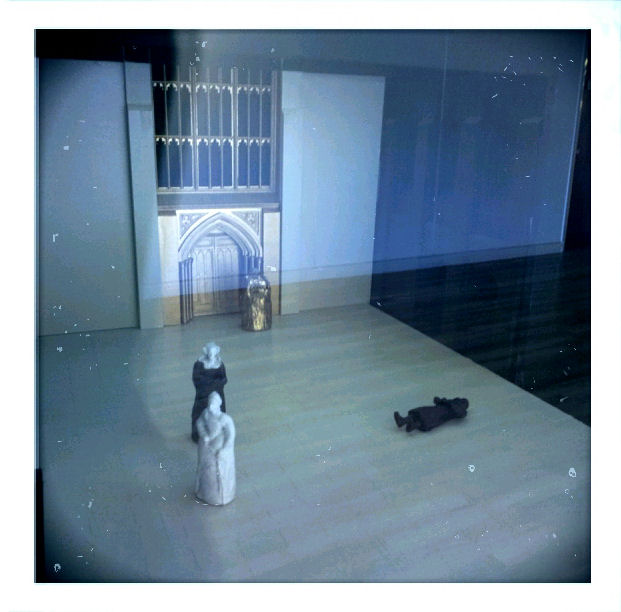
 he said the flames


 off stage right shouts “WHEEL”
 The BeZine