Her (dis)like of poetry showed through
her pure contempt while reading it. She thought
high interpretation of the unintelligible half poets
elevated an autopsy to a false revery for birth, and
that all the academics criticize what they understand
would be detrimental to their careers. She wanted a genuine toad, not a prince, an imaginary secret
garden, no flowers, a raw poem eaten, savored,
complete with a belch after gulping beer.
My students hate the image of an autopsy,
don’t like to consider births except in the abstract,
think if someone says “poetry,” then, poetry.
What use definitions, declinations, nuance
or inflections? Metaphors just hide the truth,
what matters comes out straight and clear.
Who cares about red wheelbarrows, blackbirds, or pigeons, for that matter?
And certainly, they argue, we don’t dislike
all that we don’t understand.
From the outset,
my wrists were bound;
wrongfully arrested,
I’d plea bargain without cause,
seemingly without choice.
Craving sweet bitterness,
rocking you like a cocktail,
I would remove your top,
release my passion, and
devour you in instalments.
You, my daily medication,
the essential dose of rapture;
vital, addictive, immediate,
sped venom through my veins
that led to the heart of my despair.
Each hit delivering a mark;
I’d await side effects,
like your incredulity on waking,
interrogation from burning eyes
that scorched my cheek,
parched my tongue,
stung my eyes.
On a trip, through the ruins of your mind
where you’d once held mass,
I heard misquoted passages
echoing around the inclined victims
of those that preceded me.
The marks remain,
however concealed
as day by day
the soundless damage remains
leaving me deaf to reason,
yearning still.
from the hottest part of this land
we rode our horses
with the mouth broken
and the tongue dried like the sand
to the point that also a kiss would be painful
so we stopped in a caravanserai
for water to wet our foreheads and
horses to let sleep
and a bit of cool shadow
to drink with our eyes
so we slept
till the night was high
and the cold desert was
all in sound with the wind
and the sand danced
with twisting dreaming snakes
the morning rose
with the voices of merchants
and the prostitutes ones
and the adventurers ones
and the bakers ones
and all the other people
burned by the sun
frozen by the moon
so we started again
our long voyage in this desert
avoiding snakes
and searching for oasis
all here can erode our bodies
all here can drive us mad
all here can rive our ride
but not our broken sandals
filled with the same steps
filled with the same sand
if you kiss a frog, so I’ve been told,
there’s a chance he’ll turn into a prince,
a frog prince, which means you have you absolutely have to love him
and i’ve loved a few frogs, at least
i think i have, they never became princes
nor did their love morph me into a princess,
i’m still a cranky old crow, we are what we are
loving frogs and crows isn’t transformative ….why should it be?
one woman’s frog is another woman’s prince
Airways crackle with dissent
as voices strive for listening ears
tweets, postings spread dissent
propelled by shares and likes
as insomniac fingers tap out
fears truth is lost while hate
rises and people draw the curtains
blocking out the world, curling
into the duvet of the past.
They do not see the children
lost in water they have never sailed,;
nor the beggar standing at the gate or
the boy who missed the love of life
because his skin did not match white.
Yet look at your neighbour over the fence
he’s just like you there’s no difference,
no matter what way he prays or ties his belt
he craves peace, family, friendship, food
a place of peace to thrive and be your friend.
No golden tower or boundary line
matters to the ordinary mind.
Those cackling voices clamouring for attention
only breed fear hand hate as stern faces seek
power at any price but when the guns fall silent
peace will come again when we realize
that gold holds nothing power wanes
and beneath the skins of race and faith
we all want family, friendship, a hand
She asked me to her office, said
It’s an emergency.
The heels or the sneakers,
she asked. Nothing
in this wide world could make me wear
heels anywhere, certainly
not in a car for five
hours, stuffed like a pimento in an olive
between two administrators spearing me
for details to stir into their martinis.
The sneakers.
Of course, I said, confused
by her footwear anxiety. She paused,
But, which is more…
professional?
I stopped. Stared at
friend, colleague, mentor, go-to-person
who is leader, innovator, math coach
and only woman of color
in our building and knew this wasn’t
about the shoes.
What could this skin
of mine say back? What
shoes could offset her bold
blackness in this whitewashed world?
I can’t offer what shoes to wear
any more than I can moralize
about what clothing
Black mothers should let
their young sons wear out of houses
to keep them alive, can’t tell my black
professor neighbor not to fear dropping
his daughter’s class pet off in the backyard
of a friend’s house while they are not home,
can’t tell him it’s silly to worry about
some neighbor calling the police,
can’t tell the black anesthesiologist to just
be calm when stopped for the broken
headlight. Can’t say, It’s just
a routine stop. Can’t tell the public
relations director with natural hair
to simply ignore being followed
at the drug store while shopping
for cough medicine for her son.
Can’t advise the Latino cable guy
how to handle each door slammed
in his face as he comes to repair their connection
to Game of Thrones or Walking Dead.
Can’t correct him when he says he doesn’t need
a TV show to feel as though he is walking
dead, every single day.
I can’t tell my friend what shoes to wear.
I can’t tell her she won’t be deemed unprofessional
no matter what’s on her feet, despite
being towering strength and brilliance.
I can’t tell any one of these black lives who matter
much of anything.
I can only tell my whiteness
listen.
Carved wood mask Nacius Joseph (b. 1939) Haitian Sculptor
of the Jewish Calendar rests
in the arms of Mardi Gras, an upside down play of masked and unmasked images dancing
at the party while Purimpshpiel stages a drama: unfolding parody, satire, commentary— the whole Megillah. And who puts on an Esther mask
on the way to the Beverly Hills Purim Ball, but Hadassah herself, on her annual pilgrimage to the festivities of inversions. Nu, who do you think inspired the Rabbis to write in the Gemara that Jews should get so wasted that they cannot distinguish
…
between “Blessed” Haman and
“Cursed” Mordechai, if not Vashti?
Vashti, who released herself from the lustful gaze
of her husband’s court, now wears the mask of that same Ahashuerus who banished
his Queen to her freedom. The Tel Aviv Opera Purim Ball rejoices in the refractions of self and story—politics of the beauty contest
Wood mask Artist unknown
for the virgin, check or mate. Revelers cheer an Uncle arrogantly dressed in mourner’s cloth who entered her in competition, then stripped her of her mask to save their people, while letting his people massacre others—another masquerade.
…
And in Tel Aviv and Beverly Hills,
the masked dancers
drink up the casts and no longer recall
the difference between good and good, mask and masque—
so many layers of truths, peeled one after another, as the frenzied forgetting tears off masks over masks,
layered like ancient rubble under old cities and their tels, like history and politics, like geology and religion, until what lies beneath and beneath again barely glimmers in the eyes
…
of the masquerade.
And Hadassah laughs,
dancing freely with Vashti, two lovers at last
hidden and unhidden at Tel Aviv and Beverly Hills Balls—globes of pleasure
circling the world in three complete lines forming seventy-two masks, each one a part of the whole.
The poet dons the mask of commentator, but the poem always wears at least one mask in the presence of the poet, so beware. And, if the poem reveals (a) different mask(s) to you, dear reader, please explore. The poet does not trust that any poem reveals all of its masks at any one time, especially to the poet.
The Jewish holiday of Purim celebrates the tale told in the Book of Esther, a story that, remarkably, does not once mention G-d. Set in Persia, which rules over the Jews at the time, The Scroll of Esther (or Megillah) layers many levels of deceit and masquerade, and the tale turns on itself in many ways.
Book of Esther
The King of Persia, Ahashuerus, banishes his Queen, Vashti, when she refuses to dance in front of his guests. Mordechai urges his niece to enter the beauty contest held to replace the queen, but to hide that she is Jewish (and probably not eligible to be queen of Persia). So she uses her non-Jewish name, Esther, instead of her Jewish name, Hadassah, wins, and becomes Queen Esther.
Meanwhile, Haman, the viceroy to the King, hates Jews and especially Mordechai, who refused to bow before Haman, and who is in the story honored for revealing (through now Queen Esther) a plot against the king. Haman has to lead him through the streets on a horse, Mordechai dressed as a king, Haman’s own idea of how to be honored—which he is asked to tell the king at a party, perhaps a masque (Haman thinks it’s for himself that the King wants to know how to honor a person).
Haman, whose orders are like the King’s own (another mask), plots the hanging of Mordechai and the genocide of the Jews. While the rest of the city celebrates an occasion of state (the defeat of Jerusalem), Mordechai dresses in mourning because of Haman’s plot against his people. However, this is an act of treason during the celebration. He thus shames Esther into unmasking herself to Ahashuerus, who reverses Haman’s murderous order when he learns his wife is a Jew.
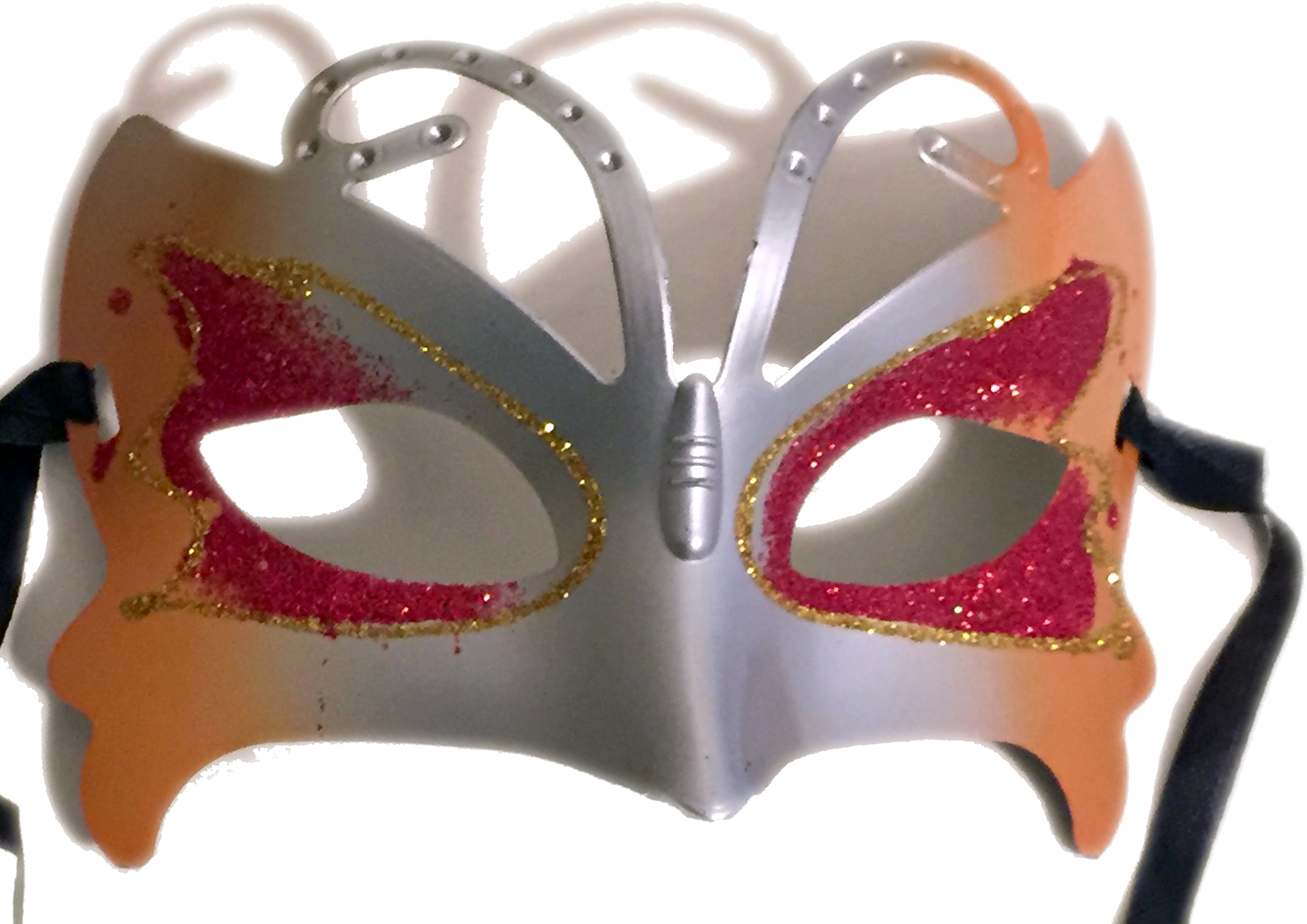
Purim mask
Jews celebrate Purim as a day of deliverance from death (and genocide). However, the rescinding of the order came too late to the walled cities, which had to fight to defend themselves (under dispensation of the king). So, the celebration of Purim as a holiday is one day later for the cities that were walled cities at the time of the story (including Jerusalem and Tiberias—this is called Shoshan Purim). The scroll ends with the recounting of Haman’s hanging and the killing of his kin, the death tolls from the battles at the walled cities, an unmasking, perhaps, of another form of genocide—in the name of defense.
The Poem
The date of the holiday itself loosely coincides with Carnival (Mardi Gras) and the Persian New Year. Jews celebrate with Purimshpiel (Yiddish for Purim stories, usually in the form of plays—traditionally, parodies and satires on current events using the story of Esther) and by donning costumes and masks, holding parties (balls), and getting drunk. Yes, the Gemara says that Jews should get drunk enough that they no longer know the difference between Haman and Mordechai, respectively, the male villain and hero of the story of Esther. Perhaps it is to make up for Eden and the whole Tree of the Knowledge of Good and Evil thing. This poem could be read as a sort of Purimshpiel variation.
The donning of masks allows us to hide who we are, but masks also reveal who we are, or an aspect of who we are that is usually hidden. Carnivalesque masquerade allows us to try on aspects of ourselves or display those energies that we normally repress or hide (perhaps in a closet somewhere, with the costume). Drunkenness allows forgetting, but also disinhibition and release. Perhaps we learn of the capacity of good and evil within ourselves, as well as about those other parts of ourselves that would otherwise be “masked” by everyday existence.
So, the poem has Hadassah, the Jewish girl, wearing the mask of her alter ego from the story, Queen Esther. Yet perhaps this is an aspect of her all along? Perhaps we all have hidden “royal” qualities? Esther replaced Vashti, who was banished by King Ahashuerus for refusing to dance (naked) before him and the court. And Queen Vashti, in the poem, wears the mask of the king. He banished her from the court, but to where? Did she stand up for her own self-respect by refusing to succumb to what, centuries later, a feminist film critic would identify as scopophilia, or the male gaze? Was her banishment a freedom? How does gender play through this story, that seems to focus on men, but relies on a woman at its center, perhaps two women, if we look more closely at Vashti?
The poem suggests in its own center that masks unveil as we peel them, but also there is the hint that they reveal at each layer (like the layers of rubble beneath old cities that mound into tels, which hint at the history of the eras of the city; and like the layers of both geology and religion, which are ancient with something hot and molten at the core, like our own psychological being). This move to the psychological enters the mystical, with the masked women, who appear to be King Ahashuerus and Queen Esther now that they wear their masks, dancing together (yet at separate balls, one in Beverly Hills, its own masquerade and center of Hollywood glitz and glamor, and the other in Tel Aviv, the “new city” of EretzIsrael). This is like the Malkhut and Shekhina, or Shabbat (King, or male aspect of G-d) and Bride ( Queen, or feminine aspect of G-d).
Arithmetic
And then comes the poem’s mysterious end, which references Exodus 14:19-21 the three lines of Torah that, with 72 letters each, Kabbalists believe can be permuted into the 72 Names of G-d. The poem suggests that these Names are both masked and masks (that hide or reveal?)—their hiddenness echoes the hiddenness of G-d in the text of Esther, and the ineffability of divinity in all of its guises.
Purim mask
The stanzas follow a sequence of line numbers each, counting the first line (which wears the mask of the title). The pattern goes (before the title, think of 0): 0 lines (an extra line break marked with … before the sections that follow after the first one), 1 line, 1 line, 2 lines, 3 lines, 5 lines, 8 lines. This pattern repeats three times (for a total of 60 lines), then goes 0, 1, 1, 2, 3, 5, for a total of 72 lines, like that number of Hidden Names.
The sequence of numbers used (0, 1, 1, 2, 3, 5, 8) is the first part of an infinite series, known as the Fibonacci sequence, that has many interesting relationships in math and nature, including the pattern of sunflower seeds in their flower, unfurling fern heads, and, significant to Jewish mystical allusions, the branching of trees.
The Hebrew word for life, chai, has the numerical value of 18. Twice chai, or double life, is 36. Double that, and…72. That the number of lines in the poem equals 72 probably doesn’t mean much more than that our lives are not singular, but layered.
Purim and the Masks We Wear by Ari Kahn — a commentary that, while coming from a very different perspective, has some interesting background from traditional Midrash.
This is a lightly edited version of :
Dickel, M. (2013). Drash Meets Mosh: Purim: A Fibonacci Sequence? (Column). Drash Pit . February. Online. Original url: drashpit.com/Main/Drash_Meet_Mosh.htm (no longer active). Archived.
People say pick one path and stick with it
and that since mistakes are bound to happen,
just make do. The grasses talk among
themselves: you’ll never get anywhere
following that line of thought. They know
it’s all the same whether you live or die,
that the right path will find you,
your shining life, and speak like a hand
gathering gravel: choose yourself first,
give up owning the future, there isn’t
anyplace far enough you can stray.
We flew along the freeway yesterday under
a cold coastal expanse of cerulean ceiling.
It reminded me of you and how we dusted
the vaults of our minds to rid them of fear
and the old lexicons of grief and guilt, the
whalebone girdles of unfounded faith and
common conventions, saccharine and sticky.
I thought of that one sea-green day we spent
under just such a sky in a land far away and
how we changed your name then, reframed
your story to tell of hope and not despair.
You sketched flowers blossoming in the dust
of a spring that promised but never delivered.
Now we don’t speak of men but of cats with
their custom of keeping heart and claws intact.
We tell ourselves stories in rhythms that resound
in deep sleep. Soon now the ancient calls to
feral festivals will still and the time’s arrived when
our only play is in the margins, fate hanging
from our skeletons like Spanish moss on old oak.
It pleases me that life’s passage spins into poemed reliquary and
a memory of the pink peau de soie I wore to your prom that June.
It is a pig poor village of elders
and children, forgotten by Tokyo,
its earners gone elsewhere.
But the schoolchildren began it,
a fun project of planting two tone
patterns of rice to learn the old
skills of working the paddy field.
The village committee cogitated.
Diversify … tourism … their superiors
had instructed; they had debts, ailing
rice fields, time and nothing to lose.
Meticulously they planned, staked,
mirrored their sacred mountain in rice –
the whole village came out. The idea grew.
More intricate patterns, more seasonal
helpers, computer generated designs.
And now thousands upon
thousands of rice plants
push their leaves skywards
through spring into summer
to sway gently in swathes of
rich burgundy, vibrant yellow-white
and all the shades of green through
‘hint of’ to emerald to deep ivy.
A Sengoku warrior gallops hectares
with panache, cartoon characters
exaggerate themselves, even
Napoleon and the Mona Lisa get
a look in; and always the snow-capped
mountain which has played god to
the village since time began, since
the first planting of life-giving rice.
The visitors come in their thousands;
their cars block the highways, they squeeze
through narrow streets, climb observation
towers to exclaim in wonder, spend little
and leave. The harvesters pull up two
thousand years of belonging in handfuls
from the soil. Inakadate will not let go.
More planning begins; the mountain looks on.
Science, the scientific method, and related modes of logic and thought are wondrous tools. Like any tool, they are beneficial when applied wisely, and they are detrimental when applied unwisely. The ‘If’ and ‘When’ and ‘How’ and the results of their applications to culture, religion and politics are so varied and storied and possibly ambiguous that I decided not to write an essay for my submission this time. There is just too much to discuss. So, although I am the least of all the poets here, I put my thoughts into a poem.
Ages of Thought,
whether Dark or Enlightened,
attempt to encompass the world.
Is it magic and mystical,
hypothetical, physical?
Can our rigorous study
render clear from the muddy?
Will our critical thinking
keep the spaceship from sinking?
Systematic inventions,
clever social intentions —
are they matters of preference,
coercion or deference?
Does “control and predict”
do us good, or constrict?
Can brain work help to consecrate
Humility and celebrate
such Human traits
as Wonder? Appreciation?
Morality? Cooperation?
When bullet points kill conversation,
and no one takes your word,
Do you trust experience, experiment,
story or definition —
And whose?
How far can poets go, then,
down into ‘icle physics?
To discover parts of subatomic mass,
so small it is beyond minute
and, in just a second, what happens is
really unbelievable, beyond imagination.
Protons collide with protons
and create a random mess
of particles, so mini and invisible,
that they cannot find them all!
There’s one they really had to find:
and in ten years, they found top quark.
So small he was that he could not be seen
or heard or measured, but they did…
They did, the clever buggers, they did!
I can see and hear and feel him
stirring in his grave; Albert is excited
at the very thought of contemplating
the distinct possibility that space-time,
(that is the space-time he invented)
could actually be outside the universe
or is that what he meant by relativity?
Is it perhaps, therefore inside itself?
Who will win the race to tell?
We know they’ll find a smaller particle
[they say they know of one already] that’s
smaller than top quark, so small it cannot be,
it couldn’t even exist, until another brain
turned it round and called it by
a human name; Higgs-Boson is…
Well, he is like a wanted criminal
only, so romantic, all the greatest
physicists and philosophers of the world
want a piece of him, or her.
They have a huge accelerator,
deep under mountains, under ground,
where no harm can come to us.
They justify the billions by saying
that the quest is so enjoyable;
so much a part of human instinct
to enquire about the boundaries,
[if they exist at all] of our perception..
..of reality, by physics and philosophy.
The journey’s worth the cost, they say,
but all the poets, they know so much more.
They know the nature of the universe
may be measured in very ‘icle parts,
so small, so infinitesimally small,
but we suspect they are beyond
description using epithets. Oh no,
they’re under the spell of mathematics!
No earthly words suffice, not there.
Even the ancient Greeks didn’t know this;
their Alpha has been squared, and will
Omega cubed and integration, calculus
return the answer they all crave?
Or will the search for ultimate smallness,
through fuzziness, get us to the end?
Is the start to finish of an expanding universe,
rather like a journey round the Circle line?
In which the poet imagines that time twists around after scientists appear to have accelerated a particle faster than light (but alas, it was a loose wire that resulted in inaccurate measurements, the particle did not exceed light speed.)
Geneva (Reuters) An international team of scientists said on Thursday they had recorded sub-atomic particles traveling faster than light—a finding that could overturn one of Einstein’s long-accepted fundamental laws of the universe. —“Particles found to break speed of light,” Robert Evans, 22 September 2011.
A particle apparently arrived slices
of a millisecond earlier than expected.
Faster than light, it knocked on the door
relatively early on a Saturday night.
The hosts had not readied the party
or sent the invitations yet, as time compressed
events into a singularity—understanding
slipped away and arrived before it left.
The single green parrot flew above the road,
its raucous call cheering the sight of the race
with time and space as a lone soldier stood guard
over the abandoned barracks of this particular dream.
A sub-atomic speeding ticket noted the date and time
of all events but perhaps its clock shifted with condensation,
a dewy drop of time dripping down the broken windshield
while the galactic waltz shifted on its axis at something
much less than the beating butterfly wing.
The whole of history would stop if we observed Shabbat
or made peace or sang a simple harmonic note,
a hidden breath of a name written by the smallest bit
of nothing as it raced to beat itself to the drummer’s distant
dance. It’s another observation point, this faster-than-light
speed, a stretching and tightening of time and space
that allows the smallest slice of a millisecond rest
before the melody continues.
—Michael Dickel
Originally appeared in: Diogen pro kultura magazin / pro culture magazine. Dec. 25, 2012. Online. And in my book Midwest / Mid-East (2012).
Each of the stanzas of this poem has the physical structure of a haiku. Though not a proper haiku (not least because there are no ‘season’ references, with the possible exception of lambs – Spring? – I don’t think so! There are no ‘Kiru’ either). Anyway, I like the way the form forces you to be pithy; there’s even less room for unnecessary words than in other poetic forms.
There is also, as you might expect, a portion of poetic licence … metaphor and allegorical reference. I have deliberately avoided punctuation until the last stanza, the punch lines, which are less equivocal. In consequence, there are different ways in which this poem can be read. According to the way in which it is read, its interpretation can change, albeit sometimes subtly. Feel free to tell me about your interpretation. Otherwise, I’m happy to allow knowledge of your personal understanding to join the many other sweet mysteries of life.
In conclusion, this poem asks questions.
Editor’s note: A version of the piece appeared earlier as a blog post.



 People say pick one path and stick with it

_-_La_Nuit_(1883).jpg "William-Adolphe_Bouguereau_(1825-1905)_-_La_Nuit_(1883)")

 The BeZine