“The apricot throws itself on the ground. It is crushed and trampled for its next life.” Yang Mija “sees” while walking through an orchard and takes notes in her poetry notebook
Poetry(2009) is Korean movie with English subtitles. It speaks quietly about life and art, devastation and redemption. Like the most refined poetry, it is nuanced, honest and dramatic without being melodramatic or manipulative. It is a spare work, whittled down to essentials. It whispers. It never shouts. Its pacing is leisurely and thoughtful. There is no suggestive music here to help you grasp the story’s progression. There are no stars who have been nipped, tucked, brushed, trussed and boosted. These people are real. They could be me or you or a next-door neighbor. The story could be anyone’s story anywhere in the world. Indeed, Director Lee Chang-dong got the basic idea for the screenplay from news reports..
“ … this story was finally born from a combination of different elements: the sexual assault case, the suicide of a girl, and the lady in her 60s writing a poem.” Lee Chang-dong in an interview HERE
Yoon Jeong-hee stars in the leading role (Yang Mija) and it is the lean script (though the movie is over two hours long) and Jeon-hee’s exquisitely understated acting that transfix us. Watch her face. Watch her body movements. These also are a kind of poetry.
“I’m quite a poet. I do like flowers and say odd things.” Yang Mija
Yang Mija is a sixty-six year-old grandmother charged with the care of a teenaged grandson, Jongwook – or Wook – whose mother is divorced and living in Busan. Wook is lazy and ungrateful and shows no respect for his grandmother or sensitivity to her age and her loneliness.
“You’re sprouting a mustache but acting like a child.” Yang Mija to Wook
Wook is part of a “gang” of male friends, fellow students, who over the course of six months repeatedly rape a young woman who subsequently drowns herself. News of this comes coincident with Yang Mija’s diagnosis of Alzheimer’s disease and her first poetry class. It is her poetry classes and effort to write a poem that provide the through-line for this story.
“The most important thing is seeing.” the poetry instructor to the class on the first day
We walk alongside Yang Mija as she struggles with these multiple challenges – not without some humor – and sorts through her emotions regarding her grandson’s actions, her sympathy for the drowned girl, and the desire of other parents to hide the boys’ culpability by buying off the drowned girl’s mother. While Yang Mija may be suffering the early stages of memory loss, she hasn’t lost her moral compass.
As she moves from one experience to the next, Yang Mija questions: How do you write a poem? Where does the poetry come from? When she decides her grandson must face the consequences of his actions, she is finally able to write her poem.
Agnes’s Song
How is it over there?
How lonely is it?
Is it still glowing red at sunset?
Are the birds still singing on
the way to the forest?
Can you receive the letter
I dared not send?
Can I convey the confession
I dared not make?
Will time pass and roses fade?
Now it is time to say goodbye,
Like the wind that lingers
And then goes, just like shadows.
To promises that never came,
To the love sealed till the end,
To the grass kissing my weary ankles,
and to the tiny footsteps following me,
It is time to say goodbye.
Now as darkness falls
will a candle be lit again?
Here I pray nobody shall cry
and for you to know
how deeply I loved you.
The long wait in the middle
of a hot summer day.
An old path resembling my father’s face.
Even the lonesome wild flower
shyly turning away.
How deeply I loved.
How my heart fluttered at
hearing your faint song.
I bless you
before crossing the black river
with my soul’s last breath.
I am beginning to dream…
A bright sunny morning again I awake,
blinded by the light and meet you
standing by me.
– Yang Mija
“It is not difficult to write a poem. It is difficult to have the heart to write a poem.” the poetry instructor on the last day of class. Yang Meja is not in attendance but has left a bouquet of flowers and her poem
Once it was crossing the unmade road to sing
to wet mouths that chewed, stare at the sway
of udders soft as babies’ heads, sniff milkiness,
glimpse emerald wings on cracked dung;
was nibbling grain from ripe heads of rye,
picking clovers, the pink and mealy white;
was thistles prickling legs, lying among feather-
head grasses that tickled as they brushed the sky;
was the night the carthorses raced round
driven by an electric storm’s purple slashes,
their madness spilling into my excitement,
drops of light next morning glistening the ground;
was climbing the Downs and letting out the fears
penned in my head; was walking a stubble field
to a blackened mill that stood defiant as it whirled
cloud and sun, roared its energy into my ears.
Now, field is the sweep below the spinney
in the park. Its glorious grasses stand unpawed
by city, smell of hay and are rarely mowed.
Here, carwhirr is muffled, collies plunge
into jungles of pungent stalks, tortoiseshells
flitter over ragwort. Ragged lines of geese
flap darkly across the setting sun’s fleece
and utter warnings that day is paling out.
Here is fade, fall and rot till willows begin
to green and signal the white surprise of spring:
blossom on blackthorn knobbles, scatters on long-
winged anemones. And where dandelions hold up
their gorgeous yellow crowns, stinging nettles
herd and cunning spiders hang their threads,
where beetles scarper, slithery worms bed,
who knows what could sprout, run wild?
I don’t mind being a spinster
Spinning, twirling, whirling, swirling in a tornado of stars conquering the galaxy
Like a Sufi
Harmonizing the sacred spiral dance to celebrate the divine in me
I can twerk too
But I will first knock on the window of your altered state of
Self-consciousness
Before intruding your geopolitical utopia with how my butt can really shake
I’d rather be a nun
And get myself thrown in jail for refusing to renounce the Dalai Lama
Than chanting the hypocritical words of the national anthem
I don’t mind being a cat-lady
For I’m used to the spoor of piss of Self-proclaimed gods marking their Territory
I’d rather you take a piss on me
Than being married off to one.
Daddy said,
This is the land of our fathers, not theirs.
Use your womb as a weapon against the Enemy
We gotta maintain our votes !
Get it on and breed as many Buddhist babies
“We five and our 25”
You must not lose to over-fertile Muslim housewives.
But daddy.
I’ve fallen in love with a Muslim man whose anarchic nipple hair grew in random directions
Jesus looking Indian who inherited a slaughter house from generation to generation.
His favourite dish is a home-cooked Persian culinary concoction
Of casserole sized pieces of lamb
Red kidney beans
And mid-eastern preserved lemons
I googled the recipe
For I don’t mind cooking it although I’m pescetarian
I could’ve been a vegetarian
But I feel less attached to sea creatures.
He doesn’t mind not eating meat when I’m around
-You know what makes this connection we have more profound?
My halal-Jesus-looking butcher is a wacky inflatable sky dancer
Whose arms flail like a winged sea cucumber in the deepest part of the ocean
He moves in erratic directions
—Just like his nipple hair
Eyebrows try to keep up
Peeks from behind a pillar somewhere with a creepy smile before he comes to get me
Let me dance with him please, daddy.
He can probably twerk too.
teach us to be kind
to the shadows
dragging behind us
the half-blind woman
stops the other half-blind woman
tells her
about those bad numbers
creeping under her door
about how they besiege
her place
and grin from the shelves
how they snigger
behind her back –
the other woman
nods sympathetically
takes bread crumbs
out of her pocket
feeds imaginary pigeons
oh God
be good
be good to recycled angels
and to homeless warriors
be good to what is left of the day
and to the darkness to come
the next step’s the liquid fall are deeper tales like a still sea whispering we are unobvious & dead ships sail to other songs
i keep the notes close & everything’s a little harder a little more tired just asking what it’s like to be human
there are places where the world seeps through where monsters gather like shells on empty beaches holes in the sky are singular response from all my voices
Perhaps I should have written a prayer note
to channel its way into a small dark niche
between ancient blocks on the Western Wall,
my kvitelach. Certainly Jehovah’s ears would
have listened to my plea, scribed in black ink.
Or maybe I should have dusted myself
with smoke from silver leaves of sage
while I tied red and blue prayer flags,
to carry my entreaty on white clouds
of smoke to Heaven and the Great Spirit.
I should have kneeled, begging Saint
Anthony for a miracle or healing from
Saint Raphael, while pink quartz beads
slid between pointing finger and thumb.
Hail Mary, full of Grace. Blessed art Thou.
No doubt, I should have fallen prostrate
on my prayer rug, face towards Mecca,
and prayed to Allah, Mighty Lord
of the Mighty Throne, heal this baby girl
distress seizes her, but you, Allah are merciful.
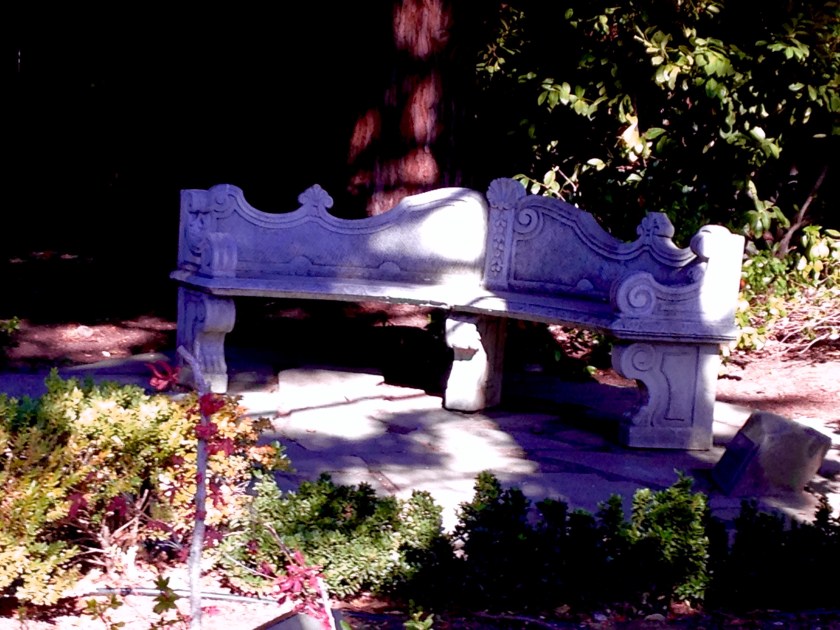
But no, I found a green-chipped bench
and sat in the park weeping, whispering prayers
for yet another orphan from Baghdad.
In the name of the Father, the Son and the
Holy Spirit…Don’t forget her pacifier…
I carefully unwrap
shells from our trip to the foot
of the once Mayan
Yucatan, place them in the sink
well. I wash sand
down the drain, white
sand we tracked back to
hotels in towns with Spanish
names—Merida, Valladolid, Playa Del Carmen—sand
that pushed between
toes in the Caribbean, now
in the hollow of steel.
Conch song rises up
to meet me inside the pink,
onto the stairs
spiraling
down into sacred
cenote—cut papaya in a bowl, marquesitas, the playas, boys
running in broken
streets with no shoes,
hammocks swinging above the dirt floor
of chanting, the rain of dreams
driving headlong into
colors. Listen! Deeper inside
the ear, deeper into
the gyre: a patch of neon
water, the nose of the Sky Snake,
a skull filled with daisies, Dia de los Muertos,
a face as thin as cracked
ice, planting seeds
from the dried gourd that holds
all the secrets of the chokol,
burning the milpa, pushing
into the day of silences, into the overlap,
time sifted finer than before it started,
well before I started, here, before I
tried to catch sand
in my hands.
rising from my heart,
bathing in my soul’s ashes,
proud of my fire…
i’m burning words with my thought,
forging new-born cries of hope…
– Liliana Negoi
I got to know Liliana Negoi a.k.a. Lily (Endless Journey and curcubee în alb şi negru), her gentle refined spirit and her intelligent and well-crafted work years ago when we collaborated on a poetry project. We still keep in touch – it must be at least five years now – and Lily agreed to join The BeZine team and is a regular contributor of poems and essays to that peace-through-the-arts forum. Here today you have an in-depth interview with this thoughtful poet and samples of her work. Enjoy!
JAMIE: How did you come to poetry and when did you start writing it?
Although I was a big fan of reading (prose and poetry), poetry began to flow from my pen rather late – by “late” I mean when I was about eighteen years old. The thing that triggered the birth of my first poem was that my philosophy teacher from my final high school form almost died Someone told us that he was in hospital, all alone, without anyone to be there for him. This idea of profound loneliness managed to touch a “sleeping layer” in my conscience. thus my first poem, Anonymous Will, was born.
Despite that first poem coming out though, I didn’t consider writing poetry in a serious manner until much later, at first because I didn’t feel that my texts were good enough, and then because people around me didn’t seem to be much interested in poetry or writing. Also, at that time I was caught up with my music studies I paid more attention to those. A couple of years later though, I discovered the Internet (yeah, I was rather late in discovering it), and via the Internet, the English poetry websites. Eighteen years ago Romanian poetry websites were less developed, and since I wasn’t frequenting literary circles, what I found online was of much help.
At first I translated some of the poems I had already written. Later I simply began to write directly in English. The rest was a matter of time; the passion for poetry was already there. And in all this time, the creations of well-known Romanian poets like Nichita Stanescu, Marin Sorescu, Ana Blandiana, Adrian Suciu, but also foreign ones, like Pablo Neruda, Walt Whitman, and lately Nikola Madzirov, were (and are) a splendid lesson to me, with regard to understanding and writing poetry.
I also write haiku and tanka, as you know, but for some reason, despite the fact that these are also poetry forms, to me they were always on a different plan than the rest. Maybe because their spirit is of a different nature, and it took me more time to “crack the nut” and understand them.
I still see myself as a beginner in many ways, when it comes to poetry, but poetry chose to come to life through (however clumsily) me. I think this is one of my biggest joys in this life.
JAMIE:You are so productive: two blogs – one in English and one in Romanian – and five books of poetry in English and one in Romanian. I believe your children are still young … and you have your love of music and gardening to feed as well. How do each of these support and feed the others?
Yeah, I guess it sounds like a lot, if you sum it up like that :). But it was (again) all a matter of time. I didn’t do all those things at once. For instance, the first one that appeared was the English blog, when I felt that I needed something else than the poetry websites (on which I spent actually quite a few years, reading, learning, understanding – the international virtual literary community is a marvelous ground, if you know how to use it). Then came up the first poetry collection, in English, and despite the fact that there were mistakes in that process which I saw later, I think the greatest thing about that printed collection is that it made me more aware of what words truly are, and how they should be treated.
The Romanian blog appeared when a very dear friend of mine told me, with a lot of disappointment, that I should also write in Romanian, not only in English (I think I forgot to tell you that, after I started to write in English, for quite a long time I wrote only in that language). So I began to write again in Romanian, and to be honest, at first I felt like a toddler who was beginning to learn how to walk :). But then I found my way again among words, and it all fell into place.
The books…well, I guess they simply followed on the way, one by one.
As for the rest – yes, my two children are only eight and seven years old, so they do require a lot of attention. All these aspects of my life, including music and everything else, are merely the pieces of a puzzle – some bigger, some smaller, but all filling up the space of my life up to the smallest crack :). And when these things can’t fill those up, I have reading, which was the first passion in my life, starting at age four. But, again, it’s not a more crowded life than others’. It just requires (as in all cases) good time management. They are all connected – children to garden, garden to music, music to writing, or in any other order you prefer :).
JAMIE:You have said that you like to write in English. What about English is so appealing? How is it different from writing in Romanian?
I started to learn English when I was five years old, in kindergarten. Back then, Ceausescu was still ruling Romania; so, to have an English teacher in kindergarten was rare. My grandmother, with a spark of genius, wanted at all costs for me to start to learn this language in private, at home, so she arranged for lessons with that teacher. There were two things that I hated about it (or more like about the way of learning it): learning vocabulary by heart and learning grammar rules :).
Later, I stared English in school in my sixth form, when I was about twelve. The problems were the same. I simply didn’t understand that what I needed and wanted was to read more in that language. I think that happened about the time when I discovered the English poetry websites. I was lucky enough to talk online to English native speakers. That simple but constant contact with this language was the thing that enabled me understand what my teachers hadn’t – the inner mechanics of the language. I think it’s the same with any language – the more you read and speak it, the faster you understand and learn it, but the main thing is to read and speak about something you are interested in, not just didactical texts.
For instance, I fell in love with Nikola Madzirov’s poetry a couple of years ago, when I bumped into it by accident, while looking for something else. I read it in English back then, from his bilingual book Remnants of Another Age, but I heard some recordings of him reading his own texts in Macedonian. I was curious to see on my own how it sounded read in that language. Now, with Macedonian, the problem is the Cyrillic language, but I was fortunate enough to know most of the Russian letters from my grandmother, so I had an easier start with that. I began reading them, always comparing my reading with the English version, and listening to the several recordings of the author, and now I’m starting to slowly understand and learn Macedonian, even if my original intention was only to “feel the taste” of Madzirov’s poetry in my mouth :).
Going back to English (I’m sorry I have such a way of “expanding” my answers, please forgive me!), I think English provided me with a fluency I didn’t expect, and, for some reason, a fluency that, at the time when I began to write in English, I hadn’t found in my own native tongue. Sure, I speak Romanian without problems, but from many points of view English had a different impact on my writin and images were easier to “paint” with English words (and it happened to me to find many images that were better worded in English than in Romanain).
I think the real issue here is the musicality of a language in certain contexts; or, better said (because all languages have their own musicality), the way in which the musicality of a language resonates to the reality stimuli surrounding us. It’s the same with music. All music is beautiful, but you don’t listen to any kind of music in any given moment of the day – all languages are musical, but you can’t capture the beauty of a moment the same way in two languages. No matter how good a translation, Basho’s haikus will never convey the same feeling as in their native tongue, simply because that language has profound connections to that form and because that form responds best to that musicality. My inner structure resonates (or at least it used to resonate) better with the way English language sounds, thus my poetry, for years, flowed much better in that language.
JAMIE:What forms of poetry do you prefer and why?
I write mostly in free verse, white rhyme, or various combinations of rhyming verse, but in time I tried newer and older forms of poetry. From these, I eventually grew much attached to sonnets (especially Shakespearean sonnets), haiku and tanka.
I also have another form, the sestina, that’s dear to me, but with that one is more like a “love-hate relationship”, so to speak. One of the people who taught me online certain things about poetry made me literally try to write several forms, and at some point he mentioned the sestina, saying that a rhyming pentameter in that form was among the most difficult things to write, so in my mind I was like “challenge accepted” :))). I wrote three such texts, the first two not so bad, but of the third one (named “panta rhei”) I’m actually very proud of. I decided that even if I am able to produce a text in this form, I am not very fond of the fact that the virtuosity is strictly connected to the way one makes use of the same six end-line words all through the poem. It’s a whirling form, maybe even maddening one – and one needs much patience and determination, and above all, a VERY good motivation to write one. I only found that motivation three times so far, maybe I will find it again, but I couldn’t say when that should happen.
Sonnets, on the other hand, were something so elegant, from my point of view; they were like a time travel at first. And as with other things, I realized that not all imagery can be “stuffed” into this form. Normally a love poem, I found that love sometimes, when put in a sonnet, feels square, just like I found out that other aspects of life, when given the form of a sonnet, gain a certain nobility.
The haiku and tanka were two forms that appealed to me first due to their minimalism and strictness of rules. I’m not talking here about the 5-7-5 haiku rule – so many great haiku poems were written without respecting that rule. I’m talking about the fact that a haiku, for instance, is merely an observation of what surrounds you, as a poet, an observation of the delicate changes in the nature around you, of the delicate balance between nature and you. Haiku is not simple, precisely because it should be simple, and we, the European and American poets, don’t know how to keep things as simple as a haiku. I love haiku because it taught me to look deeper at things, but also to see the immediate beauty of everything. It’s there. You need no metaphor to acknowledge it – the beauty of life, in its entirety.
JAMIE: You’ve accomplished so much. What are your next steps, your goals for the future?
It’s hard to have steps in poetry. My only step (in this moment) related to this is to find the best way to bring words to life. Sure, I have some book projects, but I am not as disciplined in this matter as to sit down every day and tell myself “now I’m working on this or that book”. It’s a matter of inspiration, and yes, maybe some are able to summon inspiration at will. Lately though, I find myself basking in some sort of “laziness”, let’s say. I’m more like living than writing the poetry :). I definitely won’t stop writing; I just want to understand the connection between time and poetry, between time and words.
JAMIE: What advice might you have for others who self-publish their poetry, whether it be via blogs or books or both?
I think they should write for themselves, first of all, and learn to be objective. One must realize that you begin to become a poet only after you’re willing to “trim” what you create, to understand that not all words belong to one poem, just like not all poems belong to one book.
Then comes something that someone very dear to me told me at some point: do you want to publish a book in order for it to be commercial or in order for it to be good? Because it’s highly difficult to have both things at the same time nowadays. If they write for commercial reasons…I’m afraid they will have to take advice from some other person than me :).
If they don’t write for commercial reasons, then they should first of all write with profound honesty. They shouldn’t write for others to like what they pen. They should write with the awareness that those liking their poems today might not like them tomorrow, and that what matters if first of all their personal connection to what they write.
They should write with the awareness that people liking their work now will be gone in years to come, and what they write will be seen by a different generation, with different eyes, different brains and concepts. They must decide whether they want to write something that should be valid for a while or for ever. Evanescence is beautiful to talk about but difficult to assume.
Writing something that should be valid forever is not easy. For that, you must love to read – reading forms your vocabulary, your imagination, your inspiration. You must love to see things – not just look at them, but see them, in their entirety. You must love to write. Not only on a computer keyboard, but with a pen on a piece of paper. Form a connection with the words. See them inked on paper. See the poetry of the spaces in words, not just that of their letters’ lines. You must love to talk but also to listen to people. Form connections with people. Above all, if you want to write poetry, you must be willing to live it first with all that it implies.
The Talking Rose
I was talking on an evening to a purple velvet rose
that was reigning in a glass bowl on a shelf inside my house –
I was asking it to sell me out its soul, but I suppose
what I offered was too little,
what I offered was too useless,
what I offered was too shallow,
for I thought I heard it grouse
of how priceless was the perfume which it spread inside my house.
Feeling vexed by the contempt and pride affected by the bloom
I ignored all further whisper it attempted to convey –
‘til one night, when in the thickly warm and humid summer gloom
all I heard was just the silence,
all I heard was just the darkness,
all I heard was just my breathing
vainly searching for a say
from the rose which, in the meantime, hushed its scent and passed away.
So I tenderly beheld it – purple velvet turned to brown –
as it gracefully adorned the wooden shelf within my room –
now, that all the sweet aroma had resigned the rose’s crown,
what was left was just the stillness,
what was left was just an echo,
what was left was just a shadow
of the rose that met its doom –
and I missed – oh! how I missed! – the talking fragrance of the bloom…
– Liliana Negoi
Liliana Negoi was born in 1979 in Craiova, Romania. She began to write poetry at the age of eighteen. She is the author of five collections of poetry in English (Sands and Shadows, Footsteps on the Sand – tanka collection, Cream of wordflakes, The Hidden Well and Amber Drops) and one in Romanian (aparenta curgere a lucrurilor). Texts of hers can be read both on her English blog Endless Journey and Romanian one curcubee în alb şi negru and she can also he heard reciting on SoundCloud HERE and HERE. She is also the author of a novel, Solo-Chess, available for free reading HERE. Many of her creations, both poetry and prose, have been published in various literary magazines. She is a member of the team publishing on The BeZine and established, together with Raluca Ioana Chipriade, an e-zine of Romanian art and culture named Din dragoste pentru arta.
What garden could possibly bloom
on this desiccated earth? Not lupined borders,
not lemon-throated lilies, hollyhocks, roses.
A trunk blackened by fire is standing sentry
at the gate and a gust rips into our clothes
but as we clamber past flaccid stalks
we are suddenly surrounded by flocks of trees,
gasp at ripe papayas, species of palm and guava
I didn’t know existed. Fig leaves finger us,
a banana plant offers a yellow-penis flower
but I sidle past it to a passion of red blossoms –
their fruit will be Song of Solomon’s pomegranates.
Oh think of the ruby flesh within the split globes,
those seeds Persephone couldn’t resist!
Down, slowly down the track slippery as bone
to touch cliffs with many lips trickled by water
and sit sipping from bottles in an arbour
among purple petals weightless as butterflies,
to gape at a strangely emerald pool far below,
at hills humped high into the sky, the shock
of buzzard wings – their utter stillness.
And though I’ve not yet come upon the aromatics,
sniffed dittany, pennyroyal, Ophelia’s rue,
not yet bowed to the myrtle Venus loved, descended
to the old cart by the pool, found the orange groves,
though I’ve not begun to unravel the mystery
of the charred trunks marking out the route:
four brothers’ memorial to a terrible fire
which burnt many thousands of olive trees,
some centuries old, I already know this eden,
fecund as the imagination, is the original garden –
the garden we lose however often we come upon it.
The object of the game is to regain
control of the cards you have been
dealt. The first player to express
pain is the one able to escape
payment. Players who refuse
to put their card down consciously, cannot
collect the ecstatic card. Others must “pay out”
the earned number of cards to their
opponents in slow succession, repeating
the phrase, I am one with all around me. The player who collects all
the cards first, is the winner of us all.
where trees opened the embrace
of cottage and church, the land falling
on a blanket from moor to the sea.
You bent your head to mine, white curls
brushed my brow as they had done when
I was a child, bringing comfort, confidence;
slowly you began to speak:
recalling the day of my father’s funeral:
the flight to another land, the cortege
travelling to the village where he was
laid, how people walked behind,
the ritual he requested.
Softly you said it was not the ritual for you.
You had made another life
with another who cared for you
would protect you whatever the future.
Together you’d agreed that your ashes
would blend with the roses
perfuming the air around us,
mingling with those of his first wife –
your first friend when you came to this place.
You asked whether my father would object
– curse from the grave –
“Go for it” was my answer
“if he objects or you are disturbed
he’ll send a wind to blow you over the sea”,
that marked by a bracelet of light
edging the horizon below.
I left you unaware we’d never talk again:
that your life was falling into its abyss:
that the next time I’d see you you’d be in a coffin,
that the cottage would be sold,
that the garden would be redesigned,
that the roses would be removed,
that we were saying “Goodbye”.
Clad in blue-gray woolly plaid, sensible shoes
and pressed, pristine white uniform-blouse
on the morning walk from the dorms to the convent
past the apple orchard, fruit dangling like red agate beads,
past big-eyed benign cows softly lowing,
walking briskly beyond the pen and then
into the brown wooded strip, rich in conifers,
the piney detritus crunching amiably under foot,
in the single-minded pursuit of
Sister Mary Francis, the kitchen, bread.
… we therefore beseech thee, O Lord, to be appeased, and to receive this offering of our bounden duty, as also of thy whole household …
The romance was not with bread to eat,
but with yeasts to proof, batters to mix,
and dough to knead, and rest, and grow –
that beautiful, mystical living thing you have
before the baking and dying into bread, and with
the clanking music of ovens firing up, pans crashing,
the rhythmic swish and sway of our quiet community
punctuated by the clicking of Sister’s rosary as she
monitors the students and novices at bakers’ tables.
This, the sacred work of those early hours before Mass and school
and the busy business of music lessons and art classes and
the methodical ticking of Liturgical Hours until finally Compline, sleep and
the contemplation of that final sleep and dust-to-dust.
And this being Tuesday, the day to commemorate St. John the Baptist,
and the day to bake our bread for the week to come.
…order our days in thy peace; grant that we be rescued from eternal damnation and counted within the fold of thine elect. Through Christ our Lord …
The next bake day, Thursday, dedicated to the Holy Apostles.
We work in the silence of Adoration.
In a quiet alcove
mixing flour, salt, and holy water,
then the fragile process of baking wafers on baking tongs,
silver antiques.
… which offering do thou, O God, vouchsafe in all things …
The wafers from my hand to priestly consecration, bread into body.
Enigma into doubt.
…to bless, consecrate, approve, make reasonable and acceptable that it may become for us the Body and Blood of thy most beloved Son, our Lord Jesus Christ…
Friday. The Cross and Theotokos, Mary,
mother of both God and man, Divine and human,
just a girl like me, a baker of bread.
…who the day before he suffered took bread into his holy and venerable hands, and with his eyes lifted up to heaven, unto thee, God, his almighty Father, giving thanks to thee …
Mysterious. Numinous. Inexplicable.
A lifetime ahead to figure it out.
Ecce Panis.
Take this Bread.
… he blessed, brake, and gave to his disciples saying: Take and eat ye all of this…
from the pastures and the woods, from the sky and the stream
from nature’s great cathedrals, everywhere present
... hoc est enim Corpus meum…
for this is my body
Amen.
“Where is God? Wherever you let him in.” Rabbi Menachem Mendel Morgensztern of Kotzk, Poland 1787
There were moonlit nights and many moonless nights
sober and drunken in one grain of sand
in billions of grains there were filthy hands
mud and fingernails between sunburned thighs
this is not my skin with nerves inside out
not my breast squeezed into faint whimpers
like dying swallows caught in a dry mouth
soon I’ll be a memory in last verse of songs
someone meant to write on a summer night
flesh to sand and sand to a story to tell
they’ll mention tattoos* and how I was a slave
look look how many stars in one grain of sand
in a billion grains in a billion tears
screams tangled like strings through my broken ribs
you did not know me then
before much before they tore off my clothes
and the desert night shivered with their rage
you did not see how my hair flowed like silk
on soft pillows where teenage dreams were weaved
you did not know me dressed with flowers in my hair
and my fathers arm around my adolescent frame
you did not see the stars from our wide windows
above the vineyard and my feet bare on the fertile soil
in our apricot tree’s cool summer shade
I’m in the evening news – in a pile of bones
look at the skull at the very left
see the sparrow lodged between those clenched jaws
I’m in the evening news a hundred years late
in the grains of sand shifting restless with shame
in the billion stars in your sky tonight
in my mother’s voice singing kenatzir pallas*
in the moonlit nights and the moonless nights
on a dagger’s blade in the Deir ez-Zor sand
24 April 2016 is the 101th anniversary of the Armenian Genocide, when thousands of women were dragged in the desert, raped and tortured before killed.
the reference to tattoos … they used to tattoo the women according to who owned them.
Kenatzir pallas is a lullaby very popular with Armenians and means “go to sleep my child”
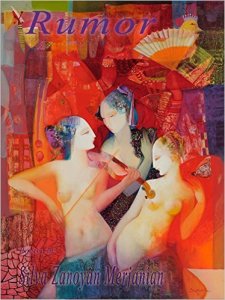
“Silva’s poetry rewards the reader with the gift of exquisite lacework, adorned with choice words and skillfully wrought poetic imagery, which allow you to get a glimpse of both the intoxicating sensuality of survival and the scalpel scars on the tender skin of life. Many-layered, it excels alike in depicting the sphere of personal experience and of traumatic social issues.” – Dr. Aprilia Zank. Lecturer for Creative Writing and Translation Theory Ludwig Maximilian University, Munich, Germany in a review of Silva’s collection Rumor, which is a Pushcart nominee. The net profits including the publisher’s go to The Armenian-Syrian Relief Fund. About $5,000 dollars have been raised to date.
[…] for you see,
you and I are like the two tips of a pair of scissors –
when we get together, the world through which we go
is entirely sheared.
but then again,
the world can remain whole
only as long as those two tips stay together –
when they’re apart they’ll shred
all that stands in their way
in order to get together again […]
I’d rewind that Wednesday
morning when Tim McVeigh
and John Doe loaded
a yellow Ryder truck
and blew 168 innocent
human beings to Kingdom Come.
Confetti of flies and flesh
floating mid sunken
concrete slabs
and jagged rebar
would swirl and swoosh
back to where it came—
Files marked A–Z
would fly back
to cabinets—melting
flesh would fuse back
to muscle and marrow
and last breaths would suck
back into living lungs
And the long-faced firefighter
would hand baby Baylee
wearing tiny yellow booties
back to the policeman
and he’d tuck her back
in the mess of rubble
And all the sticks and stones
would merge back
to American Kid’s Daycare
like they did before
Baylee and Colton and Chase
blew bye-bye kisses
to their mommies
If I were God
I’d rewind that day
all the way back to Tuesday
when Baylee blew out
one pink candle on a cake
and licked frosting from her finger
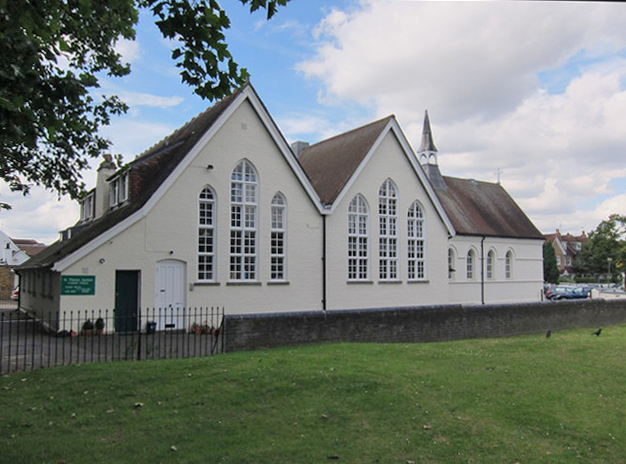
St. Thomas Aquinas Roman Catholic Church on Ham St., London
It overlooks the village pond
where cattle once drank deep,
rising white it calls to prayer
beneath a bell that summoned;
called children to the school.
Our feet trace theirs through lanes;
up the steps they climbed to class,
we kneel in pews where once desks
laid, before the sacrament.
Old walls evoke their voices
as we kneel in quiet prayer
in a village strung with kindness
in a world of haste and care.
New children raise their voices
to tell of what they’ve learnt,
not repeating tables, poems,
or letters on black slates,
but the life of Christ Our Lord.
Thomas’s image set into a niche
retells his life in wood
a humble Sicilian Dominican
who overhears our fears.
He wrote about the natural world,
look out and see our swans,
advised on debt, war and family
the cares that burned now.

 We walk alongside Yang Mija as she struggles with these multiple challenges – not without some humor – and sorts through her emotions regarding her grandson’s actions, her sympathy for the drowned girl, and the desire of other parents to hide the boys’ culpability by buying off the drowned girl’s mother. While Yang Mija may be suffering the early stages of memory loss, she hasn’t lost her moral compass.



 The BeZine