The CURRENT ISSUE PROJECT TYPE should get this as its PARENT Project Type. When the new issue is published, the new PROJECT TYPE for the issue (Vol x | Issue y | Theme gets this as the parent. The old issue gets its Volume number (Vol n) as its PARENT Project Type at publication of the new issue.
Do you suffer from the need to have a twice impeached, twice indicted, adjudicated sex abuser do your thinking for you? Are family values critical to your identity and yet you blindly follow a man who brags about grabbing women’s genitals and who had an affair with a porn star four months after his third wife gave birth to their son? Do you call yourself a Christian then tell an eleven-year-old rape victim that she must carry her baby to term? Do you chortle that you are pro-life but advocate for the death penalty and refuse to support childcare programs and school lunches for all those unwanted babies once they are grown? Are you more concerned about banning books children read about gays than banning the automatic weapons used to kill those children? Do you think that Neo-Nazi’s chanting "Jews will not replace us" are "very fine people?" Do you rail against socialism then demand that the government keep its hands off your Medicare? You may be suffering from moderate to severe Hypocrititis! Ask your doctor about OxyMoron. Thirty infusions of OxyMoron delivered anally each month should help you regain some consistency and reason. (Rubber turkey baster delivery device sold separately.) Some people using OxyMoron have developed Musicus Flatulence Perpetuum, a bewildering disorder that causes the anus to hum, “I’m a Yankee Doodle Dandy,” during prolonged political debates. Don't take OxyMoron if you are allergic to truth and facts as doing so may cause every mirror in your home to explode. Call your doctor and stop taking OxyMoron immediately if you begin to tell the truth compulsively when discretion would be best (a rare condition called Candorrhea). Your road back to consensual reality and critical thinking is waiting at the tip of your turkey baster. Ask your doctor about OxyMoron today!
…won the 2020 Field Guide Poetry Magazine Poetry Contest and placed third in the 2021 Allen Ginsberg Poetry Prize. His sixth full-length poetry collection is Pinnacles of Hope (Impspired Books, 2022). His poetry has been nominated three times for both the Best of Net Anthology and the Pushcart Prize and has appeared in Atlanta Review, The Honest Ulsterman, Ibbetson Street, The Paterson Literary Review, Impspired Magazine, Salamander Ink Magazine, and elsewhere.
In this nebula of paradoxes
Man has lost his shadow
Stupid at the crossroads of life
Faces with the dilemma in the head:
Guess which way the shadow went!

Mediocre faces in broken mirrors
They reflect the characters of hypocrites
That snatch everything they see on the ground.

A coin spins in the space of fate
While the clowns are squinting and slobbering
They eagerly await which side she will fall on.

Risk plays with short-sighted people
Until they are busy with the game of chance
They persistently search for its meaning.

This formula was not found for thousands of years
It will still be the same
And man will remain the same as he was
Waiting foolishly at the crossroads of life
With the dilemma in his head: guess
     which way his shadow went!
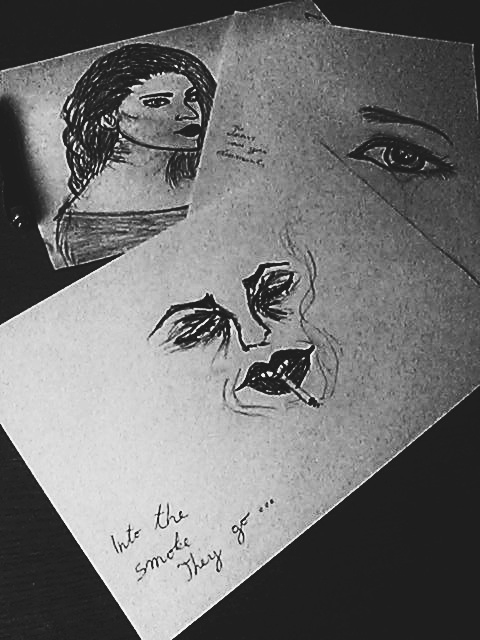
We smoke cigarettes
while walking down the street
and when we smoke them
we throw on the ground
turning them off with our feet
for a moment
suppressing thoughts.

We are not bad people
we smoke cigarettes one by one
From worries we melt into ashes,
And all this becomes our habit!

We smoke cigarettes
and we know that
Smoking kills
smoking shortens life!

and we do not worry
when we know that
Nothing is eternal
as are not these cigarettes
 which we smoke
while we are slowly being dissolved!

And we smoke cigarettes
sitting in a chair in front of a table
with glances wasted in space
we say to ourselves:
we are not bad people!

Then after we smoke them
 in ashtray we crush them
and as we turn them off,
with them we turn off the thoughts too!
…is a well-known poet from Ferizaj, Kosovo, writing in his mother-tongue, Albanian. He was born in 9 March 1968 in Pristina. He is the former manager and leader of “De Rada,” a literary association, from 2012 until 2018, and also the representative of Kosovo to the 100 TPC organization. In addition to poems, he also writes short stories, essays, literary reviews, traveltales, etc. Faruk Buzhala is an organizer and manager of many events in Ferizaj. His poems have been translated to English, Italian, Spanish, French, German, Croatian and Chinese, and are published in anthologies. .
We pick up litter in the street,
Well-meant weekend volunteers,
Students, dads with daughters, seniors,
Each bend down to fill our bag,
Bits of plastic, cigarette butts,
Styrofoam, syringes, wrappers,
What we leave from how we live.
Elsewhere others rage and riot,
Trash our lives to set us free
Like Augustus freed the Romans
Then caught them in a single will,
The end of the Republic.
So shouldn’t we be hoarding guns?
Or buying kratom, cannabis?
But spend a broiling afternoon
Bending down to weeds and asphalt
Tomorrow will be trashed again.
We can’t make out our efforts’ ends,
Can’t tell if they’re meaningless
Or the most sublime response
Life has when it looks at death.
Funny how we couldn’t guess
What now would be from way back then.
Something out of quantum physics,
A field of probability
That eventually collapses
To what turns out to be the case
But hard to know before it’s here
And hard to say when it begins.
Long ago like dominoes?
Just last week, an accident?
Or now, a slice of time so slim
It doesn’t have before or since
So how do we make plans for it?
We reach down for some cast-off trash
And find we’ve dipped our hands into
An endless stream of running water
That no one catches in a net,
All the chances, all the worlds,
Nothing solid, nothing set,
No way to know ahead of time
What we’ll get. But reach for it.
As we undress, let me bless
Your body, the familiar land.
Not Rome or Egypt, just a place
Where a man can make a life
By vineyard, orchard, yielding field
Or throw a net into the sea
Or follow flocks that slowly graze,
Where the stories of what happened
Are the bread and salt he eats
And on any well-known road
Walking he will sometimes meet
A messenger with news that he
Has been chosen for a blessing.
Gray’s patron of the nondescript,
Humdrum past-it middle age,
The ash left when romantic love
Burns out and boyfriends go their ways.
Gray’s there when illusion fades,
When weather strips the paint away
And we clearly see what’s what
With gray-eyed Athena’s gaze.
The counselor hidden by the throne,
The matter that directs our matters,
Gandalf in his early phase—
Gray has a brand of magic, too,
Trademarked style of loaves and fishes
Using ethical distinctions
Which it makes to multiply
So, we build roads that cross the swamps
Or trick opponents into mire.
It gets on well with all the colors
By letting every color lead,
Content to let them shine and glow
As children are allowed their play.
Its business is with black and white,
Those two that split the world in teams
So, everything is yes or no
And battlefields of either/or.
Gray invites them both into
Its ambiguous embrace
Where they find themselves resolved
Into endless middle ground
Where all of us find living space.
To name
the hurt was to name the Bible of her living:

the phantom scope of her trace.

Planets are for suns.
Hurts are for mild chills

who live without chapters
and procreate
yesterday's bones.

Elijah Miriam Ezekiel Sarah shine like poppies;

because
she was,
her chest felt like a stone
actually
because
she was
the dawn of
the sunset
born to
write
new chapters.
The great movie “Women Talking”
reminds me of the unseen violence
we grew up with, not so much rape and abuse
and titillation alone but that throbbing gap
between good behavior and all the aching shock
of having to be quiet in it. Oh, what we knew silently
as ourselves and, sometimes, thank the universe,
a friend found us and we would sit crouched together
tight and try to be heard as one in our words,
milking our blurred feeling into
each another’s concentrated hearing.

Women talking is what I remember
Most in the emotionally violent texture
Of a woman’s life in puberty.
How we were told to behave, to be good, to be quiet…
…grew up to protest and unions. All her life she has made peace with being on the outside and supporting people who were in trouble. Alive during the major crises of the 60s she and her writing emphathize with heroes, big moments and a fight for peace and freedom.
Grief is about a whole new trip that just keeps on
     getting older.
Grief is how it feels to have two left feet.
Grief is how it feels to be dehydrated in your arms
Grief is how it feels to be lost
in always
Grief is though how it feels
to be perpetually free.
Grief is the birth of a new beauty only you can see.
Red peonies and orange daisies on a spree
What a feast for the likes of me.
The sky was changing
The land is tilted
However, will people till  their silence to sound
To lubricate a cry of save this earth,
To give life biblical feet?

My long foot has a fleck of the august Salmon River
We Westerners as always do shine together.
My body increasingly an outcast of my loss and their anger
This body touched by a sadness which is not mine alone
How do I bring me back jocular and light struck
Can we change one
How do I help us
Emigrate  literacy here
To this moral wasteland
Once on a bright road in Pennsylvania
I wondered how one gives up
The silence of solitude all its equality,
To go in a throng your face buffered in a herd, in a sometimes huffy light.
Your mouth forever watching how to say
To find how your bells ring in the midst of multi talk,
How do you hear yourself?
How can you touch your own leaves?
Will your dreams still speak to you?
Does being we have to lose you?
…grew up to protest and unions. All her life she has made peace with being on the outside and supporting people who were in trouble. Alive during the major crises of the 60s she and her writing emphathize with heroes, big moments and a fight for peace and freedom.
Stasis, emotions gone astray
Stranded, that astral sensation from a place I once knew
Returns, penetrating, cold
I push my back to the wall, the cement feels new
What is it they say, “Fire purifies”?

What of the cold
Tearing me apart

And why should the burden of
those great mountainous forms
Above, from where I lie,
Be my responsibility?
Was this my fault, what answer do I seek?
At least a sorrow, a wail, anything
Yet, still they watch, expressionless, a poison
far stronger

The culprit, that condemns what they crave
They are that which surveys the cities
And hides the caves
They journey through crevices and claim conservation
And through these crimes that they commit
I can read their expression clearly
And it feels, stone cold
Am I
Free
The chamber around echoes
My voice
Escape
Then words

Breathe
The chains break my strength

Provoked feelings
They are here, it is them
I hear their words

They speak of my chains
I know their lies, their false promises

In the spotlight where they sing
There is darkness I have found

My shadow emanates

I have found darkness there
Where they sing in the spotlight

False promises, I know their lies
My chains speak of them

Their words, I hear
It is them, they are here

Feelings provoked

My strength breaks the chains
Breathe

Then words
Escape
My voice
Echoes around the chamber
I am Free
The cafe' was packed with agitated journalists on computers, cell phones and blackberries, on the far side was a forest of camera tripods and light stands for the TV live positions.

sitting in the
shade of an old
lime-tree
…is an Italian pedagogist, author, and poet. She began writing Japanese-style poems in 2019 and since has been published in Asahi Haikuist Network, Haiku Dialogue THF, The Japan Society UK, Drifting Sands Haibun, Cold Moon Journal, Bones Journal, Akita International Haiku Network, The Zen Space, The Wise Owl, Lothlorien Poetry Journal and sixty other international journals. Her works have been translated into Japanese, Romanian, Arabic, Malayalam, Hindi, and Spanish. Co-author of haiga and shahai with Andrea Vanacore, life partner, visionary photographer, & video-maker. Drawing and walking in nature are her passions. Her motto is “I can, I must, I will do it.”
Each life is unique and an opportunity for our Spirit to learn and make progress. This is one of the fundamental things I have learnt from my time at The Erasmus Foundation, a spiritual teaching and healing centre in Laxfield, Suffolk, in the United Kingdom. We are Spirit within a physical body, the physical including the brain, which is like the computer of the body, and the Spirit has eternal life and is our mind and contains everything about us from our very beginnings, as well as our Tapestry of Life; a framework for this particular life that we have accepted to live here on the Earth to see how we learn from the various tests and challenges, the people we meet and are close to, as well as the enjoyment and achievements that should be a part of any life. This is the balance and is all designed by what we call “The Great Mind,” a force or mind so much wiser than us with control over all life and a plan for the Universe that contains great truth, logic, and reason.
The most important value that we seem to have lost is truth. So, if we want to effect change within us and around us, I believe we need to first look at ourselves completely in truth, analyse what we find and realise what we need to do to bring about a certain balance in our structure. Because to go forward with a realisation of our purpose we need to know our strengths and our weaknesses in this particular life and put some endeavour into using the former to reduce the latter. Finding our purpose will be one of the rewards from this work and should give us motivation and energy to fuel change. This can be change for ourselves personally, for those around us, or for our world—or all three! We teach so much by our example that really a little change within can have widespread benefit. It should feel right and it should feel a comfortable path for us to take and give meaning to our daily lives. And I think it is important to realise that every single person has a purpose, otherwise we would not be here and the life would not have been designed by the Great Mind for us.
Change is part of the Natural Law which is what I believe governs the Universe we are a part of, and change is constant. If we can accept this then it might help with any fear of change that can occur at times in our life. Fear can restrict us. And often it is fear of the unknown or fear of failure that fuels this feeling. On the other hand, acceptance with understanding can free us and motivate us to use our energy wisely. If we can accept that there is a greater plan and we are part of that plan, then this could help us with any thoughts of our future, knowing that whilst we can still make some plans for the future, we can only really impact the here and now, the present, the moment in what we choose to do and how we choose to live our life. So, if we can accept that change happens, what I believe would help us is the ability to adapt; and to adapt we need to be resilient. To be resilient we need to know ourselves well in truth and have found a certain inner peace that comes with acceptance of who we are and why we are here. We can now see how the link between true self-knowledge can help us go with the flow of life and help reduce the stresses and strains that may occur at any time and within any life.
It is easy to feel overwhelmed with the imbalances and sickness of our world at this time and perhaps we sometimes try to do too much. If we touch someone in a way to help them, then that is a worthwhile accomplishment that may see that person go on to touch another and so on. We are, after all, one family and we may never know how much we teach others, but we will know that every day there is opportunity for all of us to learn.
It is important to try and keep positive, even in the harshest storm. Hope is not motivating, it feels like we have given up and there is nothing more we can do, and sometimes when it is our time to return Home perhaps that is true, we have done all we can and the last threads have fallen into place. So, rather than finding hope, perhaps we should look for the positives even on the darkest day; ask questions such as “Why is this happening? There is always a reason for everything so what can I do to help myself and others? How can I adjust my own life to go forward with the right energy and purpose?” So, of course we can change, everyone can change, the world can change; but we need that understanding of why things need to change, why things are changing, and what we can do to help. We get back to facing up to truth; about ourselves first and foremost because without a solid foundation of knowledge and understanding, without some peace inside to keep us calm and be the voice of reason, how will we play our part in a way that achieves our purpose, a purpose designed by the Great Mind with good reason.
So, this story is a long one and we are all here to play our part. We cannot take on other people’s responsibility but we might need to address our own. If we accept that change is a part of life and not something to be feared, then we can change ourselves and go forward with the flow of life in confidence and with purpose. If we also wish to help others and our world, then the best way to do this is by example, being true to ourselves and simply trying to do the best we can; and no-one could ask for more.
All of this addresses, I believe, the important and thought-provoking issues raised throughout the year in The BeZine. The answer I believe is simple, not necessarily easy and in many respects at this difficult time of great change it will be challenging and testing, but all endeavour will be worthwhile; and if our Spirit is the fuel and the engine for change then we should reach out to this gift of life that is within us all because here we will find all that we need to sustain us, to give us peace, and to enrich us spiritually.
…having attended since 1982 as a student of the The Erasmus Foundation, a spiritual teaching and healing centre in the UK, has had a number of articles published in their magazine. She has also had an article published previously in The BeZine. Julia has recently set up a website, entitled The Stranger Within, to share her writings and perhaps stimulate some thought to help people searching for answers.
to be affirmed not to be
asked to consider the odd
or confusing. through the
rigors of lessons we’ve
learned the dangers found
in any sort of displacement
of the rules of order. yet
you misidentify such
reluctance as an effort to
establish and protect peace.
which quite naturally works
to the advantage of those
wielding power. when
clothing used as measuring
point what chance art.
especially that which
reduces cost to some sort
of private joke. looking
around this morning we
find various forms of skin
revealed. from arms and
legs to shoulders clavicles.
hands to mouths feeding or
covering up. as one leaves
again soliciting and
receiving warm consensual
hugs. that reading that left
us needing to find a new
way to achieve insight.
begin with recognizing the
demand and necessity of
rereading at the least once.
never underestimate how
confusing even the clearest
writing always is. thus
being constantly left baffled.
…is a poet and retired English professor living in Missoula, MT, where he often can be found in a cafe writing in his notebook. He has books of poetry and numerous publications in print and online journals.
After my father’s death five years ago, I began examining my life in ways I never thought about before. Two years after he died, almost to a day, I had a medical emergency that put me in the hospital. This was the first time I had been hospitalized overnight. And a subsequent infection that nearly killed me and landed me back in the Emergency Room. After a few months, I went to a plant-based diet on the advice of my acupuncturist and began to feel so good that I never looked back. After a few years of eating differently and walking nearly every day, I lost so much weight and felt so good that I realized I had undergone a major transformation. I felt like a different person when I woke up in my new body every morning. But was I?
I had to remind myself that although I had lost my addictions—from both food and alcohol—and changed in the way I looked and felt, I was still the same person. For starters, I was still my father’s daughter. The stubbornness and the strength that fueled me in becoming vegan came directly from my stubborn father. After going to a healthy plant-based diet I had a consciousness shift in my thinking about all animals including humans and about lowering my carbon footprint through veganism which is connected to the future of the planet. My father ate the Standard American Diet, but he died at the age of ninety-eight, outliving all his siblings and most of his friends. I was in my late fifties when he died, and despite having created a life that worked for me, was greatly saddened by his loss. My grief was greater than I dreaded it would be. Perhaps it was because I am an only child. Maybe it is because our lives overlapped for so many years. Or it could be because my father was my last remaining parent. My mother had died decades earlier. When my father was still alive, he was my psychological barrier to mortality.
Despite the sensation of having a new lease on life, I cannot deny feeling immense sadness about the death of my father. I feel the sadness in my chest, stomach, and legs as the tension coils down to my feet. As I sit, I realize my body is tense. My toes curl toward me. I take a breath and let go, releasing the sadness that will always be with me.
After much Buddhist meditation, I have come to understand that my father lives on inside of me. This may be true, but I have had to let go of my actual father, the man whose body formed me. In a way, his death was like my death. I had to let go of a physical being, someone who had formed me and been with me so long he had become an extension of me as much as I was an extension of him. I may have been holding his arm, guiding him, and holding him up for a lot of years, but he had been guiding me for my entire life, even when I didn’t know it. The sadness of losing him will always be with me, even when my toes are not so tense they curl upwards. I sit with this sadness as I now realize it is part of me. Sometimes the awareness is stronger, other times it is just a dull reality. Even though I now realize he a part of me, this is a reality. My father is gone.
When I was younger, in my twenties and thirties, my father would kiss me goodbye after a visit and say, “Be good.” When we got into the car and it was just the two of us, my long-time partner, Barbara, used to joke, “You’re always good.”
This became a running joke with us.
But my father was sincere in those years—although at some point he stopped telling me to “Be good,” when I left.
He was watering the good seeds—an expression I often think of in Buddhism. I try to water the good seeds in myself and others. I didn’t think of it before, but this is my way of remembering my father. He was good and created good in me. I may, at times, struggle at being good—like most people, I am tempted to return negative comments—but I force myself at times to retain my equilibrium, to stay true to my goodness. At other times, maybe most, I don’t struggle with doing the right thing. Goodness just takes over. It gets me out of the chair to help even though I could just sit there and do nothing.
It is not theoretical, this feeling of my father living on inside of me. I feel him in my bones. More than ever, I remind myself of him. Often when I do my yoga practice, which I do at night, I lay on my mat in my office and stretch my legs out in a bicycle motion to strengthen my long core muscles in the center of my tall body. I remember seeing him start his day by pumping his legs, very similar exercises to what I do in my daily yoga practice. Like him, I relish the feeling of blood pumping through my body.
Since going to a plant-based diet, I feel more compassion in my body. I have long been a Buddhist but since going to a plant-based diet I feel more compassion and a new stillness inside of me. This might be because I no longer have the suffering of animals in my body from the food I’ve eaten. Maybe it is because I have the satisfying feeling of feeling full after every meal since the fiber in vegetables and fruits fills the stomach more than the unhealthy elements of the Standard American Diet. Barbara and I have gotten to know some of the animals who live at a local farm connected to an agricultural high school. Several of the cows seem to know us and are happy to see us. We have adopted two cows and they now live at a farm animal sanctuary we visited last year several years after we went vegan. The cows are an important part of our plant-based journey. So, perhaps I feel more compassion in my body because in thinking and talking about the animals, I have a purpose transcending myself.
Maybe it is the accidental weight loss accompanying being healthy which has put me more in touch with the compassion in my body. The compassion connects me to the universe and radiates love to all–toward the planet and all its beings. I feel compassion for my younger self in dealing with my father’s illness and his death. I was lucky to have had my father for as long as I did. And I was fortunate to be able to express my emotions even when I felt like a mess, when I was crying in the bathroom at the hospital, and particularly after his death. The emotions have lessened but I take a breath and realize the feeling of undeniable sadness is still there.
…Janet Mason wrote Tea Leaves, a memoir of mothers and daughters, published by Bella Books in 2012, which was chosen by the American Library Association for its 2013 Over the Rainbow List. Tea Leaves also received a Goldie Award. Her novel THEY, a biblical tale of secret genders (Adelaide Books – New York and Lisbon) was featured at the 2018 Frankfurt Book Fair. Adelaide Books also published her novel The Unicorn, The Mystery late in 2020. Her novel Loving Artemis. an endearing tale of revolution, love and marriage was published by Thorned Heart Press in August of 2022.
Aanval se me lipti thi
Jeevan ki jo dori thi
Tu khaasti (cough) rehti thi
Main roti hi rehti thi
Saanse teri phulti thi
Saanse meri chalti thi
Din beet gaye kitne
Ab yaad nahi mujhko
Main kokh se Kab Nikli
Aur dhoop me Kab baithi
Ye dhool bhari duniya
Ye kyu mujhe takti hai
Aankhe meri maa ki
Kyu aansu hi peeti hai

Kuch puchte hai Ye sab
Kya phir se hui Beti
Hai chaaro taraf khil-khil
Aage hai mere khil-khil
Piche hai mere khil-khil
Has padti hu ab main bhi
Jeevan ki jo dori hai
Mazboot woh hoti hai
Maa hi toh Sahara hai
Ye soach ke hasti hu
Rote hue kehti hu
Ab doodh pila do maa
Main roti hi rehti hu
Aur Ye na samajh paayi
Ke bojh bani hu main
Ye bhool gaye hai Sab
Iss jag ki main beti hu


Ab doodh pila do maa
Yun kokh me mat maaro
Jab-jab fasaad hota
Duniya meri lut-ti hai
Ye kaare Jahan saara
Chalta hai mere dam se
Main nasal badhati  hu
Mujhe kokh me mat maaro
Mujhe doodh pila do maa

Durga hu me ellama
Havva hu zuleqha hu
Basti hu basati hu
Mitti main mulayam hu
Sadiyo se kayi-jaan Par
Jo zulm main sehti hu
Ab Seh nahi paungi

Aawaz ka toofaan hai
Uthta hai Jo galiyo se
Ab dard ke rishto ko
Kya naam bhala doge
Tum doodh pila do maa
Tum haunsla do
Taake
Duniya ko badal daalun
I was wrapped in placenta
English
I was wrapped in placenta
Tied to the thread of life
You coughed incessantly
I cried all the time
You were gasping for breath
While I was breathing your life
How many days did pass
I do not remember now
When did I emerge from your womb
To bask in the sunlight?
Why does the world
Stare at me dusty-eyed?
Why do my mother’s eyes
Drink only her tears?

People are asking
Is it a girl again?
The world laughs around me, khil-khil
Before me, khil-khil
Behind me, khil-khil
I too laugh along with it
I bloom, I blossom
The thread of life
Is a strong one
My mother is my strength
And so I laugh
And I cry to her
Give me my milk, mother
I keep crying
I did not realise
That I was her burden
They have all forgotten
I am humanity’s daughter.

Give me my milk, mother
Do not kill me in your womb
My world is being destroyed
With the quarrels that abound
The entire world goes round
Thanks to me
I perpetuate generations of life
Don’t kill me in your womb
Give me my milk, mother

I am Durga, I am Yellamma
I am Eve, I am Zulekha
I am creation, I am the creator
I am the soft earth
Suffering since eons
I can suffer no more.


It is a storm of words
That has risen from the streets
What name can you possibly give
To relations born of pain
Give me my milk, mother
Give me courage
So that
I can change this world.
I want to drink water from a pitcher
in the room under the sun,
with the flowers,
water overflowing from the pitcher,
feeling the splash before the pitcher broke.

I want to echo the music from the radio,
to lean against the wall,
under the shed with tobacco strings
next to the garden.

I want to listen in the breath of the earth,
to believe in its eyes,
to melt into it moaning with distrust,
to get through the corn and scratch my feet
in the soil and foliage.

Let the wind rustle before going to sleep.

To look for the past in a dream,
non-existence—in the dark rooms.
To bring water from the well on the path,
the song on the path
coming down from the cloud
in blue and warm.

To bring faith from the well,
filling my breast with stars,
hands full of fireflies,
dizzy from the ground,
covered with leaves and plums,
and fragrant rotten apples,
the Earth, laden with blossom.

Where is the house?
…(Bulgaria) graduated from Plovdiv University, specialty Bulgarian philology and English language. She has published poems, stories, tales, aphorisms, essays, criticisms, translations, articles and interviews in periodical and collections. She has published the following poetry books: Nuances, 1994, God of the Senses, 2005, Pitcher, 2014, Whisper of Leaves, 2017, Green Feeling, 2018; two books of stories: An End, and Then a Beginning, 2017, Path of Love, 2018; two eBooks: Laws of Communicatons —Aphorisms, 2018, Old Things —Poetry, 2018. She is a member of the Union of the Independent Bulgarian Writers and a member of Movimiento Poetas del Mundo. She is a member and a coordinator in the team of the e-journal Ghorsowar, too. Miroslava Panayotova is an ambassador of IFCH (International Forum for Creativity and Humanity). Her verses have been translated to English, Spanish, Greek, Albanian, and Uzbek.
Evil comes to our favorite muse tree.
The spirit screeched her last catch of breath.
We rant lilt; the gulps of echos sound free.
Whop hits the crowd hard, rejecting her death.

We dance to Babalu to restore health.
But no need to speak with God's referee.
Saint Lazarus awakens healthy wealth.
As we chant, disco afro-king decrees.

In the rain, mother earth grows winds and trees.
She boosts our voices with cleansing zoom strength.
To raise ourselves on the theater marquee.
Her joint action is heavenly in length.

She trained us to research and learn success.
Afro-Caribbean elegy tree.
It would be unnatural to give repress.
Vivian Castro Mosley is God's tree.
…is a poet pursuing an MFA in Creative Writing at Mount Saint Mary’s University. He has an educational point of view that is full of historical energy. He wrote, produced, directed, and acted in his first film project, “Never Again,” in 1990 while serving a six-to-life sentence. He was only sixteen years old. He turned it into a positive experience through education thanks to the programs the Hispanic Needs Coordinator and Counselor Vivian Castro-Mosley provide at the Albany Greene Correctional Facility.
Wage peace.
Who will start?
It’s not just words
on a page, a screen,
a moment in time.

War has been declared
to claim land, resources
and the path to God.
There is no winner.
History, the story of bloodshed.
Peace comes in the doing,
heart to heart,
standing, sitting,
walking, writing.
Hold fast to the vision.
…Lisa’s poems have appeared in numerous poetry journals. She has four chapbooks, two Pushcart Prize nominations, and is an organizer for 100 Thousand Poets for Change. In 2020, she was named the first poet laureate of Sheboygan. In 2022 she published her first novel, The Lone Snake: The Story of Sofonisba Anguissola.
Grief stricken
stood outside
water buckets
watching the past
ablaze
in the
wooden chalet

futile efforts
charring
not enough
to transform
the flames
into rainbows

profound guilt
accused
of failing
to put out
flames
she had not started.
Confinement
She paced
back and forth
nervous
curious
not knowing
where to turn

unlike others
unable
to camouflage
hide from those
who claim her
as their trophy

a loud roar
subdued
forbidden
to express
so not to threaten
or intimidate

opinions
only shared
when requested
deemed acceptable
by authorities
enforcing obedience

breaking rules
led to punishment
withdrawal of benefits
infliction of

undeserving
pain
confinement to
a golden cage
protected others
from her wrath
while offering
shelter and safety

oppressed
by solitude
a fear of
shadows that
emerges with
darkness
a sliver
of light
shines through
a few
fleeting moments
to taste freedom

the white tigress
a dying breed
being rare
reduces her chance
of survival
in the wild.
Post-colonial
Don’t you see
you are mourning
a dictator
that held you captive
for so long
a language
shoved
down
your throat
while ancestral stories
were sheared
with your hair
you no longer
know
how to live
without an enemy
at your back
the promised land
offers no handouts
or fantasy futures
only the
flawed gift
of the now.
…(she/her) is a self-identifying cis-gendered Black Indigenous Person of Colour (BIPOC) woman of South Indian and Filipina descent who was raised in Nigeria and migrated to Vancouver, BC, Canada (Turtle Island). She is a peace academic and yoga practitioner whose writing explores (de)coloniality, identity and relationships that form/unform. Her work has appeared in Yellow Arrow Journal, Gypsophila, Koukash Review, Literarische Diverse, Moss Puppy Magazine, and Perilla Zine
Confined to the couch by a bad back,
I watch Israel Educational TV with my son.
There is an Arabic program on
and we slowly learn that the man
at the final fitting for a suit
("Mabrouk, Jamil!"), and the woman
showing her new dress to her best friend
("Mabrouk, Azziza!"), are getting married.
We watch the men come in to shave the groom,
the women warm the bride with dance and song,
the separate dinners with ululations
and more congratulations.  Then
the two groups bring the couple to the square.
And when Azziza and Jamil look at each other
slowly, shyly      I begin to cry.

I always cry at chasenes.
…is a poet living in Tel Aviv, professor emerita at Tel Aviv University, and chair of The Israel Association of Writers in English. She has many books of poetry in English and Hebrew and several books of literary criticism. She is also an organizer of 100 Thousand Poets for Change events in Israel.
Provided with three meals a day at fixed time, and twenty minutes outdoor in the morning half an hour in the afternoon
Washing, drying and ironing clothes, linens and towels used by strangers who thought the service was from professionals
After dinner of tasteless food before the light is put out at nine sharp we have two or three hours to ourselves
But we are too young and too hyperactive to meditate in peace Books available are quite boring for our bloody taste The fake version of Streams in the Desert is too late to save us[1] from our faltering in tender age And Catcher in the Rye that is close to our purposeless mindscape is banned
We are encouraged to write letters
to our parents who are disappointed by our misconducts
or to our siblings to apologize for the troubles we brought to them
We are advised to confess our regret and take oath
that we are new persons after being corrected
So I write and write
Unstopped
even after the light is out

Not to admit my fault
but to maintain my mind from physical confinement
to grab the last freedom I am still left with
to break away the contamination
of your political propaganda
and to engage you
Dear censorship officer
By reading tons of my writing daily
my creative and resistant thoughts
I am the one redeeming you with imaginative ideas

You are in my prison
[1]Taiwan’s long time ruler Chiang Kai-Shek had edited the Chinese version of Streams in the Desert, which became a completely different publication from the original and was recommended to the public as disciplinary material.
You Wrote Your Last Will With Fire —Taiwan, Hong Kong, China
Last Will
When the police broke into the office of your news outlet
you threw yourself into flames
It was your last will, your only freedom
of expression, manifested
after decades of
being muffled

Today you are remembered
by leaving us a society
with all kinds of
loud voices
and necessary confrontations with the government
without fear
Legacy
We are warned, again, what could come next
when publishing houses, bookstores, buildings of news media
are raided by law enforcement

We are reminded, again, what we could loss, when
publishers, book sellers and journalists
are either under the trials of
National Security violation, or
in prolonged exile
Lies
All of our protests are presented
on a blank A4 paper
with messages from
the silenced, the deceived, the wronged, the incarcerated
the misled, the distorted, the expelled
the erased, the oppressed, the executed

A blank A4 paper is our
rejection of national propaganda
our unspoken uprising

A blank A4 paper could be
as pure as the first winter snow
as sharp as a fighting knife
as quiet as a falling leaf

A slow yet deep revolution
Author’s notes
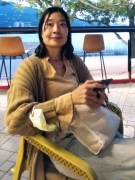
C. J. in Danshui Photo courtesy of the author
*In 1989, after decades of Martial Law rule, Cheng Nan-Jung, founder of the Freedom Era Weekly in Taiwan, set himself on fire when police were arresting him in his office. In 1992, Taiwan’s censorship of publications was finally lifted.

*After the National Security Law was imposed on Hong Kong in 2020, all the independent news outlets were shut down, and many of their reporters were expelled while others still remain imprisoned now.

*In November 2022, young people all over China reportedly launched an anti-lockdown campaign by holding a blank A4 paper as their symbol of being silenced and grounded. If authorities were to respond by arresting people simply for holding blank papers, it would make their crackdown unjustified.
…is a Taiwanese writer who has published two collections about Taiwan’s military dictatorship from 1949–1987, which was known as the White Terror: Impossible to Swallow (2017) and The Surveillance (2020). Currently she is working on her third book. Endangered Youth—to Hong Kong. Her short stories have been shortlisted for international literary awards, including the Mastermind Short Story Contest and the Art of Unity Creative Award by the International Human Rights Art Festival. She also won the Strands Lit International Flash Fiction Competition, the Invisible City Blurred Genre Literature Competition, and the Best Story of 2023 from the Story Sanctum.
 The BeZine