When traveling in Italy, we took the kids to the Florence Museum of Science, now the Museo Galileo. It housed a collection of early scientific instruments, old maps, and, of course, the history of Galileo Galilei.
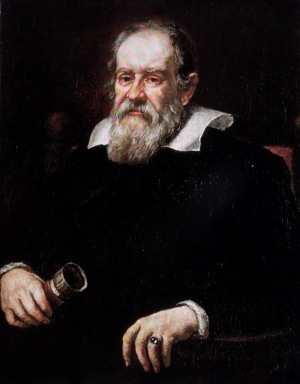
Galileo was the genius who invented, among other things, the forerunner of the thermometer and an improved military compass. He discovered The Galilean Moons of Jupiter. His theory, known as The Galilean Invariance, provided a jumping off point for two other scientific geniuses, Isaac Newton and Albert Einstein, to form their revolutionary theories regarding motion and relativity. Galileo is regarded as the father of observational astronomy, the father of modern physics, the father of the scientific method, and he even made it onto the list of the top ten people in history who changed the world. But he’s probably best known for proving the Copernican theory of heliocentricity, which states that the Earth revolves around the Sun, rather than the other way around.
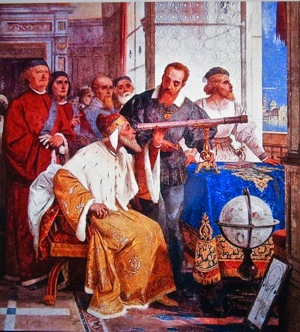
And that was his inconvenient truth.
The highlight of the Museo Galileo–at least for our kids–was the mummified finger of Galileo, resting in a fancy glass jar like a holy relic. I suppose it’s appropriate for the revered patron saint of science. Galileo was a pious Catholic and a martyr. Ironically, it was the Church that made a martyr of him for Science.

In 1633, Galileo was summoned to Rome and brought to trial by the Roman Inquisition on the charge of heresy. His crime was contradicting the Bible, which states that the Sun revolves around the Earth.
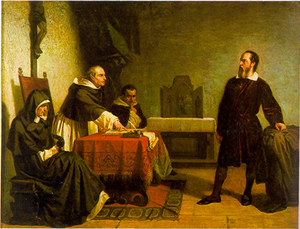
When the Inquisition threatened to extract a confession through torture, Galileo recanted, was found guilty, and sentenced to life imprisonment. His sentence was commuted, and he spent the rest of his life under house arrest. He continued to write, although the Church slapped a gag order on him, banned his books and censored his writings for another 200 years, when even the Pope could no longer hold back the tide of scientific advancement. When Galileo died in 1642, they weren’t even going to allow him a burial in consecrated ground. It was thirty years before they inscribed his name on his burial place. But in 1737, ninety-five years after his death, they brought his body out of the bad boy crypt and reburied him in a fancy marble tomb in St. Croce in Florence, across from Michelangelo’s tomb, because it was believed that Michelangelo’s spirit leapt into Galileo’s body between the former’s death and the latter’s birth. Then, in 1992, Pope John Paul II did sort of apologize for wrongfully persecuting Galileo.

The wealthy have always had a place at the table, between religion and science, as patrons, enthusiasts, or opponents, but now Big Business sits at its head. Big Business has bought and paid for a president that doesn’t believe in anything but the Almighty Dollar. The Republicans sold their souls to secure their power, dropping any pretense of morality or family values, and they bought their majority by pandering to the far right, that thirty percent of America that interprets the bible as literally they might an instruction manual to the dashboard of a new car. Science has suffered for it on both counts.
Texas is producing textbooks that not only disclaim evolution and pitch Creationism as its own brand of science, but it has cut out any reference to Climate Change. Even the conservative Fordham Institute calls it a “politicized distortion of history.” Texas is spoon-feeding its children claims that Moses was a Founding Father of America. There’s a lot of money to be made in the textbook business, and the privatization of schools, not to mention the prisons. If politics and religion, power and money are twisted into a huge tangled knot, Big Business still knows which strings to pull to get what it wants.
Civil Rights, equality, justice, education, and immigration are hot topics, but Climate Change is the new subject of denial by the Powers That Be. A few years ago I’d have said the advancement of earth science was moving at a glacial pace, but that’s not so apt an analogy any more, because glaciers are melting at an alarming rate. 98 percent of the global scientific community now recognize climate change as real and caused by human activity, but the Republican party is in complete denial. They stick their fingers in their ears and sing loudly to avoid hearing what they know is true. Again, it’s all about money. Environmental protection means restrictions, restrictions mean less profit for Big Business, and Big business gives politicians huge payoffs to deny Climate Change. This has been an ongoing struggle for more than fifty years. The damage might already be irreversible. A rapidly warming Arctic could loose a methane climate bomb resulting in widespread extinction in as little as nine years.
You may be sure that history will judge them, just as it has judged the perpetrators of the Galileo affair.

But there is one huge difference in this particular power struggle. It took 200 years for the popular tide to become too strong to resist, at which time the Church bowed to reality and accepted Galileo’s proof of a heliocentric Earth. But in the case of Climate Change, we don’t have 200 years. We don’t have ten years. We can’t wait for the next Newton or Einstein to show up, and we don’t need them to. Our climate scientists have already done the math, and it might already be too late.
And that is our inconvenient truth.
Copyright 2016 Naomi Baltuck.
Photos of Galileo courtesy of Wikipedia.
Thank you for sharing the beauty and inspiration:
 The BeZine