Apocalyptic Wind | Andrew Williams

She puzzles us. 
She births, vivifies, and heals.
She kills, purges, and wounds. 
Her stratified stirring blossoms 
Siberian squill amid demise. 
From the future, she renews the present, 
transforms the past.
She is earth-shattering renewal— 
apocalyptic wind—
Spirit—paradox. 
A Breath to Save the World
©2021 Edward Lee

Poetry ©2021 Andrew Williams
All rights reserved

Breath | Ellen Woods

five haiku

i.

up in the attic
I hammer my wild way out
sinking breath by breath

ii.

down the bannister
elephant smiles before me
blossoms in their trunks

iii.

releasing my debts
those heavy rocks I carry
freedom’s face appears

iv.

go down far enough
a foreign land emerges
original mind

v.

my thirst a mirage
at the well I need not drink
plum tree overhead

©2021 Ellen Woods
All rights reserved

Spirit’s Presence | Ellen Woods

six haiku

i.

all seeing spirit
witnesses our grief our fear
petals hold the rain

ii.

destroyer of hate
by any means required
dandelions burst

iii.

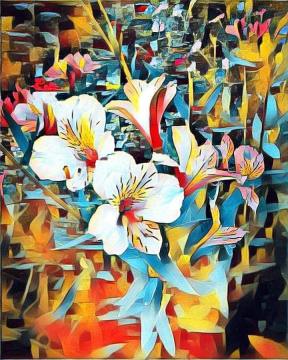
Miroslava Panayotova
Flowers
digital
©2021
lover without cause
constant everlasting grace
sun rises in east

iv.

binder of all threads
marbled fabric provides truth
fields of wildflowers

v.

provider of strength
hands feet mind heart know the way
black calla unfolds

vi.

wholeness restorer
gathering each broken shard
rivers flow to sea

©2021 Ellen Woods
All rights reserved

Life Insurance | Hildie S Block

Howard, who speaks slowly and with a “cured” stutterer’s affectation, asks me when I will die.

That’s not exactly what he says, it’s what he wishes to ask, but can’t.

“And your parents?  Did either of them die of a heart attack, stroke or cancer…before the age of 65?”

Before?  

Of those diseases? 

  “No.”  

They are dead though. They never turned 70. I don’t say this.

He asks the wrong questions.

He wants to hear good things. It means money for him. I know this. A commission. Continued employment. A life. A monthly check from us, against what we hope won’t happen.

It means “life insurance” for me. I know this. As much as it can be known.

The trick is only to answer what is asked.

I keep trying.

”Your height and weight?”

Ugh.

“Has a doctor diagnosed you with any of the following in the last 10 years?”

Wrong question again. Answer is no. Not in the last 10 years.

Keep trying, Howard.

“How much life insurance do you want?”

Long pause. Bile rises in throat. Burns. Want. Want. Not sure I want this at all.

“How much…ma’am?”

“Yes?”

“Life insurance. How big a policy?”

“How do people usually—“

“Well, you take your income.”

“My income. That’s my value. My income. Are you sure?”

“You know—if you don’t have a job, you do things that would need to be done, you know?  So you figure out how much it would cost for someone else to do that and you multiply by—“

“I multiply?”

“Ma’am?”

“Yes?”

“Yes, you take those things—you know, child care and cleaning and things that other people could do, and you multiply it—“

“I multiply it.”

My head is reeling. My heart shatters into a million trillion gazillion little pieces. My value. Multiplied by years I’m not there. My life expectancy, by my weight. My age. When my parents died.

The wrong questions.

“Ma’am—your husband has filled a lot of this out for you.”

“He has?”

“Yes.”  My wifely duties, multiplied by sitters so he can go date and replace me?

“Do you want me to go over it?”

“No. I don’t think so. “

“Okay, then, ma’am, let’s just keep going then, we are almost done.”

“We are?”

“Yes, I think so.”

“Okay.”

“So I need to set up an appointment for someone to come out and take your blood.”

“Of course.”

“And you’ll need to sign.”  

“Of course.”  Sign, in blood, the contract.

“And that will be it.”

“Right.”

“As soon as we figure out how big a policy.”

“Right.”  Pregnant pause. “That’s the trick, isn’t it?”

“Ma’am?”

“That’s the trick.”

“I’m sorry, ma’am, I don’t understand.”

“How to value someone. I mean, Howard — How much for your mom?”

“Ma’am?”

“How much?”

“What do you mean?  How much would you pay for when she isn’t there?”

“Ma’am, I’m not sure you get –“

“Really?  Isn’t that what you are asking me?  To prepay for? In case I’m not there?  Someone else?”

“Ma’am, this is just life insurance.”

“Howard, you are very young, aren’t you?”

“Ma’am?”

“Not even 25 yet, right?  Your grandparents still alive?”

“Ma’am? Do you want to talk to my supervisor?”

“No, Howard. I don’t need your supervisor.”

I take out a paper and pencil and my calendar – start putting dollar signs next to the cramped and crowded, boxes – adding it up.

My life, my parents, dead in their 60s, the things my doctors had diagnosed me with more than 10 years ago.

My hot pink calculator works the numbers, straight to “E.”

My over sharpened pencil tip breaks (NOTE: mess with the electric pencil sharpener). I take the pencil and cleave it, break it in half, cleanly in the middle. Now I have 2 pencils. That’s power.

The evening continues. Dinner, homework, kids ready for bed.

Then the husband speaks as I settle in the couch to watch the flickering images of the TV.

“Did you talk to the guy?”

“The guy?”

“From the insurance?”

“Howard? “

“I don’t know his name.”

“Yeah, I talked to him.”

“And?”

“He’s sending stuff.”

“Oh, good. Check that off.”

“I don’t want to know.”

“What?”

“The policy.”

“What?”

“I don’t want to know the size.”

“Oh, I just got –“

“I don’t want to know.”

“Okay.”

“Can you get the kids off tomorrow?”

“Yeah. Why?  What’s up?”

In my head, I hear myself say my supervisor has called a meeting. But I don’t say that out loud. It isn’t true.

“I have a thing.”

“A thing?”

“Yeah.”

“Early.”

“Okay.”

“You alright?”

“I have no idea.”

“Doctor?”

“No. Well, yeah, sort of. Has to be first thing. They said.”

“Okay.”

It was that easy. The thought in my head. The supervisor  I had to get out of the house—away from this to figure it out. I could do it. I just had to leave really really early.

And I didn’t need a pencil, or a calculator. Of this I was sure.

I didn’t even need to set an alarm. I sat straight up in bed at 3am, awake. Grabbed some favorite, ancient clothes, an old geeta burner shirt, clam diggers made of the softest cotton. I didn’t need a magic bag full of emergency kid’s supplies, band aids, tissues, restaurant toys. I needed very little.

The math.

When my parents were 20, 25 years older than I was at this very minute, they were dead.

15 years ago, doctors had told me all sorts of things were wrong with me, but 

for the last 10? I’d been fine—busy, caring for small children who insisted on growing every day.

I jumped into my car, and drove. Somehow I knew if I could change things, this day, it would matter.

New math, number of miles times speed limit over a full tank.

I drive, and I drive east. To the ocean. To Rehoboth. If I could get to the beach. If I could get to the sand and the endless, rhythmic crashing of the enormous powerful ocean onto the sand, I know it would all make sense.

I had this. At this time of day there would be no traffic. I have a meeting. I smile.

As I drive, the fear falls off. I leave it by the roadside. 

The numbers that chase each other through my head, slow.

Over the enormous suspension bay bridge, I turn on music. Beach music. Seems right. The calypso steel drums.

It is still very dark, but I can sense my heart reassembling, I can feel it.

The flat land of farms speeds by me, the music draws me east like a tractor beam.

I blink, and I can barely remember why I was going to the beach, but I blink again and pull into one of the new metered spaces on Rehoboth Avenue. Time ticks down.

I get out and walk straight for the surf. Past the bandstand. Past the Dolle’s sign. Past the beach grass. The pink light is beginning to come up over the blue grey ocean.

Toss my shoes back toward the sand and away from the sea – two gulls caw in search of Boardwalk fries.

Stand before the ocean in silence, in the space between — the meditative space.

Stare out into the sea for an answer. I face the sun as it begins to peek over the horizon.

In the next minute, the sun explodes over the ocean like a kaleidoscope of fractured color that exactly matches my newly reorganized heart – as if they were both identical mosaics of Indian mirrored sequins.

Just as suddenly as my heart shines and the sky sparkles, as if in a spasm, my arms meet overhead, my left left leg lifts.

I smile.

A pod of dolphins leaps by, joyfully billowing spray. A celebration.

The ocean pounds, so much bigger and more powerful than me. 

The pounding is my heart.

I know the answer.

I am alive.

The world is still  Beautiful. The salt air felt right and restorative. It is a place I could be in forever. A moment. Held in my heart and shooting out my fingertips.

It has been over 15 years ago—but the thing that had evened out the illnesses, time, space. Breathing. Maybe even some yoga.

Yes.

A rainbow kite flies over head. Bikes thump on the boardwalk. A lab chases a Frisbee into the surf.

My supervisor. Called a meeting. The message? Greet the day. Salute the sun.

Okay then.

Arms up, overhead, left leg slides up the right leg. I can hear the instructions clearly in my head. Audibly. Forward fold.

Plank. Grasshopper, cobra. Dog, child.

Come up.

Repeat.

Breathe.

This is

my

Life insurance.


©2021 Hildie S Block
All rights reserved

Soldiers in the Army of Mercy & Peace | Joe Kidd & Sheila Burke

We ran through the back door in the middle of the night
Didn't know what we ran for through the snow and the ice
Headed straight for the border, just to keep warm
Trying to find our mother, in the middle of the storm

We entered the city just before dawn
Singing ‘isn't it a pity,' something was wrong
Said a prayer in the corner of a room filled with mirrors
a young girl gave a warning, she said “don't interfere”
No time for hesitation, to say the least
We are soldiers in the army of mercy and peace

We fell into a circle of imaginary friends
In line for a morsel, forgiveness of sins
Looked up from the tower as the clock struck twelve
on the evening of power, St. Mary’s bells

We are gathered at the table, we stand before the throne
We kneel at the altar on the battlefield alone
We will sing this song in harmony
And our numbers will increase
We are soldiers in the army of mercy and peace

We cry when we are happy, we smile when we’re in pain
We will all march together in the pouring poison rain
We are one in a million and a million to one
Are the odds in our favor to make sure this work is done

No more weapons of destruction
No more guns designed to kill
No more rules of mass instruction that annihilate free will
We will raise our hands in freedom and our love will never cease
We are soldiers in the army of mercy and peace

We survive in a holocaust of treachery and deceit
We will fight no matter what the cost, we will not accept defeat
We are held in a higher hand, held to a higher truth
Called to be a chosen man, no matter what we do

There's a light behind this curtain, there's a voice that calls our name
There's a future that is certain, breaking free from rusted chains
Now we drink from a common well, and our prayers have been received
We are soldiers in the army of mercy and peace

Joe Kidd & Sheila Burke sing Soldiers in the Army of Mercy & Peace


©2015 Joe Kidd
All rights reserved

The Children They Will Rise | Nandi & Roman

Nandi Bushell & Roman Morello, two children, wrote and performed this. With a little help from proud others.

More information about how this came to be made.

Little Amal Goes to Wentworth Castle | John Anstie

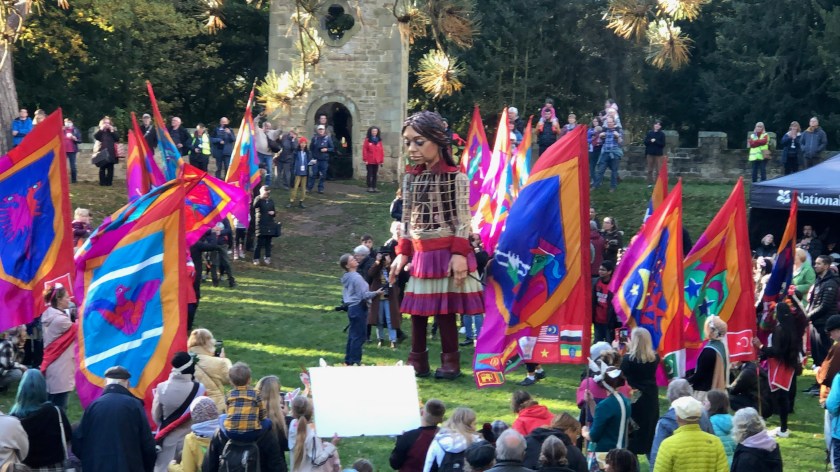
My wife and I have been volunteering at Wentworth Castle Gardens in South Yorkshire for the past ten years. On Saturday 30th October, something very special happened here. We were stewards charged with a certain amount of ‘crowd control’, in the castle folly at the top of the fifty acre gardens. It was here that Little Amal would complete her visit to the site, after her walk through the gardens. This was no ordinary day here. Wentworth Castle Gardens had been taken under the wing of the National Trust only two years before. We were very fortunate to have been selected as the penultimate destination in the UK as part of Little Amal’s long walk of 8,000 km (5,000 miles). ‘The Walk’, which became the title of the project, started at Turkey’s border with Syria and went all the way across Europe to Calais, across the English Channel to Dover, to London, Birmingham and Manchester, including several destinations in between, before completing her journey on the streets of Glasgow in Scotland during COP26, which was a last minute and very appropriate addition to Little Amal’s extraordinarily long journey.

Photo: ©2021 John Anstie

The inclusion of Wentworth Castle Gardens to the list of destinations was brought about courtesy of the lead taken by Barnsley Museums in collaboration with the Northern College and the National trust.  I was already very impressed and I dare say moved by what I had already learned of this creative and artistically brilliant but challenging project. Whilst it had become known by the rather understated title of ‘The Walk’, it was actually a logistically very challenging project involving the crossing of many international borders on route, not to mention the planning and coordinating of events at over sixty-five cities and towns along the way. The result is no less than a triumph of the human spirit over adversity. To be present and witness to Little Amal’s arrival at the castle, and to feel my own as well as to see other people’s emotional responses to this huge demonstration of art was beyond all expectations. 

This project was an enormous feat of logistical organisation as well as being an extraordinary work of theatre and art, including some astounding puppetry, the quality of which we have come to expect of the South African based Handspring Puppet Company, makers of the famous puppet in the stage production of ‘Warhorse’. The often improvised art and theatre along Little Amal’s route over a period of four months from July to November 2021, added impact. But when she arrived at the castle, the meaning of the word ‘moved’ was transformed into something of a magnitude I could not have expected. By her shear size, the way she moved, the extraordinary look and design of her face, the movement of her eyes, mouth, body, arms and hands, all controlled by the stilt walker inside and the flanking puppeteers. The effect of the whole transcended her inanimate construction. The puppet’s design and puppeteers’ abilities enabled the puppet to become truly human, a little girl, who wants to be friends with everyone she meets, whilst at the same time she longs for a reunion with her family. A little girl, who was larger than life on many levels … and three and a half metres tall.!

Photo: ©2021 John Anstie

It moved me even more to experience the reaction of the crowds of people around her, who accompanied her with quiet and very courteous respect. No real ‘crowd control’ was required. There was music and singing and moments when poetry or thanks were read to her by a child, a woman then a man, in Arabic. Even though I didn’t understand a word of what was spoken, it was still somehow very moving, hugely moving. It brings that same feeling back, here and now, as I relate this story. Towards the end of her lengthy wander about the castle, Little Amal came as close to us as she was going to get. Her head raised and the gaze from her huge brown eyes seemed to look straight at us. It felt for a moment as if she was trying to connect with us. It left us feeling neither threatened nor exposed, but just as if she was asking for help, without actually asking.  

One further gesture that proved to be perhaps the most poignant moment of all, occurred when, in the centre of the castle, she walked around the circle of the crowd around her, then stopped and stood in front of and bowed, perhaps more in hope than expectation, to offer both hands to a woman dressed in a hijab. She paused there for a moment and then I knew what this meant. One of those many moments during her long journey, always searching for her mother, her family, when she thought she’d found her … and I choked. 

Official video of the day ©2021 Barnsley Museums
The conclusion of Little Amal’s visit to Wentworth Castle Gardens. Video ©2021 John Anstie

Footnote: ’Amal’ is the Arabic word that means ‘hope’ or even ‘longing’.


©2021 John Anstie
All rights reserved

Healing Spirits | Jennifer Baker-Porazinski

The Spirit and Healing (and Healing the Spirit)

As news stories flashed around the world of sickness and death from coronavirus, a growing unease settled in.  It was stealthy at first, like an unwanted visitor. But as death tolls rose, so did my dread.  The intruder at my door became agitated, ready to break down my defenses and barrel into my home, threatening harm to me and my family.  As it turned out, my fears weren’t unwarranted. 

What began in my mind as worry, morphed into physical discomfort.  In the beginning, I convinced myself I was fine – stress was expected during a pandemic, especially among healthcare workers. But as my symptoms escalated, they became harder to ignore.  My head ached from crying (or trying not to), my jaw muscles were sore from clenching my teeth, and my chest felt like a weight had settled permanently on it.  Most of the time, I hid it pretty well. But occasionally, my sudden, uncontrollable outbursts of tears exposed me.  Early in the pandemic, I overheard my insightful husband Paul tell a friend on the phone that I was “doing okay, but mourning what was coming.” As usual, Paul knew my truth long before I did. 

I drove my middle son back to college in March 2020 to bring his stuff home. He’d left most of his belongings in his dorm room, clinging to the hope that he’d be allowed to return to campus for his last semester.  Back then, we were all still optimistic. We couldn’t fathom that his four years of hard work would culminate in us clustered around our TV, watching a virtual graduation ceremony on spotty internet.  

The mood in the car was somber as a radio reporter declared that the world was “at war with a virus.” Highway signs flashed inhospitable messages: STAY HOME.  The ferry to Long Island, normally filled with carefree vacationers crowding the small bar and sunning on the deck, was eerily empty.  The few fellow travelers on the ferry with us chose to remain in their vehicles.   In my mind, this small thing symbolized the grave situation we faced.  In a society of increasing polarization, from white supremacy to police brutality, what people truly needed was to come together. The virus had succeeded in forcing a country, already fiercely divided emotionally for political, economic and social reasons, to separate physically.  When we arrived at my son’s desolate campus on that beautiful sunny day, where students should’ve been throwing frisbees and laughing together on the lawn, we felt like characters from a dystopian novel about the end of time.

How do we breach this divide, made worse by the pandemic, when isolation is now encouraged if not enforced? Before the viral threat demanded physical separation, many were already socially isolated – cocooned in “safe” communities away from different colors, religions, or beliefs cultivates – intent on maintaining otherness.  Black men especially have been othered – unjustly vilified as violent and dangerous thugs (most egregiously evident when they stand against racism). With horror, I came to realize that while I was warning my sons not to accept rides from strangers, black parents were teaching their sons to be careful about the ever-present danger of white people (including the ones sworn to protect).  To not instill this caution would be negligent, even deadly, given the alarming mortality statistics of black youths (not to mention their disproportionate representation in prisons). 

Racism influences every facet of life from housing to healthcare, a fact made shamefully apparent during the pandemic where non-whites contracted and died from coronavirus at significantly higher rates than whites. Health outcomes are even worse for the uninsured, who are disproportionately black and Hispanic. Add to this a lack of access to nutritious foods and crowded, polluted living areas without open spaces and it is easy to understand this increased mortality. The enormous economic and social disadvantages of nonwhites in America has resulted in a sick and vulnerable population. 

Lives depend on us coming together, not separating apart.  Racism won’t go away if left unchallenged, if we remain hidden in safe, all white communities. Silence is acceptance, as clearly stated in Holocaust surviver Elie Wiesel’s 1986 Nobel Peace Prize speech. “We must always take sides. Neutrality helps the oppressor, never the victim. Silence encourages the tormentor, never the tormented.” We must always take sides. Children aren’t born with prejudice. And as they grow up, exposure to different cultures can protect them against developing it. It’s hard to hate black people if you have family members who are black. It’s hard to dislike Muslims if your best friend is one. 

Hate is taught. But love can be taught, too.

I believe change will happen when we see others as we see ourselves. I readily acknowledge this isn’t easy. In my experience with difficult patients (even those I strongly disagree with) when I truly listen to their stories I can always find some common ground. Even among the racists. Even among the misogynists. Even among pandemic-deniers spreading misinformation that has undoubtedly prolonged the pain and suffering of the pandemic. Sometimes I have to try harder to get past the rough exterior they’ve built up to hide their own anger and shame. But when I do, I always find some goodness. I’m forced to confront my own judgmental mind, and shift them out of the other category. I know I’m not unique. We all have capacity for empathy and inclusion. After all, we have so much more in common with each other than we have differences. 

In early 2020 America squandered the opportunity to make the preparations many other countries had after the pandemic was declared. Instead of a uniform plan, individual states made up their own rules, many ignoring pleas from scientists urging them to act swiftly to contain the virus.  As a result, where people lived became a crucial factor in their risk of dying – just as the color of their skin did. Mixed messages from social media and the government bred distrust and fear, further polarizing an already deeply divided country. The virus thrived in this media.

Americans wanted to believe we had a magic shield protecting us. We quickly tired of social isolation, seemingly less tolerant to the loneliness, boredom, and inconvenience of hunkering down than other countries. As the panic of the first days of the pandemic receded, we became numb to the shocking numbers – thousands of deaths every day from coronavirus. We desperately wanted to get life back to normal.  We missed friends and family. For some, this need superseded caution.  They gathered together anyway, assisting the virus in its biologically-driven impetus to flourish. 

As the weeks turned to months, grim headlines declared hospitals over capacity with escalating daily death tolls.  Freezer trucks, parked outside, served as temporary morgues.  The media reported that doctors would likely need to ration resources.  I worried about the emotional cost to health care workers forced to make impossible decisions.  As I waited with the rest of the world in morbid anticipation, I felt guilty that I wasn’t collapsing into bed at the end of each day, as my exhausted urban colleagues were. I listened in horror to stories of traumatized medical students and residents racing between patients, performing futile CPR.  Self-doubt re-surfaced:  Am I strong enough for this level of intensity?  Could I rise to the challenge if I needed to?  Did I have what it would take?  I didn’t know the answer to these questions and was awed by young people still choosing a path in medicine.  

Our fragmented healthcare system impeded the robust response the pandemic required, with deadly consequences.  Americans with medical conditions unrelated to the virus refused to seek care not only because they feared the virus, but also because they feared exorbitant medical bills at a time of financial uncertainty.  Healthcare avoidance is most apparent in black Americans who, despite being more likely to succumb to coronavirus, are twice as likely to forgo care.  The same is true for low-wage workers, who are both at high risk for viral exposure on the job and also more than twice as likely to be uninsured.  In America, uninsured people die. It is unconscionable that, in a country that excels in caring for medical emergencies,  Americans are dying at home with treatable illnesses.  Lack of access and affordability of medical care impacts everyone’s health:  When people can’t afford testing or treatment during a pandemic, the virus spreads quicker.

Paul got sick with Covid just after Christmas, held hostage for weeks as he languished in bed, groaning in pain whenever he changed positions.  Before he got sick, I’d spent nine months worried about the intruder I was certain lurked at my door.  I tried unsuccessfully to banish from my mind the horrors depicted on the news – communities ravaged, people dying alone in overcrowded hospitals.  At the time, I was sure that many of my patients wouldn’t be able to care for moderately sick relatives at home, especially if they were also sick. Caring for Paul made it painfully evident to me how a family with minimal resources might easily succumb to this virus. It became frighteningly clear how rapid it could spread among families in apartments and crowded homes, where isolation simply wasn’t possible.  I’m heartbroken thinking about people who suffered and died alone for fear of exposing other family members. 

I know I’m lucky.  I never worried I’d be fired from my job or that my family would lose health insurance. I never felt alone, thanks to the support of friends and family who waved and blew kisses through the door as they dropped off food and necessities.  I’m forever grateful to the oxygen delivery driver who braved our rural dirt road late one bitter Friday night, likely preventing Paul from hospitalization. I’m grateful for his doctor’s availability, checking in frequently by text.  But, I’m also outraged by the systemic injustice revealed by the high rates of illness and death among racial minorities and the poor.  Paul was just one sick person and, although his illness was grueling, it didn’t end in tragedy. Paul had the advantage of privilege, of skin color.  Millions of others were not so fortunate, leaving behind countless grieving loved ones.  The loss is unimaginable.

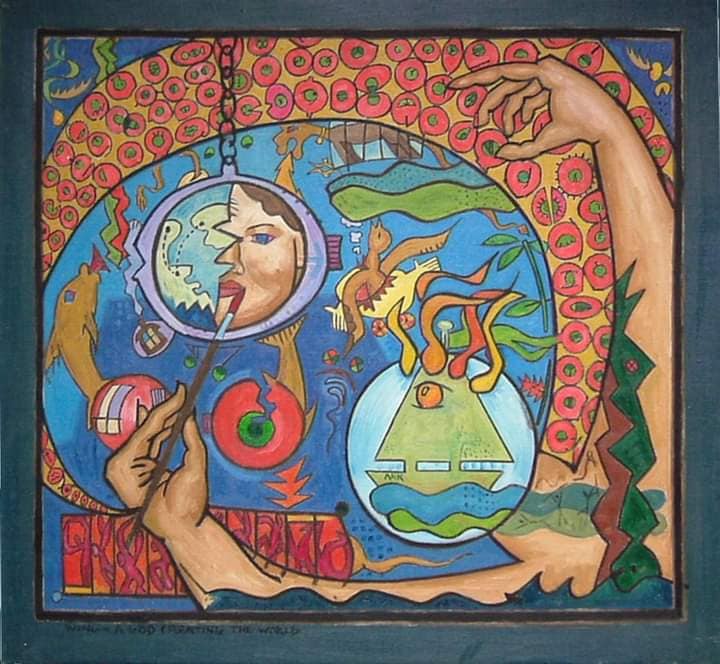
A God Creating the World
Gary Shepherd, ©2021 All Rights Reserved

Healing from the physical and emotional scars of the pandemic won’t be easy.  As a traumatized society, we must find ways to mourn our great losses together.  When raw grief loosens its painful grip over time, we remember how precious life is.   We show our gratitude to those who helped us past our heartbreak.  As medical providers care for their communities, friends and neighbors, it is impossible (if not inhumane) to force emotional separation.  Instead, the pandemic offers a rare opportunity for ordinary people to come together and act for the good of others – not only their loved ones and neighbors but for the whole country. We are all struggling.  We need each other.

Always the optimist, I look for (and find) small miracles arising in the midst of suffering.  In my role as physician, I counsel people every day on stress management and wellness – the very foundation of good health.  With no guidance from me, much of what I’d advise is actually being lived throughout America right now:  people have slowed down, simplified, and connected with their loved ones, even if only virtually.  To escape the confines of home, Americans are venturing outdoors into nature, something our distant ancestors knew intuitively was restorative and essential for good health. They are searching for (and finding) a sense of meaning.  They are fortifying the spirit, which will go a long way in maintaining health.

Almost instantaneously, the world is also more mindful. Vigilance over the virus has made everyone pay closer attention – to what they touch, to their immediate environment and to the people around them.  Neuroscience shows that mindfulness improves our health by re-wiring our brains to be less reactive and more accepting.  I expect this mindfulness will seep out into other areas of life, too.  Mindfulness fosters an appreciation of the miraculous world we live in – a planet that holds both suffering and beauty, just like each one of us.  When we look for the good and then share it with others, it provides hope – a necessary component of healing.

Advances in medicine will undoubtedly help end the suffering.  But, in addition to developing new medications to treat critically ill patients, widespread testing availability, and a broad scale vaccination program, we must have a health care system that supports prevention and provides universal care.  Our country’s early failures don’t have to define our ultimate response to the pandemic.  As we witness friends and family filing for unemployment and losing their health insurance, we can no longer deny that our tattered safety net is in urgent need of repair.  As we see the racial disparities in infection rates among our black brothers and sisters, we must be outraged that skin color is a greater risk factor for death than poor health.   We can no longer ignore the inequality rampant in our society and, even more shamefully, in our healthcare system.

When I move beyond my fear and worry, it’s hard not to be inspired. Years from now, I hope to remember this as the moment when America woke up – that in our grief we pulled together and demanded change.  I hope we commit to remodeling our failing healthcare system – that the tragedy of the pandemic serves as the final impetus to provide universal healthcare for all Americans.  To accomplish this, we will need to raise our collective voices and be heard.  We cannot remain silent.

I also hope that America finally embraces her identity as a melting pot through equality, tolerance and compassion. It isn’t too late to revive the American dream of liberty and justice for all.  In my vision of the future, the change begins locally with people reaching out to help their neighbors, as is happening all over the world right now – as happened to my own family when my husband got sick.  These acts of kindness spread with greater tenacity and speed than the virus.  As we recognize our common humanity in our neighbors (even those that look and act differently), we will no longer be able to turn away.  

In my dream of the future, I tell my grandchildren that, despite the pain and suffering of the pandemic, this was when their world truly blossomed beyond our greatest expectations to become the kinder, more beautiful place they now live in. 

Like  most Americans, I desperately wait for the end of this tragic chapter in our history.  Inspired by selfless acts of bravery and compassion, filled with anticipation and hope, I long for a chance at a new beginning – for both our sick society and for illness from coronavirus.  Our nation’s health depends on it.

Our own lives depend on it.


©2021 Jennifer Baker-Porazinski
All rights reserved

By the Grace | Gayle Bell

I was covered in potato chip crumbs, stuffing baggies while Ms. C the volunteer monitor/shelter resident at the soup kitchen barked orders to the guys milling around smoking cigarettes, washing down containers and the truck for the soup delivery. I was sitting next to a chatty com/serve girl who didn’t take one breath filling us in on her life. My newfound sista friend and I rolled our eyes and looked to the girl with compassion and mild amusement.

Every now and again the sista would take her key out her pocket and say she was afraid to lose her key. Seeing as she was in a bit of distress about it, I offered to give her one of my numerous huge keyrings on my own massive keychain full of trinkets and a handy light. She thanked me profusely and told me this was the first key that she owned in 12 years. She wasn’t gonna lose this key and a few chips missed their target while my eyes misted over at the implication. While I took a minute to take a sip of coffee and composure she took a bag of chips, water, cookies, and a Dr. Pepper, made with real sugar, girl, to take back to her home.

They are making me do 90 in 90, I’ll get my 90-day chip then.

It’s all good, said Chatty Cathy, not realizing what she missed. Me and Sis were talking about the spirit at that point, the ice being broken and the more than one makes an AA/NA meeting, experience, strength, and hope, and all that. I gave her a micro-drunk/high along and told her I have been clean and sober for 16 years. Well, asserted Cathy, I don’t believe in any of that stuff. Just what’s in front of me is what I believe.

By the time the Soupman© and volunteer sergeant agreed to take Cathy for a ride in the Soup Mobile® to make the deliveries, me and Sis breathe a quiet sigh of relief and silence. Now be careful Ms. Lady, make sure you close those bags real tight before you put them in the bucket. Don’t want the birds getting too many, they’re fat enough. Anyway, the spirit is the important thing, you don’t have to be religious to be spiritual. I wholeheartedly agreed and gave my tired old speech about the gang affiliation that I find most religions to be. The spirit is why we were both sitting on picnic benches on a beautiful spring day stuffing buckets with donated chips, gummy bears, and cereal bars along with the soup that keeps most of the homeless folks from dying that day.

I was told by one of the guys leaning on the fence that the gummy bears and bags of cookies are traded for cigarettes for the folks on the streets with kids. Sis told me that a couple of occasions she wanted to commit suicide while she was out there. I told her my attempt with a bottle of my ex-husband’s nitroglycerin pills washed down with a pint of Southern Comfort; seeing my Guardian Angel step through the wall in a bathrobe and hair curlers pissed at me because I disturbed her on her day off. By the end of my monologue, several of the guys holding up the back fence were quiet, coughing and placing nervous glances my way.

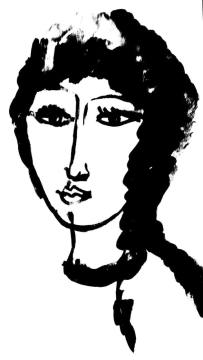
Miroslava Panayotova
Girl
drawing
©2021

My angel is 8 ft tall with a large sword, armor all over his body, when I was gang raped, he kept me from getting killed, her smile closed, a window with the shades drawn, glimpses of shadows. The men buzzed around us trying to be useful, finding cigarette butts to pick up, and offer sodas and smokes to me and her. There were water buckets to clean up, sounds of chips being crammed into baggies, soup buckets to wash.


©2021 Gayle Bell
All rights reserved

Wanted For Reckless Sandwich Buying | Gayle Bell

Walking toward my bus I see a woman dressed in 3 layers of clothing She is mumbling to 3 people who, of course pass her as if she is a brick in the wall. I look her in the eye. Spare, some change? she asks the ground in front of her. Sure, I say merrily. This is so embarrassing, looking me in the eye. I chat to her and apologize for taking too long to find my coin purse and give her my unasked-for story about being homeless once. I take her hand, put it in mine, and tip the contents of my change purse. I apologize about the pennies; pick up the ones that spill on the ground. As I’m about to wish her the best day possible, I hear at my right shoulder; Mam, do you know what you and she is doing is illegalI turn around to see this bicycle cop.

The lady shrinks inward even more. I beg your pardon, I say with as much ice calm as I can put in my voice. You see where she is standing? He says pointing to the liquor store. I haven’t had a drink in 2 days.

Mam, you don’t have to say anything to him, I say. Ms. Lady, you can have the money back, I don’t want you to get in trouble, say she. What kind of crazy magumbo world have I landed in? Ms. Lady, my only regret is I don’t have more to give you, go on ahead, he’s not going to bother you, I try to shoo her out of harm’s way, but she won’t move out of fear for me. I wheel back to him, Sir, I don’t give a damn if she wants to buy talent, drink, rock, sandwich, or some shrimp fried rice. My Lord said to give, He did not give me conditions on giving. I used to drink and drug, what has that got to do with anything?

Mam, panhandling is illegal. I could give you a ticket or have you arrested. I put both my wrists forward as if they already have cuffs on them. Here you go, do you need my id? It’s in my bra. (I’ve seen enough police beat downs to give officers fair warnings of where the id is and not just go for where it is located). Well, I’ll just give you a warning for now, just don’t do it again. As often as I can sir, as I watch the lady walk off, safe for now. When I look across the street, I see some young heads, who have apparently watched this ridiculous soap opera. I see one of the guys say to the other one while pointing at me She’s gangsta.

No, I want to tell the brotha, just trying to buy a lady a sandwich.

Kat Patton
Grandma’s Hands
drawing
©2021

©2021 Gayle Bell
All rights reserved

The Way of Life | Corinne Natalia

A life began May 14, a little before seven am—the monochrome drab of COVID lockdown scribbled over my daily routine. Cycling through unread emails, my mind slouching in the humdrum. But life wormed through my screen with prospective roommate’s message as a facade. A digital picture, bloated and blurry, with only the partial edge visible, popped onto my screen. The email reminds me now of a burrito eagerly stuffed and overflowing with beef juice and sour cream. Sloppy, but few reject a good burrito. Several scrolls down led me to her elated message:

“Okay, I’ve been trying to wait, but I’m so excited! My nephew was born this morning! Guess where I’ll be a lot of weekends!”

Automatically I congratulated her. A stingy response for the climax of a couple’s patient nine-month labors in hope. They sailed through waves of anxiety, uncertainty, and anticipation only moored in hope. They sent up prayers for their firstborn, foraged for cribs, commiserated in Lamaze classes and festered in their impatience during grandparent visits. A little boy clumping through the ceiling of an ant mound is nothing compared to the rapid scramble of first-time parents eyeing the due date. Yet, still, there is no certainty. Hospitals only gave higher success rates—not guarantees. Preparation kicks such fears aside. They welcomed someone so brand-new in a cycle so old.

But he’s just my roommate’s nephew. How could I understand the significance of such a miracle?

Thus, came Birth.


Continuing into May 15, beginning around eight forty-five morning. I shifted covers over myself and onto to my mother as we waited for the funeral to begin. The laptop blared out fuzzy light and shuddered from the sunlight tiptoeing in over our neighbor’s house through our window. The sun wanted to know who left its embrace.

Her name was Thizbe, and only a handful could attend her funeral. The rest made do with a screen.

Her father read tributes to her. Her mother choked up in remembrance. Her brother compared her to a rose.

Others remembered her love of dance, some of her care for animals, and a few her pure enjoyment of food. All held a kaleidoscope of memories. Energy laced with mindfulness cascaded down her spring-coiled hair and spiraled into her toes.

Thizbe. A name like breathing in strawberry sunbeams as thistles nuzzle your cheek.

Thizbe. Storytellers evidently dress this earth to their liking because someone draped a sullen robe of foreshadowing over such a radiant name. The Greeks stained the name in grief, but the tragedy piercingly resounded in Shakespeare.

Thizbe died at twenty-two. Gratefully, none of Ovid’s forlorn and improvident lovers reached their caressing limbs over this tale. A hidden heart condition overcame her while she jogged beside her younger brother.

No one ever diagnosed her; neither she nor her family knew. She exhausted all her strength and never recovered. Even though they flew back in time on the soonest flight they could, her parents missed her passing.

If she resided in fiction rather than flesh, an AP English student interrogating the story for symbolic meaning would rip it into the surrounding details. They would slobber over the minute connections between her sunny disposition and her heart—a twist on a Story of an Hour. Metaphysical literary analysis remains too crude a lens for inspection.

No one plastered her from their mind to a page. No strings braided in a wordsmith’s imagination and no phrases knotted into eloquent thoughts strung her up in paragraphs. No daydreamer caught her from the clouds of his petty musings and condemned her in his campfire yarns.

She lived full of contradictions and anomalies and idiosyncrasies and mediocrities through the breath of God.

Authors write for millennia but never could a character come close to the richness of any person, least of all her. If any face conviction for watering her down, turning a memory into a lowly shadow, I am guilty. But in my defense or confession, pre-mortem, I only heard her once.

She sang with her family at our church for Christ’s birth. Our interaction ended in that snug, humble sanctuary with a song. I cobbled everything else together from the testimonies of her loved ones and the impression left on me. What an impression.

She was taken too soon…too soon. For what?

For the trembling voices of her parents and the shaking hands of her brother. The question probably sears like an iron. I couldn’t help wondering, though—my logic meddling with my emotions. Leaning against mom, I, safe and breathing, snuggled on our couch as her memorial service continued.

If the Creator did not deceive, then she must have lived fully in the numbered days God lent her. However, such thoughts do not tenderly embrace an aching mother’s heart or sit quietly with a father’s anguish. Instinctively, such thoughts appear like a briar of thorns growing among rocks. Heavy and sharp. Yet, in her twenty-two years with such a vital, bursting life that she generously shared, what did she lose? Everyone dies.

In the end, poetry won. They buried her in a meadow, silently watching a lake. On her tombstone, they inscribed:  

She moved through the world like she danced- freely sharing joy, laughter, light, encouragement, faith, and love. She is radiant.

So came Death.


Ending at around three am in the morning, on May 16. Mom and I again plotted back to the living room couch and snapped our computer open. Merrier moods abounded despite sleep deprivation. My best friend’s brother met a girl. Quirks and passions matched and began to intertwine like braids of a rope. A gem and a one-question interview sealed the contract of souls, and they chose to have their hybrid wedding in the spring.

Synthesizers transcribed the sounds digitally and repeated them back to mom and me. Pairs, dusting the sanctuary of emptiness, waltzed down the aisle two-by-two into pews—not nearly so divinely inspired nor impressively crafted as an ark, but suitable for their purpose. At attention on either side, bride’s maids swathed in purple, and groomsmen resembling an uptown boy band fizzled out from consciousness as the bride wriggled side to side in ecstasy between her father and brother.

“Who gives this woman to be married?”

“We dooooooo.”

The drone came out low like cow bellows and laughter from the standing congregation resounded through the hall. Humor already echoed deep into this marriage. Music pulled everyone to their feet, and they turned their eyes to heaven—up to the screen with words scrolling down about God’s faithfulness. The monitors showed the lyrics, but the couple looked at God.

The pastor prayed, and the couple inclined their faces to one another, foreheads gently kissing. Tenderness brimmed then overflowed and leaked out our computer screen like two fountains too full, yet unable to keep from cutting off or spilling out onto everything. The couple only celebrated vague expectations of hardships or joys.

Anger, frustration, heartache, laughter, mundanity, encouragement, taxes, vacations, ministry, embraces, crashes, heights, promises, all wafted around them waiting to land a few months later. A good beginning, yet everything in between would make the difference. But of course, what are vows for?

“I take you to be my lawfully wedded wife (husband). To have and to hold from this day forward… to cherish to lead our home in Christ. To rub your feet (make you coffee), to empower (encourage) and provide (support) for you, to treasure you above all others, till death do us part according to God’s Holy ordinance, and thereto I pledge myself to you.”

Work, true work, began every moment after those words.

So came Love.


One day, will I be the same? Maybe I’ll marry; I know I will die. My faith assures me I will celebrate a wedding once I am dead. I feel guilty because I only wrote on youth. Wisdom’s quiet though. I never immersed myself in the engulfing wellspring of maturity you find from drowning in the years God’s given. But I want the same time-touched waters floating gratefully in my grandmother’s eyes and whispering in her smile. I want to know. I want to understand.

I’m not privy to that experience yet, and sometimes that’s how life goes. Mine spent three youthful days in spring—a birth before a death, a death before a marriage.

So continues life.


©2021 Corinne Natalia
All rights reserved

Omicron Action | Reed Perkins

The new COVID variant Omicron is on the way, and at this point this whole situation is as predictable as it was avoidable. As long as there are vulnerable hosts for the virus, it is going to continue to mutate. Globally, we still have two massive host populations.

The first is anti-vaxxers. This includes, as much as they sometimes object to being labeled as such, people who are refusing the vaccines on the principle of You Can’t Make Me. It’s both well within their rights and morally fucking reprehensible; I just don’t have any more time for them right now.

Stay safe. Wash your hands. Get vaccinated. Wear your mask. Wear it correctly.

The second group is composed of populations that have been ignored for vaccine distribution. These are largely colonized nations which much of the planet continues to treat as if they don’t exist. If we don’t start a strong push to get the vaccine to these populations, in the same way we successfully pushed polio and smallpox vaccine initiatives, we will never be rid of this thing because there are always going to be isolated rural populations that a new variant can spring from.

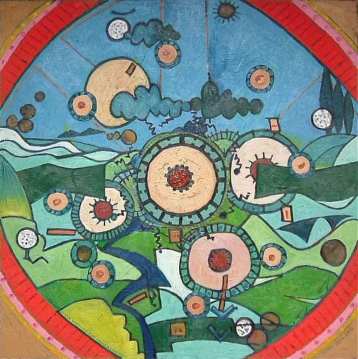
Gerry Shepherd
©2021

It is simple to place all of the blame for Omicron on Group 1, but the virus makes no distinction between the two. There is a whole group of historically sidelined people who would actually welcome the help, and we both could and should center their needs. This forces some difficult introspection though, because we can easily place the blame on members of Group 1 and their personal refusal, but the responsibility for the vaccination rate of Group 2 lies largely with our own inaction.

According to Gordon Brown, WHO Ambassador for Global Health Financing, “This inequality is simply explained: 89 percent of all vaccines have been bought by the G20, the world’s richest countries, and today they retain control of 71 percent of future deliveries. Promises from the Global North to gift vaccines to the Global South have fallen short: only 22 percent of the donations promised by America have been sent. Europe, the UK and Canada have performed considerably worse and have dispatched only 15, 10 and 5 percent respectively.”

[Ed. Note: An article in the December 19 New York Times provides another dimension of this inequity—”…only the Pfizer and Moderna shots, when reinforced by a booster, appear to have initial success at stopping infections, and these vaccines are unavailable in most of the world.” —Stephanie Nolen, “Most of the World’s Vaccines Likely Won’t Prevent Infection From Omicron]

COVID-19 needs to teach us collective responsibility and global perspective. This plague is still going on because of all of us.

You matter.

As Omicron takes over the news, you’re going to see conversations that center on Group 1. Try to find a way to bring up Group 2 as well. They’re left out of important discussions due to ignorance more frequently than out of malice, and we can correct that. You could also try to write to your Senator or Representative asking them to spend more resources on global vaccine initiatives, or if you have the resources, consider donating to groups like Doctors Without Borders or the GlobalGiving Coronavirus Relief Fund.

Stay safe. Wash your hands. Get vaccinated. Wear your mask. Wear it correctly.

You matter.


Essay ©2021 Reed Perkins
All rights reserved

Nature, The Healer | Corina Ravenscraft

The world has needed healing for a long time, but especially now, in the midst of and in the aftermath of a global pandemic. This quarter’s issue of The BeZine deals with A Life of the Spirit and Healing. How do we heal ourselves from all of the changes Covid has wrought? How do we heal the rifts, the division, the stress that the pandemic has brought to us all? If nothing else is apparent, Nature has proven to us that She has the means and ability to end us. But She can also heal us.


Japanese people have long practiced shinrin yoku, or “forest bathing”. There is even a Japanese Society for Forest Medicine. The chairman of that group, physician Qing Li, has written a book called “Forest Bathing” and he points out: “The country’s two major religions, Buddhism and Shintoism, consider forests mystical. “For Zen Buddhists, scripture is written in the landscape,” writes Li. “In Shinto, the spirits are not separate from nature, they are in it. They are in the trees, in the rocks, in the breeze, the stream, the waterfall.”

waterfalls-g4fd8da6b1_640
Image by
Wendy CORNIQUET
from Pixabay


Japanese people have long practiced shinrin yoku, or “forest bathing”. There is even a Japanese Society for Forest Medicine. The chairman of that group, physician Qing Li, has written a book called “Forest Bathing” and he points out: “The country’s two major religions, Buddhism and Shintoism, consider forests mystical. “For Zen Buddhists, scripture is written in the landscape,” writes Li. “In Shinto, the spirits are not separate from nature, they are in it. They are in the trees, in the rocks, in the breeze, the stream, the waterfall.”

forest-g0d4344c07_640
Image by Joshua Woroniecki from Pixabay


If that isn’t enough to at least pique your interest, there are dozens of articles and research papers published about the very real benefits to humans of being in and around nature. An article in Psychology Today about how the healing works in nature says, “Nature also frequently provides positive images for meditation. Just as winter turns to spring, one’s self-healing capacity can move from sickness into health. The restorative quality of nature and your own body is an important image to hold onto throughout your health and wellness journey.”

sunset-ge5e5331df_640
Image by kordula vahle from Pixabay


Consumer Reports even recommends getting outside in nature to get well! Time Magazine did a post about the healing power of nature. The University of Minnesota discussed studies about how nature impacts our well-being. Yale University focused on studies about How Immersion in Nature Benefits Your Health and asked/answered the question, “How long does it take to get a dose of nature high enough to make people say they feel healthy and have a strong sense of well-being?” The answer is: Precisely 120 minutes.

If you’re still at all skeptical, I challenge you to get outside and wander the woods, the parks, the beach…anywhere that you can “get back to the Earth” and sit quietly, just enjoying this beautiful planet on which we live. You never know…it might help you heal in more ways than you expect.


harmony-gefe0b62dd_1280

©2021 C.L.R.
All Rights Reserved