Posted in Essay, Meditation, meditative, Music, Spiritual Practice, Terri Stewart, Uncategorized

Let Your Light Shine On

Finding Light
The Light Shines On

Where is your light today? What is leading you? What is giving you hope? Joy?

“When I find myself in times of trouble, mother Mary comes to me,
speaking words of wisdom, let it be.
And in my hour of darkness she is standing right in front of me,
speaking words of wisdom, let it be.

Let it be, let it be, let it be, let it be.
Whisper words of wisdom, let it be.

And when the broken hearted people living in the world agree,
there will be an answer, let it be.
For though they may be parted there is still a chance that they will see,
there will be an answer. let it be.

Let it be, let it be, …..

And when the night is cloudy, there is still a light, that shines on me,
shine until tomorrow, let it be.
I wake up to the sound of music, mother Mary comes to me,
speaking words of wisdom, let it be.

Let it be, let it be, …..”
― Paul McCartney

A note about the light fixture:

I photographed this light at the Merchant’s Cafe in Seattle, Washington. It is the first cafe in Seattle and has seen several iterations of its business as it was built, burned down, and built again. The interesting thing is that it is in the oldest part of Seattle (of course!). It was built in a building near first avenue. The tidal flats used to flood in every day, twice a day, up to third avenue. This makes doing business quite difficult! Seattle then had businesses build their buildings at least two stories tall. Then they raised all the roads, surrounding the existing buildings with raised roads. For a while, they put ladders at the streets so people would go off of the road, down the ladder, into the businesses.

Finally, they built sidewalks that connected the streets to the second story level of the buildings. So today, in Pioneer Square, when you enter the buildings, you are, in fact, entering the second story of the buildings that were placed there. If you look down, you will notice odd glass squares in the sidewalk. Those were originally skylights so that the first story of the buildings were kind of like an inside shopping mall with a view to the sidewalk above. So even there, in the midst of a buried first floor of these buildings, the light was still able to shine!

Such a fun history!

Shalom and Amen.

Terri

© 2013, post and photos, Terri Stewart, All rights reserved, originally posted at http://www.cloakedmonk.com

terriREV. TERRI STEWART is Into the Bardo’s  Sunday chaplain, senior content editor, and site co-administrator. She comes from an eclectic background and considers herself to be grounded in contemplation and justice. She is the Director and Founder of the Youth Chaplaincy Coalition that serves youth affected by the justice system. As a graduate of Seattle University’s School of Theology and Ministry, she earned her Master’s of Divinity and a Post-Master’s Certificate in Spiritual Direction. She is a contributing author to the Abingdon Worship Annual. (The 2014 issue just released!)

Her online presence is “Cloaked Monk.” This speaks to her grounding in contemplative arts and the need to live it out in the world. The cloak is the disguise of normalcy as she advocates for justice and peace. You can find her at www.cloakedmonk.com, www.twitter.com/cloakedmonk, and www.facebook.com/cloakedmonk.  To reach her for conversation, send a note to cloakedmonk@outlook.com
Posted in Essay, Meditation, meditative, Spiritual Practice, Terri Stewart, Uncategorized

Enter the Story – An Ignatian Style Meditation

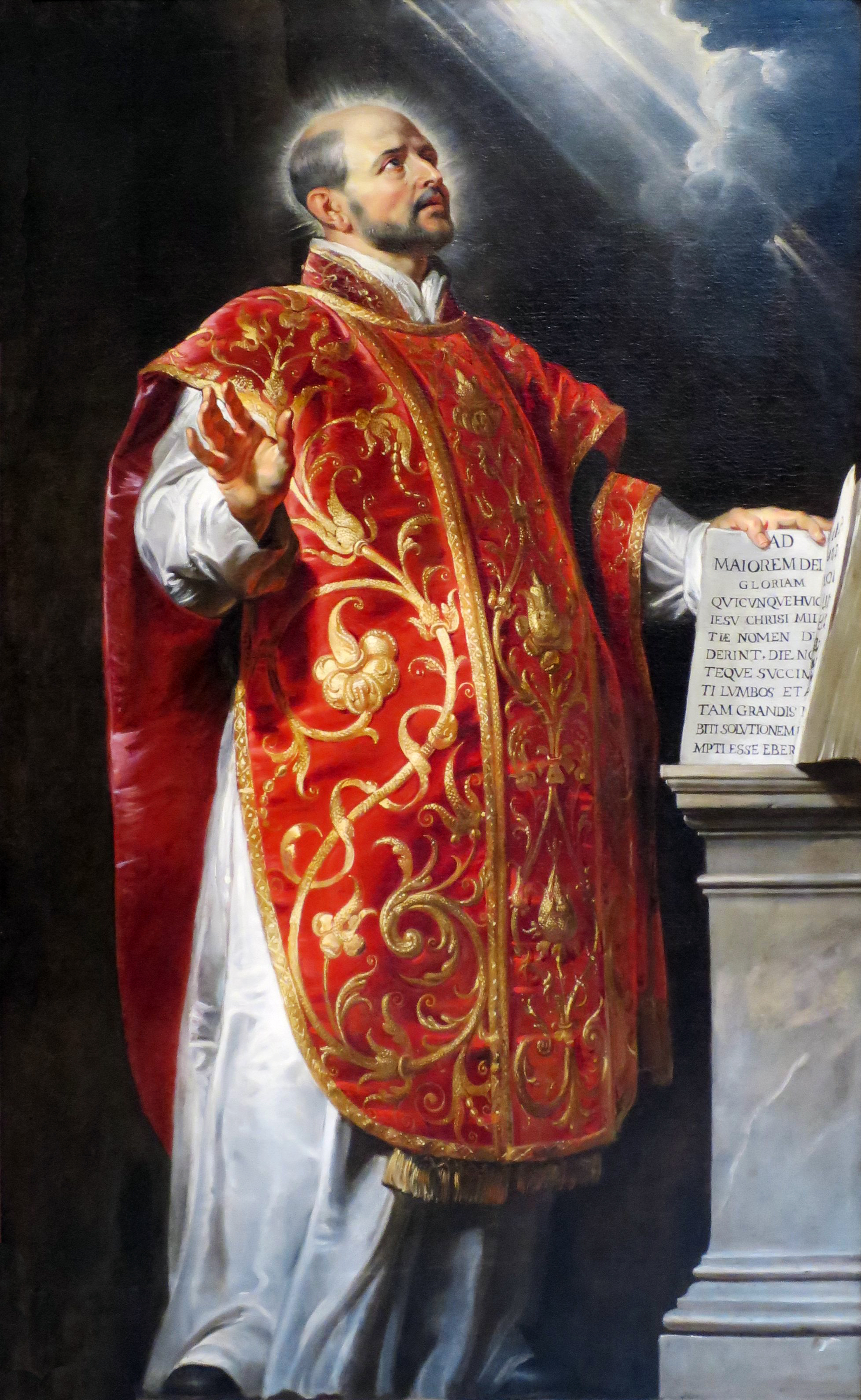
St. Ignatius of Loyola
From Wikipedia

St. Ignatius of Loyola, over time, became very concerned with spiritual practices. He developed one particular method that uses the imagination. It is sometimes called “Ignatian Contemplation.” Ignatian Contemplation uses the imagination as its center piece. In particular, using scripture and entering it using all the senses–feel the heat of the day, the dust in the road, or the smell of livestock. Enter the story in a complete way.

Today, I offer to you the story of the first king of Israel, Saul, and how he became the king. I ask you to use all your senses to enter the story. You may enter it as one of the characters or you may be a bystander. You may even be livestock! Whatever you choose, extend your reading of the story into your senses–taste, touch, smell, sight, sounds.

Take a moment and ground yourself. Sit comfortably, whatever that means for you. Take a breath in and release it.

Saul was at home, hanging out with his family and some of the donkeys escaped. Now Saul was a young, teenage boy–not viewed as a testosterone filled leader (although he is reported to be quite handsome!). Saul’s task, assigned by his family, was to go get the donkeys and return them  home!

So Saul goes on the road. He looked here and there, and the donkeys were not there. He looked over there and over here, and the donkeys were not there. Finally, the servant travelling with Saul says, “Let’s go ask the seer in town!” The seer was the prophet Samuel.

Saul travels to the seer, Samuel. Samuel tells Saul that he is destined to control the future of the Israelites. Saul says, “I’m a Benjamite, from the smallest clan! Surely not me!”

Samuel and Saul eat and then Samuel anoints Saul to become the king. Samuel then sends Saul on his way home.

Saul travels home with Samuel’s instructions. He travels home and even encounters other prophets on the road, goes into a prophetic frenzy with them, and continues towards home.

Upon his arrival home, his uncle asks, “Where have you been?!”

Saul said, “Well, we couldn’t find the donkeys, so we visited Samuel.” Saul says nothing of the anointing by Samuel, the prophetic frenzy on the side of the road, or of being made king! Nothing!

Then, Samuel comes to seek Saul out. Samuel gathers all the tribes together to “determine who will be king.” Samuel “casts lots.” (Throws dice!) Among the gathered tribes, he throws his dice, and Lo! The Tribe of Benjamin is chosen. Among the families in the tribe of Benjamin, he throws his dice, and Lo! The family of Matri was chosen. Among the people in the family of Matri, Samuel throws his dice, and Lo! Saul is chosen king.

But Saul is not there! They go to find him and he is hiding in the supply closet. Then Saul becomes the king.

What questions did that raise for you? Where were you in the story? Who were you? What will you become?

Shalom & Amen,

Terri

© 2013, post, Terri Stewart, All rights reserved

terriREV. TERRI STEWART is Into the Bardo’s  Sunday chaplain, senior content editor, and site co-administrator. She comes from an eclectic background and considers herself to be grounded in contemplation and justice. She is the Director and Founder of the Youth Chaplaincy Coalition that serves youth affected by the justice system. As a graduate of Seattle University’s School of Theology and Ministry, she earned her Master’s of Divinity and a Post-Master’s Certificate in Spiritual Direction. She is a contributing author to the Abingdon Worship Annual. (The 2014 issue just released!)

Her online presence is “Cloaked Monk.” This speaks to her grounding in contemplative arts and the need to live it out in the world. The cloak is the disguise of normalcy as she advocates for justice and peace. You can find her at www.cloakedmonk.com, www.twitter.com/cloakedmonk, and www.facebook.com/cloakedmonk.  To reach her for conversation, send a note to cloakedmonk@outlook.com

Posted in Essay, Meditation, meditative, Music, Spiritual Practice, Terri Stewart, Uncategorized

Desire and Intention

Today, I want to try a very simple meditation / body prayer. It involves movement of the arms, breathing, intention, and if you choose, your particular word for the divine or that which transcends.

Take a moment for contemplation. Turn your eyes inward and find two desires.

“You are what your deepest desire is.
As your desire is, so is your intention.
As your intention is, so is your will.
As your will is, so is your deed.
As your deed is, so is your destiny.”
~ Upanishads

First-your desire for yourself. This wish could be for love, for kindness, for healing. What you feel you need at this moment.

Second-your wish for the world.  This wish could be peace, love, kindness. What you feel is your unique gift of intention for the world. All that is present in the cosmos.

“He has told you, O mortal, what is good;
and what does the Lord require of you
but to do justice, and to love kindness,
and to walk humbly with your God?”
~ Micah

These desires will be your intentions.

As always, do this as you are able.

Sit comfortably however you like. Be aware of the earth supporting you. Take a moment to feel the groundedness and the ground of all being.

The breathing / motion pattern is this:

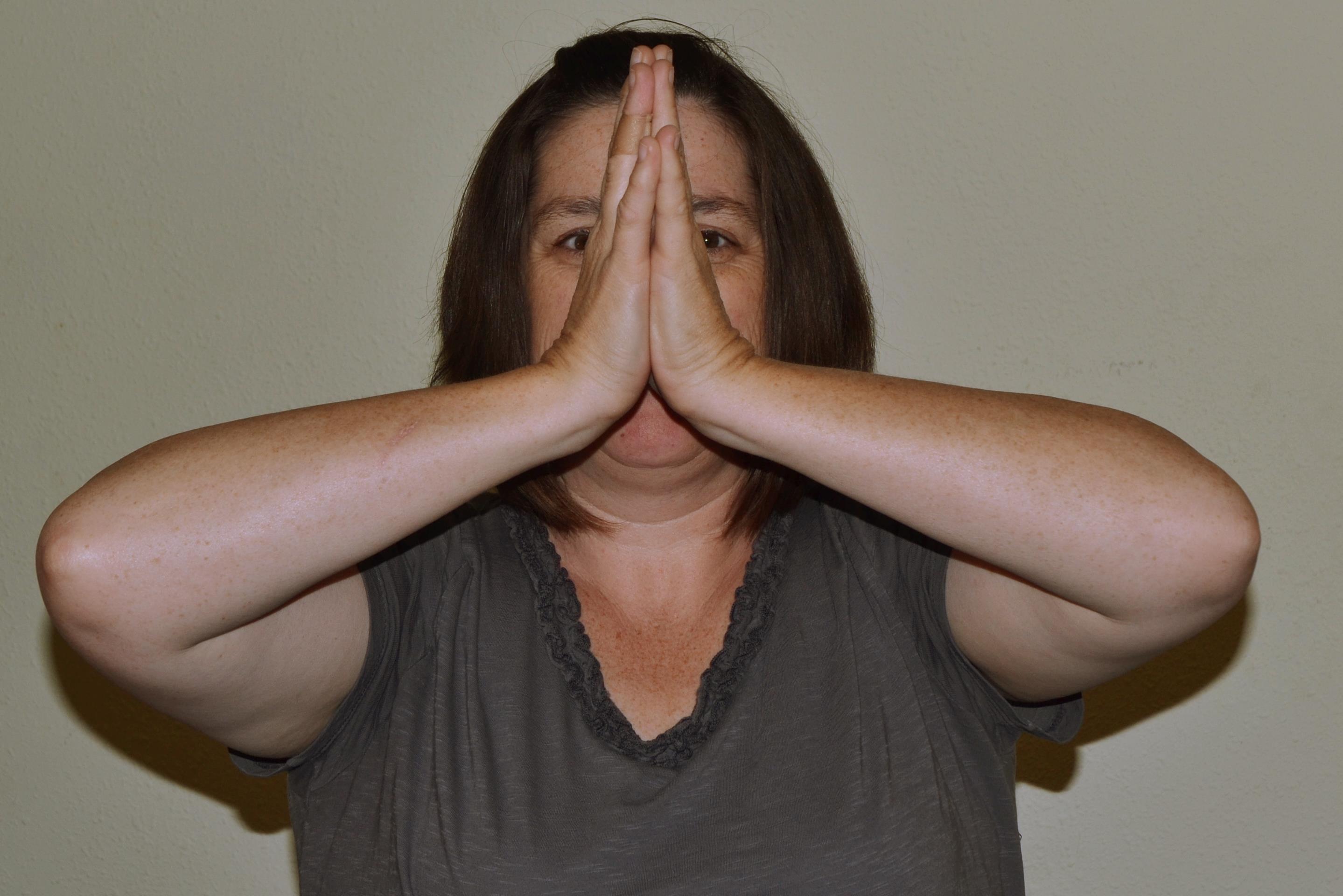
Arms loosely at sides … Inhale … and move arms to overhead in a prayer position, (hands flattened together)

Hands Overhead, Prayer Position

On exhale … Hands descend to chest / heart level while holding intention for self. Intentionally cross your eyes, your lips as you end at your heart.

Descending Towards the Heart
"om"
“om”

Express, outloud or however you feel comfortable, the particular word that encompasses the divine for you. Divine being interconnectedness to all, that which transcends all, that which is lived within, or the languaging that you choose. This could be the Sanskrit “om” (pictured), the Aramaic “abwoon” which is father, or any of the myriad words that are symbols that stand in for the divine.

Hands at heart level … Inhale

On exhale … Hands push outward, forward and go slowly to the sides (right arm going right / left arm going left). Do this while holding your intention for the world.

Pushing Intention To the World

Express, outloud or however you feel comfortable, the particular word that encompasses the divine for you.

Bring your arms gently down to your sides.

Repeat this simple meditation for as long as it feels comfortable to do so. If you desire, close the meditation with an Amen (“so be it.”)

Shalom & Amen,

Terri

© 2013, post and photos, Terri Stewart, All rights reserved

terriREV. TERRI STEWART is Into the Bardo’s  Sunday chaplain, senior content editor, and site co-administrator. She comes from an eclectic background and considers herself to be grounded in contemplation and justice. She is the Director and Founder of the Youth Chaplaincy Coalition that serves youth affected by the justice system. As a graduate of Seattle University’s School of Theology and Ministry, she earned her Master’s of Divinity and a Post-Master’s Certificate in Spiritual Direction. She is a contributing author to the Abingdon Worship Annual. (The 2014 issue just released!)

Her online presence is “Cloaked Monk.” This speaks to her grounding in contemplative arts and the need to live it out in the world. The cloak is the disguise of normalcy as she advocates for justice and peace. You can find her at www.cloakedmonk.com, www.twitter.com/cloakedmonk, and www.facebook.com/cloakedmonk.  To reach her for conversation, send a note to cloakedmonk@outlook.com
Posted in Meditation, Spiritual Practice, Terri Stewart

Adrift

sweeping fog

caresses landscapes

cast adrift

Sometimes, we become unanchored from our family, friends, or traditions. Often unanchored means adrift and that is often associated with fear and the unknown.

I remember, when I was in college the first time at the age of 18. It was a time between my first and second semester at college. I felt adrift. I was away from home, away from friends – in fact losing friends as they moved away and grew into new lives – my future was unhinging from my past in good and bad ways. Instinctively, I sought home. I went to my heart-home in upstate New York and spent time absorbing the grounding there. In many ways, that geography anchored me in ways that my drifting family, friends, faith, and future could not.

By discovering my grounding, I was able to rediscover the ground of all being.

misty fog

dancing with day-break

new growth dawns

Although I felt adrift and alone at the time, looking back, I believe that being adrift deepened who I am and what I would become. Detaching from the known and reattaching to both the known and to something new became a way of being for me. This leads all the was to seminary which I describe as a continuous pattern of deconstruction and reconstruction. Each reconstruction creates something deeper, but also something more vulnerable. And the vulnerability ultimately leads to strength.

Fog, as crazy making as it may be (and we do have our foggy days here in the PacNW), has a purpose. Turns out that the Redwood trees in California get 30%-40% of their moisture needs from fog. So this misty, chilling, low-lying-cloud ultimately offers a gift to the world. It can be irritating to be in the fog, but sometimes, just sitting still and spreading your senses out to the surrounding areas that you may not clearly see can be a gift. And this gift can be translated to the world by cultivating a habit of sitting with ambiguity.

You may ask what has my head all fogged in today? My thoughts were launched by a stunning video from Simon Christen, artist. This is a meditation on the fog that he loves in San Francisco. He calls it a “love letter to the fog of the San Francisco Bay area.” It is quite wonderful.

I would encourage you to use it to launch your own meditation on fog and being adrift. What do you need to detach from? What is the beauty you will see while cast adrift? Ultimately, where will you land?

(Shared with Permission)

Shalom and Amen.

~Terri

© 2013, video, Simon Christen. All rights reserved.

© 2013, post and poetry, Terri Stewart, All rights reserved

terriTERRI STEWART is Into the Bardo’s  Sunday chaplain, senior content editor, and site co-administrator. She comes from an eclectic background and considers herself to be grounded in contemplation and justice. She is the Director and Founder of the Youth Chaplaincy Coalition that serves youth affected by the justice system. As a graduate of Seattle University’s School of Theology and Ministry, she earned her Master’s of Divinity and a Post-Master’s Certificate in Spiritual Direction with honors and is a rare United Methodist student in the Jesuit Honor Society, Alpha Sigma Nu. She is a contributing author to the Abingdon Worship Annual.

Her online presence is “Cloaked Monk.” This speaks to her grounding in contemplative arts and the need to live it out in the world. The cloak is the disguise of normalcy as she advocates for justice and peace. You can find her at www.cloakedmonk.com, www.twitter.com/cloakedmonk, and www.facebook.com/cloakedmonk.  To reach her for conversation, send a note to cloakedmonk@outlook.com

Posted in Spiritual Practice, Terri Stewart

Connecting with the Mountain

Here, in the Pacific Northwest, there is a unique descriptor that books have been written about. It is the “none zone.” As in, “What is your religious preference?”

Answer: “None.”

I live here, in the none zone. However, there is a curious thing that happens as soon as the sun comes out. People start going up into the mountains climbing as high and as far as their bodies will let them. Going on a trail, you will never be alone. There are always people traveling with you. I thought, today as I hiked, “This is Pacific Northwest church!” Meaning people are seeking a mystical experience by going up as high as they can and as deep into nature, away from the cities, as they can.

short_semitic_viewLong ago, I mean a really long time ago, about 3,000 BCE or so, the ancient semitic worldview was quite different from our worldview. The world was flat, the mountains held up the dome of heaven, the concept was that the higher you went up the mountain, the closer you got to the divine. A concrete example of this is the many times that Moses went up the mountain in Hebrew scripture. He goes up to speak to God and comes back down to lead the people. I have included a picture depicting the ancient semitic worldview.

The picture doesn’t quite get across the idea that the highest mountain top was considered to be directly underneath the throne of heaven. So if you could get to the tippy top, you could be the closest to the divine.

In many ways, the folks here, although not religious, are seeking an experience of transformation that happens at the top of the mountain.

Seeing the beauty in sparkling water or the dappled shadows of leaves on the trail. Hearing delighted laughter as a child discovers the lake around the corner or standing still while a bird communes with you. Each act of curiosity, amazement, and even perseverance is an act of transformation. And transformation expands your heart, maybe even up to three times (odd reference to the Grinch here-“and his heart grew three times that day”)!

Baring MountainHiking, for me, feeds into my spiritual practice of contemplative walks. Coincidentally, it feeds into the ancient pattern of going to the top of the mountain to experience the divine. It is not only the ancient semitic people that did this! I am reminded particularly of the Blackfeet from Heart Butte, Montana. Their most sacred spot (no photos) is at the top of a mountain. There is a tree and people carry their prayers and offerings to that tree and put them there. It feels sacred. It is the holder of dreams and hopes. Hopefully, that is what our spiritual practices lead us to! A place inside our bodies that can hold dreams and hopes–and great sorrow.

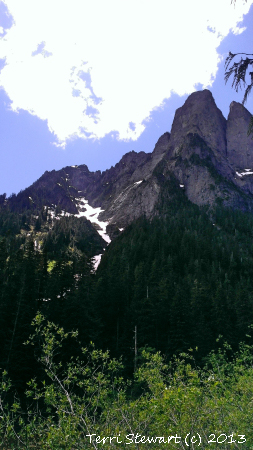
Mountains are both physical and metaphorical. Not all of us can climb up a mountain (I am not going to go all the way to the top of Mt. Rainier!). But we all face challenges. Our challenges can either be transformational or they can get us stuck in the mud. So all of this is really a wind-up to get to the questions!

  • What is your mountain?
  • Can you go up it?
  • Do you need to go around it?
  • Is there a creative, third way to approach the mountain?
  • What spiritual practices will strengthen you for the journey?

And now I’m suddenly remembering a children’s song / chant called, “Goin’ on a Bear Hunt.”

Can’t go over it!

Can’t go under it!

Oh no!

We’re gonna go through it!

What do you have to go through? And how will you go through it?

Shalom and Amen!

~Chaplain Terri

© 2013, post, Terri Stewart, All rights reserved

terriTERRI STEWART is Into the Bardo’s  Sunday chaplain, senior content editor, and site co-administrator. She comes from an eclectic background and considers herself to be grounded in contemplation and justice. She is the Director and Founder of the Youth Chaplaincy Coalition that serves youth affected by the justice system. As a graduate of Seattle University’s School of Theology and Ministry, she earned her Master’s of Divinity and a Post-Master’s Certificate in Spiritual Direction with honors and is a rare United Methodist student in the Jesuit Honor Society, Alpha Sigma Nu. She is a provisional elder in the United Methodist Church and a contributing author to the Abingdon Worship Annual.

Her online presence is “Cloaked Monk.” This speaks to her grounding in contemplative arts and the need to live it out in the world. The cloak is the disguise of normalcy as she advocates for justice and peace. You can find her at www.cloakedmonk.com, www.twitter.com/cloakedmonk, and www.facebook.com/cloakedmonk.  To reach her for conversation, send a note to cloakedmonk@outlook.com


Posted in Photography/Photographer, Poems/Poetry, Rumi, Spiritual Practice, Terri Stewart

Doors

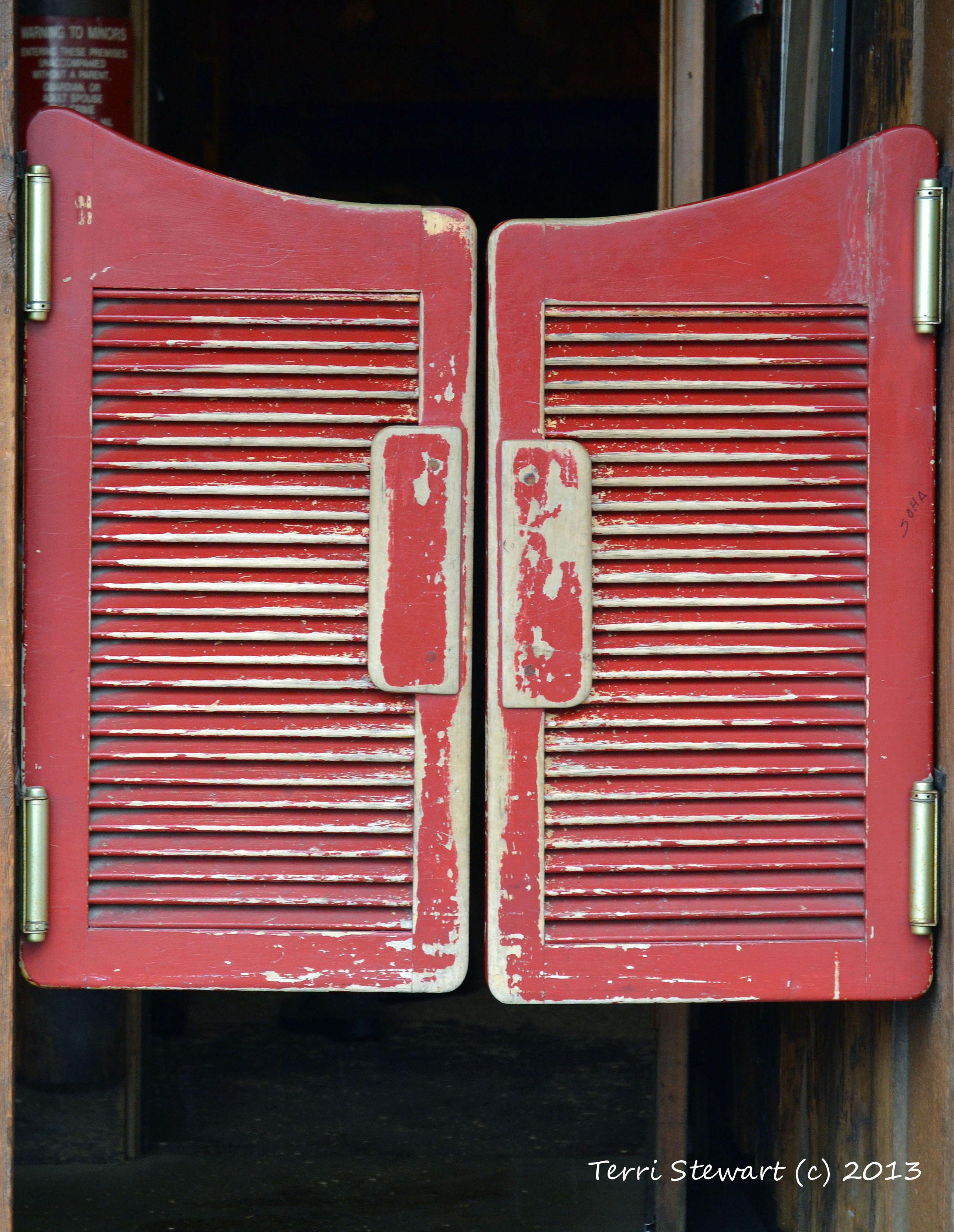
bar_doorsConsider doors. We enter or exit through doors. Sometimes we just look at doors. They lead towards something or away from something.

“As long as you are performing prayer, you are knocking on Allah’s door. And whoever knocks on Allah’s door [constantly], He will open it.” -Ibn Al-Qayyim Al-Jawzi

“The doors we open and close each day decide the lives we live.” -Flora Whittemore

“A man who does not plan long ahead will find trouble right at his door” -Confucius

“Ask, and it will be given to you; seek, and you will find; knock, and it will be opened to you.” Matthew 7:7, Christian Scripture

“In oneself lies the whole world and if you know how to look and learn, the door is there and the key is in your hand. Nobody on earth can give you either the key or the door to open, except yourself.” -Jiddu Krishnamurti

“Knowledge of what is does not open the door directly to what should be.” -Albert Einstein

Lots of thought has been given to doors! Now it is our turn to consider doors. I would like to offer up a lectio divina experience. Lectio divina is an ancient way of “being present
to a text in a heart-centered way.” (Christine Valters Paintner) It is a way of meditating or praying. When we use the lectio divina technique, we see the words we read as living, breathing essence. It becomes an encounter with the sacred. There are four primary movements of lectio (and sorry if this is repeat news!)…

Read (lectio): Read and listen for a word or phrase that creates energy within your body

Reflect (meditatio): Read again and savor the words, delve into them, use your senses to experience them

Respond (oratio): Read again and listen for the invitation coming from the text

Rest (contemplatio): Rest, be still.

Go slowly and be present. I offer you a poem from Rumi.

Lectio:

The bfirehouse_doorreeze at dawn has secrets to tell you.
Don’t go back to sleep.

You must ask for what you really want.
Don’t go back to sleep.

People are going back and forth across the doorsill
where the two worlds touch.

The door is round and open.
Don’t go back to sleep.

From Essential Rumi
by Coleman Barks

Meditatio:

weird_doorThe breeze at dawn has secrets to tell you.
Don’t go back to sleep.

You must ask for what you really want.
Don’t go back to sleep.

People are going back and forth across the doorsill
where the two worlds touch.

The door is round and open.
Don’t go back to sleep.


Oratio:

lots_of_doorsThe breeze at dawn has secrets to tell you.
Don’t go back to sleep.

You must ask for what you really want.
Don’t go back to sleep.

People are going back and forth across the doorsill
where the two worlds touch.

The door is round and open.
Don’t go back to sleep.

Rest:

forboding_door

Shalom and Amen.

~Chaplain Terri

© 2013, post and photos, Terri Stewart, all rights reserved

Terri StewartTERRI STEWART is Into the Bardo’s  Sunday Chaplain, Senior Content Editor, and Site Co-administrator. She comes from an eclectic background and considers herself to be grounded in contemplation and justice. She is the Director and Founder of the Youth Chaplaincy Coalition that serves youth affected by the justice system. As a recent graduate of Seattle University’s School of Theology and Ministry, she earned her Master’s of Divinity and a Post-Master’s Certificate in Spiritual Direction with honors and is a rare United Methodist student in the Jesuit Honor Society, Alpha Sigma Nu. She is a contributing author to the Abingdon Worship Annual.

Her online presence is “Cloaked Monk.” This speaks to her grounding in contemplative arts (photography, mandala, poetry) and the need to live it out in the world. The cloak is the disguise of normalcy as she advocates for justice and peace. You can find her at www.cloakedmonk.com, www.twitter.com/cloakedmonkwww.flickr.com/cloakedmonk and  www.facebook.com/cloakedmonk.  To reach her for conversation, send a note to cloakedmonk@outlook.com.
Posted in Meditation, Spiritual Practice, story, Terri Stewart

Candle Gazing and a Contemplative Tale

Today’s practice is two tales set to a video recording of three candles. I will confess that this was done in my living room and, well, the candles are not as flickery on the video as they were in my living room. I would suggest getting a candle and looking at it instead of the video screen! Or simply closing your eyes and listening.

Candle gazing is a contemplative meditation technique. In this manner, instead of closing your eyes, you let your eyes rest on the flame of a candle. Let your gaze rest softly, neither focusing too hard or letting the candle leave your gaze. Stay with the candle as it dances and let your mind be free.

This video is about 4 1/2 minutes long. There are a couple of brief moments of silence. Stay with the silence and get through to the other side.

The stories are from one of my favorite books, “Peace Tales: World Folktales to Talk About” by Margaret Read MacDonald. This book found us when my kids were in elementary school. (My youngest is graduating this year! Yikes!!)

Sit back. Relax. Get comfortable. Become grounded. Now listen with your heart.


Namaste, salām, shalom.


© 2013, post and video, Terri Stewart, All rights reserved

Terri StewartTERRI STEWART is Into the Bardo’s  Sunday evening chaplain. You can expect a special post from her each week. She comes from an eclectic background and considers herself to be grounded in contemplation and justice. She is the Director and Founder of the Youth Chaplaincy Coalition that serves youth affected by the justice system. As a recent graduate of Seattle University’s School of Theology and Ministry, she earned her Master’s of Divinity and a Post-Master’s Certificate in Spiritual Direction with honors and is a rare United Methodist student in the Jesuit Honor Society, Alpha Sigma Nu. She is a contributing author to the Abingdon Worship Annual.

Her online presence is “Cloaked Monk.” This speaks to her grounding in contemplative arts (photography, mandala, poetry) and the need to live it out in the world. The cloak is the disguise of normalcy as she advocates for justice and peace. You can find her at www.cloakedmonk.com,www.twitter.com/cloakedmonk, and www.facebook.com/cloakedmonk.  To reach her for conversation, send a note to cloakedmonk@outlook.com.
Posted in Photography/Photographer, Spiritual Practice, Terri Stewart

Contemplative Photography: Listen with the Eye of the Heart

Contemplative photography is a practice I try to observe. So often, I end up reserving it for vacation times. However, with the advent of phone cameras and the increased capabilities they have, contemplative photography is at my fingertips every day! I am reading a book on contemplative photography and would like to share some of the thoughts it is stirring in me and the information it has. The book is Eyes of the Heart: Photography as a Christian Contemplative Practice by Christine Valters Paintner. You can find her at Abbey of the Arts.

Contemplative seeing is described by Carmelite William McNamara as a “long loving look at the real.” Let’s think about what each one of these words means.

  • Long – to see, we need to slow down and notice our surroundings, immerse ourselves into the moment
  • Loving – to see clearly, we need to have a compassion filter that sees beauty in all things, the horrible and the joyful
  • Look at the real – to see things as they are, not how we want them to be

Contemplative seeing also requires a journey from the head down into the heart.

In Buddhism, there is a practice of contemplative photography called Miksang. This is Tibetan for “good eye.” Miksang has the goal of looking at the real without judgement or distinctions like “beautiful” or “ugly.” The goal is to see things as they are without attaching value judgments and to appreciate it. This opens up a third space, seeing things in a creative new way. I am reminded of a visit I made to the women’s prison. It was a spectacular Pacific Northwest day. Brilliant blue skies. Inside the prison, walking across the grounds, I looked up and saw the razor wire. At the same time it was incredibly beautiful and incredibly repulsive. That is the tension that the “good eye” brings.

freedom in the penitentiary

robin sitting still
between barbs of sharpened steel
her spirit will soar

In Christianity, this “good eye” is termed the “third eye” by Richard Rohr. He describes it as the moment when “our heart space, our mind space, and our body awareness are all simultaneously open and non-resistant. I like to call it presence. It is experienced as a moment of deep inner connection, and it always pulls you, intensely satisfied, into the naked and undefended now, which can involve both profound joy and profound sadness. At that point, you either want to write poetry, pray, or be utterly silent.”

The monk, Thomas Merton, started practicing contemplative photography and he said, “How the blank side of a frame house can be so completely beautiful I cannot imagine. A completely miraculous achievement of forms.” Perhaps the good eye or the third eye is simply seeing the miracle.

All this is quite a lead up to the offering I have today of a contemplative photograph. I am going to offer an image and then I encourage you to visit one from Thomas Merton he titled “Sky Hook” and described as the “Only known photograph of God.”

After entering the photograph(s), please consider sitting with the feeling that is created when you shift from head seeing to heart seeing. Gaze lightly into the distance without focusing on any one thing. Be present to the real. After you have considered these photographic offerings, perhaps you would consider gazing around you, holding compassion in your heart and seeing something beautiful. If you have your camera, great! If not, consider the magical moment of holding the image in your heart and then releasing it.

Community
Community

Reflection: What, if anything, has changed? How was the journey from head to heart?

Shalom and Amen.

Chaplain Terri

© 2013, post and photographs, Terri Stewart, All rights reserved

Terri Stewart
Terri Stewart

TERRI STEWART is Into the Bardo’s  Sunday evening chaplain. You can expect a special post from her each week. She comes from an eclectic background and considers herself to be grounded in contemplation and justice. She is the Director and Founder of the Youth Chaplaincy Coalition that serves youth affected by the justice system. As a recent graduate of Seattle University’s School of Theology and Ministry, she earned her Master’s of Divinity and a Post-Master’s Certificate in Spiritual Direction with honors and is a rare United Methodist student in the Jesuit Honor Society, Alpha Sigma Nu. She is a contributing author to the Abingdon Worship Annual.

Her online presence is “Cloaked Monk.” This speaks to her grounding in contemplative arts (photography, mandala, poetry) and the need to live it out in the world. The cloak is the disguise of normalcy as she advocates for justice and peace. You can find her at www.cloakedmonk.com,www.twitter.com/cloakedmonk, and www.facebook.com/cloakedmonk.  To reach her for conversation, send a note to cloakedmonk@outlook.com.