
B-52 Security Guard Becomes a Conscientious Objector
December 1969
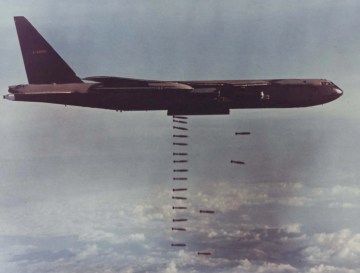
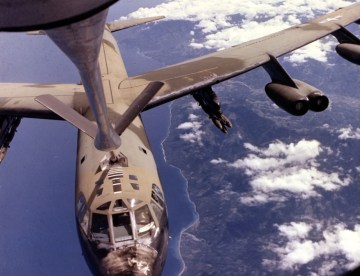
After my Air Force security guard training is completed, I’m sent to Beale Air Base in the Yuba City-Marysville area near Sacramento, California. I’m put on the flight line as a security guard for B-52s, which look to me like gigantic prehistoric birds of prey. This begins my time of walking in circles on the flight line in the rain and heat, thinking, changing, growing, wondering what the purpose of my life is.
I have a gut feeling that the war is wrong. Although we’re not allowed to take anything other than our guns and military equipment on the line, I smuggle a portable radio and earphones and listen to the lyrics of popular songs instead of just the melodies—songs by Bob Dylan, Crosby, Stills, and Nash, and all the others protesting the war. I’m also reading the underground newspapers that are finding their way on base and contain antiwar, anti-government stories about the My Lai atrocity, the shooting of Richard Bunch at the Presidio, and the hysteria running rampant on American college campuses.

Source: Pinterest
All the little irritating items of military brainwashing and propaganda gradually build up inside of me. Things I’ve taken for granted before now make me bristle. The realization that military life isn’t for me takes the form of pointing out the inconsistencies and lies whenever I spot them. I miss haircuts and am constantly reprimanded for my shoddy appearance during inspections. I lose days off and am forced to undergo crowd control practice in case we’re called upon, like the National Guard, to break up a civilian demonstration. I know my sympathies would be with the demonstrators. If the situation ever really comes up, I’ll cast aside my weapons and join the other side.
My order to fight in Southeast Asia comes through. I’m given thirty days leave before having to report first to a base in Texas for a month of intensive war training and later to a base in northern Thailand near the Cambodian border. This happens shortly after Nixon escalates the war into Cambodia, where B-52 bombers are now dropping tons of napalm. The Kent State killings are the final straw. When I leave Beale Air Base for the start of my thirty-day leave, I know I’ll never make it to Texas.
During those thirty days, I do much thinking. I decide not to flee to Canada. I hitchhike back to Beale Air Base, tell the clerks I’ve been in an accident, and am assigned to the transient barracks. For the next three weeks, it’s as if no one else on base is aware that I’m back and not in Texas. I’m content to wait for something to happen, but nothing does.
One day, I run into Terry Yavitz, another security policeman I know from a distance. We’ve rarely spoken to each other before, but when he asks me what I’m doing on base, I’m overjoyed to be noticed by someone. He asks if I want to smoke some pot. Off we go for a drive in his VW van. There I am, stoned for the first time, loving the feeling as we park and watch the most beautiful sunset I’ve ever seen.
I confess everything right there, half expecting him to turn me in to the legal department. Instead, he says that he’s involved in the underground effort against the war and is one of the writers for an antiwar newspaper being printed secretly off base in Yuba City. The paper is called Spaced Sentinel.
In the next few days, I find myself a member of a group of five short-haired hippies stationed at Beale, each of the others in his last few months of military service, each radically opposed to the war, actively involved in writing for Spaced Sentinel, and spreading antiwar propaganda around the base. Two of the members are the base photographers and are also working for the base newspaper. As such, they have access to classified information and use this in some of the stories that appear in the off-base publication.

Source: Medium
We meet every night in the photographers’ barracks room to smoke pot, listen to music, talk about revolution, and discuss my case and what should be done about it. Their room is a veritable den of iniquity with its black lights, strobe lights, and posters of Jimmy Hendrix and Bob Dylan plastered on the walls. In this room, we form a kind of conspiracy.
We spend hours discussing pacifism, Gandhi, and Thoreau. Soon it’s apparent that I have to make a statement because it won’t be long before the base clerks discover I haven’t carried out my order to ship out to Nam. We decide I should go to the base legal department to find out what my rights are and what I need to do to file for conscientious objector status. Although I’m sure I don’t qualify as a religious CO because I dropped out of the Catholic Church when I was twelve years old, my friends tell me a recent Supreme Court ruling established that conscientious objection to war under moral and ethical grounds can also be legally recognized.
The first lawyer I talk to is Jerry Mahoney, who takes an immediate interest in my case. He’s relaxed, confident, friendly, and encouraging. He tells me that he, too, is an antiwar man and spent eight years of school studying to become a lawyer. When he was drafted, he considered going to Canada, but decided he could work better within the system rather than throw away his career and eight years of schooling.
He’s very professional about finding out all the details of when I returned to the base, what I’ve been doing, what I’ve said to the clerks, the security police, and the other lawyer. He accepts my case and says it’s the most important one he’s ever had.
We set the wheels in motion for applying for conscientious objector status. We have meetings every day. He counsels me on how to answer the questions that will be asked at various interviews with officers and chaplains who will judge whether my application and beliefs are sincere. It’s all serious stuff. I feel I’m in over my head intellectually, but Jerry gives me confidence. Most of these interviews go smoothly.
About a month after returning to the base, I’m summoned to appear in my commanding officer’s office. Two other high-ranking officers are present as witnesses. Lieutenant Colonel Arnold is seething but controlled. At first his questions are polite, almost sympathetic, but as I continue to give vague answers in the manner Jerry has counseled me to do, Lieutenant Colonel Arnold becomes increasingly frustrated and begins to leer at me. For the first time in my life, I’m facing the hostility of a man who holds my fate in his hands.
Lieutenant Colonel Arnold’s face turns red. In a fit of controlled rage, he stands over me and bellows, “Airman, if you don’t straighten up and straighten up fast, I’m going to send you to prison for five years. I’ll make an example of you to show what a coward and a communist look like and how they’re treated in this man’s Air Force. I insist you tell me everything. Why have you changed so suddenly? Who are the people that have influenced you? Where do they live? Are you part of some organization? Are you connected with this filthy communist paper spreading propaganda around this base? I demand some answers to these questions and I demand them now!”
Source: Medium
I feel like the enemy I am, but I just sit there not saying anything, tears coming to my eyes. Lieutenant Colonel Arnold relaxes a bit, seemingly gaining pleasure from seeing my will weakening already. He decides to give me one more chance. I’m to go back to the barracks, get my thoughts and emotions in order, and return to his office the following morning, at which time I’ll be given the final official order to go to Southeast Asia.
I go straight to Jerry’s office, scared and confused. He reassures me everything will be all right and that the next day it’s imperative that I not say a direct “no,” but continue to give vague responses to the order I’ll be given.
The next day, there are three more witnesses and a secretary to record every word spoken. When given the order, I reply, “I don’t feel I’m mentally or physically capable of killing another human being.”
Lieutenant Colonel Arnold says, “Boy, I’m gonna court-martial you. You’re gonna regret this for the rest of your life. You’re gonna wish you never laid eyes on me, you sniffly little coward.”
The day of the court martial comes: October 6, 1970. The military courtroom is grey and solemn. The sun outside is shining brightly on the parched Sacramento Valley landscape where I’ve spent many days and nights walking around B-52 bombers before finally making my decision. Several faceless men in nondescript military dress take the stand, pointing their accusing fingers at me as I sit next to Jerry at the wooden table facing the military judge. The judge sits in calm repose, weighing the facts of the case as they are presented to him. Meaningless military words fill the courtroom.
“…willful disobedience to a direct, lawful order…”
“The accused was handed his order at 1300 hours on 30 June 1970, but failed to report to…”
“And so, Your Honor, the full sentence of five years at hard labor is requested to make a lasting example to the…”
Jerry puts me on the stand. The prosecuting attorney has no questions. I tell the judge I’ll try my best to get along at the prison rehabilitation program that I’ll be sent to, but I believe the Air Force will fail in attempting to rehabilitate me. My conscience will not allow me to participate in war in any form.
When finished, I rise from the stand. I feel dizzy. The courtroom recesses for the judge to come to a decision. An hour later, he emerges from a dingy room to call me before him. The verdict: not guilty of the original charge of willful disobedience to a direct lawful order, but guilty of a lesser charge of negligent disobedience to a lawful order. In essence, an entire day of deliberation has boiled down to the way I responded to Lieutenant Colonel Arnold’s final order to go to Southeast Asia. I never used the word “no.”
It’s a lesson in the power of language. That single sentence saved perhaps four and a half years of my life. At that moment, however, there is little consolation other than achieving a moral victory. I still have six months of hard labor to do at the 3320th Retraining Group in Denver, Colorado.
Source: Medium
A military policeman places handcuffs around my wrists and leads me to a patrol car waiting to take me to the base prison. Jerry follows me to the patrol car.
I force a smile and say, “It could’ve been worse.”
Jerry puts his hand on my shoulder and says, “You were brave on the stand. I’m very proud of you.”
I get into the patrol car. A cloud of dust rises behind the car as it lurches toward the prison. I crane my neck for a final look and see Jerry grow smaller through a brown haze until he’s a tiny speck in the distance.
©2023 Robert W. Norris
All rights reserved
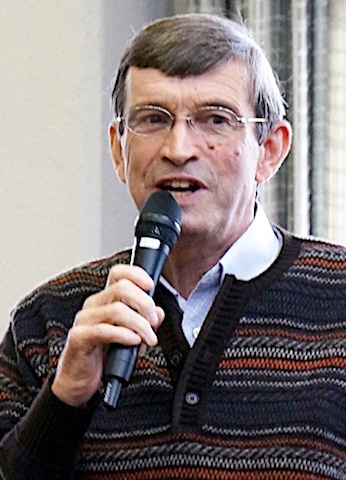
Robert W. Norris…
…was a conscientious objector to the Vietnam War. Court-martialed and served time in a military prison. Wandered the world in his twenties. Longtime Japan resident, where he became a professor emeritus. Author of five books, including his life story The Good Lord Willing and the Creek Don’t Rise: Pentimento Memories of Mom and Me.


 The BeZine