From Chapter 24 of a memoir manuscript,
working title: Woven Voices a Witness to Terror
Leaden skies and rain had settled in for the past week, curtailing small planes and drenching the trail, the only route in and out of Centro Uno. Two nights of concussive bombing on the east facing slopes of the Sierra Madres just outside of Centro Uno made me nervous and Pamela terrified.
I didn’t know what to expect next after the reports of the Guerrillas at La Resurrección. We heard from a campesino getting seeds at the garden that the killing of the captain was in response to a massacre in Ixcán Chiquita. Pamela, pale and shaking, told us, “We’re going to have to leave tomorrow! I can’t stay here. I’m going to die.” I thought that she was being overly dramatic, but by the next day, I, too, realized that we were in serious danger, not just of bombs but of blood poisoning. Rubber boots and the humidity conspired to result in Ernesto and I coming down with what was called granos, a severe case of jungle rot. There was no immediate cure for it in the village. In fact, in Segundo Centro, a mother had used a remedio called Aldrin to cure her child’s granos. Aldrin is one of the world’s most toxic pesticides. Fear of the granos infection had pushed her to try this toxin on her little boy when she felt there was no hope, and it had killed him.
Ernesto had grano first; his small innocuous pimple grew to a four-inch, slightly swollen red patch, but his infection stayed fairly small and wasn’t changing quickly. Mine, on the other hand, had blossomed out of control, my leg, itchy and red, inflated so much that I couldn’t fit my foot and ankle into the neck of my rubber boot.
photograph courtesy of the author
“You need to get that treated,” Pamela insisted.
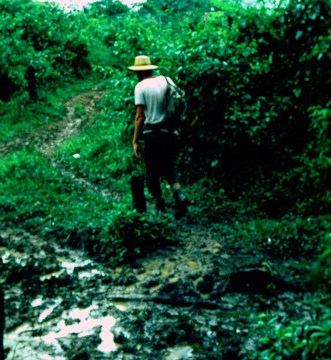
We set out the next morning right before daybreak on the trail to Mayalan. Ernesto saddled up Lugnut with a pack saddle and strapped on Pamela’s luggage as well as her briefcase with documents on the testing we had done and her analysis of the health of the community. My mochila was strapped to the very top. Lugnut was not a pack animal—in retrospect it would have made more sense to get a good sturdy small mule rather than a horse, but good-hearted Lugnut lumbered along behind us, trying to keep his balance in the deep mud. We were quite the Health Resource Center team, trudging and hobbling, infected and sick.
I was in such pain it was hard to feel anything but a pulsing throb. Every time I slipped and hit a rock or a root, I thought I would scream. I had started the hike with my rubber boot on my good foot and a piece of nylo wrapped around my swollen foot. The cheery yellow piece of plastic stripped off in the third deep muddy root pool as we entered the trail. I blocked out imagining mud crawling with microbes and hookworms as we pushed through the eight-and-a-half-kilometer hike.
Pamela kept repeating, “I am going to die, I need to get out of here now.”
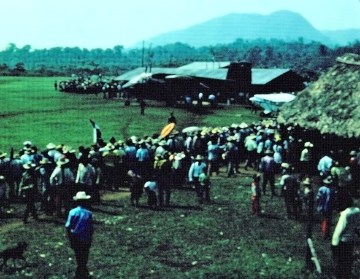
After six-and-a-half hours of fighting the slippery mud and rocks, we finally arrived at the hill above Mayalan. Just focusing on the hike took so much energy that we had stopped worrying about who or what was beyond the tree line. Pamela had never seen the militarization of Mayalan, having only flown into Centro Uno, and shocked, she turned to me, “What is going on?”
photograph courtesy of the author
Descending into the village from the rocky ridge, an Arava circled in for a landing. We sped up, hopping faster, slipping and sliding over the rocks and slimy roots. My leg and foot had swollen to two to three times larger than normal.
We arrived at the bodega right as the Arava on the pista opened, cracking in half, and Victoriano and another Todo Santero climbed down the metal stairs. I asked the cooperativista in charge, “¿Estamos muy enfermo podemos salir hoy?” He told us that no; the plane was there in Mayalan for at least a night, if not longer. Even though I was sick, there would be no leaving that day. I asked, “Can you please check and see if there is anyone else flying?”
Just then, static from the radio broke our depressed silence, and he said, “Guy ya viene y hay lugar para una persona.” Guy had been at La Resurrección and had heard that someone needed to fly out but only had space for two people. One was a sick child and the other person ended up being Pamela.
Within 30 minutes she was gone.
Lugnut and I started back to Larry’s abandoned house. Alone and unable to do anything but drag my leg, I wondered how I, the clearly dangerously infected volunteer, had been left in Mayalan when Pamela, who was not as sick, left. Who would care for me?
Lines of red were creeping up past my knee onto my thigh. I thought I saw them growing incrementally, twisting like tiny snakes running up from the dark red grano. I staggered and then veered over to the clinica, a small 10 x10 board and batten wooden building with a metal roof and a dispensing window.
Melicio asked me, “¿Ha tomado Penicillin?”
“I’ve never had any antibiotics of any kind,” I responded. He replied, “Aye dios mio hay veces es pelegroso pero vamos a ver.” I remembered that there is a potentially life-threatening reaction that some people have to penicillin. Not much of a choice, I would either lose my leg or die.
The children helped me hop to Larry’s house and un-saddle Lugnut and turn him out. Finally sitting, I lifted my leg and propped it up and then realized I was unable to bend or lower my leg, the pain excruciating. The children enthusiastically brought me dinner from the local comedor. I was not alone.
Maybe it was the penicillin or maybe the infection, but I was plagued by paranoia and weird dreams of being left in the house and not being able to move. In the dark, my foot stood out high above the mattress balanced on the stool. It was eerily light out with the night lights high above the coiled barbed wire line powered by generators that overwhelmed the jungle sounds. It had been so long since I had heard un-natural sounds and saw unnatural light, and it was disorienting, distracting, and menacing.
The next morning, I heard a shout and saw the children running to the house escorting Ernesto, who hobbled, one hand on a hefty branch that he was using as a cane. He too had gotten worse and decided to seek medical help. We were able to fly out the next day on an Arava to Guatemala City.
When we arrived in the city, we found a clinic immediately and a doctor who knew about granos and jungle rot. He looked me in the eye and said, “If you had delayed a day longer, the streptococcus infection and blood poisoning spreading up your leg would rapidly have become gangrenous, and it would have been necessary to amputate your leg.” He suggested that we relocate our work to the capital. “The Ixcán is killing you.”
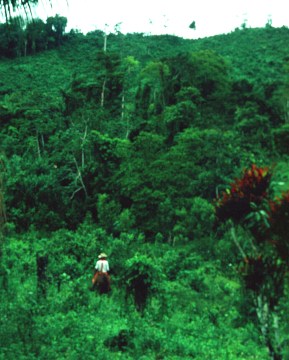
Despite the doctor’s warnings, I had passed into an unusual place mentally where my own personal safety and health were less important than returning and doing the work. A week later, having soaked it in an anti-bacterial bath all week at the hangar, my leg was partially healed and the swelling greatly reduced.
photograph courtesy of the author
We returned to the base, and I saw the gauntlet: Army regulars with Galils hanging across their chests, muzzles pointing down, checking the passengers looking like they were expecting nothing unusual. The jaunty, almost joking way we had discussed not having anything dangerous with us rapidly dissipated and was replaced with a growing cold that began in my groin and radiated up to my face in stark contrast to the 98 degrees with easily 90% humidity.
As I stepped up and dumped my pack, paperback books fell out and the closest soldier picked up 100 Years of Solitude and fanned it, looking for illicit messages of who knows what…coordinates to a Guerrilla camp? Then, the one they called Jose, grabbed my kit, poking through the small flowered bag with toiletries, one of those with the frosted zippered compartments, and fumbled as he unzipped one by one: toothpaste, toothbrush, pills, dental floss, and several tampons, the kind that doesn’t have a tube, just a string. In his hand with the tail hanging down it looked like a firecracker or maybe a small bomb with a fuse cord.
He jumped back, releasing the safety as he swung the blue-black muzzle of the Galil up to my face. He held up my tampon with the string hanging down and shook it, screaming, “¿Qué es esto? Es una Bomba!”
Reading the terror in his eyes, his shaking hands and the gun moving from across my chest to my head, I froze. This time, I realized that I was one false step away from being killed. Ironically, I hadn’t had my period in months due to malnutrition and disease, and now I was going to die for something that I didn’t even use?
I started to laugh, hysteria within reach. He pushed me to the ground, knocking my glasses off. Time stopped, the thick bladed short grass damp with humidity, drops of water beading up, magnifying the sun and heat, my cheek pressed to the rain-soaked grass. A scent I remember from childhood, my mother’s friend’s backyard, a St. Augustine lawn, the rough, thick blades that I used to do somersaults on.
How to describe the use of something so foreign? Their wives and mothers just used a rag.
The private’s superior heard the terrified yelling, saw the commotion, and strode over. He wrenched the tampon out of the private’s hand and smacked him across the face yelling, “Cayate.”
The private continued yelling, “¡Es una bomba!”
And then I heard a thud as he hit the private on the side of the head with the butt of his gun. “Idioto.”
I saw a hand extended and grasped it. He helped me up and returned the tampon to the flowered kit.
And then in English, he said, “I am so sorry, they know nothing.”
Having studied in the U.S. at the war college, as so many Guatemalan officers had, and speaking fluent English, he clearly knew the function of a tampon. Shaken, I bent down and scooped up my books and the rest of my toiletries and stuffed them into the pack, focusing on the trail head back to Centro Uno.
Just three years later, this officer would participate in the genocide, but not that day.
I wondered out loud, “What will we find in Centro Uno after all of this?”
“Who knows?” Ernesto said.
The atmosphere had changed in the two and a half weeks we were gone; the children ran up to greet us when we made the rocky descent into the village, but their parents looked more somber. The dense green jungle and the rainforest now provided shelter for both the Guerrillas and the Army. The lack of clear site lines and the unknown created a fear that materialized as anger on all sides. Before, the sound of a bird or a capybara bounding through the underbrush would have elicited a shrug or curiosity. Now, as terror of Guerrillas and soldiers seeped in and gradually infected everyone, the commonplace sounds of the jungle created anxiety. With fear so widespread, just leaving the village and going to the milpa daily to work was a concern, but there were no options. The villagers were all unarmed, their only defense, a machete.
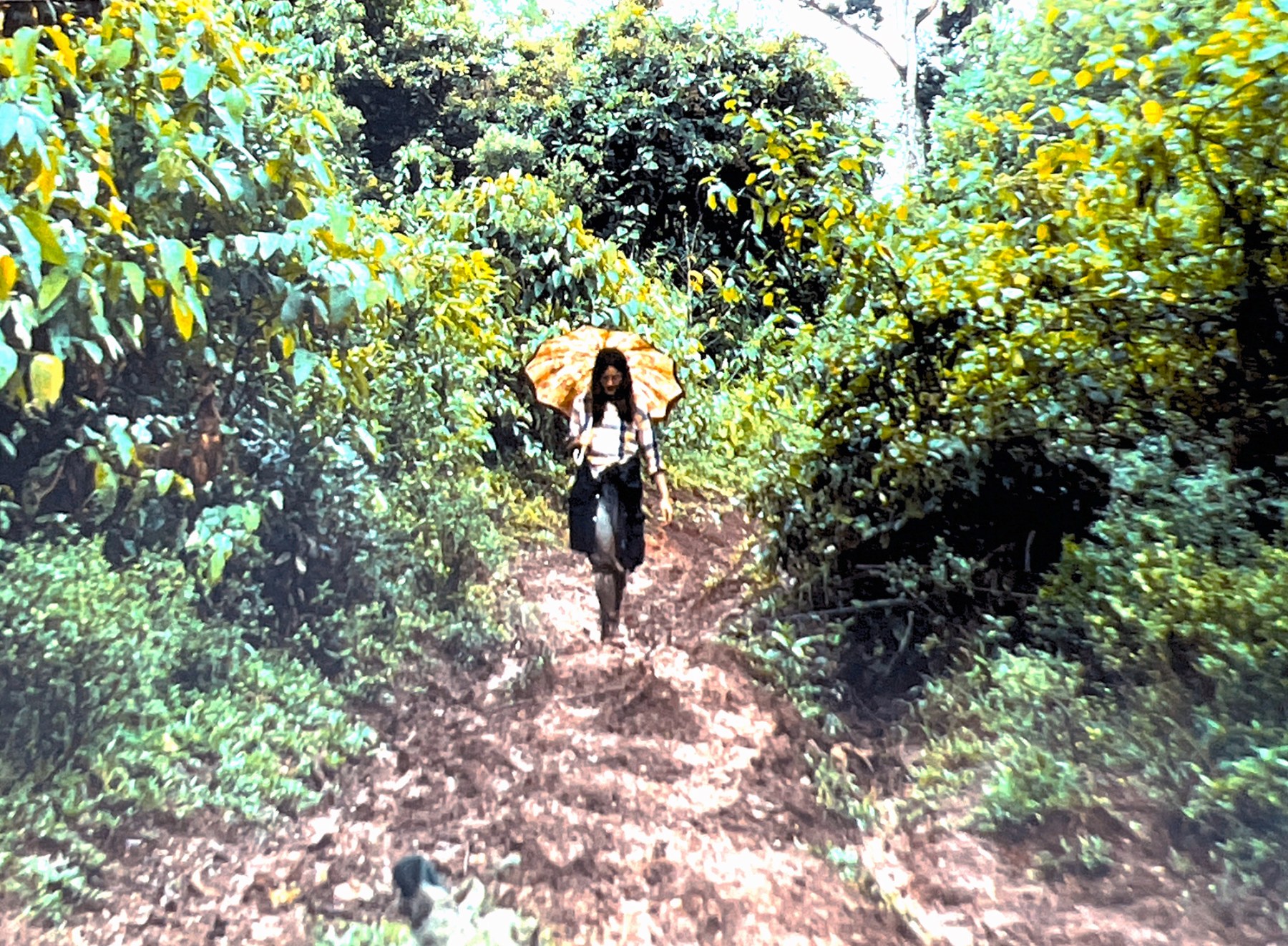
photograph courtesy of the author
©2023 Lesley Lucinda Miles
All rights reserved
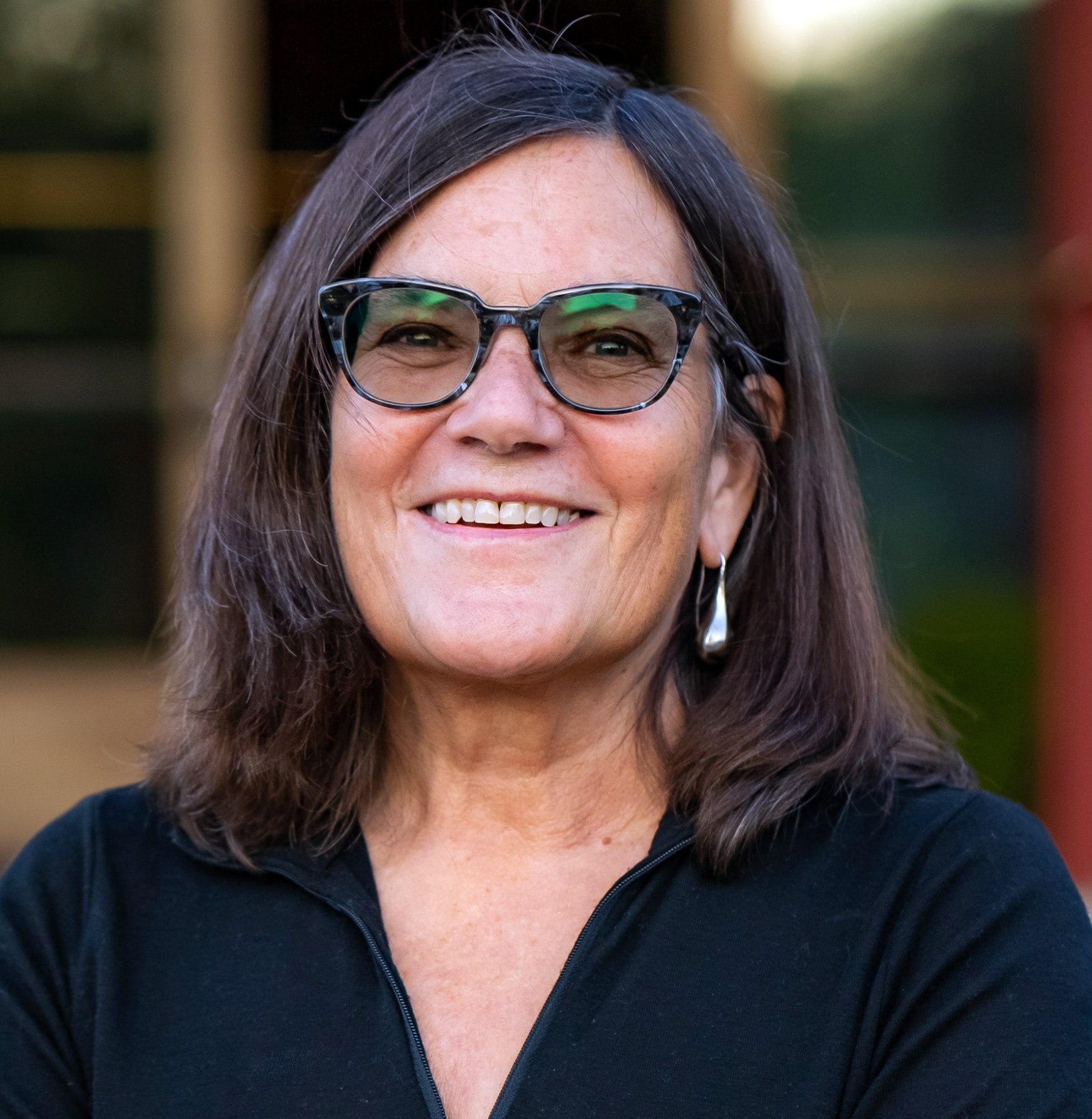
Lesley Lucinda Miles…
…is an architect and principal of Weston Miles Architects. In the 1970’s, after studying horticulture at Cal Poly San Luis Obispo and training in French Intensive Biodynamic organic gardening in Santa Barbara, California, she worked as a volunteer agronomist in the Ixcán jungle in northwestern Guatemala. She was a witness to the end of one of the most progressive land use programs ever established in Guatemala and to the beginning of a genocide. After forty years and psychoanalysis for PTSD, she began to write.


 The BeZine