Rose-Tending

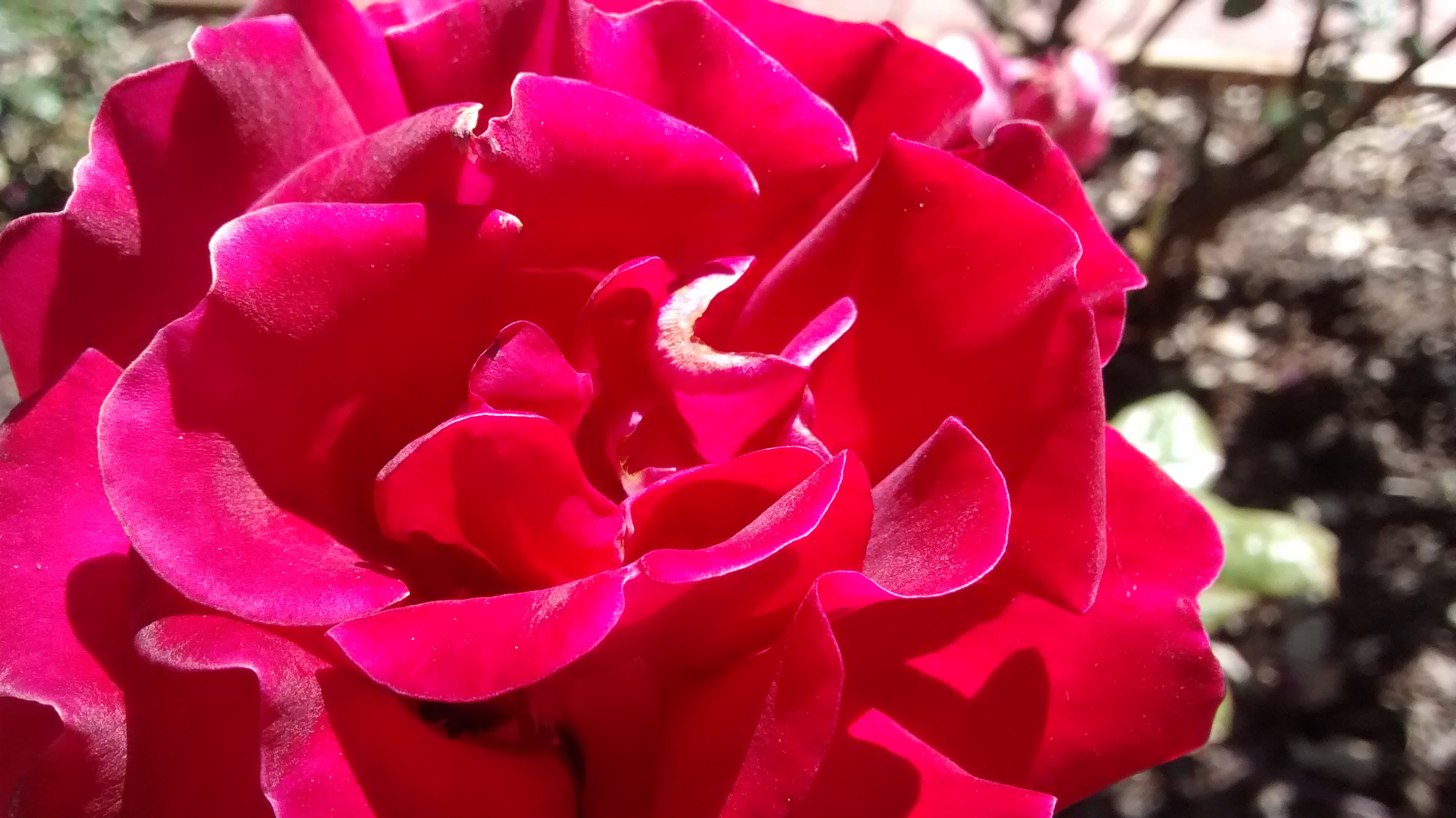
IMG_20140525_103219903(For Saffron, who will understand)

I guess I look ridiculous to the neighbors as they pass by,
Lying on the ground, staring up at the sky,
My head underneath a tangle of rose-tree branches –
“Canes” as true rose aficionados technically call
These black, stark, angular arthritic knuckles that
One must only ever touch with thick canvas gloves,
Lest a thorn – whose name is “Legion”, for they are many here –
Pierce tender flesh, draw blood, draw curse, and spoil
One’s romantic meditations on rose-hood, substituting
Instead an insidious intuition of hidden harm,
Of treacherous mendacity masquerading as sweetness, as softness.

But I guess my neighbors, or anyway, those who took a second
Glance, would understand, would understand when they saw
The gloves, the old straw hat, the gardening shears – though the posture would still mystify.
They would understand that, also, were they to join me here on the ground,
Which they would be welcome to do, were any not averse to such loss of dignity.
They would understand that, while seeing thorns is easy from a more
Dignified position, that the seeing of rosebuds is best done from a position
Lower down, closer to the earth, preferably upside down, a form of self-humiliation,
Like St. Peter crucified in Rome.

So here I lie.

Clouds drift by, cotton tufts caught in the brutal lattice of cane and thorn,
Sky fractured into azure plates by crooked black boundaries swept by wind.
Eyes drift from cane to cane, eclipsing sun, finally alighting on a single rosebud,
The first of an early spring, unexpected, dew-drop catching sunfire in a
Glissando of color … well worth waiting for; well worth a little lumbar pain
Heralding youth as well as age. Oh, the thorns are still there, observable
From any angle. Never fear.

But rosebuds are best seen from below, from a less exalted, less dignified
Vantage that invites the baptism of dew on forehead, of light in eye.

– James Cowels

© 2011, poem, James Cowels, All rights reserved; 2015, photograph, Jamie Dedes, All rights reserved

Blessed Are They Who Mourn

In the northwest corner of Iraq,
in a Kurdish stronghold, toppled,
in a drafty hovel,
a child, alone, whimpers.
for his parents
who will not return.

In a small country on the African continent,
in an isolated region near the coast,
in the ruins of a burnt-out shack,
a mother wails.
Her child, her lover are dead
bled out by a virus.

In a remote village of Ukraine,
in an unsettled township,
in a frigid home,
an old man shivers.
His world is shattered,
he wonders what comes next.

In a not-far part of my city,
in a homeless settlement by the river,
in a flimsy tent made of old blankets,
a family waits,
dreams of a recent past
before they lost their jobs.

In a southwest suburb of here,
in the warmth of a mansion,
in a world not known to us,
a childless couple grieves
the death of the dog they loved
for seventeen years.

In a corner of my heart,
in the waking hours of morn,
in the silence of my room,
these losses loom.
How can I comfort
so much loss?

Victoria C. Slotto

Quan Yin

unnamed

merciful goddess
such compassionate goodness
(womanly essence)

embodies your soul
melds eastern and western world
cherry blossoms rain

– Victoria C. Slotto

© 2015, poem, Victoria C. Slotto, All rights reserve; photograph, David Slotto, All rights reserved

The Redemption of Eve

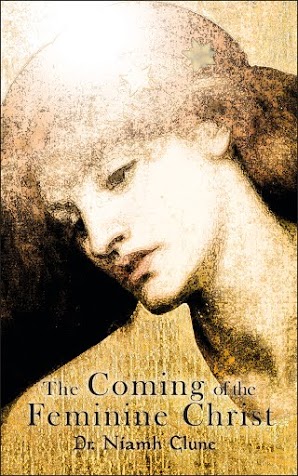
cover 4

(Extract from The Coming of the Feminine Christ by Dr. Niamh Clune)

The mystery surrounding the Ark of the Covenant still persists. Many seek the Ark, as they seek the Grail believing it to be a material object rather than a mystical one. Whether or not it actually exists, must be left to archaeologists and relic seekers to determine.

In the context of this story, the Ark of the Covenant is another of those metaphors that describes a Thing-of-God’s, about which nothing may be known or spoken, not even if it exists. It belongs to metaphysical reality as a relic content of the ancient psyche.

The Ark contained four things: Moses’ tablets of the law, Aaron’s rod, golden candelabra and the urn containing manna from heaven. These four sacred things are physical representations of ancient core psychic contents, which were considered sacrosanct, divine Things-of-God and preciously held within the human soul.

These Things-of-God are psychological building blocks through which the human soul is expressed in the world. Over the course of time, as east met west, the four sacred things came to represent the quaternary of being that shape-shifted into representations of the Blessed Trinity and its reciprocity with Humankind.

The tablets of Moses bear early reference to humankind’s relationship with the Father Archetype or God the Father. In this case, the heavenly Father is portrayed as a spiritual lawmaker. As eras moved one into the other and Moses led his people out of Egypt, a new Age was dawning. Humankind was moving out of the astrological sign of Taurus and into the new sign of Aries.

The astrological sign of an Age usually spans two thousand years. As humankind spiritually moves from one Age to another, a new Covenant between Heaven and earth must always begin. Mythically, the tablets signify the embodiment of that New Covenant.

Aaron’s rod symbolises the Son of Father and possibly portrays an early Christ archetype. The golden candelabra correlate with the light of the Holy Spirit which illumines us from within. And the sacred urn symbolises the sanctified human heart in which all three aspects of the Blessed Trinity meet in humankind and radiate their grace. Thus, grace, the manna from heaven, is the gift contained within the chalice. Through grace, land, bloodline, culture and creed receive benediction and healing.

These motifs of the Blessed Trinity and its relationship to Humankind are again resurrected in the Grail myth. The Chalice contains the three persons of the one godhead. Its relationship to Humankind is embodied in the blessed woman who will give us counsel. She symbolises matter that is the sanctified human body, the physical expression of spirit.

In this motif, ancient stories coalesce. Their continued transfiguration had been born of those preceding ages as a creative synthesis of cultures, trends, eras, beliefs, sacred motifs and relic contents. Finally, the prophetic psychic content of the message [Sic. described in The Coming of the Feminine Christ] reaches us and is relevant for the age in which we now live and have our being. This tiny motif, when indwelled, unfolds its mystery and complexity. It tells us that Aquarian seekers of wisdom are destined to integrate the three persons of the one godhead in the awakened, conscious heart, and when they do, they will radiate grace which will separate truth from falsity.

This is the grace bestowed by authenticity. The Grail is not an object to gain, but something we become. Such individuals will become Feminine Christs: not born of the womb but of the sanctified heart. Without father or mother, genealogy, beginning of days or end of life, these are priests forever, in the order of Melchizedek, of the spiritual bloodline of all those Christs who went before and will come again.

As already described, I trod the inner path following the mystic thread of ancient symbols deeper into the labyrinthine passages of the ancient psyche. I indwelled the sacred motifs and images. As I did so, the secrets of a threefold initiation in water, which baptises the emotions, in blood, which baptises the bloodline, and in fire, which baptises the spirit, became revealed.

Each initiation is unique. It is always difficult to impart its secrets. In this description; therefore, I can only generalise and describe my own experience and experience of working as a psychotherapist with many others.

The threefold initiation is experienced over a long period of time. The process begins with a slow, deep, burning sensation in the top of the head. At first, this sensation might be accompanied by what feels like an overstimulation of the chakras. Before we learn how to acknowledge emotion through catharsis, this psychic stimulation can cause us to feel “spaced out!” This is because the emotional body has become congested through tacit stimulation. As yet, it has not begun its release.

Issues dissolve in tears of cathartic self-forgiveness. At first, as we confront negative traits and tendencies and wrestle with our demons, many experience shame. This is the first baptism in water. Tears baptise personal emotions, purging anger, hurt, rejection, abandonment, betrayal, grief and the whole gamut of emotions that we, as feeling, sentient beings are capable of feeling. Such emotions have their focus in the solar plexus. As we enter into cathartic process, these are raised into the heart. Gradually, we awaken to the wider world of feeling and meaning, developing a deeper sensibility, empathy, participation, presence and resonance. We have begun to experience the broader unity of being.

This is an ongoing process, during which time, the astral body is vastly expanded. The feeling function is enhanced and differentiated, enabled to be in communion with a whole field of experience, yet valuing differences contained with that field. And just as the pupa is transformed into a butterfly, the astral body is being gradually transformed into an emotionally purer receptacle for the emergent soul. The spiritual heart is now prepared for the second baptism.

Our journey now shifts from the personal to the transpersonal into psychological core issues and mythic complexes that keep the soul in bondage. This is the baptism in blood, and this journey leads us deeper into the Mystic Labyrinth. We begin to recognise the psychic DNA pulsing through our veins. We recognise how personal issues are deeply connected to much more ancient stuff connected to the psyches of our fathers and mothers and through them, connected to our ancestry. We begin to recognise underlying collective patterns and how they shape-shift over time as they are influenced by differing cultural mores.

Once recognised, we begin a process of detachment, not brought on by denial, but through the development of right relationship to self. We have come to know our demons, which are never eradicated. They are always there, waiting to take possession of us. But, because we know them, they lose much of their impact on the psyche. We have learned how to extricate ourselves from obsessive engagement with them bringing them under control through conscious recognition. They cease to have their wicked way with us!

Metaphorically, the sins of the fathers are no longer visited upon daughters or sons. And although we are always aware of those patterns, we have learned how to transform negative contents into something positive, creative and light-giving.

Psychologically, the heart is split asunder, washed clean by the Blood of Christ, archetype of the human soul, spark of divinity within us. We have come to the heart’s core and experienced Love as the purifying force. The purified heart is the embodied Chalice. And it will guide the seeker to the third baptism.

By now, the Initiate recognises the sacred vibration of her or his secret name. At last, s/he has come to the sacred place to the centre of the heart where the four quarters of being stand still. This stillness cannot be achieved by an act of will or visualisation. It is born only of inner baptism and subsequent real transfiguration.
The Spirit descends in response to the call of the awakening soul. But in order to speak of the final act of spiritual baptism, I must, once again, resort to more poetical, metaphorical language…

The soul calls out to the One Initiator to extend the rod of spiritual fire and strike the chord of sudden knowing. This kind of dynamic thought is born only of the impelling silence in which the inner thinker thrives. It comes from the world of idea, is felt in the centre of being where the power of God stands still. In that stillness, salvation for Adam and all his descendants is accomplished. This is a baptism of fire; it consecrates the spirit.

The chord reverberates throughout the Initiate. It tunes up the whole of being bringing all dissonance into alignment. The soul is liberated, energy trapped is freed. Each chakra opens and is illuminated. From octave to octave, each sounds its note of perfect harmony.

The Apocalypse speaks cryptically of this initiation. John the Divine describes the opening of the Seven Seals and how, in his vision, he had seen Seven Spirits sit before the Throne of God. The Seven Seals refer to the chakras, which open unto the light of the Seven Spirits, the seven great cosmic archangels in whom we live and move and have our being. When this happens, we become linked to the universe, plugged in and charged up!

When their perfection comes into communion with the seven chakras, it also brings imperfection to the surface. Archaic remnants sealed in the murky depths of unconsciousness spill out like plagues.
This process happens naturally. It is unwise to call it forth. This is each individual’s Apocalypse. And only the awakened heart can transfigure us.

I speak now in more detail of another ancient mystery, the raising of the Kundalini, a mystery that is little understood but which underlies much of our ancient symbolism.

Different schools of healing teach the opening of the chakras and raising of the Kundalini. This is often performed through breathing exercises or the use of visualised Colour. However, the Kundalini can only safely be raised through an awakened, conscious heart. The reason for this is that subtly, each chakra is connected to its corresponding World Chakra. Should the seeker begin sequentially (which is often the taught system) from the root chakra working up the spine without first having purified the heart; and thereby, expanding the astral body, premature raising of the Kundalini could dramatically burn through the etheric web leaving the seeker with no protection from the full force of the world’s undifferentiated primal root chakra energy. This psychic refuse could destroy the Initiate, causing insanity or disease. Only character, courage and heart-centred consciousness can withstand the opening of the Seven Seals, when the forces of the underworld spew their psychic plagues, those negative traits and tendencies inherited through our psychological DNA.

The Initiate’s odyssey involves a conscious journey into each of the chakras in esoteric order, catharting each sorrow and confronting each demon.

The secrets of raising the Kundalini have never been written. Personal experience allows me to understand the esoteric order in which the chakras open. This opening is by no means sequential. And, fortunately, this inner event takes place over a long period of time.

As already mentioned, the process of initiation begins with the slow burning in the head centre. This continues for a number of years. This is the first call of spirit, as it gradually begins the threefold baptism. Its focus in the Crown Chakra, known also as the Thousand Petal Lotus subtly vitalises the pineal gland. Energy of the greater Will begins in a trickle through the head centre. From there, spiritual force moves into the brow centre and arouses the pituitary gland into fuller functioning.

When Christ spoke to Joseph during his confinement in prison, He told him: “As the trunk bore the apple that grew from the tree by the miracle of God, so too had the Son of God to die upon the wood, in order to accomplish this salvation.”

The apple that grew by the miracle of God refers to the pituitary gland, which is the ruler of the Ajna centre, the mythical seat of consciousness. The down-pouring, threefold fire of Spirit super-stimulates the gland and brings with it, direct spirit knowing. The pituitary is thus referred to as the apple, fruit of the Tree of Knowledge.

The pituitary gland is also said to rule the third eye: the organ of perception that enables us to see into inner realms. When fully awakened, the Initiate’s perception of metaphysical realms is greatly enhanced. S/he will die upon the inner tree, in other words, transfigure through a deepening perception of Spirit. The inner tree is the Alta Major, whose roots burrow deep into the root chakra, with branches reaching up to the crown chakra. This is the tree of knowledge upon which the Initiate stands alone, and upon which, spiritual salvation for the bloodline is accomplished.

This is why, when Christ visits Joseph during his confinement in prison, he tells him that because of the chalice, no victim shall be offered up. This signified that future sacrifice would be an internal one bringing about real transfiguration: the foundation-shift of Asraya Pavravrtti.

There are many, mythic references to the apple or fruit of the Tree of Knowledge. Indeed, Avalon was known as the Island of Apples. Perhaps this metaphor referred to Initiates who entered the inner realms via the Avalon of their own beings, awakening the third eye and thus becoming seers and keepers of the sacred knowledge hidden in the soul.

The ancients thought the right functioning of the endocrine system held the secret of immortality. Should the pituitary gland be stimulated by the down-pouring fire of Spirit, it was believed by the ancients that elixirs would be discharged into the bloodstream. This elixir of life was the healing promised to the one who found the Grail. Metaphorically, these elixirs are supposed to purify the blood. The blood will carry them to stimulate all other glands in the endocrine system.

Whether or not an elixir or positive hormone is actually secreted during this process must be left to speculation. What is clear is that something triggers the endocrine system to set in motion a process that will open the chakras and raise the Kundalini. Proving this would be impossible. It would involve monitoring the secretion of hormones into the bloodstream preceding the raising of the Kundalini! As raising the Kundalini usually happens unbidden, such processes must remain in the domain of metaphysical reality. These hormones probably leave no discernible, physical trace. But I can attest that the process is experienced physically as a tremendous surge of energy accompanied by a burning sensation, a kind of electric fire in the soles of the feet surging throughout the whole being, right up to the crown!

The down-pouring fire of spirit first began the opening of the Alta Major chakra. The carotid gland governs the condition of the Alta Major which, in turn, is spiritual ruler of the spine. During the slow process of initiation, the Alta Major projects the fire of down-pouring Spirit into the channel situated on the right-hand side of the spine. This channel, or nadis, is known as Pingala. As the fire of illumination penetrates deeper into the chakras, the psychic refuse of our ancestral lives is gradually discharged upwards, flowing up the channel on the left-hand side of the spine, known as Ida.

The Alta Major is the gateway to the emotional/astral world, the back door to the unconscious. The next chakra to open, therefore, is the solar plexus. This is the seat of emotion. When the fires of illumination penetrate the solar plexus, our emotions are raised into the heart. They pierce the spiritual heart from below rupturing the heart’s etheric web.

The heart centre now begins its full awakening. It becomes more inclusive and expansive, attuned to world suffering. It becomes the central force of our being. Acting as a magnet, it begins the slow and painful turn of direction that will draw the primal energy of the lower chakras up into consciousness. All the energy of primal sentience will be transfigured through the heart.

The heart raises sexual energy from the sacral centre. This is the next centre to be vitalised. The Initiate penetrates ancestral miasma. Sexual energy is transmuted via the heart and raised to the brow centre. It feeds and strengthens the third eye so that its vision may penetrate yet deeper, into sentient, desire worlds

Eventually, the fires of illumination reach deep into the energy dormant in the root chakra. When the heart is the centrifugal force of being, it is safe to experience this centre’s expression. It is unnameable, a deep, dark impotence, an ancient yearning. This is the yearning of the spirit trapped in the desire world, the fallen angel seeking its redemption.

It is the primal consciousness of the body, also known to alchemists as the Chthonic spirit.

Situated beneath the base of the spine, and dormant in the root chakra, is coiled the serpent fire known as Kundalini. Mythically, she has been attributed a feminine identity because she rules matter, from whence the term mater or mother derives. She is the mother who has dominion over the latent energy of substance itself. She rules all things physical and has dominion over the world of instinct, survival and desire.

When touched by the fire of spirit, the coiled serpentine energy of the mother awakens. This is the snake that tempted Eve to desire consciousness.

Her fires snake up the spine through the central channel of Sushumna. She burns through the remainder of the etheric web. Her fires now combine with the waters of the astral world. The desire nature has, by now been purged, the astral body greatly expanded.

Her fires are raised heavenward to the crown centre where she unites with the energy of Spiritual Will. When combined with the fires of down-pouring Spirit, we eat of the fruit of the Tree of knowledge. We are visionaries of past and future. This is the conjunctio or sacred inner marriage referred to by alchemists of the Middle Ages, or modern-day transpersonal psychotherapists.

Matter has been raised heavenward and unites with the threefold nature of the one godhead. Raising the feminine spirit latent in matter to consciousness makes the mother blessed. She is the blessed woman who will give us counsel.

In Biblical mythology, the uncorrupted body of Mary, mother of Christ, was raised into heaven after her death. This image was taken literally by the Church. It is, however, symbolic of the raising of the Kundalini. Matter, from the Latin mater, means mother. It is raised heavenward and thus redeemed. All the centres are vitalised. All limitations are destroyed. The Initiate stands perfected, in that God and human are reconciled.

The third eye is fully opened. The crown of the Initiate’s head has been baptised with His blood, and salvation is accomplished. The Initiate has gained the gift of prophecy, priesthood and kingship. S/he is a true seer, a priest of God Most High in the order of Melchizedek. The voice of God is heard to speak the name. This name carries the vibration of a sacred task for which the Initiate is named, only by God.

S/he is touched by an archetype, destined to live out a collective myth. S/he will stand on earth as a conduit through which inpouring spiritual light comes to ground. The raising of the Kundalini creates a vacuum in the etheric web. The Initiate has left an empty, psychic space. By the laws of physics, it must be filled.

The Initiate’s consciousness acts as a magnet that draws the energy of the collective unconscious into the vacuum. The vacuum serves as an open channel that constantly fills with the suffering of the world. The Initiate feels it all. From there, the sins of the world are transmuted through the greatly expanded heart of the Initiate who is now functioning as a living Christ.

The Initiate has become a link between Heaven and Earth. Through her or his intercession, Spirit is invoked that will come to meet the call of earth. The consciousness of the collective is gradually raised, earth’s vibration gradually more attuned to cosmic being.

S/he is a feminine Christ, transmuting the sins of the world through the divine feminine ~ the awakened heart.

– Niamh Clune

Chris Reminds Me

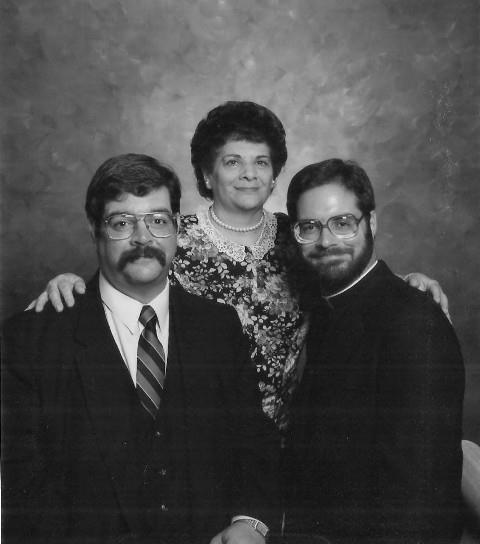
Dan and Chris at Dan't ordination as a Spiritan Priest (Roman Catholic)
Dan and Chris at Dan’t ordination as a Spiritan Priest (Roman Catholic)

Pentecost was on May 27 the year I wrote this, my brother Christopher’s first birthday since his death from heat stroke August the year before. It’s also the official opening of the new Spiritan Formation House here in the Philippines. My Mom’s first birthday after her death was the solemn consecration of the first parish church of the Resurrection of the Lord Chinese-Filipino Catholic Community here in Iligan. First birthdays after death seem to be good for my family. Heck, I figure there should be at least one new Outback Steakhouse opening somewhere on my first birthday in heaven!

I find myself thinking a lot about Chris as his birthday on Pentecost approaches. In just a couple of months it’ll be 25 years since my first vows, too. Chris has taught me a lot about religious life, a lot about being a Christian over the years. He’d get a kick out of that, I’m sure, since he always felt he couldn’t quite get a handle on God. It didn’t mean he’d stopped reaching, though.

Chris and Dan on either side of their mother, Yvonne.

After Mom died, Chris was living in a tiny room in a boarding house that couldn’t produce any permits to exist. He was, as he always joked, the only one he was sure had no links to al-Qaeda. Around him were young men from Egypt, Jordan, Palestine, Syria and Lebanon. They were typical Brooklyn illegal immigrants, most of whom drove for equally typical Brooklyn illegal car services. All that was fine with Chris, and he was actually improving his pitiful Arabic skills…or at least his hand gestures and grunts, which in themselves account for over 37% of Arabic conversation. One day he went out for a walk; he had been out of work for a while on medical disability, a fact he never accepted well. After a stroll through the neighborhood, he returned to find that smoldering ashes and general chaos were all that remained of the house…and of his few possessions, including a TV that dated from before the advent of remote controls. I had a whole novitiate of lessons on “detachment from worldly things”; Chris did the crash course in one afternoon.

The others, with proper respect for the immigration services, scattered quickly to the houses of distant cousins throughout the neighborhood, or to one of the local mosques, especially to what everyone simply calls “the 69th Street Mosque”. Of course all the mosques have proper names, but most are impossible for the tongues of Brooklynites, so they are simply known as “the 69th Street Mosque”, or “the 12th Avenue Mosque.” Who says common sense isn’t common in Brooklyn?

Once all our family in America lived in Brooklyn, but now they have scattered outside the city and the state. Chris was the last hold-out, a rare Brooklyn-born Lebanese still living in Brooklyn with the latest wave of immigrants. Cousins outside of New York invited him to stay with them, as did confreres who heard of his trouble. But all of them were out of New York City, and the miles and miles of general-assistance red tape would become even redder, wider, and longer if he left the city proper. He’d have to file and refile differently, line up to wait hours, just in time to be told to come back again. So he ended up in a city shelter. One of those cold places where you have to leave at 8 in the morning and can’t come back until late in the evening. He could use his government issued food stamps to eat. I remember seeing food stamps when I was a kid. They were like tickets in a book and you gave them in payment, not unlike tickets for a “B Ride” in Disneyland of old. But instead of “The Magic Mountain Ride” you could get a can of tuna for dinner, Chicken of the Sea at that. Now everything is in the magnetic swipe band of what looks like a credit card. Progress! We haven’t done so well with poverty, but we’ve sure come up with a great new food stamp card.

To get out of the elements, Chris used to go to the public library to e-mail me here in the Philippines. He’d wait in line for hours to get the half-hour daily maximum allowed for free internet service. Most of that time was spent sending job applications. I was his one luxury letter sent a week. He wrote once, “You’re right; ‘being’ is a lot harder than ‘doing.” He was referring to a conversation we had had twenty-five years ago this July, in Farnham, outside Montreal. The night before my first profession of vows Chris asked if I was joining religious life because I believed there’s a God who is actually around and interested and wanted me to be a Spiritan, or so I could reach out and help people. I tried to explain at the time that it was “both”, not an either/or question. And it made me think of a line from a renewal program that was all the rage when I was in college, Genesis 2. It was something to the effect of “So often we are busy doing holy things that we don’t have the time to become holy ourselves.” That’s why “being” is so important; being who you are, being with God, so that you can become holy yourself while doing holy things. I made up my mind then in college that I wouldn’t just do holy things, but I’d become holy, too. But Chris always felt he had to do. In fact, unable to figure out what to do with his time in spite of his bad health, he was on his way to a city-sponsored workshop to update his work skills when he fell over dead from heat stroke, a few blocks from the BMT subway he had just taken to Manhattan. Chris defined himself by what he did, but he reminds me to see myself for who I am.

I remember his e-mail telling me how just before his bureaucratic papers, documents and files were approved and the day of his long-awaited exodus from the shelter to a legal room for rent arrived, he ran into one of the young Egyptian men, Abdelkader, who offered to bring him to the mosque for a hot meal and a place to stay. Brooklyn’s nickname is the “City of Churches”, but it was only the mosque that swung open its doors for Chris. When Jesus said “love your neighbor as yourself”, the scholar of the law asked “Who is my neighbor?”, and Jesus told the story of the Good Samaritan (Luke 10:25-37). Chris didn’t know his Bible stories well, but he learned a lot from life. He always reminds me to do that. Once he had offered cake and coffee to a house of uncertain Arab Muslims far from home, and then the mosque offered him dinner and a rest from endless wandering in the damp cold. He always felt like he couldn’t figure out the “Love the Lord your God” part…but he certainly had a handle on “love your neighbor as yourself”. Maybe it was because when we were young we spent too much time with symbols—icons, candles, incense, statues, holy water—that he never reached the reality they represent. So he shied away from both. “Fa-ghet-about-it”, he’d say in modern standard Brooklynese. It was as if he were at a party, just waiting for God to ask him to dance. But every time God did ask, he refused, so afraid he’d step on God’s feet. Chris reminds me to dance. God has strong feet.

He died in August, only a year older than I am now. He reminds me to live the wonderful gift of the minute, to enjoy the now since only God knows if there’ll be a later. It’s freeing and life-giving. “Can any of you by worrying add a single moment to your life-span?” (Mt 6:27) No wonder Chris was so taken with the first reading at both my perpetual vows and my ordination which said in part, “You have been told what is good and what the Lord requires of you: only to do the right and to love goodness, and to walk humbly with your God.” (Micah 6:8)

Chris took the meaning of “Church” from the Bible, and so always pointed an accusing finger at me and saying “you believe”, “you say”, when he was talking about church pronouncements, traditions or documents! He always reminds me to live and to own and to share what I believe…I am Church, we all are!

Chris died just as we here in the Philippines were busy welcoming new confreres and seminarians, and putting up the new formation house that will be officially opened on his Pentecost birthday. I know I could have asked for the money to go to New York City to bury his body. But there was and is so very much to do for the living….I had to think if meager resources should be spent on the dead. There are so many ways to mourn, you know. As the funeral liturgy so beautifully echoes the Scripture, “When the body of our earthly dwelling lies in death, we gain an everlasting dwelling place in heaven.” And besides, Chris and I are the children of immigrants, poor folk who were never able to go back to their homeland to bury their own dead. Chris inherited two things from Dad, a strong aversion to a suit and tie, and an even stronger aversion to spending money. Except Chris didn’t have colorful, if somewhat repetitive, stories about having to eat only potato soup during the Great Depression to justify himself. It would be ironic if I, now in a vow of poverty, used that as an excuse for all the luxuries my family had learned to live without. Or if, as the fancy books put it, I couldn’t tell my “wants” from my “needs”. Chris keeps me honest.

So faced with the fundamental truth of life and death, I let New York, my wonderful New York, bury his weary bones in an unmarked paupers grave, along with the homeless, the unnamed and the unchained. I figure some he must have already met along the way. But they are only bones turning to dust. Christopher himself, and all those unnamed, have gone home to dance with the Lord, the music and the rhythm finally clear. Finally. Chris and God are hand-in-hand; and God’s leading. And me, well, I keep swaying to the music…step, step, shuffle, turn! God has strong feet.

Father Daniel S. Sormani, C.S.Sp.

© 2015, essay and photograph, Daniel S. Sormani, C.S.Sp.

Twelve Things Your Grandparents Said …

©old-age-by-cecigian

When you are very young, forty seems ancient and grandparents are, of course, so old they are practically another species. Like dinosaurs…almost- but-not-quite extinct and very much at home in museums. Their homes bear the traces of a ‘bygone era’…you know, a whole twenty years ago… and it is impossible to imagine yourself walking in their shoes. Not that you would be seen dead in them…

I clearly remember my own feeling of awe when my mother reached the venerable age of thirty. I was already pretty much grown up… in my own eyes at least… and could barely conceive of a time when I would be that old. These days, of course, thirty is a spring chicken and even my grandparents would have been younger then than I am now. I remember too some years later when my great grandmother, well into her late nineties at that point, explained that she still felt 18 inside; it was only her body that had aged. At a little over half her age, I know what she means these days and I got to thinking about some of the other things my grandparents had said to me.

1. “I wouldn’t want to be 18 again…” Now why, thinks the youngster, wouldn’t you want to be standing on the threshold of life, with a body that works as well as it looks?

Too damned right I wouldn’t want to be 18 again says the older self… I wouldn’t mind bits of me turning back the clock to that particular decade. Mainly the ones that were measured in inches. But on the whole you can keep the teenage years. Too much angst, too many hormones. And anyway, every day is a threshold. And, the older you get, an achievement.

2. “It’s all downhill from here…” This one needs a certain amount of clarification. When they said ‘all’, they meant it. Back then I assumed they were speaking merely of advancing years. And possibly the inevitable descent of salient points of the female anatomy. Not everything from cheeks to hair.

On the other hand, downhill is always easier, more comfortable… and usually far more fun.

3. “Wait till you’re my age…” Been there, done that… what next?

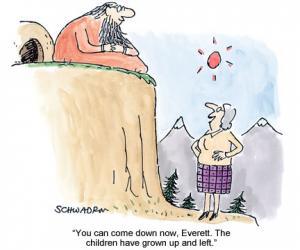
0804-harley-schwadron-d2

4. “Wait till you have kids…” See above.

Of course, when those kids have children of their own there is both the joy of grandparenthood and the silent satisfaction that comes when you realise that you survived all the sleepless nights and the worry… and not only when they were babies either.

And now you don’t have to.

Then you get a dog.

ani-002

5. “Youth is wasted on the young…” The old can be younger than the young. Youth has a brash self confidence that masks its insecurities. Time brings a ‘what the hell’ attitude that ceases to worry about society’s curtain twitchers.

6. “I’m old enough to get away with it…” Think purple hair. The unholy glee involved in doing the things your younger self would not have dared to do. There appears to be an exponential ratio between advancing years and the ability/desire to embarrass any of your children who think you should grow up. Also see above.

7. “What?” “Eh?” “What number is that bus?” You, of course, are never going to find yourself losing hearing or vision. You are young and indulge the ‘elderly’ fifty somethings with a certain amount of exasperation.

Wrong. Your hearing will diminish, if not in volume then in range. You won’t even realise you have been lipreading for years until you can’t hear the dialogue in that night scene of the movie. And if all else fails, your hearing will become selective. Because it can.

Your eyesight is a different matter. It is at this point the zoom lens on the camera comes into its own, allowing you to see both blurred distance and close detail.

The eyes on needles are now being made impossibly small and printing fonts are becoming unreasonably tiny. And no, you haven’t got your glasses because you’ve forgotten where they are…

On the other hand, you see more than you have ever seen before. Mainly because whatever they are up to, you have already done.

old-age-1-jpeg

8. “They’re comfortable…” There are few things more elegant than an older person who has ‘made an effort’, few things more beautiful than eyes filled with knowledge and experience of life. Yet flatties and elasticated waistlines are your preferred style these days.

You’ve teetered around in stilettos (I’m probably talking about the women here) were in at the original birth of the mini skirt (applies in various ways to both genders) and you can still dress up with the best.

You are, however, no longer obliged to be a contortionist to get into skin-tight jeans, can choose warmth over style… or simply create your own. See point 6… and point 5 for that matter. And possibly point 2.

9. “Ouch…” (Or a variety of other groans, creaks and noises) Face it. Any machine is going to wear out; use it at maximum capacity and it will eventually become ‘loose in the joints and very shabby’. This is no bad thing. It means you have lived.

10. “I couldn’t care less these days…” This, of course, is something of a dichotomy. On the one hand most of the previous points illustrate that where the opinion of the world is concerned, this is actually true. This is the inner freedom that the years bring as their gift.

On the other, it is an out and out fallacy. You don’t stop caring as you get older, in fact, if anything, you care more deeply. You care about the changing world, seeing with the clarity of distance the follies of youth being played out upon the world stage. You have little patience for the posturing and jostling for position of the power hungry. You just may not shout quite as loudly about it. But then again, you just might.

You have seen enough to know what really is important… and those things you care about. You cherish friendship and companionship, your family and those you love. And getting out of bed in a morning.

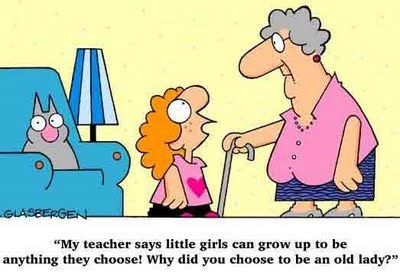
old-age-cartoon_career

11. “I remember when…” Don’t knock it. The elders of a tribe used to be valued. You have become a caretaker of the past, passing on what you have learned of the wisdom of generations. You become a walking Wikipedia. The original wifi. Here too the camera comes into its own, not capturing beauty, but memories to share; visual reminders for a time when the personal RAM (randomly accessible memory) is so crammed full of a life well-lived that retrieval becomes debatable.

old-age-cartoon_career

12. “If I had known then what I know now…” What…no mistakes? Now where would the fun be in that?

Neil Gaiman, the ‘middle aged’ writer whose twitter handle famously states that he ‘will eventually grow up and get a real job’ says it perfectly.

“I hope that in this year to come, you make mistakes.

Because if you are making mistakes, then you are making new things, trying new things, learning, living, pushing yourself, changing yourself, changing your world. You’re doing things you’ve never done before, and more importantly, you’re Doing Something.

So that’s my wish for you, and all of us, and my wish for myself. Make New Mistakes. Make glorious, amazing mistakes. Make mistakes nobody’s ever made before. Don’t freeze, don’t stop, don’t worry that it isn’t good enough, or it isn’t perfect, whatever it is: art, or love, or work or family or life.

Whatever it is you’re scared of doing, Do it.

Make your mistakes, next year and forever.”

There’s not a lot to add to that, is there?

2c2f13e40a38e18dd621d3cb491bb57b

– Sue Vincent

2014, feature article and photo of pup, Sue Vincent, All rights reserved; cartoons are from various sources (noted on the cartoons) are copyright protected and via Sue Vincent

Warrior In a Place of Ghosts

b2ba34a662dd199f2a63457422a47fa8

Plenty Horses

The fickle winds swirled me around, like I was
a snowflake dashing among the bullets
and over the frozen dead at Wounded Knee.
I, who could read the spirit of The People
and also read the books of the Wasi’chu.
I, who was shunned as neither Brulé nor white.
I, a ghost in the land of the Ghost Dance.

After I shot the yellow leg leader
of the Šahíyena scouts who hunted and
drove us to that place where the winter winds
tossed away our life and lives like dried leaves,
I once again became one of The People,
not a murderer as the Whites said.
I was a warrior, only now one in a place of ghosts.

On December 29, 1890, a detachment of the U.S. Army’s 7th Cavalry Regiment entered a camp of about 350 Miniconjou and Hunkpapa Lakota people at Wounded Knee Creek to disarm them before returning them to the Pine Ridge Reservation. But then a shot rang out, and some 300 Lakota men, women and children were gunned down. The Wounded Knee Massacre is viewed as the end point of the so-called “Indian Wars” between Native and European American people.

But a week later, a young Brulé man named Plenty Horses, recently returned to the Rosebud Reservation from the Carlisle Indian School in Pennsylvania, shunned by his people for being like a White and by the Whites for being Indian, shot and killed Lt. Edward W. Casey, commandant of the 8th Cavalry’s Cheyenne Scouts. By doing so, he hoped to regain standing among his people as a warrior.

Charged with murder, Plenty Horses was eventually acquitted based upon his need to be regarded as an enemy combatant in order to provide a validation of the Army’s massacre at Wounded Knee. It was indeed, a time and place buffeted by winds of hatred, confusion and tragedy. I hoped to somehow express that “world turned upside down” state of Plenty Horses’ unique situation on the anniversary of the Wounded Knee Massacre with this piece.

– Joseph Hesch

© 2015, poem, Joseph Hesch, All rights reserved; photograph of Plenty Horses (1890) by  John C.H. Grabill, from the Grabill Library of Congress, LC-DIG ppmsc 02524, public domain

Turning Night Into Day

There was once a wise old rabbi who asked his students, “How can you know the exact moment when night ends and day begins?”

“I think I know,” said one of his pupils.  “Is it when, from a great distance, you can tell a dog from a sheep?”

“No,” said the rabbi.

“I know,” said another.  “It must be when, from a distance, you can tell a date palm from a fig tree.”

“No,” said the rabbi.

His students looked at each other and then at the rabbi.  “We don’t know,” they said.  “Please tell us.”

And the rabbi replied, “It is when you look into the face of any person from any nation…

…man…

…or woman…

…Jew or gentile…

…and see your brother…

…or your sister.”

”And that is the blessed moment,” said the rabbi,  “when the dawn is come.”

c2014 NaomiBaltuck

Tears for Icarus

IMG_0201
The Lament for Icarus by H. J. Draper

Spiral cloud mountains build in the sky, towering to 20,000 feet, I’d guess. Below, is the town of Douai, where we know Bloody Richtofen’s Jasta 11 calls home this month.

The golden disk to the west is setting and the Albatros scout planes rise to meet us. This is going to be a ripping scrap, I can tell. And then we are in a whirlwind of brown machines and red machines, red-white-blue cockades and black Iron Crosses all flashing by so fast that sometimes you can hardly keep your bearings. Like so many of these recent fights, everyone gets scattered across the sky. But I can’t look out for everyone when I have to do my other job, kill Germans and come home to Flora.

A red aeroplane with a yellow nose and tail whips past Cecil Lewis, and I take chase. I will get to 50 victories. I will get to 50. I must get to 50. He twists and dives and heads into the clouds and I know he can’t shake me. My attention is solely on his tail. I recognize the flash of the setting sun on his goggles as he glances fearfully over his shoulder at me, as I’ve seen that look hundreds of times before. I know it as sure as I know the booming of my own heartbeat in times like this.

I fire burst after burst into him, a drum of bullets from the Lewis on the top wing and 60 or 70 rounds from the Vickers gun in front of me.

I see him drop below me and I know he’s done. I see it all so plainly. The craziness and blood lust that overtakes me at such times ebbs away. And I think of my Flora, my Bobs again.

Then I break through the clouds, seeing from my altimeter that we’ve dove to only 200 feet. But the clouds are in the wrong place.

“Flora,” I cough, “why are the clouds below me and the church steeple above me?”

“Rest, Albert, lie back and rest.”

I fight the urge to rest, I have to get back to the squadron, get back to England, get back to Bobbsy. The glowing disk in front of me fades away. It’s not the disk of the sun, or my identity badge, it’s my spinning propeller. It stops and then I only see its top, hanging vertically like that stalactite church steeple in front of me.

And then that great noise.

“What’s going on, Bobs? Can I come home to you now? General Trenchard promised me I could come home now.”

“Yes, Albert, you can come home. You don’t have to hurry, though. We’re waiting.”

I see her face above me again, so beautiful, so young. Even now when I see her I can barely catch my breath. Yet her eyes are so very sad as I lay my head back in her lap. I feel raindrops on my face.

“Don’t cry Bobs,” I say.

****

Fifteen year old Cecille Deloffre had lived amid the sounds of war for a quarter of her life. She’d learned to sleep to the thunder of the big guns as if they were a summer rainstorm. She ignored the buzzing drone of the aeroplanes as they flew west-to-east and east-to-west each day, often punctuating their passage with the very unmilitary staccato drumbeat of their machine guns.

Cecille had seen some of these machines fall from the sky, glowing and tumbling like a cigarette tossed by one of those German soldiers hidden in the steeple of the nearby church in the village of Annoeulin.

This evening during dinner she had heard the fight above her home, sounding so much like someone had struck a hornet nest and the swarms spreading across the sky.

Then Cecille heard the sound of what could have been two aeroplanes directly above. Her mother crossed herself and tried dragging Cecille from the table to the root cellar beneath the kitchen floor.

She broke from her mother’s grasp and ran into the small fenced yard in front of their farmhouse just as one machine spit a tongue of fire back from its yellow shark-like nose, engine sputtering, gliding to a crash landing on the other side of the village.

She heard another aeroplane’s engine sputter and stop, just as it whooshed, upside-down, from the low storm clouds not 300 metres up the road. Its pilot wore no helmet and she could see his eyes but not his face in the growing dark.

Then the aeroplane just fell, like an old leather-bound book dropped from a table.

Cecille stood frozen for a second to see if this machine would catch fire. But it only lay crushed on its side like a coffee-colored bird knocked from the sky by a kestrel. The pilot’s head move and she ran toward the aeroplane, unsure why, with her mother screaming after her.

As she came up to the crash site, the young man within the broken machine released his buckle and fell from the cockpit with a thud, a moan, and a faint rasping wheeze.

Cecille reached for the boy and pulled him a few metres away from his machine. She rested his head in her lap and he slowly opened his eyes, looking up at her with such longing that she couldn’t keep from crying.

“Don’t cry Bobs, Bobs, Bosshh…” she heard him barely whisper. Then stillness.

From behind them came the pounding sound of the jackbooted soldiers from the steeple. They chattered with delight, so sure they shot down a British flyer. But they hadn’t. Cecille noticed the boy had no wounds on his body.

Her eyes red with tears, Cecille looked down at the boy again and saw but a small bruise beneath his eye where his goggles had been. In her lap, the face of 20 year-old Capt. Albert Ball, MC, DSO, VC lay in silent repose. The sooty stain on it was variegated in white by the tracks of tears, like the half-smiling black marble bust of a saint. They were his tears and that of a beautiful young girl he briefly saw and was sure was the one he loved.

Cecille looked up at the surrounding soldiers and spat out, “Il est mort, Boche. C’est fini.”

But Albert couldn’t hear her. He had just won his 50th and he was flying home.

– Joseph Hesch

© 2015, fiction, Joseph Hesch, All rights reserved; painting, public domain

Their Compassion Has Legs

“All you need is a sense that there is no such thing as ‘no’ and everything is possible.” Moira Kelly

This shining face, this sweet spirit with reason to be bitter and yet he is not. He is a hero and pure inspiration. When Naomi Baltuck (Writing Between the Lines/Life from a Writer’s POV) posted this video on Facebook, I was as touched as anyone would be. I had to wonder though about his mom. What kind of hero is she, I thought, remembering the heroes of my childhood: Josephine Baker and my spiritual mother, Pearl Buck. Each of these women grew their families in unique – and extraordinarily unselfish – ways.

“All my life, I have maintained that the people of the world can learn to live together in peace if they are not brought up in prejudice.”  Josephine Baker (1906-1975)

Josephine_Baker_1950Josephine Baker was born in America but became a French citizen. She was a dancer, singer, actress and civil-rights activist.  As a child living in St. Louis, Missouri, she suffered from discrimination, abandonment, and poverty.  As an adult she had one miscarriage. She adopted twelve children, two girls and ten boys. They were from diverse races and cultures because, in addition to caring for them, she wanted to show that people can get along despite their different backgrounds. In the early ’80s two of her sons went into business together. They started Chez Josephine, which is on Theatre Row (42nd Street) in Manhattan. They dedicated the restaurant to their adoptive mom’s memory and decorated it with her memorabilia.

“. . .  the test of a civilization is the way that it cares for its helpless members.” Pearl Buck (1892-1973)

220px-Pearl_Buck_(Nobel)Pearl Buck was an American novelist, writer, humanitarian and the first woman to be awarded the Noble Prize in Literature (1938).  She grew up in China and spent most of her life there until 1934. She had a deep affection for and knowledge of the countries of the East, not just China. She suffered through the Nanking Incident when the National Revolutionary Army captured Nanking (now Nanjing) in 1927.  Many Westerners were killed, their homes destroyed, and their property stolen.  Her only biological child, Carol, had phenylketonuria (PKU), which causes mental retardation and seizures.  Pearl Buck adopted seven children. At a time when mixed-race children were considered unadoptable, Pearl Buck founded Welcome House, Inc., the first international, interracial adoption agency. Welcome House has placed some five thousand children since it was established 1949.

“The greatest act of kindness changes generations. Wherever there is the greatest evil, the greatest good can be achieved.” Moira Kelly (b. 1964)

emmanuel-kellyThis brings us to a contemporary hero: the mother of Emanuel Kelly, the young man in the video. Moira Kelly is an Australian humanitarian whose work has garnered her many awards and acknowledgements.  When she was eight years old, after seeing a movie about Blessed Teresa of Calcutta (now Kolkata), Moira committed herself to working with disadvantaged children.  She is the legal guardian of twins from Bangladesh, Trisha and Krishna. They are surgically separated but originally cranially conjoined twins.  Moira Kelly also adopted the Iraqi-born Emmanuel and his brother Ahmet, both born with underdeveloped limbs. Among her efforts is Children First Foundation, formed to provide transportation and healthcare for children with urgent needs in developing countries.

These women are mothers in the best senses of that word. Their ideals are real and they stand by them. They have saved children from abandonment and loneliness, from poverty and hopelessness and, in some cases, from early death. They are goddess mothers and true heroes.

© 2013, essay, Jamie Dedes, All rights reserved, Originally published on The Bardo Group blog
Video uploaded to YouTube by DrReaps
Photographs of Josephine Baker and Pearl Buck are in the U.S. Public Domain.
I don’t know the provenance or copyright holder of the photograph of Moira Kelly and her sons. If it is yours, let me know and I’ll credit you or take it down as you wish.

The Year Turns

p1060964

Ice-Storm The year has turned. This evening, weather permitting, we will gather with others to celebrate the changing seasons and honor Grandfather Fire without whom we could not live. We will mark the Sun’s return, remembering the change of seasons is also within us. Here in the Northern Hemisphere the days will now lengthen as the sun begins His slow drift northward. That is the future; this morning the dark lingers. Jennie has moved through the house; lit candles mark her passage.

After a night of sleet, we have freezing rain. The snow plow just came through, potentially a mixed blessing as the coating of sleet protected the road’s surface from icing. A neighbor, out early, calls over through the darkness to ask whether she might bring us anything from the grocery.

Yesterday we braved the storm and the crowds and went shopping. One of our purchases was a second bird feeder. We have squirrels and have wagged a long competition with them regarding the feeders. This time of year flocks of birds come to our back yard feeding station a couple of times a day. Often they also find their way to our front porch where they watch our comings and goings at close range, often greeting us. Perhaps we will place one of the feeders near there.

As Saint Francis knew, the animals and birds are within us. This is ancient knowledge that awakens and reawakens in persons and cultures across the generations. We know their longings and hungers intimately.

Last night as the sleet and freezing rain fell I drummed and journeyed. I wanted to meet the storm directly, to feel the push and pull of warmth and cold and the tricky point of balance between them. As I journeyed I felt the deep antipathy we humans know in relationship to harsh cold and deep darkness. I wondered whether our failure to address climate change reflects that ageless fear of winter.

We warm bloodeds seem drawn to the South and to Grandfather Fire. Father Sun burns brightly within our mitochondria. There is a mysterious power attached to the hearth; there we meet Grandfather, hopefully safely contained. We press in, close to the radiating heart of the flames. Once upon a time we cooked our meals there, witnessing the wondrous transformation of raw into cooked. Grandfather brought us the gift of readily absorbed nutrients and energy, setting us free to explore the world. Mother Earth, Grandmother Moon, and Grandfather Fire also live within us, creating the seasons of the soul and body. Grandmother water shapes our very being.

In a few days those of us who celebrate Christmas will leave cookies and milk, or something stronger, by the warm hearth, gifts of memory and affection for the spirits and the Ancestors, the Ancient Ones. They live with and within us, and willingly or not, we follow the trajectory of their desires and needs. Even from the spirit realms they follow our lives. Some seek the high emotion of drama and suffering, others wish us well, hoping we can find our way to joy, happiness, and connection with one another, all creation, and the Creator.

Yet, Christmas is in the future. Tonight we will remember and express gratitude to the host of beings with whom we share our lives, and to the Creator who gives us awareness and the immeasurable gift of Life. As the year turns, we will remember that we are also changing, that each life holds many lives, and that we are continually reborn. We are the great turning that is the year.

– Michael Watson, M.A., Ph.D., LCMHC

© 2014, essay and photograph Michael Watson, All rights reserved

How Skinny Girls Survive


The decade of our destiny remains in memory like a petrified forest of events caught between less notable times. In 1960 I still had four-and-a-half years left to endure at St. Ann’s by the Sea; that is, when I wasn’t enduring my frayed mother or the charity of some kind but put-upon relative or family friend.

I was quiet and introverted back then. Excess baggage best take care not to make noise, intrude, interrupt, argue. Poor little Vinchenza St. Claire. That’s what they would say of me. They’d be surprised to see me now, all grown-up, grown old, and sometimes caustic as hell … And it’s Vinnie, if you please. Not Vinchenza. But I see I’m getting ahead of myself. I tend to do that.

So the Christmas holiday over, the new year begun, and the sun rising and setting on schedule, I packed my suitcase and violin, kissed my much relieved mother good-bye, and took the subway to Ridgeville and from there the Ridgeville Rail to Lincoln Green and St. Ann’s.

The return-to-school adrenalin rush after the winter holiday was nothing like it was after summer vacations. Still, there was that excitement: a new year birthed of all the new years before it, a thing rich with predecessors and heavy with promise. I was in the middle of writing my first novel, a weighty story filled with all the melodrama a twelve-year-old could wrest from a yearning heart. Given my age and mindset, it was predictably autobiographical and appropriately titled – I thought – How Skinny Girls Survive.

The skinny girls referred to were Fanny and me; only Fanny didn’t arrive back at school until we were a month into the winter semester. I missed her. I worried about her. I had no idea of the complications that delayed her return: the death of her mother and the whispered suspicion that it wasn’t from natural causes.

© 2012, story, Jamie Dedes, All rights reserved

Photo credit ~ Petr Kratochvil, Public Domain Pictures.net

“The Lamb” (aka “devotion”)

lovers-hands-6781279603436enlu

From the coldest snow
To the warmest sun you go
And I go with you.

From blossom of spring
To golden leaves of autumn
I bathe in your light.

From the beginning
To the ending of the world
I am ever yours.

– John Anstie

(Read the author’s commentary on this poem)

© 2010, poem, John Anstie, All rights reserved; illustration “Lovers Hand” by Talia Felix, Public Domain Pictures.net

And I Love Her Still

1024px-Stipula_fountain_pen

I found a note from one remembered love,
It’s one she’d written many years ago.
She’d washed her fountain pen and had to see
if it would write just like it used to do!

It flowed so beautifully, this conversation
partly with herself; partly me.
Contented, she announced the startling news
that it had started raining; and the cat
had just come in to sit upon her knee;
and then a line, ’twas almost incidental,
as if she didn’t need to let me know,
still moist from her sweet, honeyed pen,
I saw her words say how she loved me so.

My yearning heart took flight and lodged itself
somewhere between her lips and finger tips,
my stomach glowed with love’s eternal warmth
that only comes from passion so consumed.

Her letter’s affirmation spans the years
with warm remembered grace that dries my tears.
Her words were sown like seeds on fertile earth
and bore the fruits of love in painful birth.

No greater confirmation could reveal
that I am blessed with how I know I feel…

that, undeniably, I love her still.

[Poetics Notes: This poem is written in, what is for me, an anchor of poetic story telling… Blank Verse. This was championed by William Shakespeare in all of his plays, but apparently was also used, in some way by Greek and Latin poets.

By definition, Shakespearean blank verse is written with five metrical ‘feet’ (that is units of two syllables) or pentameter, it is mostly, in this poem at any rate, ‘Iambic’, which is to say with stress on the second part of each metrical foot. Occasionally, in order to maintain the sense, from the words available to me to achieve the desired effect, emotion or expression, the meter changes to ‘trochaic’ pentameter and occasionally with the odd syllable missing, or silent – as in the line “partly with herself; partly me.”, where the semicolon provides a pause, which replaces the unstressed first part of the foot, linking to the second, stressed first syllable of the word “partly..”; the beginning of this same line has a missing unstressed syllable, which is effectively replaced by the last syllable of the word “conversation” at the end of the previous line. The effectiveness of this deviation from the scheme, of course, depends on how the line is read, but I think it works well!

Whilst it still has regular poetic rhythm and balance, using this form is a wonderful way for a poet to retain the feel of story telling prose, by not having a regular rhyme scheme. The exception I make for this poem, however, again following the Bard’s tendency for their use, is that I used three rhyming couplets in iambic pentameter in the concluding lines of the piece and one at the end of the second stanza. The poem finishes with a single title line.]

– John Anstie

© 2013, all words,  John Anstie, All rights reserved; photograph “Power of Words” by Antonio Litterio under CC BY-SA 3.0 license

Special Delivery

Yesterday a package arrived from Australia.  My sister was moving and there was no place in her new home for our mother’s silver tea set–the one Mom kept on her buffet in her little house in Detroit.  My sister could’ve easily packed it off to a thrift store or sold it at a garage sale. Instead she kindly chose to pay postage to send it all the way to America to reunite the silver service with mom’s old buffet, which now lives in the dining room of my home in Seattle.

Three days ago I put my son on a plane to Turkey, where he will teach English for the next three years.  I can fret, or be proud of him for having the courage to make such a momentous move.

His sister Bea was scheduled to come home from her program in Lithuania two days after Eli’s departure. Unfortunately they would miss each other, but Eli turned it into an opportunity.  In the wee hours of the night before he left, we hauled a little surprise for Bea up from the basement.  Eli hoped she’d like it even better than the last surprise he left her.

It was the perfect way to present Bea with motion-activated cooing tribble slippers she hadn’t even known she needed.

Still, it lacked a certain ‘Je ne sais crois.’

Actually, Eli knew exactly what it needed.

…And then he added the finishing touch.

Packing done, boarding pass printed, and still enough time to play one last game of Pandemic and save the world before our trip to the airport!

On the way we brainstormed how and when to visit, just as I used to do with my mom before each parting. And nowadays we can even Skype in the meantime.

My mom taught her kids to look for the bright spots. She could find ’em where you wouldn’t have thought there was one.

After Mom’s first chemo session, my sister Constance and I suggested going home to rest. Mom said, “The doctor says it won’t hit me until tonight. We’re going to Sanders Ice Cream Parlor. If I have to get sick, I’m going to throw up ice cream.”


Bea arrived two days after Eli left.  His parting gift was appreciated (up to a point). Now it resides in his room, scaring the heck out of me and making me laugh every time I go in there to open the blinds.

Bea, unpacking the heirloom tea set, said, “We’re going to have a MONSTER Tea Party!” There was another unexpected gift from Auntie Down Under–an uber-protective full-body swimsuit. Bea ran to try it on. Like Clark Kent bursting from a phone booth in Superman duds, out of Bea’s room flew Doing-Things-That-Aren’t-Fun-But-Are-Good-For-You-Girl.

Doing-Things-That-Aren’t-Fun-But-Are-Good-For-You-Girl (aka The UV Protector) threw Fashion Sense to the wind, and bravely faced the sun and its evil rays–in public.

All our lives we’ve heard,”You gotta break an egg if you want an omelet.” We jump willingly into the fray, enduring, for instance, the red eye flight for the trip to Europe.

My mom used to say, “When you’re holding your baby in your arms, you forget the pain.” Then Mom’s sister lost her baby. So what if there’s no baby to hold? My Aunt Loena would say you have to find others to hold and love, which she did. But some challenges you cannot go around, hire out, or wiggle free from.  It’s the stuff no one else can do for you, even if they wanted to.  It’s the bend in the river of life where there is no turning back and no standing still. Moving forward is all you can do, and your only choice is about how you do that, whether you are five years old or ninety-five, whether it’s getting a tetanus shot or chemotherapy, whether you are saying goodbye for now or forever.

I know and love–and I’m sure you do too–some very dear people who are facing some of life’s most daunting challenges and have been taxed in ways most people can only imagine.  Yet they are getting up and going to work each day and taking their kids to school and playing Werewolves with them at the end of the day with stents in their chest.  Or telling stories to bring joy to their audiences while undergoing months of chemo, and celebrating the last treatment by traveling the great cities Europe.  Or writing Haiku with one hand while learning how to walk again after a stroke. Or surviving cancer to reinvent themselves, leaving a bad marriage and developing a highly successful career as an artist. Or after a hip replacement, beating the odds from sheer determination to progress from wheelchair to walker to cane to standing on their own two feet while receiving radiation for a spot on the lung.

Who ARE these people? They are not the Supermen and Wonder Women of the world; they are the Clark Kents and Diana Princes, who through sheer strength of will and spirit quietly forge on through fire and ice. They are the real superheroes, delivering the right stuff. Their legacies are not the silver tea sets, but the stories they give us to hold in our hearts.

All words and images copyright Naomi Baltuck.

Winter Is Here, I Know


No illusions, no illusions, no lies, no softened truth
no tears, no bargains, though sun shines and birds sing,
Winter is here, I know.

Winter is too  smart to invite either love or lechery,
and those men,  husbands or lovers, long for someone
not as inclined to ponder – as one man complained –
while I watched the grass die, the leaves dry, the earth harden,
a cool wind blowing across the bodies that house our souls.
Annoying them with that question …
“Why?”

Once Spring danced like wild flowers in the wind,
held dew and promise and smiled like a well-fed child.
It had never heard the word defeat and didn’t know hate or anger.
Spring liked to play, and romp, and sing and
hung on a tree to ripen, her question
“Why?”

Summer took itself seriously,
was wide-eyed with longing, sizzling in the sun.
It wore a red dress and
the champagne happiness of a husband and baby
Summer was as brave as youth is bold,
a silver bell that rings and rings and never stops.
So much and more than enough . .
and yet – a tremulous
“Why?”

Autumn gently smiled, like Da Vinci’s lady, and danced old dances,
reminisced Begin the Beguine, stepping lightly on brown leaves.
It was lined with gold and muted silks, remembered is manners,
nodded wisely, spoke sagaciously , and was a might too profound.
Haughty. . . it just knew it knew
“Why?”

Oh! But Winter…
Winter is content, sees itself in Time displaced and learned
laughter has meaning as fleshy bonds and boundaries dissolve.
A bit stiff, cold, and slow now, slowing to honor the sacred,
to say “i love you,” to say “it was good,” to say “thank you.”
Sun rise, sun set, and once dormant trees burst forth with green,
sanguine and serene, just a habit now that question
“Why?”

– Jamie Dedes

(c) 2010, poem, Jamie Dedes, All rights reserved; Photograph courtesy of John Witherspoon, Public Domain Pictures.net.

Virgins No More

In 1493 Christopher Columbus visited the chain of islands that he named after St. Ursula and the 11, 000 virgins.

My sister Lee, my friend Kathy, and I were all Virgin Island virgins, having never before set foot upon them.

Until last week.

We flew into St Thomas and took the car ferry over to the island of St. John.

St. John is a US territory, with nearly two thirds of its land set aside as a National Park and wildlife sanctuary.  It was a short drive from our hotel on Cruz Bay…

…to the pristine beaches of the U.S. National Park.

Big blue land crabs made their homes in the muddy floors of the mangrove swamps…

…while tiny red crabs in the tens of thousands sounded like rain on the forest floor when they skittered into hiding.

Pelicans could be seen fishing on every beach.

Iguanas frequented both beaches…

…and grassy areas.

And so many birds!  Dark hummingbirds, yellow songbirds, cranes, egrets, and many others.

Everywhere we saw ruins of a troubled past, where slaves once worked the sugar plantations dotting the island.

Who sat on the tiled veranda of this mansion sipping coffee and enjoying the ocean breeze within sight of the mill, where slaves were forced to stir boiling kettles of sugar syrup in unbearable heat?

At the Annaberg Planation, this windmill processed sugar cane.

It is a relic of a cruel past.

By 1733 slaves outnumbered Europeans 5 to 1.  Harsh laws condoning torture, amputation, and murder were enacted to keep slaves under control, but instead prompted a bloody rebellion.  Slaves rose up and held the island for six months before the French Militia helped the Danes crush the revolt.  Rather than return to slavery, hundreds threw themselves off rugged cliffs into the sea below.

In 1848, when again faced with uprisings, the governor of St. John declared an end to slavery on St. John.

This statue of a slave, sugar cane knife in hand, blowing a conch shell to sound the call to freedom, celebrates hard-won liberty.

Today 78 percent of the population is descended from African slaves.

The Virgin Islands are brimming with color, whether it be in nature’s sphere…

…or made so by human hand.

 It is a place filled with joyful music…

…and lively spirits.

They know how to live down there.

They work hard.

And play hard.

 And take nothing for granted.

All words and images 2014 Naomi Baltuck, unless otherwise stated.

The Many Degrees of Spooky

Okay, guys.  There are so many degrees of spooky.  There is silly spooky fun, much of it tasteless.

Well, actually this one tasted pretty darn good!

So did these guys, but you know what I mean.

In the real world, mildly spooky is a vicious ATM that eats your cash card five minutes after landing in a foreign land, and then being forced to use your rusty high school Spanish to try to get it back over the phone from a bank where no one speaks English.  To no avail.  The machine can smell your fear, and the voice on the other end of the line really doesn’t care.  But you know you’ll survive.

Or how about when your staircase remodel is taking far too long, and every night you build a barricade of chairs and boxes around the gaping opening, and you realize you’re telling your children, “Don’t fall in the stair hole!” as often as you’re saying, “I love you!”

We visited a 16th c. chapel in Portugal made entirely of bones. Over the doorway a sign says,”We, the bones that are here, await yours.”  That’s kind of creepy.

But, hey, it’s the bones of monks long dead at the time of construction; they wouldn’t have minded anyway.  And it did happen a long time ago.

But how’s this for scary?  This memorial reminds us that not so long ago, in our parents’ lifetime, a Holocaust happened in which, not just six million Jews were systematically slain, but blacks, homosexuals, the disabled, the mentally ill, anyone without a protector, and anyone who spoke out for them.  Still we ask ourselves, “How could that have happened?”  Or even, “How could we have allowed that to happen?”

Our country was founded on the groundbreaking principle that all men are created equal.  Many have fought and bled and died to extend that right to include all humans.  But there are legislators and candidates trying, step by step, to demote and disenfranchise homosexuals, minorities, and women.  And talk about spooky!  In our wealthy country, they want to slash humane assistance and every kind of safety net, including social security and medicare, for widows and orphans, the disabled, the elderly, the ill, and others who have no voice, no resources, and no options.  Public school funding has been cut to the bone, undermining a poor child’s means of improving his life.  Even if they have declared that corporations are people, why does a multi-billion dollar corporation like General Electric make huge profits but pay zero taxes, while real people are scraping to pay 39 percent of their income?

I’m asking myself, “How did this happen?” and “How did we allow this to happen?”

Yeah, it’s spooky, and I’m scared.

All words and images copyright 2012 Naomi Baltuck