The Republic of Innocence

no mendacity in the natural world ~ just an
untamed grace in the meditative industry of ants,
in the peaceable company of small creatures
going about the business of food finding
and mating and homemaking in the loam of
this province, the republic of innocence

here is the soul-filling beauty of sun rising over
jacaranda as she paints her joy on a blue dawn;
robin with her russet-hued breast hunts for worms,
her instinctive motherhood proud of babies
 in
the spar and scrap of nest life . . .  it is in this
the uncivil cosmos – that the gentle breezes

dance with us on our mud-caked travels along
ripening pathways through meadow and brush;
as the flaxen sun shifts from rise to fall,
our hearts beat with their ribbons of ruby life,
pulsing with ebbs and flows of love and fear ~
soon – we know –  clouds will gray with the

inevitable dark and shivered moon will show
her craggy depths, sooty with doubt and danger,
our earthiness projecting its own shadows;
still we trust nature’s homilies, content in this
province where we’re left to be ourselves, left to
write our own wildness on the mirror of time

How near to good is what is wild.” Henry David Thoreau

– Jamie Dedes

© 2013, poem, Jamie Dedes, All rights reserved

Writing Your Self, Transforming Personal Material

We wrote the book because we believe that personal writing is very potent both for the writer and the reader, because some of the greatest literature is rooted in personal material. Myra Schneider in an interview HERE.

The subtitle of this book about personal writing is “transforming personal material.”  I think it is implicitly also about personal transformation. It always seems to me that writing and reading about life is a healing activity, a way to live hugely, and a way to empower ourselves and others. If we can do it well enough to engage others, whether our purpose is to leave a record behind for family, to set the record straight, or simply to share and entertain, the experience is rewarding.

Writing Your Self is the most comprehensive book of its type that I’ve yet to read, and I’ve read many. It is organized in two parts:

  • Part I: Here the focus is on life experiences, the exploration of those human experiences that are universal. These include childhood, self-conceptions, relationships, displacement, physical and mental illness and disability, and abuse.
  • Part II: Here the focus is on writing techniques, recognizing material that is unfinished, working on refinements, and developing work projects.

Writing Your Self is rich with examples from known and unknown writers including the authors. By example as well as explanation the authors reinforce what we all intuitively understand to be true: that telling stories preserves identity and clarifies the human condition. It helps us understand what it means to be human. The experience of working through the book was something like a rite of passage.

I very much can see the use of this book by individuals training themselves and by teachers of adult learners who wish to write memoir, poetry, fiction, or creative non-fiction. It would be useful in hospital therapeutic writing programs or in writing programs for active seniors.

Memories, both recent and distant, tell us who we are and so play a crucial role in our experience of life…

You may have memories which you want to plunge into or you may have material like a diary or letters which summon them up. There are other ways though of triggering memories. We offer a series of suggestions. Chapter 13, Accessing memories, secret letters, monologues and dialogues, visualizations.

I think Chapter 13 alone is worth the price of admission. I work a lot off of childhood memories and even the event that happened two minutes ago comes back to me with a dreamlike quality when I sit to write. I have not thought of the things I do naturally as triggers, but indeed they are. It was quite interesting to see these natural aids laid-out and organized on the page to read: objects and place as starting points, physical sensation as triggers, people in memory, and predominant feelings. The section on secret letters – that is, letters that you write someone and never send – was particularly interesting. I’ve only done this twice in my life, but I know some folks who do it all the time. I’m sure it is a common practice and would make a fine jumping-off point for some. The authors go on to monologues and dialogues – now everyone does that in their heads – and visualization. Hey, if you can see it, you can write it.

I’m an experienced writer and I enjoyed the book and the exercises and learned a few new things, got a few new ideas. If you are inexperienced or stuck midway in a transition from one form of writing to another, you’ll benefit from the exercises, ideas, and instruction in Writing Your Self: Transforming Personal Experience. This one’s a definite thumbs-up.

Myra Schneider  is a British poet, a poetry and writing tutor, and author of the acclaimed book: Writing My Way Through Cancer. Your can visit her HERE.

John Killick was a teacher for 30 years, in further, adult and prison education, but has written all his life. His work includes both prose works and poetry. You can visit him HERE.

– Jamie Dedes

It’s Never Too Late

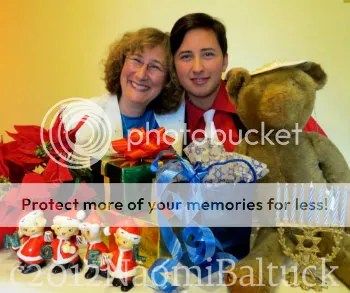
At our house we celebrate Christmas and Hanukkah, and we also give a nod toward the Solstice.  This year we planned to observe the Solstice with a bonfire, and burn twenty years’ accumulation of tax receipts in our firepit, but it never stopped raining long enough to light a match.

Eli and I told Christmas and Hanukkah stories at the Renton History Museum.  One cannot properly tell stories without feeling the spirit within.  So we were primed for both holidays.

Afterwards we went to Farmer Brown’s Tree Farm to cut our own Christmas tree.

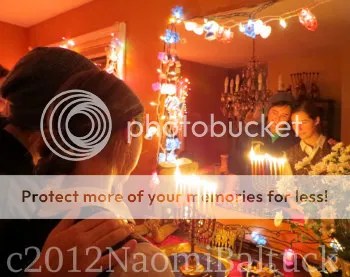
Then we went home to light the menorah.

 We had company this year, long lost cousins of my father, the son of Jewish immigrants from the Ukraine.  June Aptekar Allen Smith and her husband Haskell traveled to Seattle from Texas to celebrate their first Hanukkah ever.

They played dreidel and sang the blessings for the first time, just as June’s ancestors had done for nearly two thousand years.

At 88 and 89, they are still fascinated by the world around them, by history, travel, current events, and the stories of strangers they meet in their every day life.  We reconnected with June and her daughter ten years ago, at an Aptekar family reunion in Tucson.  They introduced us to June’s niece Nancy and her husband Ian, who happened to live right here in Seattle, and who we now love like, well… family.

During this visit, we compared notes and stories about our Aptekar roots, taking into account June and Haskell’s meticulous research, papers and letters from my mother’s attic, my Grandma Rose’s recently rediscovered autobiography among them.  Cousin Bryan drove up from Portland to represent yet another branch on the Aptekar family tree.  We pieced all our snatches and snippets and scraps of information into a more comprehensive family history, from before the pogrom of Odessa in 1905 to my great grandparents’ subsequent immigration through Ellis Island, and on to Detroit.

In 1905, the Aptekar family huddled in the cold and the dark, listening to the screams of horses and the crash of breaking glass.  They lived on the Great Boulevard, where Cossacks charged down the street, burning the businesses and homes of Odessa Jews, killing 800 Jewish men, women and children, and causing 2, 500 casualties.  Trapped inside without food or fuel for the fire, the Aptekar family huddled in their winter coats, and broke through ice in the water pail to drink.  With tears streaming down his cheeks, my great grandfather Jacob Aptekar chipped tiny pieces of sugar from the sugar cone to feed to his hungry children, promising them he would find food for them soon.  And promising himself he would take his family away from that hateful place forever.  Jacob’s hair turned white overnight, and my Grandma Rose’s little sister Clara died in her arms.

Victims of 1905 pogrom in Odessa

Over the next two generations, time, geography, estrangement, and self-imposed exile tugged at the threads of the Aptekar family tapestry.  More than a hundred years later, the descendants of Jacob’s children, Reuben, Rose, and David, gathered around one table for latkes, applesauce, and Hanukkah sushi.

Broken threads can be repaired and rewoven…


…and it is never too late for a happy ending.

All words c2012 Naomi Baltuck.

Rememberance and Forgiveness

November was a month of both remembrance and gratitude. Here in the United States we have Veteran’s Day and Thanksgiving, but how often have you thought about them in the same context? What I mean is, how often have you thought about the veterans and what they will do for/at Thanksgiving?

“Although flawless counts are impossible to come by – the transient nature of homeless populations presents a major difficulty – the U.S. Department of Housing and Urban Development (HUD) estimates that 49,933 veterans are homeless on any given night.” ~ National Coalition for Homeless Veterans

Image borrowed from http://www.respecttheturkey.com

Thanksgiving is a time to give thanks for what we have in our lives. It’s also a time to give back to those who are less fortunate. It can be an opportunity to “serve those who serve/have served us” and there are plenty of vets who need the help. So here’s what you can do to help, if you’re so inclined:

  • Determine the need in your community. Visit with homeless veteran service providers. Contact your mayor’s office for a list of providers, or search the NCHV database.
  • Involve others. If you are not already part of an organization, align yourself with a few other people who are interested in attacking this issue.
  • Participate in local homeless coalitions. Chances are, there is one in your community. If not, this could be the time to bring people together around this critical need.
  • Make a donation to your local homeless veteran service provider.
  • Check for places in your area that will be offering Thanksgiving dinner for homeless vets. This is one example. Check local churches, food banks, the Salvation Army or soup kitchens who might need donations of food or money or who could use volunteers on that day (or any other day, for that matter).
  • Offer to drive a veteran to an event. The DAV has a program to make this easy for anyone wanting to help. Simply click the link at the beginning of this sentence and see for yourself.
  • Keep veterans off the streets

    “In times of war, exhausted combat units were removed from the battlefield to “stand down” in a place of relative security to rest. The Department of Veterans Affairs’ Stand Down program is designed to help homeless veterans “combat” life on the streets. Stand Downs are usually one- to three-day events to provide food, shelter, clothing and health screenings to homeless and unemployed veterans. To find a Stand Down program in your community, contact your local VA hospital in the VA Medical Center Directory.

    A phone call can also make difference in the life of a veteran who is homeless or at risk of becoming homeless. Call 877-4AID-VET, or 877-424-3838, to be connected 24 hours a day, seven days a week with help at the VA. The VA has set a goal of eliminating homelessness among veterans by 2015.” ~ from CNN.com

  • Here are some more sites to give you some extra ideas:

Military.com

The Veteran’s Site (part of the Greater Good Network)

US Vets Inc.org

Milserve.org

Oprah.com

Embracing the ‘M’ Word

On our recent trip to Mexico, we had a Mayan guide, Murux.

I was worn out with the extreme heat and sun, after walking around Chichen Itza, a huge complex of Mayan ruins.

In between visits to Mayan ruins, Murux took us to Cenote Sagrado Azul.  A cenote is a sinkhole or cave providing access to the extensive system of underground and underwater caves beneath the Yucatan Peninsula.  Of the estimated 30, 000 cenotes, a few are open to the public for swimming.  Murux says the Mayans regarded them as sacred entrances to the Underworld.  I was a little skeptical when I saw this sign.


I mentioned once that I only swim in the warm waters off the Hawaiian Islands.  I don’t like being cold.  Nor do I like public showers, public pools, or making public appearances in my swimsuit.  But my husband Thom gave me a gentle nudge (with a sharp stick), and somehow I found myself suited up, reluctantly stepping into the open outdoor shower outside the entrance to Cenote Sagrado Azul.  Dripping wet, I walked past the security guard through the archway, and looked down from the rim into the cenote.  In that instant, I was transported from the oppressive heat of a dusty dry world into another world entirely.  With its hanging vines, watery echoes, and tiny streams dripping down stone walls into a jade pool, it was like a scene from a Tarzan or an Indiana Jones movie.

I descended slippery stone steps through a tunnel into the actual cave, along with a swarm of tourists who had just arrived by bus.

We all stepped into an underground chamber, open to the sky, with sunlight filtering down through the vines.

Stairs hugged the wall, leading up to a ledge where swimmers took turns making flying leaps into the water.  No fear of hitting the bottom—this was the entrance to the Underworld, and it was bottomless.

Thom marched into line and took the plunge.  I’d already embraced my familiar and comfortable role as photographer and journalist, and I clung to it like a life raft.  I did touch my toe to the water, and it was cold.  I didn’t want to leave my camera hanging unguarded on a post.  And there were all those velvety black catfish-like creatures swimming around in there…

Like a mahout with a stubborn elephant,Thom backed me down the first couple rungs of a small wooden ladder.  I was in up to my waist before I balked.  A woman, already in the water, said something in Spanish, and she started to peel my fingers away from the ladder.  I was shocked at this breach of personal space, and held on even tighter.  The woman laughed, and slapped at my hands.  It was clear that she wasn’t going to go away, and she wasn’t going to give up.  Some part of me really wanted to let go, and I knew I would probably regret it if I did not take that plunge.  I released my grip, and splashed backwards into the cool clear water.


The word ‘magic,’ is overused.  But the ‘M’ word is the only one I can think of to describe that moment, that magic, that Mexico, that me.  I surfaced, the woman smiled, and melted into the crowd, like an angel who had come down to earth, completed her mission, and moved on.   The tour bus must’ve recalled its passengers, because when I swam out to the center of the pool and looked back, I felt like the only person in a world where time did not exist.  It was like learning to breathe again.  It was a baptism.  It was letting go of the heat, the shyness, the fear.  It was a little like falling in love.

I am now a believer.  And not only in spirit guides.  I now know it’s possible to step through the entrance to the Underworld, and exist in that sacred place where kings and princesses bathe and are renewed.

All words and images c2013 Naomi Baltuck


World AIDS Day, a reflection

Focus, Partner, Achieve – A World AIDS Day Reflection

The virus would surely kill him but not today. Today he was stable enough to be released. He would need the support of loved ones and constant medical care the rest of his remaining days but people were afraid of the virus and insisted on keeping it as far away as possible, even if it meant isolating its host…

Ebola isn’t the first deadly virus to come knocking on America’s door. Daily headlines of Ebola diagnoses brought the early days of HIV ignorance roaring back to life, a time when fear led so quickly to closed borders and hundreds, then thousands of people left to die, untouched and alone.

…He was no longer welcome to stay in this foreign land and the diagnosis now banned him from returning to his own….

What had humanity learned from its 25 year crusade against HIV that could provide solace as we squarely face Ebola today? Could fears be eased by facts as they had in the past? Most importantly, would compassion rise above our worries to heal the world?

…Yet there were those who were not afraid, their ignorance eradicated by knowledge. Brave souls who knew there was no danger, chose to mask the stigma-laden facts and sent him home with dignity.

My brother got lucky in the midst of his most ill-fated days to know such bravery at the time of his AIDS diagnosis decades ago. There’s hope in the similar stories of heroic boldness in the presence of this Ebola outbreak. It causes me to linger on the “World” of World AIDS Day and reflect on the tenacity of a global generation that lassoed HIV and maintains a tight grasp to postpone its devastating spiral to a fatal AIDS diagnosis. What began as an ego-driven race to exclusive credit for the next breakthrough evolved into dependence on global partnerships, a humbling acceptance that one size treatment, delivery method, prevention message does not fit all and AIDS cannot be defeated until the world is cured.

HIV, like Ebola, is an equal opportunity virus that laughs at the walls and closed doors containing our fear. To defeat such a beast requires no less than the message contained in this year’s theme for the World AIDS Day goal to bring about an AIDS-free generation – Focus, Partner, Achieve. Cure the world.

– Tracy Daugherty

© essay Tracy Daugherty, All rights reserved.

Seasonal Cheer

December is usually that time of year that we reflect on the year which is almost done and start thinking about Christmas and the coming new year. For me, this means a “clearing out” of things I’ve accumulated or held onto throughout the year (mentally, emotionally, spiritually and especially physically). In the tradition of “clearing out”, I’ve been slowly but surely deleting old e-mails.

One of them I came across was from several years ago and I thought I would share the joy of it with all of you, in case you hadn’t seen it. It was about Christmas Trees from all over the world. It seems that the Christmas Tree is a global symbol of celebration and delight at this time of year. The lights twinkle, the ornaments sparkle, and the decorating brings together friends and family to provide the warmth of camaraderie during the cold, dark, winter month of December. So sit back, grab a hot toddy or cup of hot cocoa and enjoy seeing how others celebrate their Christmas Trees. 🙂 (Note: The photos and text by each picture are what was included in the e-mail).

Times Square Tree

Before the ball drops in Times Square, the Big Apple turns on its
holiday charm with the Christmas tree in Rockefeller Center.

White House Tree

The Capitol Christmas tree in Washington, D.C., is decorated with 3,000 ornaments that are the handiwork of U.S. schoolchildren. Encircling evergreens in the ‘Pathway of Peace’ represent the 50 U.S. states.

Monte Ingino TreeThe world’s largest Christmas tree display rises up the slopes of Monte Ingino outside of Gubbio, in Italy’s Umbria region.
Composed of about 500 lights connected by 40,000 feet of wire, the ‘tree’ is a modern marvel for an ancient city.

tokyos-akasaka-grand-prince-hotel tree
A Christmas tree 100 Meters tall, befitting Tokyo’s nighttime neon display is
projected onto the exterior of the Grand Prince Hotel Akasaka.
Prague Tree

Illuminating the Gothic facades of Prague’s Old Town Square, and casting its glow over the manger display of the famous Christmas market, is a grand tree cut in the Sumava mountains
in the southern Czech Republic.

Murano Glass Tree

Venice ‘s Murano Island renowned throughout the world for its quality glasswork is home to the tallest glass tree in the world. Sculpted by master glass blower Simone Cenedese, the artistic Christmas tree is a modern
reflection of the holiday season.

Moscow TreeMoscow celebrates Christmas according to the Russian Orthodox calendar on Jan. 7. For weeks beforehand, the city is alive with festivities in anticipation of Father Frost’s arrival on his magical troika with the Snow Maiden. He and his helper deliver gifts under the New Year Tree, or Yolka, which is traditionally a fir.

Lisbon-Praça do Comércio TreeThe largest Christmas tree in Europe (more than 230 feet tall) can be found in the Praça do Comércio in Lisbon, Portugal. Thousands of lights adorn the tree, adding to the special enchantment of the city during the holiday season.

German chapel Tree‘Oh Christmas tree, oh Christmas tree’: Even in its humblest attire,
aglow beside a tiny chapel in Germany’s Karwendel mountains,
a Christmas tree is a wondrous sight.

Lafayette dept store treeOoh la la, Galeries Lafayette! In Paris, even the Christmas trees are chic. With its monumental, baroque dome, plus 10 stories of lights and high fashion, it’s no surprise this show-stopping department store draws more visitors than the Louvre and the Eiffel Tower!
St Peters Square TreeIn addition to the Vatican’s heavenly evergreen, St. Peter’s Square in Rome hosts a larger-than-life nativity scene in front of the obelisk.

Christmas Tree at Puerta del Sol in MadridThe Christmas tree that greets revelers at the Puerta del Sol is dressed for a party. Madrid’s two-week celebration makes
millionaires along with merrymakers. On Dec. 22, a lucky citizen
will win El Gordo (the fat one), the world’s biggest lottery.

Trafalgar-Square-TreeA token of gratitude for Britain’s aid during World War II,
the Christmas tree in London’s Trafalgar Square has been
the annual gift of the people of Norway since 1947.

Frankfurt Tree

Drink a glass of gluhwein from the holiday market at the Romer Frankfurt‘s city hall since 1405 and enjoy a taste of Christmas past.

Location unknown treeAgainst a backdrop of tall, shadowy firs, a rainbow trio of
Christmas trees lights up the night (location unknown).

– Corina Ravenscraft

Lifting Stones

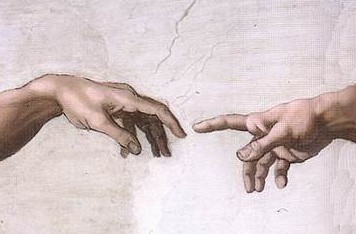
Hands_of_God_and_AdamIt happened several days ago that, when I took my children to school, that my elder one’s teacher mentioned something about the kids’ religion class, and on my way home I couldn’t help thinking about that topic – religion – about  which I have written here in the past. Obviously, that topic involved God (as I said once, I am not an atheist, it’s just that my belief in and my relationship with God are of a different nature than the standard ones) and the fact that more and more people, despite talking about God and saying that they believe in Him, have the habit of putting a huge distance between themselves and the higher being we’re talking about. And I was wondering WHY they do that, when it hit me: I had just thought about it. The problem here is the “higher” thing.

You see, it’s common use to say that God is in “the sky”. Up above. In heaven. Even better, in the seventh heaven. Or ninth. Or whatever number you want. But I can’t recall the last time when someone said that to him God was right here, on Earth. And it’s because of this growing distance that we don’t feel the touch of His grace. It’s because of this image of “an old guy, with white beard and long white hair, with a staff in His hand, floating intangibly on a distant cloud”. So stupid…not God, but we. We are the stupid ones. For we send God in farther and farther heavens and then we don’t see Him anymore around us and complain that we don’t feel His touch. To many of us He is just a name. A noun. A vocable. An icon or a statue in a church, and nothing more. But we forget that He is the essence of all life, of all energy, and that means that He is EVERYWHERE around us, in us. And since nothing happens without a reason, I then remembered a fragment from the scroll of Nag Hammadi, better known to people as the Gospel of Thomas, which I had the curiosity to read just several days ago. In the 77th saying, Jesus affirms that “I am the light that shines over all things. I am everything. From me all came forth, and to me all return. Split a piece of wood, and I am there. Lift a stone, and you will find me there”, stating thus the unity between God and us all, stating thus the profound connection which we fail to see or feel anymore, or which we even reject by thinking of God to be so far away, above us, while we see ourselves in this telluric dimension of life. THIS is where the breach happens. In our minds. In our hearts. In our misunderstanding of the fact that this “higher” being is actually so close to us that we are a part of it.

I will end this with a lovely parable that I happened to read once, but that remained in my mind. Once, in a monastery, there lived only five more monks. People didn’t go there anymore, and the abbot was sad, because he felt that he had failed his mission. At some point he has the occasion to talk to a rabbi and he asks this one for a word of wisdom, an advice of how to revive his order. And the rabbi says that “The only thing I can tell you is that the Messiah is one of you” and then he left. The abbot, hearing that, wondered who of the five monks could have been the Messiah, and he was suddenly afraid that maybe he mistreated the Holy One. So he told the other monks what he had been told by the rabbi, and they all began to think about that. Each of them wondered who could be the Messiah, and so they started to treat each other with more and more respect, on the off chance that one of them might be the One. It was only a matter of days before the atmosphere in the monastery changed, turning into a wonderful environment. When other people happened to come to the monastery, they saw the love and respect that radiated from the relationship between the five monks, and then they were touched by that too, and wanted to be a part of the order. Thus the order was revived, simply because people there tried to see the Messiah/God in each of those around them.

There’s so much more to say about this topic, but I’ll only tell you that we should do that too. We should see God in each of us, and even more, in each of the beings and things surrounding us. And then the far-away heaven would be much closer than we could imagine :).

– Liliana Negoi 

© 2014, essay, Liliana Negoi, All rights reservedIllustration ~ Detail from Michelangelo’s Sistine Chapel’s painting.

I Knew Advent

I knew Advent. He was working in construction around Nazareth when he felt it coming. He went South to The Scent (which they called ‘Jericho’ in ancient days) looking for his cousin; John lived in and with The Scent, on the dank banks of the Jordan amid the decaying waste and blooming flowers. There were no banana blossoms or land-mines on the West Bank, nor coffee brewing on the East, but sweetest dates have lined that river since memory began. John washed him in spring flood-waters but it was not enough. Maybe a dove fluttered pointedly overhead but the water only carries part of the medicine: the rest is in the Earth. He knew it was time for The Spirit Quest; nothing in scroll nor synagogue nor the seasoned hands of Elijah-reincarnate could preclude the necessity of climbing up a deserted mountain and then down… down into a cave — the Hole of Preparation. Starve.Ferment. Dream.  Minister.

I am often clueless, just as his fishermen friends were. Months later three of them went atop “The Breast” with him — that gorgeous mountain they called ‘Tabor’ in Galilee. They climbed the fertile mound and a mist washed over him, peeled away his dusty husk. Those boobs would have stayed there forever if he hadn’t said “yulla” (or something Aramaic that means the same: “Oh God — let’s go”). He had another hole to visit in The Holy. Transformation entreats of Death — in ‘Jerusalem’.

I climb boob-hill sometimes, too, and start my fog-machines: I pray for something brilliant, cheap, fading. The alternative is frightening; make the long trek to Temptation’s mound and dessicate myself in meditation. I’ve seen where he brewed with Salvation; it’s cramped and lonely, a precarious crag pocked with austere crevices.

Being Wholly Holy demands many holes. He said a seed must go into the ground and die before it begins flourishing. Our facts decompose yet our Truth persists in resonance. Caterpillars self-enshroud; grubs burrow into dung and emerge as sturdy, glistening beetles. Wise creatures commit suicide and gestate in their own skin to become their destiny. Our insides scramble and liquefy, searching for truest order. Death comes first, perhaps grief, and then a shattering panic. The hand that leads us is pierced and banished, so that only Spirit remains. He was right: it’s better. It’s natural.

Transfigurations are cosmetic. Rocks only pretend to be bread. A voice from the air buoys us to The Temple’s Zenith and says “you don’t ever have to die!” then sails us to the clouds and says, “the Earth belongs in you!” But Jesus was still drenched from the river, spawning in his hole. He said, “get behind me, backward fool — I belong in the Earth.”

That Spirit Quest was the first substantive occurrence in the Gospel; it superimposed its meanings onto the strange confluences in Bethlehem decades prior. I must find my own hole, though I am not sure how or where to dig it…

holes

– JD Gore

Light From Darkness

beckywithington

The true light, which enlightens everyone, was coming into the world. – John 1:9 (NRSV)

– Becky Withington

© 2014, pencil art, Becky Withington, All rights reserved

Slowly We Go

slowly we go

into the wilderness

naked and unarmed

wilderness

by Terri Stewart

Terri is the Online Canoness at http://www.BeguineAgain.com

Preparation Ritual

Reflection Candle: To prepare ourselves for Advent and the Coming of Light

Time: Four and a half weeks before the Light comes back. Also good for a day-long or afternoon retreat

Supplies: glass pillar candle (see picture.) Paper (tracing paper is lovely for this), markers and crayons and paints, scissors, glue. Images from magazines or printed out. Really anything that catches your spirit’s attention and heart will be perfect.

Goals: to reflect on 1. Our own divine pregnancy, 2. Your guiding star, 3. Shelter, and 4. The dance of darkness and Light.

There are five parts to this reflective exercise. You may spread each part out over the span of four and a half weeks or spend an afternoon going through the parts.

The resulting candle is one intended to inspire and sustain your personal ministry in the world. Once complete, light it as a prayer.

1. Our Own Divine Pregnancy.

Reflection:

It is told that God impregnated Mary and a baby, flesh and blood, resulted. I believe when we co-conspire with the divine, goodness and love spring forth as well for us in service to the world. When you sit very, very still, what can you feel stirring in the womb of your heart? What in your life is Calling you to co-conspire with the holy in order to birth this goodness that is larger than yourself and at the same time uniquely of yourself?

Instructions:

Take a moment and draw whatever images or words come into your consciousness.

As you go about your day look for images and add those to your paper.

Go through magazines and look for words or images. Paperclip your findings to the paper.

Set this all aside for the culmination at the end. But feel free to come back and add as things come to you.

2. Your Guiding Star

Reflection:

The Star of Bethlehem guided Joseph and Mary to Bethlehem to where the Light of the World was born. It guided sheepherders and kings to find the Light of the World. What is your guiding star? What three values guide your life and serve as a litmus test as to what if your work to do in the world?

Instructions:

Take a moment and draw whatever images or words come into your consciousness. If the guiding values are verbs, I invite you to put them in the active tense, “ing” and try those on.

As you go about your day look for images and add those to your paper.

Go through magazines and look for words or images. Paperclip your findings to the paper.

Set this all aside for the culmination at the end. But feel free to come back and add as things come to you.

3. Making Way for Shelter

Reflection:

Once Mary and Joseph arrived in Bethlehem they were repeatedly turned away. As the story is told, there was simply no room at the Inn. They were offered a space reserved for lowly animals. When have you turned other people or ideas away because there was just no more room, no more energy or other resources to make this person or idea a priority? What in your life could you evict to make room for unknown, divine people or ideas? Take a moment and listen to your still, small voice. What would happen if you evicted the “should’s” or meaningless minutia, the noise from your life? What is keeping you from letting go? And what could this new space in your life, this waiting shelter, look like?

Instructions:

Take a moment and draw whatever images or words come into your consciousness.

As you go about your day look for images and add those to your paper.

Go through magazines and look for words or images. Paperclip your findings to the paper.

Set this all aside for the culmination at the end. But feel free to come back and add as things come to you.

4. The Dance of Darkness and Light

Reflection:

We are now in the darkest time of the year. Many creatures hibernate. What is hibernating within you?

The darkness is often a time of angst for people. What pulls on your heart and craves the comforting glow of light?

And many curse darkness as a symbol of evil. Evil, being that which disconnects us from love and divinity. What in your life disconnects you from love, the divine, and your true self?

Whether darkness means sleepy hibernation, a time of sorrow and worry, or pure evil, sit with it. If it feels too much, ask God to hold it for you while you look at it.

The antidote to darkness is Light. What light are you calling into your life? What light do you send out to the world?

Imagine this Light diminishing the Darkness.

Instructions:

Take a moment and draw whatever images or words come into your consciousness.

As you go about your day look for images and add those to your paper.

Go through magazines and look for words or images. Paperclip your findings to the paper.

Set this all aside for the culmination at the end. But feel free to come back and add as things come to you.

5. Candle Creation

Reflection: Lay out all the images and take them in. How are they connected?

What images stand out for you?

What images seem no longer relevant? Feel free to thank them and then set them aside.

Looking at all the images does a scripture or hymn come to mind?

What prayer emerges? What do you need from God to say “yes!” to the coming Light?

Instructions:

Now is the time to assemble the images and words and glue them onto your candle. Consider cutting pictures and words from your journal pages to glue onto the glass.

Once the reflection candle is just the way you want it, light it and sit quietly with it. Bask in it’s glow. Take in this collage of images and words. What new do you see? What invitations or instructions do you see? What are you most drawn to? What prayers float from it?

Closing benediction:

May you this candle collage inspire and sustain your personal ministry in the world. May this candle be a guiding prayer. Remember you come from Light and at the same time you are Light of and for the world. Go out and spread bright blessings. The world is waiting.

Candle

Tandi Roberts, Unitarian Universalist

©2014. Permission to use this reflection exercises freely and to change it up to fit your needs. Please credit Rev. Tandi Rogers as appropriate. She is an ordained minister in the Unitarian Universalist tradition. Currently residing in Tacoma, WA and serving the Unitarian Universalist Association as their Innovation & Network Specialist.

Preparation

Preparation

Too sleepy to pray

The little bird now waits in his nest

To sing the coming day,

Bathed and washed in the light,

Anointed with the ointment

Of a hundred thousand loving rays

That were once but one,

Making home of the earth

With colors that are not of the world—

Never speaking, only singing

With wings outstretched to the sun.

– Frank Watson

Florida Sunset With Pelican

© 2014, Frank Watson, All rights reserved

The Leaves Still Fall

I remember days when I awakened
thinking nothing much changed
in my world except these whiskers,
the calendar and clock,
once I closed my eyes in hope
of escaping what had.
One night I cast aside my covers,
with old Mollie’s assistance,
and walked into the autumn air.
Out in our lonely space, she asked
me to open my eyes to the night,
turn my head just so, and listen to
the earth turn, see it roll beneath
those curtains drawn across the firmament.
A tap on my shoulder affirmed her lesson.
The leaves still fall even while we sleep.

– Joseph Hetch

© 2014, poem, Joseph Hetch, All rights reserved

For the Love of a Good Cuppa

coffee ceremony is a ritualised form of making and drinking coffee. The coffee ceremony is one of the most recognizable parts of ArabEritrean and Ethiopian culture. Coffee is offered when visiting friends, during festivities, or as a daily staple of life. If coffee is politely declined then most likely tea (shai) will be served.  MORE [Wikipedia]

This year The Good Man and I had the chance to celebrate the Fourth of July with some good friends. There were six of us total (three couples), and we met at our friend’s house for a special treat.

One of our crew had just recently returned from a trip to Ethiopia. She and her husband are in process of adopting an adorable baby boy and she had to make a visit to work through the paperwork with the local courts.

While in country visiting her baby son and patiently working though the long process, she was treated on several occasions to the Ethiopian coffee ceremony.

On our Fourth of July holiday, she wanted to share this ceremony with us, her friends.

About the coffee ceremony, here’s a quote from Ethiopian ambassador Haile-Giros Gessesse:

“Coffee has social value in our society. It is deep rooted in our culture. The coffee ceremony in local areas is used mainly for social gatherings. In the mornings and evenings parents, especially mothers gather together for a coffee ceremony and also use it as a platform for exchanging information in their surroundings. It is a means of communication. When people sit down they usually spend three hours finalizing the ceremony, starting with the preparation, and then roasting to brewing it.” CRJEnglish.com

Our friend had hauled home a big bag of green coffee beans, water hulled (the good stuff) not fire hulled, and we sat outside in the beautiful sun while she told us about the ceremony.

First, she roasted the beans on the grill. We watched as she shook and swirled the pan, much like a slow Jiffy pop motion.

When we all agreed that it looked like the beans were at a good medium roast we all took in a whiff of the fantastic aroma from the pan.

We then took turns using a mortar and pestle to smash the beans down to a nice grind.

It was satisfying work to smash, smash, smash those crispy beans and release the beautiful scent and oils.

The grinds were then put into a French press and once brewed, a round of coffee was poured into six cups.

Yuuuummmm! It had a floral aroma and tasted so light and delicious. So amazing with just a touch of sugar and nothing else.

In keeping with tradition, we had three rounds of coffee while we discussed our lives, the news of the day, baseball, and got caught up with each other. This is part of the ceremony, the community, the support, the friendship.

Now, I love a great cup of coffee, but I rarely drink caffeinated coffee. After three cups I was ready to clean my house top to bottom, jog a thousand miles, and throw a 98mph fastball.

But it was a happy caffeinated high.

I was honored to be a part of the ceremony and I can hardly wait until our friends bring home their baby boy. I hope to we can continue to give him a sense of community and family…maybe even over a cuppa or two…or three.

– Karen Fayeth 

© 2011, feature, Karen Fayeth, All rights reserve; Wikipedia quote and photograph by Wei Tong. 

You Just Missed It

Speeding north on I-87 any
early autumn afternoon,
you could feel the thip thip thip
of the tar strips tickling
your tires and toes,
if you really paid attention.
But you were more concerned
with what you left behind in that mirror
and with that tossing of red light
rosary beads surrounding you.
The trees to your left and right flash
like a natural zoetrope, animating
an unnoticed world as you pass.

You don’t see the geese lighting
with a sun splash on the Mohawk.
You could never imagine the little girl
sitting alone in that shabby house
you just passed hoping her mom
gets home from work by 10:30.
If you looked to your right,
you might have seen those puppies
that escaped their yard, bumbling
and yipping through the brush
heading for the same roadside that
browsing deer on the opposite side
consider crossing to after sundown.
You just missed it because you wondered
if pizza or chicken waited home for you.

– Joseph Hetch

Finding Silence

Dictionaries define the word in negative terms:
muteness, reticence, taciturnity, noiselessness.
The second volume of The Shorter Oxford English
does include quiet in its weighty considerations

but fails to recognize that at the heart of it
is presence, not absence. I think I already knew
when I was a child running through the wildness
of the moors that silence was a dimension of sound

for there it was fed by curlew cries, by the wind
rushing over untidy cotton grass and clumps
of marsh marigolds gleaming from bogs, by the great
grey ships honking far below on the Firth of Clyde.

Silence isn’t a plant to be cultivated in a solitary house
perched on a hill, not the cave single-minded seekers
hunt out so that they can contemplate meanings
away from the hurly-burly of the over-peopled world

with its cash machines and quarrels, ceaseless phones,
splashes of laughter. Silence is that small place
we come upon, the patch we clear to be with our selves
in shop, train, lane, doctor’s waiting room – anywhere.

– Myra Schneider

© 2014, poem, Myra Schneider from The Door to Colour, recently released by Enitharmon Books