SILVER AND GOLD

In a bedside table drawer rest two gold bangles,
one, my grandmother’s, the other, my great aunt’s
both given by my mother to me.
Circles of affection, dented by longevity,
each is secured by a gold lace safety chain.

In a modern gold-gilt frame
the bangles rest on the girls’ wrists, just visible.
My grandmother looks out beyond her family
My great aunt wears the only pocket watch.
She stands very straight next to her father.

My family is marking a milestone, a shining perhaps,
twenty five years of their parents’ union,
plated with thrift and endeavour, and lustrous in the raising
of six offspring who survived, and the wee one in his grave.
Touch that space beside his mother where he is missed.

– Maggie Mackay

© 2016, poem, Maggie Mackay, All rights reserved

BOOKS THAT CHANGED MY LIFE

Ask a librarian, “What’s your favorite book?” and he or she is likely to cock an eyebrow and respond, “Is this a trick question?” Luckily, this month’s theme at The BeZine is “Books that changed our lives”. For me, that’s a much easier question to answer.

A quick bit of background: I’ve always been a Type A personality. I used to worry about every little detail and tried to plan for everything. I was always anxious about the future, dreaded unexpected problems and tried to control everything (and sadly, a lot of people) in my environment. It led to a constant state of stress, which affected my physical health and took a toll on my mental and emotional well-being, too. Not long after I graduated college, I fell into a spiraling depression, hit rock bottom and it seemed like there was no way back to a life worth living. Then a well-meaning friend gave me a book that quite literally changed my life. That book was The Tao of Pooh by Benjamin Hoff.

Tao and Te

It started me on the path of Taoism and I never looked back. It was closely followed by “The Te of Piglet” and then “The Tao Te Ching” by Laozi (Lao Tzu). I learned that we all have elements of each one of A.A. Milne’s lovable characters from the Hundred Acre Wood. It’s what we do (or don’t do) with each day that counts, and we only ever have one day at a time, so it’s worth making the best of each day. Worry and anxiety are a waste of energy. The only thing we ever have control over is ourselves, and how we react to what life hands us each day.

taoteching

If you find yourself stressed and anxious, a Type A personality without the ability to let go of control and take what comes, I highly recommend reading all three books I mentioned. I can pretty much guarantee that you won’t regret it, and maybe they’ll change YOUR life, too! 🙂

Tao and Te2

© 2016, essay, Corina Ravenscraft, All rights reserved; book cover art and book page under fair use

BOOKS THAT CHANGE LIVES

I have 4 broad cubbyholes for experience titled “Distraction”, “Entertainment”, “Useful” and “Inspirational”. This is not a system of judgment, simply an organizational game that my homo sapiens brain finds oddly relaxing. I can truly laud events in any of those categories, but sorting them is something that satisfies in a strange way, like the way I play Solitaire on the computer before bed. When I thought of all of the books in my life (and since our home is an online book-selling business, I literally have tens of thousands of books in my daily life!), I wondered how to pick which to write about. These categories are going to help me navigate this topic. Books that change lives can fall under any of these headings.

P1040649

I have to start with Children’s Books because I was a child when books began to influence me. Certain Children’s Books can fit under each of those labels. Did you ever try to distract a child in tears by offering to read a story? Sure. Did you ever pick up your jacketless copy of Ferdinand and flip to the illustration of the contented bull under the tree smelling flowers because you were seeking escape? Yes! So maybe “Distraction” is a place where some of my favorites can be filed.

“Entertainment” is a fine role for a Children’s Book. Pure imagination (Roald Dahl), puzzle-solving (Graeme Base, I Spy…), and song and dance (Priscilla Superstar, Eloise) come to mind. Rhyming books by Dr. Seuss and Bill Peet were always fun to read aloud to my kids. Of course, I do voices. (After all, I was a Voice Performance major in college and a theater teacher!) Books can serve up silliness in all shapes and sizes.

1996b

A child’s book becomes “Useful” when it has a gentle way of teaching a very important lesson. I loved Babar immediately, and slept with a plush version each night, thumbing the yellow felt of his crown until its softness lulled me to sleep. I learned to respect animals and humans, that responsibility can bring anxiety, and that belonging to a community helps you to feel secure and peaceful.

When I think of books that are “Inspirational”, I think of them as initiating changes that transcend mood and feeling and circumstance. Perhaps you can call them “paradigm-shifters”. Every so often, a Children’s Book has that kind of impact, too. They defy the age-ism of the Children’s or Young Adult section. The Lorax, The Chronicles of Narnia, The Little Prince, A Wrinkle In Time. These books introduced me to the realms of mysticism and philosophy that I began to explore in greater depth as an adult. Ishmael by Daniel Quinn. Poems by Hafiz.

There are iconic books that have shaped my life that I think I would put in a separate cubbyhole, perhaps shaped and decorated more like a shrine. These are sacred texts: The Bible. The Road Less Traveled by M. Scott Peck. When Things Fall Apart by Pema Chodron. The Miracle of Mindfulness by Thich Nhat Hahn. They became almost monolithic in my life journey at certain points.

Most of the goods manufactured by human beings are problematic to me. Luxury items strike me as senseless and leave me completely cold. Clothing is necessary but has a seamy underbelly in Fashion. You don’t even want to get me started on Plastic! But Books – well, they could be the veritable justification of civilization itself, as far as I’m concerned. I cannot imagine my life without them.

– Priscilla Galasso

© 2016, essay and photographs, Priscilla Galasso, All rights reserved

BOOKS AND THE GREAT WEATHER

Leaf-OutThe weather has turned, the cool rain of this morning having ended, replaced by chill and a stiff breeze out of the northwest. Here and there, the overcast parts to share blue sky and allow shafts of sunlight to filter down to the earth. Wanting to be on the safe side, we’ve brought in the geraniums.

My attitude towards books is a lot like our New England weather, highly changeable and demanding. Being a avid reader, I have developed a suspicion that, like the Great Weathers, almost any book can change one’s life for good or ill, and that timing has a lot to do with the outcome.

Lately, I’ve been reading quite a bit, sampling here and yon. This week I’m engaged with Michael Yapko’s, Treating Depression with Hypnosis, a handbook for mental health clinicians. Michael understands that depression is shorthand for life lived under a regime of fear and hopelessness, a malaise characteristic of our time. He offers the reader hope, and urges us to resist the influence of those who sell programs of self improvement, and those who encourage us to ignore the real problems in our lives and the world.

The book was written more than a decade ago, yet remains a smart, useful, compassionate read. One of the takeaways is that when one is a change agent, the best gauge of success is whether one’s work actually leads to change. Michael warns against allowing the drive to “do it right’ trump our joy in watching others make the changes in their lives they wish to make. I so appreciate his straightforward urging that we allow our clients to tell us how we are doing!

He makes two other strong assertions: it is useful to be focused on the future and to tolerate ambiguity; these strategies, he insists, spark relief and enhance compassion. Michael argues convincingly that an orientation to the past pretty much assures we will fail to notice new options in the present. It’s not that we should ignore the past, rather, he encourages us to learn from the past while being open to a future that is not governed by it. He also suggests we practice “not knowing,” and allow things to be not only ambiguous, but perhaps unknowable. If we do so, he believes, we may find ourselves more thoughtful and kind, and better able to address the challenges of our client’s lives and the world.

My teachers insisted that the task of the change maker is to awaken the Healer Within, and I have come to believe that the best books do that as well, be they texts, plays, novels, or thin volumes of poetry. These books awaken me, guiding me to be more accomplished and effective at aiding others while reminding me to reach for, and nurture, what heals me. They stir things up and get me moving.

I’m not certain why this book landed in my hands at this time. Perhaps it chose me, in part, because I was recently at a hypnosis training that left me feeling a bit dispirited. Or, maybe, after a period where I have not utilized hypnosis as frequently as I might, I am just drawn back to it. I do not know, so I am seeking to simply be curious as to what is at play here, to trust my spirit and allow it, and my unconscious (whatever that may be), to guide me. I know from long experience that when I am able to do this, to trust and be curious, change comes more easily and becomes something akin to contagious. As a result, I become a more effective healer, and a happier person.

Speaking of change and weather, my beloved just came in from a wildflower walk on this day of leaf-out. She’s about an hour early; it seems everyone got cold, and having seen enough of spring’s splendor for one increasingly uncomfortable day, decided to go home.

I imagine she may shortly settle down near the fire with a good book, one fitting the fickle weather of the day. Chances are, her reading will lead to a rich conversation. I’m looking forward to that; after all, deep conversations help me feel alive, to experience belonging in relationship and the world. As a result, they, like good books, are often profoundly healing. Ah, but that is something to write about another time.

– Michael Watson

© 2016, essay and photograph, Michael Watson, All rights reserved

ESCAPING INTO REALITY

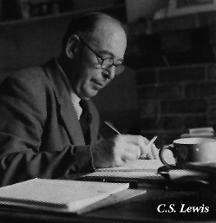
skepticThe late professor of literature and Christian apologist C. S. Lewis is reputed to have said “We read in order to know we are not alone”. I have only ever encountered this quotation in the movie about Lewis, Shadowlands, which chronicles Lewis’s relationship with American divorcee Joy Davidman. But, even if Lewis never uttered those particular words, the movie, at least, told the truth about my relationship with four texts that changed my life in critical ways: Alfred, Lord Tennyson’s great poem “Ulysses,” Prof. David Blumenthal’s Facing the Abusing God, Peter DeVries’s harrowing novel The Blood of the Lamb, and Albert Camus’ The Myth of Sisyphus. Though I did not realize it at the time, the confluence of these four texts would – at first on an unconscious, “subterranean” level – define my spirituality for decades after encountering them, despite the surface appearance of Christian faith I was always careful to maintain.
CS_Lewis

Rather than repeat myself by going into an account of the significance of “Ulysses,” I will refer you to my article in The BeZine for December of 2015. (I will also refer you to its companion piece, about the downside of “sailing with Ulysses” published the following month.) Beyond that, I will only repeat what I said in the December article: that “Ulysses” made such a powerful impression on me that, even though I was only in the eighth grade when I first encountered it, after reading the poem only a half-dozen times, I found I could recite it perfectly and verbatim from memory. I still can.

The book by Prof. (and Rabbi) David Blumenthal of the Candler School of Theology at Emory University in Atlanta, GA, I encountered as a result of a casual, off-the-cuff, oh-by-the-way remark from Victoria Riesz, who, along with Fr. Jim Eblen, team-taught a class called Theological Reflection in Ministry at Seattle University’s School of Theology and Ministry (STM) during my first summer as an MDiv student there in 1998. At first, I was just intrigued by the title: Facing the Abusing God. There are two reasons the title prompted me to read the book itself, one reason “institutional-cultural”, and the second reason, of which I was not conscious at the time, quite deeply personal. To understand the former reason, you have to know that the “institutional-cultural” theology of STM is that God is radically approachable, radically non-threatening, and radically … well … radically benevolently disposed – even radically friendly – toward human beings. STM’s view of God was then, and I think still is, quite the opposite of the view of God expressed by C. S. Lewis in one of the Narnia books: the great lion “Aslan [God’s persona in Narnia] is not a safe lion”. The “institutional-cultural” theology of STM, by contrast, insists that God is very safe. Being exceptionally proficient at using the language, I could talk the talk of the “safe God”. But I was never very good at walking the walk. So for reasons I was not altogether conscious of at the time, I was never “at home” in such a theology. Hence my sense of intrigue with a book bearing a title like Facing the Abusing God. Not “the abusing Church” or “the abusing male-centric hierarchy”, both of which would have been quite congenial to the prevailing ideology of STM. But “the abusing God“. As the old Brewer and Shipley stoner song says, that was “one toke over the line”.
1280px-Urval_av_de_bocker_som_har_vunnit_Nordiska_radets_litteraturpris_under_de_50_ar_som_priset_funnits_(2)

When I read the book, I discovered why – and the answer to “why” was considerably more than I bargained for. To his enduring credit, Blumenthal takes with utter theological seriousness what Fr. Ron Rolheiser, in a recent column, calls the “difficult texts” of (both Testaments of) the Bible. But unlike Fr. Rolheiser, Blumenthal reads the “surface” of the text just as it stands and unflinchingly draws the “plain-text” inferences therefrom: that God is – not always, but certainly on occasion – ruthlessly vindictive, cruel, and capriciously abusive, a conclusion that, Blumenthal argues, is amply justified by a reading of the account of God’s relationship to Israel in the Hebrew Bible. (I suppose I should say that, while Blumenthal, does not accept the historicity of all such texts, he does – as I do – take all of them seriously as theological parables.) He also cites the experience of friends of his, usually from various synagogue communities with which he is acquainted, as evidence that people’s contemporary experience of God continues to follow this pattern. Especially heartbreaking is the experience of one woman, whom Blumenthal  calls “Diane,” who was abused by her father, who shrieked to God for help … but whom God did not help. Thanks to Blumenthal’s book, “Diane” taught me that I was not alone. At one point, “Diane” remarks that her experience with power, both “father power” and Divine power, is that the likelihood of abuse increases proportionately with the degree of power, so that, as Diane says, “I cannot trust omnipotent God not to abuse”.

Neither can I. Facing the Abusing God taught me what my real, actual, lived theology was – at that time, in my pre-atheism days – and revealed to me why, though I could “talk the talk,” I could not, probably never would, “walk the walk”: I had spent, up to that point, 40 years trying, as I say now, to “please the Great Unpleasable”. I was intent on “busting a gut for Jesus” – and in the end, all I ended up with was a busted gut. I remember vividly that as I read the book, I would have to stop every half-dozen or dozen pages, put the book down, go outside, and – in the concealment of our cedar privacy fence – pound my fists against the side of the house until my knuckles were bloody. Then I would go back inside the house, pick up the book, and read some more. From that point on – summer, 1998 – though I still believed in God … well … sorta-kinda … I from that day never hesitated to challenge the rhetoric of “Aslan the safe Lion” in my classes at STM, often to the chagrin of professors and fellow students. I graduated with my degree in December of 2000. I don’t know, but I strongly suspect, that STM was glad to get rid of me.

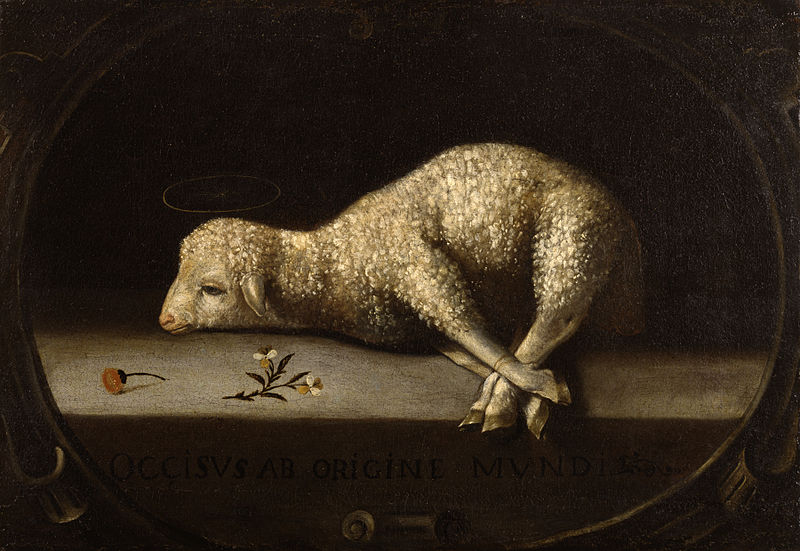
But Facing the Abusing God was just the final drop of water that caused the glass to overflow. Years before that, I had read Peter DeVries’ thinly fictionalized autobiographical novel The Blood of the Lamb. I say “thinly fictionalized” because, like the main viewpoint / first-person protagonist of the novel, Don Wanderhope, DeVries had endured the loss, due to leukemia, of his teenage daughter. Don started out as a Christian believer, albeit a gadfly to his more conventionally devout Dutch Reformed Church friends and relatives. Along the way, he falls in love with a young woman – a fellow patient in a TB sanatorium – whom he supports through the disease itself, as well as the painful diagnostic procedures she is forced to endure as part of her treatment. When she dies, Don begins his journey into the wilderness of the Problem of Evil, joined along the way by the world-weary director of the sanatorium, who endures Don’s questions, all of which the director has lived with for decades of his professional life. Finally, released from the sanatorium and cured, Don meets and marries a woman, who, as it turns out, becomes severely depressed and emotionally unstable, and who is eventually institutionalized. But together they have a child who seemingly is the compensation that the God in Whom Don still believes sends as recompense for previous suffering. When Carol is 13, she is afflicted with leukemia – just like DeVries’ real-life daughter – and the remainder of the novel comprises Don’s and Carol’s struggle with chemotherapy, radiation, the false hope of temporary remissions – followed by relapses. When Carol is in the hospital for what turns out to be her final chemo regimen, Don leaves her briefly to buy her a birthday cake so they can celebrate. He arrives back at the hospital, cake in hand, just in time to watch Carol die. When she is gone, he leaves the hospital, walks to a nearby church and, standing on the top step leading to the entrance, flings the cake straight up at a figure of the crucified Christ,hitting Him in the face.
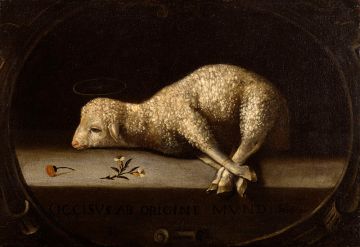
800px-Josefa_de_Ayala_-_The_Sacrificial_Lamb_-_Walters_371193

At the end of the novel, I envied Don his cake-flinging abilities, and the final event of Lamb haunted me as I finished Facing the Abusing God. I also realized, as a result of both books that, unlike a lot of people who treat the Problem of Evil as a pipe-and-brandy armchair academic diversion, I take the Problem of Evil with utter and intimate and immediate “existential” seriousness. With me it’s personal. Carol is not the only one God left naked. God also did not protect my dad from a physically and emotionally abusive father, nor did He protect mom from a learning impairment and at-least-borderline mental retardation accompanied by extreme emotional fragility. Nor did God protect two women whom I deeply loved from accident and disease. (The upside of that is that I do not take my wife Diane for granted: as I also tell all and sundry, if you want a guarantee, go buy a damn fridge from Sears.) For me, the Blumenthal and DeVries books taught me that, over my lifetime, belief in God – and the value of same – has been like a pair of cheap denim jeans after a couple dozen or so washings: the blue gradually fades away. But if you paid too much for the jeans in the first place, you probably will be reluctant to admit this.

Finally, when I was a freshman in college, I read for the first of literally a few-hundred times, Albert Camus’ The Myth of Sisyphus, which to this day I regard as unsurpassed and seldom equaled in sheer wisdom.

After college, I went to work for Boeing at a job that required extensive travel to France (in fact, all NATO countries). Prior to travel, Boeing gave me intensive training in reading and writing the French language. (My fellow students referred to the course as “suicide French”.) This had the unexpected side benefit of enabling me to go back and read Sisyphus in the original language, and I discovered in Camus a French prose stylist easily the equal of Blaise Pascal (whom I could also now read in French). Even in a good English translation, Camus’ prose style is what I can only call “lyrically astringent”:

The only serious philosophical question is the problem of suicide: deciding whether or not life is worth living amounts to answering the fundamental question of philosophy. All the rest … are games. One must first answer. And if it is true, as Nietzsche says, that a philosopher, to deserve our respect, must teach by example, you can appreciate the importance of that reply, for it will precede the definitive act.

By now, I can quote the opening sentence of Sisyphus without even consulting the book.
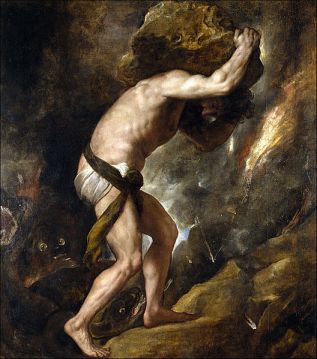
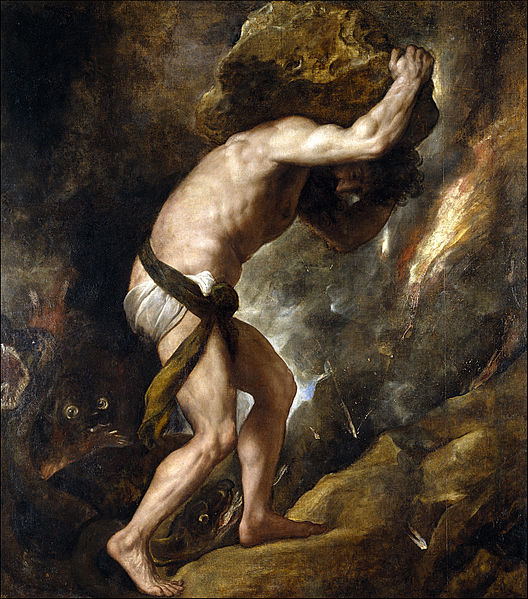
528px-Punishment_sisyph

For me, the most revolutionary achievement of Camus in Sisyphus is basically the same as the achievement of Blumenthal and DeVries in their books: looking reality in the face, seeing it as it is, and taking that appearance seriously on its own terms. And then saying as much.

It happens that the stage sets collapse. Rising, streetcar, four hours in the office or the factory, meal, streetcar, four hours of work, meal, sleep, and Monday Tuesday Wednesday Thursday Friday and Saturday according to the same rhythm – this path is easily followed most of the time. But one day the “why” arises and everything begins in that weariness tinged with amazement. Albert Camus An Absurd Reasoning

The “why” plagued me in STM with the theology of the radically friendly God. The “why” plagued me with the parallel between the experience of my parents and loved ones, on the one hand, and the experience of Carol – both DeVries’s real-life daughter and her fictional counterpart – in The Blood of the Lamb. The “why” still plagues me. And you know what? I would not have it any other way. The “why” is life. Or at least, the “why” is my life. And, yes, it is indeed like rolling a great rock uphill, only to see it roll back downhill again. The Myth of Sisyphus, in a certain sense, gives me permission to embrace the “why,” futile as it is, and to keep rolling it uphill, and to keep watching it roll back downhill, again and again and again. At this point in my life, the “why” is the reason, as Tennyson says, “the vessel puffs her sail”. So I have even come to agree with what Camus says at the end of Sisyphus: Il faut imaginer Sisyphe hereux (“We must imagine Sisyphus happy”).

My relationship with books – these and others – has always been the reverse of the way that relationship is usually conceived in the ambient culture. Books have seldom been an escape from reality. For time and time and time again – for time out of mind – I have had the experience, thanks to books, of discovering that it was the life I was living that was fictitious. The life I discovered in books, on the other hand, was what Matthew Arnold, in much the same context, called “the hidden life” … my real life. And if you are asking yourself whether to give me comfort or condolences, the answer is “Yes”!

– James R. Cowles

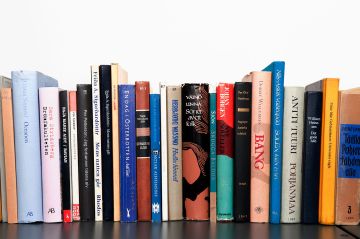
© 2016, essay, James R. Cowles; Image credits: Books: CC BY 2.5 dk; C. S. Lewis: Creative Commons Attribution-NonCommercial-NoDerivs 2.5 License
Sacrificial lamb: Josefa de Óbidos (1630–1684) … public domain; Sisyphus: Titian … public domain; Forest fire: William L. Rowe, US Department of Agriculture, public domain

The First Book That Shaped Me

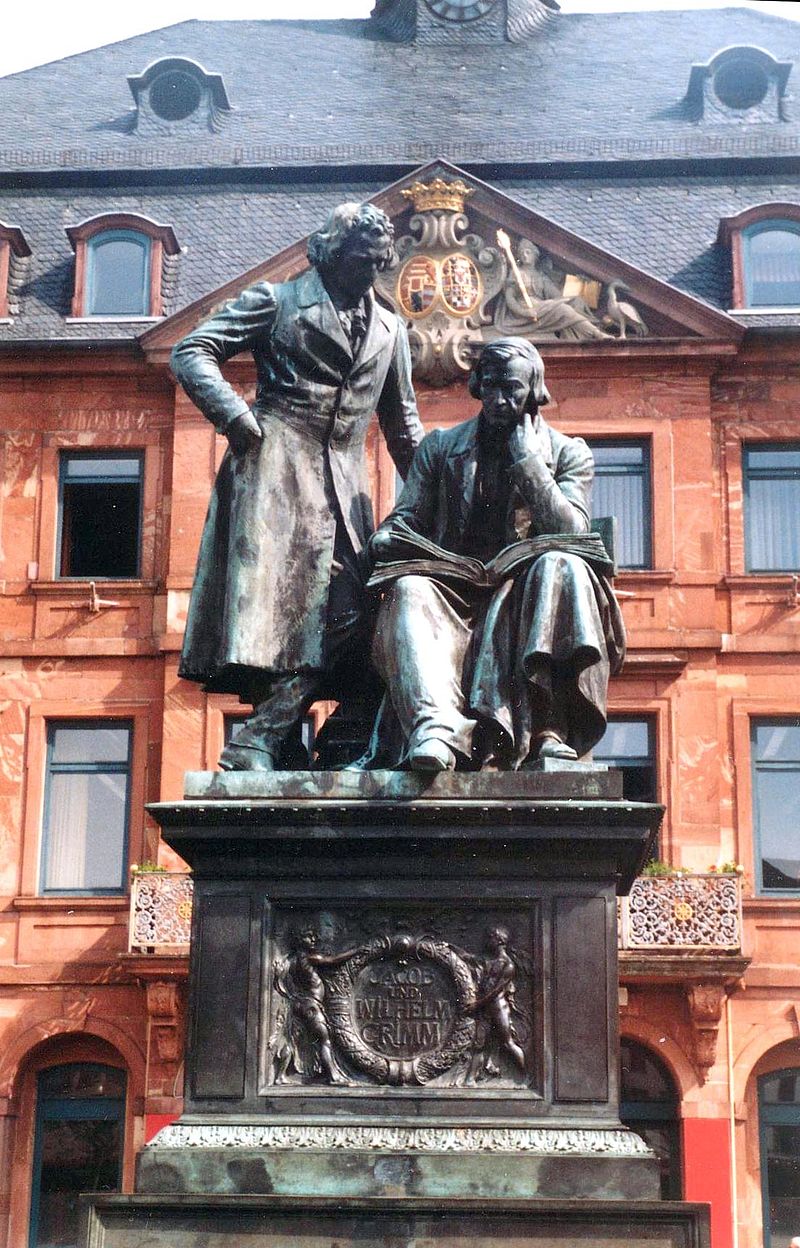
Monument to brothers Grimm on the market place in Hanau. (Hessen, Germany)

“A book that changed my life” is not an easy theme for me personally. Mainly because, from my point of view, every book (or almost every book) I read changed my life in one way or another, so I could stop at many, many titles and make lists of reasons why they played such an important role for me.

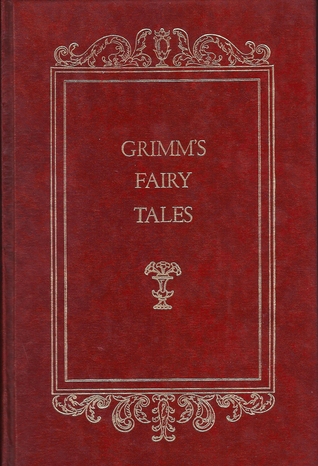
10729325I decided, however, to “dig deep” within my memories and find the very first book that influenced me, and I realized that it was actually the first book of stories that I read when I was about 5-6 years old, the Grimm brothers’ fairy tales. I know this is not one of the books you probably expected me to mention, but I realized that this was the book that opened my mind towards literature, towards reading, towards the world of fantasy, and it is worth mentioning as much as any other “heavy literature” or philosophy or whatever else.

Those stories built inside my mind as a child so many images, so many ideas, and they “injected” me with an endless hunger for reading, so I owe them a very large share of my present. Sure, there are people nowadays who say that those stories have less educational aspects, passages that may horrify (personally I don’t remember EVER having nightmares because of them), but what they forget is that these stories (Grimm’s and not only those) bear in them the water of magic, which is the best water that can nurture a child’s mind. Children NEED stories, in order to establish a scale of values, in order to develop their imagination, in order to understand certain aspects of this world which complex words cannot explain to them. And you would be amazed what a sharp sense of good and bad children can get from stories :).

So yes, this is the very first book that changed my life, and this is why I chose to tell you about it: because it was the first door to understanding life which I opened by myself and which opened all the other doors, because it made me NEED to read the same way I needed to breathe. Because it made me see that books are the air of the human mind.

– Lilianna Negoi

© 2016, essay, Lilianna Negoi, All rights reserved; the brothers Grimm statue photograph is in the public domain; the book cover is Grimm’s Fairy Tales: Household Stories from the Collection of the Bros. Grimm (Avenel Books, 1973) fair use

Looking South with Frodo Baggins

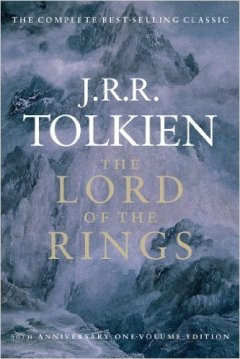
51d4G0sFMzL._SX331_BO1,204,203,200_The book that left a lasting mark on me, which I read at the age of 21, still in my formative years, was Tolkien’s ‘Lord of The Rings’. It seemed to represent two major things: the first is life in all its varied forms, good and bad; the second is that it was an epic journey through all that ‘good and bad’.

Five years ago I wrote a poem about another journey. It was four injured and disabled veteran soldiers, who made it, unaided, all the way to the North Pole. It was epic and, for these four remarkable men, a chance to revisit and resolve their brush with mortality.

The poem is about challenge; about the triumph of the human spirit over adversity. But most particularly, it is about not bearing life’s burden on your own, but rather learning how to ask for help, how to share concern or worry, which, despite his feelings of isolation in his quest, Frodo Baggins eventually found he had friends, who helped him through.

For some things in life, you cannot just ‘tough it out’. However strong you think you may be, there are some challenges in life that you cannot, nay should not tackle alone, because everyone has their limits; there is always a barrier, either physical or emotional or both, that will inhibit the progress of any man or woman; will put a stop to their journeys.

Perhaps this is because, once you show your vulnerability, far from becoming prey to vultures and demons, you will also attract the support of true human beings, those who are true team players, those who care. And anybody who endeavours to achieve things that not everyone would attempt, has that spirit. It is often a spirit born of near death experience, but may also be a response to physical and emotional pain.

511emrnGxhL._SX316_BO1,204,203,200_

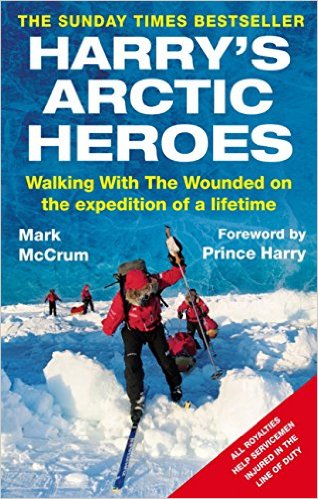
It is both these things that four men from the British armed forces set out to overcome in a seemingly impossible challenge. These four servicemen, who were all injured in combat in Afghanistan, set out to enter the record books as the first disabled team to walk unassisted to the North Pole. It involved a great deal of preparation and training for all of them.

The men are: Capt Martin Hewitt, 30, whose right arm is paralysed after being shot; Capt Guy Disney, 29, whose right leg was amputated below the knee after he was hit by a rocket-propelled grenade (RPG); Sgt Stephen Young, 28, who suffered a broken back in a roadside bombing; Pte Jaco Van Gass, 24, who had his left arm amputated and suffered significant tissue loss to his left leg after being hit by an RPG.

For the first few days of their trek, they were also accompanied by Prince Harry, who supported their campaign both before and after it was completed. The documentary, shown on BBC1 in the summer of 2011, was called “Harry’s Arctic Heroes”.

In this expedition, these four men represented every soldier, airman and sailor who is ever injured in conflicts, but particularly those who lose their faculties in some way, be it the loss of a limb or sight or mind.

The poem also has a ‘dark’ side, as it shakes a metaphor at dealing with our mortality, not least by reference to ‘The Dream of Gerontius’. The journey ‘North’, in this sense, is figurative and is my way of demonstrating that metaphor to the ultimate journey that we and all animals make as an integral part of our lives. “Looking South” represents the looking back on ones life, which in the case of these four injured servicemen, was their life so far. And for a majority of those, who deal with life’s challenges, some significant moments also represent a looking back on our lives…

… so far.

~~~~~~~

If you stand in the wind
and allow it to bend you
so you flex and withstand it,
don’t let it uproot you,
then you’ll find it can’t hurt you
in spite of extraordinary pain.

If your instinct for flight
is taken away
your options for fighting
in an instant are gone,
like a parent removing
your permission to play…

…with the most bitter of tears.

If there’s anything surer
than the moment you hear
a deafening sound
of silence and the fear
rushes in like air
to a vacuum.

There’s nothing more certain,
never so clear,
as if a vision of your life
were etched in white light
closing your eyes
and blinding your sight…

…but opening them on the inside.

It seems you were born
for this moment;
that this is your time.
You appear to have arrived
at the moment when pain
can no longer touch you.

That stress and the anguish
of screaming self-doubt
have momentarily left you,
your inside looking out;
outside looking in;
thoughts perfectly scrambled…

…like the dream of Gerontius.

Circumventing your demons,
overcoming your fear
this vision of whiteness
tears at your heart and your soul;
bedazzling lightness
of mind; supernal disclosure;

a revelation that you’ll never
be left on your own.
You will never be able
to embark on this journey
without your friends;
your brothers in arms,

… but they’re not the Invisible Choir.

Your angels are next to you;
there by your side, if you look.
Maybe a Prince or a pauper,
but either will brook you;
all you need is to ask;
as long as you let them know.

Then, when you stand there,
sharing legs, shoulders, arms,
looking South when you know
that there’s no further North,
surveying a World,
that will sing your arrival…

…knowing now that you truly have life.

– John Anstie

© 2016, essay and poem, John Anstie, All rights reserved; illustration, book covers copyrights with publishers and used here under fair use.

A MERRY LITERARY CHRISTMAS

A Merry Literary Christmas

by Alice Lowe

When Christmas shopping time draws nigh…

And I am faced with gifts to buy…

I think about one relative

Who always had one gift to give.

And every year her present came.

And every year it was the same.

While other gifts were round and fat,

(Their secrets hidden) hers was flat.

Rectangular, the corners square,

I knew exactly what was there.

I’d pass it by without a look—

My aunt had sent another book!

I’d only open it to write

A “thank you” that was too polite,

But every year when Christmas went

I’d read the book my aunt had sent,


And looking back, I realize

Each gift was treasure in disguise.

So now it’s time to write her here

A thank-you note that is sincere.

So—thanks for Alice and Sara Crewe,

For Christopher Robin and Piglet and Pooh,

For Little Nell and William Tell…

And Peter and Wendy and Tinker Bell.

Thanks for Tom and Jim and Huck,

For Robinson Crusoe and Dab-Dab the duck,

For Meg and Jo and Johnny Crow

And Papa Geppeto’s Pinocchio

For Mary Poppins and Rat and Toad

King Arthur and Dorothy’s Yellow Brick Road,

For Kipling’s Kim and tales from Grimm,

And Ferdinand, Babar and Tiny Tim.

I loved them all, I’m glad I met them.

They’re with me still, I won’t forget them.

So I’ll give books on Christmas Day

Though I know what all my nieces say–

I know it from the way they write

A “thank-you” that is too polite.


A Merry Literary Christmas©Alice Lowe

Images ©2016Naomi Baltuck

Night Light

full moon just expired,
one more circle becoming history.

a huge moth
courts the lantern next to me,
in love with the unknown,
and the lantern pins the moth’s living shadow
against the pages of the book in my hand.

under the moth’s gray fluttering shade
words scream,
brought to life by the dance of night’s butterfly,
ghostly figments of some pitch serialism –
threads pulled out with an apparent accidentalism
from the page’s canvas with a blunt crochet hook.

meanings melt all-together
while the book becomes the moth,
fluttering its pages under the light of my “why” –
and greedy
my eyes finish devouring
about the same time that the moth’s wings
inert
close.

the lantern remains alive though –
there’s always room for another moth

© Liliana Negoi

Confessions of a Light-reading Poet

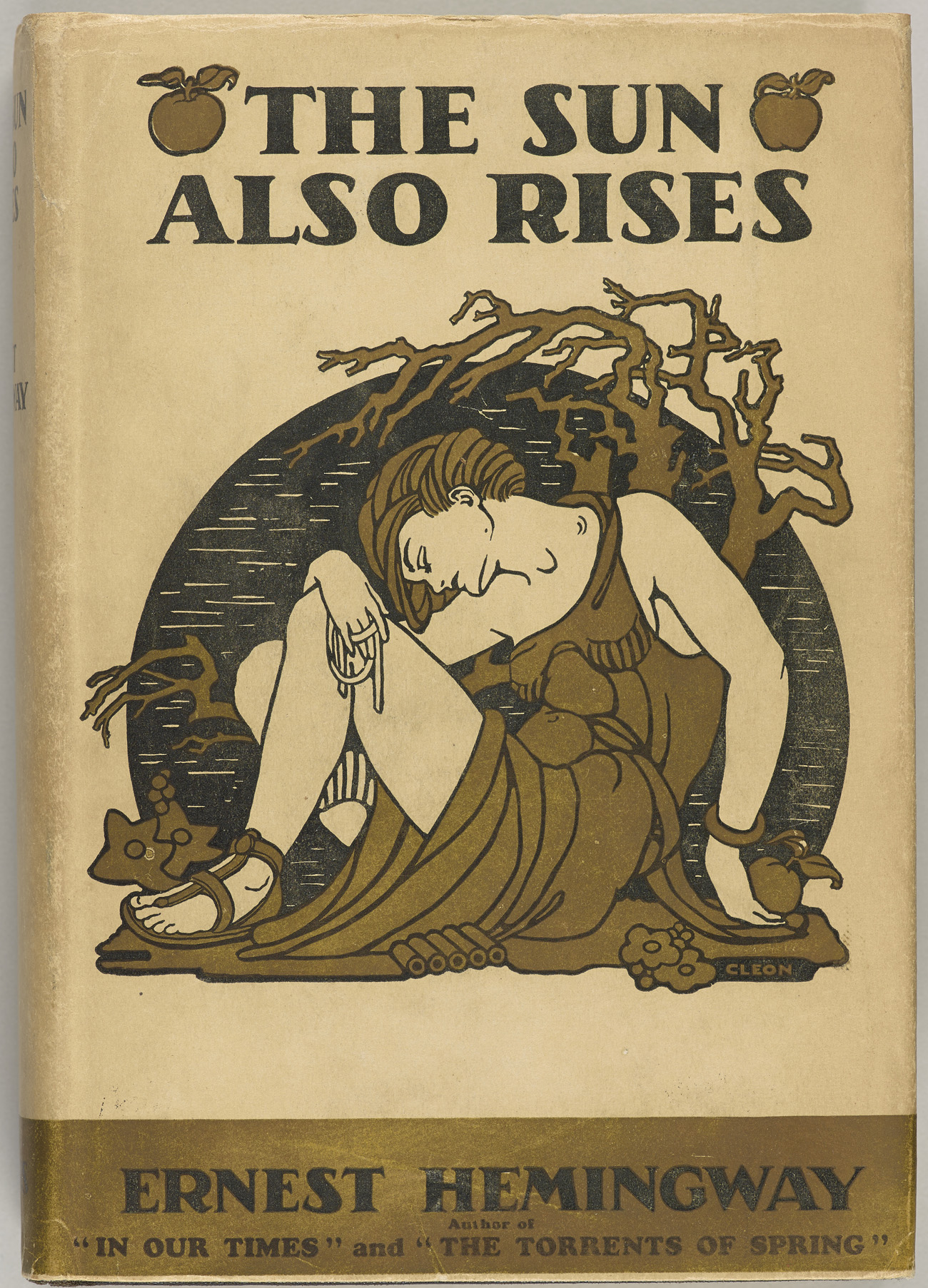
Hemingway, Ernest, 1899-1961. The sun also rises / New York : Charles Scribner's Sons, 1926. PML 128141 Dust jacket

According to most of your rules manuals,
I’m a poor excuse for a writer.
I’ve read six books in the past year
and two of them were The Sun Also Rises.
I can’t write every day and
I don’t want to hear how you do.
Some say I’m a poet, though I believe I’m
a reborn storyteller who spins tales on paper
in busted up lines. Papa Hemingway,
Robert Parker and Ron Carlson taught me
how to fib like this. See, it’s a guy thing…
and the only way I can get away with lying
in this world full of women
who read between my broken parts.

The poetry I learned from no one, except
maybe a big lesson from old Bill Stafford
who said I didn’t have to be perfect, just lower
my phony idea of your standards and write.
It’s kind of like drinking beer, I guess.
So as a poet, I’ve become a minor league beer snob
who dislikes major league beer snobs.
Oh, and while I’m at it,
I believe canned cheese product
is both fine dining and a swell serving device.
I sing fairly well, but never in front of people,
so maybe I don’t. My dog Mollie ain’t saying.
She doesn’t care if she lies perfectly, either.

– Joseph Hesch

© 2016, poem, Joseph Hesch, All right reserved; illustration, under fair use, the cover of the first edition (1926) of Hemingway’s roman à clef, his first big novel, which established him as a preeminent 20th Century writer.

Schwund und Reue

tumblr_m7cax6AT5t1rrnekqo1_1280

Can read, won’t read.
Would read, don’t read.
That book sits face up on the table
next to me, it’s eyes staring at
my sheepish ones, like those
of a portrait that follow you
around the room, accusing, unblinking.

Or maybe they’re like
those of that dead French soldier
lying in the crater with Paul Bäumer
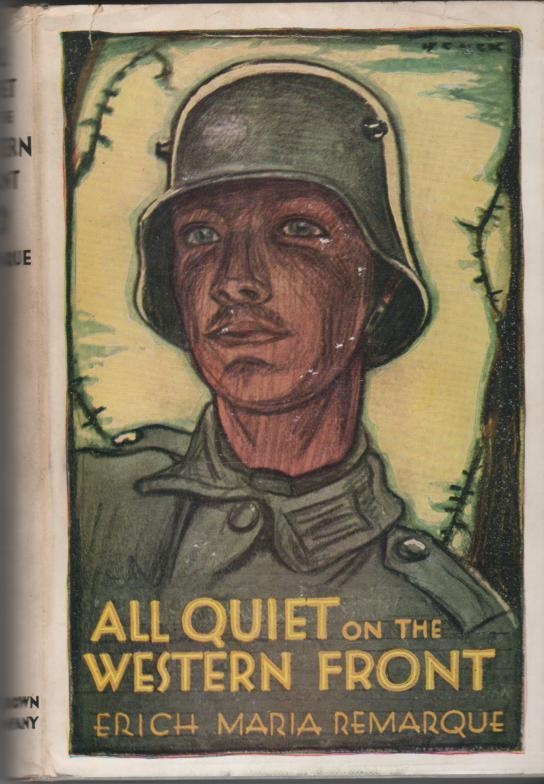
in All Quiet on the Western Front,
another book I never finished.
Like Paul, I feel remorse, loss,
over somehow killing my old hunger.

I was once voracious like you,
but lost the combat for my consciousness
and now I lie here, paralyzed,
with my toes framing that big screen,
notebook and tablet on my lap,
pinned down in my depression by this
bombardment of distractions.

I want to pick up that book and
conquer it, but, shell-shocked by media,
all I do is numbly flip a couple of pages
and place it face-down again.
I really wish I could be like you,
finishing every bit of reading you…

– Joseph Hesch

© 2016, poem, Joseph Hesch, All rights reserved; illustration under fair use, the cover of the first English language edition of Im Westen nichts Neues, a novel of the First World War.  The translation was entitled All Quiet on the Western Front, not a reference to peace but to stagnation.

A Peace of My Mind

Last September my son Eli and I went on a road trip to deliver my daughter Bea, an incoming freshman, to Stanford University.

Then all of a sudden Bea was at school…

…and Eli and I were back in the van for the long drive home.

For our trip down, we’d booked nice hotels in advance.  It was all about our last hurrah before saying goodbye to Bea. Maybe because we didn’t want to think about returning without her, we forgot to plan the trip home.  We were unprepared, disorganized, and we both kept looking around for Bea.

It was after midnight when we pulled into Redding, CA.

We found a place that was simple, but clean, and woke refreshed and ready to move on–from Redding, and from Stanford.  We were going to write ourselves a new story.

We explored a delightfully shabby gold rush town, browsed its antique stores, and bought some dusty old tomes.  Back on the road, Eli read aloud from  The Last of the Plainsmen, Zane Grey’s 1908 memoir about the end of an era and the start of a new one.

Perhaps inspired by Grey, Eli suggested swinging by Crater Lake National Park.  It was out of our way, and we didn’t even know how far, because we hadn’t brought a proper map.  We hadn’t been there since the kids were young enough to earn their Junior Ranger Badges.  I recalled Crater Lake as a one trick pony, with one view of a lake, gorgeous, but unaccessible.  If we couldn’t get there before dark, the trip would be pointless.

It was a gamble.

We decided to go for it.  We had a few ‘Where are we going, Carl?’ moments.  Like at a crossroads, where two roads both had signage pointing to Crater Lake. The sun was sinking, and we couldn’t afford to get lost.  I kicked myself for not stopping earlier for directions.  This was a remote wilderness, late in the day and late in the season, without even another car to flag down.

Do you believe in spirit helpers?   I took this handsome creature’s greeting as positive reinforcement.

Upon leaving the endless forest to begin our ascent.  Whatever happened, the view on the way to the crater was worth the drive.

At last we arrived at the crater rim, with sunshine to spare, but not for long.

As the sun sank behind us, the shadows crept up the side of Wizard Island, until it looked like it was wearing a little sun hat.

While we looked down on shadow, on the far side of the crater, the sun still shone.

Our goal was to visit as many viewpoints as possible before we lost the light.

Crater Lake was not a one trick pony.  It was a Horse of a Different Color.  With the constantly changing light, the landscape changed dramatically too.

Each view highlighted different sights and inspired different insights.

Whether looking from a distance…

…or close up.

We were alone on the top of the world, awestruck by the beauty surrounding us, not just of the lake, but the valley as well.

Eli captured the detail of an alpine meadow in this shot….

…while I borrowed back the camera to capture the big picture.

Feverishly, we passed the camera back and forth.  Where one of us recognized the stark beauty of an outcrop…

…the other saw a sleeping lady, turned to stone by an evil wizard.

Eli and I discovered our new superpower…

We had learned to spin straw into gold.

Golden moments.

Golden Memories.

Peace of mind.

All words and images copyright Naomi Baltuck

The Mistery of Life

One of the most breathtaking places I’ve ever been is Switzerland, and not just because of the high altitude.

How can someplace be so wild and rugged…

…and yet so tidy and tame and settled?

You can take an escalator to the top of the mountain…

…and just when you think you’re alone in the most remote place in the world…

…you stumble upon a chalet where you can buy a cup of Ovaltine.

Or you hear cowbells and realize you are not alone after all.

When you’re looking straight up at the sky, where no mountain ought to be–surprise!–you realize it’s just playing peek-a-boo from behind the clouds.

We went for a hike, but the landscape seemed so domestic that we felt we should really call it  a stroll.

We stopped to make a friend or two along the way.

And belted out the words to The Sound of Music because…why not?

Unlike the deliberate and well-defined cable car ride up to our little village, there was no clear threshold, no magic doorway from domestic to wild.  The landscape changed so gradually we hardly noticed.

No cowbells here.

And then a shroud of mist descended so swiftly.

The path was obscured and maps were useless.

We couldn’t see the landmarks described in the guidebook. It would soon be dark.  We had no choice but to put one foot ahead of the other…

…keep walking and enjoy the mystery and adventure…

…and trust that sooner or later we would get where we were going.

That’s life.

All images and words copyright Naomi Baltuck.

Lullabye

In Ireland, the ocean is everywhere.

Sometimes hiding in the mist…

History hangs heavy in the ocean air, like breath moistened by a story.

In rough weather…

Or calm…

Whether watching intently…

Or only vaguely aware of it…

You can still smell the salt in the air…like a ghost.

You can feel it like a heartbeat…

And hear it like a lullabye…

Copyright 2012 Naomi Baltuck

A LIFE IMMERSED IN POETRY: Myra Schneider celebrating over 50 years as a poet and writer

Myra Schneider
Myra Schneider

When I learned that Myra would be celebrating her 80th birthday this June, I figured I’d better grab her for an interview before anyone else pounces. Having said that, I don’t think I was the first in line. Who wouldn’t want to gather and savor the voice of so much experience: eleven collections of poetry, children’s books, author of Writing My Way Through Cancer and, with John Killick, Writing Yourself: Transforming Personal Material. Myra has collaborated on more anthologies than I can count, is a poetry coach and champion of women poets, a consultant to Second Light Network of Women Poets and a poetry editor.  Myra’s professional life seems like it is and always has been quite full and busy. Yet along the way – even when coping with catastrophic illness – Myra is able to take a breath and pen …

Today there is time
to contemplate the way life
opens, claims, parts, savour
its remembered rosemaries,
spreading purples, tight
white edges of hope, to travel
the meanings of repair, tug
words that open parachutes.

excerpt from Today There Is Time in Writing My Way Through Cancer

JAMIE: I know your interest in poetry started quite early in life.  As you look back through the lens of long life, how have your preferences, interests and style of poetry changed and why?

MYRA: By the time I’d finished at university at the beginning of the 1960s I was steeped in poetry of the past. As well as Shakespeare and Chaucer I loved Anglo-Saxon poetry, John Donne, Wordsworth and the other Romantic poets, also Gerard Manley-Hopkins. I expected poetry to be intense, spiritual and often about the natural world. My knowledge of twentieth century poetry was limited mainly to T S Eliot, some poems by Ted Hughes, Sylvia Plath and the war poets, all of whom I was excited by. However, the poetry scene in London, where I lived and still do, was pretentious at that time and male-dominated. I was soon put off poetry and for several years I read and wrote very little. When I came back to it I gradually began to read much more widely: contemporary British poets such as Seamus Heaney, Gillian Clarke, Anne Cluysenaar, Mimi Khalvati and John Burnside, and poets from further afield such as Derek Walcott and Les Murray. I also read American poets as varied as Elizabeth Bishop, Mark Doty, Louise Gluck and Philip Levine. I particularly like the expansiveness I have found in American poetry. Intensity and spirituality and the natural world are still central to me but my view of what they include has greatly widened which has influenced my own writing. This, over time, has become much more honed and also more varied in style and subject matter.

door_to_colour

JAMIE: Has your way of organizing yourself changed overtime; for example, the times that you write, when you do revisions and so forth?

MYRA: When I started writing I did not think much about the writing process. I tended to write down whatever came into my head for poem and then draft it letting it take whatever shape it seemed to fall into. Very occasionally I wrote a rhyming poem in regular verses. Later, I thought much harder about form and also in the 1990s I started to keep a notebook in which I jotted down words, ideas and details for poems. Around this time I discovered the poem worked much better if I spent a longer time working on the material and trying out the form it might go into before I started drafting unless, which happened rarely, a poem suggested itself and its shape very clearly. I found out too that allowing raw material to incubate either for a day or two or much longer frequently helped me to see what to do with it. Now I often work on more than one poem at a time – one that’s in its late stage and needing revision and one at an early stage. My main writing time has always been in the morning but I sometimes work on poems later in the day or on a train journey. In addition a certain amount of ‘writing’ goes on in my head and this could be at any time of the day or night – I might see how to cope with a problematic line or an idea for a new poem might start germinating.

JAMIE: What – if anything – has changed in terms of inspiration for poetry?

MYRA: When I started to write I had a very strong need to explore personal material – my childhood and my difficult relationships with my parents. Beyond that my poems were mainly triggered by my immediate reactions to the natural world and my teaching experience of severely disabled adults. A much greater range of subjects inspires me to write now. These include the role of women which I have explored in a number of ways, also issues like the environment, violence and the refugee problem. I feel a need too to write longer narrative poems which explore relationships and usually an issue or a theme in depth. For several years now many of my short poems have been set off by something apparently small: making tea in my yellow teapot, a painting or a small occurrence such as watching an old man running in long grass. The poem then follows a line of shifting thought aroused by the object or occurrence and takes in more than one subject. I firmly believe the most everyday material can connect with serious subject matter. My poem In the Beginning, which follows a line of thought about the big bang theory, starts and ends with a cat bowl.

JAMIE: What suggestions would you make to someone just beginning to write poetry?

MYRA: The first thing I would mention is the importance of reading a wide range of contemporary poets and I would also advise the reading of some key poets from the past. Poetry is a craft as well as an art and it’s crucial to discover how poets use different techniques and to learn as much as possible from outstanding poets about how they write. Elizabeth Bishop is a very good person to study as she uses both strict and free forms brilliantly and also tackles her subject matter in a variety of ways. There is an invaluable book, How to Read a Poem by Edward Hirsch, which looks in depth at how to read a poem and it includes a useful glossary which explains poetic terms. Quite soon after starting to write I would advise learning about the full range of poetic forms. This can be done either in a class or from a book, preferably one that’s been recommended. If at all possible I also suggest joining a poetry class or workshop which offers rigorous but supportive feedback.

JAMIE: And finally, what is the job of the poet, what is the place of poetry in our lives and in the greater world?

MYRA: I believe the role of the poet is to reflect on human experience and the world we live in and to articulate it for oneself and others. Many people who suffer a loss or go through a trauma feel a need for poetry to give voice to their grief and to support them through a difficult time. When an atrocity is committed poems are a potent way of expressing shock and anger, also of bearing witness. I think that the poet can write forcefully, using a different approach from a journalist, about subjects such as climate change, violence, abuse and mental illness and that this is meaningful to others. I very much believe too that poetry is a way of celebrating life. I think it deserves a central place in our world.

IN THE BEGINNING

Wheatflakes in a chestnut-brown bowl, thinking
slowed down by sleep: the morning is the same
as any other. But no repeat is exact –
the cloud cover is thicker/thinner, skin
a day more creased, closer to dust.

And this morning is marked by tufts of sparrow
on the floor: the machine that laced a small body
with blood has been stopped. The postman’s late.
Headlines exclaim from the paper. When I put on
the right glasses I discover today is momentous.

Scientists have proved the big bang they believe
set off the universe. Trying to follow, I soon
flounder among technical terms, am rescued
by the tulips standing on the breadcrumbed counter.
Their parrot scarlet sings and sings in my head.

If I’m to get a grip on time and space
I must widen my field of vision. Outside,
car tyres hiss. As drivers slow
at the roundabout they’ll read: ‘Jesus is alive’,
chalked in pigeon-dropping white on a support

of the railway bridge. I question this slogan
as I swoop underneath in my crimson Mini estate…
If I’m to understand I must study sciences
for decades, and focus on a past before bridges
arched, before Jesus walked on water,

before ape men squatted in caves,
before dinosauars lumbered,
before leaves fleshed steaming forests,
before rocks hardened,
before the Earth was flung into orbit round the Sun,
before the birth of galaxies now burnt out,
before matter scattered.

Warm fingers black with newsprint, I tremble
at the dark and shapelessness before the beginning,
the mystery of something grown out of nothing,
the changes that led to the kickstart moment
when space ballooned and time began.

Today has shrunk too small to tackle but from habit
I pour Go Cat for the murderer. A petal
falls. The post flaps onto the mat. I pick up
your letter, and suddenly nothing in the universe
is more important than reading your words.

– Myra Schneider

Myra’s books may be purchased through her website, Second Light Live, and poetry p f; also her Amazon page U.S., Amazon page UK.

© portrait, interview responses, book cover art, poems, Myra Schneider; introduction, Jamie Dedes

these drought-full days, three poems by Jamie Dedes

FullSizeRender-3

stone creek

no rain that summer
no clouds for the sun to part

the stoney bed of the creek so dry,
we walked on it, finding the tiny skeletons
of wild things – a deer mouse, a fish head

a heat deranged cat visited, brown and scraggy,
beaming her anger from yellow eyes,
her maw quirky and dry
her tongue gone mad

a drought-full day

it’s “drought-full” she says,
my japanese friend –
as though it were “dreadful”
which it is, dreadful
the five-year drought
i hunger for rain

drought-full, she says again
pensive, as we stroll B Street
in search of a café, a mojito
sugar, mint, caffeine, ice!

a black gentleman passes
with a nod at her he says
. . . . .Nǐ Hǎo
shizuko keeps walking,
. . . . .says nothing
the man looks puzzled, a bit hurt
he’d meant a courtesy,
greeting her in chinese,
i stop, rest my hand on his arm
“she’s japanese,” i say
by way of explanation,
he smiles then, and
on we walk, shizuko and me
on this hot drought-full day
seeking relief in a mojito

Foraging for Blackberries

Summer arrived a bit ahead of schedule
with dry air, stifling heat, persistent drought,
languid children, too hot and too sleepy.
The weird winter weather put a damper on some crops,
but others arrived earlier than usual …
So here I am, foraging for blackberries in June.
At Tragg’s Market they arrived this morning,
their deep purple tamed, trapped in clear plastic boxes,
stacked by pears tossed on a wayward rumor of fall

– Jamie Dedes

©2015, Jamie Dedes, poems and photo

View Founding and Managing Editor, Jamie Dedes’ bio HERE

gary lundy

in the painting sex seeks a hidden meaning.

disparate images forced together through will of knife. you lounge in late afternoon sunlight. rip fabric in to for ideas. pasted similes and eyes that don’t belong. there is a laziness embroiled among us. we sit alone along opposite walls. retell singular stories that fight for meaning. clouds bear a stark likeness to our fondling hands. bangs outwit the law of opposites. you now course through my blood. again remind of slow motion monotony. while i place it outside its resident site. to better understand location. locomotion. later we sigh deep breaths of resignation. a stranger knocks loudly on the front door.


it can’t be all right. all the blood

letting. down by the sea of chairs. in a kitchen. or living room. how marvelous the color. red. in the night you send stark messages to a friend. seek release. in spite of mounting desires i swim currently safe. to feed the stabilizing bar of reenvisioning. stoop low. yearn deep in knee high fantasy. along the way you coin an over used phrase. stuff praise atop the refrigerator. stiff. plummet sirens down a street. meaning. recently i acquire a new set of rule breaking. seek after some sort of conversion. a language out played. street dive nose tag. a flurry of painting words. atop redundant images. a kind of love lust loss. for all i know you’re still alive. wandering. when i ought to be preparing. i write sequined skirts on dancing boys. scarlet clouds against an abandoned building. windows. surplus prepositions fight against flight. no where to be seen. circles of sleepless. it was the mistake you make. assuming i would want to read your thoughts. as behaviors. in a foreign untouched tongue.


my body calls today.

to stay. put up a fight. to stay less clean. feet with their smiling smell. calluses and deformed nails. to never again think to occur to remember. you. govern direction from dance and toes. it is a wrong voice that speaks. out of indifference. a consumes silence. a sound as little as an unexplained explosion. of light. sit completely still. listen as windows blare their song. of promise. a mirror barks orders. distills moments into gratuities. this book plays a dangerous game. of checks and minuses. we walk along the store fronts. pretend to afford luxurious. in the night repetitions. one promise broken shards of glass on the floor. among discarded words. and an other. and an other. birds still wire sing. chirp of chirped pleasure. i do what i don’t want to do. leave for a place empty vacant faces. to leave becomes only. what can be more quiet than sunday morning city. your smile. two cars drive by. i pretend smoke rings. sixty-six degrees of insurmountable.

© gary lundy

View guest contributor gary lundy’s bio HERE