points

[…] for you see,
you and I are like the two tips of a pair of scissors –
when we get together, the world through which we go
is entirely sheared.
but then again,
the world can remain whole
only as long as those two tips stay together –
when they’re apart they’ll shred
all that stands in their way
in order to get together again […]

© Liliana Negoi

View contributing writer Liliana Negoi’s bio HERE

(Social) Media(ted) (Democratic) Poetry

An Essay


Michael Dickel


Milton thought that the readers of poetry were “a few,” while Baudelaire spoke of the democratization of the poet; scholars have identified both prose poetry and free verse as “democratizing” influences in poems. Slam poetry—which originated in Chicago in the 1980s as a white, working-class scene and expanded with the Nuyorican Poets Cafe slams—has more convincingly been regarded as a democratic poetry. Poetry slams have spread internationally, propelled in part by social media. Social media itself, however, has created perhaps the greatest shift in poetry production and readership that may herald a democratic poetry and poetics. What does that mean to “poetry” in its various definitions? That is not at all clear.

Poetry now thrives across the World Wide Web. In addition to social media, there are online journals, some refereed through an editorial process (many with longer histories, having migrated from, or as a complement to, print journals). And affordable self-publishing through online print-on-demand services, such as Lulu.com and CreateSpace.com, make it possible for almost anyone with access to a computer and the internet to produce their own book, and for small publishers to proliferate. Established publishers and editors who select work—and have long been accused of undemocratic elitism, cronyism, regionalism, racism, sexism and of generally being part of the white patriarchal power structure in the West—no longer control the gates to publication.

Those gates today stand wide open. Anyone can post a poem on social media. People like and share poetry on Facebook, post poems and images on Instagram. They tweet and re-Tweet links to poems on Twitter, as well as Tweet entire poems of 140 or fewer characters (a new genre). Bloggers post poems, and poets have blogs. All around the Internet, poetry pours forth—and not only in English. People who call themselves poets, and make their poetry available online, do not require an editor’s approval for the publication of a single poem.

Many people read these online poems, too. Some readers comment on and critique the poetry. Some share links to the posted poems. Many sites and online forums promote voting, with the most popular poems (often the best promoted on social media) granted higher placement in listings, awards, and even print publication. The readers have more say about the poetry, its reception and acceptance, than editors.

This democratic approach to poetry may well have roots in slam poetry. Susan B. A. Somers-Willett, in her book, The Cultural Politics of Slam Poetry: Race, Identity, and the Performance of Popular Verse in America (U MI Pr 2009), writes:

…Miguel Algarín, a former Rutgers University professor and cofounder of the Nuyorican Poets Café, dubbed the practice of poetry slams “the democratization of verse.” As an open venue, the poetry slam is continually welcoming new audiences and practitioners into it ranks, all of whom can have a say in what is rewarded at the slam and where the art form is going. Poetry slams create communities of poets and poetry lovers in which verse is not only disseminated but discussed, critiqued, debated, and even reinvented. (p, 137)

This description of slam poetry, which began before the Internet spread its Web around the world, fits social media poetry and online poetry forums. While online journals that still require an editorial process do not demonstrate the same democratic process, even those sites often allow for comments and response, which, whether moderated or not, provide for immediate feedback and direct dialog between writer and reader. And some online and print journals have sprung up that select poems for inclusion through voting by readers, a parallel to slam-audience voting.

While this all speaks to the existence of “democratic” poetry online, I want to raise two questions here about social media poetry. The first comes from Paul Kameen, in his book, Writing/teaching: Essays toward a rhetoric of pedagogy (U of Pittsburgh Pr, 2000): “Has the democratization of poetry created a genuinely democratic poetry, or just a much larger number of writers writing for each other?” (p. 105). The critique that poetry from the Modernists to the present largely consists of poems written for other poets comes up often. Usually, the point seeks to puncture the balloon of the most recent rising-generation of poets. Recently, this critique has been aimed at creative writing workshops and MFA programs in particular.

Yet, the question remains relevant—even if many or possibly most of the writers posting poetry on social media did not attend a university writing program or workshop: Do social media writers write mostly for other social media writers?

A large number of my Facebook friends write, edit, or teach writing. However, in my own un-systematic observations, fewer of the likes or comments come from my academic life. More comments and critiques come from other writers. A lot of writers I meet on Facebook came to writing as readers, and experimented with posting their own work, only to discover that others liked to read it. Some have learned from what gets liked and what doesn’t, from how people comment, and from critiques online. A few have requested  me (and others, I’m sure) to comment on a draft before posting it. So, in this way, social media forms communities of writers.

In my own experience, a lot of readers (at least of my work), are in fact other writers. Does that mean I’m writing for other writers? Possibly. I like it when other writers comment favorably on my work. When someone else comments it thrills me, especially if the comment resembles that of an architect friend who does not write, who posted a comment about my writing “…scrubbing out the inside of [her] brain…” I try to write for readers like her, who like what happens to them when they read my work.

All of this brings me to the second question: What effect does democratic poetry have on poets and poetics? Having a few engaged readers satisfies me (and of course I would enjoy having lots of readers), but should I strive for the most readers? Should I change how and what I write to suit this world-wide audience and what it wants to read? Should I let the majority determine my own poetics?

I don’t like rhyming poetry and rarely use obvious end-rhyme schemes. I don’t like writing inspirational poetry full of vague generalities and “wisdom” sayings. Yet, from my impressions, the most popular poems on social media strain for just such effects. I prefer to disrupt the reading, to disturb concepts we too easily think true. I prefer to raise questions and to question my own ideas—especially those in the poem. I fear that if I really want a large audience, I would need to write something more like greeting-card poetry.

This view of online poetry could reveal my own elitist attitude, I admit. Rather than a winner-take-all desire for a large audience, though, participants in democratic poetry could value a poem not for how many likes it gets on Facebook or Retweets on Twitter. Money earned won’t provide a measurement of the value of the poetry, either. I hope that whoever measures this elusive value will measure my poetry by how many readers feel that my poems “scrubbed” their brains (in a positive sense). And those readers may not be the majority of online readers.

However, this idea may in fact reveal the most democratic aspect of social media poetry—that I don’t need the majority of an audience’s approval in order to continue participating, unlike slam competitions. My poetry can reach those readers who will value it, without the gatekeepers or a majority vote, through pluralistic democratic values that allow any one poet to post any one poem.

Michael Dickel, Ph.D., associate editor of The Woven Tale Press

Originally published in print: “Foreword: (Social Media) (Democratic) Poetry,” The Art of Being Human. Vol. 14. 2015, pp. 7–11.

© Michael Dickel

View Contributing Editor Michael Dickel’s bio HERE

If I Were God

If I were God—

I’d rewind that Wednesday
morning when Tim McVeigh
and John Doe loaded
a yellow Ryder truck
and blew 168 innocent
human beings to Kingdom Come.

Confetti of flies and flesh
floating mid sunken
concrete slabs
and jagged rebar
would swirl and swoosh
back to where it came—

Files marked A–Z
would fly back
to cabinets—melting
flesh would fuse back
to muscle and marrow
and last breaths would suck
back into living lungs

And the long-faced firefighter
would hand baby Baylee
wearing tiny yellow booties
back to the policeman
and he’d tuck her back
in the mess of rubble

And all the sticks and stones
would merge back
to American Kid’s Daycare
like they did before
Baylee and Colton and Chase
blew bye-bye kisses
to their mommies

If I were God
I’d rewind that day
all the way back to Tuesday
when Baylee blew out
one pink candle on a cake
and licked frosting from her finger

© Sharon Frye

View guest contributor Sharon Frye’s bio HERE

God’s Spine

Sex is not a one-to-one
ratio of gender to desire.
It is a cloud of fine red dust

falling from the black
windowsill of wordless
night, the fragrant chorus of heat

from our twin bodies begging
redemption. Rough-cut of chest,
fingers moving up to eyes,

shell white rolled
back. Bedding, cold relief,
I trace your outline in sweat. We

fall undone—the spine
of leaf unpinned from its tree.
An opening at the root. Morning

will come with terrible
teeth but now we clap
backs when dynamite goes off.

© Terri Muuss

The Other Woman

When I wake up in the morning
With a vague smile
You will never notice my tired face
Or my hollow eyes
I will drink a bitter coffee
And keep the curtains closed
Because yesterday’s phantoms
Who still hide in my hair
Are damned with the curse of light

Instead of reading a newspaper
I will listen to Fauré’s requiem
And have a conversation with the dead
They will remind me of my grave
That stretches from Gaza to Sarajevo
And how good I was to learn
All the savage ways of death
While I am still alive

When I wake up in the morning
Shivering and suffocating with guilt
You will never know
That I have spent the night warming
The body of a child curling in snow
Who died dreaming of a sun
And a loaf of bread I couldn’t find

You will never realize
How I suffer in my own body
Because I can’t reconcile with my faces
That my joy is a rumor
And my grief is difficult to uproot
Because I always carry a genocide
In my blood

You will only kiss my shoulder
Wish me a good day
And leave me to my demons

© Imen Benyoub

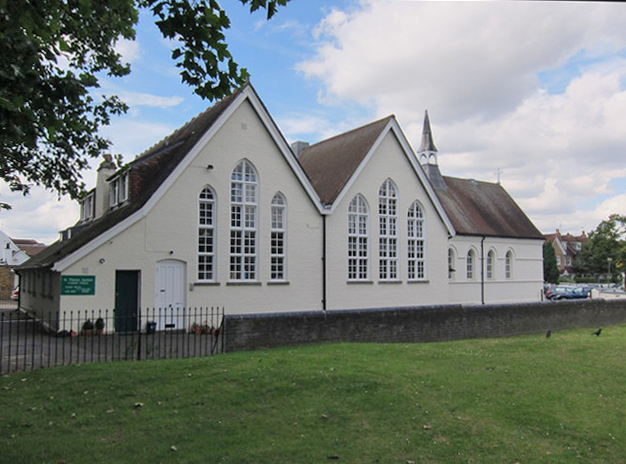
St. Thomas Aquinas — Ham

St. Thomas Aquinas Roman Catholic Church on Ham St., London

It overlooks the village pond
where cattle once drank deep,
rising white it calls to prayer
beneath a bell that summoned;
called children to the school.

Our feet trace theirs through lanes;
up the steps they climbed to class,
we kneel in pews where once desks
laid, before the sacrament.

Old walls evoke their voices
as we kneel in quiet prayer
in a village strung with kindness
in a world of haste and care.

New children raise their voices
to tell of what they’ve learnt,
not repeating tables, poems,
or letters on black slates,
but the life of Christ Our Lord.

Thomas’s image set into a niche
retells his life in wood
a humble Sicilian Dominican
who overhears our fears.

He wrote about the natural world,
look out and see our swans,
advised on debt, war and family
the cares that burned now.

– Carolyn O’Connell

© poem, Carolyn O’Connell; photograph of the church is courtesy of Hugh Venables via Geograph.org.UK under CC A SA 2.0

View guest contributor Carolyn O’Connell’s bio HERE

Exclusive, a poem

My favorite poetry is philosophy dressed in dreaming, not logic. It imagines a larger reality, a more expansive love. Rilke is the gold standard, I think.  Oh, but that is the pièce de résistance, and there’s so much more besides that. I am a poem consumer, not a gourmet chef. I know very little of form or craft, but I love to taste and participate. So I’ve written a poem for International Poetry Month. It’s a love poem to my late husband because, well, you might as well start with breakfast.

Exclusive

Thick, boyish lashes fringe
Other eyes, perhaps as blue,
Open, tender toward Beloved

Still smiling youths may offer
Eager grins, warm confidence
Gleaming ‘neath soft whiskered lips

Clear voices might ring
Thrilling, gentle as yours when
You sang at daybreak just for me

Surely now first loves make vows,
Grow mature together, devotion’s
Friendly joy becoming solid strength

Fathers must bend heart and arm
Wrap manhood’s grace boldly around
Each golden, blessed child – like you

No doubt live sorrowing pairs
With looming loss, still holding,
Fingers trembling, to brave last words

I cannot boast an only, greatest grief;
I know this storied world is vast.
But still I weep in fond belief
That you and I loved first and last.

© Priscilla Galasso

View Contributing Editor Priscilla Galasso’s bio HERE

Poetic Evolution

Poetry moves us. It makes us think, feel, inspires us to do more, be more. It has been here as long as people could speak and sing, and it will probably outlast the end of humanity. Like everything in life, it has had to evolve and adapt. One of the main purposes of poetry, to communicate something with someone else, has necessitated that new ways of reaching an audience. This is especially true now, in this digital age of instant gratification and social media.

Poetry has learned to deliver its message via video, recorded poetry slams, Skype, flash mob poetry in action…blink and you might miss it. But even if you DO miss it, you can probably find a recording of it somewhere. No longer is it simply written words on an immortal page in some heavy, dusty collection of poetry, or an oral history sung through the ages and generations. There are still formal forms, still meters (or even free form, as even it has a “beat”), still rhymes (or not), still those who will read it and listen to it. Some things about it do not change.

There have been many famous poets who have attempted to define what poetry “is”; the well-known, poetic “greats”, and they all have valid definitions. I tend to agree with one of my favorites, Robert Frost, who said:

“Poetry is when an emotion has found its thought and the thought has found words.”

To me, poetry is a type of communication that touches the heart and soul.

In honor of (inter)National Poetry Month celebrations here at The BeZine, I would like to share a couple of poetic videos with all of you. Both of these “spoke” to me. I hope that you find them as powerful as I did, and maybe that you will look at poetry as more than dry, printed words on a page. It is very much a living thing. And it continues to evolve, just like people do. 🙂

First, is a poem by actor Woody Harrelson.

Next, is a piece by rapper Prince Ea

© Corina Ravenscraft

View contributing writer Corina Ravenscraft’s bio HERE

Caught

Stepping into the gateless garden you see
a frail hammock slung between the old
rose bush and the lavender you like
to pinch for its scent though its flowers are bleached.
At once the trees in the park vanish, their songs
of praise in crimson, puce and apricot –
you trace the spider to the net’s centre. Gold
and silver needles shed by the sun are caught
in its radial and circular threads.
The house is tugging but you’re spellbound
by a trap for lesser insects that a dog’s snout,
a child’s finger could easily destroy.
It’s poignant as the mystic moon, the square root
of minus one you once grasped, dumbfounded.

© Myra Schneider

View guest contributor Myra Schneider’s bio HERE

Michael Castro – poetry

We Need To Talk

I am more than your idea,
I am tangible, touchable,
a human being like you.
We breathe the same air,
want the same things.
We need to talk.

I am more than my skin tone,
more than the weight I bear,
more than the clothes I wear,
more, even, than my hair,
more than who I sexually prefer,
more than my accented speech,
hear me!—we need to talk.

So get out of your closed mind,
It’s claustrophobic in there—thoughts fester
if they can’t expand. Let’s meet.
Get out of your car, onto the street.
Let’s discover each other
on common ground.
We need to talk.

I say, take off your armor,
put away your gun,
don’t just stare dumbly into your
smart phone.
Hel-lo!
Or as they say in the East, Namaste,
& Savati
the god in you
honors the god in me.
We need to talk.


America Loves Guns More Than Children

America loves its guns more than its children.
America hunts down its children in the streets,
massacres them in the schools, mows them down in the malls.

American loves its guns more than its children.
Keeps its gun with it at all times, at all costs.
Would rather wage war than feed or educate poor kids.

Would rather everyone be armed than everyone be smart.
America loves its guns more than its children.
America carries its gun in the store, in the bar, in the church,

anywhere you might be– make you feel safe?
America loves its guns more than its children.
America buries its children—doesn’t tuck them in at night,

doesn’t read them stories in bed. Instead,
America, lonely & stressed, sleeps with its gun under its pillow.
America dreams of its guns–& wakes up groggy& all wet.

America sells guns to crazy people,
sells weapons of war to madmen militias,
sells guns out of the trunks of its cars.

America loves its guns on tv, in the movies, on the news.
America loves its shooting range, its gun shows, its American Sniper.
America is entertained by its guns.

America coarsens young minds with gun culture.
America’s love of guns kills love of life.
America loves its guns more than its children.

America buys guns & cuts education funding.
America loansharks its college students, “takes them out” with
debt—
America loves its guns, while its jobs flee overseas.

America’s love of guns fills its armies & its prisons
America blows its own dream to bits.
America loves it guns while its infrastructure crumbles.

America loves its guns while its air & water thicken & sicken.
NRA America says guns don’t kill.
30,000 American deaths by guns per year.

America is armed & dangerous.
America makes bigger & better guns—sells them around the world.
America is world’s biggest arms merchant.

American guns are big business. Big Business Are US.
America is mowing down its children right & left
in the warzones, the streets, the schools, the malls;

Mowing them down right here today,
mowing down their present, mowing down their future.
America loves its guns more than its children.


Double Kwansaba* After Michael Brown

When police are the threat, who’s there
to protect? When walking in the street
can get you busted, shot, or beat
just for being black, talking back, looking
wrong, or looking strong—how can we
really be: a viable city, where people
can live in harmony? a free country?

With tanks in the street, who or
what do they defeat? No good results,
only bad; fear is what drives us
mad. And fear, the root of hate,
becomes the Police State. Instead of tear
gas, hear us! Let’s relate, for a
start, human to human, heart to heart.

*A kwansaba is a form invented by East St. Louis Poet Laureate Eugene B. Redmond: seven lines, seven words per line, no more than seven letters per word


Read more from Michael Castro in this issue of The BeZine:
Michael Castro—In his own words.

Other poems by Michael Castro will also appear on The Woven Tale Press website as part of a feature on Activist-Poets, Monday, April 25, 2016.

View guest contributor Michael Castro’s bio HERE

Ars Poetica and Inspiration

For Poetry Month of April 2013, Michael Dickel posted on his blog two poems published five years ago (now, in 2016) in a small anthology. Are poems like omelets? What is inspiration?

A r s   p o e t i c a

Water drops in hot oil disappear instantaneously
like meaning in conversation between two
who do not speak. Steam and sizzle, pop, sound
out a string-theory rhythm. Eggs separated, whites
beaten stiff, yolk to lemon yellow, make the best
omelets, if you fold together the parts again.

Whipped egg whites and egg yolks ready to be folded together for an omelet.
“Eggs separated, whites/ beaten stiff, yolk to lemon yellow, make the best/ omelets…”

The pan is not enough, by itself. After the eggs
brown and float on the oil, they need the oven.
Heat the filling, well cut and mixed, spiced
with pepper and garlic. No one will taste such
a breakfast; no feast leaves these pages—
cooking with pleasure and love, seeking 

Separated egg-omelet, rising in cast iron skillet.
“The pan is not enough, by itself.”

nourishment. There is no universal way to
cook eggs; there are many. And which eggs?
What filling? Who graces the table to join
this morning repast, a slip of a tongue
on the garlic clove, a red pepper bite,
the silvery cool of basil sliding down—

Separated egg-omelet, in cast iron skillet, finishing in the oven.
“After the eggs/ brown and float on the oil, they need the oven.”

don’t sing this song, or repeat this recipe,
it will only get you in trouble. Serve with
salad, cheese, orange juice and hot coffee.
Eat well, in silence if need be, for this may
be the last meal. Or the first. Or none.
Dance like water turning to steam in the skillet.

Cheese omelet.
“Eat well, in silence if need be…”


I n s p i r a t i o n

Of course, they say a dollop of sweet in a pot of salt:
ten-percent inspiration, ninety sweat. Perhaps the bank
clerk Eliot spoke of daily work, practice like the firefighter,
preparing for the poet Eliot’s hot blaze.

Outside this balcony a road curves, down
toward the shipyards at the bay,
containers suited for rail, truck and ship
lined up along the stunning sea.

Lake Pokegama, Minnesota, dusk ©2005 Michael Dickel
“Ah, to be carried off by fire or water,/ dreaming of reaching another’s shore…”

Ah, to be carried off by fire or water,
dreaming of reaching another’s shore,
words an emanation up, down, up—
but how do we know if nothing received

or sent the silence just before the big bang?

Open Door (Tzfat, Israel) B&W photo ©2006 Michael Dickel
“words an emanation up, down, up—”

Both poems originally published in print:

  • Dickel, M. (2009). Ars Poetica. Listening to the Voice Inside: Poetry from the Voices Israel Workshop, Haifa, 30.6.2009. Jerusalem: Voices Israel. Print. p. 61.
  • Dickel, M. (2009). Inspiration. Listening to the Voice Inside: Poetry from the Voices Israel Workshop, Haifa, 30.6.2009. Jerusalem: Voices Israel. Print. p. 24.

View Contributing Editor Michael Dickel’s bio HERE

SECOND LIGHT NETWORK … showcasing the ambitious poetry of ambitious women

Roman marble Bust of Artemis after Kephisodotos (Musei Capitolini), Rome.

“Women, of course, write good and bad poetry – ‘ambitious’ implies more enterprising subject-matters and approaches, as well as a unique voice for each poet.” Kate Foley and Dilys Wood, Editorial Page, ARTEMISpoetry, November 2015

Here it is April – Poetry Month! – and the month in which I know that Dilys Wood, Anne Stewart and other poets in London at Second Light Network of Women Poets (SLN) are hard at work putting a wrap on the May 2016 issue of ARTEMISpoetry. This biannual literary magazine specializes in the work of women bent on honest self-expression, subjects of substance, and well-crafted poetry.

The last issue was published in November 2015 and the focus was on ecology with an interesting feature article by Jemma Borg, scientist and poet. I touched on it in a short piece, Poets and Poetry, In the Shadow Land of Technology and Social Networking.

The issue included poems by Anne Stewart, the featured poet and the author of Janus Hour and Only Here till Friday.

Myra Schneider was the judge for the 2015 poetry contest. The winning poems are featured as well as the commended and we get a bit of the behind-the-scenes look at the hard work of judging.

“I went through over a thousand poems looking for poems that traveled, paid attention to form and made words work. Eventually I reduced a long list of 101 poems to 26 … I was very excited because the winning poems were telling me loud and clear which they were!”

No doubt it is an honor to be selected to judge – and clearly there are  rewards – but what a job as well. Certainly a labor of love. The winners for 2015 were: Carolyn King, Margaret Wilmot, Judith Taylor and Kathy Miles.

I was also pleased to read Myra’s feature on one of my own favorites, American poet Louise Glück.

In line with the issue’s theme, politics and eco-politics were explored by Kay Syrad, a regular contributor.  She discussed Priscila Uppal’s Sabotage (explores private and public acts of destruction, disruption, and vandalism in the 21st century) and Helen Moore’s Ecozoa (response to the destruction caused by industrial civilization).

Fiona Owen gifted us a thoughtful piece – both homage and exploration – on Anne Cluysenaar‘s eco-poetry.

“… Anne ponders ‘the tenuous job of the poet’ and sees the arts as having an intrinsic evolutionary role …”

In addition to poetry, ARTEMISpoetry always offers book reviews and announcements of publications, events and classes of interest … and lately continues some discussion and promotions of SLN’s last two anthologies Her Wings of Glass and Fanfare.

🙂 I recommend both. 🙂

Below is a sampling (three poems) from Fanfare with thanks to the poets and their publishers, to SLN and especially to Anne Stewart for doing the work of acquiring the permissions for me to share these poems with you here today.

January

Going into the sun
over mud flats skimmed with water

people are walking on ice or glass
their reflections perfect

and you know it’s a new year

walking into the sun
beach and sky cast in light

sheer

gone when you turn

and wave rippled mud
takes your footsteps, softly.

– Caroline Natzler

Caroline Natzler: January and Life’s Work, from Fold (Hearing Eye, 2014)

Untouchable

She shines like Lakshmi through the fields –
a gentle stride, arms at her sides.
By the houses, stooping her beauty
to the earth, she raises the brimming bucket,
its stench sealing her nostrils. Slurry clings
to hair and skin, but nothing changes
on her face, only a puckering of lips
in silent thanks to Kali
for twenty years of women’s work,
this dawn till dusk that’s nurtured seven sons;
thanks that she’s never known the blessing of –
nor visited this curse upon –
a daughter.

– Jill Sharp

Jill Sharp: Untouchable, from Ye gods (Indigo Dreams, 2015)

A Miracle at Iskitim

In Siberia, a symbol –
this is what the locals believe,
a magical birth of water:

a fresh water spring, a spurt
close to the ground, a low white
eternal flame.
We dip our cups
(plastic, from the hotel) and say,
“It tastes pure. The water is pure.”

Some people here heard the last trucks
grind out of sight, after they shut
the ‘lagpunkt’,
the slow-killing place,
left the scar for people like us
in a half circle, dark barrels

in our padded coats, gloves, hats, scarves …
With our white breaths, we breathe out lives
as we raise up transparent cups,

“The future came too late.”

– Dilys Wood

In her Gulag, A History (Penguin, 2004)Anne Applebawm refers to a new fresh-water spring near a former camp at Iskatim.

This slideshow requires JavaScript.

SLN, through community, classes, magazines and books, regularly serves up thought-provoking, often heart stirring and always engaging poetry by women as well as informative explorations and analyses of poems, collections, news and views. Whether you are an experienced professional or an amateur poet, there’s plenty to enjoy here, plenty to learn and think about. I venture to say though that if you are an older woman poet working to find your voice, you’ll discover special inspiration and encouragement through Second Light.

Membership (demographic restrictions), ARTEMISpoetry and the anthologies and other books can be purchased through Second Light Network of Women Poets or p f poetry

– Jamie Dedes

©the poets own the copyrights to their poems and they are featured here with permission; the photograph of the Artemis statue is courtesy of Marie-Lan Nguyen and generously released by her into the Public Domain.

POET, TEACHER, INSPIRATION: Dilys Wood and the Latter-day Saphos

Sappho (/ˈsæfoʊ/; Attic Greek Σαπφώ [sapːʰɔ̌ː], Aeolic Greek Ψάπφω, Psappho [psápːʰɔː]) was a Greek lyric poet, born on the island of Lesbos. The Alexandrians included her in the list of nine lyric poets. She was born sometime between 630 and 612 BCE, and it is said that she died around 570 BCE, but little is known for certain about her life. The bulk of her poetry, which was well-known and greatly admired through much of antiquity, has been lost; however, her immense reputation has endured through surviving fragments.
“Sappho (/ˈsæfoʊ/; Attic Greek Σαπφώ [sapːʰɔ̌ː], Aeolic Greek Ψάπφω, Psappho [psápːʰɔː]) was a Greek lyric poet, born on the island of Lesbos. The Alexandrians included her in the list of nine lyric poets. She was born sometime between 630 and 612 BCE, and it is said that she died around 570 BCE, but little is known for certain about her life. The bulk of her poetry, which was well-known and greatly admired through much of antiquity, has been lost; however, her immense reputation has endured through surviving fragments.” [Wikipedia]
Sunday: I began my dive into Dilys Wood’s Antarctica* (Greendale Press, 2008), spending my discretionary time engaged by this collection, which includes The South Pole Inn, a novella in verse.

“I dreamt I gave you the white continent
I wrapped it in white wedding wrap, embossed
with silver penguins and skiis …”
from Her Birthday Present in the section Love in a Freezing Climate: Four Poems

*****

“Wherever I look, the bacillus of melt
weakens the floes.”
from Future

DILYS WOOD is a poet, an editor and the founder (“convenor” as she might say) of the London-based Second Light Network of Women Poets (SLN), which produces the biannual ARTEMISpoetry and includes a publishing arm, Second Light Publishing.  I first encountered Dilys thanks to Myra Schneider. That award-winning poet with eleven published collections is a consultant to SLN.

While Internet and email have a way of helping to cross borders and make affinity-based connections, closing the gaps in culture and miles (in this case some 5,500 miles as the crow flies), the tools are imperfect. It’s not the same as meeting, talking and observing in person. However, when you read what people write, when they risk themselves by putting their very souls on paper, you do get to know something about their values and passions. My strongest sense of Dilys was as the quiet persistent energy behind a women’s poetry collective and an apparently indefatigable advocate for women’s right—including women over 40—to poetic voice. 

At the point in which I first encountered Myra, Dilys and SLN, Dilys had collaborated on (mainly with Myra) four anthologies of women’s poetry. She had two collections of her own poetry published, Women Come to a Death (Databases, 1999) and Antarctica. That was, I think around 2010. Since that time, we are gifted through Dilys and Myra, Anne Stewart (poetry p fand others on the SLN team with so many fine anthologies and magazines of women’s poetry, that I can hardly keep track. 

This slideshow requires JavaScript.

Dilys is modest in presenting herself. Her Poet’s Page on SLN’s website says simply –

Dilys started writing poetry again after retiring from the Civil Service, where her jobs included being secretary of the Women’s National Commission. She shortly after founded Second Light, focussed on the needs of women reconnecting with writing after forty. Second Light Network developed into a support group and, on a small scale (though reviews suggest significant), publisher of women’s poetry. Together with her own writing (Antarctica, 2008; Women Come to a Death, Katabasis, 1997), Dilys has been the joint editor (mainly with Myra Schneider) of 4 womens poetry anthologies.

If The Poet by Day (my information hub for poets and writers) was a poem, its title would have to have the tagline after Dilys Wood. The site is not the product of collaboration and membership. Nonetheless, its commitment to sharing information on poets and poetry, including gifted if lesser-known poets, and promoting and encouraging poets who are marginalized by their gender, ethnicity, disability or age – is very definitely inspired by Dilys work and commitment to mature women and the work and commitment of Myra Schneider and the other SLN women as well as by my own love of poets and poetry and the whole of poesy history and culture.

This is Dilys in her own words as she “spoke” in a guest blog post here several years ago:

NEW SAPPHOS, CHALLENGES FOR WOMEN POETS

I run a network for women poets and naturally I want our members to be treated equitably, with recognition of any woman’s potential to be in the top flight of creative artists.

Some poets feel that ‘male and female he made them’ should not be an issue. I disagree because I want to celebrate and gain personal inspiration from the last fifty years. There has been a vastly increased involvement of women as students of poetry, published poets, book purchasers and consumers of ‘products’ such as poetry festivals. I also want it debated why this has not meant equality of treatment by journals.

Why do some leading journals publish fewer poems by women and use fewer women reviewers? What part is played by prejudice and what by our diffidence? Do we submit enough work and persist when submissions are rejected? Are there subtle shades of prejudice? Are we taken seriously on ‘women’s topics’ but not when writing about spiritual experience or politics?

A first step is to convince ourselves that there is no ceiling. Emily Dickinson surely lives up to the epithet ‘unique genius’? Her work is incredibly economical, dense, universal and deeply moving. She is totally original in style and thought. Her work alone ought to kill the slur that biology-based inferiority explains historical under-achievement.

So many more women have found now their voice. Let’s celebrate poets who excite us, from Emily Bronte (say) to Jorie Graham (say). We can also start thinking seriously about differences and about inflated reputations. Let’s be wary about ‘celebrity status’. This tends to narrows true appreciation. Read voraciously. Include lesser known poets and dead poets. You will be impressed by how much exciting writing is on offer.

– Dilys Wood

* “Antarctica,” Greendale Press, 2008 (all proceeds to Second Light Network funds). �5.95 through poetry p f (scroll down on the page to which this is linked)

© The New Sapphos, Dilys portrait, book cover art, Dilys Wood; © introduction, Jamie Dedes; Sapho embrassant sa lyre Jules Elie Delaunay (1828-1891), public domain

Second Cease Fire

Opening the Iron Gate my feet trace
a path round silent ponds,
through black stands of blasted trees
rumbling from the smoke of winter’s war
flinging out naked branches
tipped by the solstice sun.

All is silence! No rustle of leaf, wing or
clink of feet scatters stray stones,
stirs this moment of equality –
seasonal ceasefire!
I walk on almost fearing fire
as a flicker of wing catches my gaze.

The path reveals a seat, I pause:
a coo calls “come” – a signal
returned by a trill as the wood erupts
with a cantata springing unseen
as all the hidden throats emerge

to fill the afternoon with hope.

© Carolyn O’Connell

View guest contributor Carolyn O’Connell’s bio HERE

In Memoriam

“I love, love, love you,”
you sang to me
In your last fragile days,

I love, love, love you, Mom.

You left too quietly
careful not to wake your child.

But I will always see you–
sketching at the lake’s edge.

on the horizon, phthalo blue,
crimson red ignites
your autumn, raw pigment
mutes your ocean storm

These were your colors
a lifetime of blended hues…

You have left me a white moon
scrubbed across an unfinished canvas.

But one frail hand reaches out
from beneath your fleece throw:
“You’re a very satisfying daughter.”
And inside, I am reaching up

to thank you
for showing me beauty
in the broken shell

For all you’ve done for me,
for others for who you are,
for gracing me as my mother.

© Sandra Tyler 2016

View Guest Contributor Sandra Tyler’s bio is HERE

Enjoy the Show

Donna Kuhn paints, dances, and writes poetry. She’s also a video artist. This video poem stretches our concepts of genre, media, and poetry. So,


Enjoy the Show


You can see another of her videos on The Woven Tale Press here.

View guest contributor Donna Kuhn’s bio HERE

Three by Ann Emerson, one of the original Bardo Group members

San Francisco Bay Area poet, Ann Emerson, was one of the first two people I invited to join in the collaboration we now call The BeZine. It was originally named Into the Bardo, in reference to the Buddhist state of existence between death and rebirth; so named because of life-compromising illnesses.

Ann was a gifted poet, but she didn’t find that out until after she was diagnosed with a rare bone cancer. She discovered her voice in a hospital poetry class. Ultimately she studied with Ellen Bass in Santa Cruz, California. 

img_0961After diagnosis, Ann survived for an almost consistently tortured six years. Physical pain. Trauma. Fear. Chemo. Poverty. She had signs posted around her house that said, “Live!”

While Ann spent a lot of time in the hospital, her home was a cabin in the Redwoods of La Honda, a stone’s throw from the log cabin where Ken Kesey and the Merry Pranksters so famously partied in 1964. She lived with her cats. Originally there were six and they were all blind. No one would take them in, so Ann did.

l.NbSuLbZWIcnyodRP

Ann was just a thesis away from her Ph.D. A few weeks before she died, four of Ann’s poems were published in American Poetry Review

416250017_370-jpg

Two days before Ann died, she married the gentleman who was her sweetheart of thirty years. Ann’s wedding was held in her hospital room. Those of us in the attendance were required by the hospital to wear yellow gowns over our street clothes. The bride wore yellow too. The flowers and the ring were from the hospital gift shop. The founder and leader of our support group for people with catastrophic illness, a Buddhist chaplin, performed the ceremony. One of us took wedding photographs using a cell phone.  I created a virtual wedding album. It was in its way lovely, but it was achingly sad.

IMG_8407

When Ann died, we sat with her for some time because Buddhists don’t believe the soul leaves the body right away. Ann’s Buddhist teacher – someone she held in high regard – came and lead us in meditation and blessing.

Here – on the third anniversary of Ann’s death – are three of her poems. In closing, I added A Hunger for Bone, the poem I wrote the day her ashes were released to the sea near Julia Pfeiffer Burns State Park in Big Sur. My poem in no way comes up to the gold standard Ann set, but it tells the story. 

—Jamie Dedes

Julia_Pfeiffer_Burns_State_Park


Elegy for Cat Five

Fuck the Glory that is Poetry,
fuck the smell of God in my hair,

The world is the color of driftwood,
this ordinary Wednesday in June.

Let’s have a moratorium on poems
about my shitty news from Stanford

and how I can’t tell heat from cold.
My blood dirty as brown sand in a museum,

and my cat, well, he has news too.
Death woman, skeleton cat,

I turned 57 yesterday when
the veterinarian said No.

I am taking us both to the ocean
for as long as we need:

red sand staining white fur.
I am smelling my cat’s iodine breath,

I am putting my hand in the wound
in my side. Dry brine stinking up

the air, seawater choking the
cawing gull in his throat.

And my face, he’d better
not fucking forget.

One more day leaving me
for a little peace of mind.

.
A Modern Poem (draft 1)

.
I am walking again through an American night,
past police stations with barred gates, windows
glazed warm with doughnuts, patrol cars in the lot.
I stand outdoors seeking coffee: someplace where
eyes will not wander through me when I sit in a red
booth filled with books as women fearing Altzeimer’s
hoard cats. I stay up until dawn, waiting for panic
to subside, to find the meaning in all things
in a city which says I am nothing.

..
I wake in my American forest, from a dream
of being shot: when one lives in a forest one cannot expect
the humane society always arriving in time. I walk through
the cabin and on down the path: moonlight blurs the redwoods,
wind blurs water. I feel like a girl safe in a picture book.
Indoors the television screen shines blue as topaz.
I am walking again through the forest aglow with
snowy owls and see-through salamanders.
Far from eyes broken like windows, and people
thinking they are nobodies, reading the paper
about life being rebuilt by night so that
no one notices it tumbling by day.


The Wrong Side of History

Fifty years ago, a house of
pale cinderblock. Sixty miles

north of here, Richmond
California, the poor

mending holes with colored thread.
I live in a house of

unnatural law, I am painting
landscapes in black: horses

and floating carpets of leaves.
When I am ten my father fills my mouth

with dirt for saying I want to die:
a ripped sheet twisted over my eyes,

my ankles hobbled in bed;
I summon the kingdom of horses

where lullabies murmur
brittle-legged ponies to sleep.

When I am twelve the city catches fire:
ruined faces of mares stretch for pages,

and when the tar roof seeps into
my room, I still do not run away.

Say nothing about the comfort of solitude,
stars crowded like sensations under the skin.

Say nothing about the morning blow of light,
the herd coughing on last night’s oily weed

– Ann Emerson

A Hunger for Bone

we scattered your relics, charred bone,
yours and your cats, to be rocked by waves,
to be rocked into yourself, the rhythm
enchanting you with cool soothing spume
merging your poetry with the ether,
rending our hearts with desolation,
shattering the ocean floor with your dreams
lost in lapping lazuli tides, dependable ~
relief perhaps after pain-swollen years of
suckle on the shards of a capricious grace

those last weeks …
your restless sleeps disrupted by
medical monitors, their metallic pings
not unlike meditation bells calling to you,
bringing you to presence and contemplation,
while bags hung like prayer-flags on a zephyr
fusing blood, salt, water
into collapsing veins, bleeding-out
under skin, purple and puce-stained,
air heavy and rank; we came not with chant,
but on the breath of love, we tumbled in
one-by-one to stand by you

to stand by you
when death arrived
and it arrived in sound, not in stealth,
broadcasting its jaundiced entrance
i am here, death bellowed on morphine
in slow drip, i am here death shouted,
offering tape to secure tubing, handing
you a standard-issue gown, oversized –
in washed-out blue, for your last journey
under the cold pale of fluorescent light

far from the evergreen of your redwood forest,
eager and greedy, death snatched
your jazzy PJs, your bling and pedicures,
your journals and pens, your computer and
cats, death tried your dignity and identity –
not quickly, no … in a tedious hospital bed,
extending torment, its rough tongue salting
your wounds, death’s hungering, a hunger
for bones, your frail white bones – but you
in your last exercise of will, thwarted death,
bequeathing your bones to the living sea

– Jamie Dedes

© 2011, Ann’s poems, her photo and that of her cate, Ann Emerson estate; © A Hunger for Bone and the yellow flower photograph,  Jamie Dedes; photograph of Julia Pfeiffer Burns State Park in Big Sur courtesy of wordydave under CC BY SA 3.0

Three Poems by Michael Dickel

Water Poems
Photo to accompany poetry Trout Swimming Banyas Stream, Israel Photo Collage ©2016 Michael Dickel
Banyas Stream, Israel

1

Floating in the current
Waiting For the right moment
I watch it drift away.


Banyas Water Falls, Israel, Photo ©2016 Michael Dickel to accompany Water Poems, poetry by Michael Dickel
Banyas Water Falls, Israel

2

The water tumbles over
Every cliff broken, still, and silent
In the crashing sound
Pounding its feet.


Turtles on log Hula Lake Reserve Photo ©2016 Michael Dickel to accompany Water Poems, poetry by Michael Dickel
Hula Lake Reserve, Israel

3

The papyrus and turtles thrive
Downstream, the calm waters
Flowing by them, sustenance
And succor their delight.

Turtle photo, Hula Lake Reserve, Israel, to accompany Water Poems, poetry by Michael Dickel
Hula Lake Reserve, Israel


Papyrus, Hula Lake Reserve, Photo ©2016 Michael Dickel to accompany Water Poems, poetry by Michael Dickel.
Papyrus, Hula Lake Reserve, Israel

Originally in Fragments of Michael Dickel on 1 Apr 2016

© Michael Dickel

View Contributing Editor Michael Dickel’s bio HERE