The Great Education Escape

Riding the Chariot

A fiend roared within him, fueled by germs rioting throughout his system. They wanted more whipped cream, blue sex, smoke-filled rooms; they wanted more income, better homes, self-determination; they wanted democracy to rule his body. If he had a hammer, justice would rule with silver scales. The fool would lead them.

But bang-bang, the gavel falls, overruling his objections. The fiend takes over, and his cells and the germs war, killing each other and putting the community that one might think of as his body into perpetual motion.

The teacher makes a scene for them to memorize, part of the first act of their lives. This is his job, to create neat scenes for his un-dilated pupils to use to construct a belief system and life to come. He has long since listened to the critics and realized the play will be a flop.

It all falls in on him when the fiend takes over his body.

“Class dismissed. Go home, read Rabelais, Larsen, Stein, Baldwin, Kerouac, Morrison, Atwood, Harjo, and DeLillo. Write an experimental novel. Go off the grid. Build a life from your own materials.”

The pupils stare at him intently, comprehensively unable to stand under this downpour, an outpouring of blinding insight.

“Seriously, once you have done that, come back to me and ask for an A. Until then, you have only failed, like me.”

He walked out of the class. The ‘flu had won. He went to the office, pulled a blank piece of paper from a copier, and wrote a note to the principal. Two words: I quit. Then he signed and dated it.

The school never heard from him again. Someone thought they saw his name on an
essay about Rabelais, Freire, and the need for revolution in the classroom. The principal read a review of an experimental novel that he might have written. A former student searched for him on Google, but his name disappeared from the screen.


20130710-220704.jpgWalking the ravine ahead of angels, those messengers of shadowed new light, he forgot his mother. The trees painted, making art that lasted a mere second as a breeze brushed their shadows. With affection, he thought of an Aztec descendant he met in Machu Pichu.

The land around him had a great thirst, not for rain, but for memory. A camera, hidden in a satellite, re-collected this moment of light bouncing from the rock party, a ball spinning on a pivot.

It made little difference to his views of the cosmopolitan metropolis instantiated in Berlin when the rodeo stopped in at the saloon. That poor raccoon, the gun, the Bible, the gin—you know the song. These thoughts swirled through the germinating revolution, the German revolution, the germ revolution, each a rival to his dreams.

They tried stealing his sanity, but they found the vault empty, as he had discarded all previous construction materials, leaving a lattice of emptiness while seekers discussed the seven paths of mysticism in a courtyard around seventy-seven corners of relationship to the hole filled with rain.

The wandering, colorful man no longer knew how to belong to the swimmers, so he stopped treading water, only to find that the water spit him out.

20130710-220850.jpg

He felt silly, and thought of fixing it all, perhaps by pulling the plug and disconnecting the hole from the screen. Still, a tired wink of his mind and his wonder returned, more quickly than the drink in the saloon arrived for the rodeo’s raccoon. His doctor thought he was depressed. His ex-girlfriend thought he was manic.

It could be bad, or better, if he only found what he needed to remember to forget. His skin would then refrain from thirsting for the rain, afraid that the world would fall from his shoulders, crash onto the pathless road; the wheels of the chariot would crush him with it. The soil would drink his memory. And the trees would brush over it all a surrealistic image, covering the sketch without any pentimento.


His dilated pupils did not like the new teacher. Their vessels expanded until they burst, exploding many myths at once. The principal was not their pal. They left school, but only after many years. They read theory. They taught in universities. They thought they were experimenting.

—Michael Dickel @2017

20130710-220330.jpg


An earlier version of this appeared here on Meta/ Phor(e) /Play, Michael Dickel’s blogZine. A closer version to this one appears in his collection of flash fiction, The Palm Reading after The Toad’s Garden. This version has some small edits and one name listed to the authors the pupils should study. What does this have to do with social justice? A critique of education, conformity, and exclusion might be found in its surrealistic-hybrid traces.


Off the Trail of Consumer Capitalism

Off the trail

Author’s note: Originally written in July, 2013, this piece seems even more relevant and urgent 5 years later. It originally appeared here, on Meta/ Phor(e) /Play. A revised version appears in my flash fiction collection, The Toad’s Garden after The Palm Reading. This version has been slightly edited, most significantly to add the word “consumer” to modify capitalism, as the term “consumer capitalism” has come to my attention as one bandied about in place of democracy as the essential system of the United States (and promoted by some on the so-called “Christian” Right, although from my perspective, that political group seems neither Christian nor right…). The line about the great purges goes back to 2013, but we now see something like them beginning to form…


By chance I learned that they planned to crucify the married couple for honeymooning off the grid and outside of the mainstream consumer economy. The couple backpacked along the Appalachian Trail, using second-hand equipment, carrying home-prepared dried goods for meals , which friends provided to them as gifts.

The followers of Christ, Consumer-Capitalist, found such sacrilege untenable, especially in light of the anger it would cause the Corporate Lords of the Boardrooms.

I overheard my editor on his cell, assigning someone to cover the Meeting of Judgment where the sentence would be pronounced. When I understood that the other reporter wouldn’t be back from her current assignment in time, I sauntered in and asked what Ed had for me, like I didn’t know anything.

“The Reverend called to request we send someone to this meeting, give it coverage to send the message out. Work, spend, play inside the economy.”

“Got it. Keep the money flowing to oil the consumer capitalism machinery of wealth.”

I knew the catechism, but didn’t believe it. I’d sent dried lemon peels, home-made penne (dried to preserve it), a chunk of parmigiana traded on the underground market, and a sealed container of pesto for them to make a backpacker’s lemon pasta.


The Meeting of Judgment followed the usual pattern of these religious courts. A minister of the Reverend’s flock read out the charges. Two other ministers sat on either side, listening gravely. They conferred briefly. It didn’t matter that the accused even now were somewhere hiking in the woods.

As per custom, the ushers served cups of tea to the witnesses of the Meeting. We remained silent. I sipped a sad orange-pekoe until the lead minister announced the decision.

Crucifixion. It had come back in style around 2020, shortly after the great purges that deported, jailed, or enslaved first the non-Christians, then the wrong-type of Christians.

I had not seen a crucifixion. Up to now, it had been an advantage of a rural assignment.

“What are you going to do?” The man I knew as Germaine asked me. He’d popped up out of the crowd as I pushed out the door.

I’d seen Germaine at several social gatherings of people like me. My circles went along with the Reverend to a point, that is, enough to survive, and no more. We kept to ourselves, and tried to avoid the scrutiny of the Reverend and his ministers.

“Do? I’ll write a story about the Judgment, the reasons for it, and watch to see how many hits it gets on the Screens.”

I didn’t know Germaine enough to be baited into saying something damaging. Besides, that was what I planned to do.

“No, about them. We can’t let them get caught.”

“You could get crucified yourself for getting involved. Even what you said is a crime against Christian Consumer Capitalism.”

“What is Christian Capitalism? Something made up by corporate overlords who overeat from our consumption. There never was such a religion.”

I walked away. I considered whether he might be an agent provocateur, meaning I should report him before he denounced me for doing nothing. I decided that I didn’t want to get involved, and would invoke my sometime role as investigative reporter should he accuse me.


The next morning I had coffee with Frank, someone I thought I knew enough to trust under most circumstances. He told me that Germaine had been arrested for sedition, blasphemy, and heresy as a result of spouting the Devil’s own socialism.

“I’ll be damned.”

“Probably,” Frank said. “To tell you the truth, I thought he was a spy.”

After Frank went off to work, I looked for a screen-story on Germaine, but didn’t find one. I wondered how Frank had heard.

I read my own story on my screen, instead. It played well, several hits, re-posts, and praiseful comments.

It bored me. No, more than that, it sickened me.

I didn’t believe any of it. I knew the young couple, knew they loved the woods, knew they couldn’t afford a resort honeymoon because they wanted to buy a house and the downpayment would take everything they had.

They actually wanted to fit in and had no revolutionary or irreligious intent. They wanted to get along, but to also live their lives and not be pulled under the tide of consumer debt.

Just then, I realized that the Reverend and the ministers didn’t care. And maybe Frank didn’t read about Germaine on a screen.


The Reverend wanted to make a statement, keep people scared, keep people trying harder than ever to feed the economy and concentrate power and wealth into the Corporate Lords, who ran the Reverend.

Or maybe the other way around, the Reverend ran them. It doesn’t matter now, I realize.

Frank wanted me to play along and keep away from people like Germaine. It was almost a friendly gesture. It could have been a warning, even.


And that’s why I find myself sitting in a deer stand along the Appalachian Trail. The newlyweds should pass under it sometime today, if they haven’t yet been waylaid.

When they do, I’ll wait to see if they find the package I left out.

It has printouts of the screen story I wrote. It has a copy of the Judgment Decree. It has a map of little-known trails that cross this path, and what cash I could withdraw without getting stopped by a minister.

I thought that I would watch them pick it up and wait until they were gone, then make my way home after a few stops to justify my travel, should I get checked.

Now, I’m thinking maybe I’ll ask if I can walk with them a while when they go off the trail. I’ll cut out after a few days, find my own way.

I don’t know why I’ve decided to do this. I just don’t feel like writing another story I don’t believe in, I guess.

—Michael Dickel ©2018, 2017, 2013

20130729-230444.jpg

Closed Doors to Hotel Rooms

Mr. Weinstein Will See You Now
by Amanda Palmer and Jasmine Power


released on BandCamp 23 May

Mr Weinstein Will See You Now - Artwork / photo: coco karol / design: andrew nelson
photo: coco karol
design: andrew nelson

A bit of lyric

amanda:
you came with bows and bells…

jasmine:
i’m not here to have

amanda:
you came here armed for action…
you knew the drill.

jasmine:
move over before i shelve myself
i’m not here to help you.

amanda:
every man behind the curtain

jasmine:
jerking knobs and smoking guns

amanda & jasmine:
shut your eyes pay no attention
just keep calm and carry on

black or blue, you choose
you’re free to be in between
play or lose
you say

Conversation fragments (via email)

Amanda Palmer: The song [Mr. Weinstein Will See You Now] began as a “let’s write something, anything together” jam session between me and Jasmine Power, a 24-year-old Welsh songwriter who happened to be over to a dinner party at my house. She’d been randomly invited over by a mutual Welsh playwright pal of ours, Hywel John. We’d never heard each other’s music, and after bonding over a late-night music-sharing wine-party, we found ourselves in a studio three days later, excited to create something from scratch.

The news about Stormy Daniels was just hitting fever pitch, and I found myself thinking about closed doors to hotel rooms across the world and over time and how they’ve been the backdrops of so many of these painful encounters. That was the starting point, and we wrote with the idea of a split self: two voices inside one woman’s head.

I’m goddam proud of it.

Me: First listen—haunting, almost like ghost voices signing from the memories.

[I meant singing, but, signing—why not?]

Sorry—possibly a vague impression. It takes me a few listens/reads to absorb poetry. This is poetry.

Amanda Palmer: That’s the idea. The lyrics aren’t supposed to be completely audible.

Me: Like the memories and stories—suppressed and emerging.

Amanda Palmer: Exactly.

A bit of lyric

amanda & jasmine:
black or blue
you choose
you’re free to be in between
play or lose
you say
it’s still not what you meant to mean
black or blue
you mean
what?
you can’t be serious
don’t you dare forget

jasmine:
that i’m the one writing this
i’m the one writing this

amanda:
and this never happened.

jasmine:
i’m the one writing this.

amanda:
this never happened.

jasmine:
i’m the one writing this.

Memory fragment

For me, sexual abuse re-sounds as shattering glass.

Decades ago, I worked as an overnight counselor in a shelter for runaway teens. One night, shattering glass took me into a room. A teen girl held her hand, blood running down it. Broken glass from the window had cut her open as she slammed her reflection in the glass.

She had been praying. She saw herself in the window. She was angry at god and struck herself, her reflected self in the black glass of night.

When I went over to her, starting to tend to her wounds, she kept shouting, “he fucked me he fucked me he fucked me,” looking at her bloody hand. Then she looked up at me. “My father fucked me,” quietly.

Am I surprised by #MeToo? No. I saw too many teen girls sexually abused by family members, by fathers—if men did this to their own daughters, why wouldn’t they abuse any woman?

Encounters with teens’ stories—shattered psyches wanting to rebuild a sense of self, running away from what they could no longer live with—these stories forged what I would later call my “street feminism.”

The power of a whisper shocked me into an awakening awareness. It was, perhaps, the most powerful whisper I have ever heard.

Mr. Weinstein Will See you Now

The strength of Amanda Palmer’s and Jasmine Power’s performance lies in the haunting, quiet emergence of story fragments weaving into a single story—the building emotion, the details that in Hollywood’s male gaze would be erotic details:

your shirt is on the table…

your skirt is on the floor…

countered by crossing voices from women’s emotional reality:

you crouch down in the bathroom…
our time is at a loss
the mirror makes you sick…
won’t have you in me

The music uses piano to paint the emotion, the growing power of the singers. As they share their stories, their voices slowly build toward crescendo. Matt Nicholson, a British composer and film-music arranger, brings “strings and orchestration to make the track more cinematic; almost overdoing it at points to kick Hollywood in the face,” Amanda Palmer writes.

At times, the orchestration pulls back to let the voices and piano convey raw emotion:

amanda & jasmine:
just turn me over

jasmine:
fast and
let’s get this over with

amanda:
let’s get this over with

jasmine:
let’s get this over with

Amanda Palmer: I’d been fiddling in my own head for months with ideas for songs and tunes to address the #MeToo movement, and it’s such a hard thing to write about it. It’s so personal to these women, these stories, and it felt too wrong to write something funny and cabaret; the topic is too harrowing.…
It doesn’t sound like anything I’ve ever made before; it’s almost a mini piece of theater.

Me: Disturbing, powerful theater that almost hurts—the beauty of the singers’ voices, the music, combined with the pain and hurt of the reality of sexual violence—“black or blue/ you choose / you’re free to be in between”—but in between is neither here nor there—dissociative—hard to find a self, to cohere.

Shattering glass.

Until the voices gather the shards, arm themselves, and reclaim their lives:

amanda:
every version has two endings

jasmine:
every time the penny drops

amanda & jasmine:
open casket, open casting
this is where the story stops

jasmine:
i storm out through the hallway
i leave the scars inside
you won’t portray my picture
this film is mine

And at the end of the song, in response to “this never happened,” the song arrives at: “i’m the one writing this.”

Amanda Palmer and Jasmine Power
are “the one[s] writing this”

Amanda Palmer: It’s not surprising that, just like the movement itself, it took two women getting into a room together, comparing notes and joining forces to create something almost like an anthem for taking back our narrative.

Every time I play the track for one of my female friends, we have an important moment together.

I don’t know if most people will even understand this song; and I don’t care.

The women we wrote it for will understand.

—Michael Dickel
Essay @2018 Michael Dickel
Song Lyrics @2018 All Rights Reserved (Used by Permission)


Mr. Weinstein Will See You Now

photo:
coco karol
design:
andrew nelson

Song written by Amanda Palmer, Jasmine Power and Sketch & Dodds
Vocals: Amanda Palmer and Jasmine Power
Piano: Sketch & Dodds

Production: Sketch & Dodds
Strings: 7 Suns Quartet
Cello: Earl Maneein
Violin: Jennifer DeVore

Recorded at Applehead Studios, Woodstock by Chris Bittner, and at The Bunker Studios, NYC, by Todd Carder
Jasmine’s vocals recorded by Owain Jenkins at StudiOwz in Wales-Pembrokeshire in December 2017.
Mixed and Mastered in London by Taz Mattar


This originally appeared on Meta/ Phor(e) /Play as Behind Closed Doors to Hotel Rooms.

Related from Michael Dickel, on The BeZine:

Warm Blanket of Silence

An essay Michael Dickel has been writing since 1988, and of which he read a revised version for the International Day for the Elimination of Violence Against Women at Verses Against Violence 3, organized by Rachel Stomel in Jerusalem, on 24 November 2016.

Gertrude’s Poem

To name a purple flower—hubris;
To call red a rose.
A rose is a rose is a rose,
She said.
The fruit of purple.
So like an apple—
so unlike an apple—
poison to eat.
—Sodom’s apple
milkweed—
A rash thought that
blisters my skin.
A rose is a rose is a rose,
She said.

—Michael Dickel
©2018

Sodom's Apple Ein Fascha (near the Dead Sea) photographs ©2018 Michael Dickel
Sodom Apple [1]
Ein Fascha
(near the Dead Sea)
photographs ©2018 Michael Dickel

[1] Calotropis procera, a milkweed native to the Dead Sea and Sodom, Israel and other desert regions” (Wikipedia). Known also as Apple of Sodom.

Which is also the title of a Marilyn Manson song written for a David Lynch film, Lost Highway (warning: strong images in this YouTube music video of the Marilyn Manson song):


This poem originally appeared on Instagram, in an earlier version.

Multiplying Media, four poems by Michael Dickel

19 August 2005
©2018 Michael Dickel


Skin Rug poem graphic
Skin Rug
©2018 Michael Dickel


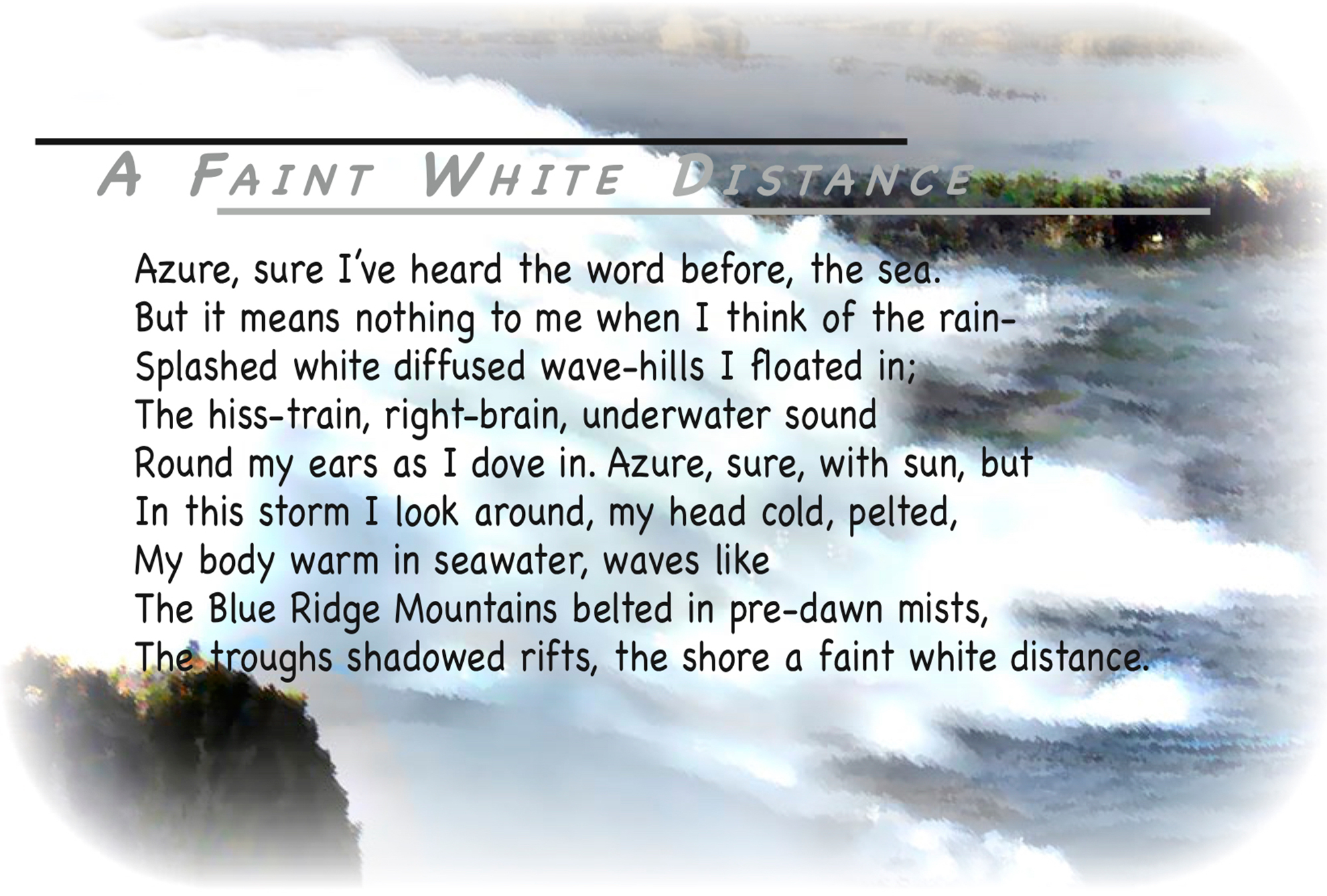
Faint White Distance
©2009 Michael Dickel
from The World Behind It, Chaos…


Strange Fire
©2012 Michael Dickel

Headphones recommended for the full sound-sculpture effect.


Graphics, poems, and music ©Michael Dickel All Rights Reserved


[Click on an image to see it full size.]


Earthquake and devastation

Shaken earth weeps
floods of ice in all lands,
attempts to cleanse itself.
We diseased cells have
metastasized, eaten
its forbidden flesh,
perforated its bones.
What it cannot shake
off it sweeps away
in wind or burns
off in fires. Glaciers
wear down what remains.
Everything known is now
extinct. Only new forms
emerge, scathed and
transformed from death
by cancerous greed—
into a fallen grace.

—Michael Dickel
©2018

Shekinah III: My beloved whispers in my ear

And these words, which I command thee with this day, shall be upon thy heart…
And thou shalt bind them for a sign upon thy hand, and they shall be for frontlets before thine eyes.

—Deut. VI:6, 8

I.
My beloved whispers in my ear; she reveals herself to me—
her Words, jewels upon my breast, upon my hand, upon my forehead.
When my beloved walks in the field, the heron flies up with cackling praise;
she inspires the crane to laugh as it rises into the sky; the swallows dance for her.
I have come and gone with uncertainty and doubt; but my beloved inspires constancy:
Though in times of drought the hill dries out, the hollows hide some mud, remembering.
My beloved brings rain into the high, parched fields that have forgotten her;
she walks among the swaths and sheds her tears for each cut stalk.
The hollows swell with water to quench the beasts and grow the iris;
my beloved reflects their grace as they mirror the sky among the grasses.

II.
The storm was terrible: the thunder rumbled long in the night; the lightning terrified;
a wind blew through the window of the house and tapped upon the walls.
Yet, my beloved whispered in my ear and I wore her words like jewels.
In her arms I rested as the fields drank deeply, the dry holes filled with sweet water.
In the dark I am drawn to my beloved; she is even more glorious in the light:
She is a stand of gentian unexpectedly found near the edge of the willow.
An eagle flies above the goldenrod and pines; I know my beloved thinks of me.
The thought of my beloved eases my burden as I toil on the road to her house:
Her kisses, sweeter than blueberries freshly picked, inspire acorns to rise toward the sky;
her caresses provide strength to the birch, the aspen, the maple, the oak, but also to grasses.

III.
I hold my love; she holds me. I have studied her in the willow, the iris, the thistle:
finches, warblers, and wrens feed and live in her shelter, so my love feeds and shelters me.
The oats have been cut, the hay rolled and stored for the winter.
My love comes to me and whispers in my ear; she reveals herself to me.
The geese gather and call, flying over the trees, landing in the pond:
my love sighs and the grasses bend; the aspens sigh and my love bends to me.
Her kisses build the temple; her love holds me and I heal:
My beloved is mine, I am hers. She points to the flowers off the path:
small white bells, tiny blue trumpets, vetches, paintbrush; I don’t know all the names.
My beloved knows the Names of the Flowers; she whispers them to me: I embrace her.

—Michael Dickel
©1999


Hebrew

עברות


  :III שכינה
אהובתי לוחשת לי באוזן


והיו הדברים האלה, אשר אנוכי מצווך היום– על לבבך… וקשרת לאות, על ידיך; והיו לטופפות בין עיניך

-ספר דברים, פרק;, פסוקים ו’-ח;


I.
אהובתי לוחשת לי באוזן; היא נגלת אלי-
מילותיה, תכשיטים על חזי, על ידי ועל מצחי.
כשאהובתי פוסעת בשדה, הענפה אצה מקרקרת תשבוחות:
לעגור היא נותנת השראה לצחוק במעופו אל השמיים; הסנוניות רוקדות עבורה.
באתי והלכתי עם ספק וחוסר ודאות: אולם אהובתי משרה השראה בלי הפסקה:
גם אם בשעת בצורת הגבעה מתייבשת; הנקיקים מחביאים קצת בוץ, זוכרים.
אהובתי מביאה גשמים אל הגבהים, אל שדות קמלים אשר אותה שוכחים;
היא מהלכת בין האלומות ומזילה דמעות על כל גבעול שנגדע.
הנקיקים מתרחבים ממים שמרווים את החיות ואת משקים ומצמיחים את האירוס;
אהובתי בבואה לחֵינם באותה מידה שהם משקפים את השמיים בין הדשאים.

II.
הסערה היתה נוראית: הרעם הרעים לאורך הלילה; הברקים הבהילו;
הרוח נשב מבעד לחלון ונקש על הקירות.
אבל עדיין, אהובתי לחשה לי באוזן ואני לבשתי את המילים שלה כמו תכשיטים.
נח בזרועותיה בעוד השדות בשקיקה שותים, הנקיקים היבשים במים מתוקים מתמלאים.
בחסות החושך אני נמשך אל אהובתי ובאור היא אפילו עוד יותר מופלאה:
היא גבעול גנציאן סגול הנמצא במפתיע בפאתי הערבה.
נשר חג מעל האורנים ושיחי שרביט הזהב הצהובים; אני יודע שאהובתי עלי חושבת.
המחשבה על אהובתי מקלה על המשא שלי בעוד אני עומל לעשות אל ביתה את דרכי:
נשיקותיה, מתוקות מאוכמניות טריות, מעוררות השראה באיצטרובלים להתעלות מעלה אל רקיע;
ליטופיה כוח נונתים לליבנה, לצפצפה, למייפל, לאלון אבל גם לעשב.

III.
אני מחזיק את אהובתי; היא מחזיקה אותי. למדתי אותה בערבה, באיריס, בחוח:
פרושים, גדרונים וסכבים ניזונים ובמקלטה חיים, ככה אהובתי מאכילה ועלי מגנה.
שיבולת השועל נחרשה, עובדה ואוחסנה לימות החורף.
אהובתי אלי ניגשה ולי באוזן לוחשת; היא מגלה עצמה בעבורי.
האווזים מתאספים וקוראים, עפים מעל העצים, באגם נוחתים:
אהובתי נאנחת והאווזים רוכנים; הצפצפה נאנחת ואהובתי רוכנת לעברי.
נשיקותיה בונות את המקדש; אהבתה אוחזת בי ואני מחלים:
אהובתי שייכת לי ואני לה. היא מצביעה לעבר הפרחים לצד הדרך:
פעמונים קטנים לבנים, חצוצרות זעירות כחולות; מברשות, מטפסים; אני לא מכיר את כל השמות.
אהובתי יודעת את שמות הפרחים; היא לוחשת לי אותם; אני אותה מחבק.

—מיכאל דקל

תרגום לעברית: גילי חיימוביץ’
2018©

Hebrew translation by Gili Haimovich
©2018


The English original was published in Midwest / Mid-East
and in Diogen pro kultura magazin / pro culture magazine.

A Defense of Activist Poetry

51pv4fg0wpl-_sx329_bo1204203200_By now, those who pay attention to poetry and in particular the poetries of witness and activist poetries, know well that it follows from a long tradition. Yet others, especially cultural and political conservatives, argue “protest” poetry or “political” poetry both do not constitute “Literature,” and that such poetry cannot help but be time-bound little more than contemporaneous commentary. I have been told that some of my poetry is “journalistic,” and that I am caught in a “fashionable” trend from the mid-1950s that has no literary roots beyond, possibly, the Beats. Such arguments simply are nonsense.

unknownCarolyn Forché’s volumes Poetry of Witness: The Tradition in English 1500–2001 and Against Forgetting: Twentieth-Century Poetry of Witness demonstrate, with excellent examples, a long history of social and political engagement in English poetry. In fact, one might claim just the opposite of the (usually disguised political) claims that the tradition began in the middle of the 20th C. could be made, that solipsistic confessional poetry that is more autobiography than engaged in the world emerges from that time, in counter-balance to a history of poetry engaged in the outside world.

For this post, I provide two examples of poets from the first half of the 20th Century who engaged in the world.

*****

The first, two poems come from the well-known poet William Butler Yeats: Easter, 1916, written in response to a political protest forcefully broken up by the British, who executed 16 of the protesters. The poem, written in September 1916 and published in 1928, ends with a powerful commentary on the protest, the execution-martyrdom that resulted, and, prophetically, the continuation of the Irish struggle: “A terrible beauty is born.”

Easter, 1916

I have met them at close of day
Coming with vivid faces
From counter or desk among grey
Eighteenth-century houses.
I have passed with a nod of the head
Or polite meaningless words,
Or have lingered awhile and said
Polite meaningless words,
And thought before I had done
Of a mocking tale or a gibe
To please a companion
Around the fire at the club,
Being certain that they and I
But lived where motley is worn:
All changed, changed utterly:
A terrible beauty is born.

That woman’s days were spent
In ignorant good-will,
Her nights in argument
Until her voice grew shrill.
What voice more sweet than hers
When, young and beautiful,
She rode to harriers?
This man had kept a school
And rode our wingèd horse;
This other his helper and friend
Was coming into his force;
He might have won fame in the end,
So sensitive his nature seemed,
So daring and sweet his thought.
This other man I had dreamed
A drunken, vainglorious lout.
He had done most bitter wrong
To some who are near my heart,
Yet I number him in the song;
He, too, has resigned his part
In the casual comedy;
He, too, has been changed in his turn,
Transformed utterly:
A terrible beauty is born.

Hearts with one purpose alone
Through summer and winter seem
Enchanted to a stone
To trouble the living stream.
The horse that comes from the road,
The rider, the birds that range
From cloud to tumbling cloud,
Minute by minute they change;
A shadow of cloud on the stream
Changes minute by minute;
A horse-hoof slides on the brim,
And a horse plashes within it;
The long-legged moor-hens dive,
And hens to moor-cocks call;
Minute by minute they live:
The stone’s in the midst of all.

Too long a sacrifice
Can make a stone of the heart.
O when may it suffice?
That is Heaven’s part, our part
To murmur name upon name,
As a mother names her child
When sleep at last has come
On limbs that had run wild.
What is it but nightfall?
No, no, not night but death;
Was it needless death after all?
For England may keep faith
For all that is done and said.
We know their dream; enough
To know they dreamed and are dead;
And what if excess of love
Bewildered them till they died?
I write it out in a verse—
MacDonagh and MacBride
And Connolly and Pearse
Now and in time to be,
Wherever green is worn,
Are changed, changed utterly:
A terrible beauty is born.

– William Butler Yeats

Yeats’ poem, Nineteen Hundred and Nineteen, comments powerfully and bitterly on violence, war, oppression, and the loss of our own humanity in modern times. The poem, in six parts, has a history of difficult critical reception—critics had a hard time reconciling it with others of Yeats’ works. However, since the later part of the 20th Century, his poem has had a more thoughtful reading by the critics, possibly giving weight to saying he was “ahead of his time.”

Nineteen Hundred and Nineteen

I.
Many ingenious lovely things are gone
That seemed sheer miracle to the multitude,
protected from the circle of the moon
That pitches common things about. There stood
Amid the ornamental bronze and stone
An ancient image made of olive wood —
And gone are Phidias’ famous ivories
And all the golden grasshoppers and bees.

We too had many pretty toys when young:
A law indifferent to blame or praise,
To bribe or threat; habits that made old wrong
Melt down, as it were wax in the sun’s rays;
Public opinion ripening for so long
We thought it would outlive all future days.
O what fine thought we had because we thought
That the worst rogues and rascals had died out.

All teeth were drawn, all ancient tricks unlearned,
And a great army but a showy thing;
What matter that no cannon had been turned
Into a ploughshare? Parliament and king
Thought that unless a little powder burned
The trumpeters might burst with trumpeting
And yet it lack all glory; and perchance
The guardsmen’s drowsy chargers would not prance.

Now days are dragon-ridden, the nightmare
Rides upon sleep: a drunken soldiery
Can leave the mother, murdered at her door,
To crawl in her own blood, and go scot-free;
The night can sweat with terror as before
We pieced our thoughts into philosophy,
And planned to bring the world under a rule,
Who are but weasels fighting in a hole.

He who can read the signs nor sink unmanned
Into the half-deceit of some intoxicant
From shallow wits; who knows no work can stand,
Whether health, wealth or peace of mind were spent
On master-work of intellect or hand,
No honour leave its mighty monument,
Has but one comfort left: all triumph would
But break upon his ghostly solitude.

But is there any comfort to be found?
Man is in love and loves what vanishes,
What more is there to say? That country round
None dared admit, if Such a thought were his,
Incendiary or bigot could be found
To burn that stump on the Acropolis,
Or break in bits the famous ivories
Or traffic in the grasshoppers or bees.

II.
When Loie Fuller’s Chinese dancers enwound
A shining web, a floating ribbon of cloth,
It seemed that a dragon of air
Had fallen among dancers, had whirled them round
Or hurried them off on its own furious path;
So the platonic Year
Whirls out new right and wrong,
Whirls in the old instead;
All men are dancers and their tread
Goes to the barbarous clangour of a gong.

III
Some moralist or mythological poet
Compares the solitary soul to a swan;
I am satisfied with that,
Satisfied if a troubled mirror show it,
Before that brief gleam of its life be gone,
An image of its state;
The wings half spread for flight,
The breast thrust out in pride
Whether to play, or to ride
Those winds that clamour of approaching night.

A man in his own secret meditation
Is lost amid the labyrinth that he has made
In art or politics;
Some Platonist affirms that in the station
Where we should cast off body and trade
The ancient habit sticks,
And that if our works could
But vanish with our breath
That were a lucky death,
For triumph can but mar our solitude.

The swan has leaped into the desolate heaven:
That image can bring wildness, bring a rage
To end all things, to end
What my laborious life imagined, even
The half-imagined, the half-written page;
O but we dreamed to mend
Whatever mischief seemed
To afflict mankind, but now
That winds of winter blow
Learn that we were crack-pated when we dreamed.

IV.
We, who seven years ago
Talked of honour and of truth,
Shriek with pleasure if we show
The weasel’s twist, the weasel’s tooth.

V.
Come let us mock at the great
That had such burdens on the mind
And toiled so hard and late
To leave some monument behind,
Nor thought of the levelling wind.

Come let us mock at the wise;
With all those calendars whereon
They fixed old aching eyes,
They never saw how seasons run,
And now but gape at the sun.

Come let us mock at the good
That fancied goodness might be gay,
And sick of solitude
Might proclaim a holiday:
Wind shrieked — and where are they?

Mock mockers after that
That would not lift a hand maybe
To help good, wise or great
To bar that foul storm out, for we
Traffic in mockery.

VI.
Violence upon the roads: violence of horses;
Some few have handsome riders, are garlanded
On delicate sensitive ear or tossing mane,
But wearied running round and round in their courses
All break and vanish, and evil gathers head:
Herodias’ daughters have returned again,
A sudden blast of dusty wind and after
Thunder of feet, tumult of images,
Their purpose in the labyrinth of the wind;
And should some crazy hand dare touch a daughter
All turn with amorous cries, or angry cries,
According to the wind, for all are blind.
But now wind drops, dust settles; thereupon
There lurches past, his great eyes without thought
Under the shadow of stupid straw-pale locks,
That insolent fiend Robert Artisson
To whom the love-lorn Lady Kyteler brought
Bronzed peacock feathers, red combs of her cocks.

– William Butler Yeats

If you are viewing this from an email subscription, you’ll likely have to link through to this site to view the video here of Yeats reading Nineteen Hundred and Nineteen.

*****

unknown-1For the second example, I move to a lesser-known writer. John Cornford, the great-grandson of Charles Darwin, died during the Spanish Civil War under “uncertain circumstances at Lopera, near Córdoba in 1936.” We have no idea how much he might have contributed to poetry, had he survived. However, his poems written during the Spanish Civil War did survive, and were published posthumously. Born in 1915 in Cambridge, England, he was a committed communist. “Though his life was tragically brief, he documented his experiences of the conflict through poetry, letters to family and his lover, and political and critical prose which spoke out against the fascist regime and its ideologies.”

Sandra Mendez, a niece of John Cornford who also holds the copyright to his work, created a song from his poem “To Margot Heinemann.” The YouTube below is her performing that song.

If you are viewing this from an email subscription, you’ll likely have to link through to this site to view the video here of Yeats reading Nineteen Hundred and Nineteen.

These are just two of many examples that could be drawn from the long history of English letters. Engaged poetry, poetry of witness, activist poetry, political poetry—all comprise an important aspect, perhaps the most important aspect, of what we call “Poetry.”

– Michael Dickel

Select Resources and Links
Burt, Stephen. The Weasel’s Tooth: On W. B. Yeats. The Nation.
Dickel, Michael. Curator / Editor. Poet Activists: Poets Speak Out. The Woven Tale Press.
Rumens, Carol. Poem of the Week: Poem by John Cornford. The Guardian.

THE POET AS WITNESS, an interview by Jamie Dedes with Michael Dickel

© 2016, essay, Michael Dickel, All rights reserved

Peace in the house…

Peace in the house, A–Z
an incomplete guide


Average the
costs
contained in
conflicted—
me;

brave the
challenges
chanced by
characterizing as human—
them;

consider
another
analogy
announcing—
I

decide
altogether
all people could be,
altruistically—
we;

eviscerate
guilt
guile
grand schemes of—
us;

forget
everything
everyone
ever told—
you—

generically and
specifically this, a
species of
spelled out—
our

historically
transfigured
transfixed
transferred—
other,

(those)

ischemic
stories
stuttering to a
stop—
we

join
together
today not
tomorrow to change—
ourselves;

knowing
nothing,
no longer
noting—
I;

lingering
longingly
looking
lost—
we

make
connections
contacting
considerations, again—
we…

nested in:
not us,
not them,
nothing more than
seeing the tear

(in someone
else’s eye).

Opening
crying eyes
almost,
finding—
them;

possibly
possibility
potentiality
probability—
peace;

questions
forming
to know,
not to tear
down;

restoring
connections
lost
to fear;
then

saying
what comes
from hearts
broken
un-broken,

they
offer
a slice
something almost
broken open,

undulating
sweet tastes
of light
promising—
they;

view
us as
we view us
and we view
them

with
similar
intent
to build—
us;

xylophone
bell tones
singing
together—
we;

yearn
for this
peace
to be—
our;

(reality)

zeniths—
like lemon
and orange—
sweet and sour
all together.

—Michael Dickel ©2018


Abecedarian
Related to acrostic, a poem in which the first letter of each line or stanza follows sequentially through the alphabet.

The Poetry Foundation

Peace Conceit

Peace Conceit

וַיִּנָּ֣חֶם יְהוָ֔ה כִּֽי־עָשָׂ֥ה אֶת־הָֽאָדָ֖ם בָּאָ֑רֶץ וַיִּתְעַצֵּ֖ב אֶל־לִבּֽוֹ׃

And then G-d regretted
that G-d had made man on earth,
and G-d’s heart was saddened.

—Bereishit (Gen.) 6:9–13

…neither joy, nor love, nor light,
Nor certitude, nor peace, nor help for pain
—Matthew Arnold, Dover Beach

On this dark morn, while we sit by
where gulls are heard, the boats asway,
swells rising high on trembling bay,
I yearn to say— please touch my hand,
caress this old frame, kiss me again.

But no voice stirred. So, in cold storms
two faces cast gazes where form ends.
Masks fly for bait to make hearts sigh.
For conversation, we seek words
that toss olive twigs as bread for birds.

Pleas out of phase— touch me again,
kiss my old shame, caress my hands.
No reply justifies tumbling waves,
foghorn echoes, our souls’ dismay.
No warmth wraps us. The last doves’ve died.

—Michael Dickel ©2018


In the positive sense, a conceit originally referred to an extended metaphor with a complex logic that governs a poetic passage or entire poem. By juxtaposing, usurping and manipulating images and ideas in surprising ways, a conceit invites the reader into a more sophisticated understanding of an object of comparison. Wikipedia

Less conventional, more esoteric associations characterize the metaphysical conceit. John Donne and other so-called metaphysical poets used conceits to fuse the sensory and the abstract, trading on the element of surprise and unlikeness to hold the reader’s attention.The Poetry Foundation


Two Lamentations

A Priest’s Lament


Labyrinth Digital landscape from photo @2018 Michael Dickel
Labyrinth
Digital landscape from photo
@2018 Michael Dickel

i
Starting from the outside,
the labyrinth’s path moves closer,
further, closer, as it takes a poet
deviously toward the center.

Mosaic patterns, partly broken
by frost, perpetually bloom there.
Gray, mossed-stones line the path—
they frame the wanderer’s flower.

ii
We wandered that desert
for forty years. All we had
for communication were
specially designed tents

built from detailed plans—
each folding floorboard
and floating nail exact—
a cellular plan from God.

iii
That lonely God longed for
our calls, the return of a gift
we could not understand.
We just turned on each other

instead. We hoarded words
into locked arks as though
we owned them or understood
what they meant. We didn’t.

iv
We meant to know more. Ever since,
with poor reception, a limited data plan,
we still pretend we can call God
whenever we want. We pray

for every child shot in school
as though words could unlock
such cruelty. We pray that we
will not long be held responsible.

v
I long for the days before
those instructions were given,
before we built the tabernacle,
before we transformed the tent

to stone on top of a mountain,
before we thought we knew
what God wanted us to do,
before we decided we were priests.


Poem of separation (kodesh, kodesh, kodesh)


(vi)
A wandering God longs for us
from outside a forty-year labyrinth,
folding time, returning space, locked
into receiving words that cannot be given.

We thought we knew.

(vii)
On the seventh day, God rested.
We have not seen or heard
Creation since. Our language
overwhelms the world.

We thought we knew.


—Michael Dickel


Poet Tree Labyrinth Digital Landscape @2018 Michael Dickel from photos by Terri Carrion and Michael Dickel
Poet Tree Labyrinth
Digital Landscape @2018 Michael Dickel
from photos @2018 by Terri Carrion and Michael Dickel

This two-poem sequence was written at Lake Jackson, Tallahassee, Florida, during Michael‘s participation in the 100 Thousand Poets for Change Residency Program 2018, in the days following the Marjory Stoneman Douglas High School mass killings in Parkland, Florida. The 100 Thousand Poets for Change organization has planned poetry events as gun violence protests for peace and memorials for Parkland. More information with a schedule can be found here.


Selection from Nothing Remembers


The following poems are from an unpublished manuscript, Nothing Remembers. This selection explores the spirituality and rituals of death (and remembering), among other themes. [Autumn 2018 update— the poetry collection, Nothing Remembers, is scheduled to be published by Finishing Line Press during summer, 2019.]


For Irwin Gooen

…for man goes to his everlasting home,
and the mourners go about in the street.

—Kohelet 12:5

The door closed. Clouds cover the moon;
the rain a memory blocking out the stars.
Desire has drained into the trembling house,
tools disused gather dust. Seeing nothing
out the windows, the house wraps dark arms
around the one in his old chair, quiet now.
Some music might have played, but his lovers
forgot the words and did not sing anymore.
Higher on the ridge, a lone bird calls alarm.
The mills on the river below fall in on themselves.
But apple trees still blossom, lilacs scent the air.
The oxygen tube shines silver, snapped
like a cord, unneeded. A pitcher of water
fell, crashing into the silence. At dawn,
a golden light suffuses the house, the man’s
body empty in his old chair. His fountain of
words evaporates off the wall where he wrote them.
The wheels have fallen from the truck.
When his friends find him, they lay him
beneath the stone he carved.

And the dust returns to the earth
as it was, and the spirit returns to G-d,
Who gave it.

—Kohelet 12:7


nb: Kohelet is the Hebrew-Jewish name for The Book of Ecclesiastes

Originally appeared in print: “For Irwin Gooen.” Voices Israel Poetry Workshop June 2010. Jerusalem: Voices Israel. 2010. p. 17.


Drawing Breath(less)

A bit stretched,
this line we pen between life
and death, between life
and life. Sometimes
our own. Sometimes
another’s.

Elongated,
my legs akimbo on the couch
reading some poetry, a novel,
a bit of a bitter philosophy.
You sip coffee in the morning—
maybe wine, if evening
falls while we.

Opening up
the locked cabinet we find as usual
an emptiness familiar, comforting—
vacuumed of emotions, better.
Like work and social
gatherings where
they pretend.

We pretend.
Something involving chocolate,
painted skin, holding
each other together
against centripetal forces.
Central petals of the flower
tight in bursting buds.

Reaching stars
when standing, that is, seeing
them tired, failing to drink enough.
Glimpses of intimacy obscured
and hidden while seeming to
reveal. Grief in a game of
hide and seek.

I don’t know if
you or I will ever understand. This.
Perhaps I am in the psychiatric ward
again. Where I used to work. Or perhaps
you are in rehab, for your failure to drink
enough alcohol to fuel the economy.
Forgetfulness sells.

In explorations
such as these nothing can be found,
everything lost forgets where it lived,
death lives and life, well, you know.
Toss the rounded river stones
into a pile, throw some flat stones
skipping over water.

In explorations,
I don’t know if
reaching stars
we pretend—
opening up,
elongated,
a bit stretched.


Moon Glow Cemetery Row Digital art ©2015 Michael Dickel
Moon Glow Cemetery Row, Digital art, ©2015 Michael Dickel

Nothing remembers

where in our times we these rocks piled into buildings
that fell down a thousand years ago dis(re)membered from war
or earthquake raised and razed again into where nothing
recalls again the warm day anemones bloom hollyhocks
poppies forget no one and another rain day another dry day
pass hot and cold while an orvani drops blue feathers in flight
a hawk sits calmly on a fencepost and flocks of egrets
traipse toward the sea no cattle no grains all harvested
in this place we would call holy land nothing left to it but conflict
with the passing of her life that tried so hard to hang onto one
moment many moments missed so many more empty echoes
a difficult way to say goodbye to a mother watching her
evaporate like rain in the desert her mind dust that dries
lips her droned words faded as warmth from a midnight rock
meaning what the layers of history these rocks un-piled
reveal sepia photos a couple of tin-types dust school
reports cards newspaper holes the shells of bugs raised and razed
again and again into our times where nothing remembers


Originally appeared in print: “Nothing Remembers.” The Indian River Review. 2. 2013. p. 9.

Here is a video of Michael Dickel reading it (in Tel Aviv):


©2010–2017 Michael Dickel

Visions Then and Now / Again

mud dug out of holes
where concrete constructions
                              soon poured in safe
strong-posts

little pink running shoes splattered in puddles

a fence wrapped around my yard
the gate high, the latch out of reach
my daughter said she thought
                            "…real hard.  Why we have fence?"

later

the tv showed us The Magic Flute
ashes on the steps of the administration building
a bent sign "I hate CIA"                   discarded in the bushes

voices said  "There is no justice here"

I read the Salvadoran Aide Memoire        and I imagined
the Salvadoran dead flowed from Carolyn Forché's heart
out of her
           eyes
                 onto
                      her
                           page

from her words
                       they tried to grab me

I drove
the highway did not change
        José Napoleon Duarté redeclared his aim
               Kim Jong-un aims his words like missiles
                        media hypodermics inject poison thoughts

a picture of bulldozers muddying graves,
in history books I suppose
the Holocaust	                           Never Again 
and again and again and again, never-ending again

someone else's two year old in a hole,
a doll, limbs unnatural angles, feet bare

Life Magazine
Viet Nam, Cambodia

Online
Afghanistan, Syria

Death unloads a magazine
into the crowded street

nightmares, not dreams, told of men,
in bamboo cages
buried in sand
                       in meter-square boxes

I could have made those boxes
with scrap lumber
fence wood piled up,
neat left overs
not quite a meter high

how hungry I am for left-overs

Forché wrote somewhere that she threw up
         puked
            at my distance
                 I did not puke

I heard Duarté say "Salvadoranian,"
it sounded like "subterranean"
in a past I do not know

and I hear all of the misprunciations
of my mind, slipping past to present to past
future simple complex tenses unwrapped

I saw a daughter in the ground
muddy feet askew                  no grave marker, 
not fancy, not plain

Just the fence around my yard
its six-foot gate
No two-year old hand
should reach that latch     to get out
or to get into this world…

I woke up.
I remember that after
we watched, so many years ago,
my daughter ate yogurt
in the morning and asked,
"I see Magic Flute?"

©2017 Michael Dickel

Come on up folks

Come on up, folks, right here and now, get your famous utterances here, ten for a dollar, only ten for a dollar! One violation per utterance and fire and war and brimstone come calling, ten of them, I tell you, such a deal you cannot find anywhere else. Come on up, folks, up this mountain—who shall be king of the hill (or queen—you listening there gary? It could be you!) who shall follow the smoke in the day and the fire at night and hunger for the lost and lead the poor and feed the cold chill night of despair and dispossession disposition unknown—for just ten, count them, ten utterances for a dollar! And you can fight over the order and fight over the fine print define your terms, ten for a dollar. I’m telling you folks, come on up, step right up to the altar of idolatry, loving the electric bill and the gas company and the defense contractor beyond recognition of the face at the beginning of the multi-national parrot sale. Parrots, ten for a dollar as they echo your laugh tracks and needle your relatives pining away in a major depression. For a dollar, ten for a dollar! Pills or utterances, wishes or commandments, prayers or players, I tell you such a deal you cannot find anywhere else but the lowest place on earth, the newest crust, the Syrian-African rift, and oh what a rift it is, oh, what a rift it is. Ten for a dollar! I’m telling you, who needs a dozen when you only have ten fingers and toes, fingers and toes, fingers and toes, ten for a dollar! On the battlefield who cares how much per utterance but only a blessed dime, blessed, blessed time. What can you get for a dime bag death dream time? But four, get full of sorrow drowning the pleasure of ten utterances, love-making screams desire and joy, ten utterances for a dollar. Just ten. Just a dollar. Come on up, folks, ten utterances for a dollar. Come, come, come, come on up, folks. Come on up.


©2017 Michael Dickel

High Technology Death


High
Technology

I mean, it’s
Ready to go
Easy to use
Off the rack
One size fits all
New improved formula
Drive through convenience
Super economy size

Hey, it’s
Fast and easy
New better than ever
Bright attractive packaging
Scientific studies prove
As advertised in Life
Safety tested

Guaranteed No mess

You know, it’s
Labor saving easy clean up
As seen on TV
Good Housekeeping Seal of Approval
Nine out of ten doctors recommend it
Research has shown
No assembly required
Government approved

Complete Total Death


©2017 Michael Dickel

Poetics Performance

Brechtian Knots Performing a Poetics of Constructed Memory

My relationship with performance provides a complex series of braided knots as I reflect on it and try to untangle its influences in my life and creative work. While the make-believe of child’s play and the various attempts to “show” myself to adults as a child certainly root this tangle, my first recollection of a formal role goes back to Kindergarten.

In some drama acted by 5 year-olds, I had a short spoken part. The performance was scheduled during the class hours, at a time when most families where I lived had only one parent working (the father, of course). I recollect tears and devastation when my mother, a teacher herself, explained to me the morning of the performance that she would not be there. She had asked a neighbor lady, who watched me after the half-day class, to come instead. I was not happy.

The ending was Hollywood (or at least Hallmark), however—when I was on the stage, ready to read my lines, I saw my mother in a seat, not the neighbor. Apparently her principal had offered to take her class so she could come. How stereotypical is that ending?

Commissar Strolovitch

My next memory really begins the tale I want to tell, though, one of politics and drama. In 1966–1967, I was in sixth grade, and it was the Cold War era. Our class play, chosen no-doubt by our good teacher, was pure anti-Soviet propaganda. My role? Commissar Strolovitch, of the Supreme Soviet Union. I was, of course, the bad guy. The plot unfolded a simple line of propaganda—students in the Soviet Union could not choose their own destinies, the State dictated them. And, horror of horrors, this was done on the basis of an exam.

Near the end of the play, I stomped on stage in military rigor, wearing an old Civil Air Patrol coat and leather riding boots, saluted, and declared that the hero of the play had failed the test and would go to work on a farm, or something like that. Maybe it was a farm. Someone else, who wanted to work on a farm or whatever it was (my memory is not precise on this) would go to university. After all, this is what the exam results determined. No choice for the poor individuals caught up in this Communist trap.

The students wore old Boy Scout shirts and red kerchiefs, young Communists all. Now, I see the irony of the fact that the Civil Air Patrol and the Boy Scouts were U.S. proto-military youth groups whose apparel were being used to critique the proto-militaristic U.S.S.R.

During dress rehearsal, or maybe it was even the performance in front of our parents (scheduled in the evening, both of my parents attended), the back wall of the “classroom,” painted brown paper held between some boards, fell backwards. Our teacher declared (in my reconstruction, but something like this): “How realistic. They Communists build so poorly, their buildings literally fall apart around them.” We all laughed. Those Commies.

I grew up in an almost-all white suburb of Chicago. I had not yet heard of Cabrini-Green, the most notorious (but not the only) Chicago public housing project. The Projects of Chicago, LA, New York, and other cities, were notorious for poor construction, inadequate public services and maintenance, and breeding grounds for despair and violence. I doubt that my sixth grade teacher new much about them at the time, other than perhaps that white people didn’t live or go to them, if that much.

These realities of U.S. life were across racial lines, and at this time, only two years since the signing of the Civil Rights Act, still largely ignored. The Watts Rebellion (also called the Watts Riots) of 1965 were considered a “Negro problem.” The Detroit Rebellion (also referred to as Riots) lay in the summer ahead, as did those in Newark, New York, Minneapolis, Milwaukee, Tampa—159 U.S. cities, total in the “long hot summer” of 1967 (according to Wikipedia). Other uprisings by the “uppity Negros” also lay ahead, after the assassination of Martin Luther King, Jr., in the spring of 1968.

At the time I also had not yet, of course, heard Noam Chomsky speak or read his writing on such things as mass media or how governments tend to point to other governments and say—hey, those guys do this and that which is really nasty to its citizens and the world, but not us, we’re different. Of course, he says it more elegantly and I’m oversimplifying from global impressions, but his point is that if a government says all of the “bad” governments use these strategies for staying in power, likely that government does it, too.

I will return to this political theme in the story, but first, a bit of Shakespeare and The Bible, followed by a ballet.

Lord of the Court

My next formal performance was actually in a theatre auditorium, albeit in my high school. I was an extra, one of the lords in Theseus’ court. I wore a tuxedo for the first time. I walked around and spoke quietly to others, but without lines—we just populated the court behind the actual characters of the story, as needed. I was white, privileged, and even in my essentially supernumerary position, I got to wear a tuxedo. After all, I lived in white (upper) middle class suburbia. Upper is parenthesized, because my family was middle class, hence we lived in the development houses, not the nicer houses in the older part of town where executives who commuted to Chicago lived. Still, I benefitted from a good education and got to wear that tux in a high school described (because of its architecture) as “the castle on the hill,” and its football team called “The Hilltoppers.”

Shortly after this time, I started playing guitar and listening to folk music, sixties music (hey, it was 1969), singer song-writers, and, influentially, protest music. Actually, I had been listening to the music for years, as all three of my older brothers played guitar (we all still play) and brought home records and copies of Sing Out! I was still beginning to play guitar.

So it should be no surprise that my early attempts to play in local “coffeehouses” geared to youth (and run in such places as church basements) proved less than successful. Someone threw peanuts at me one night. Another night, possibly unrelated to my playing, a black-leather jacketed wannabe motorcycle gang member tried to kick me in the chest, but I stepped back just in time so that he only grazed me. (I actually think it was because I was a “hippie” and he thought he should attack me for it).

I still play music, but people now occasionally ask me to do it, and no one throws peanuts. Or tries to kick me. Well, not usually, anyway.

Spotlighting Job

Job suffered, in the Archibald Macleish play, J.B., as a result of a bet between Zuss (Zeus) and Nickles (Old Nick) playing God and Satan in a circus tent. History, Science, and Religion come to offer conflicting comfort to J.B. after Zuss / God destroys his life. Unlike the Biblical story, J.B. rejects both God and Satan and finds comfort in human companionship. This time, I took a role back stage, setting up lights and running the light board—dramatizing the performing actors below (the board was up above the stage). I was still in high school, but had by now moved to a middle class suburb of Minneapolis. It was a good school, too. I mostly remember wanting to date another student who was also working on lights. And a great cast party after opening night.

Scheherhezade

As a boy, I had a Bowdlerized copy of A Thousand and One Arabian Nights. Much was missing, including, at least in my recollection of it, the framing story of Scheherhezade and the reason she was telling the stories. It just had the stories, watered down. In my first year out of high school, I learned of the much spicier frame for those stories of a Sultan, his unfaithful favorite wife (did he really have a harem?), and his distrust of all future lovers to the point of killing them after their first night of marriage, so they couldn’t cheat on him.

Scheherhezade tells him a story on their wedding night, and he asks for another. She starts, but stops just when it gets interesting (the original cliff hanger?), falling asleep. He spares her—she continues to tell her stories, interrupting them by falling asleep at a crucial point. He continues to spare her, for 1,001 nights, then realizes he doesn’t want to kill her.

I had another supernumerary role—a soldier in the Nijinsky ballet for Rimsky-Korsakov (Russians, both), Scheherhezade. There was a harem orgy, with the Golden Slave and the favorite wife of the Shah. It was all a trap of course, as the Shah had told his wives he was going on a hunting trip, when in fact he was trying to prove to his advisor (brother?) that his wives were faithful. They weren’t, hence the orgy.

In something of a return to my sixth grade role of Commissar Strolovitch, I came on stage marching like a soldier in the midst of this orgy, at the climactic moment, as it were—an orgasm of military presence. The director wanted us to appear almost like wooden soldiers, so I did. I even got to be the lead soldier, killing the Golden Slave. I also continued with backstage work, this time with sets and canvas that is stretched, tacked to the floor, and coated with rosin, for the dancers.

This was at a professional auditorium, for a semi-professional ballet company, and it was reviewed in the local newspapers. The review that I remember loved the ballet, except for the soldiers, who were too wooden. As I was wooden in response to the director’s wishes, I figured, “good boy, you did what you were supposed to do.” That’s part of the story of my privilege. I get to excuse criticism if I was following orders.

The whole framework of the story, of the sexism, masters, slaves, women owned and their live threatened by men—this only came to my consciousness later. This despite growing up in an abusive and violent home. It wasn’t until I started working with runaways, a few years later, then in crisis intervention and suicide prevention, for about a decade, before I started to recognize how much men’s violence—itself a performance of toxic masculinity—impacted women’s lives.

The “exotic erotic other” (Edward Said‘s term, which I did not at the time know—like the words of Chomsky or the troubling erasure of U.S. realities from a propagandistic education before it) of the Middle Eastern foreigner and its Colonial view, as projected by the ballet, seemed to me to be entertainment, merely the art of dance, at the time.

Some theory

I began to study theatre more seriously in the Spring term of that same year, although perhaps my chronology becomes suspicious at this point, as my memory can’t recall which year I was actually in Scheherhezade, only which year I started to study theatre in university. Actually, I studied the ballet Petruschka in my first-term Humanities course, and I think that may have coincided with performing in Scheherhezade. Or, perhaps, the ballet came the next year.

In the Spring of my first year, though, I enrolled in a study abroad program offered by my university, in London. The courses I was eligible to take, as a first-year student, were Shakespeare’s plays. The professor was a drama professor from the English Department of my university.

The courses I was not allowed to take, but benefited from anyway, were in contemporary British drama. All of the students could attend the plays at the Young Vic Theatre. We saw John Osborne’s Look Back in Anger, Harold Pinter’s Old Times, and others by these and other (white, male) playwrights. A lot of Osborne showed at the Young Vic, as I recall. I don’t blame the professor for the lack of diversity of the playwrights—the course was contemporary British drama, and it was only a few years into the 1970s, and he arranged group tickets at the Young Vic, a “hotbed” of contemporary British drama at the time. What was not white and male likely wasn’t very visible.

However, the playwrights did open my eyes to other ways of seeing plays. And the professor interested me enough to continue studying with him for several courses in drama, after we returned to our home campus. In the course of those studies, I learned about Bertolt Brecht and Luigi Pirandello, and somehow without realizing it, started becoming post-modern. Brecht influenced my thinking about performance, drama, and literature a lot. I risk oversimplification, but I point in particular to notions of disrupting the smooth viewing experience of “getting lost” in the play, so that the audience “finds” that they are witnessing a production, a constructed reality, in a world of social and political realities. Brecht resisted escapism and entertainment. He early on introduced “multi-media” to do some of this disruption, as well.

Since these introductions, I have gone further—in performance (studying improvisational music and performance with well-known musicians, for example), in theory (in this account, Genet, French Feminism, post-modern novels, literary theory, language poetry, and more remain in the future). Still, this part that I have conveyed of the knotted memories, reflections, paths of my relationship to what I call performance remains a formative base of my poetics.

In my poetry, I try to disrupt the reader, to get the reader to take a skeptical stance toward the text, the constructions, my own flawed perception as the builder of the text, to find social and political inconvenient truths—all while still exploring language and sound as music (dissonant and consonant) to entice the reader to move forward, play, and dance with the words and possibilities of meaning, even if imprecise or even false.

Conclusions, such as they are

Through this Brechtian lens I have offered here: a fallen backdrop, Boy Scout and Civil Air Patrol uniforms, riding boots, Cabrini-Green, the 1960s racial rebellions by African-Americans; a tuxedo-clad supernumerary lord in a Greek myth’s court; suffering on the basis of a bet in a circus tent (bet is also the second letter of the Hebrew aleph-bet, or alphabet, in the Greek); and a Middle-Eastern orgy story where the threatening (golden) male slave is killed by yours truly—a white, American, Jewish poet, living in Israel—and itself frames and motivates a woman’s need to offer exciting tales to her husband in his, not their, bed, just to stay alive.

All of this might be taken as a cracked and broken metaphor for the destructiveness of what we now call toxic masculinity. Or, as the psychologist Alfred Adler is supposed to have said (or written on the blackboard) after his lectures—then again, the case might be completely different.

In the end, this text itself is a performance of my activist poetics. Beware of how it constructs others, but even more so, beware of how it constructs me. Zeus (Zuss) is no hero. I am (not) a performer. This text is (not) performance, thus performs an illusion / delusion / lesion (that is, rupture).

My (better) poems perform disruptive communication (I claim) that cannot always be understood or interpreted (I explain). In reality (“What is reality? Brouhaha…“), the poems may work against interpretation, also the title of an influential book from my past that, like much that shapes this essay, comes later than the performances discussed in it. My better performances pull the audience in and then shakes water all over them, like a wet dog, hoping to wake myself up or dry the audience off. I have yet to really achieve such a performance, I simply imagine it to happen. However, the audience gets wet (or wetter) nevertheless, covered in imaginary spray. And I have yet to dry off.

  ©Michael Dickel
August 2017

Hybird: Warm Hunger

Author’s note: I recently read this poem at a poetry event billed as an Interfaith Eco Poetry Slam at Tmol Shilshom, a well-known literary cafe in Jerusalem. This is a hybrid between non-fiction, found poetry, and performance poetry. The unfortunately unseen connections between hunger, stress, climate change, and war lead to a desire for the equally unfortunately unseen hope for peace and harmony. Read it rhythmically, fast. Hear the sounds at play as well as the words at play.

Landscape 10 Digital Art ©2015 Michael Dickel
Landscape 10
Digital Art
©2015 Michael Dickel

Warm Hunger

Food Fatigue Craving
Climate Change Hunger
War Peace Harmony

symptoms of (earth) malnutrition
medication (poison) reaction or
(industrial) side-effect low blood
sugar (hypoglycemia) too much
(junk food) eating disorder
mononucleosis anemia (chaos)
(drought) dehydration (children)

general (election) anxiety disorder
panic attack depression (adult)
heart (love) rhythm /dis/harmony
/dis/order acute stress reaction
bipolar (melting) /dis/order hepatitis
a b & c pulmonary hypertension (floods)

food hunger and climate change
(Carbon Brief 10 June 2011)

a feeling of (migrant) discomfort or
(human) weakness caused by lack
of food coupled with (commodified) desire
to (not) eat of or at a fairly or comfortably
high (low) temperature

Climate change
threatens to put the fight against
hunger back by decades
(Guardian 2 September 2014)

balmy heated hot lukewarm cold-blooded
mild pleasant sunny sweltering beached
(whale) temperate tepid broiling close
flushed glowing melting perspiring
roasting scorching sizzling sweating
clement snug summery sweaty
thermal toasty warmish having

a color in the red-orange-yellow
part of the visible electromagnetic
(organic) spectrum feel or suffer hunger
through lack of food (distribution) craving
desire famine greed longing /dis/satisfaction
lust starvation yearning ache war
appetence appetency emptiness famine

esurience famishment greed gluttony
mania ravenousness vacancy void
voracity want yen a stomach
for appetition big eyes
bottomless pit eyes for munchies
sweet tooth close often used
in the context of a game

in which “warm” and “cold”
indicate nearness to the goal
you can’t take it with you
but if you try sometime

In Wild Winter Warm North Pole
Storm Chills U.S. Forecast
as Flooding Threatens Levees
(NYT Weather 30 December 2015)

a lack of food that can cause war
illness or death especially war
among large numbers of people war
have a strong desire or craving for peace
for having showing or expressive peace
of enthusiasm affection or kindness peace

Climate Change Will Worsen
Hunger Study Says
(Worldwatch Institute 31 December 2015)

archaic being well off as to property (war)
or in good circumstances rich (peace)
make or become warm (harmony)

© Michael Dickel

Social Media As Empty Vessels | Michael Dickel

Selling Ourselves
on an Empty Medium


Michael Dickel

I advertise sometimes on social media. I’ve learned something about how it works. These are some thoughts about what social media really is about—perhaps a change of perspective, like the famous wine glass or kissing couple image, will help us to think about how the business of social media provides structure for the post-truth phenomenon.

To be clear, what I have to say is not new or exclusive to social media. Noam Chomsky has pointed out that “news” media (as all media) are not in the business of giving its audience (readers or viewers) the news (or entertainment or other “content”). The business model sells the audience to advertisers. Newspapers used to be sold for less than the cost of printing, and broadcast did not initially charge (cable and satellite changed that, but most news and much other media content comes in the basic plans, without premiums). And, famously, Marshall McLuhan told us “the medium is the message.”

News media at least also provide(d) content gathered, written, and delivered by journalists who (at least before “post-truth”) cared about ethics, truth, and fact, and who provided an important social service (if not perfect and often shaped or biased). The ads, are often seen as a “necessary evil”— commerce to provide this service. Still, ads remain(ed) the business model and, thus, subscriptions and ratings mattered.

Audience matters more than ever, because what social-media companies discovered is the medium is not just the message. It is everything.


Audience is the only content in social media, in a sense, and the medium (Twitter, Facebook, Instagram, etc.) simply holds the audience. The audience busies itself with creating its own content and, well, being social. Hence, social media. These media should not be confused with content-media. While both sell audience to advertisers, content-media create or distribute others’ content to attract audiences. Social media create a medium for audiences to inhabit.

Therefore, social media are little more than empty frameworks—pure medium, with no content. The audiences are not only sold to advertisers, they now produce the content that keeps other audiences (and themselves) engaged.

This engagement is necessary in order for the social media companies, which provide the framework-medium, to sell the advertising to reach those audiences. And the medium—computers—provides detailed and accurate measure of the impact of the ads, which makes the advertiser’s purchase of audience more effective per dollar.

The medium, therefore, pushes engagement. Think of the increased availability of emojis / emoticons on the media, including Facebooks additions to the thumb on posts and, now, on post comments. More interactions that amount to increased engagement. Even those not posting have something to do and contribute to the process, and choosing an emoji instead of just clicking the thumb shows a higher level of engagement with that particular content.

So, what significantly differs with content-media, is that the content itself actually comes from the target audiences, who engage in it through an increasing number of channels (posting, comments / replies, likes, shares / replies, emoji, etc.). The social-media companies don’t produce content, just the frameworks—that is, the medium.

We, the users / audience, produce the content for social-media companies, give it away to them, and think we’re doing it to entertain ourselves and friends. However, more important to the business model, we’re also attracting and entertaining audience that the social-media companies can sell to advertisers—and make no mistake, we also are in that the audience for those advertisers.

Many of us, myself included, promote our own projects, work, businesses to these audiences with the “content” we produce. Many of us, myself included, also advertise on social media. So any one individual, such as myself, fills multiple roles within any one social medium. The social-media companies, however, control the medium and benefit from each and every role any individual plays. The more roles, the better for the companies.

(Granted, traditional media to “keep relevant” and stop audience loss, have increasingly incorporated engagement and aspects of content creation—from reader blogs to comments and replies online, so the distinction is less clear with contemporary news outlets than with traditional outlets of the past.)

We, as users / audience, engage— “curate,” “share,” “post,” “like” —all of which keeps the audience for the ads (ourselves and others) distracted from the marketing purpose of the media while providing the audience for the ads that the social-media companies sell (to us). This “engagement” also provides the framework with the information to target our interests so that it can present ads we are more likely to respond to with a “like,” “emoji,” “click,” or “conversion” (e.g., sale for the advertiser, purchase for you). And we participate willingly.

The algorithms the companies create don’t measure truth, although I should say they haven’t up until recently, when Facebook announced one to recognize “fake news.” The companies design the algorithms to measure and record engagement and conversions in relationship to interests and content. Content that attracts attention (and ad responses) rules the news feeds, timelines, recommend-for-you links, and thus rules the media waves.


They call it “Big Data,” all of the information that can be found out about us on the internet, much of it through social media and about our social-media engagement. And the Russians have taken this all quite seriously, using social media for political purposes.

Note that the social-media companies don’t directly sell conversions—the term for sales. The advertisers do track them, with help from the social-media companies and their software. They track these for the effectiveness of the ads and ad settings. Also, the more conversions, the more valuable an audience and the more successful the medium that holds that audience.

All of our content and engagement contribute to the “Big Data” out there. And the data provides a surprisingly, and scarily, detailed picture of who we are.

One researcher found a way to connect pages we like on Facebook with specific personality profiles with some reliability. The methods he used seem to have been used by a political consulting company to shape ad messages to fit those personality types and to target the ads to those specific audiences. They also used the data to choose which audiences to ignore as unlikely to respond.

Reportedly, the consulting firm worked with the Brexit and Trump campaigns, both of which succeeded when expected not to. Whether or not the work this company (reportedly) influenced the “surprise outcomes” remains a question for debate. However, the fact that these campaigns heavily used social media is another aspect of the medium and how important the audience it holds is (and such use is not only in ads, but for tweets and posts).

For reasons largely to do with evolutionary survival, we respond to fear, anger, and (literal and figurative) loudness. We pay attention to it because for most of our evolution, these types of social voices warned us, kept us safe, got our adrenalin going so we could put out fires, defend against dangers, or run away.

Therefore, it should not surprise us that LOUD lies, SHOUTED anger, SHRIEKS of fear (or ALL CAPS) get us going, our adrenalin roaring, and our tendency to quickly respond (with more action and less thought). This responsiveness could—just possibly—lead us also to more engagement, as a sort of “action.” We respond by clicking more little icons, typing another comment (reply), sharing (retweeting) more, and yes, probably also by clicking on ads more—a less direct response, but with adrenaline flow, we go.

Those famous (possibly Russian) trolls, however, keep the lies moving, the energy flowing. Why did social-media companies not “do something” about trolls before? And why are their responses (largely) minimal and ineffective now? Probably because they “influence”—the “audience” for ads probably “engage” more on social media and with the ads themselves when trolls keep the medium roiling. As the companies sell both exposure (showing the ad) and response (click), numbers alone are the main factor. However, the higher the response rate , the much more valuable the audience.

So the more engaged the audience and the more sales (of ads, by the users) the audience generates, the more the companies profiting from the medium don’t want to limit or lose that audience or anything / anyone who keeps it engaged.

Trump has mastered Twitter for getting people riled up—it doesn’t matter for or against, his Tweets get responses, articles, commentaries, editorials in response now that he’s President, symbolic head of the vast U.S. social network. Even if you or I reject the legitimacy of his presidency, he ranks as social-influencer-in-chief, or, in other words, troll-in-chief. And most of us have probably read one (likely more) of his tweets or at the very least, read about them.

Truth doesn’t matter in this medium. Only having an audience in it and how the audience responds to each other in it. The more engagement, the more the creators of the media can sell ads—ads fed into and made more effective in the medium according the data our engagement produces. The medium and its ability to hold an audience and promote engagement matter more than anything.


I don’t have evidence to support all of these ideas. These are thoughts I’ve been working through, and may eventually shape themselves into a long-term research and writing project. So don’t take these words as truth. They are not post-truth, either, though.

Think of them as speculation and hypothesis, a beginning of a process of trying to understand something about the media that contain us as its sole purpose to exist.

However, if it is the case that the liars, haters, shouters—the trolls and Trumps—do increase audience size and engagement (clicks and conversions), then we may be destined for a post-truth social media world until we choose not to respond and engage—that is, until as audience, we choose how to respond by not reacting, how to quiet the social around the trolls, liars, click-bait artists who (want to) roil it.


©2017 Michael Dickel