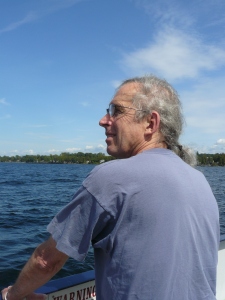
Cinque Terra

We’ve just returned from a two week sojourn in Italy. In the coming weeks I hope to share some of those experiences with you.

In October 2011, just weeks after Hurricane Irene devastated Vermont, severe flooding struck Cinque Terra, the five village national park on the Italian Riviera, devastating some of the villages and most of the hiking trails. Today the good people of the region continue to rebuild, as do many Vermonters. Maybe this shared experience contributed more than we knew to our love of the people and landscape of Cinque Terra.

Jennie and I spent three days in the largest of the villages, Monterosso. We chose Monterosso largely because it is relatively flat, a real boon for me. We had been advised against visiting Cinque Terra on the grounds it is too touristy and has too many stairs for my Polio legs. Sure enough, when we climbed down from the train in Monterosso, we were greeted by wall-to-wall people. It turned out that Italy’s largest and most prestigious bicycle race was passing through the village the next day. Then, as if a piper had passed through the village, by noon the next day they were gone.

Monterosso
Monterosso

Monterosso turned out to be mostly quite accessible, and we encountered a few people in wheelchairs there. The physical layout of the other villages were much less disability friendly, as they arise more or less vertically from the sea. This verticality, very much as it did here in Vermont, contributed to the severity of the floods; mountains have enormously more ground surface than do flat areas, and water flows downhill, gathering force and speed as it does so. When several inches of rain fall in a relatively brief period of time, flooding can be catastrophic.

Everywhere we went in Cinque Terra there are signs of repair. In Vernazza, arguably the most beautiful and most damaged of the villages, much remains under construction, even as the villagers truly welcome the grateful tourist. Vernazza was the site of one of our most memorable meals, and a lovely, post swim in the Mediterranean, gelato. (No, I did not swim but Jennie did!). Yes, the water was still quite chilly, although there were reportedly warm pockets.

Vernazza
Vernazza

Our second day was spent on a small boat, touring the park from the ocean side. As there is no way I could manage the remaining trails, this allowed me to get a feel for this magical place. The captain, Angelo, took us, and two other couples, for an afternoon on the water. Maybe fifteen minutes out of port, he opened a bottle of prosecco, passed out glasses, and began to serenade us with arias. As we motored along the cliff face, he told us about the flooding, about his falling in love with, and marrying a California woman, their happiness, and his former life as a park ranger. He explained to us that with the rise of tourism, many families no longer do the back breaking work of tending their grapevines, nor maintaining the terraces on which they grow. This contributed greatly to the washing away of the hillsides when the flooding came.

Our Captain
Our Captain

One of the highlights of the afternoon was a stop at his friends’ cafe in Manarola. The meal was magical, the wine local and good, and the company memorable. It turned out the family grows most of the food they serve, and makes their own wine. Maybe it was no coincidence that our two favorite meals of the trip were in Cinque Terra. Slow food, indeed!

First Course
First Course

© 2015, essay and photographs, Michael Watson, All rights reserved

The Realm of the Unimaginable

BridgeIt is summer and we are busier than we expected; this leaves us eager for time to play and create. Here in Vermont, summer is short, even with climate change, so there is an imperative to use these warm days well. Now that we are a couple of weeks past the solstice, the evenings are noticeably shorter, and although the days grow warmer, we know winter is not that far off.

I spend most of my days with people who have survived The Unimaginable, looking for words and images that communicate something of the experiences that have driven folks to me. Often enough, I find myself in conversations about the ways The Unimaginable makes even the simplest human task daunting, the most everyday experience, other.

Take feeling. Most of the time most of us know what we are feeling, along with our dreams and desires. The Unimaginable frequently replaces dreams, aspirations, and yes, feelings, with numbness and unknowing. In its wake, simply choosing something to eat for lunch can seem a daunting task. The Unimaginable also makes violence mundane, everyday, ubiquitous; too often, it is multigenerational, touching lives across across long stretches of time.

There is now an enormous clinical literature that addresses The Unimaginable. Usually writers describe the process of recovering from its effects as either dreadfully mundane or heroic, a dialectic that names two sides of living in its aftermath, but which obscures the complexity of the experience. Confusion, despair, rage, and a host of other emotions, feelings, and desires break through the numbing, threatening to destroy relationships, careers, and aspirations, to consume one’s life, then retreat as numbing and routine regain control. It can seem as though one lives life midway up the beach, always subject to the whims of the ocean and the ever shifting boundaries of the shore. No footing is firm, no resting place safe.

Much work that seeks to aid people in their search to wrest their lives from the grasp of The Unimaginable is itself, from the outside, mundane. The first task is to establish a sense of relative safety in the present. Then we work together to slowly, sometimes imperceptibly, make room for feeling and knowing, for meaningful daily activities and rewarding relationships. Of course, stages are just a convenient construct, for healing is a complex endeavor. Yet throughout the process, whether it be months or years, we are alert for moments when The Unimaginable becomes something we can imagine, know, and find meaning in, for these are the moments that open the way for deep healing.

It is the transition from the realms of The Unknowable to the place where we are free to imagine, feel, and fully engage life that offers the possibility of renewal; it is frequently a hard won relocation, and it is this that gives rise to narratives of the heroic. Yet, the journey may well not be experienced by the pilgrim as heroic. Surprisingly often, it is simply a long, hazardous walk taken in response to some deep, insistent impulse, some demand of the mind and soul. More often than not the journey is memorable more for its everyday discomforts and revelations, than for deeds of courage, although much courage is demanded along the way.

At some point on that healing journey one must wrestle creativity from the grasp of the Unimaginable, must find ways to express that which maintains its hold on our lives by refusing expression. The arts, ritual, and simple conversation are all avenues for both imagining The Unimaginable, and giving it solidity and form. The Unimaginable is a lot like Chaos, a close ally perhaps, and, like Chaos, when it is given form it becomes something else. The urge to give shape and form to The Unimaginable is, ultimately, the impulse that guides the healing journey.

– Michael Watson, M.A., Ph.D., LCMHC

© 2015, essay and photograph, Michael Watson, All rights reserved
Lara/Trace Writes About Residential Schools

St._Joseph's_Orphanage<VTGrowing up, I was taught that healers must be engaged in the lives of the people. I often think of my beloved teacher, Ipu, who repeatedly risked his life to aid his people in the Amazon. He was a gentle, loving man, with a fierce commitment to social justice, and an acute understanding that social issues lie at the heart of much suffering. When I am asked why I devote so much of my blog to social change, I find myself feeling bewildered; after all, the fates of the Earth, individuals, and whole peoples, are tightly interwoven. There cannot be true healing without justice.

A focus of many Indigenous people these days is the history of the residential schools which were common in the U.S., Canada, and Australia, during the last century. These were institutions designed to “save the person by removing the Indian”. Untold thousands of children were forcibly removed from their homes and placed in residential schools, often many hundreds of miles distant. Once there, the children were subject to harsh treatment, horrific abuse, and, much too often, death.

Here, in Vermont, many children found themselves in St. Josephs Orphanage, in Burlington. Many of the practices documented for residential schools were utilized at the orphanage, with horrific long-term effects. I have heard scores of stories from close to a hundred survivors, narratives so painful I would have nightmares for weeks following our meetings. Now the city appears to be actively seeking to erase and forget this dishonorable chapter of local history.

In recent years both Canada and Australia created commissions to look into the histories and practices of these institutions. The ensuing reports make mind-numbing reading, yet they also open the door for healing. Still, neither government has followed through on the recommendations of their commissions, and many Indigenous people in those countries consider the results of the commission process to be profoundly flawed, if not disingenuous.

Hakea wrote the following note to me when we were discussing the situation in Australia: ” I do not want anyone thinking that Australia is a shining example in Aboriginal matters. Cultural and racial genocide is occurring right now, it’s just got a different terminology attached to it – ‘lifestyle choices’ and ‘economic growth’. All of the commissions and enquiries and apologies were for nought. Injustices are still being wrought upon our Aboriginal people. Institutionalisation is rife. Young Aboriginal people consider that going to gaol is a rite of passage. Australia cannot be held in high regard on Aboriginal matters. So much shame. (See the Documentary – Our Generation (2010)).

In the U.S., Federal and State governments have refused to address these histories and the lingering suffering they created. It is difficult to imagine the multigenerational trauma will be addressed until governments and religious organizations take full responsibility for their actions.  Laura Trace Hentz has been following the commission responsible for investigating residential schools in Canada. Below is her latest dispatch. I hope you will share Lara’s article with others.

Lara writes:

I do not know if readers of this blog have followed what is happening in Canada and their years-long investigation called the Truth and Reconciliation Commission (TRC).  In 2014 I heard Justice Murray Sinclair speak about TRC at Yale. READ HERE. He spoke about their findings and what the Canadian government promised to rectify the abuses in the residential boarding schools. Many churches and provinces were mandated and forced to release their records to the commission.

The definitions of genocide fit the TRC findings. They call it cultural genocide. Children lost their family. Some children lost their lives. Children. This happened to children.

What happened in Canada also happened here in the US.  We don’t have an investigation by our government. WHY? I don’t know and I don’t know if it will ever happen.

After the residential schools in Canada, the 60s Scoop took even more children and placed them with non-Indian parents. And it’s not over. It’s ongoing there and here.

Read Mo

2015, essay and photo, Michael Watson, All rights reserved; Lara’s bio is HERE.

Still Here: Blogging Against Disablism

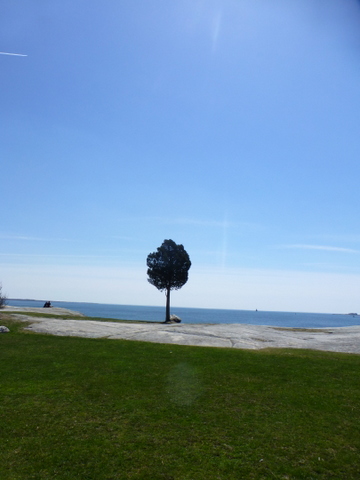
Lone-CyprusDisabilism is a Gimp term for the ideology and practice of discriminating against people with disabilities. Discriminatory practices of all forms appear to be on the rise in North America. In the U.S., where all programs that protect minorities are under attack, there has been a growing chorus of calls for the dismantling of the Americans With Disabilities Act.

Contrary to much of the Disabilist propaganda, life remains very difficult for most people with disabilities. Much architectural infrastructure remains inaccessible, and the unemployment rate for persons with disabilities is double the rate of the non-disabled. It is likely most people with severe disabilities have given up looking for employment and are thus not counted amongst the unemployed.

The 90’s were, throughout the Western World, a time of disability activism. In the U.S., many of the activists were Polio survivors. At the time, the everyday world was, far much of the disabled community, simply inaccessible. If one used a wheelchair, one simply could not get on a bus! (The playwright and disability theorist, Kaite O’Reilly recently discussed both the disability civil rights movement in the U.K. and the workings of Disabilism in a marvelous lecture. I encourage you to watch.)

Until our civil rights movement, people with disabilities were largely invisible. When I am in a wheelchair in a crowded space, say a museum, I remain invisible, as people literally trip over me. When I am in India, I am a very visible anomaly: a professional person navigating the world on crutches. (An Indian colleague recently told me that disability cannot be discussed at the moment in India. It is too hot a topic.) Most disabled people in India stay home.

Back in the early 90’s Bill T. Jones, the MacArthur Award winning choreographer, created a piece entitled, Still Here.  The dance gives expression to the lived experience of persons with life threatening conditions, including disabilities. It created a furor! In 1997, Bill Moyers interviewed Bill T. Jones about Still Here. It is one of my favorite hours of t.v.. Not long ago I wrote a post about Still Here and its continued resonance for Native people and folks with Disability. The sad thing is that there are a great many people in North America who would like us Gimps and Natives to be gone, or to at least stay home and out of the way.

Beyond the idea of Disability as label or stigma, is Disability as lived experience. I have spent much of the past few months addressing Polio related issues. Working with a Polio knowledgeable therapist has helped me revisit the illness and its aftermath, understand some of the new challenges I, and other Polios, face, and acknowledge some of the losses associated with Polio. The therapist has given me information to read and poked sore areas of my psyche with skill and kindness.

I am deeply appreciative of the resources, kindness, and training she, and other Polio clinicians have showered on me. I am also grateful to all those who helped me understand the ways the trauma of Polio, and the able-bodied gaze, have shaped my thinking and life. At times. I find myself both relieved and filled with sadness and grief; there are so many losses.

There was a time when I was able, a before and after Polio, although that was many decades ago. My therapist likes to remind me that those without disabling conditions are temporarily abled; disability is always possible. Perhaps that possibility keeps many anxious and avoidant of persons who are clearly disabled. One may pass but probably one cannot hide from one’s disability or from the losses it brings to life. Nor can one hide from Disability itself; Disability stalks everyone.

Oddly, I have the sense of Polio as present and immediate, even in a world where it is thought, like winter’s snow, to have melted away almost to extinction. Polio is a virus, a piece of RNA that infects cells, reproduces itself in enormous quantities, and leaves the cells weakened or dead. It can present as little more than a stomach upset, or leave a person paralyzed or dead.Whether we acknowledge it or not, Polio remains an active presence in our world, especially in the lives of survivors and their families.

As I write, a flock of geese flies over, headed north, and the radio news announces a polio outbreak in Afghanistan in which at least 25 persons have been made ill. I have been rereading Anne Finger’s Elegy for A Disease, and the book lies open on the sofa. It is both a personal and a social history of the disease, an illness with a long history of influencing human lives. I have the sense Polio is sitting with me as I write and ponder, an alive, thoughtful presence, vibrant and well in spite of our efforts to eradicate it. Polio doesn’t seem to be going anywhere.

We Gimps are Still Here as well. We, too, are not going anywhere.

– Michael Watson, Ph.D.

© 2015, essay and photograph, Michael Watson, All rights reserved
Healing Stories

StoriesAs a a multicultural man (Shawnee, Lakota, and Scott), I am curious about how we of mixed cultures travel though life, and how we story to journey. As an Indian, I hold our traditional stories close to my heart. These stories offer me solace and guidance on my life’s walk.

Stories, for me, are good to know and good to think about. They tell me much about where I have come from and who I may be. They are a gift from the Ancestors, and from the Creator, and as such, are sacred. Indian stories are often funny, bawdy, and, yes, even heartbreaking. They are a lot like real life.

Stories, at their best, teach us how to be human. Of late, I’ve been noticing just how human I am. Even though I am in my late sixties, spring brings out the younger man in me. As the weather warms I become more playful, get out and about more, and begin to notice other people. As a result, I am reminded that I am a primate, biologically hard-wired to be social.

As traditional healers have known for eons, the quality and extent of one’s social networks is a very good predictor of future health and wellbeing. These markers are also useful in predicting our response to illness and misfortune. The best stories offer us pathways to rich social lives and a future sweetly saturated with meaning.

As a mental health clinician, and traditionally trained healer, I am asked to address trauma, illness, and suffering on a daily basis. One of the most insidious effects of trauma, and all too often, of illness,  is social isolation. When the trauma occurs early in life, and especially if it continues over an extended period, the survivor may easily find herself or himself profoundly alone as a child, and later, an adult. This isolation is driven by fear, and, too often, intense self loathing. When illness strikes, even those of us with rich social networks may find ourselves alone.

A richly storied childhood seems to inoculate us against trauma. In Native American cultures children were traditionally taught stories that modeled social engagement, connection, and resilience. The heroes and heroines of these stories utilized their connections to the spirit world, the Natural world, and the tribal community to remain resilient in the face of terrible suffering.  The stories were themselves embedded and anchored in small communities that tended to intervene on behalf of children who were in distress. Such stories surely aided children and adults when adversity entered their lives.

Sadly, the impacts of colonization, especially war, alcohol, and introduced diseases, fragmented both our Indian communities and their story sharing traditions. Forced assimilation and, crucially, the theft of children, and their subsequent forced attendance at boarding schools, further weakened the social and storied safety net. Although the boarding schools are, thankfully, in our past, their legacy, and may of the forces of colonialism, continue to influence the lives of Indian children, as evidenced by the tsunami of youth suicides in Indian country.

Traditionally, stories were owned by individuals, families, or tribes, and, to a considerable extent, this remains true. Ordinarily one asks the owner for permission to tell a story. That convention has largely been ignored by folklorists and others who have collected, and published, Indian stories. This has resulted in massive cultural theft, yet it has also given us a deep reservoir of traditional stories, many of which seek to remind the listener they posses rich inner resources and the capacity to be resilient. For those of us who have largely lost our Native heritage, these collections of stories are an enormously important resource.

There are similar resources in the European tradition, and I have, throughout my career, used stories from the Brothers Grimm in clinical settings. I have, in doing so, sought out the earliest available versions of these stories, versions rich and raw, and thoroughly human. Often, clients are surprised that narratives of such descriptive power could lie beneath stories made popular by Disney. Yet, these European folk stories almost always lack the sense of belonging and community so fundamental to their Indian relatives. I wonder whether the sheer destructive power of European history had already created cultures of relative isolation by the time the Grimms collected the stories.

I was taught early on that stories are powerful healers, and that sharing traditional stories offers to clients the possibility of a harbor, and safe anchorage, for their lives. I have come to believe that Narrative Therapy, while potent, is often insufficient, as it may fail, when used alone, to embed persons in the life affirming web of tradition and community. Repeatedly, I am reminded here is something profoundly healing about traditional stories, narratives that invite us to recognize our plight, no matter how harsh, as inherently human.

What stories have offered you solace and healing? Perhaps you will share one with us. I hope so!

– Michael Watson, M.A., Ph.D., LCMHC

© 2015, essay and photograph, Michael Watson, All rights reserved
The Year Turns

p1060964

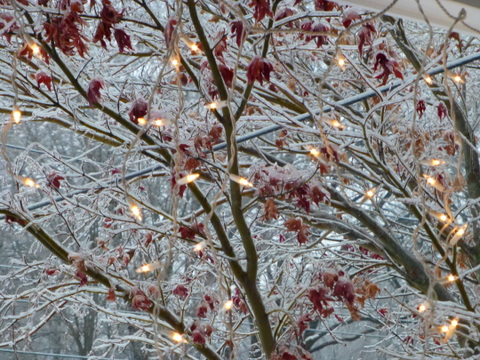
Ice-Storm The year has turned. This evening, weather permitting, we will gather with others to celebrate the changing seasons and honor Grandfather Fire without whom we could not live. We will mark the Sun’s return, remembering the change of seasons is also within us. Here in the Northern Hemisphere the days will now lengthen as the sun begins His slow drift northward. That is the future; this morning the dark lingers. Jennie has moved through the house; lit candles mark her passage.

After a night of sleet, we have freezing rain. The snow plow just came through, potentially a mixed blessing as the coating of sleet protected the road’s surface from icing. A neighbor, out early, calls over through the darkness to ask whether she might bring us anything from the grocery.

Yesterday we braved the storm and the crowds and went shopping. One of our purchases was a second bird feeder. We have squirrels and have wagged a long competition with them regarding the feeders. This time of year flocks of birds come to our back yard feeding station a couple of times a day. Often they also find their way to our front porch where they watch our comings and goings at close range, often greeting us. Perhaps we will place one of the feeders near there.

As Saint Francis knew, the animals and birds are within us. This is ancient knowledge that awakens and reawakens in persons and cultures across the generations. We know their longings and hungers intimately.

Last night as the sleet and freezing rain fell I drummed and journeyed. I wanted to meet the storm directly, to feel the push and pull of warmth and cold and the tricky point of balance between them. As I journeyed I felt the deep antipathy we humans know in relationship to harsh cold and deep darkness. I wondered whether our failure to address climate change reflects that ageless fear of winter.

We warm bloodeds seem drawn to the South and to Grandfather Fire. Father Sun burns brightly within our mitochondria. There is a mysterious power attached to the hearth; there we meet Grandfather, hopefully safely contained. We press in, close to the radiating heart of the flames. Once upon a time we cooked our meals there, witnessing the wondrous transformation of raw into cooked. Grandfather brought us the gift of readily absorbed nutrients and energy, setting us free to explore the world. Mother Earth, Grandmother Moon, and Grandfather Fire also live within us, creating the seasons of the soul and body. Grandmother water shapes our very being.

In a few days those of us who celebrate Christmas will leave cookies and milk, or something stronger, by the warm hearth, gifts of memory and affection for the spirits and the Ancestors, the Ancient Ones. They live with and within us, and willingly or not, we follow the trajectory of their desires and needs. Even from the spirit realms they follow our lives. Some seek the high emotion of drama and suffering, others wish us well, hoping we can find our way to joy, happiness, and connection with one another, all creation, and the Creator.

Yet, Christmas is in the future. Tonight we will remember and express gratitude to the host of beings with whom we share our lives, and to the Creator who gives us awareness and the immeasurable gift of Life. As the year turns, we will remember that we are also changing, that each life holds many lives, and that we are continually reborn. We are the great turning that is the year.

– Michael Watson, M.A., Ph.D., LCMHC

© 2014, essay and photograph Michael Watson, All rights reserved

A WORLD OF DIFFERENCE: On Seeing and Being Seen

Early Azaleas

The cold returned this past week, and many trees and flowers seem to have taken a deep breath and halted their rush into Spring. Were the maple sugaring season ongoing, these would have been perfect sugaring days and the sugar houses would be boiling madly. (The warmth of a couple of weeks ago stopped the sugar season short.) Now, there is an air of expectancy in the natural world, a quickening and watchfulness, for we are in April, and returning warmth and renewing rains become daily more likely.

The seasonal round brings comfort and a sense of belonging. Maple sugaring gear is cleaned and put away. A few people have made it into their gardens, preparing for the warm season to come. Neighbors, yard and garden tools in hand,  wave to one another. “This sure is weird weather, ain’t it,” echoes down the block. A few daffodils have burst into bloom in south-facing flower gardens, some making their way indoors to adorn tables.  Throughout the neighborhood there is shared business and meaning.

Last week, in class, I showed the Bill Moyers interview with Bill T. JonesStill Here. The video, from 1994, follows the MacArthur Award winning choreographer as he morns the loss of his mate, faces mortality via an AIDS diagnosis, and creates his groundbreaking dance, Still/Here. The video addresses many topics our culture still finds difficult, and does so with refreshing directness: death, terminal illness, homosexuality, loss, and race, among others.

The real focus of the film is difference, a too-hot-to-handle concern in many cultures. Difference is a form of social glue, allowing us to identify ourselves in opposition to the other. It is also the source of creativity, innovation, and adventure, as well as some of our most threatening taboos. The tensions between these functions are played out daily in our cultures, our personal relationships, and our inner worlds. For many people around the world, accepting new technologies, no matter how socially disruptive, has become easier than accepting differences among human beings.

Of course, issues of difference demand attention in the therapy setting. Whether we sit with couples struggling with disagreements about how to manage daily life, young women critical of their body image, or youth and adults who carry labels of major mental illness and wrestle with unique experiences of the world, the underlying concerns are those of difference and acceptability. Always the questions held deep inside include, “Am I loveable as I am?” and “Am I safe?” These are not simple questions.

A walk in the forest offers the opportunity to see difference. No two plants of the same species are identical.  Life history and microecology play an enormous role in the development of each individual. From the point of view of the forest, each is perfect. Only through the gaze of other organisms do individual plants acquire differentiated value. When humans are involved, value is most likely culturally ascribed. Persons of diverse cultures may well read the worth of an individual plant differently from one another, as may individuals of separate species.

Ideally, psychotherapy offers persons the opportunity to challenge internalized or culturally enacted views of  difference in relationship to her or his life. In the process, it may place any number of subversive, liberatory tools at the disposal of those seeking help. Such therapy seeks to provide a space for the successful re-authoring of those stories that isolate and demean on the basis of rubrics of difference. In order to do so, patients are encouraged to challenge the authority of many voices, within and without. Yet, no one can successfully create a rewarding life alone; we each need others to witness and affirm our acts of courage and self authoring.  The therapist is a necessary, yet usually insufficient witness.

Would you share with us your healing stories of seeing, and of being seen by others?

Michael Watson, M.A., Ph.D., LCMHC,  (Dreaming the World)

© 2013, photo and essay, Michael Watson