When I wake up in the morning
With a vague smile
You will never notice my tired face
Or my hollow eyes
I will drink a bitter coffee
And keep the curtains closed
Because yesterday’s phantoms
Who still hide in my hair
Are damned with the curse of light
Instead of reading a newspaper
I will listen to Fauré’s requiem
And have a conversation with the dead
They will remind me of my grave
That stretches from Gaza to Sarajevo
And how good I was to learn
All the savage ways of death
While I am still alive
When I wake up in the morning
Shivering and suffocating with guilt
You will never know
That I have spent the night warming
The body of a child curling in snow
Who died dreaming of a sun
And a loaf of bread I couldn’t find
You will never realize
How I suffer in my own body
Because I can’t reconcile with my faces
That my joy is a rumor
And my grief is difficult to uproot
Because I always carry a genocide
In my blood
You will only kiss my shoulder
Wish me a good day
And leave me to my demons
My favorite poetry is philosophy dressed in dreaming, not logic. It imagines a larger reality, a more expansive love. Rilke is the gold standard, I think. Oh, but that is the pièce de résistance, and there’s so much more besides that. I am a poem consumer, not a gourmet chef. I know very little of form or craft, but I love to taste and participate. So I’ve written a poem for International Poetry Month. It’s a love poem to my late husband because, well, you might as well start with breakfast.
Exclusive
Thick, boyish lashes fringe Other eyes, perhaps as blue, Open, tender toward Beloved
Still smiling youths may offer Eager grins, warm confidence Gleaming ‘neath soft whiskered lips
Clear voices might ring Thrilling, gentle as yours when
You sang at daybreak just for me
Surely now first loves make vows, Grow mature together, devotion’s Friendly joy becoming solid strength
Fathers must bend heart and arm Wrap manhood’s grace boldly around Each golden, blessed child – like you
No doubt live sorrowing pairs With looming loss, still holding, Fingers trembling, to brave last words
I cannot boast an only, greatest grief; I know this storied world is vast. But still I weep in fond belief That you and I loved first and last.
Stepping into the gateless garden you see
a frail hammock slung between the old
rose bush and the lavender you like
to pinch for its scent though its flowers are bleached.
At once the trees in the park vanish, their songs
of praise in crimson, puce and apricot –
you trace the spider to the net’s centre. Gold
and silver needles shed by the sun are caught
in its radial and circular threads.
The house is tugging but you’re spellbound
by a trap for lesser insects that a dog’s snout,
a child’s finger could easily destroy.
It’s poignant as the mystic moon, the square root
of minus one you once grasped, dumbfounded.
Poetry moves us. It makes us think, feel, inspires us to do more, be more. It has been here as long as people could speak and sing, and it will probably outlast the end of humanity. Like everything in life, it has had to evolve and adapt. One of the main purposes of poetry, to communicate something with someone else, has necessitated that new ways of reaching an audience. This is especially true now, in this digital age of instant gratification and social media.
Poetry has learned to deliver its message via video, recorded poetry slams, Skype, flash mob poetry in action…blink and you might miss it. But even if you DO miss it, you can probably find a recording of it somewhere. No longer is it simply written words on an immortal page in some heavy, dusty collection of poetry, or an oral history sung through the ages and generations. There are still formal forms, still meters (or even free form, as even it has a “beat”), still rhymes (or not), still those who will read it and listen to it. Some things about it do not change.
There have been many famous poets who have attempted to define what poetry “is”; the well-known, poetic “greats”, and they all have valid definitions. I tend to agree with one of my favorites, Robert Frost, who said:
“Poetry is when an emotion has found its thought and the thought has found words.”
To me, poetry is a type of communication that touches the heart and soul.
In honor of (inter)National Poetry Month celebrations here at The BeZine, I would like to share a couple of poetic videos with all of you. Both of these “spoke” to me. I hope that you find them as powerful as I did, and maybe that you will look at poetry as more than dry, printed words on a page. It is very much a living thing. And it continues to evolve, just like people do. 🙂
Opening the Iron Gate my feet trace
a path round silent ponds,
through black stands of blasted trees
rumbling from the smoke of winter’s war
flinging out naked branches
tipped by the solstice sun.
All is silence! No rustle of leaf, wing or
clink of feet scatters stray stones,
stirs this moment of equality –
seasonal ceasefire!
I walk on almost fearing fire
as a flicker of wing catches my gaze.
The path reveals a seat, I pause:
a coo calls “come” – a signal
returned by a trill as the wood erupts
with a cantata springing unseen
as all the hidden throats emerge
My gardens hold no trace of man
Wherever he comes he builds burdens
He tries to grow racism or casteism
But my gardens do not have any plants or trees with names
Scattered around are statues of fauns
and satyrs in my homegrown gardens
Apsaras and houris may gambol
gently on its lawns, unmanned
My gardens do not belong to any nation
any class or gender or time
They do not understand the use of the word my
They are gardens, always in their prime.
My gardens are God’s gardens
My gardens are your gardens
Everybody’s, yes, our gardens
My gardens are the only ones in their prime
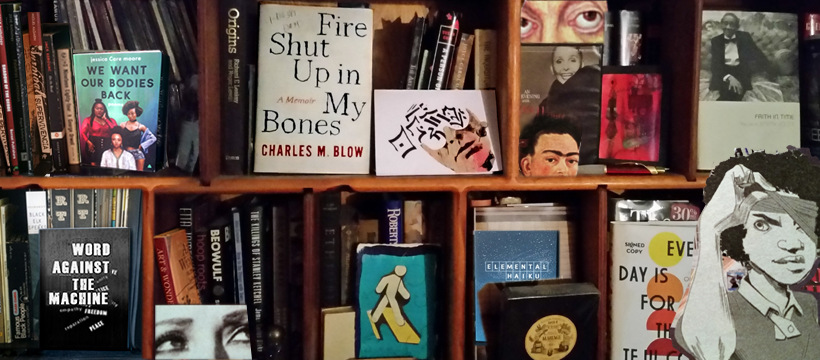
“Each day I squeeze the contents of my heart over whatever expression I’m wearing & imprint it onto a notebook page–my version of St. Veronica’s veil.”
Joseph Hesch (A Thing for Words) lives in a beautiful region, upstate New York, at the confluence of my own beloved Hudson River and the Mohawk River. It’s a nice setting for a poet.
Joe was a professional writer for forty years. Post-retirement finds him doing writing that is more creative – poetry and fiction – with publication in quite a number of magazines and literary journals. He has self-published two collections of poetry. Joe is also a member of The BeZinecore team of contributing writers and his poems and flash fiction are featured in the zine just about every month.
JAMIE: Joe, I know you worked as a journalist for a good part of your life. Did you also write poetry or did you come to it late? What’s it like now that you are not working for “the man?”
JOE: Journalist or hired typewriter and gum-flapper for Skidmore College, a three-state professional organization or the State of New York over my 40-plus years in the working world. And no, I definitely was not writing poetry until I reached the age of 55. Not in high school, college nor when I was a professional writer.
A pretty miraculous recovery from a heart condition let me know each day is a blessing not to be wasted. I decided I’d best hurry and let the writer’s heart I thought I had within me live again.
I started to write sassy essays that I shared with friends. Then I wrote a bit of memoir one afternoon about my childhood Christmases. I took a chance and it was accepted for publication in a Christmas anthology. I continued to write for the discoveries I was making in myself and my world. And then everything stopped. Absolutely dead in the water. I’d run out of those easily reached ideas and emotions. I didn’t know what to do.
A friend told me my prose always sounded quite poetic to her. “Why don’t you write a poem?” she said. So I started out with the 5-7-5 structured hug of haiku. Then I wrote a poem about not being able to write anymore, stringing together those five- and seven-syllable lines. She suggested I submit it to some journals. I did and it was accepted for publication. Poetry had recharged my life machine and put me back in the world as a writer.
I never wanted to be a poet. Never wrote a poem in my life before those haiku. I consider myself a storyteller. You could say my poems are stories with the sentences broken into bite-sized pieces, stacked like crackers. But I’ve discovered more about myself as an emotional being, as a feeling man since I began to write poetry than I could have imagined in fifty-some years on this Earth. So, about no longer writing for the man? They can’t pay you enough in any job to learn the discoveries I have as a poet.
JAMIE: Tell us about your two collections.Do you have plans for another? If so, what would be the theme.
JOE: Oh, thanks for asking. Yes, I have two collections available on amazon.com. The first, Penumbra: The Space Between, I put together in 2014. I guess you could say it’s my coming-out as a poet in middle age. I hope I expressed my impressions on life and nature from the view of a man emerging from years of darkness into a brighter personal and artistic existence, standing astride middle age. Neither young nor old, still peering at things from the edge of shadow and light, the penumbra. I’m kinda proud of it as a first effort.
In my second collection,One Hundred Beats A Minute, I hope to convey impressions and imaginings of life, love, art, nature and what I see outside or inside the swirly-glassed windows of my soul. All of its sixty poems, the number of seconds in a minute, are bound within the frame of one hundred words. No wiggle room, exactly one hundred, or my obsessive mind gets all edgy. When I succeeded at hitting 100 and putting that final period on the page, where my obsession met compulsion and life met art, I squirmed in my seat, my knees and heels tended to flutter up and down from the floor and my heart beat like I’d just run a sprint of a hundred meters. I hope readers can experience that feeling here and there in this collection, too.
My next collection? I haven’t thought very hard about anything yet. However, I have thought a for long time about putting together a collection of my short stories and flash fiction. Already have the title, the title of my first short story after I began writing for myself again—But Don’t Touch, as in “You can look, but…” So many of my stories are the opposite of my poetry. Many seem to have the theme of men who have problems reaching out to or accepting intimacy, whether it be carnal or merely the simple warm touch of another’s hand.
“Writer and poet who’s spent decades writing for The Man. Still do. Except now I’M the man.”
JAMIE: What sorts of poetic activities do you participate in and why?
JOE: Not many, and I feel badly about that. But when I go out to read to other writers, I just don’t feel a sense that I belong. Never have. Nevertheless, for the past four or five years, I’ve read at the Albany Word Fest Open Mic that the Albany Poets group holds during April for National Poetry Month. I’ve also run up the Adirondack Northway to read at the legendary Caffe Lena in Saratoga Springs. That’s an interesting feeling, reading your poetry where Bob Dylan made his bones as a poet in song. But I don’t get out enough to share my work with others. Maybe I’m shy that way. Or maybe just lazy, other than writing something for someone, only lately myself, every day for the past 40 years.
JAMIE: Why is poetry important to you and why should it be important to us?
JOE: Wow, that’s a big one. I guess it merits a big answer, then. Simply put, poetry, my finding poetry as an outlet for my long dormant creative self, helped save my life, most certainly the quality of it. I don’t know how long I could go on wandering in that vast desert of empty when I knew I was supposed to do something creative to fulfill myself.
Beyond that, though, I like to think poetry holds up a mirror, sometimes cracked and refracting, others with a soul-illuminating clarity, to who we are as individuals, families, communities, nations, a world. They can bring us the great Ahh moment, as well as the Ahh-Hah! And most of the time goes for the writer—at least this one—as well as the reader.
IN THE ROOM
Here in the room the breaths come
maybe every ten seconds apart,
snoring sounds from a mouth agape,
now voiceless, beneath eyes mostly closed,
but probably unseeing.
She doesn’t hear the talk in the room.
We think. We hope.
Above the bed, a little plastic bag
of morphine perches like blessed fruit
from a swirly silver branch atop
the six-wheeled tree they’ll roll
out of the room whenever her spirit does.
Here in the room we watch, we wait,
hearing only the sounds of the family,
of the bubbling O2 humidifier,
the beeps of monitors and machines,
the murmurs and shoe-squeaks from staff
in the hallway on the fifth floor
as the hospital awakens this morning.
And punctuating it all come
the snorting gasps of a life dwindling away
every ten–no, fifteen–seconds.
We think. God help her, we hope.
The reverie of falling water
green against the rich backdrop
reflecting the forest foliage
breaks into my nightmare
where I had to take up weapons
to defend myself against the ones
who were trying to kill off my friends
My green spaces are a baptism of light
They do not try to coerce, threaten or buy my silence or affright
my wife or children with fascism’s cry, saying
“rally to the black hammer and the hordes under its banner”
My green spaces reject it simply
by being green
The world shows its middle finger
to the black hammers, even in war time
These green spaces of my poetry are the ones they will come to
for rest
after the weary battle is won and over.
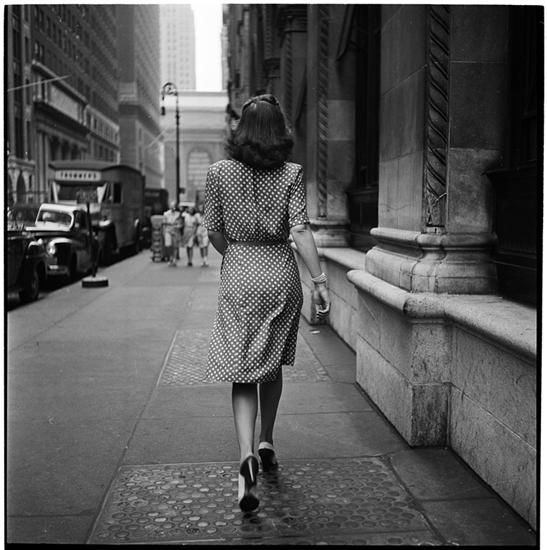
Street Conversations (Woman walking down the street.) 1946 Photo by Stanley Kubrick
Who is she, whose heels click by
and I just have to look up to see?
Who is she, who rustles by
in a fragrant cloud that stops
my tracks with a stroke of heat
not felt in years?
Who is she, whose curve of calf
and confident buh-bump bounce
stirs my heart and blushes my cheeks
with summer sunshine glow?
Who is she, who made me look without trying
and left me wondering who and why and…
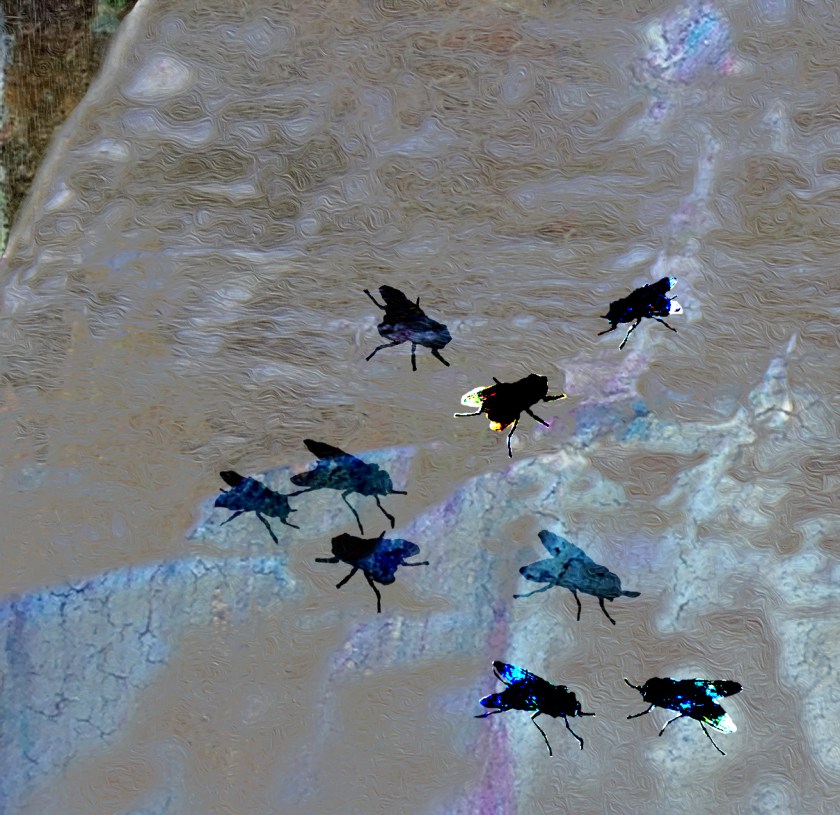
July, the air outside thick with biting flies. The house alive with more docile creatures, black and buzzing. Even in mid-December this farm house fills with them. They come from nowhere.
Several houseflies clamber for escape with busy wings against the screen. Up and down they search, yet only find the upper storm window — daylight feeding a frenzy of scientific discovery — and the lower screen, a shadow lattice that will not stop the air.
Like a lover who relies on faith, these true-believers come to worship at the altar of thought — each fly some forgotten moment, some decision not taken, an ounce of regret.
I could close the inner window and trap them; then they would not buzz around my bed at night, reminding me of my failures butting their heads into a reading lamp suspended above my pillow.
Oh, they’d still get their precious light, the wind would come through for them, even a bit of water on a rainy night. They might not die, even without food.
Perhaps I leave the window open for the breeze. Or maybe because I would still see them there, hear them call — even louder than the fan, even at night, even while I slept.
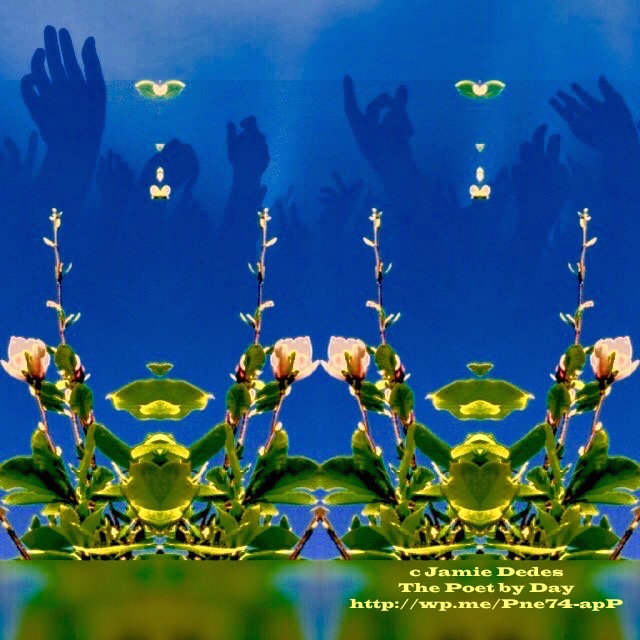
no mendacity in the natural world ~ just an
untamed grace in the meditative industry of ants,
in the peaceable company of small creatures
going about the business of food finding
and mating and homemaking in the loam of
this province, the republic of innocence
here is the soul-filling beauty of sun rising over
jacaranda as she paints her joy on a blue dawn;
robin with her russet-hued breast hunts for worms,
her instinctive motherhood proud of babies in
the spar and scrap of nest life . . . it is in this –
the uncivil cosmos – that the gentle breezes
dance with us on our mud-caked travels along
ripening pathways through meadow and brush;
as the flaxen sun shifts from rise to fall,
our hearts beat with their ribbons of ruby life,
pulsing with ebbs and flows of love and fear ~
soon – we know – clouds will gray and the
inevitable dark and shivered moon will show
her craggy depths, sooty with doubt and danger,
our earthiness projecting its own shadows;
still we trust nature’s homilies, content in this
province where we’re left to be ourselves, left to
write our own wildness on the mirror of time
“How near to good is what is wild.” Henry David Thoreau
My days are ordinary now,
but they weren’t anything close
to that ideal at the time you
extended your hand.
We laughed at family
gatherings, just you and I–
knowing we were being bad,
which made it even funnier,
you being holy and all,
and me, a lowly sinner.
But you never saw me that way.
You were more Glastonbury
than Dublin,
More Yeats than Pope.
There are many aspects of life
that are still ordinary –
The sparrow’s call in
spring time,
the ball of fire
we call the sun
almost bouncing.
The days come and go–
Just like that.
I’m used to that idea.
It’s just you,
being gone
that will never feel ordinary.
Note: My friend, Father Patrick Rice earned his doctoral degrees in theology and poetry from Fordham University in New York City. He was a priest at St. Thomas Moore in Convent Station, NJ, from 1974-1979; Holy Spirit Church from 1979-1994; St. Francis de Sales Church in Vernon, NJ, from 1994-1997; St. Catherine of Siena, Mountain Lakes, NJ, from 1997-2009 and St. Kateri Tekakwitha in Sparta, NJ, from 2009 until his death. He was buried in Ireland. His spirit, however, remains alive and above ground in the hearts of all who knew and loved him. VG
Far within a forest thick, unperturbed by Time’s swift tick, stands a testament to Fae, roots deep as night, top tall as day.
Climbing vines hide tiny doors. Its feet are wreathed with mushroom spores. Leaves of Celadon and Jade mingle with the mossy shade and dappled greens of shimmered hues, creating screens for a secret muse.
Ancient seneschal of Pan, rarely revealed to the likes of man; misted tendrils obscure the way, they will not find it, try though they may. Only the pure of heart and need may find the chosen of Cernunnos’ seed.
If you should find a Fairie Tree, carry peace, tread lightly and leave it be. Respect the centuries that it’s stood, and be blessed by the Sidhe of the Woods.



 no mendacity in the natural world ~ just an
 My days are ordinary now,

 The BeZine