Everyday he climbs
white ladders of snow
to get higher and higher.
He half‐slips between daylight and dreams,
wonders if any swirl remains on his fingerprint
or if his god‐mark has faded
like a vending machine tattoo.
Just days before
he blocked his mother’s
slamming door with his foot.
He’d hoped for a hot shower
clean cotton sheets that had billowed on the breeze, maybe snatch
a cookie from the old owl jar,
but his father Abram rose
and pushed him back in the night.
Now, he stands outside himself
looking in mirrors of sun‐glassed eyes,
people walking by his lifeless body.
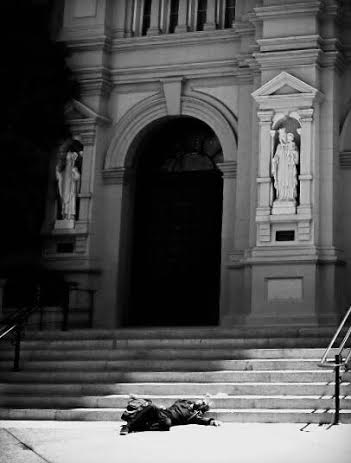
He’s splayed across Cathedral steps posture of the Pieta,
Jesus laying limp on Mary’s lap,
when all was done
and the angels watched.
The search begins and ends
in this same spot every day,
where the concrete beneath me
is as hard as a cold-blooded heart
but as giving of daylong warmth
as a full bottle.
The seeking is much better at night,
when you can’t see the memories
in the face of the sun.
Those are the ones that hurt
if you stare too long at them.
And faces are meant to be ignored.
Illumination and clarity
are overrated anyway when
what you’re trying to remember
is how to forget, and the memory
is as rough as this concrete upon
which the search begins and ends.
I prefer the hard and warm
of this perch, and the comfort
of that bottle, to the soft
and cold arms that won’t let me go,
chill and flaccid as the lips
they drew to mine.
Ruddy-faced, the ragged wanderer wraps his
coffee cup and his smoke in one hand.
His other he keeps in the pocket
of his third-hand Mets jacket.
Whether he’s grasping something within
or he’s just trying to keep it warm
is a mystery. Odds are 4-to-1 no cash
shares those five fingers’ holey berth.
Joyous, head high, the urban drifter
throws smiles like sunbeams right into the
faces of these straight-life, shivering souls
with whom he coasts starkly bright morning streets.
Their eyes are up, too, but they focus
past the no one that walks near them,
seeing instead only the faces in the
steamed-up coffee-shop window.
That’s the one framing their same
familiar frowning reflections as yesterday.
Rainstorms remind me to be more thankful
When caught in this disappointed handful
For the time that I spent alone on the streets
Now inside my home when it snows or sleets
Grateful to God giving praise when I pray
Behind locked doors where the wolves are at bay
Having a new roof and a warm cozy bed
With good hot meals and a place for my head
Some are still standing in the long soup line
Smelling like wet dogs and cheap screw cap wine
It’s choices they made of their own choosing
Most are smart men who’d rather be boozing
There are new families with kids in soup lines
Victims of lost jobs or the banks some combined
With a clean conscience, not judging, only examine
Is it a lack of faith, sin, trials or predetermined
We are the instruments of His ordained works
If we don’t help who’ll do the framework?
Offer aid and assistance when you can
We are all saved by grace and His plan
In 1971, I was a junior in high school. Two friends of mine who were seniors and I made up what we called the “editorial triumvirate” of Early Wine, our high school literary magazine. (I was the first editor who wasn’t a senior; I don’t know if I was the last, but after what we put out as a magazine, possibly I was the last.) I wrote poetry—well, the “poetry” of a 16 year-old. I thought I understood and knew it all. And at the same time, I felt as though no one understood me amid waves of massive insecurity about all of the little codes and clues and hints about which I knew nothing at all. Adolescence.
One day at the record store, I came across a new Pete Seeger album, Rainbow Race and bought it. I don’t think that it is a very well known album of his, but I listened to it endlessly. It was in a stack of vinyl records that I typically played on Friday afternoons, getting ready to go out—along with David Crosby (If I Could Only Remember My Name), Incredible String Band (Liquid Acrobat as Regards the Air), Pink Floyd (Meddle)—granted, an odd mix. Who remembers stacking vinyl records on the long spindle of the changer and letting them play?
This song, Words, Words, Words, suited my adolescent angst. However, more than that, it likely shaped my sense of epistemology, of how we really don’t understand words, how we get tangled up in questions of meaning, how the structures they appear to build so easily come tumbling down… While I was still 16, and at the time thought that others were the ones who didn’t understand the words, the message of this wise and humble man tell me (us) that he also didn’t understand them planted a seed:
If I only understood them,
While my lips pronounced them,
Would not my life be changed?
I’m not sure that we can truly understand words the way an Other understands them. Part of understanding language, for me, is to remember that we all read the words from our own context and experience. While I may try to paint a particular image or idea with words, what it “means,” rather than being 16-year old sure of itself, shifts with the lighting and the seasons, with the perspectives of each reader.
This does not mean that every perspective is as acute or as accurate as every other perspective. However, it does suggest the necessity or empathy and compassion in writing and speaking—even or especially when communicating with those with whom we disagree. We might actually find that the Other’s perspective makes sense in context and from that Other’s experience, even if we still feel there are errors produced from the perspective and context. Experience, identity, so many things shape our understanding of the world. I hope to learn to better listen for those shaping forces and to the Other, toward an empathy of hearing, reading, speaking and writing.
So, here, for your listening pleasure, Pete Seeger singing Words, Words, Words from the album Rainbow Race.
Words, words, words
In my old Bible
How much of truth remains?
If I only understood them,
While my lips pronounced them,
Would not my life be changed?
Words, words, words
In Tom’s old Declaration
How much of truth remains?
If I only understood them,
While my lips pronounced them,
Would not my life be changed?
Words, words, words
In my old songs and stories
How much of truth remains?
If I only understood them,
While my lips pronounced them,
Would not my life be changed?
Words, words, words
On cracked old pages
How much of truth remains?
If my mind could understand them,
And if my life pronounced them,
Would not this world be changed?
It’s nine in the morning and I’ve been going for hours.
The ground shook in Nepal, the riots in Baltimore— the preachers praise the winners then they blame the sinners,
but all I think about is another cup of coffee before I shower.
All I want is another cup of coffee before I shower.
It’s nine in the morning and I’m already weary.
The politicians jockey with faces serious and sallow— they stitch up innocence from the pockets of the rich,
but as I stare at my screen my eyes just become bleary.
All I want is another cup of coffee before I shower.
It’s nine in the morning and my work sighs and waits.
The bankers line up, the merchants sell their weapons— Syria, Libya, Iran, Irag, wars with customers for the stores,
but I worry about my retirement investments’ sorry state.
All I want is another cup of coffee before I shower.
Nine in the morning, or maybe nine at night.
The chaos dances to the wild fire light, the darkness
wraps us in its smothering traps, depleting what’s left
of meaning and hope, but I, I just survive with my fright.
All I want is another cup of coffee before I shower.
It’s nine in the morning and I can’t put on my shoes.
I don’t understand why I feel so depressed, do you?
My screens bring me the news, entertain, I see a lot,
but I sit and I wonder, I wonder who invented the blues?
All I want is another cup of coffee before I shower.
It’s nine in the morning, I’ve been going for hours.
The ground shook in Nepal, the riots in Baltimore— the preachers, they praise the winners while they blame the sinners,
but all I think about is another cup of coffee, another cup of coffee
before I shower. All I want is another
cup of coffee before I shower.
All I think about is another cup of coffee
before I take my morning shower.
Left hand wraps the neck of my Larrivee
and I press four fingers into a G-major shape.
I like the fuller sound of my pinky on the high E,
ring finger on the B, both third fret.
G, C9, D, the I-IV-V progression.
Then E-A-B. All nice big cowboy chords,
twelve bars, like the progression
from January to December.
It’s always like that…the years,
the mindless strumming through life.
This past one was good to great,
with its share of sad, so I turn the chords
into 7ths and play it all as a slow Blues.
E7-E7-E7-E7/A7-A7-E7-E7/B7-B7-E7-B7
Repeat, repeat, repeat.
This gets pretty boring, the passage
of chords, of days, of months,
unless I throw in some solo runs.
I sometimes show off
(for myself, up in my Lair).
You know, just to be free of Life’s structure.
But this thing has to end.
I can hear my critics downstairs,
so, as I come back ’round to Bar 11,
I go grab my I Chord, the E,
and let it ring nice and long,
closing my eyes to remember it
until my next time.
They have a word for finishing up
on that tonic chord. We resolve back to it.
Just like in that last bar of a year,
a life, we end things with resolution.
Shhh… it’s still ringing.
(August’s theme at the BeZine is Music. This is a piece I wrote some years ago and it never felt finished, so I thought I would revise it and set it here for all you fine readers to enjoy.
I didn’t know my maternal grandfather (we grand-kids called him “Grand-e”, rhymes with candy) that well, as he died when I was young. But I have seen the pictures and heard many tales of his prankish sense of humor. He was a large, jolly man who loved to tell jokes and laugh. He also sang songs while playing the mandolin and was quite nimble on his feet for having such a hefty frame. My mother kept his mandolin in wonderful condition and examining it helped inspire this piece.)
They say he used to dance and sing, when he played his mandolin. I’ve heard the stories a thousand times, about my “Grande”, Marvin.
I only have vague memories — he passed when I was young. I look at his instrument with wonder, about whiskey and jigs, songs sung.
I marvel at the oiled, mellow wood, aged well, without a crack. I hear the thin, tuned silvery strings, and sometimes wish him back…
If only to see his merry moves, or watch his sausage-fingers play. I can hear and picture it perfectly, and I wonder what he’d say,
if he knew,
how cherished this family memory was? Would he strum the words, and dance them, too?
If the world could reverse, and time stand still, I’d dance at my grand-father’s side and then, I’d hug him, love him, and ask for a tune. And I’d listen to him pluck his mandolin.
Theirs was band made of
a slide guitar and a violin,
a duo whose members each played
with one ear tuned inwardly,
the other absently to their partner.
They’d jam beneath the broadleaf oak,
whose canopy protected them
from the cold and cleansing rain
that often followed them there.
Their compositions were made
of dreamy minor chords,
swooping sad harmonies,
the call and response of
each one’s own weepy blues and
dissonant solos in F and B.
Such duos never last, though.
Once each their storms stopped,
its rain still fell from the ancient leaves,
echoes no one wished to hear.
Strings drenched in the shadowy
drops of Me never sing so well
as under the sunny skies of Us.
Didn’t matter to them. They always
played with their eyes closed.
– Joseph Hesch
For both literature and creative writing courses, I like to use poems set to music in my teaching (as well as songs written as songs), which helps students hear (and sing) the music of poetry. Songs and poems have intimate links. It is interesting that in Hebrew, the word for poetry, שירה [sheer-AH], is derived from שיר [sheer], song. שיר also means poem, although the word “poem” has been Hebraized now, as well פואמה [po-EM-ah]. In Biblical Hebrew, I have been told, only one word speaks to both.
Songs are poems, in their own right. And possibly, poems were songs in the long, long, past even before Biblical time, sung before they were spoken, spoken before they were written. So, it is not surprising, today, to find many poems set to music or songs inspired by poems, with variations made to fit the music or modern language.
Paul Simon’s Richard Cory takes a poem by Edwin Arlington Robinson, and updates its images and language, while staying close to Robinson’s original (from a book of persona poems about different people in a New England town):
Richard Cory
Whenever Richard Cory went down town,
We people on the pavement looked at him:
He was a gentleman from sole to crown,
Clean favored, and imperially slim.
And he was always quietly arrayed,
And he was always human when he talked;
But still he fluttered pulses when he said,
“Good-morning,” and he glittered when he walked.
And he was rich—yes, richer than a king—
And admirably schooled in every grace:
In fine, we thought that he was everything
To make us wish that we were in his place.
So on we worked, and waited for the light,
And went without the meat, and cursed the bread;
And Richard Cory, one calm summer night,
Went home and put a bullet through his head.
And Paul Simon’s 1960s version (lyrics in the sub-titles):
While browsing through books one day, still in high school, I came across Robinson’s poem and discovered that Simon’s song had roots. At first, I wondered what that meant about Simon’s originality. Yet, by then I knew that Shakespeare borrowed his stories and even some of his text from other sources. I thought, okay, cool. Simon reads literature. He knows what he’s doing. He’s a writer, not just a popular musician. And Richard Cory remains a song that I very much like. And a poem that I like, too.
Another, more subtle poem, Pequeño Vals Vienés (Little Vienna Waltz) by Federico García Lorca, inspired Leonard Cohen’s This Waltz, which is more closely translated from Lorca than Richard Cory by Simon. In fact, Lorca influenced Cohen to the point where he named his daughter, Lorca, in honor of the poet. Here is Cohen singing, with Spanish sub-titles:
And here, Luigi Maria Corsanico reads the Lorca poem in Spanish, with Tchaikovsky in the background and images of painting by Renata Brzozowska, a lovely combination of arts:
A little while back, I taught a first-year literature course at Bar-Ilan University, in Israel. The first day of our poetry unit, I played Israeli singer-songwriter David Broza’s song based on Elizabeth Bishop’s poem, One Art. Unfortunately, the only YouTube video I found for the song has poor song, so I use my CD of Broza’s Live at Masada album (where he’s joined by Jackson Browne and Shawn Colvin). At the same time, I project the words to the poem. Here is the official audio site for an earlier album with a version of the song, which is not as good, but still good enough. You will have to scroll to the track for The Art of Losing, his title for the song:
For a completely different take on Bishop’s poem, here is a new music composition with piano and baritone, composed by Luis Passos:
For my course, I skipped Passos’ composition, and moved to another Broza song. words directly from a poem by Percy Bysshe Shelley, If You Don’t Kiss Me. Again, I projected the words of the poem so the students could see the relationship between the original poem and the song:
David Broza’s Official YouTube Channel includes a web series from around 2010, Poetry from the Bench, where he sits on a bench in a garden reading poems by poets such as Lorca, Liam Rector, W. H. Auden, Israeli poet and his fellow singer-songwriter, Meir Ariel, in the original languages. Of course, there are a lot more videos with his music, too, well worth the listening.
Of course, my course also looked at Richard Cory and This Waltz. The students felt this musical introduction to poetry opened them to its pleasures. We enjoyed the poems and the songs together, and then reading poetry became more akin to listening to music than to an analysis and decoding chore. Yes, we did start to talk about the poems, the lines, the metaphors, and we analyzed them. First though, we enjoyed them. And the music helped, as one of the pleasures of poetry.
I leave you with Natalie Merchant (joined by Susan McKeown) singing Emily Dickinson, Because I Could Not Stop for Death:
The song comes on, in the random,
shuffling way life occurs,
the happenstance of seeing one another
across a parking lot and you
studiously ignoring or maybe
running away. The song comes on
and I’m confronted with the
old decision to ignore, or to skip,
or to turn the whole thing off.
The song comes on, and once
I’d hit Repeat because once
I connected it with you. Even now
I do, seeing you in the long ago,
before the collapse of
a make-believe house constructed
on some fantasy Sandman’s leavings.
All those nights of
Repeat…Repeat…Repeat.
So the song comes on and I reach
for the Skip button to run from
its first two bars. I know each beat
and note by two memories. And I pause.
The heartbeat of it, the voice,
they don’t belong to you anymore,
they belong to the song.
And the song remains the same.
I’m the one who’s changed,
Turn it up.
Out under the maples, noon light
dappling the scene like drops of sun,
Joe strums his Martin, humming along
his own accompaniment. His fingers
glide along the ebony board,
pressing the strings into tuneful
Cs and Gs, and even the F-sharps
and B-minors that come out like
the ragged brushing of steel-string
corduroy trouser legs when I try them.
I’m a little jealous as I watch
and listen, hacking away at
my fallow word garden,
pressing my uncalloused fingers down
in search of the chords
to some sort of art, too.
Mine is an arrhythmic melody
played on a soulless keyboard,
the worksong of one lost in empty silence.
I heard it first from the angels
who whispered in my ear
the last five nights, while
dark dappled on dark and
my instrument gathered dust
as it lay upon the pillow.
Mine is a solo piece, I know,
but I hear the angels humming
along with me anyway.
It’s the end of the drive, the night fallen down into the sleeping dream-state of the union, awareness a jazz guitar and stand-up bass drumming on the sidewalls of our tires doggedly flashing past the cold air. Smoke and cigarettes, the lovely woman sleeps by the string bass with a coat to keep it warm and we all want a picture but Aaron—only Aaron— took photos of the band through the curtains from outside the house while nobody noticed and everybody came, engineers hovering in the basement and writers full of liquor dancing to the rhythm of cow bells.
Pain has long washed over me
like the waves of a symphony orchestra.
It’s manifestation from pizzicato strings,
up the ranks to shrill reeds and blaring brass.
The concert master within plucks a string,
a twinge, a spark in my body,
or draws his bow long, back and forth,
so seamlessly extending the exquisite tone
across my neck, my shoulder, all the parts
grown to accept the groaning background music
of a life full with this symphony
of self-written suffering. Today,
muffled timpani, always there, almost-hidden
by itself in the left side of the back row,
thuds its dull soreness, the ensemble resting
for a few bars. It’s a manly ache, this,
a limping, crippling thump played
with a pair of lives I’ve left ungrieved,
the heartbeat of my days, my nights,
this concerto of my times.
Scotch taped prayers
dot plaster walls of gray bungalow
Behind doors, above beds,
petitions hang like pressed
summer flowers
Pól writes his finest love song
Sings it daily in radiated ears of his mother
Humming a song her daddy taught her
Katie pushes her toe against a cloud
“I’ll fly away, Oh Glory…I’ll fly away”
She swings higher and higher
stretching pint-sized legs
toward the top of the sky
On stretches of cosmos
Alejandro paints copper suns
from his cube of apartments
ether fragments
of warp and weft light
weave chords that ring bell
The old Colonel runs finger
‘round aqua glass, catching
final golden drop from last jar
of peaches his wife canned
Honeyed shades of her quiet songs
pulse once more like glucose
through his veins, he sings
A neighbor’s Christmas lights
scuttle across rooftop in July
Random trails slapdash shingles
like slug patterns
Still, mourning doves coo
three-note trinities
above kitschy red bulbs




 The BeZine