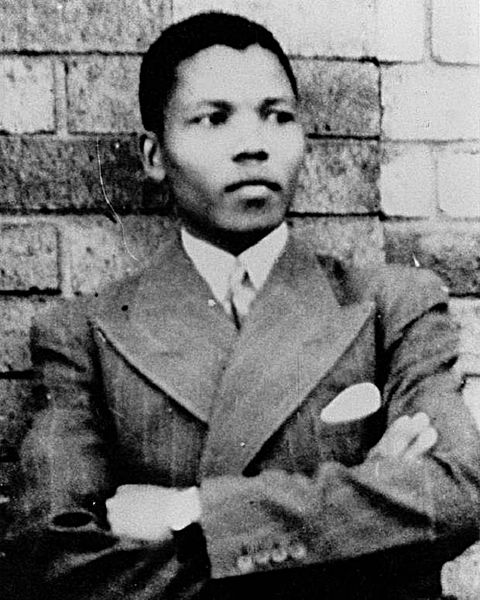
Nelson Mandela (1918-2013), Anti-Apartheid Revolutionary, Politician and former President of South Africa (first Black president, and philanthropist
I was saddened by the news of Nelson Mandela’s passing. Whilst it was not unexpected, his death has set in train much reflective thought, not only about the man he was, but also about his leadership, which was imbued with a kind of power to bring people together that is rarely seen amongst today’s political leaders.
In an essay and a poem, previously published in the summer, here on the Bardo, the word ‘fortune’ featured large in their purpose. The essay, “Fortes Fortuna Adiuvat”, was also recorded in two parts and broadcast on Roger Alan Baut’s rather unique ‘Blue Sky Highway’ Episode 3 (on BlogTalk Radio). I did eventually write an epilogue over on ‘Forty Two‘, in which I told the story of my chance encounter with a devout Christian, who harboured rather bitter feelings toward Islam. Whilst not the subject of this post, it does focus on the fortune I sometimes feel, particularly inspired by great lives, whose vision spans across the whole spectrum of human purpose, beliefs and faiths. Nelson Mandela inspired those feeling in me.
There is a need to ask the question: has this man set the standard for world leadership and will any politician be capable of taking up his mantle; will just one world leader step out of their political comfort zone and turn Mandela’s legacy into a blueprint for a new future order?
Madiba, his tribal name, the man from Qunu, had fortune for sure, in that he was clearly born with the genetic foundation of a strong constitution; he was also, somehow, able to show courage of an exceptional kind, in all sorts of ways.
As an angry young man, he fought against an oppressive regime, who felt that segregation was the only way they could manage to control a population – and preserve the security of their / the nation’s (delete whichever you think is least applicable) interests. This was Apartheid, the slogan adopted in 1948 by the Afrikaner National Party, which the white regime maintained until February 1991, not long after Mandela’s release.
It took several years of concerted protest and sanctions from the international community eventually to bring about the release of Mandela and his fellow political conspirators. That might have been the end of it, but Mandela somehow mustered the magnanimity and strength to leave his anger and resentment inside the prison cell, which had confined him for twenty seven years. Not only this, but his new regime set up the Truth and Reconciliation Commission, which was an extraordinary attempt to bring about reconciliation between the oppressors and the oppressed and to learn how to forgive.
I feel very fortunate to have witnessed the effects of one man, who was supported by many of his own friends and fellow strugglers as well as by the many anti-apartheid movements and protests around the world, and sanctions, which the persistent pressure from those protest movements eventually brought to bear on political establishments.
Each of us is born with a unique footprint, a unique perspective, but each of us can also learn from our environment and from great lives. Nelson Mandela was a great man, a charismatic leader. His fortune was his birthright, his genes, which will have imbued him with some of the characteristics that enabled him to endure the privation of incarceration, absorb and process the positive and healing forces that worked on his mind during that time. The environment that surrounded him will have forged the spirit that underpinned the great leader and human being he came to be.
Human progress toward a better order in the world, toward peace, has as it’s building blocks, the example laid by such great lives. Mandela’s legacy therefore leaves us with an opportunity. Future leaders of the world don’t have to be imprisoned, to be freedom fighters or terrorists, to qualify as great leaders, but they, like each new generation, can learn the obvious lessons from the generation before them. Here’s hoping there will be more Nelson Mandela’s, who have the courage to step out of their comfort zone, to step away from anger and resentment, to show that fortune does favour the bold.
There has been much poetry written about this man; such was his influence and inspiration. I wrote this at the time of his death, amidst the chaos of some severe storms over the UK (hence the opening reference):
“Twenty Seven Years”
As the West winds blew their fury the earth let out a cry; as if to deny the awful truth, it was more than just a sigh. As if one life had greater value than all of this; all of the love that a world full of great lives could bear; bear to contemplate the loss of a legend, but whose wisdom will be immortal …
How many years in a small, small room
with the same view through the bars.
How many years of breaking stone
that broke his view of the stars.
How many years of prayer and pain,
to grow his wings and fly,
like soaring eagle, dancing crane,
over mountains in the sky.
How many years to find his truth,
and reconciliation
that helped empower his legacy
from the torment of a nation.
How long did it take to forge his spirit,
imbue his captors’ tears
with the power of his forgiveness
after twenty seven years.
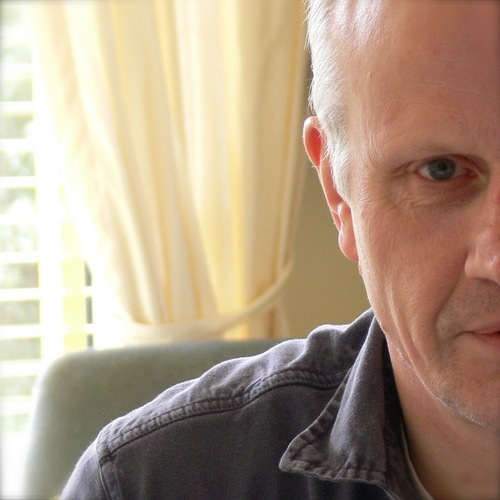
JOHN ANSTIE (My Poetry Library and 42) ~ is a British poet and writer, a contributing editor here at Bardo, and multi-talented gentleman self-described as a “Family man, Grandfather, Occasional Musician, Amateur photographer and Film-maker, Apple-MAC user, Implementation Manager, and Engineer. John participates in d’Verse Poet’s Pub and is a player in New World Creative Union. He’s been blogging since the beginning of 2011. John is also an active member of The Poetry Society (UK).
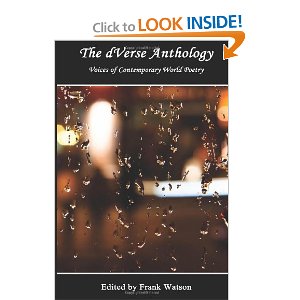
John has been involved in the recent publication of two anthologies that are the result of online collaborations among two international groups of amateur and professional poets. One of these is The Grass Roots Poetry Group, for which he produced and edited their anthology, “Petrichor* Rising“. The other group is d’Verse Poet Pub, in which John’s poetry also appears The d’Verse Anthology: Voices of Contemporary World Poetry, produced and edited by Frank Watson.
* Petrichor – from the Greek pɛtrɨkər, the scent of rain on the dry earth.
Fortune seems to be the word of the moment for me; it keeps recycling itself and coming back to haunt me! On the one hand I’m not surprised, because I feel I’ve had my fare share of it. I was born into a middle class family, privately educated, for the most part and afforded the grants to enable me to attain undergraduate as well as postgraduate degrees. As a result of this start in my life, my career path has enabled me to get jobs in disciplines that require scientific, engineering and management skills, which later led to positions outside my original education and training, including giving me sufficient wit to own and manage my own company for a while.
Recently, I become involved, through the initiative and actions of Peter Wilkin, a Poet friend and co-author of the anthology, “Petrichor Rising”, which we published in July this year, in a charitable project, which is an early rising star of the social networks, called the Rucksack Project.
The Rucksack Project is relatively little known charitable concern, set up within the last two years by one man, Matthew White. It is not a registered charity because it does not accept donations. Instead, it empowers people physically to contribute their time along with the resources of local charity shops to make up a rucksack containing several essential material items aimed at helping to sustain homeless people against the cold Winter weather.
Whilst in the process of preparation for this rucksack ‘drop’, which is planned to take place in Bradford, UK, on 21st December, I was recently told a story by a fellow chorister of his meeting with a homeless person. In brief he had passed the gentleman of the road on his way to a well-known fast food restaurant for a quick bite. Because my friend didn’t have any change, instead, whilst getting his own meal, he bought and extra meal and a cup of hot coffee. On his way back to where they were performing, he explained why he hadn’t stopped before and gave the homeless person the meal and coffee he’d just purchased and carried on his way.
Within a few paces, he felt the meal, still in its bag, fly past his left ear; clearly, it wasn’t wanted by its homeless recipient. My friend uttered his displeasure to us with the swift judgement of one who maybe hasn’t experienced at first hand, the kind of issues that drives people to become homeless, which include alcoholism and drug addiction; which in turn can be caused by pre-existing mental health issues, neglect or abuse, particularly as children. Or perhaps my friend had just not thought about it long enough to come to a more humane conclusion.
I would say to anyone who has not been touched in some way by a mental health issue, in a family member or a friend, or who has not come across a child or teenager, who has been abused – either physically or mentally – and consequently disenfranchised from family life; tossed into the precarious position of depending on the largesse of others or the state; they are not work shy wasters! Instead of throwing charity at them and running, try sitting down beside them, talk to them and find out what is their story … and listen. If they have become an agitated addict, this won’t be easy, but do try, because you may be surprised how much it means to them to be treated like a fellow human being, like equals. It behoves us to remember how lucky we are. There but for fortune go we.
JOHN ANSTIE (My Poetry Library and 42) ~ is a British poet and writer, a contributing editor here at Bardo, and multi-talented gentleman self-described as a “Family man, Grandfather, Occasional Musician, Amateur photographer and Film-maker, Apple-MAC user, Implementation Manager, and Engineer. John participates in d’Verse Poet’s Pub and is a player in New World Creative Union. He’s been blogging since the beginning of 2011. John is also an active member of The Poetry Society (UK).
John has been involved in the recent publication of two anthologies that are the result of online collaborations among two international groups of amateur and professional poets. One of these is The Grass Roots Poetry Group, for which he produced and edited their anthology, “Petrichor* Rising“. The other group is d’Verse Poet Pub, in which John’s poetry also appears The d’Verse Anthology: Voices of Contemporary World Poetry, produced and edited by Frank Watson.
* Petrichor – from the Greek pɛtrɨkər, the scent of rain on the dry earth.
[This piece was started some months ago, before I wrote the poem Fortune, featured here on the Into The Bardo a few weeks ago. That poem and this piece focus on a common theme, which is, perhaps more than any other in my writing life, a constant thread of philosophical thought for me. This is that, however much we may be short on fortune, there is never cause to give up on our hopes and dreams, or more realistically, our ‘visualisation’ of what we want from this life.]
~~~~~~~~~~~~~~~~~~~~~~~~~~~~~~~~~~~~~~~~~~~~~
Picture, via Google Images and courtesy Canvas Art (www.the-canvas-art-shop.co.uk)
“Oh what a tangled web we weave, When first we practise to deceive!”
(Sir Walter Scott, Marmion, Canto vi. Stanza 17.
Scottish author and novelist: 1771 to 1832).
Some days are better than others . . .
The better ones allow me to indulge myself in my passions. I could have walked the dog and come back feeling refreshed, or have attended a rehearsal with the Waldershelf Singers and feel utterly uplifted, or complete a piece of prose or, better, a poem and feel a sense of release. On other days, I feel disillusioned, cynical, angry, like throttling public figures (politicians) to within an inch of telling them what a bunch of useless, self-interested, lying, cheating ne’er-do-wells they are! … which they are, almost to a man (and woman) …
Why is it that, once human beings attach themselves to an organisation, an establishment, a business, a company, a corporation, a religion, or they declare their political affiliations, somehow, they lose the ability to tell the truth, assuming their integrity would allow them to differentiate between the truth and a lie, in the first place. They become overly deferential, assume the organisation’s rules are right and, worst of all, become somewhat apathetic and are inclined to assume the ‘elders’, senior leaders of the organisation are right and therefore entitled to our undying respect.
This subjugation of self, a denial of the person that was borne into this world, through that infinitely variable process, driven at its lowest level by chemistry and physics, in turn determined by the relevant genetic ‘pool’ and nurtured by the geographic, economic, demographic, societal and political environments it is our fortune, or misfortune, to have grown up in, is undeniable. This denial of the uniquely wired ‘self’ and its particular talents and aptitudes, opinions and attitudes, and the ability to discern right from wrong, truth from the lie, and I mean the real truth, the kind that only you yourself will know deep inside, is almost guaranteed.
Does it have to be this way?
I think that I’ve come to hold this position rather late in life. Questioning authority is the stuff of rebellious youth, isn’t it? When we didn’t know any better, few had any time for the opinions of young people, anyway!
Is it so, because we are too shallow? … I don’t think so, not for everyone, anyway.
Is it because we are too lazy or unable to think for ourselves … almost certainly for some.
Is it because we have to earn a living? … inevitably a contributory factor.
Is it due to the fact that, as human beings, in spite of our incredible capacity for ingenuity, we are still very insecure; none of us are ever entirely in control of our lives and I mean NONE of us, given the uncertainties of our own health and particularly of the natural world and what Mother Earth herself can throw at us! We therefore have to enwrap ourselves with a protective external blanket, woven by someone else’s dreams or designs, at one extreme by the premeditated manipulation of tyrannical leadership or, at another, simply by the desire to ensure the annual bonus, a generous pension, public honours, a knighthood … or simply the reassurance of knowing from where our next meal will come?
Is it because we are all limited in our capacity to take on too much information, store all the factors affecting any number of problems that face us each day; wrapped up in life’s complexity that sometimes threatens to overwhelm us, wouldn’t we prefer to take an easier option and permit others to make decisions for us, which acts as a perverse kind of freedom? Herein lies a major truth. But it’s not easy for managers and leaders either.
Contrary to the impression we might receive from those in stations so elevated, it may act as some comfort to those who aren’t to know that the higher up the ladder of success we go, in whatever field of human endeavour, the more insecure we get. Why, you ask? It is because we have our limits, all of us, and some of us are more limited than others; that is our birthright, given the variable abilities, with which we are endowed, the tactics and strategies we have learned and been taught to cope; it is the way we are wired. The higher up the ladder of success all this leads us, the stronger becomes our inclination, consciously and unconsciously, to hang on to whatever we’ve got; the more inclined we become to develop further selfish strategies to aid this survival process. That’s what it is to be human, well, at least to be an animal. Being human does, nevertheless, endow us with an extra ability: high intellect and, with it, a great responsibility and, yet, this tendency, this seemingly irresistible force, does inevitably lead to greed.
So what happens!
We get our heads down and graft, manoeuvre, wheel and deal, whatever it takes to gain influence, fame, attention, success, with whatever vanity or hope or need that has the greatest hold on our hearts, minds … and stomachs.
At some future moment in time, we then find ourselves, well, what’s the best word to describe it … trapped, yes trapped by our ambitions, needs, material greed, more than by hopes and dreams.
I should say something about dreams. Before you think I’m about to crush them, I’m not. As one who writes poetry and pieces of prose like this, I find dreams are just as important as the ambitions of a professional footballer I know, who learned, early on in his journey through that precarious profession, that visualising your goals (figuratively as well as literally in his case), that is imagining yourself scoring the goal, over and over again, is a truly powerful and effective way of motivating yourself to feel better about your abilities and potential. This is, for me, an unexpected way in which to feed the creative imagination; such is the process that leads to the products of human ingenuity as well as understanding and success. But, a word of warning about dreams! They can also be manipulative! They can be induced and ‘used’ by others to manipulate control over lives – take advertising, particularly on the television, as one example! We need to learn how to distinguish good from bad dreams, your own from other people’s dreams, just as we should be able to tell the difference between good and evil.
Now, I’m not necessarily talking about conspiracy theories here, about demons and evil people, who sit in back rooms and scheme to overthrow regimes or gain control of whole populations. No, I’m talking, for the moment at least, about the demons inside our heads; the ones that lead us to the point of paranoia, the fear of not being ‘successful’, wearing the right ‘fashion’, living in the right district, driving the right car, appearing in all the right ‘places’, doing what’s apparently ‘right’ in society … tricky concept this, but I’ll try to explain my thinking.
If you were to ask a child of five or six to tell you their dreams of how to make the world a better place, wouldn’t they give you magical answers, which involve the charm of fairy tale characters and imaginative, not to say unusual (and, sadly, unlikely) conclusions to their stories?
If you were to pose that same question to a child in their mid ‘teens, wouldn’t their answer be tainted with a little more realism, perhaps even a touch of hopeless, hormonal cynicism, whilst still retaining some of that childhood naiveté, a lack of what we grown-ups would call wisdom?
If you were to ask a grown up poet or a philosopher, I think their answer would come out in one of several subtle ways, but one thing is for sure, any poet, with integrity, that I know, would try to address all of the issues that confront us head on, in an honest way. This is perhaps because they rarely make a living from their writings and, therefore have no vested (financial) interest in it, other than for the integrity of their material and perhaps for a bit of recognition!
Even Poets …
Yes, even poets and philosophers have to live and pay their ‘rent’. So, somewhere along the path of life, we have to align ourselves with an organisation or two, toe the line and obey the rules. We most certainly should obey the law and, if we don’t agree with it, don’t break it, lobby to change it! There is nothing wrong with toeing the line, provided there is a fair share of integrity within the organisation; provided that we don’t lose sight of our own personal integrity, justice, beliefs, values and, above all else, what we know, deep down inside, makes each of us unique individuals, our identity.
For those, who are born with a genetic code that, given the right environment, encouragement and education, predestines them to a life of leadership and possibly even greatness, let us not forget that for those of us, who remain, whilst we may not have had the good fortune of the same faculties and opportunities, we do nevertheless represent the vast majority of the population of the world. So, if we do still have a vote in what can reasonably be described as a democracy, then we must use it or lose it! If we have the ability to write, we should do it! We must make our mark upon the paper, make our feelings, our values and beliefs known. Whilst we still have the freedom to do so, we have the ability to depose those in power who do conspire to deceive us, who have been corrupted by their privilege and who would continue to weald the power they have from such privilege for self interest. Otherwise we get what we deserve. If that happens to be a comfortable life that we’ve achieved by subordinating our own integrity, it is our choice, but, from where I am now in my life, I know that I would sooner follow and trust someone who refused to allow themselves to be trapped by the material rewards of compromising complicity, than one who, in the fullness of time, would be racked with regret, that they didn’t follow their conscience and their dream of a better life … a better world.
It would be wrong of me, however, to leave you with my totally cynical outlook, without mentioning that, thank God, there are some remarkable people in this world, who, at and on all sorts of levels, do remarkable work on behalf of their fellow human beings. Whether they be local community charity workers and volunteers, international aid workers or the likes of the inspired Mother Teresa of Calcutta’s Missionaries of Charity foundation, they are all driven, by some degree of selflessness, to improve the lot of the less fortunate and I have nothing but admiration for them.
If there is a moral to my tale, this long and rambling piece of prose, it is that I believe life can become much less complex, when we stop trying to satisfy someone else, when we discover the very best in ourselves. However unfair, unjust or unreasonably difficult life seems to be sometimes, we should never allow ourselves to give in to the pessimism that results from a state of despair at the world, to roll over on our backs with our legs in the air! We must never believe that someone else, whether it be a single person or a large faceless organisation, either has control over us or is beyond control by the voting, lobbying, plural us. For writers and poets in particular, as long as we can breath and weald a pen, we can do something, however small, and collectively we are able to make a difference, even if we don’t feel we can hop on the next flight to Africa, we musn’t allow ourselves to believe that we can’t still bring something to the table from our own unique armoury of intellectual skills. We can, above all, in our own way, be winners. It takes courage to step out of the crowd, but courage comes in many colours, one of which is being true to your innermost convictions. Fortune really can favour the bold.
[If you don’t already read it, you could do worse than by starting to read poetry now. Good poetry should open the eyes that are shut, elevate the spirit that is depressed and enrich the soul that is impoverished. Good poetry is the highest form of literature, which should tell us the way it is and feed us with deep insights that we would otherwise not experience; and I mean insights and creative thought that will enable change, not only in your own life, but also others.]
JOHN ANSTIE (My Poetry Library and 42) ~ is a British poet and writer, a contributing editor here at Bardo, and multi-talented gentleman self-described as a “Family man, Grandfather, Occasional Musician, Amateur photographer and Film-maker, Apple-MAC user, Implementation Manager, Engineer and general all-round good egg.” This he tells us with tongue firmly planted in cheek. Add grace and humor to the list.
John participates in d’Verse Poet’s Pub and is a player in New World Creative Union. He’s been blogging since 2011. John is also an active member of The Poetry Society (UK). He says of his work, “Much of my writing and my poetry focuses on the future and the important part that our children, and the way we treat them, play in this. It also spans a diversity of life’s experiences, some moving war poetry and particularly observations of life for a modern generation.
Also a member of Grass Roots Poetry Group John steered their anthology, Petrichor* Rising, into publication. It is now in print and available for purchase. “Petrichor Rising takes you on a journey that exposes you to the full spectrum of emotions, from barely concealed despair to hope, from love to sorrow, with a clear appreciation of nature’s value and humanity’s shortcomings. It rides a roller-coaster that moves you to consider many of life’s challenges from a different perspective, as all good poetry should. It is at once haunting, yet shocking, with aching nostalgia alongside enchanting stories of dragons. It gives you optimism and hope tinged with shadows of doubt. It writes about places never seen and humanity’s uncaring nature, in prosodic social commentaries and observations of the minutest details of life, mood, atmosphere and romance. It contains clever writing that brings you close to the edge of society, still capable of moving you, but not pulling any punches. It has poetry with a universal appeal covering subjects as varied as the loss of a cat or a harrowing account of the 7/7 London bombings, poetry that focuses on the roots of all that makes us respond to life and long for something better.”
* Petrichor – from the Greek pɛtrɨkər, the scent of rain on the dry earth.
 JOHN ANSTIE (My Poetry Library and 42) ~ is a British poet and writer, a contributing editor here at Bardo, and multi-talented gentleman self-described as a “Family man, Grandfather, Occasional Musician, Amateur photographer and Film-maker, Apple-MAC user, Implementation Manager, and Engineer. John participates in d’Verse Poet’s Pub and is a player in New World Creative Union. He’s been blogging since the beginning of 2011. John is also an active member of The Poetry Society (UK).
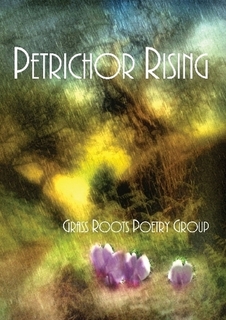 John has been involved in the recent publication of two anthologies that are the result of online collaborations among two international groups of amateur and professional poets. One of these is The Grass Roots Poetry Group, for which he produced and edited their anthology, “Petrichor* Rising“. The other group is d’Verse Poet Pub, in which John’s poetry also appears The d’Verse Anthology: Voices of Contemporary World Poetry, produced and edited by Frank Watson.

 The BeZine