Posted in Dharma Talk, Essay, Meditation, memoir, Poets/Writers, Priscilla Galasso

Honoring My Father

George William Heigho II — born July 10, 1933, died March 19, 2010.

Today I want to honor my dad and tell you about how I eventually gave him something in return for all he’d given me.

My dad was the most influential person in my life until I was married.  He was the obvious authority in the family, very strict and powerful.  His power was sometimes expressed in angry outbursts like a deep bellow, more often in calculated punishments encased in logical rationalizations.  I knew he was to be obeyed.  I also knew he could be playful.  He loved to build with wooden blocks or sand.  Elaborate structures would spread across the living room floor or the cottage beach front, and my dad would be lying on his side adding finishing touches long after I’d lost interest.  He taught me verse after verse of silly songs with the most scholarly look on his face.  He took photographs with his Leica and set up slide shows with a projector and tripod screen after dinner when I really begged him.  He often grew frustrated with the mechanics of those contraptions, but I would wait hopefully that the show would go on forever.  It was magic to see myself and my family from my dad’s perspective.  He was such a mystery to me.  I thought he was God for a long time.  He certainly seemed smart enough to be.  He was a very devout Episcopalian, Harvard-educated, a professor and a technical writer for IBM.  He was an introvert, and loved the outdoors.  When he retired, he would go off for long hikes in the California hills by himself.  He also loved fine dining, opera, ballet, and museums.  He took us to fabulously educational places — Jamaica, Cozumel, Hawaii, and the National Parks.  He kept the dining room bookcase stacked with reference works and told us that it was unnecessary to argue in conversation over facts.

Camping in Alaska the summer after his senior year in High School: 1951.

My father was not skilled in communicating about emotions.  He was a very private person.  Raising four daughters through their teenaged years must have driven him somewhat mad.  Tears, insecurities, enthusiasms and the fodder of our adolescent dreams seemed to mystify him.  He would help me with my Trigonometry homework instead.

Playing with my dad, 1971.

I married a man of whom my father absolutely approved.  He walked me down the aisle quite proudly.  He feted my family and our guests at 4 baptisms when his grandchildren were born.  I finally felt that I had succeeded in gaining his blessing and trust.  Gradually, I began to work through the  more difficult aspects of our relationship.  He scared my young children with his style of discipline.  I asked him to refrain and allow me to do it my way.   He disowned my older sister for her choice of religion.  For 20 years, that was a subject delicately opened and re-opened during my visits.  I realized that there was still so much about this central figure in my life that I did not understand at all.

Grandpa George

In 2001, after the World Trade Center towers fell, I felt a great urgency to know my father better.  I walked into a Christian bookstore and picked up a book called Always Daddy’s Girl: Understanding Your Father’s Impact on Who You Are by H. Norman Wright.  One of the chapters contained a Father Interview that listed dozens of questions aimed at bringing out the father’s life history and the meaning he assigned to those events.  I decided to ask my father if he would answer some of these questions for me, by e-mail (since he lived more than 2,000 miles away).   Being a writer, this was not a difficult proposition for him to accept.  He decided how to break up the questions into his own groupings and sometimes re-phrase them completely to be more specific and understandable and dove in, essentially writing his own memoirs.   I was amazed, fascinated, deeply touched and profoundly grateful at the correspondence I received.  I printed each one and kept them.  So did my mother.  When I called on the telephone, each time he mentioned how grateful he was for my suggestion.  He and my mother shared many hours reminiscing and putting together the connections of events and feelings of years and years of his life.   On the phone, his repeated thanks began to be a bit eerie.  Gradually, he developed more symptoms of dementia.  His final years were spent in that wordless country we later identified as Alzheimer’s disease.

I could never have known at the time that the e-mails we exchanged would be the last record of my dad’s memory.  To have it preserved is a gift that is priceless to the entire family.  I finally learned something about the many deep wounds of his childhood, the interior life of his character development, his perception of my sister’s death at the age of 20 and his responsibility in the lives of his children.   My father is no longer “perfect”, “smart”, “strict” or any other concept or adjective that I could assign him.  He is simply the man, my father.  I accept him completely and love and respect him more holistically than I did when I knew him as a child.  That is the gift I want to give everyone.

I will close with this photo, taken in the summer of 2008 when my youngest daughter and I visited my father at the nursing home.  I had been widowed 6 months, had not yet met Steve, and was anticipating my father’s imminent passing.  My frozen smile and averted eyes are fascinating to me.  That I feel I must face a camera and record an image is somehow rational and irrational at the same time.  To honor life honestly is a difficult assignment.  I press on.

© 2014, essay and photographs, Priscilla Galasso, All rights reserved

.
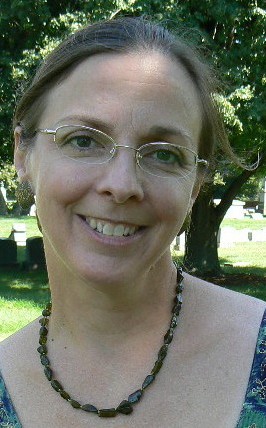
004PRISCILLA GALASSO ~ started her blog at scillagrace.com to mark the beginning of her fiftieth year. Born to summer and given a name that means ‘ancient’, her travel through seasons of time and landscape has inspired her to create visual and verbal souvenirs of her journey. Currently living in Wisconsin, she considers herself a lifelong learner and educator. She gives private voice lessons, is employed by two different museums and runs a business (Scholar & Poet Books, via eBay and ABE Books) with her partner, Steve.
Posted in Disability, Essay, General Interest, memoir, Mental Health, Michael Watson

The Olympics, Polio, and the Medicine Wheel, Part One

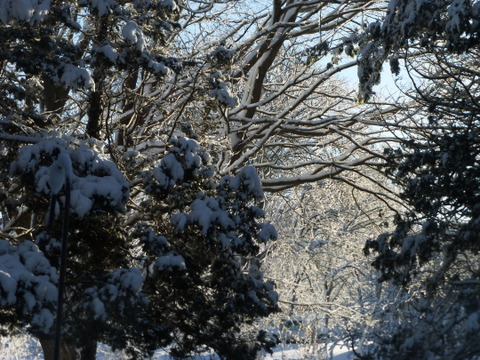
Snowy-MorningEditor’s Note: This is the first of a two-part piece on Perfectionism originally posted on Dreaming the World. Part II will post here tomorrow.

I am an elder, and as such I am given the task of teaching and supporting the young. On the Medicine Wheel of this lifetime I am in the Northwest, the place of honoring the challenges of my life, understanding them as best as I am able, and sharing what I have learned with others. Perhaps you will share your thoughts about the experiences I share below; I would greatly value that.

We, along with many others, spent a good deal of time during the past two weeks watching the Olympics. Over time we noticed, especially from NBC’s coverage, that the commentators seem to believe winning and perfection were all important. This is a sad thing. One does not have to watch much before one becomes aware the announcers are ceaselessly pointing out errors and failures. Rather than empathy for the competitors, one is barraged with demands for perfection and minute details about failure to achieve such.  There is very little celebration of the athletes who fail to meet the announcers’ or judges’ criteria.

This hits home on two fronts. The first is cultural. I was raised to appreciate the efforts of all. Winning is fun, but should not shame others. Nor should anyone be left behind after the games are over. Further, perfection was considered suspect. One was advised to build imperfection into one’s art and welcome it in one’s life. After all, we are not the Creator although we are aspects of His/Her creation. Only the Creator can be perfect, and it is likely even S/He makes mistakes; as we are reflective of the Creator this suggests that even mistakes can be good and holy. The unbridled pursuit of perfection endangers the individual and the culture, the community and the ecosystem.

The second part is I am a survivor of Bulbar Polio. My phsysiatrist says I am “a walking quad”; rather than disparaging, this is a simple statement of truth. I have severe neurological injuries; Polio destroyed motor neurons all over my body. My arms and hands have considerably diminished capacity; my legs and feet lack strength and mobility; breathing can be a challenge. I am not perfect by the dominant culture’s standards.

Add to this my Native American heritage and the soup becomes thick indeed. I once heard a man, who understandably thought he was with other Europeans, say something like,  “There is nothing more pathetic than a disabled Indian.”  What are we to do with that? Indeed, what are we to do with NBC’s virtual silence on the topic of the Para-Olympics?

Herein lies the difficulty. One one hand I was encouraged to accept  and honor imperfections. On the other, as a Polio survivor I was taught to do my level best to pass as normal, to overcome limitations, and to forget my illness and its  aftermath. Additionally, as a child in a Native family that was actively passing, I was taught to be invisible, a lesson that surely applied to Polio as well.

It is a profound challenge to resist the limiting messages of our families and the dehumanizing ones of the dominant culture. I have done my best, yet I have also spent much of my life seeking to achieve others’ views of perfection, even though not even normalcy was not an option.This has been painful.

I don’t know whether you have ever thought about the Wounded Healer.  In Traditional cultures ill youngsters are often expected, should they recover, to become healers. I use the term “recovery” loosely. Youngsters who face and survive catastrophic illness may not have the same physical capacities as their normative friends. Yet their illness may also give them abilities and insights not readily available to others. When the child is ill the healers do their best to aid. They also seek to discern the nature of the illness; often such illness are understood to be calls from the spirits, initiations into the realm of healers. When there is a spirit call, training in the healing arts accompanies recovery. The illness frequently leaves a footprint in the life and work of the survivor; he or she becomes a wounded healer, knowledgeable about many of the territories and challenges that accompany illness.

This is a different model than the academic learning focus of the West. Of course, the two paths are not mutually exclusive. Indeed, they may intersect, even overlap at times. Both address the needs of the body. Some Western trained healers have adopted the Indigenous understanding that the soul and psyche must also be attended to.  (Milton Erickson, although not to my knowledge Indian, comes to mind as someone who walked both roads well.)

I have come to this point on the Medicine Wheel by living my life from within this severely injured body. This is a sharp contrast to the physically perfection of elite Olympic athletes, or the health and wealth gurus we see on PBS and on innumerable infomercials. The television sages convey the message to us that illness, poverty, loneliness, and all other forms of suffering are moral failures. They do not speak this directly, rather they hold up their carefully managed perfection as a mirror to our human frailties. They offer advice, even salvation; for a fee we can be just like them. But I, and many others, cannot.  The very lifestyles they espouse harm us, and endanger our precious planetary ecosystem and all that lives therein. Where, I wonder is their wisdom and compassion?

We approach the Spring, the East in the Abenaki view of the Medicine Wheel, the place of rebirth and awakening. I am curious how my changing understanding of this beloved, traumatized body will blossom in the coming year.  I wonder whether our culture can set aside the deeply held values of independence, competition, and perfectionism that shaped the  our country (the very ones espoused by those television commentators). Can we own our imperfections, and acknowledge the harm we have inflicted on ourselves and so many others, inside and outside our country? Can we embrace those who suffer illness, poverty, displacement, abuse, or isolation?

As we follow the journey of the sun into the East, we are invited to begin again, to open our eyes and practice compassion and understanding. May we  find the courage to do so.

– Michael Watson, Ph.D.

© 2014, essay and photographs (includes the one below), Michael Watson, All rights reserved

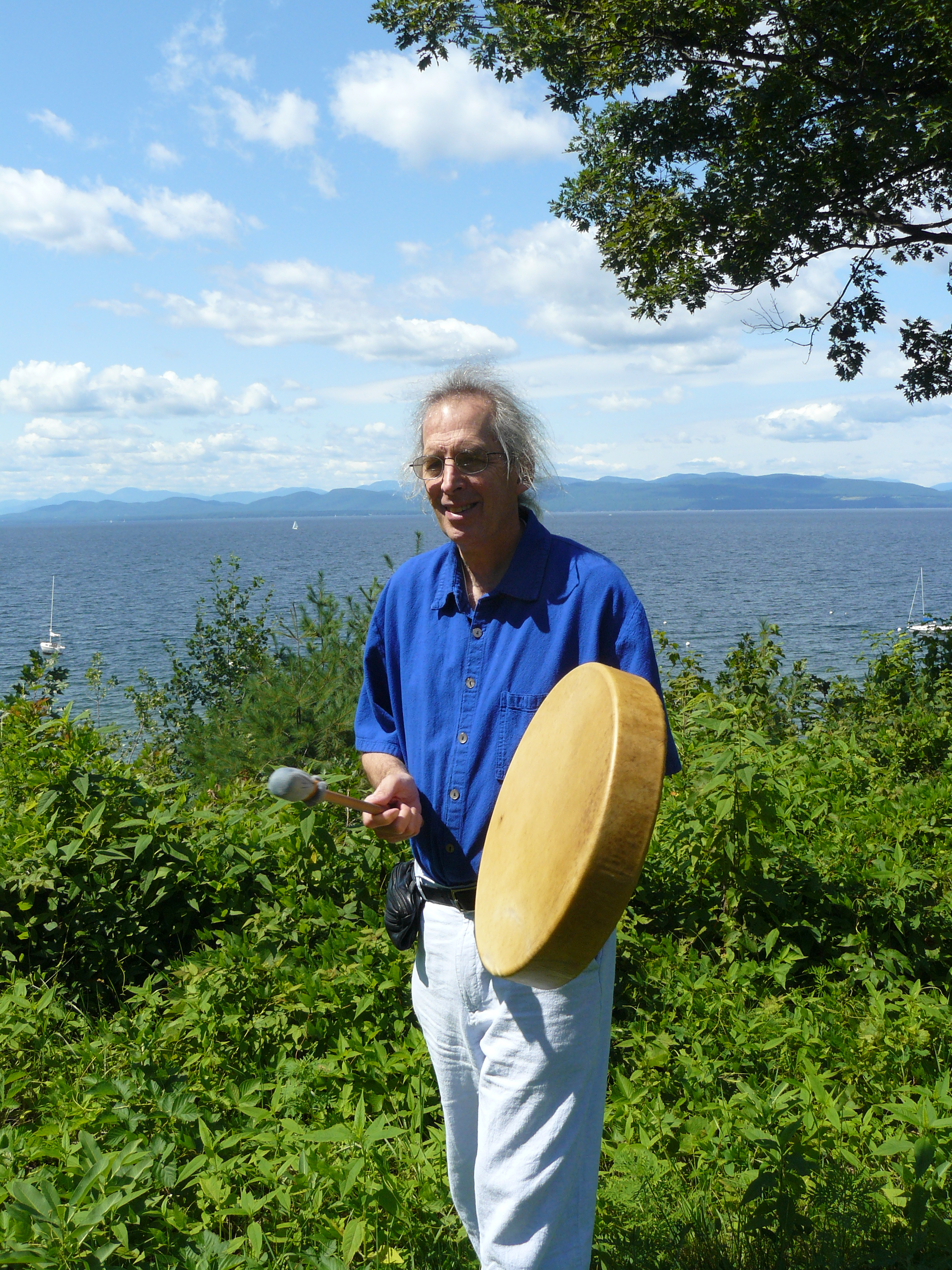
michael drumMICHAEL WATSON, M.A., Ph.D., LCMHC (Dreaming the World) ~ is a contributing editor to Into the Bardo, an essayist and a practitioner of the Shamanic arts, psychotherapist, educator and artist of Native American and European descent. He lives and works in Burlington, Vermont, where he teaches in undergraduate and graduate programs at Burlington College,. He was once Dean of Students there. Recently Michael has been teaching in India and Hong Kong. His experiences are documented on his blog. In childhood he had polio, an event that taught him much about challenge, struggle, isolation, and healing.