Posted in Jamie Dedes, Poems/Poetry

BEGGING BOWL

·

The begging bowl is a symbol of receptivity and of acceptance, a parable of the soul.

·

BEGGING BOWL

by

Jamie Dedes

a bell pealing from a tower

a bird singing in the evergreen

the monks at the forest edge

these we are, speaking to the wind

sighing to night’s great indigo sky

holding out our begging bowls

to be filled with bee and bud

the alms of our noon-hours

·

·

Photo credit ~ Vintage Old Monk (China) with begging bowl courtesy of The Buddha Gallery

Poem by Jamie Dedes, copyright 2011, all rights reserved

Posted in Essay, Jamie Dedes

THE MELLOW FRUITFULNESS OF FALL

THE MELLOW FRUITFULNESS OF FALL

by

Jamie Dedes

SEASON of mists and mellow fruitfulness, 
        Close bosom-friend of the maturing sun; 
    Conspiring with him how to load and bless 
        With fruit the vines that round the thatch-eves run…

To Autumn by John Keats (1795-1821), English poet, Romanic Movement

Autumn, transition between sultry summer and tempestuous winter, is a time to honor the dead, count and celebrate the harvest, and give thanks. The diverse peoples of the Northern Hemisphere indulge in family fun, feasting, crafts fairs, parades, and fine arts. Among the earliest celebrations are the Jewish Yom Kippur and Rosh Hashanah, closely followed by Succot, the Feast of the Tabernacles. Originally the feasts were literally in tabernacles (huts). Now venerated around the family table, there’s the typical holiday scramble to assemble and prepare traditional foods: challah bread, gifilte fish or a roasted chicken, and apple cake or oatmeal cookies for dessert.

Harvest Moon, the first full moon before the fall equinox, presents another excuse to party. At communities, like Callaway Gardens in Georgia (U.S.A.), folks watch college football, take horticulture tours, and go cycling.  Falling Leaf Moon is next, when the veil between the worlds of the living and dead is said to be thinnest. Celebrated by Pagans and Wiccans, it’s considered a ripe moment to gather for séance.

On the heals of Falling Leaf Moon is Halloween and all things spine-tingling. Special events at places like Carisbrooke Castle and Pendennis Castle in England – where the gothic and ghostly meet – offer visitors historic tours, spine-tingling walks, and spooky tales. It all harks back to the earlier times that birthed today’s foods, feasts, and falderal.

Dia de Todos los Santos (Day of All Saints) and Dia de los Muertos (Day of the Dead) are honored in Central and South America with customs that represent a melding of cultures, American and European. Feasting is the order of the day: suckling pig and tamales. There’s music and prayers, picnics held at graveyards, and tables decorated with candles, photographs of deceased relatives and friends, and T’ant’a Wawas (bread figurines for the Day of All Saints).
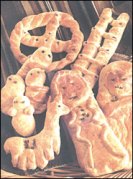
T’ant’a  Wawas

It would seem we humans – no matter the culture – like to celebrate our gratitude by feasting on the wealth of our harvest. In North America the big event of the season is Thanksgiving, a holiday that falls in early October in Canada and late November in the States. Major crops in North America include pumpkin, corn, potatoes, nuts, apples, and wheat, all ingredients for dinners of roasted and stuffed turkey, corn on the cob, mashed potatoes and gravy, and pumpkin or apple pie. Happy kitchen chatter and clatter and the scents of cinnamon, cardamom, and sage fill the air.

Cities everywhere have parades, but the Macy’s Thanksgiving Day Parade in New York has a long history. It started in 1824 when immigrant workers wanted a festival like the ones they enjoyed in Europe. Today the parade is an exciting oversized event with mega-stars from television, Broadway and Hollywood and mega-sized balloons and floats. Forty-four million view it on TV.

Like the trade gatherings of the original peoples (Native Americans), crafters fairs are held at large event centers where crafters sell their handcrafted foods, household items, jewelry, and toys. These visually sensual treats arrive just in time for holiday decorating and gift giving. Often the fairs include musical entertainments, story-telling, and crafts classes as well.

A wealth of entertainment is offered everywhere: but Paris is queen, honoring autumn with theatre, music, dance and the visual arts at the Festival d’Automne à Paris that runs the length of the season, September through December.

Wherever the eye travels this season the décor, natural or inspired by nature, is bright, rich, and rustic. Public and private places are decorated with gourds, spiny ears of wheat, scarecrows, and leaves turned orange, red, and gold. Though autumn’s common denominator is the celebration of abundant crops, that abundance is excelled by the diversity of the dishes, peoples, and landscape across the Northern Hemisphere.

The links on challah bread and T’ant’a Wawas are to recipes

·

© essay, Jamie Dedes, 2011 all rights reserved

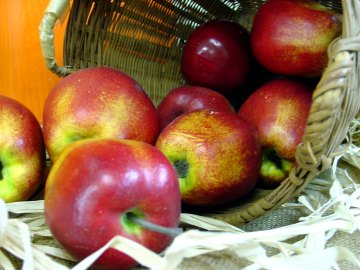
basket of apples/photo credit ~ morgueFile

T’ant’a  Wawas/photo credit  ~ The Global Gourmet

Posted in Book/Magazine Reviews, Jamie Dedes

NINE GATES: ENTERING THE MIND OF POETRY

NINE GATES: ENTERING THE MIND OF POETRY

by Jane Hirshfield (b. 1953, American) author and poet

Review by: Jamie Dedes (Musing by Moonlight)


An award-winning author and poet, Jane Hirshfield has published seven collections of poetry in addition to  Nine Gates: Entering the Mind of Poetry, a collection of essays. Her most recent book of poetry is Come, Thief (August 2011). In collaboration with Mariko Aratoni, Hirshfield edited and translated four volumes of poetry by women of ancient Japan.

Ms. Hirshfield is a Zen Buddhist and her practice informs her work with spiritual insight and delicate nuance.  She has said, “It is my hope that the experience of that practice underlies and informs [my poetry] as a whole. My feeling is that the paths of poetry and of meditation are closely linked – one is an attentiveness and awareness that exists in language, the other an attentiveness and awareness that exists in silence, but each is a way to attempt to penetrate experience thoroughly, to its core.” [The Poetry Foundation]

Nine Gates: Entering the Mind of Poetry (September 1998) is a series of nine essays that were written by Jane Hirshfield over a ten-year period and published or presented at poetry events.

*****

Gates are a means of exit and entrance, providing connection between the inner and the outer.  The premise of Hirshfield’s book is that the art of poetry is the gate by which we are offered  “mysterious informing.” Nine Gates is at once a primer for the reader and a manual for the writer. This is a book that is reverent of art, artist, and life. All is sacred ground.

The book begins at the beginning – the root of poetry – concentration.  “By concentration, I mean a particular state of awareness: penetrating, unified, and focused, yet also permeable and open.” As she says, this is Huxley’s “doors to perception” and James Joyce’s “epiphany.”  It is what I would call sacred space, and this focus, this concentration, “however laborious, becomes a labor of love.” In this chapter, I particularly appreciated the short discussion of voice: writers whose ear is turned to both the inner and outer have found their voice and thus are able to put their  ”unique and recognizable stamp” upon their work.

The book closes with “Writing and the Threshold Life” and a discussion of the space into which a writer withdraws, liminal space.  The writer, she tells us, becomes like the monk giving-up identity and assumptions. . “The person [in liminal state] leaves behind his or her identity and dwells in the threshold state of ambiguity, openness, and indeterminacy.” This is all rather like the person going through a ritual transitions. Only after transition to this liminal space, neither here nor there, is community wholeheartedly embraced. To see clearly and to embrace the whole without judgment, one has to be free of the standard cannon and the received wisdom.  The idea being that the creative life is one that gives up the ordinary conventions, which is the price of freedom.

Encased between the two portals of concentration and the threshold life are discussions of originality, translation (what we learn from the poetry and linguistic traditions of others), “word leaves” (images), indirection (the mind of the poet circles the poem), inward and outward looking, the shadow side of poetry (between the realms of heaven and hell), and poetry as a “vessel of remembrance.”

The book’s range is broad, using poets and their wisdom from ancient times to modern and from East to West. The essays are at once a delicate lace and a sturdy practical homespun. All is approached with respect, clarity, and intelligence. Each chapter is a gentle nudge toward more authenticity, greater truth, deeper spirituality. In her introduction, Jane Hirshfield says that because the essays were written at different times some themes and quotes are repeated and removing the repetitions proved impossible. I felt the repetitions served to reinforce. I was grateful for them. If I have any difficulty with this book, it was the conflict between not wanting to put it down and wanting to put it down to start writing in the spirit of entering the mind of poetry. A definite thumbs-up on this one.

·

Essay ~ © 2011, Jamie Dedes, all rights reserved

Cover art ~  © publisher, posted under fair use

·

Posted in Jamie Dedes, Perspectives on Cancer, Uncategorized

PERSPECTIVES ON CANCER #33: Writing Your Self, Transforming Personal Material

WRITING YOUR SELF

Book Review

by

Jamie Dedes

We feel this book review puts a fine close on our series, Perspectives in Cancer. Writing as a healing art, whether as a purely personal exercise or for publication, is powerful. One of the authors of Writing Your Self, Myra Schneider, learned that with her much appreciated work,Writing My Way Though Cancer. That effort informs much of Writing Your Self.

This review was originally published at Musing by Moonlight.

Four of Myra’s poems were published earlier in this series.

We wrote the book because we believe that personal writing is very potent both for the writer and the reader, because some of the greatest literature is rooted in personal material. Myra Schneider in an interview HERE.

The subtitle of this book about writing is “transforming personal material.”  I think it is implicitly also about personal transformation. It always seems to me that writing and reading about life is a healing activity, a way to live hugely, and a way to empower ourselves and others. If we can do it well enough to engage others, whether our purpose is to leave a record behind for family, to set the record straight, or simply to share and entertain, the experience is rewarding. Writing is a powerful healing path.

Writing Your Self is the most comprehensive book of its type that I’ve yet to read, and I’ve read many. It is organized in two parts:

  • Part I: Here the focus is on life experiences, the exploration of those human experiences that are universal. These include childhood, self-conceptions, relationships, displacement, physical and mental illness and disability, and abuse.
  • Part II: Here the focus is on writing techniques, recognizing material that is unfinished, working on refinements, and developing work projects.

Writing Your Self is rich with examples from known and unknown writers including the authors. By example as well as explanation the authors reinforce what we all intuitively understand to be true: that telling stories preserves identity and clarifies the human condition. It helps us understand what it means to be human. The experience of working through the book was something like a rite of passage.

I very much can see the use of this book by individuals training themselves and by teachers of adult learners who wish to write memoir, poetry, fiction, or creative non-fiction. It would be useful in hospital therapeutic writing programs or in writing programs for active seniors.

Memories, both recent and distant, tell us who we are and so play a crucial role in our experience of life…

You may have memories which you want to plunge into or you may have material like a diary or letters which summon them up. There are other ways though of triggering memories. We offer a series of suggestions. Chapter 13, Accessing memories, secret letters, monologues and dialogues, visualizations.

I think Chapter 13 alone is worth the price of admission. I work a lot off of childhood memories and even the event that happened two minutes ago comes back to me with dreamlike qualities when I sit to write. I have not thought of the things I do naturally as triggers, but indeed they are. It was quite interesting to see these natural aids laid-out and organized on the page to read: objects and place as starting points, physical sensation as triggers, people in memory, and predominant feelings. The section on secret letters – that is, letters that you write someone and never send – was particularly interesting. I’ve only done this twice in my life, but I know some folks who do it all the time. I’m sure it is a common practice and would make a fine jumping-off point for some and a satisfactory exercise – complete in itself – for others. The authors go on to monologues and dialogues, which certainly everyone spins in their heads.  They discuss visualization. Hey, if you can see it, you can write it.

I’m an experienced writer and I enjoyed the book and the exercises and learned a few new things, got a few new ideas. If you are inexperienced or stuck midway in a transition from one form of writing to another, you’ll benefit from the exercises, ideas, and instruction in Writing Your Self: Transforming Personal Experience. This one’s a definite thumbs-up.

Myra Schneider  is a British poet, a poetry and writing tutor, and author of the acclaimed book: Writing My Way Through Cancer. Your can visit her HERE.

John Killick was a teacher for 30 years, in further, adult and prison education, but has written all his life. His work includes both prose works and poetry. You can visit him HERE.

© essay, Jamie Dedes, 2011 all rights reserved

Copyrighted cover art, fair use.

♥ ♥ ♥ ♥

Jamie Dedes ~ Jamie is a former freelance feature writer and columnist whose topic specialties were employment, vocational training, and business. She finds the blessing of medical retirement to be more time to indulge in her poetry, creative nonfiction, and fiction. She has two novels in progress, one in final edits, and is pulling together a poetry collection. Her primary playground is Musing by Moonlight. She is the founder and editor/administrator of Into the Bardo. Jamie’s mother was diagnosed with cancer the first time at thirty-six. She went three rounds with breast cancer, one with thyroid cancer, and died at seventy-six of breast and colon cancer.