Posted in Essay, Spiritual Practice, Terri Stewart

Finding Sacred Space in Mandala

I love the idea of Mandalas. Mandala means sacred circle in Sanskrit. The idea of sacred circles permeates the spiritual underpinnings of many traditions. The circle of Native American tradition where a sacred circle is danced, not to be broken. The circles of trinity in Christian tradition. The Mandala of Hindi and Buddhist tradition. The circular labyrinth that dates back up to 25,000 years. Walking a circle, dancing a circle, drumming a circle, drawing a circle, even singing a circle … “make the circle wide, make it wider still” … creates a moment of sacred space meeting the co-creative spirit of human and transcendence.

That is beauty.

Lately, I have been thinking about mandalas more than normal because I am co-organizing a mandala workshop called, “Finding Your Spiritual Identity with heART: A Mandala Workshop.” Julia Weaver, a mandala practitioner, will be coming to town and doing two workshops for me- one with the girls in detention (how awesome is that?!) and one for the people of Seattle.  I love that she is being so flexible in offering her gifts and talents.

That is also beauty.

So today, to create our sacred space, I’d like to do a mandala meditation. I am using one of my own images and some meditation ideas that I have found at jeweledlotus.com.

Take a moment and center yourself. Imagine a circle of protection, love, compassion, and mercy surrounding you. Let your gaze rest softly on the computer screen. Rest your feet comfortably on the ground if possible. Simply become as comfortable in your own spot as you can become. As Julia says (and which I will quote in the video!),

“As you gaze at a mandala,
breathe slowly, and relax your eyes.
See with your heart and listen for guidance.
Gently open to your own luminous Divinity.”

Shalom and Amen,

Terri

(c) 2014, post, Terri Stewart

terri

REV. TERRI STEWART is Into the Bardo’s  Sunday chaplain, senior content editor, and site co-administrator. She comes from an eclectic background and considers herself to be grounded in contemplation and justice. She is the Director and Founder of the Youth Chaplaincy Coalition that serves youth affected by the justice system. As a graduate of Seattle University’s School of Theology and Ministry, she earned her Master’s of Divinity and a Post-Master’s Certificate in Spiritual Direction. She is a contributing author to the Abingdon Worship Annual. (The 2014 issue just released!)

Her online presence is “Cloaked Monk.” This speaks to her grounding in contemplative arts and the need to live it out in the world. The cloak is the disguise of normalcy as she advocates for justice and peace. You can find her at www.beguineagain.com ,www.twitter.com/cloakedmonk, and www.facebook.com/cloakedmonk.  To reach her for conversation, send a note to cloakedmonk@outlook.com

Posted in Essay, Spiritual Practice, Terri Stewart

Walking the Sacred Path with President Nelson Mandela

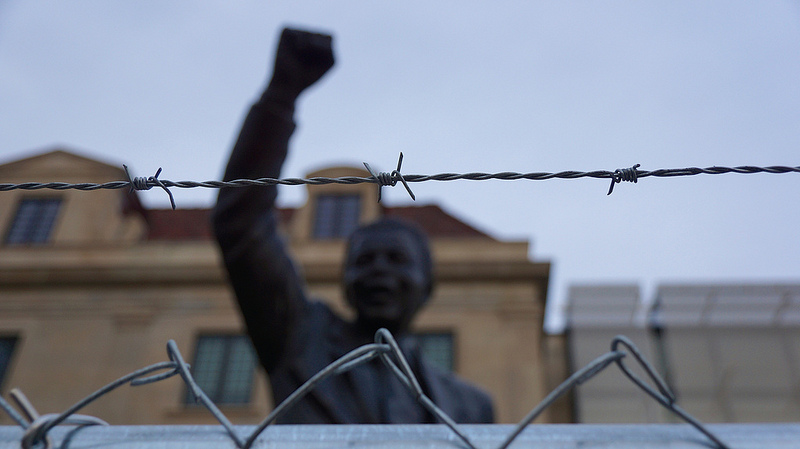
Nelson Mandela

This post is complementary to a post created at http://beguineagain.com/. I encourage you to read this and then read that post.

Today is the wrap-up in our recent series about President Nelson Mandela. As I was pondering how to close out the thoughts and hearts of our community, I remember that President Mandela was a deeply spiritual man who relied on the African theology of Ubuntu to carry the day. Ubuntu, which I have written about before, is the idea that “I am because we are.” It is deeply rooted in Africa with not only Mandela but Desmond Tutu subscribing to Ubuntu as core beliefs. Ubuntu is described below by Mandela himself.

“A traveler through our country would stop at a village, and he didn’t have to ask for food or for water. Once he stops, the people give him food, entertain him. That is one aspect of Ubuntu but Ubuntu has various aspects. Ubuntu does not mean that people should not enrich themselves. The question therefore is: Are you going to do so in order to enable the community around you to improve?” http://www.youtube.com/watch?v=Dx0qGJCm-qU#t=28

Knowing that this deeply spiritual man connected so strongly to a traditional spirituality, I have decided to combine the traditions of President Mandela and the gleanings of the Bardo Group with the ancient prayer practice of Midday Prayer. I am relying on the ancient rhythm but substituting readings from our authors and from President Mandela.

The general pattern of Midday Prayer is opening, hymn, psalm, Gloria, reading, prayers of the people, Lord’s prayer, collect, conclusion. This will be an adaptation of this ancient pattern. Someday we can discuss the prayer pattern and its ancient roots that extend beyond Christianity into Judaism and earlier.

Take a moment, light a candle, slow down and begin again with President Nelson Mandela leading the way.

A Midday Meditation in the Tradition of Ancient Mystics

Honoring Nelson Mandela

Help us as we pause at this point in the day to find safety and refuge, peace and mercy.

Glory to all that ties us together and brings our hearts into the center so we may listen. As it was in the beginning, it will be now, and will be forever more. Amen.

Hymn, excerpted from John Antsie

As the West winds blew their fury
the earth let out a cry;
as if to deny the awful truth,
it was more than just a sigh.
As if one life had greater value
than all of this; all of the love
that a world full of great lives
could bear; bear to contemplate
the loss of a legend, but
whose wisdom will be immortal …

Psalm, excerpted from Charles W. Martin

once
or twice
in a lifetime
an ancient returns
showing
the way
not
as a prophet
or
god-like figure
but as
a man
or
a woman
willing to expend
all their life forces
to open
the minds
of all those
willing
to listen

Glory to all that ties us together and brings our hearts into the center so we may listen. As it was in the beginning, it will be now, and will be forever more. Amen.

Reading: Inspired by Jamie Dedes, by President Nelson Mandela, Speech on World Civilisation, November 2000

The world had become much smaller, as I realised when racing on jumbo jets that I had never seen before, and talked every day on amazing new international telephones. I had to acquaint myself with this new phenomenon of globalisation, that enabled money and capital to flow instantly across the globe, and made the economies of the world startlingly more interdependent.

The effects and consequences of globalisation had to be internalised by many other South Africans, as well. South Africa became isolated from the international community during the apartheid years, and now saw how closely interconnected countries and economies had become. We welcome the process of globalisation. It is inescapable and irreversible. We can no more ignore it, as I said before, that we can reject the idea of winter by refusing to wear warm clothes. It can carry with it not only investment and transfer of expertise, but also knowledge and understanding of other people and cultures.

But if globalisation is to create real peace and stability across the world, it must be a process benefiting all. It must not allow the most economically and politically powerful countries to dominate and submerge the countries of the weaker and peripheral regions. It should not be allowed to drain the wealth of smaller countries towards the smaller ones, or to increase the inequality between richer and poorer regions.

Please take a moment for silent reflection.

Meditation: Inspired by Jamie Dedes, by President Nelson Mandela, Africa Standing Tall Against Poverty, 2 July 2005 [edited]

Massive poverty and obscene inequality are such terrible scourges of our times – times in which the world boasts breathtaking advances in science, technology, industry and wealth accumulation.

We live in a world where knowledge and information have made enormous strides, yet millions of children are not in school.

We live in a world where the Aids pandemic threatens the very fabric of our lives. Yet we spend more money on weapons than on ensuring treatment and support for the millions infected by HIV.

It is a world of great promise and hope. It is also a world of despair, disease and hunger.

Overcoming poverty is not a gesture of charity. It is an act of justice. It is the protection of a fundamental human right, the right to dignity and a decent life.

While poverty persists, there is no true freedom.

Please take a moment for silent reflection.

Have mercy on our souls.

Group prayer

Holiness, wholeness, perfectedness
The Name of the path of healing is sacred
Let the cosmos be filled with mercy and kindness!
Let the cosmos be filled with acts of justice and love!
Let it be so, here, on earth, and everywhere in the cosmos.
Let our needs be fulfilled with love so that it
Staves off temptation allowing an end to injustice and poverty.
The cosmos of love and mercy has power to move hearts and make it so.
Forever. And ever.
So it shall be.
Amen and amen.

Intercessory prayer for the poor and concluding collect

We lift up all who live below the poverty line – knowing that we do not succeed if they do not succeed. Each one is a unique and precious beloved person in the human family.

We know that good things can go to them if we work towards justice, love, and mercy to provide for the needs of one another in loving kindness and in political will. Let us seek help so that we may help the less fortunate who experience the apartheid of poverty.

This is an abundant world if we would act with mercy and justice for all. Sharing our resources in an equitable manner worthy of the label, loving kindness. While we ask for strength for the impoverished, we ask for the hearts of the comfortable to be shattered with love for neighbors both known and unknown so that we may truly live in an Ubuntu world, erasing the line between the haves and have-nots and transforming the cosmos into Sacred Wholeness.

Peace I give to you, peace I leave with you.

Shalom and Amen.

~Terri

(c) 2013, post, Terri Stewart

(c) 2013, photo, Ted Eytan, CC AT-SA 2.0, http://www.flickr.com/photos/22526649@N03/11235545336/
terriREV. TERRI STEWART is Into the Bardo’s  Sunday chaplain, senior content editor, and site co-administrator. She comes from an eclectic background and considers herself to be grounded in contemplation and justice. She is the Director and Founder of the Youth Chaplaincy Coalition that serves youth affected by the justice system. As a graduate of Seattle University’s School of Theology and Ministry, she earned her Master’s of Divinity and a Post-Master’s Certificate in Spiritual Direction. She is a contributing author to the Abingdon Worship Annual. (The 2014 issue just released!)

Her online presence is “Cloaked Monk.” This speaks to her grounding in contemplative arts and the need to live it out in the world. The cloak is the disguise of normalcy as she advocates for justice and peace. You can find her at www.beguineagain.com ,www.twitter.com/cloakedmonk, and www.facebook.com/cloakedmonk.  To reach her for conversation, send a note to cloakedmonk@outlook.com

Posted in Essay, Spiritual Practice, Terri Stewart

What’s in a Name? Finding Sacred Space in Identity

Christening  (c) 2009, Paula Bailey CC 2.0
Christening

A little secret: I am preaching on Sunday. So today’s inspiration is gleaned from random thoughts about what I have been studying. And I have been studying names. In the Gospel of Matthew, the story of Jesus’ beginning has an angel telling Joseph the name for this baby:  Jesus. Jesus is the English form of Yeshua which is a form of Joshua. Yep. Joshua. Where have we heard that before? Joshua is the name of the guy in Hebrew scripture who takes the people into the promised land. How is that for being saddled with a name? Joshua also means, arguably, “God saves.” Additionally, Matthew references the Book of Isaiah and the name Immanuel, “God with us.”

And I think being saddled with a name like Terri is a problem! Well, I don’t really think it is a problem, but in second grade, I had problems. My reading teacher put masking tape on each reading book so she could write our names onto our book. I don’t know why, perhaps because I was as boisterous then as I am now, but she put “Terrible Terri” onto my second grade reader. I was distraught. But, being ever so bashful, I said, “no, you need to change this.” And then it became Terrific Terri. Just goes to show that advocacy has always been in my personality. But I was hurt that a teacher would label me as Terrible.

Naming, labeling, creates expectations that can hinder us or help us in our journey. I think the name “Terrible Terri” is a hindrance! But the name “God Saves”… well, it could go either way. You either live up to that name or you become completely overwhelmed. Or maybe even both! It can be both an inspiration and an absolutely terrifying expectation. I wonder if Jesus ever worried about getting it wrong? For example, he was out in the country, and this woman runs up to him asking for him to heal her daughter and he says, “I did not come for your kind…you’re like the dogs underfoot at the dinner table!” Ouch. I hope he at least winced at that one. He did not live up to the expectation, at that moment, of being the perfect picture of saving grace. But he grew into it as he changed his mind. (Matt 15:21-28) and included the very ordinary mother and her daughter in his ministry. That’s kind of inspiring, isn’t it? A picture of someone willing to listen, hear, and change. We don’t get much of that in our daily life. Witness: CNN, MSNBC, FOX. Maybe that is one place where “God saves.” When we engage in a relationship, listen to each other, hear what is said, and change for the better. That might be new growth. That might be creating sacred space. Can I get an Amen?

My son, Colin, is transgender. His original name was Caitlyn. Caitlyn means “pure.” Pure is quite a lot to live up to. When Colin came out, he chose his name. He chose Colin for two primary reasons-he likes the name and it was close enough to Caitlyn that it would be easier for people to make the transition. Colin has several options in its meaning, but since Caitlyn is of Irish origin, we decided to continue with the Irish origin (much to the Scottish family’s dismay!). Irish-ly speaking, Colin means “peaceful dove.” Hmm. I don’t think Colin is quite the peaceful dove, but maybe he will live into it. In fact, upon reflection, I think he has lived into it in many ways. He may not be a quiet, peaceful dove. But he does advocate for right relationship between people and has zero tolerance for bullying. Can you exuberantly advocate for peacefulness? I think so.

We finally took Colin in to get his name changed legally. The judge looked at the paperwork “Caitlyn” to “Colin,” looked at me, asked me if all the signatures were valid and if this was something “she” wanted. I answered, “My son desires to change his name to Colin.” The judge blinked. Looked back down at his paperwork and then decreed it so. Then Colin got 100 pats on the back as he left court. And not one negative word was said. He was beaming from ear to ear. This was his naming ceremony. The moment in time where he stepped into who he really was. It was important. There is something sacred in claiming yourself and knowing your own identity, your own story. There is also something very difficult in the process. And, it is ultimately a very loving act. Can you love yourself enough to know your name? Not the name slapped onto your second grade reader, but the name you choose? Is your name Inspiration? Compassion? Love? Challenge? Maybe your name is a complex amalgam of inspirational-compassion-that-challenges-while-whispering. (Well, I would not whisper, but you take my meaning?!)

What name do you claim? What name do you want to jettison? What name has claimed you?

Shalom and Amen!

~Terri

(c) 2013, post, Terri Stewart

(c) 2009, photo, Paula Bailey, cc licensed 2.0, http://www.flickr.com/photos/32625013@N00/4195762309/

terriREV. TERRI STEWART is Into the Bardo’s  Sunday chaplain, senior content editor, and site co-administrator. She comes from an eclectic background and considers herself to be grounded in contemplation and justice. She is the Director and Founder of the Youth Chaplaincy Coalition that serves youth affected by the justice system. As a graduate of Seattle University’s School of Theology and Ministry, she earned her Master’s of Divinity and a Post-Master’s Certificate in Spiritual Direction. She is a contributing author to the Abingdon Worship Annual. (The 2014 issue just released!)

Her online presence is “Cloaked Monk.” This speaks to her grounding in contemplative arts and the need to live it out in the world. The cloak is the disguise of normalcy as she advocates for justice and peace. You can find her at www.beguineagain.com ,www.twitter.com/cloakedmonk, and www.facebook.com/cloakedmonk.  To reach her for conversation, send a note to cloakedmonk@outlook.com

Posted in Essay, Jamie Dedes

ELDER POWER: Growing Strong in Broken Places

ELDER POWER:

Growing Strong in Broken Places

by

Jamie Dedes

Authors, like coins, grow dear as they grow old; It is the rust we value, not the gold. – Alexander Pope

Originally published in the now defunct California Woman.

I come to this place of Elder Power through the experience of a chronic, potentially life-threatening illness. Illness is many things. It is a mentor, not chosen, not welcome, but a mentor nonetheless. It is a challenge that often breaks the bonds of affection, the temper of the spine, and the sharpness of the mind. It is a reminder to everyone involved of his or her fragility and mortality. Everyone is touched: family, friends, and colleagues. Everyone is changed and the good or ill of it is largely choice

My family and friends want me to help others by writing from a more clinical perspective, but it seems to me that the clinical lessons are less important than the life lessons. It is the life lessons that give us the strength to keep going, that are the true value to be shared, and that make us elders. To me “elder” implies more than “senior” or “senior citizen,” which I see as demographic terms for people who have reached retirement age. A senior is someone who has merely put in time, while elder is about attitude and state of mind. Elder implies one who has learned a few things along the way.

As a writer, it is the life lessons, not the clinical ones, which inspire and inform my work. I have learned, for example, that all humans are in process and therefore imperfect; and that, no matter what our differences are, the most important things are to remain open to communication and to accept and release our own follies and those of others. I have learned that neither illness nor threat of death preclude joy. I have learned that people who are joyful rarely do harm to themselves or others. I have learned that fear of death has to be directly addressed and then firmly put aside in favor of the business of living. As the saying goes: “It’s not over until it’s over.” Until then, we have responsibilities to others and ourselves. The only real difference between someone who has a life- threatening illness and someone who doesn’t is that the former is no longer in denial.

“If people bring so much courage to this world, “ wrote Hemingway in A Farewell to Arms, “the world has to kill them to break them. The world beaks everyone, and afterward, many are strong at the broken places. But those that will not break, it kills. It kills the very good and the very brave and the very gentle impartially. If you are none of these it will kill you too but there will be no special hurry.”

I am not good, or brave, or particularly gentle. Sometimes I let it all get me down. I descend into fear. I am impatient with process, with taking meds and going for seemingly endless tests and doctors’ appointments. Maybe that’s why I’ve outlived my original expiration date by ten years. My mother used to say, “Only the good die young.” My best quality may be that under my protective shell of intractability, I actually am willing to be broken and reformed. I suppose only time will tell if I have grown “strong at the broken places.”

So, here I stand, after twelve years of battle, at the dawn of a bright new day in a body that is now significantly disabled and quite a bit older. It’s still a good morning and a good body. I recognize I once dealt with a worse handicap than my current disabilities. That handicap is commonly referred to as “youth.” I survived. Maturity on the other hand is a true boon, a gift to savor and enjoy with layers of luxurious nuance I had not anticipated. I do not long for my youth. I love my graying hair. I love my wrinkles and the loose skin on my neck. I love the mild deformity of my feet. These things remind me that I am still here after all. I will not dye my hair, though I have. I will not get chemical injections or cosmetic surgery. I will not use rejuvenating grooming products that have been tested on defenseless animals. I am inspired by civil-rights-era African-Americans who sported Afros, said essentially “this is who we are and what we look like,” and chanted “black is beautiful.” I am graying. I am wrinkled. It’s all lovely and lyrical and makes me smile. It’s about ripeness, not rottenness. It’s honesty: what you see is what you get. Aging is beautiful. With maturity, one finds character refined and perspective broadened, energy expands and compassion flowers. The experience of joy comes more easily.

As survivors, we owe it to those who have gone on, to live in gratitude for this gift of a long life. How ungrateful and what an insult it is to them for us to bemoan our maturity and yearn for our youth as we so often do. What an incredible waste of time and energy such yearning is. Many don’t survive childhood in their impoverished and war-torn areas. Some others don’t survive childhood due to congenital or other diseases. My sister died by her own hand when she was twenty-seven. I have a wonderful, talented, smart friend in her mid-thirties who will pass within three months from this writing. Like you, I have relatives and friends who didn’t make it to fifty, much less sixty or seventy. All things considered, aging is a gift not a curse.

Some of our power comes from our sheer numbers. I read somewhere that we are some six hundred million strong worldwide. In each of our countries, we represent a huge political constituency, a lucrative market, and an enormous fount of energy, experience, and expertise. If that isn’t power in this modern world, what is? What a force for peace we could be. Some of our power comes from consciousness. We are awake now. We have learned how to live in the moment and how to live joyfully, hugely. That alone is a lesson to share. Some of our power comes from more time and focus. Many of us are retired or semi- retired or on disability, or soon will be. Implicit in that is the time to keep abreast of issues in our communities, countries, and our world. We can take the time and make the effort to get accurate information, to analyze carefully, and to share appropriately; that is, in a well considered, non-inflammatory, non-sensational manner. We can act with grit and grace.

Let us show that we are strong in the broken places. Let those of us who have this gift of long life seize on it and ply our elder power. Let’s live with joy, do good, and have fun. Most of all let us be generous with our love. Soon enough, when the time is ripe, our bodies will return to the earth. Our spirits will go wherever spirits go. The river of earthly life will continue to flow. Our children will see us reflected in the eyes of their children. Our grandchildren will strain to hear our voices in rustling leaves and breezes that whisper to them in the night. They will seek us out in moonlight and the warmth of the sun, in the roar of the oceans and the gentle meandering of a lazy brook. They will find us in the good earth and in the good hearts of the lives we’ve touched with concern and compassion.

© 2009  photo and essay, Jamie Dedes All rights reserved