When we marched,
Slithered
Through slimy mud past riot-shielded cops in Alexander
(This is the ghetto.)
While children peered wild-eyed from dark windows,
For some of us these were re-runs of earlier apartheid-burdened days.
But, then, it was defiant resolution that drove our hearts and braced our feet.
Now, sadness at betrayal sat sadly on our hearts.
Our shouted slogans hung heavy over us in grimy air.
We winced at familiar oft-repeated lies
Oft-repeated lies.
There are people for whom poetry exists almost exclusively as an aid to social change, to political discourse– not as some sort of didacticism – but as a discussion, a wake up call, a way of approaching some truth, finding some meaning, encouraging resolution. I’m not one of them. I am as likely to write about the beautiful flowers that have just popped on my orchid – at last – or something my mom said fifty years ago as I am to write a poem on a social issue. But it does happen and quite often: a horrific war photo, a news report of an injustice, a homeless person outside the grocery, a friend in pain that I can trace to some social issues, and the words start to flow. There’s the urge to respond, to do something – the urge to activism.
As I make my way around the blogosphere, I delight to see how many poets blog for causes – “worthy” causes as my mom would say – and I know that “worthy” is in the eye of the reader. War is big. For those poet-bloggers who are pacifists, this medium offers one means of passive resistance. Perhaps passivism is the strongest form of resistance and poetry the conscience of the collective soul.
In the 70s, the American author, poet, and musician, Gil Scott Heron, wrote The Revolution Shall Not Be Televised (video below). It comes to mind now. For those who remember, this might seem odd. It’s a Nixon-era piece, but we’re still struggling with the trivialities Heron is so beautifully strident about. And the revolution couldn’t be televised. It would be too big for one thing. Though Heron was addressing issues for blacks, I would submit that while we have different histories, we’re all struggling to stay afloat on the same broken-down raft.
In Dennis Brutus’ poem above, he points to the world we now live in. Having survived Robben Island with Nelson Mandella, he was freed only to find that while apartheid ended in South Africa it had become world-pervasive. The issue now he discovered was no longer race but economics: the few haves vs. the masses of have-nots. And those who have just a bit – enough to feel safe and perhaps a bit smug – are just a hairbreadth away from have-not.
I can’t help but think that the revolution so many of us seek is rooted in transforming values. Hence, it is more evolutionary than revolutionary. As such, perhaps it is too gradual and pervasive to be televised. Perhaps it is evident in our blogosphere and the heart-born prose and poems of simple folk like you and me with nary a pundit or politician among us. Perhaps it’s a bottom-up thing, more likely to be blogged than broadcast, rising from homespun poetry – outsider literary art – sometimes rudimentary and awkward, but always quiet and true and slow like a secret whispered from one person to the next. It is perhaps something stewing even as we write, read, and encourage one another. Perhaps there is some bone and muscle in what we do. Individually we have miniscule “audiences.” Collectively we speak to enormous and geographically diverse populations.
I think I hear army boots a-marching, marching across networks everywhere. Or perhaps poetic fancy has caught my spirit today and all is dream …I hope not. Blog on …
So let some impact from my words echo resonance lend impulse to the bright looming dawn
If you are viewing this poem on the home page, you will need to click with your mouse on the subject line of the post to see the poem laid out properly.
And a man said, Speak to us of Self-Knowledge.
And he answered saying:
Your hearts know in silence the secrets of the days and the nights.
But your ears thirst for the sound of your heart’s knowledge.
You would know in words that which you have always known in thought.
You would touch with your fingers the naked body of your dreams.
And it is well you should.
The hidden well-spring of your soul must needs rise and run murmuring to the sea;
And the treasure of your infinite depths would be revealed to your eyes.
But let there be no scales to weigh your unknown treasure;
And seek not the depths of your knowledge with staff or sounding line.
For self is a sea boundless and measureless.
Say not, “I have found the truth,” but rather, “I have found a truth.”
Say not, “I have found the path of the soul.” Say rather, “I have met the soul walking upon my path.”
For the soul walks upon all paths.
The soul walks not upon a line, neither does it grow like a reed.
The soul unfolds itself, like a lotus of countless petals.
♥ ♥ ♥
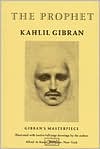
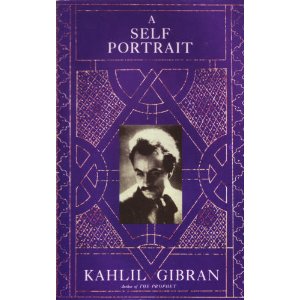
The Lebanese-American artist and poet-philospher, Gibran Khalil Gibran, died on this day in 1931. He was born in 1883. He wrote in the Arabic and in English and was from the northern Lebanon town of Bsharri (the ancient name meaning “the house of Ishtar,” after the goddess Ishtar worshiped by the ancient Phoenicians). Bsharri is in the Kadisha Valley below the famed cedar forests of Lebanon. In modern times Bsharri was enclave for Maronite Christians escaping from the Ottoman Turks. Until the late 19th Century/20th Century, Aramaic* was the language of Bsharri. Its influence is still evident in the verbal inflection of its people.
Initially, The Prophet (1923, U.S.), was not well-received by critics, though it met with some success with the public. By the sixties and the counter-culture** it – and all his work – gained greater acceptance and a wider audience. As with other like spirits, Gibran is considered a mystic by some and a charlatan by others. Gibran found wisdom in the transcendent elements of all spiritual traditions he encountered, but was born into a Maronite family.
The Maronites are Eastern Catholics in communion with the Apostolic See (the seat of authority for the Catholic Church based in Rome, Italy), and followers of St. Maron, a Syrian priest of the fifth century. Also from the Aramaic speaking peoples, St Marion was a friend and contemporary of St. John Chrysostom (Turkish) and Anthony the Great (Egyptian) and led a monastic life. Before the rise of the Ottoman Empire and the subsequent Lebanese diaspora, this was the majority population in the Lebanon. 3,500,000 people practice this religion world-wide. In the United States some 200,000 are Maronite.
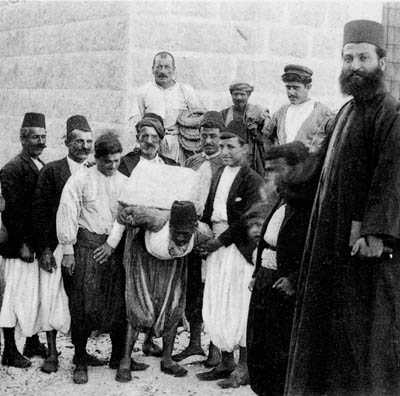
Maronites building a church on Mt. Lebanon, circa 1920s. Public domain photo via Wikipedia.
Video posted to YouTube by utterboxtv. This is a short documentary of about ten minutes.
Gibran Museum in Lebanon courtesy of Xtcrider via Wikipedia. Public domain photo.
Gibran Memorial at Copley Square in Boston, Massachusetts, U.S.A. via Wikipedia. Public domain photo.
1904 – 1930, written in Boston, New York and Paris, where Gibran studied art under Rodin.
* Aramaic, a Semitic language, was the language of Jesus and the Apostles, the literary language and the vernacular of ancient Asia Minor, Syria, Mesopotamia, and Palestine. The Peshitta texts (Old and New Testaments) were written in Aramaic and some claim they are the original New Testament documents.
**counter-culture – a cultural movement initiated mainly in the U.K. and the U.S. It spread though most of the western world between 1958 and 1974 with its peak after 1964. The counter-culture movement of the ’60s created a cultural divide mainly along age lines with youth forming a subculture questioning the social norms of the day and changing many regarding wars (especially Vietnam), sexuality, religion and spirituality, music, drugs, abortion, women’s rights, racial rights, gay/lesbian rights, free speech, environmentalism, dress codes, and so forth. It started in ’58 in London with an act of civil disobedience when students marched to ban the bomb (i.e. nuclear weapons).








 The BeZine