
BUDDHIST POETRY IN THE WEST
by
Jamie Dedes
We often think of the Beats when we think of Buddhist inspired poetry in the West. Actually, the influence of Buddhism in the West began 100 years ago, largely due to the midwifery of Ezra Pound, that American expatriate poet of the Lost Generation, an influential figure in the Modernist Movement in poetry. He played a role in Imagism, his generation’s rejection of flowery Victorian and Georgian poetry in favor of directness and economy. Pound took a year to write of this experience in the Paris Underground, distilling essence much as the Japanese did with their haiku, a poetic form.
The apparition of these faces in the crowd;
Petals on a wet, black bough. Ezra Pound
Where the Lost Generation adopted stylistic elements of Buddhism and struggled with meaninglessness under the pall of World War I, the Beat Generation was anything but lost and went beyond style. In ‘50s atmosphere of paranoia, the Beats found sanity in Buddhism. In the light of non-duality, no difference between heaven and hell, man or woman, the hierarchies and them vs. us mentality becomes meaningless. The mendicant life recommended by Buddha becomes a haven. Life on the road and the poetry of rebellion become antidotes to 1950s conformity and consumerism in America.
Western interest in Zen and Zen poetry is perhaps a surprise to some but it is also absolutely serious. Alan Watts criticized the Beat Generation poets, calling them dillettantes. He couldn’t say that of today’s Buddhist and Buddhist-influenced poets, not with the likes Leonard Cohen, an ordained monk, and Jane Hirshfield, who received Soto-Zen lay ordination. Buddhist inspired poetry today is characterized by neither hopelessness nor rebellion, rather by the Buddhist spiritual values of non-duality, transience and impermanence, and the practice of present moment and mindfulness. In their hands, reading and writing poetry becomes spiritual practice.
© essay 2011, Jamie Dedes, all rights reserved
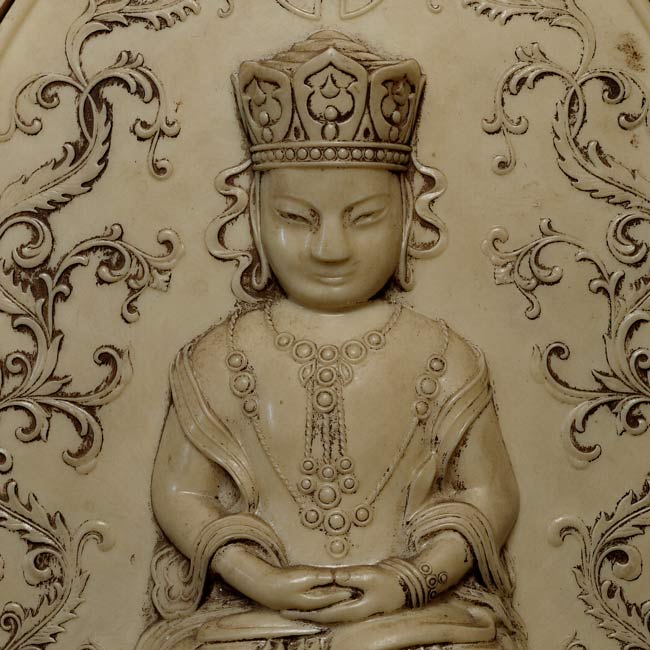
Photo credit ~ Beautiful and very uncommon Chinese Celloid Buddha Shrine. Probably late Ching, circa 1900. 8.5″ tall, 6.25″ wide, 4 5/8″ deep. Item 4216 courtesy of curator of The Buddha Gallery.

♥ ♥ ♥ ♥
Poet Jane Hirshfield in an interview about poetry at an event of the Aspen Writers Foundation.
Video uploaded to YouTube by plumtv
Poet Leonard Cohen reading Days of Kindness
Video uploaded to YouTube by Proculledtwo.

 The BeZine
Two fascinating videos! What messages in so few words. Amen!
Leonard’s poem has my heart print on it. While it rings a distant bell, having it dusted off is much appreciated. There is nothing to replace Leonard reading his own poetry.
LikeLike
I’m glad you enjoyed the videos, Amy. You are absolutely right: there is nothing like hearing Leonard Cohen read his poetry. His voice resonates, but then everyone from Canada seems to have a good speaking and singing voice. There must be something in your water! 😉
Thanks for your visits and comments.
Jamie
LikeLike
I find such resonance in this post…in Buddhism itself. One of the beauties of Buddhism is the way in which those of us of other faith orientations can enrich our own lives with its practice and values. (I think of Thomas Merton, here). Thank you, Jamie.
(Did you get my e-mail about re-posting? I’m not sure I sent it to your new address)
LikeLike
Yes, I think of Merton too here. I think Buddhism can breath new life into our “old” religions. I went to a monestery near my home recently only to find it sterile and not at all like these places used to be. I like the work Brother David Steindle-Rast is doing toward this end.
Got the email. Thank you! 😉
We are so pleased to host you again, Victoria.
Jamie –
LikeLike