Posted in Buddhism, Teachers

UPDATE: Buddhist Global Relief

Ven. Bhikkhu Bodhi, American Buddhist Monk, Theravada Tradition

Founder and Chairperson

Buddhist Global Relief

Photo ~ Ken and Visakha Kawasaki under Creative Commons Atribution-Share Alike 3.0 Uported License via Wikipedia

This is just in from the Ven. Bhikkhu Bodhi. J.D.

·

BGR Logo
let the lotus
of compassion
enfold the world

Buddhist Global Relief came into being in June 2008, born of the conviction that Buddhists should play a more active role in helping our unseen brothers and sisters around the world emerge from the crushing weight of poverty and social neglect. Inspired by the Buddha’s great compassion, we chose chronic hunger and malnutrition as our special focus. Our programs are intended to help people escape this brutal trap by promoting more sustainable methods of food production and more equitable systems of food distribution. We also sponsor the education of poor children, especially girls, and right livelihood opportunities for poor women, enabling them to earn more to feed their families.

In only three years, we’ve already launched over twenty-five projects in Asia, Africa, Haiti, and the U.S. The most recent include:

  • regular nutritious meals for hungry children in Port-au-Prince, Haiti
  • wells to provide water for poor families in Cambodia
  • training in employable skills for indigent girls in Sri Lanka
  • educational assistance for slum children in Nagpur, India
  • training farmers from Malawi in ecologically sustainable agriculture
  • a community garden and orchard to produce nutritious organic vegetables and herbs in Mqatsheni, South Africa
  • a greenhouse to grow produce for the poor in the Maryland-Pennsylvania region of the U.S.

Today BGR is playing a major role in representing Buddhism on the stage of global giving. Last year, we were even invited to participate in conferences on collaboration in poverty alleviation at the White House and the National Cathedral. These led to several partnerships with Oxfam America on projects in Cambodia and Vietnam. Recently Tricyleand Buddhadharma, two major American Buddhist journals, featured articles about BGR (please see Tricycle’s Feeding the world’s hungry and Buddhadharma’s Buddhist Global Relief articles). We want this Buddhist presence to flourish, visibly representing the compassionate spirit of the Dharma in ways made urgent by the terrible persistence of poverty and malnutrition.

We’re doing our utmost to turn back this tide, but we can’t achieve our goals without help from friends who share our ideals and resonate with our values, good-hearted people like you. Your donations are the key to everything we do: to combating hunger and malnutrition, to educating poor children, to helping those who cannot help themselves. And because we’re an all-volunteer organization, we use the funds we receive prudently, with care and discretion, to ensure that over 90% of every dollar goes directly to finance projects.

As we come to the end of 2011 — the time for selfless giving — please bring forth a heart of generosity for the world’s poor and hungry people, who need a helping hand in order to rise up and stand on their feet. Please give generously. When you give, you become a part of our mission, a partner in our endeavor to express compassion in action. Bear in mind that to give is to receive, to experience the joy of offering others the chance to live with dignity and hope.

May all blessings be with you and your family,

Ven. Bhikkhu Bodhi signature

Ven. Bhikkhu Bodhi
Founder and Chairperson

Buddhist Global Relief is a 501(c) (3) organization. Gifts are deductible to the full extent allowable under IRS regulations. You can either donate online at the BGR website or send a check to:
Buddhist Global Relief
PO Box 1611
Sparta, New Jersey 07871 USA

If your company has a Matching Gift Program, please enclose the necessary forms as well.

Posted in Jamie Dedes, Poems/Poetry

DREAMING OF THE SHEIK

I’m the Sheik of Araby,

Your love belongs to me.

At night when you’re asleep

Into your tent I’ll creep.

The Sheik of Araby, lyrics by Harry B. Smith and Francis Wheeler, music by Ted Snyder, written in 1921 in response to the popularity of Rudolph Valentino and the movie The Sheik.

·

DREAMING OF THE SHEIK

by

Jamie Dedes

·

Oh yes, I’d say she’s about seven in that picture

Blue-black hair, curls bursting and tied with string

Hands folded neatly, one little foot turned in

·

With dark doe eyes staring at the waiting world

Long lashed and bright with hope and longing

What future did those clear sparkling eyes behold

·

What music played the strings of that young heart

She must have dreamt of men and marriage,

Well, she would assume love as young people do

·

Some standard dreams maybe, the house with

A white porch and rocker, a picket fence and

A back yard of rich dark earth, flowers and fruit

·

Sweet children would be a part of this fairy-dream

Roses for birthdays, lilies at Easter, and garland in May

Christmas trees and mistletoe and other such …

·

As she watered rubby beets and greens on the fire escape

And helped her mother with chores and siblings

No doubt she dreamed dreams gifted by movies, magazines

·

As she tied her worn boots, getting ready for school,

Smoothing her hand-me-down dress, then running

Down the steps and on through the slums …

·

She must have dreamed then of ocean mists and

Fresh air, streets with trees and well-groomed homes

And well-polished horseless-carriages for transit

·

When she grew old enough did she wait hopeful

On well-worn curbs under jaundiced street lights

A ghetto-bound Diana waiting for her handsome Sheik

·

And he, the Sheik looking for his Sheba, did he find her

Did he take her hand as she stood lovely, innocent

And did he soon leave her only to be followed by another

·

Did each Sheik stay long enough to steal her heart

And riding off take another piece of her, a souvenir

Of yearning and promise, love and gullibility …

·

Is that why she lies here now, eyes grown pale, heart empty

And a silent wail rising from the sacred depths of her being

“The movies and the magazines”, she says, “they lied …”

Then whispered softly: “When Valentino died, women

lined the streets for his funeral cortége and cried  … “

·

Rudolf Valentino as the Sheik and Agnes Ayers as Lady Diana.

“Women are not in love with me but with the picture of me on the screen. I am merely the canvas on which women paint their dreams. ”
Rudolph Valentino – 1923

Video posted to YouTube by tengirlsag

© 2009, 2010, 2011 Jamie Dedes, All rights reserved

Posted in Jamie Dedes, Poems/Poetry

HEARTS UNDER LOCK AND KEY

I wait until I hear a gate latch lift
the turn of key in lock.
I sit amongst toys and unwashed clothes,
I sit and she fingers the beads until you speak
in a voice that no longer seems familiar, only strange.
I turn as our child tugs at the string.
I hear a snap and a sound like falling rain.
The Albatross, Kate BassThe Pasta Maker
·
HEARTS UNDER LOCK AND KEY
·
by
·
Jamie Dedes
·
I really wanted
to speak to you of this:
the love I had wild
and so long ago
that now it’s dry
parched like a river
·
Once it was a love moist
as a green spring rain
delicate as snow
prolific as a poet
I gave you my love
a sweetly tender thing
·
a well-written poem
on twenty-pound linen
You handed love back
wrinkled and torn
and nicotine stained
smelling of whiskey
·
I handed you love
on our white wedding day
when you kept your heart
under lock and key
and your eyes wouldn’t
seek mine at the rail
·
I gave love to you
in the palms of our child
you brushed his sweet face
and flew away to
lose yourself in a
gold land with gold girls
·
Now I too keep my heart
safe under lock and key
and heavy the lock is
closed so tight with rust
and no hope in sight
no hope wanted
·
© 2010, 2011, Jamie Dedes, All rights reserved

Photo credit ~ © 2010, 2011, All rights reserved, Barb Stone, The List of Buddha Lists


Posted in Film/Documentaries/Reviews, Jamie Dedes

TRADING IN TRASH: garbage collecting, growing up, and multi-nationals in Egypt

Video posted to YouTube by massify.

Documentaries about impoverished communities around the globe — in Latin America, Africa and Asia — feature heart wrenching images of children picking their way through garbage dumps to gather food to eat or material goods to sell. But nothing quite compares to the story of Cairo‘s Zaballeen, a community of Egyptian Coptic Christians who have for generations survived by scouring their city for trash, carting it off to their ‘garbage neighborhood’ and recycling it. MORE [About.com Documentaries]
·
TRADING IN TRASH
documentary review
posted by Jamie Dedes (Musing by Moonlight)
·
The short story: Given the stunning events in Egypt over much of the past year, it seems appropriate to cover this documentary film that illustrates life for one of Egypt’s minority groups. GARBAGE DREAMS follows three teenage boys born into the trash trade and growing up in the world’s largest garbage village, on the outskirts of Cairo. It is home to 60,000 Zaballeen (or Zabbaleen), the Arabic for “garbage people.” Far ahead of any modern “Green” initiatives, the Zaballeen survive by recycling 80% of the garbage they collect.  Face to face with the globalization of their trade, each of the teenage boys is forced to make choices that will impact his future and the survival of his community. Released in 2009, the list of screening venues around the world is HERE.
A Donkey at Moqattam Hill in Cairo
courtesy of Matthias Feilhauer under the Creative Commons Attribution-ShareAlike 3.0 License via Wikipedia.
A Group of Boys at Moqattam Village
courtesy of Ayoung ShinAyoung0131 licensed under the Creative Commons Attribution-ShareAlike 3.0 License via Wikipedia.
·
Expertly weaving personal fears, family tensions and political action, GARBAGE DREAMS records the tremblings of a culture at a crossroads. Jeannette Casoulis, New York Times.
·
Courtesy of Iskander Films, Inc. under the Creative Commons Attribution-Share Alike 3.0 Unported license.

Stunning debut . . . Tech credits are aces. As fascinating as [Iskander’s] anthological revelations are, it’s her lensing that grants her subjects immense dignity (they never appear “other” in their poverty) and her film its curious beauty. Ronnie Scheib, Variety

With a population of 18 million, Cairo, the largest city in the Middle East and Africa, has no sanitation service. For generations, the city’s residents have relied on 60,000 Zaballeen, or “garbage people,” to pick up their trash. The Zaballeen collect over 3,000 tons a day of garbage and bring it back to their “garbage village,” the world’s most effective and successful recycling program.

Paid only a minimal amount by residents for their garbage collection services, the Zaballeen survive by recycling. They have transformed Mokattam, their garbage neighborhood, into a busy recycling and trading enclave. Plastic granulators, cloth-grinders and paper and cardboard compacters hum constantly. While Western cities would boast of a 30% recycling rate, the Zaballeen recycle 80% of all the waste they collect.

The Zaballeen, who mostly belong to Egypt’s minority Coptic Christian community, were originally poor and illiterate farm laborers. Driven out of the rural south due to a lack of work, these disadvantaged farmers saw Cairo’s trash as an economic opportunity. They have created a recycling model that costs the state nothing, recycles so much waste and employs tens of thousands of Cairo’s poorest.

The Zaballeen earn little, but in a country where almost half of the population survives on less than $2 a day, it is a livelihood. Or has been.

In 2005, following the international trend to privatize services, the city of Cairo sold $50 million in annual contracts to three private companies (two from Italy and one from Spain) to pick up Cairo’s garbage. Their giant waste trucks line the streets, but they are contractually obligated to recycle only 20% of what they collect, leaving the rest to rot in giant landfills. As foreign workers came in with waste trucks and began carting garbage to nearby landfills, 60,000 Zaballeen saw their way of life disappearing.

Laila, the teacher at The Recycling School, the garbage village’s local school, sighs with despair, “They don’t see that we are poor people living off of trash. What are we suppose to do now?”

An evocative examination of the clash between tradition and modernism . . . Championed by Oscar winner Al Gore and the spur for a million-dollar donation by the Bill and Melinda Gates Foundation, ‘Garbage’ could ride its sociological importance to Oscar recognition. Andrew Schenker, Village Voice

Two thumbs up on this one. See it if you can …

Video posted to YouTube by garbagedreams.
Related Articles
Posted in Uncategorized

HAPPY THANKSGIVING …

BEST WISHES TO ALL

FOR A WONDERFUL WEEK

and

TO THOSE WHO CELEBRATE

HAPPY THANKSGIVING

Photo credit ~ David Wagner, Public Domain Pictures.net

Posted in Film/Documentaries/Reviews, Guest Writer

THE LAST PASSENGER PIGEON

“This is a fundraising promo video for The Last Passenger PigeonSpecies Extinction and Survival in the 21st Century. This documentary will recount the total destruction by humans of the most abundant bird species in North America, and possibly the world.

2014 will mark the centennial of the birds’ extinction. The film will explore how this event occurred and put it in context of today’s conservation challenges and accelerated species extinctions. We are planning a multi-media event: a television documentary broadcast, the publishing of a book, River of Shadows: The Life and Times of the Passenger Pigeon, by Joel Greenberg, and a national educational outreach campaign known as Project Passenger Pigeon. The outreach component is led by Greenberg and David Blockstein, Senior Scientist at the National Council for Science and the Environment, and a diverse consortium of over 20 American and Canadian institutions, scientists, scholars and authors, with the Peggy Notebaert Nature Museum/Chicago Academy of Sciences as the lead sponsoring institution.

The promo includes roughed out scenes such as a storyboard for a live action and computer animation depiction of the pigeons as experienced by John Audubon, preliminary interviews and scenes that begin to tell the story of the pigeon.

For more information contact: dmrazek@sbcglobal.net”  video and narrative courtesy of David Mrazek 

MARTHA

The Last Passenger Pigeon

“In 1857, a bill was brought forth to the Ohio State Legislature seeking protection for the Passenger Pigeon. A Select Committee of the Senate filed a report stating “The passenger pigeon needs no protection. Wonderfully prolific, having the vast forests of the North as its breeding grounds, traveling hundreds of miles in search of food, it is here today and elsewhere tomorrow, and no ordinary destruction can lessen them, or be missed from the myriads that are yearly produced.”[28]

Fifty-seven years later, on September 1, 1914, Martha, the last known Passenger Pigeon, died in the Cincinnati Zoo,Cincinnati, Ohio. Her body was frozen into a block of ice and sent to the Smithsonian Institution, where it was skinned and mounted. Currently, Martha (named after Martha Washington) is in the museum’s archived collection, and not on display.A memorial statue of Martha stands on the grounds of the Cincinnati Zoo.” Wikipedia

Photo credit ~ Public domain photograph (1914)  via Wikipedia

Posted in Poems/Poetry

WHEN YOU SEE MILLIONS OF THE MOUTHLESS DEAD

CHARLES HAMILTON SORLEY (1895 – 1915)

British Poet

Charles Hamilton Sorley was born in Aberdeen in 1894. The son of the profressor of moral philosphy at Aberdeen University, Sorley was extremely intelligent and won a scholarship to Marlborough College.

In 1913 Sorely decided to spend a year in Germany before taking up the offer of a place at University college, Cambridge. When war was declared in August 1914, sorley immediately went back to England and enlisted in the British Army. Sorely joined the Suffolk Regiment and after several months training, Lieutenant Sorly was sent to the Western Front.

Sorley arrived in France in May 1915 and after three months was promoted to captain. Charles Hamilton Sorley was killed by a sniper at the Battle of Loos on October 13, 1915. He left only 37 complete poems, including the one he wrote just before he was killed, When you see Millions of the Mouthless Dead. Sorley’s posthumous book, Marlborough and Other Poems was popular and achieved critical success when it was published in 1916. [adapted from Spartacus Educational, a site developed by John Simpkin (MPhil.), British educator, historian, and member of the European History E-Learning Project] J.D.

·

WHEN YOU SEE MILLIONS OF THE MOUTHLESS DEAD

by

Charles Hamilton Sorley

When you see millions of the mouthless dead
Across your dreams in pale battalions go,
Say not soft things as other men have said,
That you’ll remember. For you need not so.
Give them not praise. For, deaf, how should they know
It is not curses heaped on each gashed head?
Nor tears. Their blind eyes see not your tears flow.
Nor honour. It is easy to be dead.
Say only this, “They are dead.” Then add thereto,
“yet many a better one has died before.”
Then, scanning all the overcrowded mass, should you
Perceive one face that you loved heretofore,
It is a spook. None wears the face you knew.
Great death has made all this for evermore.

·

Photo credit ~ a cropped and retouched version of a portrait of British soldier poet, Charles Hamitlton Sorely dated c. 1914/1915, since Mr. Sorely is in uniform here and was enlisted in 1914 and killed in 1915. The photo was first published in 1918. The collection of his poems came out in 1919. The photo is from For Remembrance: Soldier Poets Who Have Fallen in the War. The photograph is in the public domain.

*Poems ~ excepts from Marlborough and Other Poems by Charles Hamilton SorelyIt would appear that this book is currently in the public domain. You can read the entire book on or download it from Internet Archives HERE.

Posted in Essay, Jamie Dedes

POET ACTIVISTS IN SOLIDARITY


“From time immemorial, poetry has built better bridges between people than those with bricks and stones. And these bridges do not get old or obsolete … ” [Change Is Born in the Womb of Poetry]  MujeebJaihoon


POET ACTIVISTS IN SOLIDARITY

by

Jamie Dedes

After much resistance, I finally joined Facebook under my name HERE and created a page for Into the Bardo HERE. Facebook is yet another something that can consume too much time, but it’s also a gold mine of information and introductions to talented, responsible folks from around the world. Through poet-Friend connections I recently received an invitation to participate in:

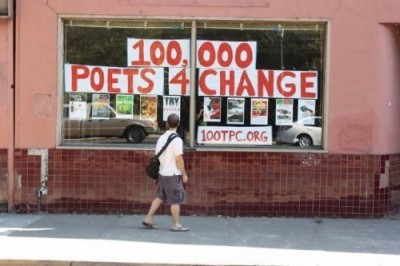
100 THOUSAND POETS OF THE WORLD (100 Thousand Poets for Change) – This puts me in mind of Sam Hamill‘s Poets Against the War, when hundreds of poets marched and read outside the White House in protest against the war in Iraq. That was a well-defined effort. In this case the first question that comes to mind is “What kind of change?” 

The first order of change is for poets, writers, artists, anybody, to actually get together to create and perform, educate and demonstrate, simultaneously, with other communities around the world. This will change how we see our local community and the global community. We have all become incredibly alienated in recent years. We hardly know our neighbors down the street let alone our creative allies who live and share our concerns in other countries. We need to feel this kind of global solidarity. I think it will be empowering.  Excerpt from the press release of March 2011 announcing the the first 100 Poets for Change global event that was held on September 24, 2011. The next global event is scheduled for September 29, 2012.

100 Thousand Poets for Change is a unified effort among activist poets, artists, photographers, and musicians working toward a sustainable world through simultaneous events held across the globe, basically consciousness raising and peaceful protest. This September under the umbrella of  100 Thousand Poets for Change, 700 events were held in 550 cities representing 95 participating countries united to promote environmental, social, and political change. That’s pretty amazing and down-right gratifying. 100 Thousand Poets for Change is not getting the press that the Occupy movement is getting, but it is striking by virtue of its size, support, and sustainability.

Bob Holman and Margery Snyder, in an article on About.com said, “the beauty of the concept of 100 Thousand Poets for Change is that it is completely decentralized and completely inclusive.”  All those involved are hoping, through their actions and events, to seize and redirect the political and social dialogue of the day and turn the narrative of civilization towards peace and sustainability.

Throughout the year, there are also small local events. Even as you read here today, the Sharjah International Book Fair is in progress will run  through November 27. 100 Thousand Poets for Change was invited to participate and is actively doing so.

If this effort sounds like something that interests you as a poet and/or citizen of the world, check out the website HERE.

POETS AGAINST THE WAR started in 2003 by Sam Hamill is now defunct, but all the poems have been placed in a university archive. I was honored to find that two of mine are included. Sadly the web domain has been assumed by others for advertising. However, there is a bound collection of some of the original poems, Sam Hamill, Poets Against the War.

Δ

AUDRE LORDE (1934 – 1992)

Caribbean-American poet, writer, activist

trying to make power out of hatred and destruction

trying to heal my dying son with kisses

Power by Audre Lorde, The Collected Poems of Audre Lorde

NOTABLE AND QUOTABLE

“[Poetry begins] that process by which we insure the future because we know so much more than we understand. We must first examine our feelings for questions, because all the rest has been programmed. We have been taught how to understand, and in terms that will insure not creativity, but the status quo. If we are looking for something which is new and something which is vital, we must look first into the chaos within ourselves. That will help us in the directions that we need to go–that’s why our poetry is so essential, is so vital. Now whether poetry has the responsibility to effect social change . . . it doesn’t really matter. As we get in touch with the things that we feel are intolerable, in our lives, they become more and more intolerable. If we just once dealt with how much we hate most of what we do, there would be no holding us back from changing it. This is true with any kind of movement. This is the way in which the philosopher/Queen, the poet-warrior leads.” Audra Lorde in an interview Karla Hammond, American Poetry Review, March-April 1980

©  Jamie Dedes, 2011 All rights reserved

photo credit ~ Audra Lorde (1980) by K. Kendall via Wikipedia and licensed under Creative Commons Attribution 2.0 Generic.

Posted in Guest Writer

DO WE STAND TO BE COUNTED?

DO WE STAND TO BE COUNTED?

by

Marilynn Mair (Celebrating a Year)

Do we stand to bear witness, or stand to be counted? Is it just because we’re tired of sitting down, or do we feel a real need to step into history? When do we say– no, that’s enough? When does it get to the point where nothing is more important than being there, even our regular lives. I have been there in the past and sometimes I bear witness now, but never to the point of letting everything else go. I watch others stand up today, and wonder if this fight is mine, is ours, or if it’s just the grumbling of a few moderns who suddenly lost their easy-button. In my class the students worry out loud that future generations will forget how to remember since their smartphones always remind them. Or that their younger cousins know about things, but not how to actually do them. Will the Occupy movement have any large-scale effects? No answers here. But I’m thinking a few days in a park actually talking, a few nights in a tent lacking the isolating comforts of home, just might be a good thing for those who perhaps have never before been there.

© 2011 Marilynn Mair, All rights reserved

♥ ♥ ♥

I am pleased to introduce for the first time here: Marilynn Mair (Celebrating a Year), also known as the “angel of the tremolo” and “the first lady of mandolin”. Marilynn is Professor of Music at Roger Williams University, Bristol, Rhode Island, U.S.A. Her most recent CDs are Meu Bandolim and Enigmatica. Her most recent book is Brazilian Choro – A Method for Mandolin. This post and photograph entered here today are from Celebrating a Year. They were posted by Marilynn on October 18 and are re-blogged with her permission. For more of Marilynn’s story, link HERE.  Jamie Dedes

_____

“Best known for her performances and recordings of chamber music, Ms. Mair has also, in recent years, become increasingly involved in the field of Brazilian music, performing and recording “choro,” an early-20th-century style of Brazilian jazz that features mandolin. She has researched choro extensively, and her articles on its history and music, published in Mandolin Quarterly and elsewhere, are some of the most complete available in English.” Max McCullough (Mandozine)

Video uploaded to YouTube by .

Posted in Essay, Jamie Dedes

CHRISTOPHER HITCHINS: Life, Death, and Deathbed Conversions

CHRISTOPHER HITCHINS (b. 1949)

English-American journalist and author

In the course of a forty-year career, Christopher Hitchins, famous (or notorious, depending on your view) for his atheism has dismayed a lot of believers of one persuasion or another. Last year he was diagnosed with a terminal cancer. Many have wondered if on his deathbed he would become an eleventh-hour convert. Here in an interview with CNN’s Anderson Cooper, Hitchens discusses his thoughts and feelings about life and death. It’s an interesting addition to the on-again off-again discussions on this blog of illness, dying, and death. I found two things particularly striking: 1.) Hitchins willingness to accept culpability for his illness as a result of his chosen life-style, which included cigarettes and alcohol. 2.) Hitchins’ mother committed suicide and Cooper’s brother did. The two men agreed that there’s no closure. Having had a suicide in own family, I find I agree with them.  Jamie Dedes

If you click on the video, it will take you to YouTube where you can view it.

Photo credit ~ Christopher Hitchens by Omaraty009 via Wikipedia under the Creative Commons Attritution-Share Alike 3.0 Unported license.

Video uploaded to YouTube by 

Posted in Poems/Poetry

A FINAL POEM

CECIL DAY-LEWIS (1904-1972)

BRITISH POET LAUREATE (1968-1972)

·

This well-received post is re-blogged today:

C. DAY LEWIS AT LEMMONS

by

Jamie Dedes

I discovered the Anglo-Irish poet Cecil Day-Lewis (C Day-Lewis) quite by accident the one day some time ago when I was preparing my Sunday news feature for the main site of an online poetry community with which I am involved. On the basis that we all benefit from knowing our roots and connections – no matter our occupation – I always start off with a snippet about a poet who either was born or died on the day of the posting. Cecil  Day-Lewis died on May 22 in 1972 of pancreatic cancer. He was the British Poet Laureate from 1968 until his death. There’s lots about him and his work that nags for my attention, but one poem really struck home.

At Lemmons (1972), according to the C Day Lewis website (HERE), was written by Day-Lewis on his deathbed at the home of Sir Kingsley William Amis (1922-1995), the English poet, novelist, critic, and educator. Amis is quoted as saying that, “At no time did Cecil mention death. My own strong feeling is that he came to draw his own conclusions from his physical decline and increasingly severe – though happily intermittent – bouts of pain, but, out of kindness and abnegation of self, chose not to discuss the matter.” This last poem, which demonstrates a wonderful grace and acceptance, was published posthumously.

AT LEMMONS

by

C Day Lewis

Above my table three magnolia flowers

Utter their silent requiems.

Through the window I see your elms

In labour with the racking storm

Giving it shape in April’s shifty airs.

·

Up there sky boils from a brew of cloud

To blue gleam, sunblast, then darkens again.

No respite is allowed

The watching eye, the natural agony.

·

Below is the calm a loved house breeds

Where four have come together to dwell

–            Two write, one paints, the fourth invents –

Each pursuing a natural bent

But less through nature’s formative travail

Than each in his own humour finding the self he needs.

·

Round me all is amenity, a bloom of

Magnolia uttering its requiems,

A climate of acceptance.  Very well

I accept my weakness with my friends’

Good natures sweetening each day my sick room.

·

Photo credit ~ Copyrighted cover art (fair use) for Peter Stanford’s biography of Day-Lewis,C Day-Lewis, a Life. Definitely on my reading list.

Posted in Guest Writer, Poems/Poetry, Uncategorized

OF DYING

OF DYING

by

Victoria Ceretto-Slotto (liv2write2day)

That pain surrounds our birth, there’s no denying,
though worse, the fear that comes with thoughts of dying.

For life’s sojourn is pierced by sounds of crying,
as day-by-day we creep unto our dying.

Absorbed by fear of loss, we turn to buying
mere toys to mask remembrance of our dying.

And as our days grow long we know dark sighing
of friends and those we love. We watch their dying.

Perhaps, at length, we will eschew defying,
instead, embracing death: Victorious dying.

·

© poem, Victoria Ceretto-Slotto, 2011 All rights reserved

© photo, Dead Tree in Sepia from Grumpy-Puddin’s Photostream via Victoria, some rights reserved

♥ ♥ ♥ ♥

Victoria Ceretto-Slotto ~ A former nurse, Victoria is a novelist, poet, artist, and a docent at Nevada Museum of Art. Currently she is hard at work with final edits on her novel, Winter Is Past, recently accepted for publication. A second novel is in progress. Victoria finds inspiration in the mysteries of life, death, art and spirituality. She lives and writes in Reno, Nevada and Palm Desert, California with her photographer husband and two canine kids. Victoria shares some of her poetry on liv2write2day’s blog, where she also provides writing prompts and offers coaching with Monday Morning Writing Prompt and Wordsmith Wednesday.

Posted in Jamie Dedes, Poems/Poetry

SOUL’S WINTER

In my coat I sit

At the window sill

Wintering with the snow …

The Dead of Winter by Samuel Menashe in Samuel Menashe: New and Selected Poems

·

MY SOUL’S WINTER

by

Jamie Dedes

soul’s winter with days like secret lights

like eels slithering in the depths of the sea

with vague interests and a fathomless eye

stilled by a gray groping arctic freeze into

thinking of what-fors, whys, then howling

and waking up in spring with the hope of

answers in the hint of fresh green summer

·

© poem, Jamie Dedes, 2011 All rights reserved

Photo credit ~ morgueFile

Posted in Poems/Poetry

SUCH, SUCH IS DEATH

CHARLES HAMILTON SORLEY (1895 – 1915)

British Poet

Charles Hamilton Sorley was born in Aberdeen in 1894. The son of the profressor of moral philosphy at Aberdeen University, Sorley was extremely intelligent and won a scholarship to Marlborough College.

In 1913 Sorely spent a year in Germany before taking up the offer of a place at University college, Cambridge. When war (World War I) was declared in August 1914, Sorley returned to England and enlisted in the British Army. He joined the Suffolk Regiment and after several months training, Lieutenant Sorly was sent to the Western Front.

Sorley arrived in France in May 1915 and after three months was promoted to captain. Charles Hamilton Sorley was killed by a sniper at the Battle of Loos on October 13, 1915. He left only 37 complete poems, including the one he wrote just before he was killed, When You See Millions of the Mouthless Dead. Sorley’s posthumous book, Marlborough and Other Poems* was popular and achieved critical success when it was published in 1916.  [adapted from Spartacus Educational, a site developed by John Simpkin (MPhil.), British educator, historian, and member of the European History E-Learning Project] J.D.

·

SUCH, SUCH IS DEATH (1915)

by

Charles Hamilton Sorley 

·

Such, such is Death: no triumph: no defeat:

Only an empty pail, a slate rubbed clean,

A merciful putting away of what has been.

And this we know: Death is not Life, effete,

Life crushed, the broken pail. We who have seen

So marvellous things know well the end not yet.

Victor and vanquished are a-one in death:

Coward and brave: friend, foe. Ghosts do not say,

“Come, what was your record when you drew breath?”

But a big blot has hid each yesterday

So poor, so manifestly incomplete.

And your bright Promise, withered long and sped,

Is touched, stirs, rises, opens and grows sweet

And blossoms and is you, when you are dead.

·

TO GERMANY (1914)

by

Charles Hamilton Sorely 

You are blind like us. Your hurt no man designed,
And no man claimed the conquest of your land.
But gropers both through fields of thought confined
We stumble and we do not understand.
You only saw your future bigly planned,
And we, the tapering paths of our own mind,
And in each other’s dearest ways we stand,
And hiss and hate. And the blind fight the blind.

When it is peace, then we may view again
With new-won eyes each other’s truer form
And wonder. Grown more loving-kind and warm
We’ll grasp firm hands and laugh at the old pain,
When it is peace. But until peace, the storm
The darkness and the thunder and the rain.

Photo credit ~ a cropped and retouched version of a portrait of British soldier poet, Charles Hamitlton Sorely dated c. 1914/1915, since Mr. Sorely is in uniform here and was enlisted in 1914 and killed in 1915. The photo was first published in 1918. The collection of his poems came out in 1919. The photo is from For Remembrance: Soldier Poets Who Have Fallen in the War. The photograph is in the public domain.

*Poems ~ excepts from Marlborough and Other Poems by Charles Hamilton Sorely. It would appear that this book is currently in the public domain. You can read the entire book on or download it from Internet Archives HERE.

Posted in Jamie Dedes, Poems/Poetry

BEGGING BOWL

·

The begging bowl is a symbol of receptivity and of acceptance, a parable of the soul.

·

BEGGING BOWL

by

Jamie Dedes

a bell pealing from a tower

a bird singing in the evergreen

the monks at the forest edge

these we are, speaking to the wind

sighing to night’s great indigo sky

holding out our begging bowls

to be filled with bee and bud

the alms of our noon-hours

·

·

Photo credit ~ Vintage Old Monk (China) with begging bowl courtesy of The Buddha Gallery

Poem by Jamie Dedes, copyright 2011, all rights reserved

Posted in Poems/Poetry, Spiritual Practice

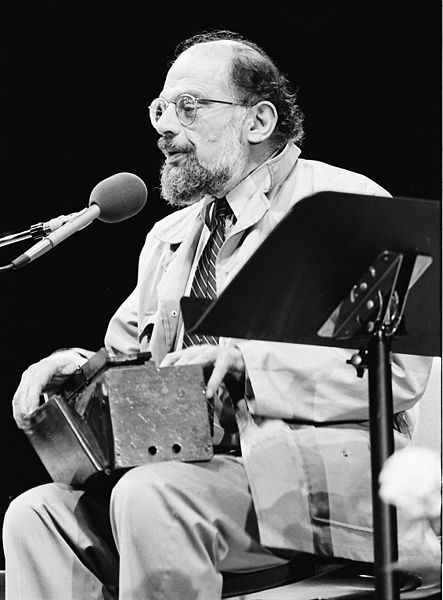
MEDITATION 101: Courtesy of Alan Ginsberg

DO THE MEDITATION ROCK

by

Allen Ginsberg 

is in this collection ~

Collected Works 1947 – 1997, Alan Ginsberg

recommended reading, three thumbs up!

Posted in Essay, Guest Writer

THE LOVELORN PEACOCK

THE LOVELORN PEACOCK

by

Gayle Walters Rose (BodhiRose)

Gayle’s cute story of the unrequited love of a bird of a different feather … (Editor’s Note)

In the summer of 1971, I moved from my hometown of Orlando (Florida, U.S.A.) down to Miami to help start an ashram there.  A friend and I were part of an organization that taught yoga, meditation, vegetarian diet and a lifestyle of disciplined, spiritual practice.  He had been dispatched from the main center in Orlando, some months prior to start yoga classes down south and had showed up at my door one day to ask if I would move there and help him.  I thought to myself, sure – why not – it would be an adventure.

He had rented a small house in Coconut Grove on shady, coconut tree-lined Kumquat Street and I took up residence in one of the tiny bedrooms when I arrived.  Right down the street was another communal compound of people making a home together in a large, two story house.

It was a cool time to live in Miami.  There were neat little head shops, and many hippie-type stores that sold candles, incense, clothing, books, etc. and some great health food stores and even restaurants that were completely vegetarian.  It was all new to me but I was in my element!

Before long we had gatherings of like-minded people coming nightly for our yoga classes and life was humming along.

Part of the charming quaintness of Coconut Grove was the community of peacocks that freely roamed the neighborhood streets.  You could hear their ear-piercing calls from blocks away but I never tired of spotting them walking down the road, perched in a tree, or up on someone’s roof.

One male peacock in particular started frequenting the small, enclosed courtyard in front of our house.  Soon he started showing an unhealthy interest in me.  Whenever I would arrive or depart the house, and if he happened to be outside, he would approach me with his feathers spectacularly displayed and “shake” them at me.  This bird was courting me!  With his feathers held straight up, he was just about as tall as I was.  Whatever direction I took, he would get face-to-face with me and “shimmy”.  I became a bit intimidated by this…yikes!  He was extremely insistent:I took to running past him to get in or out of the house but, after some time, I believe he finally realized that his love for me would remain unrequited and he moved on elsewhere to find a more suitable partner.

·

© story/essay ~ Gayle Walters Rose (Bodirose), 2011 All rights reserved

Photo credit ~ morgueFile

Posted in Jamie Dedes, Uncategorized

HAPPY DIWALI!

File:Oil lamp on rangoli.jpg

Burning oil lamp on a colourful rangoli designed on Diwali courtesy of Rangoli under the Creative Commons Attribution-Share Alike 2.0 Generic license.

October 26, 2011

Deepavali (also spelled Divali in few countries) or Diwali, popularly known as the festival of lights, is an important five-day festival inHinduismJainism, and Sikhism, occurring between mid-October and mid-November. For Hindus, Diwali is the most important festival of the year and is celebrated in families by performing traditional activities together in their homes. Deepavali is an official holiday in India,NepalSri LankaMyanmarMauritiusGuyanaTrinidad & TobagoSurinameMalaysiaSingapore, and Fiji.

The name Diwali is itself a contraction of the word “Deepavali” (Sanskrit: दीपावली Dīpāvalī), which translates into row of lamps. Diwali involves the lighting of small clay lamps (diyas, or dīpa in Sanskrit: दीप) filled with oil to signify the triumph of good over evil. During Diwali, all the celebrants wear new clothes and share sweets and snacks with family members and friends. Most Indian business communities begin the financial year on the first day of Diwali. MORE

HAPPY DIWALI TO THOSE DEAR FRIENDS WHO ARE CELEBRATING

THEIR FESTIVAL OF LIGHTS, THEIR VICTORIES OF GOOD OVER EVIL.