Posted in Essay, Jamie Dedes

THE MELLOW FRUITFULNESS OF FALL

THE MELLOW FRUITFULNESS OF FALL

by

Jamie Dedes

SEASON of mists and mellow fruitfulness, 
        Close bosom-friend of the maturing sun; 
    Conspiring with him how to load and bless 
        With fruit the vines that round the thatch-eves run…

To Autumn by John Keats (1795-1821), English poet, Romanic Movement

Autumn, transition between sultry summer and tempestuous winter, is a time to honor the dead, count and celebrate the harvest, and give thanks. The diverse peoples of the Northern Hemisphere indulge in family fun, feasting, crafts fairs, parades, and fine arts. Among the earliest celebrations are the Jewish Yom Kippur and Rosh Hashanah, closely followed by Succot, the Feast of the Tabernacles. Originally the feasts were literally in tabernacles (huts). Now venerated around the family table, there’s the typical holiday scramble to assemble and prepare traditional foods: challah bread, gifilte fish or a roasted chicken, and apple cake or oatmeal cookies for dessert.

Harvest Moon, the first full moon before the fall equinox, presents another excuse to party. At communities, like Callaway Gardens in Georgia (U.S.A.), folks watch college football, take horticulture tours, and go cycling.  Falling Leaf Moon is next, when the veil between the worlds of the living and dead is said to be thinnest. Celebrated by Pagans and Wiccans, it’s considered a ripe moment to gather for séance.

On the heals of Falling Leaf Moon is Halloween and all things spine-tingling. Special events at places like Carisbrooke Castle and Pendennis Castle in England – where the gothic and ghostly meet – offer visitors historic tours, spine-tingling walks, and spooky tales. It all harks back to the earlier times that birthed today’s foods, feasts, and falderal.

Dia de Todos los Santos (Day of All Saints) and Dia de los Muertos (Day of the Dead) are honored in Central and South America with customs that represent a melding of cultures, American and European. Feasting is the order of the day: suckling pig and tamales. There’s music and prayers, picnics held at graveyards, and tables decorated with candles, photographs of deceased relatives and friends, and T’ant’a Wawas (bread figurines for the Day of All Saints).
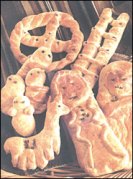
T’ant’a  Wawas

It would seem we humans – no matter the culture – like to celebrate our gratitude by feasting on the wealth of our harvest. In North America the big event of the season is Thanksgiving, a holiday that falls in early October in Canada and late November in the States. Major crops in North America include pumpkin, corn, potatoes, nuts, apples, and wheat, all ingredients for dinners of roasted and stuffed turkey, corn on the cob, mashed potatoes and gravy, and pumpkin or apple pie. Happy kitchen chatter and clatter and the scents of cinnamon, cardamom, and sage fill the air.

Cities everywhere have parades, but the Macy’s Thanksgiving Day Parade in New York has a long history. It started in 1824 when immigrant workers wanted a festival like the ones they enjoyed in Europe. Today the parade is an exciting oversized event with mega-stars from television, Broadway and Hollywood and mega-sized balloons and floats. Forty-four million view it on TV.

Like the trade gatherings of the original peoples (Native Americans), crafters fairs are held at large event centers where crafters sell their handcrafted foods, household items, jewelry, and toys. These visually sensual treats arrive just in time for holiday decorating and gift giving. Often the fairs include musical entertainments, story-telling, and crafts classes as well.

A wealth of entertainment is offered everywhere: but Paris is queen, honoring autumn with theatre, music, dance and the visual arts at the Festival d’Automne à Paris that runs the length of the season, September through December.

Wherever the eye travels this season the décor, natural or inspired by nature, is bright, rich, and rustic. Public and private places are decorated with gourds, spiny ears of wheat, scarecrows, and leaves turned orange, red, and gold. Though autumn’s common denominator is the celebration of abundant crops, that abundance is excelled by the diversity of the dishes, peoples, and landscape across the Northern Hemisphere.

The links on challah bread and T’ant’a Wawas are to recipes

·

© essay, Jamie Dedes, 2011 all rights reserved

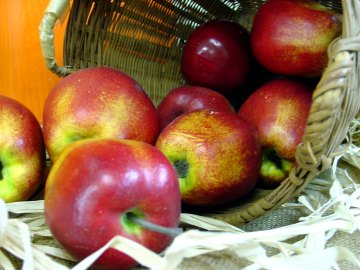
basket of apples/photo credit ~ morgueFile

T’ant’a  Wawas/photo credit  ~ The Global Gourmet

Posted in Book/Magazine Reviews, Jamie Dedes

NINE GATES: ENTERING THE MIND OF POETRY

NINE GATES: ENTERING THE MIND OF POETRY

by Jane Hirshfield (b. 1953, American) author and poet

Review by: Jamie Dedes (Musing by Moonlight)


An award-winning author and poet, Jane Hirshfield has published seven collections of poetry in addition to  Nine Gates: Entering the Mind of Poetry, a collection of essays. Her most recent book of poetry is Come, Thief (August 2011). In collaboration with Mariko Aratoni, Hirshfield edited and translated four volumes of poetry by women of ancient Japan.

Ms. Hirshfield is a Zen Buddhist and her practice informs her work with spiritual insight and delicate nuance.  She has said, “It is my hope that the experience of that practice underlies and informs [my poetry] as a whole. My feeling is that the paths of poetry and of meditation are closely linked – one is an attentiveness and awareness that exists in language, the other an attentiveness and awareness that exists in silence, but each is a way to attempt to penetrate experience thoroughly, to its core.” [The Poetry Foundation]

Nine Gates: Entering the Mind of Poetry (September 1998) is a series of nine essays that were written by Jane Hirshfield over a ten-year period and published or presented at poetry events.

*****

Gates are a means of exit and entrance, providing connection between the inner and the outer.  The premise of Hirshfield’s book is that the art of poetry is the gate by which we are offered  “mysterious informing.” Nine Gates is at once a primer for the reader and a manual for the writer. This is a book that is reverent of art, artist, and life. All is sacred ground.

The book begins at the beginning – the root of poetry – concentration.  “By concentration, I mean a particular state of awareness: penetrating, unified, and focused, yet also permeable and open.” As she says, this is Huxley’s “doors to perception” and James Joyce’s “epiphany.”  It is what I would call sacred space, and this focus, this concentration, “however laborious, becomes a labor of love.” In this chapter, I particularly appreciated the short discussion of voice: writers whose ear is turned to both the inner and outer have found their voice and thus are able to put their  ”unique and recognizable stamp” upon their work.

The book closes with “Writing and the Threshold Life” and a discussion of the space into which a writer withdraws, liminal space.  The writer, she tells us, becomes like the monk giving-up identity and assumptions. . “The person [in liminal state] leaves behind his or her identity and dwells in the threshold state of ambiguity, openness, and indeterminacy.” This is all rather like the person going through a ritual transitions. Only after transition to this liminal space, neither here nor there, is community wholeheartedly embraced. To see clearly and to embrace the whole without judgment, one has to be free of the standard cannon and the received wisdom.  The idea being that the creative life is one that gives up the ordinary conventions, which is the price of freedom.

Encased between the two portals of concentration and the threshold life are discussions of originality, translation (what we learn from the poetry and linguistic traditions of others), “word leaves” (images), indirection (the mind of the poet circles the poem), inward and outward looking, the shadow side of poetry (between the realms of heaven and hell), and poetry as a “vessel of remembrance.”

The book’s range is broad, using poets and their wisdom from ancient times to modern and from East to West. The essays are at once a delicate lace and a sturdy practical homespun. All is approached with respect, clarity, and intelligence. Each chapter is a gentle nudge toward more authenticity, greater truth, deeper spirituality. In her introduction, Jane Hirshfield says that because the essays were written at different times some themes and quotes are repeated and removing the repetitions proved impossible. I felt the repetitions served to reinforce. I was grateful for them. If I have any difficulty with this book, it was the conflict between not wanting to put it down and wanting to put it down to start writing in the spirit of entering the mind of poetry. A definite thumbs-up on this one.

·

Essay ~ © 2011, Jamie Dedes, all rights reserved

Cover art ~  © publisher, posted under fair use

·

Posted in Essay, Jamie Dedes

BUDDHIST POETRY IN THE WEST

BUDDHIST POETRY IN THE WEST

by

Jamie Dedes

We often think of the Beats when we think of Buddhist inspired poetry in the West. Actually, the influence of Buddhism in the West began 100 years ago, largely due to the midwifery of Ezra Pound, that American expatriate poet of the Lost Generation, an influential figure in the Modernist Movement in poetry. He played a role in Imagism, his generation’s rejection of flowery Victorian and Georgian poetry in favor of directness and economy. Pound took a year to write of this experience in the Paris Underground, distilling essence much as the Japanese did with their haiku, a poetic form.

The apparition of these faces in the crowd;

Petals on a wet, black bough. Ezra Pound

Where the Lost Generation adopted stylistic elements of Buddhism and struggled with meaninglessness under the pall of World War I, the Beat Generation was anything but lost and went beyond style. In ‘50s atmosphere of paranoia, the Beats found sanity in Buddhism.  In the light of non-duality, no difference between heaven and hell, man or woman, the hierarchies and them vs. us mentality becomes meaningless. The mendicant life recommended by Buddha becomes a haven. Life on the road and the poetry of rebellion become antidotes to 1950s conformity and consumerism in America.

Western interest in Zen and Zen poetry is perhaps a surprise to some but it is also absolutely serious. Alan Watts criticized the Beat Generation poets, calling them dillettantes. He couldn’t say that of today’s Buddhist and Buddhist-influenced poets, not with the likes Leonard Cohen, an ordained monk, and Jane Hirshfield, who received Soto-Zen lay ordination. Buddhist inspired poetry today is characterized by neither hopelessness nor rebellion, rather by the Buddhist spiritual values of non-duality, transience and impermanence, and the practice of present moment and mindfulness. In their hands, reading and writing poetry becomes spiritual practice.

© essay 2011, Jamie Dedes, all rights reserved

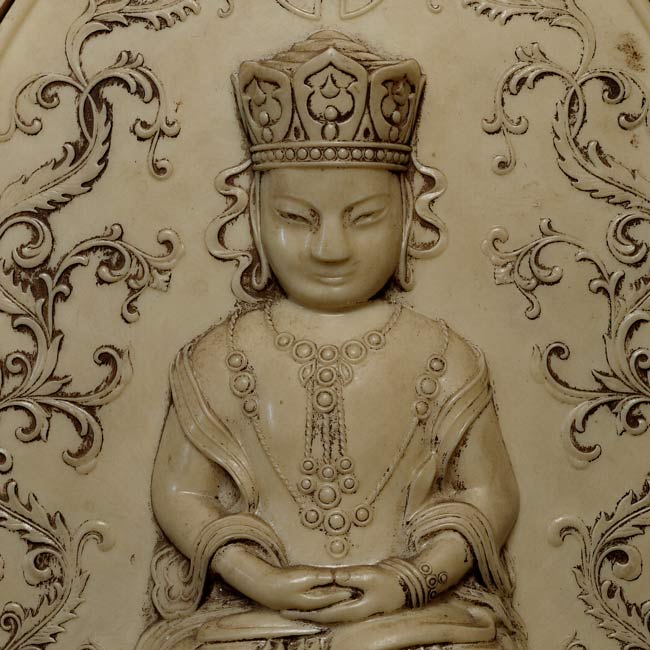
Photo credit ~ Beautiful and very uncommon Chinese Celloid Buddha Shrine. Probably late Ching, circa 1900. 8.5″ tall, 6.25″ wide, 4 5/8″ deep. Item 4216 courtesy of curator of The Buddha Gallery.

♥ ♥ ♥ ♥


Poet Jane Hirshfield in an interview about poetry at an event of the Aspen Writers Foundation.

Video uploaded to YouTube by 

Poet Leonard Cohen reading Days of Kindness

Video uploaded to YouTube by 

Posted in Uncategorized

BUDDHA KITTIES

Photos by Barbara Stone (List of Buddha Lists)

Buddha’s and kitties Rumi (above) and Uma (below) courtesy of the curator of The Buddha Galery.

© 2011, The Buddha Gallery, all rights reserved

“Zenning out …”

Posted in Jamie Dedes, Perspectives on Cancer, Uncategorized

PERSPECTIVES ON CANCER #33: Writing Your Self, Transforming Personal Material

WRITING YOUR SELF

Book Review

by

Jamie Dedes

We feel this book review puts a fine close on our series, Perspectives in Cancer. Writing as a healing art, whether as a purely personal exercise or for publication, is powerful. One of the authors of Writing Your Self, Myra Schneider, learned that with her much appreciated work,Writing My Way Though Cancer. That effort informs much of Writing Your Self.

This review was originally published at Musing by Moonlight.

Four of Myra’s poems were published earlier in this series.

We wrote the book because we believe that personal writing is very potent both for the writer and the reader, because some of the greatest literature is rooted in personal material. Myra Schneider in an interview HERE.

The subtitle of this book about writing is “transforming personal material.”  I think it is implicitly also about personal transformation. It always seems to me that writing and reading about life is a healing activity, a way to live hugely, and a way to empower ourselves and others. If we can do it well enough to engage others, whether our purpose is to leave a record behind for family, to set the record straight, or simply to share and entertain, the experience is rewarding. Writing is a powerful healing path.

Writing Your Self is the most comprehensive book of its type that I’ve yet to read, and I’ve read many. It is organized in two parts:

  • Part I: Here the focus is on life experiences, the exploration of those human experiences that are universal. These include childhood, self-conceptions, relationships, displacement, physical and mental illness and disability, and abuse.
  • Part II: Here the focus is on writing techniques, recognizing material that is unfinished, working on refinements, and developing work projects.

Writing Your Self is rich with examples from known and unknown writers including the authors. By example as well as explanation the authors reinforce what we all intuitively understand to be true: that telling stories preserves identity and clarifies the human condition. It helps us understand what it means to be human. The experience of working through the book was something like a rite of passage.

I very much can see the use of this book by individuals training themselves and by teachers of adult learners who wish to write memoir, poetry, fiction, or creative non-fiction. It would be useful in hospital therapeutic writing programs or in writing programs for active seniors.

Memories, both recent and distant, tell us who we are and so play a crucial role in our experience of life…

You may have memories which you want to plunge into or you may have material like a diary or letters which summon them up. There are other ways though of triggering memories. We offer a series of suggestions. Chapter 13, Accessing memories, secret letters, monologues and dialogues, visualizations.

I think Chapter 13 alone is worth the price of admission. I work a lot off of childhood memories and even the event that happened two minutes ago comes back to me with dreamlike qualities when I sit to write. I have not thought of the things I do naturally as triggers, but indeed they are. It was quite interesting to see these natural aids laid-out and organized on the page to read: objects and place as starting points, physical sensation as triggers, people in memory, and predominant feelings. The section on secret letters – that is, letters that you write someone and never send – was particularly interesting. I’ve only done this twice in my life, but I know some folks who do it all the time. I’m sure it is a common practice and would make a fine jumping-off point for some and a satisfactory exercise – complete in itself – for others. The authors go on to monologues and dialogues, which certainly everyone spins in their heads.  They discuss visualization. Hey, if you can see it, you can write it.

I’m an experienced writer and I enjoyed the book and the exercises and learned a few new things, got a few new ideas. If you are inexperienced or stuck midway in a transition from one form of writing to another, you’ll benefit from the exercises, ideas, and instruction in Writing Your Self: Transforming Personal Experience. This one’s a definite thumbs-up.

Myra Schneider  is a British poet, a poetry and writing tutor, and author of the acclaimed book: Writing My Way Through Cancer. Your can visit her HERE.

John Killick was a teacher for 30 years, in further, adult and prison education, but has written all his life. His work includes both prose works and poetry. You can visit him HERE.

© essay, Jamie Dedes, 2011 all rights reserved

Copyrighted cover art, fair use.

♥ ♥ ♥ ♥

Jamie Dedes ~ Jamie is a former freelance feature writer and columnist whose topic specialties were employment, vocational training, and business. She finds the blessing of medical retirement to be more time to indulge in her poetry, creative nonfiction, and fiction. She has two novels in progress, one in final edits, and is pulling together a poetry collection. Her primary playground is Musing by Moonlight. She is the founder and editor/administrator of Into the Bardo. Jamie’s mother was diagnosed with cancer the first time at thirty-six. She went three rounds with breast cancer, one with thyroid cancer, and died at seventy-six of breast and colon cancer.

Posted in Guest Writer, Perspectives on Cancer

PERSPECTIVES ON CANCER #31: Isolation

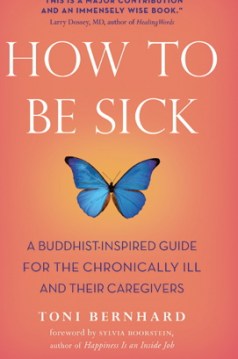
Although this book concerns living with chronic illness … which may not be life-threatening but is certainly quality of life-threatening … many of the issues Toni Bernhard discusses are relevent issues for cancer patients. Not the least of these issues is isolation. The book is available online through Barnes and Noble and Amazon or through the publisher HERE. Three thumbs up on this one. A recommended read. Jamie Dedes

HOW TO BE SICK:

A Buddhist-Inspired Guide for the Chronically Ill and Their Caregivers

by 

Toni Bernhard

“All human beings need the company and support of others. We create our world together. But community can be a tremendous challenge for someone who must spend a lot of time in bed or must suddenly take to bed in spite of plans to be with others. The Dharma places a very high value on community, which is called sangha. The word originally referred to the disciples of the Buddha. It then evolved to include Buddhist monks and nuns. Today sangha refers to the entire spiritual community that supports a practitioner . . . .

“Before I got sick, I was active in several Buddhist sanghas. I co-hosted a weekly meditation group with Tony [Toni’s husband]. We used a local meeting hall every Monday night. At least once a month, I would lead the sitting and then give a talk. We also hosted a monthly group at our house in which we discussed Dharma readings that Tony and I chose and distributed each month. The readings were the starting point for a spirited and often humorous two hours of reviewing our lives since we last met. This was sangha at its richest for me. Tony still hosts this group at our house.

“When I got sick, I could no longer participate in these activities, even though the meeting hall is three blocks away and the monthly group is a room away . . . . In addition to losing this precious source of spiritual support, I had to adjust to the social isolation that accompanied the illness like night follows day.

“‘It’s hard to distinguish between the effects of my illness and the effects of isolation,’ wrote a member of an online support group for people with an illness similar to mine. I, too, have days when the isolation feels like the illness itself. People who are house-bound are not just isolated from one-on-one personal contacts. We are often isolated from nature and even from the warm feel or a friendly crowd. Our best bet to see the changing seasons is on the drive to and from a doctor’s appointment, but this is often a stress-filled outing. Similarly, our best bet to be in a crowd is in the waiting room at the doctor’s office—not the most comfortable or uplifting of settings. I recently read a blog entry from a woman with chronic fatigue syndrome in which she said she went to get a blood test a week early just to be around people.”

© text and cover art, Toni Bernhard, 2011 all rights reserved. Blogged here with the permission of the author. No reblogging without Toni Bernhard’s permission.

Video uploaded to YouTube by . I’m the author of “How to Be Sick: A Buddhist-Inspired Guide for the Chronically Ill and Their Caregivers” (Wisdom Publications 2010). The theme of the book is that illness and wellness are not mutually exclusive. Our bodies may be sick or otherwise disabled, but our minds can be at peace. For reviews and other information, including where you can order the book, please go to How To Be Sick.

♥ ♥ ♥ ♥

Toni Bernhard fell ill on a trip to Paris in 2001 with what doctors initially diagnosed as an acute viral infection. She has not recovered. In 1982, she’d received a J.D. from the School of Law at the University of California, Davis, and immediately joined the faculty where she stayed until chronic illness forced her to retire. During her twenty-two years on the faculty, she served for six years as Dean of Students.

In 1992, she began to study and practice Buddhism. Before becoming ill, she attended many meditation retreats and led a meditation group in Davis with her husband.

She lives in Davis with her husband, Tony, and their hound dog, Rusty. Toni can be found online at How To Be Sick. [Bio courtesy of Wisdom Publications.]

Posted in Guest Writer, Perspectives on Cancer, Poems/Poetry

PERSPECTIVES ON CANCER #30: When Cancer Strikes

WHEN CANCER STRIKES

by

Dan Roberson

It was both
a blessing and a curse,

Her chestnut
hair was often tangled or worse,

There were
times Laura hated her hair,

Conditioners,
detanglers, moisturizers,

Sometimes made
her wish it wasn’t there,

 ·

It had been
that way as far back as memory could get,

Uncontrollable
when dry, hard to manage when wet,

Laura’s
curly hair was admired often, she’d confess,

But it was
often a distraction as a frizzy mess,

There weren’t
many options on how to fix her hair,

She worried when
the wind made it fly here and there,

Often Laura
looked out of control and people would rudely stare,

 ·

Looking
calm, peaceful, and beautiful was her goal,

Forgotten were
the comments about her beauty as a whole,

Intelligence
and her abilities made her special in all she did,

But under
hats, tied up in tight braids, her curly hair she hid,

 ·

Laura was a
businesswoman, ambitious in every way,

Determined to
be a success before she turned old and gray,

Laura was
also wife and mother with two children on her mind,

Time for
them or even for herself, was very hard to find,

 ·

Her husband
sent her flowers every month to let her know,

That he would be waiting for her if she decided to take life slow,

Her life was filled from dawn till night, with one job to the next,

Rarely did
she spend quality time with Joe, and both were too tired for sex,

Vacations
were quick and far away, with pictures to prove she was there,

But wherever
she went and whatever she did, she covered up her hair,

 ·

Questions
from a young M.D. on her routine annual exam,

Made her mad
when he said, “We need further tests for you, Ma’am,”

She went
through the tests mainly to prove him wrong,

Much to her
chagrin blood was drawn, it didn’t take them long,

Laura balked
at first when new appointments were made,

But soon she
was on her way and memories of the visit began to fade,

 ·

Later that week several phone calls at work interrupted
her day,

“We want you
to come in, not tomorrow, perhaps yesterday,”

“What’s so important?”
she wondered as she brushed tangles from her hair,

“I’ve always
been so healthy, so why should I care?”

That night
Laura brushed her hair ninety-nine times or more,

With each
tug she commented, “Curly hair is such a chore,”

 ·

But Laura
was restless, the upcoming visit was eating at her,

And at her
next appointment she decided she would concur,

“You have
cancer,” he said quietly, “we should treat it aggressively,”

“I don’t
have time for cancer!” she shouted, “or even time for me,”

“We need to
treat it with chemotherapy,” he stated, “as soon as we can,”

“If we want
to win this war, we have to make a plan,”

“Doctor, I’m
too busy for this, I’ll do chemo in the spring,”

“Then they’ll
bury you deep while you sleep, the chemo won’t mean a thing,”

 ·

The nurse
read a list of changes that Laura might expect,

Foods to
eat, nausea, loss of hair, there was little time to reflect,

She could
deal with changes in her diet, so why did she care,

Yet on her
way home one thought returned, she would lose her hair,

 ·

What would
she do about work, would everyone lose respect?

And what
about her children and her Joe, what would he expect?

“This is not
fair,” she thought, “I’ve fought hard to get where I am,

Now I have
cancer and that puts me in a jam,”

She’d talk
to the doctors and see how this could be fixed,

Laura knew
how business worked, maybe this could be deep sixed,

She was
afraid to hug her husband, likewise with the kids,

With this
draining more from her, their marriage would be on the skids,

Joe listened
to her intently and suggested a group for her to attend,

“I don’t
need a support group,” she countered, “I just want to mend,”

He left a
number of the group in case she wanted to call,

For two days
Laura wanted nothing to do with the group at all,

 ·

But the
third evening as she brushed and detangled her hair,

Laura
wondered what others did when strangers began to stare,

She called a
cell phone number knowing she had to make a choice,

She agreed
to go to a meeting when she heard a cheerful voice,

“Come on and
join us, we’ll have a special guest tonight,

You’ll find
we have lots of fun because no one gets uptight,”

Nervously she
brushed her hair as she waited for her ride,

In the car
it was explained she’d have to wait outside,

 ·

Waiting outside
a home made her feel this was not the place to be,

But she only
had time to see what they wanted her to see,

Conspicuously
placed was a sign stating the group’s name,

“Birds of a
Feather” and in smaller print, “We’re all the same,”

 ·

Laura was
led in at the appointed time but saw one empty chair,

“It’s saved
for you,” a woman called out, “and your beautiful hair,”

How could
she explain that soon her head would soon be bare,

She was
afraid they might laugh and show they didn’t care,

Laura’s fear
was growing as she glanced about the room,

She was the
only one with cancer and ready to meet her doom,

 ·

Businesswomen,
single women, mothers, daughters, wives,

These women
were all beautiful and had normal lives,

“We have a newcomer tonight, so welcome Laura
with applause,”

The leader
continued, “And in case she’s worried, it’s time for us to pause,

We’ve faced
our fears before, and sometimes hid our shame,

But together
we are strong and our freedom we proclaim,”

 ·

One by one
each removed a wig to reveal her hair was gone,

“We’re all
in this together, no one is all alone,”

Their smiles
were wide and welcoming as the leader took her hand,

“When you
can, let Laura know that you really understand,”

 ·

When the
meeting was over Laura returned home,

She kissed
her children and showed them her comb,

She
explained her disease and told them about her hair,

They answered,
“We love you, mommy, we don’t care,”

Her husband,
Laura learned, was compassionate and kind,

He loved her
for her heart, her ambition, and her mind,

They decided
to fight cancer together and strive for the best,

And they’d
spend more time living and loving with zest,

The cancer
went into remission and Laura grew back her hair,

And whether tangled,
frizzy, or wind-blown, now she combs with flair.

© poem and artwork, Dan Roberson, 2011 all rights reserved

♥ ♥ ♥ ♥

Dan Roberson ~ lives in Kansas City, Missouri.  He says, ” I celebrate life. I retired from teaching and now I’m looking for new parades to lead, or to follow. I’m alone, still hoping to be a published author, and trying to stay on my chosen path. I have no anchor to hold me down and I’m ready to rid myself of possessions that impede progress. I want my imagination to soar. I’m open to learning about new worlds, new countries and languages, and different ways to look at things I thought I knew. Every day is a bonus day and I look forward to the challenges it brings. I’m finding out that technology is fast and getting faster and there is much information that I need to learn.”  You’ll find Dan at My Blog.

Posted in Jamie Dedes, Perspectives on Cancer, Poems/Poetry

PERSPECTIVES ON CANCER #29: Nothing

NOTHING

by

Jamie Dedes

·

no buddha, no bodhi tree

no earth upon which to sit

in silent meditation

no suffering, no not suffering

nothing

rest assured

·

© poem, Jamie Dedes, 2011 all right reserved

Photo credit ~ Photo credit ~ A small temple beneath the Bodhi treeBodh Gaya, built in 7th century, after the original built by King Ashoka in 3rd century BCE, ca. 1810, British Library, public domain photograph via Wikipedia

♥ ♥ ♥ ♥

Jamie Dedes ~ is a former freelance feature writer and columnist whose topic specialties were employment, vocational training, and business. She finds the blessing of medical retirement to be more time to indulge in her poetry, creative nonfiction, and fiction. She has two novels in progress, one in final edits, and is pulling together a poetry collection. Her primary playground is Musing by Moonlight. She is the founder and editor/administrator of Into the Bardo. Jamie’s mother was diagnosed with cancer the first time at thirty-six. She went three rounds with breast cancer, one with thyroid cancer, and died at seventy-six of breast and colon cancer.

Posted in Guest Writer, Perspectives on Cancer

PERSPECTIVES ON CANCER #28: Living With Dying

LIVING WITH DYING

by

Gayle Walters Rose

 When my mother’s best friend, Katherine, became ill with stomach cancer, her daughter enlisted Katherine’s friends to be of support as she went through her chemotherapy treatment and subsequent recuperation.  Her daughter lived out-of-state and had a medical practice and could not be with her day-to-day.

I had known Katherine my entire life.   She was one of the most positive, bright lights I had ever known.  Her daughter and I had spent much time together as children, which included many hours swimming in the beautiful lake that they lived on.  Katherine’s husband had died many years prior.

Her daughter was very organized and efficient with setting up people in shifts to take turns staying with Katherine during her illness.  Sometimes this included remaining overnight with her.  But Katherine had a very independent nature, even at age 87, and at times would insist that she was OK and send us home.  Her daughter had tried her best to convince Katherine to move to North Carolina and stay with her family, but Katherine always refused.  She had been there for over 50 years.  During one afternoon, she confided in me that she would never leave her beloved home on the lake.   The house had an enclosed porch that overlooked the water and we would sit out there for hours as we talked and relaxed.  Her eyes would occasionally scan the lake and she would comment on a bird that had caught her eye or an activity by a neighbor around the water’s edge.

We were able to share ourselves like never before.  She regaled me with all kinds of stories from her past and shared intimate feelings.  She told me she was totally at peace and was not fearful of death.  I felt somehow as if I were a vessel for her to pour her heart into and was so grateful that I could be of service to her in this way.

I marveled at her serenity during this difficult time.  There was no “battle”, just gentle, quiet acceptance and the allowing of what was.  She illustrated to me what it meant to live in the moment.  Her ease and even emotions were a gift to me as well.

One day she tired as we had been sitting on the porch for quite some time and so we retired to her bedroom.  Climbing into her bed, I propped myself next to her as we watched television.  A short time later, as I noticed her eyes getting heavy, I told her I would leave and let her sleep.  Lowering myself down on the bed so I could look into her eyes, I held her hands in mine and told her how much I loved her.  She smiled at me with beaming love in her clear, sweet, blue eyes and told me how beautiful I was.  Tears pooled in my eyes as I realized, in that moment, what grace she possessed.

Katherine died quietly in her sleep with hospice in attendance several months after her diagnosis.  Her bedroom window was open to the lake.

© photograph and essay, Gayle Walters Rose, 2011. All rights reserved. No re-blogging or publishing without the permission of the author.

♥ ♥ ♥ ♥

Gayle Walters Rose ~ lives in Winter Park, Florida and has been blogging since August of 2010. She is an adventurous writer, experimenting with various forms of poetry and with fiction and creative nonfiction.Gayle comes from a large family, and she is the mother of grown daughters. Much of her writing is about nature or things of the spirit. Early in life, she lived in an ashram and often shares that experience and its lessons.

Gayle’s favorite quote is “Never think there is anything impossible for the soul. It is the greatest heresy to think so. If there is sin, this is the only sin; to say that you are weak, or others are weak.” (Swami Vivekananda)  You’ll find Gayle blogging at Bodhirose’s Blog, where she is much appreciated by the online poetry community for her fine work and because she is genuine.

Posted in Guest Writer, Perspectives on Cancer

PERSPECTIVES ON CANCER #27: Cookies for Kids Cancer, Do Whatever It Takes

[In the United States alone in 2007], approximately 10,400 children under age 15 were diagnosed with cancer and about 1,545 children will die from the disease.  MORE Childhood Cancers Fact Sheet, Cancer Topics, Cancer.gov

COOKIES FOR KIDS CANCER

by

© Cookiesforkidscancer.org

Beginnings

Cookies for Kids’ Cancer, a 501(c)3 non profit, was founded by parents inspired by their son Liam’s battle with cancer. They were shocked to learn that the main reason over 25% of kids diagnosed with cancer do not survive is because of a lack of effective therapies. And the reason for the lack of therapies was very simple: lack of funding. They pledged to support the development of new and better treatments by giving people a simple way to get involved.

It all started with 96,000 cookies…

Gretchen had a crazy idea for a larger-than-life bake sale with the goal of baking 96,000 cookies with friends and volunteers. Dozens of other families whose children were also battling Neuroblastoma got involved and began to take orders for cookies from friends, co-workers, and neighbors. All 96,000 cookies were sold in three weeks, thanks to the work of over 250 volunteers. The event raised over $400,000 for pediatric cancer research, but it was soon clear that something bigger than a bake sale had begun. Even weeks after the event was over, requests for cookies kept coming in. What started as a desperate act to raise money and awareness for her child’s own cancer blossomed into something much bigger than any had planned. The event caught the eye and the hearts of the media and people all over the country. Emails from across the United States started flooding in asking the same simple question “what can we do to help?”

Be a Good Cookie

Make a difference by joining the mission to find a cure for pediatric cancer. There are many ways to support Cookies for Kids’ Cancer. Hosting a bake sale is a sweet and simple way for people everywhere to get involved in the fight against pediatric cancer. Send our cookies for birthdays, anniversaries, or just because. Our cookies taste as good to eat as they feel to give.

And you don’t have to eat or bake cookies to be a Good Cookie. Other supporters have run marathons, held tag sales, organized golf tournaments, collected spare change, and hosted car washes to support Cookies for Kids’ Cancer. We’ve even made it simple to donate online once or once a month with online giving. The ideas are only limited by your imagination. No effort is too small and every penny counts.

Our mission:

Cookies for Kids’ Cancer is committed to raising funds to support research for new and improved therapies for pediatric cancer, the leading cause of death by disease for children under the age of 18. Through the concept of local bake sales, Cookies for Kids’ Cancer provides the inspiration and support for individuals, communities, and businesses to help fight pediatric cancer. 

Facts about Kids’ Cancers

Cookies for Kids’ Cancer is not about one child or one type of pediatric cancer. It is about changing the facts of pediatric cancer for the better, forever. Important statistics to know:

  • Cancer claims the lives of more children annually than any other disease ” more than asthma, muscular dystrophy, multiple sclerosis & AIDS combined.
  • 46 children per day are diagnosed with cancer totaling nearly 13,000 new cases per year.
  • Cure rates have improved dramatically and advances in childhood cancer research has provided seminal insights into the cancer problem in general. Today, 4 out 5 children diagnosed with cancer can be cured.
  • While long-term goals for the pediatric cancer community will focus on securing more federal funding for childhood cancer research (more than the 1-2% of the National Cancer Institute budget that is current expended), philanthropy plays a critical and essential role in the ongoing battle against childhood cancer.

About the Founders

Gretchen and Larry Witt founded Cookies for Kids’ Cancer in 2008, just a few short months after the success of their first cookie sale during the holidays 2007. Their efforts have always been inspired by their son Liam who was diagnosed with stage 4 cancer in 2007 at the age of 2. Tragically, Liam came to the end of his courageous 4-year fight with cancer on January 24, 2011 at the age of 6. Though devastated by his loss, the Witts remain more determined than ever to continue the fight against pediatric cancer.

Gretchen Witt has been recognized nationally for her leadership as a mom on a mission. In 2010, Witt was named one of Woman’s Day Magazine’s 50 Women Changing the World and Traditional Home Magazine’s Classic Woman of the Year. She was also featured in the December 2009 issue of O, the Oprah Magazine, for her work with Cookies for Kids’ Cancer. She accepts speaking engagements to tell the story of the beginnings of Cookies for Kids’ Cancer, the need for funding for pediatric cancer research, and to share her experiences as a mother fighting endlessly for her son and for all children. Her story resonates as one of determination and guts with a willingness to stop at nothing to do what’s right and what’s best for all kids fighting cancer. Audiences as varied as The Cornell Club NYC, Meredith College’s 2010 Commencement and the International Housewares Show in Chicago have all been inspired by her words and her passion.

Feature photograph and article courtesy of cookiesforkidscancer.org.

Video upload to YouTube by 


Posted in Guest Writer, Perspectives on Cancer

PERSPECTIVES ON CANCER #26: Her Days Are Numbered

HER DAYS ARE NUMBERED

by

Dakshima Haputhanthri

·

Her days are numbered

She was the only one who knew

The world filled with warmth

Is gonna end like dew

She thought of those she loved

Her fears aren’t new

But now it’s time, and she should say adieu

This thing that eats her inside

She had no control, it stab her life like a knife

Nothing can be done, no cure

It seems to be stealing her life

It’s so deadly, but she has determined to live for the moment

She smiled through her tears, she had no choice…

·

© poem by and photograph, Dakshima Haputhanthri, 2011 all rights reserved

♥ ♥ ♥ ♥

Dakshima Haputhanthri ~ is from Sri Lanka. She is a writer and poet and a lawyer by profession. She says, “I am a simple mortal with an undying passion for writing … Writing gives me wings and I fly, thinking and wondering about life and how people refuse to reveal their true selves.” Dakshima blogs at Love Among Other Things. 

Posted in Guest Writer, Poems/Poetry

PERSPECTIVES ON CANCER #24: More Than Love At First Sight

MORE THAN LOVE AT FIRST SIGHT

by

Dan Roberson

I said, “I
fell in love with you at first sight,”

You said, “Oh,
it was a crazy night,”

I said, “The
moon was beautiful and bright,

But I couldn’t see anything but you,”

 ·

You said, “I
don’t think that was true,

You came in with
someone dressed in blue,”

I said, “I’ll
have to admit once more you’re right,

Let’s just
forget about love at first sight,”

 ·

It was not
as important as I thought it would be,

It was a
step in the right direction, don’t you agree?

We were
newlyweds ready to begin,

Confident we
could change the world, again and again,

 ·

But it was the
second step, or maybe it was three or four,

When we
connected deeply, right at heart’s door,

Steps five
or six, we really began to communicate,

Every day I
grew more in love, it was such a happy state,

 ·

Knowing your
love for me was also deep,

Made it so
easy to have a restful sleep,

Love at
first sight seemed unreal and so long ago,

As life
expanded our love continued to grow,

 ·

We were stepping
into our future, two of a kind,

I was so
crazy about you as if I’d lost my mind,

Years went
by so quickly with you at my side,

And I still
thought of you as my beautiful bride,

 ·

When you
were stricken with that terrible disease,

I had to
tell you “I love you” to put your mind at ease,

I still
loved you when your hair began to fall,

It didn’t
change the way I felt, no, not at all,

 ·

The moon outside
is breathtaking and luminous tonight,

But you’re
lying here cold in the middle of the night,

Your frail
body is still beautiful to my sight,

I’ll lie
beside you until morning’s early light,

 ·

Remembering
tears and laughter we shared,

The ways we showed
each other we cared,

How we
worked through our problems every day,

Learned to
forgive and to often pray,

 ·

We didn’t
let disagreements go on long,

As we trusted
each other we were twice as strong,

I didn’t
really understand love at first sight,

We took our
turns at being wrong and right,

 ·

Now you’ve
left this earth on your final flight,

And my heart
is filled with love at last sight.

·

@ poem and artist’s rendering of Dan, Dan Roberson, all rights reserved. No reblogging or pinting without the permission of the author.

♥ ♥ ♥ ♥

Dan Roberson ~ lives in Kansas City, Missouri.  He says, ” I celebrate life. I retired from teaching and now I’m looking for new parades to lead, or to follow. I’m alone, still hoping to be a published author, and trying to stay on my chosen path. I have no anchor to hold me down and I’m ready to rid myself of possessions that impede progress. I want my imagination to soar. I’m open to learning about new worlds, new countries and languages, and different ways to look at things I thought I knew. Every day is a bonus day and I look forward to the challenges it brings. I’m finding out that technology is fast and getting faster and there is much information that I need to learn.”  You’ll find Dan at My Blog.

Posted in Jamie Dedes, Perspectives on Cancer

PERSPECTIVES ON CANCER #23: Steve Jobs “Death is life’s change agent.”

STEVE JOBS (February 24, 1955 – October 5, 2011)

American entrepreneur, inventor, and founder, chairman and CEO of Apple, Inc.

Drawing from some of the most pivotal points in his life, Steve Jobs, chief executive officer and co-founder of Apple Computer and of Pixar Animation Studios, urged graduates to pursue their dreams and see the opportunities in life’s setbacks — including death itself — at the university’s 114th Commencement on June 12, 2005. Stanford University

I am late putting our post up for today and this is not what I had planned to put up for you. It certainly is not something I wished for Mr. Jobs, who died today – much too young at fifty-six – of  a rare pancreatic cancer.  At this Stanford College commencement in 2005, he tells three stories. They are about living fully, while factoring in the reality of death. “Stay foolish,” he says. “Stay hungry.” It is entirely appropriate to our series I think to post this video. It is presented here in gratitude. I am writing this on my AppleMac and have enjoyed using Apple computers for about twenty-years, thanks to the largess of my son. One man’s vision: Apple, Inc. has employed members of my family and provided jobs for countless people in the community in which I live and around the world. Jamie Dedes

The transcript for this speech is HERE for those in areas that cannot access YouTube.

Photo credit ~ Steve Jobs shows off the white iPhone 4 at the 2010 Worldwide Developers Conference courtesy of Matt Yohe, his original work licensed under the Creative Commons Atribution-Share Alike 3.0 Unported license.

Video upload to YouTube by Stanford University and copyrighted by it.

Posted in Essay, Jamie Dedes

THE GIRL EFFECT: An Amazing Multifaceted Global Effort to Fight Poverty

THE GIRL EFFECT:

An Amazing Multifaced Global Effort

by

Jamie Dedes

The Prospective on Cancer series will resume tomorrow. Today we break for the October 4 kick-off of The Girl Effect Blogging Campaign. 

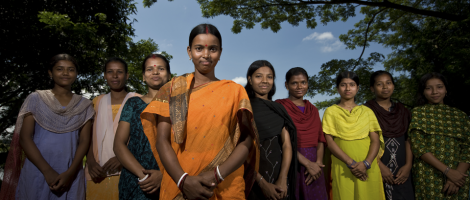
Last year when I participated in this blogging event, I focused on the plight of the girls. This year my focus is on the The Girl Effectproject. It is a stunning multifaceted effort that seeks to end poverty through understanding, documenting, and promoting the value, needs, and priorities of girls in developing countries. It forms a untied global collaboration of development partners for research and program design and delivery. It needs our support, not just as bloggers and writers, but also as workers, volunteers, and donors.

This project might sound to some like an effort with a bias, but it is really an effort to improve the social and economic fabric of families and communities by opening educational and economic opportunities to girls aged ten to twenty-four. Efforts are made toward removing barriers to family and economic stability, barriers like early pregnancy, school dropout, and HIV/AIDS. Girls are ultimately the backbone of their families and communities reinvesting ninety percent of what they earn in their families as opposed to boys’ reinvestment of sixty percent.

The studies that the development community have implemented and are sharing among partner agencies provide information we haven’t ever had before on girls in this age group in the developing nations. Their studies conclude with action items for governments and policy makers. Under the banner of The Girl Effect, the global community is united in assessing the cost to individuals, families, communities, and countries when girls live in poverty, are bared from education and proper health care, and suffer abuse.

The Girl Effect seeks support for efforts that address some things those of us in the developed nations take for granted: like being counted.  When a child has no birth certificate and is not counted in any census, she has no identity and there is no way of knowing if programs that are in place are reaching her and helping her.

The Girl Effect partners seek to:

  • acquire funding for programs and to track program outcomes;
  • support, encourage, and provide opportunities for complete primary education and for secondary education;
  • provide health care, wellness programs, and HIV/AIDS prevention programs;
  • organize health-care delivery systems that are effective in reaching this demographic;
  • provide economic empowerment for earning, saving, and building assets;
  • ensure legislation that supports women’s rights;
  • empower girls to advocate for themselves; and,
  • mobilize nations, communities, and families, men and boys, to support the efforts of girls to protect and educate themselves and improve their lives and those of their families.

The programs that are offered by partners include education, legal help, micro-loans, and health care. Donations may be made through Global Giving.

© 2011, Jamie Dedes, all rights reserved. Posting or printing permitted by request only.

Photo credit ~ Girl Effect photo courtesy of Brent Stirton/Getty Images.

Video uploaded to YouTube by .

Posted in Guest Writer, Perspectives on Cancer, Poems/Poetry

PERSPECTIVES ON CANCER #22: Bath

BATH

by

Myra Schnieder

·

Kindness, an Irish lilt in her voice,

spares me the effort of running the water

and supports my elbow when, stripped

of everything but wound dressings,

I take a giant step into the tub.

·

Warm water wells into my crotch,

unlocks spine, lullabies stomach.

Is it because I’ve passed through

extremity that this comfort is intense

as the yellow daffodils trumpet?

·

Yesterday – my raw body stranded

by the basin, chill sprouting on my skin

while a Chinese student nurse

conscientiously dabbed each

helpless area – is miles away.

·

Dimly, I remember a stark room

and the high-sided saltwater bath

I was dipped in a few days

after giving birth. As Kindness

babies my back with a pink flannel

·

I’m reborn though maimed, ageing.

And this pool of bliss can no more

be explained than the song that pours

from a lark as it disappears into

stitchless blue, the seed circles

·

that cram a sunflower’s calyx,

day splashing crimsons

and apricot golds across the sky

before it seeps into the silence

of night, the way love fountains.

 ·

© 2011, Myra Schneider, all rights reserved. This poem is posted on Into the Bardo  with the permission of  Ms. Schneider. Any further reposting requires her permission. 

Photo credit ~ amazon preparing for a battle (Queen Antiop or Armed Venus), byPierre-Eugène-Emile Hébert 1860 (National Gallery of ArtWashington, D.C.), public domain photograph via Wikipedia

·

Bath is an excerpt from:

Writing My Way Through Cancer  Jessica Kingsley Publishers (2003), and

Multiplying The Moon  Enitharmon (2004)

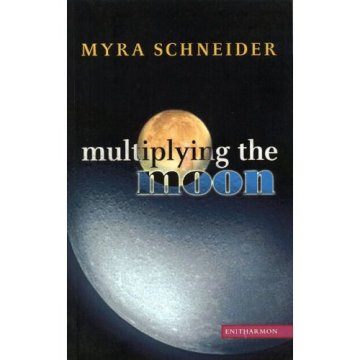
Editor’s note: The opening poems of Multiplying the Moon are Myra Schneider’s response to her experience of terrible illness. In the aftermath of fighting breast cancer, she found herself writing poems that explore transience, death, and survival from many different angles. The main theme of `Voicebox,’ the long fictional narrative in the middle of the book, is communication; the poem follows the connections and disconnections between its main characters. In a short poem sequence, the poet draws on findings from the 1901 census to re-create her father’s early life, and the understanding she gains helps her to feel a new closeness with him. This is united by the theme of investigation of the self and its relationship with the outside world.

♥ ♥ ♥ ♥

Myra Schneider ~ was born in London in 1936 and grew up on the Firth of Clyde. She is the author of four poetry collections from Littlewood, three novels for children from Heinemann, and has three poetry collections published by Enitharmon: Exits, The Panic Bird and Insisting on Yellow. With John Killick she has written Writing for Self-Discovery  (Vega, Chrysalis Books) which was re-published in 2002. Her book Writing My Way Through Cancer, was published by Jessica Kingsley in 2003. The book is her fleshed-out journal from the year 2000 when she was diagnosed with breast cancer. It includes poem notes and poems and a section of therapeutic writing ideas.

Posted in Guest Writer, Perspectives on Cancer, Poems/Poetry

PERSPECTIVES ON CANCER #21: Amazon

AMAZON

by

Myra Schneider


 for Grevel

 ·

For four months

all those Matisse and Picasso women

draped against

plants, balconies, Mediterranean sea, skies

have taunted me

with the beautiful globes of their breasts as I’ve filled

 ·

my emptiness

with pages of scrawl, with fecund May, its floods

of green, its irrepressible

wedding-lace white, buttercup gold,

but failed to cover

the image of myself as a misshapen clown

 ·

until you reminded me

that in Greek myth the most revered women

were the single-breasted

Amazons who mastered javelins and bows, rode

horses into battle,

whose fierce queens were renowned for their femininity.

 ·

Then recognising the fields I’d fought my way across

I raised my shield

of glistening words, saw it echoed the sun.

·

© 2011, Myra Schneider, all rights reserved. This poem is posted on Into the Bardo  with the permission of  Ms. Schneider. Any further reposting requires her permission. 

Photo credit ~ amazon preparing for a battle (Queen Antiop or Armed Venus), byPierre-Eugène-Emile Hébert 1860 (National Gallery of ArtWashington, D.C.), public domain photograph via Wikipedia

·

Amazon is an excerpt from:

Writing My Way Through Cancer  Jessica Kingsley Publishers (2003), and

Multiplying The Moon  Enitharmon (2004)

Editor’s note: The opening poems of Multiplying the Moon are Myra Schneider’s response to her experience of terrible illness. In the aftermath of fighting breast cancer, she found herself writing poems that explore transience, death, and survival from many different angles. The main theme of `Voicebox,’ the long fictional narrative in the middle of the book, is communication; the poem follows the connections and disconnections between its main characters. In a short poem sequence, the poet draws on findings from the 1901 census to re-create her father’s early life, and the understanding she gains helps her to feel a new closeness with him. This is united by the theme of investigation of the self and its relationship with the outside world.

♥ ♥ ♥ ♥

Myra Schneider ~ was born in London in 1936 and grew up on the Firth of Clyde. She is the author of four poetry collections from Littlewood, three novels for children from Heinemann, and has three poetry collections published by Enitharmon: Exits, The Panic Bird and Insisting on Yellow. With John Killick she has written Writing for Self-Discovery  (Vega, Chrysalis Books) which was re-published in 2002. Her book Writing My Way Through Cancer, was published by Jessica Kingsley in 2003. The book is her fleshed-out journal from the year 2000 when she was diagnosed with breast cancer. It includes poem notes and poems and a section of therapeutic writing ideas.

Posted in Guest Writer, Perspectives on Cancer, Poems/Poetry

PERSPECTIVES ON CANCER #20: Today There Is Time

TODAY THERE IS TIME

by

Myra Schneider

to touch the silken stillness

of myself, map its landscape,

the missing left breast, to lay

my nervous palm softly

as a bird’s wing across

the new plain, allow

tears to fall yet rejoice

the surgeon has scraped

away the cancer cells.

·

Today there is time

to contemplate the way life

opens, clams, parts, savour

its remembered rosemaries,

spreading purples, tight

white edges of hope, to travel

the meanings of repair, tug

words that open parachutes.

© 2011, Myra Schneider, all rights reserved. This poem is posted on Into the Bardo  with the permission of  Ms. Schneider. Any further reposting requires her permission. 

© 2011, cover art courtesy of publisher. All rights reserved.

·

Today There Is Time is an excerpt from:

Writing My Way Through Cancer  Jessica Kingsley Publishers (2003), and

Multiplying The Moon  Enitharmon (2004)

Editor’s note: The opening poems of Multiplying the Moon are Schneider’s response to her experience of terrible illness. In the aftermath of fighting breast cancer, she found herself writing poems that explore transience, death, and survival from many different angles. The main theme of `Voicebox,’ the long fictional narrative in the middle of the book, is communication; the poem follows the connections and disconnections between its main characters. In a short poem sequence, the poet draws on findings from the 1901 census to re-create her father’s early life, and the understanding she gains helps her to feel a new closeness with him. This is united by the theme of investigation of the self and its relationship with the outside world.

♥ ♥ ♥ ♥

Myra Schneider ~ was born in London in 1936 and grew up on the Firth of Clyde. She is the author of four poetry collections from Littlewood, three novels for children from Heinemann, and has three poetry collections published by Enitharmon: Exits, The Panic Bird and Insisting on Yellow. With John Killick she has written Writing for Self-Discovery (Vega, Chrysalis Books) which was re-published in 2002. Her book ‘Writing My Way Through Cancer’, was published by Jessica Kingsley in 2003. The book is her fleshed-out journal from the year 2000 when she was diagnosed with breast cancer. It includes poem notes and poems and a section of therapeutic writing ideas.

Posted in Guest Writer, Perspectives on Cancer

PERSPECTIVES ON CANCER #19: Radical Mastectomy

RADICAL MASTECTOMY

by

Cindy Taylor

I brought her home

and

The flowers came

From far and wide

For her

Shorn, severed body

lying

In our marriage bed

Iwouldn’t couldn’t didn’t

When she said

“touch me”

… that devastated landscape …

What

About

Me?

♥ ♥ ♥ ♥

Cindy Taylor ~ Cindy is a freelance writer, a poet, editor and proofreader. She has an abiding passion for food and wine and an endearing zeal for life, which she shares with us on her award-winning food blog, The Only Cin. Cindy lives in Johannesburg, South Africa with her husband, daughter, and a fine cast of animal friends. Judging from photographs, she has a world-class kitchen and an abundance of red shoes.