Yesterday upon the stair, I met a man who wasn’t there.
He wasn’t there again today. Oh, how I wish he’d stay away!
photograph c2013 Naomi Baltuck
This is the first stanza of Antigonish, written in 1899 by Hughes Mearns. It was inspired by rumors of a ghost roaming the stairs of a haunted house in Antigonish, Novia Scotia. It inspired a popular Glenn Miller song in 1939, with vocals by Tex Beneke.
– Naomi Baltuck
Editor’s note: What a fine example of how – with our art – we feed one anther. Here people pass around a folk tale. A poet picks it up and writes a poem. A composer finds the poem and sets it to music, which musicians then play accompanied by a singer singing the poem. Wonderful! J.D.
NAOMI BALTUCK ~ is a Contributing Editor and Resident Storyteller here at Bardo. She is a world-traveler and an award-winning writer, photographer, and story-teller whose works of fiction and nonfiction are available through Amazon HERE. Naomi presents her wonderful photo-stories – always interesting and rich with meaning and humor – at Writing Between the Lines, Life from the Writer’s POV. She also conducts workshops such as Peace Porridge (multicultural stories to promote cooperation, goodwill, and peaceful coexistence), Whispers in the Graveyard (a spellbinding array of haunting and mysterious stories), Tandem Tales, Traveling Light Around the World, and others. For more on her programs visit Naomi Baltuck.com
Pavel Friedmann was born in Prague on January 7, 1921. He was deported to Terezin on April 26, 1942 and later to Auschwitz, where he died on September 29, 1944. At least 960,000 Jews were killed in Auschwitz. Other victims included approximately 74,000 Poles, 21,000 Roma (Gypsies), and 15,000 Soviet prisoners of war; and 10,000-15,000 members of other nationalities (Soviet civilians, Czechs, Yugoslavs, French, Germans, and Austrians). Women, men, children.
While it is common to say “never again” … meaning that event we refer to as THE Holocaust … it’s important to remember that there are Holocausts (genocides) in process now and there have been many in our history … think of Armenia, Rawanda, the Congo, Cambodia, Vietnam, Sudan, Iraq, Somalia, North Korea, the Kurdish peoples, Syria, Palestine … Time and past time to put an end to it …
I like to remember the lesson taught by Pastor Martin Niemoller (1892-1984) – a victim of the Nazis – and passed on to us. There is some controversy over the many versions of his “First they came …” It is often presented as a poem. The great jazz musician, Charles Mingus, recites a version before his musical composition, Don’t Let It Happen Here. In any event, the point is made: political apathy is dangerous.
First they came for the Jews
and I did not speak out-
because I was not a Jew.
Then they came for the Communists
and I did not speak out-
because I was not a Communist.
Then they came for the trade unionists
and I did not speak out-
because I was not a trade unionist.
Then they came for me-
and there was no one left
to speak out for me.
– Pastor Martin Niemoller
– Jamie Dedes
Photo credits: Sidney Fagin – New College of Florida; German postage stamp with sketch of Pastor Martin Niemoeller (licensing status unclear ) via Wikipedia
American composer, mandolinist, professor, writer, and poet
Concert performer, recording artist, professor of music, mother of two musically talented kids, director of America’s pre-eminent summer school for mandolin and guitar — any one or two of these can be a full-time job, but Marilynn manages to do them all. MORE [MANDOZINE]
However untrained my ear may be, I immediately appreciated that there was something exciting and fresh in the audios Marilynn Mair uploaded to her blog Celebrating a Year. The reason for the freshness was that it was Brazilian jazz, called choro, something with which I was not familiar. I think the first audio might have been Isso, which was written by Marilynn and performed by her and Luiz Simas on Meu Bandolim, their CD released 2010. [Sample] I was hooked. I sent the link around to all my music-loving family and friends.
Choro (pronounced SHOH-roh) is best described in American terms as “the New Orleans jazz of Brazil.” It is a complex popular musical form based on improvisation, and like New Orleans jazz,blues, or ragtime, grew from a formalized musical structure and many worldly influences. But to the people of South America, choro is Brazil. It is life. MORE [Saint Paul Sunday]
As lutes go, I was most familiar with the oudof my Lebanese/Turkish background; but I also grew up among Brooklyn Italians and enjoyed their mandolino [The Serenade of Italy]. The European instruments have the oud as a common ancestor. Curious, I quieried Marilynn about choro and in response she gifted me with two of her seven CDs. That was my virgin venture into the delightful sounds of this distinctly Brazilian music. Now it’s an addiction.
Marilynn is professor of music at Roger Williams University at Bristol, Rhode Island. Each year, she travels to Brazil to continue research, study, and teaching. In fact, as I write this, she’s on her way to Rio to teach a class of mandolinists at the Universidade Federale and to write music. She always shares her adventures with us on Celebrating a Year, her blog.
The set of compositions that Marilyn is currently writing is a series of hybrid choro in which Marilynn uses themes from classical music and jazz to creat Brazilian music. She finished three: Um Quinto do Ludwig, a bossa nova based on the first movement of Beethoven’s 5th symphony; Farrapo (Rag) based on Scott Joplin’s The Entertainer, and Sonatinha based on Beethoven’s Sonatina in C for Mandoline. These trips may be a change of scenery for Marilynn, but they’re not a break from the work she loves. She’ll be hard at it on the next three compositions, one of which is to be based on Piazzola’s Milonga do Angel.
Next on her agenda is SummerKeys, a music camp providing students of mandolin and guitar with a week private lessons, plucked-string ensambles, concerts, new friends and mentors. SummerKeys is at Lubec, Maine. (Info and registration for that is HERE should you be interested.)
With all of her professional activities, it’s hard to believe that Marilynn also participated in the 2010 National Novel Writing Month (NaNo). She did this in solidarity with her equally talented brother – engineer and author – Ian Mair (Death in Mexico). Marilynn completed her 50,000 word commitment entirely in poem, writing to Edward Hopper paintings in décima joining the décima with free-verse as a narrative with the décima as soliloquies. This is much like Cuban musical décima, which were often interspersed with instrumental improvisation. I asked her why décima:
It was originally a Spanish poetry form first published in 1591. I was drawn to it because in the migration to the Americas the form survived and flourished as an improvisational song form. It has such a strict form and that’s surprising. No one improvises sonnets. As a song form, particularly in Cuba, it added four-line intros or outros, and improvised instrumental interludes between décimas. That worked for my manuscript because I could use the four-line piece to introduce or explain a décima’s connection to the plot line. And the interludes became free verse connectors dealing more specifically with the protagonist’s changing state of mind and emotions. But this all really developed in the process of writing all month.
I started writing décima earlier this year because I was intrigued by the form, and since no one seems to be writing them in English, or ever has, it seemed more “my” form to explore. I liked what I was coming up with so decided to go with that for NaNo rather than the more obvious villanelle or an iambic pentameter ballad.
Marilynn’s poetry is featured on her blog [Celebrating a Year] each Wednesday, where you can also catch up with her daily musings and photography. Marilynn is a contributing writer here at Into the Bardo. Her most recent contribution is Shred the Social Safety Nets.
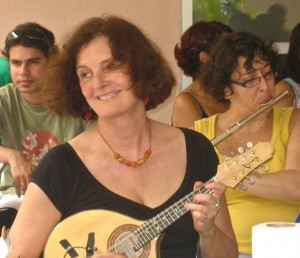
By way of close, here’s Marilyn playing mandolin at a recording studio in Brazil with Grupo Água no Feijão Tocando Assanhado. They are recording the CD Meu Bandolim. Enjoy!
Marilynn Mair, mandolin, bandolim
Solo & Duo, Enigmatica, Água No Feijão
Author, The Complete Mandolinist- A Comprehensive Method
Co-author, Brazilian Choro – A Method for Mandolin
Director, The American Mandolin & Guitar Suitcase Seminars http://www.marilynnmair.com/
“I sing of brooks, of blossoms, birds, and bowers
Of April, May, of June, and July flowers.” – Robert Herrick
Photo credit ~ courtesy of The Buddha Gallery, unusual vintage Chinese monk with offering bowl.
Sarabande ~ began as a dance in triple metre in the 14th century in Central America and evolved in 16th century Europe into a slower musical form. J.S. Bach’s Six Suites for Unaccompanied Cello are perhaps the most recognized solos written for cello and remain among Bach’s most popular works.
Leisure by W.H.Davies(1871 – 1940), Welsh poet and writer
·
In 2007 the Washington Post posed the question: “Can one of the nation’s great musicians cut through the fog of a Washington, D.C. rush hour? Thus it came to pass that – masquerading as a street musician – the world renown violin virtuoso, chamber musician, and orchestra leader, Joshua Bell, played his Gibson ex Huberman (1713, Antonio Stradivari) using a bow made in the eighteenth century by Francois Tourte for the pleasure of DC Metro commuters. He treated them to the sweet strains Chaconne (Bach‘s Partita No.2), AveMaria (Schubert), Estrellita (Ponce), and closed with a Bach gavotte.
Bell concerts are packed to capacity and tickets can run to three figures. During the forty-three minutes he played in the D.C. metro, 1,097 people passed him by and he collected $32.17. Twenty of those dollars were donated by the only commuter to recognize him. Only four-or-five people actually stopped to listen.

 NAOMI BALTUCK ~ is a Contributing Editor and Resident Storyteller here at Bardo. She is a world-traveler and an award-winning writer, photographer, and story-teller whose works of fiction and nonfiction are available through Amazon HERE. Naomi presents her wonderful photo-stories – always interesting and rich with meaning and humor – at Writing Between the Lines, Life from the Writer’s POV. She also conducts workshops such as Peace Porridge (multicultural stories to promote cooperation, goodwill, and peaceful coexistence), Whispers in the Graveyard (a spellbinding array of haunting and mysterious stories), Tandem Tales, Traveling Light Around the World, and others. For more on her programs visit Naomi Baltuck.com






 The BeZine