

VESAK 2012
Remembering the Buddha and his teachings
with joy, gratitude, and generosity |
|
•
[I’m sorry that I could not share this letter with you in a more timely fashion. The Buddha’s birthday was on May 6 this year. Nonetheless, the message is an important one. We are committed to supporting this effort and hope to engage your support as well. Thank you for reading …. J.D.]
•
Dear Friend,
 The most important holiday in the Buddhist calendar, Vesak, is just around the corner. Starting on the full moon day of May, the month of Vesak celebrates the birth, enlightenment, and passing away of the Buddha. It is a day – and a month – not only for joy and gratitude but also for recollection: for remembering the Buddha’s teachings and making a more earnest effort to practice them.
The first step of Buddhist practice is giving, and the most basic gift is the gift of food. The importance of food can be gauged from the Buddha’s own life story. In the Middle Length Discourses, he tells us that before his enlightenment, he undertook long fasts that reduced his body to a tent of bones. When he saw that the true path to awakening requires deep meditation, he also realized: “It isn’t easy to meditate with an emaciated body.
 Let me eat sustaining food such as rice and porridge.” It was only after he regained his strength that he could reach his goal.
Not only is it hard to meditate with an emaciated body, but when one is malnourished it’s hard to do anything – except wait intently for the next meal. Yet close to a billion people around the world endure this fate. It’s to give such people a fresh chance at life that BGR came into being, and this purpose has inspired our work through the years.
We don’t just give handouts. Rather, we seek to make people productive and self-sufficient. We do so in diverse ways: by supporting the education of poor children, especially girls; by creating right livelihood opportunities for women; and by supporting ecologically sustainable small-scale agriculture. In just four years, we’ve already sponsored fifty projects around the world, in Asia, Africa, Haiti, and the U.S. Some of our recent projects include:

 Today BGR plays a major role in representing Buddhism on the stage of global giving. In fact, in late April we participated in a historical conference at the White House that brought representatives of the “Dharmic religions” into contact with government agencies in a common commitment to humanitarian service.
We hope to continue our mission long into the future, both in the U.S. and abroad. However, we can’t fulfill our goals without help from friends like you who share our ideals and resonate with our values. Your donations are the key to everything we do: to combating malnutrition, educating poor children, and helping those who cannot help themselves. And because we’re an all-volunteer organization, we use the funds we receive prudently, with care and discretion, to ensure that 85-90% of every dollar goes directly to finance projects.
So, remembering the great compassion the Buddha extended to us, let us extend compassion to others. This Vesak season please bring forth a heart of generosity and support the work of BGR. When you give, you become part of our mission, our partner in giving a helping hand to those who need help. And you experience the joy of knowing that you are truly making a positive difference in this world, a difference that’s transforming lives.
 May all blessings be with you and your family, on Vesak and beyond.
 Ven. Bhikkhu Bodhi
Founder and Chairperson Buddhist Global Relief is a 501(c)(3) organization. Gifts are deductible to the full extent allowable under IRS regulations. You can either donate online via PayPal on the BGR web site or send a check to:
Buddhist Global Relief
PO Box 1611 Sparta, New Jersey 07871 USA If your company has a Matching Gift Program, please enclose the necessary forms as well.
|
Category: Teachers
HONORING THE ULTIMATE MOTHER: Falling back in love with Mother …

THICH NHAT HANH (IN BROWN) AT HUE CITY AIRPORT, VIETNAM (2007)
“The situation the Earth is in today has been created by unmindful production and unmindful consumption. We consme to forget our worries and our anxieties. Tranquilizing ourselves with over-consumption is not the way.” Thich Nhat Hanh, 2010, Tricycle Magazine
The Guardian UK posted an article in February that was written by Jo Confino and in which the dear Zen teacher, Thich Nhat Hahn, discusses his views on current environmental challenges and the need for a spiritual revolution to address them. I hope you will link through and read the article today or watch the interview video below in honor of our ultimate Mother, Earth. In Metta on Mothers Day, J.D.
“Zen master Thich Nhat Hanh has been practising meditation and mindfulness for 70 years and radiates an extraordinary sense of calm and peace. This is a man who on a fundamental level walks his talk, and whom Buddhists revere as a Bodhisattva; seeking the highest level of being in order to help others.
Ever since being caught up in the horrors of the Vietnam war, the 86-year-old monk has committed his life to reconciling conflict and in 1967 Martin Luther King nominated him for the Nobel Peace Prize, saying “his ideas for peace, if applied, would build a monument to ecumenism, to world brotherhood, to humanity.”
So it seems only natural that in recent years he has turned his attention towards not only addressing peoples’ disharmonious relationships with each other, but also with the planet on which all our lives depend.” MORE
And here is the video of the interview:
Photo credit ~ courtesy of Lu’u Ly via Wikipedia and generously released into the public domain.
Video ~ uploaded to YouTube by NiemPhatThanhPhat .
EVERYWHERE IN THE WORLD human beings of every color, persuasion, and ethnicity dream …
 MARTIN LUTHER KING, JR. (1929-1988), American Clergyman, Activist, and Leader of the American Civil-Rights Movement
Delivering I Have a Dream, 1963 at the Lincoln Memorial, Washington, D.C. U.S.A.
No one articulated the dream of human dignity with quite the same poetry and passion as Martin Luther King, Jr.
When we let freedom ring, when we let it ring from every village and every hamlet, from every state and every city, we will be able to speed up that day when all of God’s children, black men and white men, Jews and Gentiles, Protestants and Catholics, will be able to join hands and sing in the words of the old Negro spiritual, “Free at last! free at last! thank God Almighty, we are free at last!”

Editorial Note: We humans struggle for freedom in many circumstances and many places. In November of the same year that Dr. King delivered this speech, the first world-wide Prisoner of Conscience Week was honored. Such events remind us that no wo/man is truly free until all are free.
MAY ALL SENTIENT BEINGS FIND PEACE
The photograph of Martin Luther King, Jr. is in the public domain and is viewed here courtesy of Wikipedia. The video of Dr. King was uploaded to YouTube by sullentoys . The Joyful Noise gospel acapella group was uploaded to YouTube by LadyKej.
THE BREATH WITHIN THE BREATH
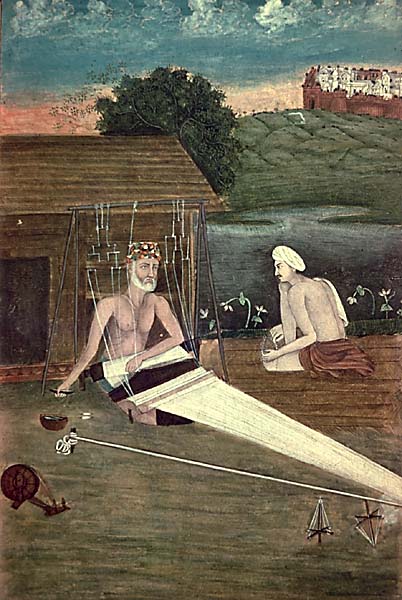
KABIR (1440-1580), MYSTIC POET OF INDIA
One of India’s great poets, Kabir’s gentle influence seems to have been broad and includes Sikhism, Bhakti, and the Sant Mat (path of the saints) sect, Kabir Panthis (Kabir’s Path). Sant Mat’s primary principle is a disciplined inward devotion to the Divine. One branch of that movement is Science of Spirituality under Sant Rajinder Singh Ji Maharaj, who has a substantial following in North and South America as well as India. Sant Mat spiritual practice involves Jyoti and Shabd meditation techniques. Jyoti is a basic practice in which the practitioner assumes a relaxed position and, with mind stilled, repeats any name of God with which s/he is comfortable. Shabd meditation is rather more complicated and involves an initiation process and a focus on the Inner Light and Sound.
In this reading of Kabir by Ram Dass, the core issues of life are explored. J.D.
·
© 2012 Jamie Dedes, All rights reserved
Illustration ~ public domain via Wikipedia
Video uploaded to YouTube by Saattya .
CHRISTOPHER HITCHENS: Living Hugely, Dying Gracefully
I have seen the moment of my greatness flicker,
And I have seen the eternal Footman hold my coat, and snicker,
And in short, I was afraid.
—T. S. Eliot, “The Love Song of J. Alfred Prufrock.”
Living Hugely, Dying Gracefully
CHRISTOPHER HITCHENS
by
Jamie Dedes
CHRISTOPHER HITCHENS died yesterday of esophageal cancer at the age of sixty-two. Famous or infamous – depending on your view – for his atheism among other things, he is an example of one who lived hugely, was unapologetic, and died gracefully.
I don’t agree with a lot of what he wrote and said, but how dull when there are no differences. Life would be an intellectual wasteland. As long as we take our differences to the debate halls, the blogs, and the voting booth and not to the killing fields, it’s okay.
I admired his sharp mind and wit. Nonsmoking teetotaler I am, yet I appreciate the spirit in this – quoted from his New York Times obituary – “He also professed to have no regrets for a lifetime of heavy smoking and drinking. ‘Writing is what’s important to me, and anything that helps me do that…'” He honored himself right to the end even as he admitted that his lifestyle contributed to his illness. Hitchen’s attacked our sacred cows and some of them deserved attacking. He made us examine our dusty old assumptions in the privacy of our minds and indeed some came up lacking. I admire him enormously.
Perhaps more than anything, I admire the grace with which he lived with dying. He did a more honest and dignified job of it than many of us in our faith communities. He was diagnosed in June of 2010 and wrote about this journey in his Vanity Fair columns. The “cynical contrarian” had heart, perhaps even a kinder more generous heart than many an avowed theist.
I sometimes wish I were suffering in a good cause, or risking my life for the good of others, instead of just being a gravely endangered patient.”
He wrote that the
Prospect of death makes me sober, objective.”
He pursued his craft right to the end.
Cancer victimhood contains a permanent temptation to be self-centered and even solipsistic,” Hitchens wrote nearly a year ago in Vanity Fair, but his own final labors were anything but: in the last 12 months, he produced for this magazine a piece on U.S.-Pakistani relations in the wake of Osama bin Laden’s death, a portrait of Joan Didion, an essay on the Private Eyeretrospective at the Victoria and Albert Museum, a prediction about the future of democracy in Egypt, a meditation on the legacy of progressivism in Wisconsin, and a series of frank, graceful, and exquisitely written essays in which he chronicled the physical and spiritual effects of his disease. At the end, Hitchens was more engaged, relentless, hilarious, observant, and intelligent than just about everyone else—just as he had been for the last four decades.” Vanity Fair
He wrote with excruciating honesty.
Like so many of life’s varieties of experience, the novelty of a diagnosis of malignant cancer has a tendency to wear off. The thing begins to pall, even to become banal. One can become quite used to the specter of the eternal Footman, like some lethal old bore lurking in the hallway at the end of the evening, hoping for the chance to have a word. And I don’t so much object to his holding my coat in that marked manner, as if mutely reminding me that it’s time to be on my way. No, it’s the snickering that gets me down.
On a much-too-regular basis, the disease serves me up with a teasing special of the day, or a flavor of the month. It might be random sores and ulcers, on the tongue or in the mouth. Or why not a touch of peripheral neuropathy, involving numb and chilly feet? Daily existence becomes a babyish thing, measured out not in Prufrock’s coffee spoons but in tiny doses of nourishment, accompanied by heartening noises from onlookers, or solemn discussions of the operations of the digestive system, conducted with motherly strangers. On the less good days, I feel like that wooden-legged piglet belonging to a sadistically sentimental family that could bear to eat him only a chunk at a time. Except that cancer isn’t so … considerate.” MORE [Vanity Fair]
Thank you, Mr. Hitchens, for making me think and rethink.
Thank you, Vanity Fair, for hosting his work so regularly.
© 2011, Jamie Dedes All rights reserve
Photo credits ~ all the book covers are courtesy of Barnes & Noble. Hitchens at the podium at Portsmouth, England courtesy of ensceptico via Wikipedia under Creative Commons Attribution 2.0Generic license. Hitchens at third party protest at the Presidentical Debates Commission, Washington, D.C. September 28, 2000 via Wikipedia courtesy of Carolmooredc under the Creative Commons Attritubtion-Share Alike 3.0 Unported license. Hitchens in debate “Is God Great” with John Lennox at Samford University in Bermingham, Alambama March 3, 2009 via Wikpedia courtesy of stepher via Wikipedia under Creative Commons Attribution-Share Alike 2.0 Generic license.
UPDATE: Buddhist Global Relief

Ven. Bhikkhu Bodhi, American Buddhist Monk, Theravada Tradition
Founder and Chairperson
Buddhist Global Relief
Photo ~ Ken and Visakha Kawasaki under Creative Commons Atribution-Share Alike 3.0 Uported License via Wikipedia
This is just in from the Ven. Bhikkhu Bodhi. J.D.
·
 |
let the lotus
of compassion enfold the world |
|
Buddhist Global Relief came into being in June 2008, born of the conviction that Buddhists should play a more active role in helping our unseen brothers and sisters around the world emerge from the crushing weight of poverty and social neglect. Inspired by the Buddha’s great compassion, we chose chronic hunger and malnutrition as our special focus. Our programs are intended to help people escape this brutal trap by promoting more sustainable methods of food production and more equitable systems of food distribution. We also sponsor the education of poor children, especially girls, and right livelihood opportunities for poor women, enabling them to earn more to feed their families. In only three years, we’ve already launched over twenty-five projects in Asia, Africa, Haiti, and the U.S. The most recent include:
Today BGR is playing a major role in representing Buddhism on the stage of global giving. Last year, we were even invited to participate in conferences on collaboration in poverty alleviation at the White House and the National Cathedral. These led to several partnerships with Oxfam America on projects in Cambodia and Vietnam. Recently Tricyleand Buddhadharma, two major American Buddhist journals, featured articles about BGR (please see Tricycle’s Feeding the world’s hungry and Buddhadharma’s Buddhist Global Relief articles). We want this Buddhist presence to flourish, visibly representing the compassionate spirit of the Dharma in ways made urgent by the terrible persistence of poverty and malnutrition. We’re doing our utmost to turn back this tide, but we can’t achieve our goals without help from friends who share our ideals and resonate with our values, good-hearted people like you. Your donations are the key to everything we do: to combating hunger and malnutrition, to educating poor children, to helping those who cannot help themselves. And because we’re an all-volunteer organization, we use the funds we receive prudently, with care and discretion, to ensure that over 90% of every dollar goes directly to finance projects. As we come to the end of 2011 — the time for selfless giving — please bring forth a heart of generosity for the world’s poor and hungry people, who need a helping hand in order to rise up and stand on their feet. Please give generously. When you give, you become a part of our mission, a partner in our endeavor to express compassion in action. Bear in mind that to give is to receive, to experience the joy of offering others the chance to live with dignity and hope. May all blessings be with you and your family, Ven. Bhikkhu Bodhi Buddhist Global Relief is a 501(c) (3) organization. Gifts are deductible to the full extent allowable under IRS regulations. You can either donate online at the BGR website or send a check to:
Buddhist Global Relief
PO Box 1611 Sparta, New Jersey 07871 USA If your company has a Matching Gift Program, please enclose the necessary forms as well. |
PEACE …

BUDDHA
Hatred does not cease by hatred, but only by love; this is the eternal rule.
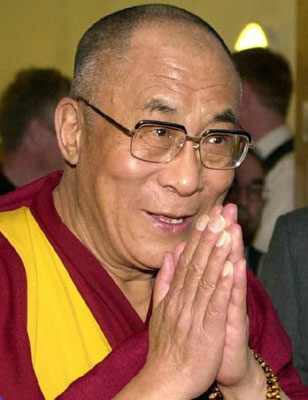 14th DALAI LAMA, TENZIN GYATSO
We can never obtain peace in the outer world until we make peace with ourselves.

RUMI
Out beyond ideas of wrong-doing and right doing
there is a field. I’ll meet you there.
 RABBI HILLEL THE ELDER
What is hateful to thyself do not do to another. That is the whole law, the rest is commentary.
 PARAMAHANSA YOGANANDA
Kindness is the light that dissolves all walls between souls, families, and nations.
 ST. PAUL THE APOSTLE
So now faith, hope, and love abide, these three; but the greatest of these is love.
PEACE AND LOVE:
DECISIONS, NOT PRAYERS
 Artist’s rendition: Reflection Memorial
Site of the Twin Towers, New York City
IN MEMORY
♥
LISTEN TO YOUR HEART
·

MAHATMA GANDHI 1869 -1948), India’s peaceful activitst
“You must be the change you want to see in the world.”
·
PEACE
·
LOVE
·
STEWARDSHIP
♥
IN LOVING MEMORY
for
THE FALLEN
and
THEIR FAMILIES
OUR HYPERLINKED WORLD

Commercial interests with their advertising industry do not want people to develop contentment and less greed. Military interests in economic, political, ethnic or nationalist guises, do not want people to develop more tolerance, nonviolence and compassion. And ruling groups in general, in whatever sort of hierarchy, do not want the ruled to become too insightful, too independent, too creative on their own, as the danger is a threat that they will be insubordinate, rebellious, and unproductive in their alloted tasks. Robert Thurman
♦
Robert Thurman holds the first endowed chair in Buddhist Studies in the West, the Jey Tsong Khapa Chair in Indo-Tibetan Buddhist Studies. After education at Philips Exeter and Harvard, he studied Tibet and Tibetan Buddhism for almost thirty years as a personal student of His Holiness the Dalai Lama. He has written both scholarly and popular books, and has lectured widely all over the world. His special interest is the exploration of the Indo-Tibetan philosophical and psychological traditions with a view to their relevance to parallel currents of contemporary thought and science. Columbia University, Department of Religion
♦
Robert Thurman won the TED (Technology, Entertainment, Design) Prize in June of 2007. In addition to that and the accomplishments listed in his Columbia University bio above, he writes for BeliefNet and cofounded Tibet House in New York, which is dedicated to preserving Tibetan culture. One of his more recent books is Why the Dalai Lama Matters, subtitled “His Act of Truth as the Solution for China, Tibet, and the World.”
In the video below, the acceptance presentation for the TED Prize, Dr. Thurman talks about our hyperlinked world. He describes a world in which we can know anything at any time. This means that we are always aware of the suffering of others and cannot ignore our inter-relatedness. We cannot ignore the misery of others. He suggests that this is in effect a mass enlightenment and a step toward Buddhahood. J.D.
Video posted to YouTube by TEDtalksDirector.
Photo credit ~ Robert Thurman courtesy of Tenzin Nyima licensed under the Creative Commons Attribution-Share Alike 2.0 Generic via Wikipedia. The lotus illustration below is from PD Clipart.org.

THE GARDEN OF MY HEART

Thich Nhat Hanh (b. 1926) Zen Monk, Dharma Teacher, Social Activist, Writer, Poet, Peacemaker
Nhat Hanh is now recognized as a Dharmacharya and as the spiritual head of the Từ Hiếu Temple and associated monasteries. On May 1, 1966 at Từ Hiếu Temple, Thich Nhat Hanh received the “lamp transmission”, making him a Dharmacharya or Dharma Teacher, from Master Chân Thật. MORE [Wikipedia]
Though a Zen Buddhist monk, Thich Nhat Hanh combines traditional Zen with techniques from Theravada Buddhism, the wisdom of the Mahayana tradition, and ideas of modern Western psychology to teach meditation and spiritual values and practices in a way that resonates for people from diverse religious, political, and cultural backgrounds. He is a writer, poet, and peacemaker with over 100 books published (many in English). He was suggested for but never received the Nobel Prize for Peace by Dr. Martin Luther King, Jr. Since 1966, Thich Nhat Hanh has lived in exhile in France. Based at Plum Village, a meditation community in the south of France, he is a leading Buddhist teacher, encourages engaged Buddhism (a movement for social activism that he founded), and conducts humanitarian efforts.
Thich Nhat Hahn coined the term “interbeing,” a pointer to the Buddhist principles of impermanence and nonself, which bring light to the idea and ideal of the inter-connectedness of all things. He founded The Order of Interbeing, the members of which include lay people. Link HERE to brief summaries of each of the fourtheen mindfulness trainings of the Order of Interbeing. J.D.
“If in our daily lives we can smile, if we can be peaceful and happy, not only we, but everyone will profit from it. If we really know how to live, what better way to start the day than with a smile? Our smile affirms our awareness and determination to live in peace and joy. The source of a true smile is an awakened mind.”
~ from Peace is Every Step by Thich Nhat Hanh
Here is a meditative interlude. The title of this post is a quote from the meditation, which is an excerpt from an album called Graceful Passages: A Companion for Living and Dying. It features spiritual teachers from many traditions offering advice to the dying – in other words, advice to all of us. Today and everyday : in metta, A.E., R.R., J.D.
Video posted to YouTube by pantheist46n2.
NEW RETREAT CENTER, S.F. Bay Area

This year is our time of greatest opportunity to renovate our new retreat home and to acquire and protect the adjacent 38-acre private nature preserve. If we can complete the renovation as planned, we will have a retreat center that operates in the same efficient and welcoming manner that beautifully continues the Dharma culture we have at IMC. Just as we do at IMC, the retreat center will offer retreats freely, with no costs to participants. MORE [Gil Fronsdale, Insight Meditation Center (IMC), Redwood City, CA]
We do not represent or speak for the Insight Meditation Center (Vipassanã Buddhism) in Redwood City, California, U.S.A. However, we did want to be sure that our Bay Area friends and readers know about this new retreat center and that our readers from around the world know they can link anytime and from anywhere to IMC’s audio dharma where they can listen to discourse and classes by some very dear and wise Buddhist teachers.
We are all greatful for the benefits we have received from this sangha and its teachers, especially Gil Fronsdal and M.B. J.D.
For more about Gil Fronsdale, the Retreat Center, and current plans:
Video posted to YouTube by insightmed .
Link HERE to make a donation.
Photo credit ~ Insight Meditation Center, Redwood City, CA , all rights reserved.
ONE VIEW OF KARMA AND REBIRTH
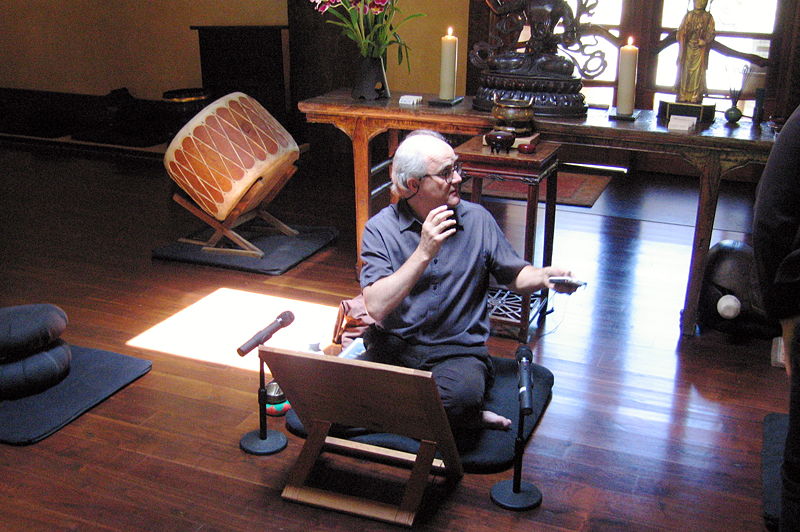
STEPHEN BATCHELOR (b. 1953), Buddhist teacher, author, scholar
Author of Buddhism Without Beliefs
Stephen Batchelor is a contemporary Buddhist teacher and writer, best known for his secular or agnostic approach to Buddhism. Stephen considers Buddhism to be a constantly evolving culture of awakening rather than a religious system based on immutable dogmas and beliefs. In particular, he regards the doctrines of karma and rebirth to be features of ancient Indian civilisation and not intrinsic to what the Buddha taught. Buddhism has survived for the past 2,500 years because of its capacity to reinvent itself in accord with the needs of the different Asian societies with which it has creatively interacted throughout its history. As Buddhism encounters modernity, it enters a vital new phase of its development. Through his writings, translations and teaching, Stephen engages in a critical exploration of Buddhism’s role in the modern world, which has earned him both condemnation as a heretic and praise as a reformer. MORE [About Stephen Batchelor from his website]
In this video, Stephen Batchelor presents his view of Karma and Rebirth and the reasoning that supports his perspective.
Video posted to YouTube by ForaTv.

GREAT JOYFUL PROCLAIMER

Samdech Preah Maha Ghosananda (1929 -2007)
Buddhist Monk of the Theravada tradition.
Patriarch of Cambodian Buddhism during Pol Pot’s reign of terror
Maha Ghosananda, his Pali Monastic name means joyful proclaimer
He lost his entire family and his friends at Khamer Rouge
Biography HERE
♥ ♥
♥
“Peace is possible!”
Maha Ghosananda’s motto.
♥ ♥
♥
“Don’t struggle with people, with men. Struggle with the goals and conditions that make men fight each other.”
“If a driver is not sober how can he drive a car? If you don’t calm your spirit, you cannot bring peace to the country.”
♥
“I do not question that loving one’s oppressors – Cambodians loving the Khmer Rouge – may be the most difficult attitude to achieve. But it is a way of the universe that retaliation, hatred, and revenge only continue the cycle and never stop it. Reconciliation does not mean that we surrender rights and conditions. It means that we see ourselves in the opponent – for what is the opponent but a being in ignorance, and we ourselves are also ignorant of many things. Therefore, only loving kindness and right mindfulness can free us. [From his essay The Human Family.]
♥
“We must find the courage to leave out temples
and enter the temples of human experience,
temples that are filled with suffering.
If we listen to the Buddha, Christ or Gandhi, we can do nothing else.
The refugee camps, the prisons, the ghettos
and the battlefields will then become our temples.”
and enter the temples of human experience,
temples that are filled with suffering.
If we listen to the Buddha, Christ or Gandhi, we can do nothing else.
The refugee camps, the prisons, the ghettos
and the battlefields will then become our temples.”
♥
I was so taken with the story of this “joyful proclaimer” in Rob’s story yesterday, that I had to do research on him. I don’t think he’s written any books and there are few videos and none with a dharma talk, but the whole of the man’s life was a dharma talk,* an inspired and inspiring one. J.D.
·
The quotes were gleaned from two sites, which others may wish to visit:

Photo credit –nyana_ponika under under the Creative Commons Attribution-Share Alike 2.0 Generic license via Wikipedia.
* Dharma talk – public discourse. The wonderful thing about dharma is that it is not dogma! J.D.
CHERISH HOME

Carl Sagan (1934-1996)
American astronomer, astrophysicist, cosmologist, author and popularizer of natural and space science
CARL SAGAN was the David Duncan Professor of Astronomy and Space Sciences and Director of the Laboratory for Planetary Studies at Cornell University. He played a leading role in the American space program since its inception. He was a consultant and adviser to NASA since the 1950’s, briefed the Apollo astronauts before their flights to the Moon, and was an experimenter on theMariner, Viking, Voyager, and Galileoexpeditions to the planets. He helped solve the mysteries of the high temperatures of Venus (answer: massive greenhouse effect), the seasonal changes on Mars (answer: windblown dust), and the reddish haze of Titan (answer: complex organic molecules). MORE [The Carl Sagan Portal. This site is recommended, well worth your time.]
Carl Sagan may not be a teacher in the Buddhist sense, but he is a teacher with a wise and compassionate message. Here Sagan puts things into perspective for all human kind:
Video posted to YouTube by CarlSaganPortal.

Earth as seen from Apollo 17.
“A mote of dust suspended in a sunbeam . . . ” Carl Sagan
♥
Let there be peace.
It’s a decision not a prayer.

RENUNCIATION & EASE

Gil Fronsdal (b. 1954), American Buddhist Guiding Teacher, Insight Meditation
Gil was trained as a Vipassana teacher by Jack Kornfield and is part of the Vipassana teachers’ collective at Spirit Rock Meditation Center. He was ordained as a Soto Zen priest at the San Francisco Zen Center in 1982, and in 1995 he received Dharma transmission from Mel Weitsman, the abbot of the Berkeley Zen Center.
He is the guiding teacher of the Insight Meditation Center (IMC) of Redwood City, California. He is one of the best-known American Buddhists. He has a PhD in Buddhist Studies from Stanford University. His many dharma talks available online contain basic information on meditation and Buddhism, as well as subtle concepts of Buddhism explained at the level of the lay person. MORE [Wikipedia]
Here Gil talks about being aware of what takes us away from ease in order to be able to return to ease again.
Video posted to YouTube by Saattya (2008).
Access complete dharma talks by Gil Fronsdal and other Buddhist teachers HERE at the website for Insight Meditation Center, Redwood City, CA, U.S.A.
Photo credits: Gil’s photo courtesy of Insight Meditation Center under under the Creative Commons Attribution 3.0 License; orchid courtesy of Jamie Dedes.

A LAMP UNTO YOURSELF

BE A LAMP UNTO YOURSELF
From
Joseph Goldstein in The Experience of Light
As the Buddha was dying, Ananda asked
who would be their teacher after death.
He replied to his disciples
“Be lamps unto yourselves.
Be refuges unto yourselves.
Take yourself no external refuge.
Hold fast to the truth as a lamp.
Hold fast to the truth as a refuge
Look not for a refuge in anyone besides yourselves.
And those, Ananda, who either now or after I am dead,
Shall be a lamp unto themselves,
Shall betake themselves as no external refuge,
But holding fast to the turn as their lamp,
Holding fast to the truth as their refuge,
shall not look for refuge to anyone else besides themselves.
It is they who shall reach to the very topmost height;
But the must be anxious to learn.”
♥ ♥ ♥ ♥
TEACHER
Joseph Goldstein has been leading insight and loving-kindness meditation retreats worldwide since 1974. He is a cofounder of the Insight Meditation Society in Barre, Massachusetts, where he is one of the organization’s guiding teachers. In 1989, together with several other teachers and students of insight meditation, he helped establish the Barre Center for Buddhist Studies. MORE

The Standing Buddha above is courtesy of The Buddha Gallery.com.

THERAVADA SPIRITUALITY

THERVADA SPIRITUALITY IN THE WEST
by
Gil Fonsil
While the Western contact and study of the Theravāda tradition goes back to the earliest Christian missionaries in Sri Lanka in the sixteenth century and to European scholars in the early nineteenth century, the beginning of popular Western interest in and inspiration from Southeast Asian Buddhism began around 1870. Since that time there has been two peaks in this interest: the first, from 1870 to 1912 and the second, a century later from 1970 to the present. The former was characterized primarily by an intellectual orientation as Europeans and Americans found in the early Buddhist texts preserved by the contemporary Theravāda tradition an attractive alternative to Western religious beliefs. In contrast, the current upsurge in interest centers predominantly around religious praxis, with specific practices attaining great popularity sometimes completely divorced from the doctrinal and religious context of the Southeast Asian Theravāda tradition(s). At the same time however, an influx of immigrants from Theravāda countries, especially to the United States, has resulted in the presence of numerous Thai, Burmese and Sri Lankan temples that replicate the cultural forms of Theravāda Buddhism of their respective home countries. Most of these ethnic temples created since 1970 have had little impact outside of their respective ethnic constituencies.
With the exception of the partially westernized Sri Lankan missionary Anagārika Dharmapāla (1864 – 1933; discussed below), Theravāda Buddhism has mostly been introduced to the West by westerners. As can be expected, the importation of Theravāda Buddhism to the West has involved a selection, translation and adaptation process as westerners defined the tradition for themselves. What has been most fascinating about this process is that the twentieth century Theravāda Buddhism that many westerners are encountering in Southeast Asia has been profoundly changed by the nineteenth century Asian contact with the West and with Western interpretations of Buddhism. MORE [Insight Meditation Center, Redwood City, California, USA]
♥ ♥ ♥ ♥
Teacher
Gil Fronsdal is the primary teacher for the Insight Meditation Center in Redwood City, California; he has been teaching since 1990. He has practiced Zen and Vipassana in the U.S. and Asia since 1975. He was a Theravada monk in Burma in 1985, and in 1989 began training with Jack Kornfield to be a Vipassana teacher. Gil teaches at Spirit Rock Meditation Center where he is part of its Teachers Council.
Gil was ordained as a Soto Zen priest at the San Francisco Zen Center in 1982, and in 1995 received Dharma Transmission from Mel Weitsman, the abbot of the Berkeley Zen Center. He is currently serving on the SF Zen Center Elders’ Council.
Gil has an undergraduate degree in agriculture from U.C. Davis where he was active in promoting the field of sustainable farming. In 1998 he received a PhD in Religious Studies from Stanford University studying the earliest developments of the bodhisattva ideal. He is the author of The Issue at Hand, essays on mindfulness practice, and the translator of The Dhammapada, published by Shambhala Publications.
You may listen to Gil’s talks on Audio Dharma.
The Buddha illustration is courtesy of The Buddha Gallery. If you click on the photograph, you will link to a detailed description.
TIBETAN NEW YEAR

Tibetan New Year, Losar
The celebration of the Losar dates back to before Buddhism was brought to the Tibetan plateau, when most people practiced the Bon religion. At this time winter ceremonies were held to offer incense and religious poems or prayers to calm the local spirits and deities. These religious rites evolved into a Buddhist festival probably during the reign of Pude Gungyal, ninth King of Tibet.
According to folklore, the change began when a woman named Belma introduced the concept of measuring time according to the phases of the moon. It may have originally been more of a farmers’ festival as the earlier accounts of celebration focus on harvest, cultivation, and healthy crops.
It is also at this time when the Dalai Lama and the government make a point of consulting the Nechung Oracle to see what the future may hold in store for Tibet. MORE [Wikipedia]
Tibetan New Year began this year on March 5. Traditionally it was celebrated for fifteen days. In modern times, it is celebrated for just three days. We honor the holiday in solidarity with Tibetan Buddhists around the world. Despite the sad fact of Tibetan diaspora, the Dalai Lama continues to be an inspiration for his compassionate guidance and optimism. From whom could we better learn the lesson of Optimism in the Face of Adversity? Enjoy the video and happy new year to all.
Video posted to YouTube by gyalwarinpoche.
♥ ♥ ♥ ♥
May all sentient beings have happiness and the causes of happiness.
May all sentient beings be free from suffering and the causes of suffering.
May all sentient beings never be separated from the happiness that is free from suffering.
May all sentient beings abide in equanimity, free from attachment and anger that holds some close and other distant.
Tenzin Gyatzo, His Holiness, The Fourteenth Dalai Lama,

♥ ♥ ♥ ♥

 The BeZine