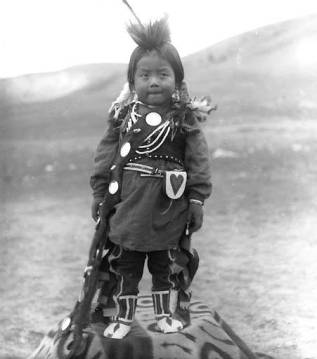
Photographer Latham, Edward H.
Collection Edward H. Latham Collection #. 409
Repository University of Washington Libraries. Special Collections Division
Editor’s Note: It was historically custom in the United States to displace native children, putting them into boarding schools to accelerate cultural assimilation. They were given new names, denied family connection and forced to drop their native languages and traditions. Then, during the ’50s and ’60s hundreds of Native American children were given in adoption to white families, another attempt to transracially and transculturally break ties with kin and tribe. This was The Indian Adoption Project, launched by the Bureau of Indian Affairs and the Child Welfare League of America.
That program is sometimes paired in references to The Orphan Train -1853-1929 – a mass adoption program which transported orphaned and homeless children from densely populated Eastern cities of the United States to rural areas to be put into the care of mostly farm families. The results were mixed, some children finding loving families and adoption but many ending up as free labor and otherwise abused. This was the beginning of the American foster care system. The difference is that however imperfect The Orphan Train, it was actually an attempt by its founder to do something good and kind. The boarding schools and The Indian Adoption Projects were about cultural genocide.
In 1978 Congress passed the Indian Child Welfare Act (ICWA) that errected significant barriers to the adoption of native children outside their tribal affiliations. In the case referred to in Lara’s article below, Veronica’s birth mother gave her up for adoption to a white family, denying Veronica’s willing and able birth father, Dustin Brown, custody. Brown is of Cherokee descent and the Cherokee Nation backed Brown in his fight for custody. There were many complexities, a contentious battle ensued and the case made headlines. Brown was arrested for custodial interference and Veronica was placed in the care of her paternal grandparents and Brown’s wife. [An earlier version of Lara’s feature was published in Dissident Voice in 2011.] Jamie Dedes
I am 59 years on the long road as an adoptee warrior.
In the past few years, my adoption wariness rose to a new level with the Baby Veronica [Ronnie] and Dusten Brown story. When asked how this tragedy affected me, I’d say, “I am Ronnie Brown 50+ years later. My dad would have raised me too.” I hurt to think about Ronnie. The adoption industry won again.
Ronnie’s story brought up memories of my own loss, isolation, grief, disappointment, what I call “anger turned inside,” and how it tore me to shreds. With the very real long-term effects of assimilation by closed adoption, I’d spent more of my life as a stranger to my own relatives. I hope Ronnie Brown won’t have this problem to endure. Her early life and her adoption are plastered on the Internet, literally.
My own recovery started when I read my adoption file in 1979 and saw my name Laura Jean Thrall. I was 22 and didn’t quite know what to do with this information. I’d hoped someone was looking for me. Sadly no one was. I didn’t get depressed or feel suicidal, but apparently many adoptees do hurt themselves, kill themselves, and suffer more than the world realizes. I pretty much faced everything head-on, like a car crash.
After reunion with my birth father in 1994, my story and journey became more about finding history. What is known today about the Indian Adoption Projects and the aftermath of Adoption Resource Exchange of North America (ARENA), few people even know it happened…but right here in America, Native children were taken and given to white people and missionaries and boarding schools for a reason. Every single Indian reservation has this story: Thousands and thousands of Indian children disappeared. The reason: kill the Indian (to save the Man) (to make him white), to eradicate our sovereignty to take more land.
Adoption was used as a weapon against American Indians and First Nations. Tribal children were sold into adoption, molded into American proto-types, our tribal membership erased. In some states, it’s still happening in 2015.
For the Lost Children of Indian Adoption Projects, blood is never erased by adoption. But with sealed adoption records, it’s made nearly impossible to reunite.
In the words of a Cree elder, “You must know where you came from yesterday, know where you are today, if you’re to know where you’re going tomorrow.” True. I’ve lived it.
– Trace Lara Hentz
© 2015, article, Trace Lara Hentz, All rights reserved; photograph, public domain.

 The BeZine
A similar story was played out in Australia from 1905-1969 and eventually led to a “National Sorry Day” in 1998 when parliament acknowledged their regret in creating a “Stolen Generation”.
LikeLike