Swann in the City

When I was a boy, probably long before you were born, I would deliver newspapers in the west end of Albany’s Arbor Hill.

Before I retired from tossing news to writing it, I suffered not much more than bruises and a knife scratch in conducting mobile commerce with the inhabitants of that eroding neighborhood. Needless to say, the tenor of business changed during and since my times there.

So many days now, I read or hear of another young guy, young like I was then, falling to a gunshot wound in my old streets. Some die. Most don’t. I sometimes worry that I don’t wonder much about it, though. I felt it coming.

I felt it in the steel of a razor on my chest. I could sense the momentum of it like I’d smell the miasma of cabbage and weed and spongy diapers in the hallways of Third Street and Livingston Avenue. Later in life, in my newspaper days, I’d recognize its cousin aroma in jails and prisons, the one with a soupçon or so of filthy bodies. It’s not an aroma you ever forget. Some of my old neighbors carry it on them like their tattoos to this day.

Every now and then, I’ll catch a whiff of it, and with a Proustian flash stronger than any almond cake, I’ll be whisked back to those times, a bag of newspapers over one shoulder and half my attention over the other. Today, the memories were dredged up by a request for a city poem. Maybe I’ll write another.

I’ve written plenty of them about my Albany, the city older than any of you live in across this vast land. It’s a small city, often with big city people moving through it on their way to even bigger ones. A lot of us came back here like salmon to spawn.

But there’s some things all cities have in common. We all have histories written in blood and sweat, which continue to drop on the concrete every day. We all know that young men catch bullets as easily in Albany as they do in New York, Detroit or Los Angeles.

I don’t know if that’s ever going to stop. But I understand where it comes from. I saw the snowball become an avalanche. I left only my bloody initials on the declaration of interdependence we call a street, a neighborhood, a city. I just hate to keep reading whole stories written that way.

– Joseph Hesch

© 2014, essay, Joseph Hesch, All rights reserved

Nine Gates: Entering the Mind of Poetry

Jane Hirshfield is a Zen Buddhist and her practice informs her work with spiritual insight and delicate nuance. She has said:

“It is my hope that the experience of that practice underlies and informs [my poetry] as a whole. My feeling is that the paths of poetry and of meditation are closely linked – one is an attentiveness and awareness that exists in language, the other an attentiveness and awareness that exists in silence, but each is a way to attempt to penetrate experience thoroughly, to its core.” [The Poetry Foundation]

Nine Gates: Entering the Mind of Poetry (September 1998) is a series of nine essays that were written by Jane  over a ten-year period and published or presented at poetry events.

*****

Gates are a means of exit and entrance, providing connection between the inner and the outer. The premise of Hirshfield’s book is that the art of poetry is the gate by which we are offered “mysterious informing.” Nine Gates is at once a primer for the reader and a manual for the writer. This is a book that is reverent of art, artist, and life. All is sacred ground.

The book begins at the beginning – the root of poetry – Concentration.

“By concentration, I mean a particular state of awareness: penetrating, unified, and focused, yet also permeable and open.”

As she says, this is Huxley’s “doors to perception” and James Joyce’s “epiphany.” It is what I would call sacred space, and this focus, this concentration, “however laborious, becomes a labor of love.” In this chapter, I particularly appreciated the short discussion of voice: writers whose ear is turned to both the inner and outer have found their voice and thus are able to put their ”unique and recognizable stamp” upon their work.

The book closes with “Writing and the Threshold Life” and a discussion of the space into which a writer withdraws, liminal space. The writer, she tells us, becomes like the monk giving-up identity and assumptions.

“The person [in liminal state] leaves behind his or her identity and dwells in the threshold state of ambiguity, openness, and indeterminacy.”

This is all rather like the person going through a ritual transitions. Only after transition to this liminal space, neither here nor there, is community wholeheartedly embraced. To see clearly and to embrace the whole without judgment, one has to be free of the standard cannon and the received wisdom. The idea being that the creative life is one that gives up the ordinary conventions, which is the price of freedom.

Encased between the two portals of concentration and the threshold life are discussions of originality, translation (what we learn from the poetry and linguistic traditions of others), “word leaves” (images), indirection (the mind of the poet circles the poem), inward and outward looking, the shadow side of poetry (between the realms of heaven and hell), and poetry as a “vessel of remembrance.”

The book’s range is broad, using poets and their wisdom from ancient times to modern and from East to West. The essays are at once a delicate lace and a sturdy practical homespun. All is approached with respect, clarity, and intelligence. Each chapter is a gentle nudge toward more authenticity, greater truth, deeper spirituality. In her introduction, Jane Hirshfield says that because the essays were written at different times some themes and quotes are repeated and removing the repetitions proved impossible. I felt the repetitions served to reinforce. I was grateful for them. If I have any difficulty with this book, it was the conflict between not wanting to put it down and wanting to put it down to start writing in the spirit of entering the mind of poetry. A definite thumbs-up on this one.

An award-winning author and poet, Jane Hirshfield has published seven collections of poetry in addition to Nine Gates: Entering the Mind of Poetry, a collection of essays. Her most recent book of poetry The Beauty: Poems is scheduled for release in March 17, 2015 by Knopf Doubleday Publishing Group. In collaboration with Mariko Aratoni, Hirshfield edited and translated four volumes of poetry by women of ancient Japan.

– Jamie Dedes

© 2014, review, Jamie Dedes, All rights reserved

Beneath the Surface

Look up and see the sun,
brilliant and refracted
as only winter can
shatter
d~a~y~t~i~m~e.
The chill surrounds you,
urging you to doze
like the trout,
suspended in three dimensions
to drift aimlessly
around that calm wash.
But you can’t.
You must stalk and capture
those
bubbles
you see
against the sky,
each their own
SUN,
providing light and life
in the cold below the cold.
That’s where life exists
as it does above,
just slower and without escape
unless someone breaks
the white glaring firmament
to reach
for
your
hand,
if they know what goes on
there
beneath the surface.

– Joseph Hesch

Thomas Hobbs v. The Family Cat

Courtesy of National Portrait Gallery, UK.

Thomas Hobbs, English Philosopher, 1588-1679

“The life of man, solitary, poor, nasty, brutish, and short.” The Leviathan by Hobbs

vs.

Photographs courtesy of (c) Karen Fayeth.

Gypsy, American blogger, bon vivant, and foodie, 1999 –

“The life of cat – adored, rich, gracious, gentle, and long.” Gypsy.

IT’S A CAT’S LIFE.

– Jamie Dedes

Out of the Box

At the end of your life, what will you have to show for it?

The question hurtled across the dark room and caught a ray of light as it passed the door that someone had left ajar. Institutional light.

What’ll you make of yourself? The words howled down the corridors of a time past when she had allowed other people to define her life.

She pulled the ratty shawl she’d knitted tight about bony shoulders covered by a layer of crepe-like skin and rued the dropped stitch she hadn’t bothered to catch as it slipped yet another row towards the mustard-stained fringe.

At the end of your life, when death draws near . . .

The question bounced around in her skull like ping-pong balls in a Lucite box smeared with little kids fingerprints. It was powered by air, she recalled—a project at a science fair that demonstrated random molecular movement? Yes, that was it.

The box was broken now. Molecules split to atoms to neutrons, protons and electrons. And more recently, quarks—whatever the hell they are.

The shattered box of her beliefs, strewn about and discarded like clothes too tight and out-of-style. Like toe-crushing shoes.

She fingered the blanket, threading her fingers in and out of woven sterile cotton: institutional warmth, or lack thereof.

The conundrum chased her around the corners of decades. It unfurled and breathed heavily on the nape of her neck–raspy, persistent. Or was that her roommate once again in respiratory distress?

Her hands lay before her. They were still now—old, used hands with see-through skin. Gnarly knuckles that appeared warped and disfigured like twigs from the oak tree in her backyard. (At home, not in this place).

Hands that had touched, caressed, soothed. Healed even. And sometimes caused pain.

Her distended veins bulged: rivulets crossing the map of her life. She pushed back her skin, stopped the flow, released, and watched dark corpuscles stream back in, carrying life-giving oxygen to her cells. One more day of life—or at least a part of one.

Good-looking veins, she thought, but deceptive like her life had been. Stick a needle in that fat one and it’ll blow or roll.

That’s what fifty plus years of nursing did for her. The knowledge of veins, arteries and blood. And shit, piss and vomit. And worse—much worse. At the end of her life, what would she have to show? That she could read blood vessels?

Service can pass for love, she knew.

If she were her own patient, what would be her diagnosis of herself. Her mind clicked into scientific mode and she began to reflect.

Subjective:

There was the hard, hard heart she carried in a steel box inside her hollow, hallow chest. This woman can’t afford to feel in the face of so much loss: dead babies, dead everyone. Nope, too dangerous look at the subjective. Think it’s better to pass on that one.
A cool breeze blew in from nowhere, walked down the juts of her vertebrae and settled at the base of her spine. Fanning out, the chill expanded and squeezed about her body to embrace the emptiness.

Objective:

Well, these were the facts. Two dead husbands; one dead daughter; a son gone missing; a divorce. Six dead dogs, one cat still alive. Not much money in the bank; a vacant, paid-for house, watched over by a neighbor (along with the cat, of course). A 12’ X 7’ cubicle in a room of three old ladies, surrounded by beige curtains—a hiding place, a box. 13K plus change in credit card debt and no one to leave it to. Ha-ha. A mind that bounces from here to there, imprisoned in a withered body; layers of skin that hang like empty sacks; lost promises.

A memory tossed her into the past: the day they’d painted their house a bright yellow with white trim: the happiness of the color and the joy of standing hand-in-hand with her second husband—the one she really loved because he loved her, too.

She shooed that thought away. Can’t afford to feel, remember?

Assessment:

The box is smashed and fragments of a life that could have been poured out. The diagnosis is clear: Altered reality; meaning deprivation related to . . .” To Nothing.

She’d read an obituary that morning about a woman who had it all wrapped up and tied with a bow, it claimed. Died in profound peace, it said. This mother, wife, friend knew where she wanted to go and went there, or something to that effect. They outlined it for the obituary readers: died surrounded by loved ones who would attend the funeral in the church, it promised. Neatly placed in her box. Amen.

Plan:

That’s what she needed: the answer to the question, she decided, wasn’t in this place. She knew it wasn’t this—not a box-room filled with white sheets, white blankets and a white commode chair. Not the sickly smell of urine and dirty dentures and not a hand-knitted shawl with a dropped stitch and a mustard stain on gray yarn.

She needed a plan with color.

Dragging her legs, numb with cold, to the edge of the bed, she reached for her walker and grasped the rubber handles encrusted with grime—particles of food and feces—and hauled her ass into a standing position. She shuffled slowly into the open corridor with its fluorescent white sheen. Her droopy butt lay bare for all the world to see beneath the open back gown of flimsy gray and pink cross-hatched fabric bleached almost white.

She crept along the hall, stopping briefly at the crash cart that reminded her of OPI “Big Apple Red” nail polish. She palmed the vial of potassium chloride from the unlocked drawer of the cart, concealing it along with a 22 gauge, 1” needle and 5cc syringe. A scarf would do for a tourniquet, she figured and alcohol was academic, wasn’t it?

Approached by the evening shift nurse she requested an AMA. The LPN called the social worker but patient rights won out. As she signed the papers discharging her Against Medical Advice, the team called a taxi and the MD then helped her box her few belongings.

The plan was coming together.

At the end of your life, what will you have to show for it? The phrase rattled in her tin box heart as she slipped the key into the lock of her front door.

Musty odors of cat litter and un-lived-in, unclean linens overwhelmed her.

Purty, her cat mewled with excitement, threaded between her legs, stroking her back to life. Exhausted, she plopped into the overstuffed chair in the front room. A burst of dust enveloped her, but she was home.

She sat there till the early morning sky allowed light to slither around the edges of the curtains.

Purty curled up in her lap and purred and purred. Reaching over she pulled the blinds allowing sunlight to fill the room. Yellow sunlight bounced off yellow walls in her yellow house. It was still there, the yellow she remembered. Joy slipped in.

She thought about the drug stashed in her purse with the syringe, but let it be for the moment. Stretching out her weary limbs, she stood as Purty leaped to the floor.

I need another day she thought and decided in that moment it might be wise to reevaluate her plan. Instead, she wandered through her house in search of color and meaning. Purty, her calico cat, followed her everywhere.

At least have time to find something to show, she told herself, smiling that the last words on her chart were AMA, not RHC. Respirations Have Ceased. Smiling that she was, indeed, OOB.

No, not Out Of BedOut of the box.

As a nurse, I spent much of my time working with the elderly. This fictional account imagines how a retired nurse could feel about her life…if she didn’t have something to turn to–like writing! A bit of an explanation: in nursing, we applied the scientific method to patient assessment using a method called S.O.A.P–that’s what the Subjective (How are you?) Objective (What the nurse can notice) Assessment (Making a nursing diagnosis) and Plan (What to do about it) refer to. Don’t know if this is how it’s done right now…but it’s a good way to problem solve in any life situation. Try it with a problem you’re facing!

– Victoria C. Slotto (Victoria C. Slotto, Author)

© 2011, short story, Victoria C. Slotto, All rights reserved

she leaps from the cleavage of time

she’s present
returned to bite through the umbilical of tradition,
to flick her tongue
and cut loose the animus of our parents,
like a panther she roams the earth, she is Eve wild in the night,
freeing minds from hard shells
and hearts from the confines of their cages,
she’s entwined in the woodlands of our psyches
and offers her silken locks to the sacred forests of our souls ~
naked but for her righteousness,
she stands in primal light,
in the untrammeled river of dreams
the yin to balance yang
the cup of peace to uncross the swords of war ~
through the eons she’s been waiting for her time
her quiet numinosity hiding in the phenomenal world,
in the cyclical renewal of mother earth,
whispering to us as the silver intuition of grandmother moon
she, omen of peace birthed out of the dark,
she is the revisioning of the Divine,
nonjudgement forms her backbone
her love is unconditional
even as tradition tries to block her return,
her power leaps from the cleavage of time

)0(

– Jamie Dedes

Original water color by Gretchen Del Rio

©2013, poem, Jamie Dedes, All rights reserved; illustration, Gretchen Del Rio, All rights reserve

Illustration ~ this lovely watercolor painting by Gretchen Del Rio with its girl-tree, panther and other spirit animals seemed the perfect illustration for my poem on the spiritual return of the feminine. The real back-story on the painting is just as interesting. Gretchen says, “I painted this for a 14 year old Navaho girl. It is for her protection and her power. She sees auras and is very disturbed by this. She is just amazing. Beauty beyond any words. You can see into the soul of the universe when you look at her eyes. She has no idea. I loved her the moment I saw her. My blessings for her well being are woven into the art.” Such a charming piece. I posted it full-size so that everyone can enjoy the detail. Bravo, Gretchen, and thank you. J.D.

Pondering – on silence


389px-Faras_Saint_Anne_(detail)I was reading about John Cage today and his famous piece, 4’33”. As you may know, that is a composition conceived in 1952, meant for any instrument (or combination of instruments), and the score instructs the performer(s) to not play the instrument(s) during the entire duration of the piece, which is meant to consist of the sounds of the environment that the listeners hear while it is performed, although it is commonly perceived as “four minutes thirty-three seconds of silence”.

The reason why I was reading that is less important, the irony was that there was an awful amount of noise around me while I was plunging into Cage’s reasons to write a piece about silence. Now, precisely at the time when I was sort of praying for a miracle that would stop all that noise, my eyes fell on the fragment quoted below:

“In 1951, Cage visited the anechoic chamber at Harvard University. An anechoic chamber is a room designed in such a way that the walls, ceiling and floor absorb all sounds made in the room, rather than reflecting them as echoes. Such a chamber is also externally sound-proofed. Cage entered the chamber expecting to hear silence, but he wrote later, ‘I heard two sounds, one high and one low. When I described them to the engineer in charge, he informed me that the high one was my nervous system in operation, the low one my blood in circulation.’ Cage had gone to a place where he expected total silence, and yet heard sound. ‘Until I die there will be sounds. And they will continue following my death. One need not fear about the future of music.’ The realisation as he saw it of the impossibility of silence led to the composition of 4′33″.”

And lo! While I was reading that, the huge noise around me stopped, and I was able to hear the music of my neurons, chewing on the relative silence suddenly fallen upon my surroundings . Quite a poetic coincidence, if I may add.
But coming back to the point, what people grew to call as “silence” is merely the absence of sounds. An absence otherwise relative, as demonstrated by the quote above – for our own body always plays its own music, above the absolute state of silence. Sometimes we like it, sometimes we don’t, simply because silence, like all things, is sometimes necessary, and other times it should be replaced by something else. There can be silence in the middle of the storm, as well as it can lack in the middle of some anechoic chamber. What matters most is not the physical silence that we experience, but the mental one, when the mind comes to that state of silence called peace – because that is when we actually “hear” our soul.

– Liliana Negoi (Endless Journey and curcubee în alb şi negru)

© 2013, essay, Liliana Negoi, All rights reservedIllustration ~ St. Anne by an anonymous painter in Faras, which was a major city in Lower Nugia between what is now Egypt and the Sudan. It is housed in the National Museum in Warsaw and the photograph of it is released into the U.S. Public Domain.

Nostalgia

Oh, boy.  It’s a dangerous thing to invite a widow and empty-nester to post a blog on the theme Nostalgic!  Contemplating the past can lead to maudlin stretches and lots of used Kleenex™, even if I don’t have a glass or two of wine first.  I don’t think that would be at all edifying to the blogging community, so I’m going to try hard to steer away from that.  I hope to write and show something that is true about a time that has come and gone.

Life is characterized by impermanence.  Our kids don’t stay little; our loved ones don’t stay alive forever.  What we live is present moments.  If we try to hang on to them and make them more permanent or attach our happiness to them, we are in for a world of frustration.  As we get farther away from present moments, it’s hard to remember what they were really like.  We lose perspective.  That wonderful family outing…did I yell at the kids that day?  I don’t remember.  I probably lost patience at least once.  Did my kids remember that?  How did they feel?  How did they heal?  Or is it all, as my mother often puts it, ‘a merciful blur’?

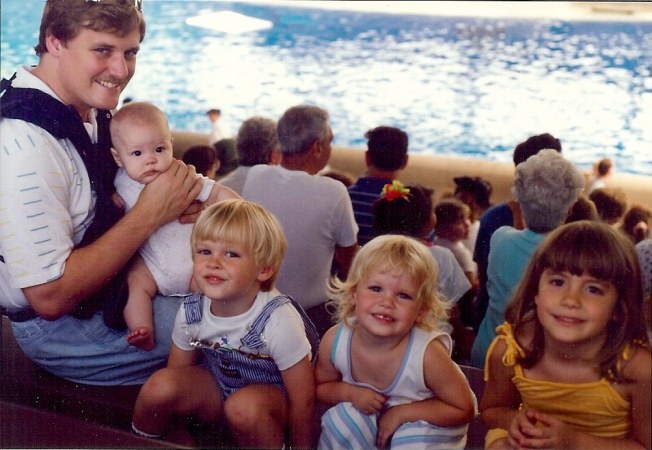
Brookfield Zool dolphin show, August 1991. Jim (RIP), Emily, Josh, Becca and Susan (who will be wed in less than three weeks).

In my current life, I see a lot of families on outings with their children, since I work at two different family museums.  Families interact in all sorts of ways.  I try to look at them with compassion and tolerance remembering what I can about how challenging it is to raise four kids at one time.  The important thing is to BE KIND in the present moment.  With your kids or someone else’s.  If the world is to be a good place to live, it’s important that all seven billion of us humans remember to BE KIND.  And this is not a glib solution.  If you think deeply about being kind, you’ll see that it is a profound power in the universe.   BE KIND to your fellow humans.  BE KIND to every living thing.  BE KIND to yourself first, and feel what that is like.  It is peace.  It is well-being and health.  It is life.  Don’t settle for feeling nostalgic about a time when you felt the world was a kinder place to live.  Make it a kinder place to live this very moment by acting kindly!

– Priscilla Galasso (scillagrace)

© 2013, essay and photographs, Priscilla Galasso, All rights reserved

nomenclature…

nomenclature
aunt bea
said
i've figured out
why people
don't believe in
global warming
it's got 
the wrong 
name
people see
and 
hear about
ice floes into homes
superstorms
around the world
these hot 
and cold 
flashes of weather
make people say
you call that
global warming
we need a name
that matches the symptoms
the earth is experiencing
a term that conveys
the extremes 
of the earth's moods
and 
the difficult times
ahead for
mankind
i'm recommending
global menopause
there's a term
even a politician
will be able 
to comprehend

– Charles W. Martin (Reading Between the Minds)

© 2013, poem and illustration, Charles W. Martin, All rights reserved

From Imen With Love

1426548_493414027428304_360525756_nOriginally published on Plum Tree Books Facebook Page
.
From Damascus to Istanbul: a child’s memories of a city . . . 
.
Dear Yasmin,
.
This morning, I saw the first jasmine flowers on our balcony.  They reminded me of you. That’s why I decided to write this letter.
.
We live in Istanbul now. I have new friends and I am learning Turkish. My parents never changed their habits. My father still smokes his hookah while he reads and my mother plants flowers everywhere to feel like our old house in Damascus.
.
Wasn’t it Mahmoud Darwish* who wrote once “Jasmine is a message of longing from nobody to nobody”? They named you after it. Everyone loves the way jasmine clutters like snowflakes at the sides of the road, falling everywhere and scattering scent to greet everyone.
.
Every city has its smells. My grandfather told me once that the heart of Jerusalem smells of spices and musk and Jaffa of oranges and the sea. He said smells are nostalgia and memory and the person can never forget them. Damascus alleys and houses smell of jasmine and rose water. It seems like an eternity passed since we left months ago, since I woke up to the sound of Feirouz singing and smells of freshly baked bread and my mother’s early morning ritual of making coffee and watering the garden.
.
The day we left, she put her gentle hands on my shoulders and gazed at me. Her hazel eyes were full of tears and she said: “Habibi, we have to leave. Go pack your things”. War already broke with news of bombed neighborhoods and dying people reached us daily. My parents tried to keep me away from its ugliness, to cocoon me in a world of poetry and flowers, but the war reached our little world and destroyed it.
.
The war brought death and fear. Houses were ruined. Most people fled. I always ask my mother about you. She said that you left with your family to go Jordan and that you would write to me soon.
.
When we arrived in Istanbul I was angry and my mother silent. We packed what we could take with us; some clothes and family albums, some poetry books my father used to read, a silver ornate dagger that belonged to my grandfather. I took a picture of us together, feeding pigeons in the square of the Umayyad mosque.
.
Istanbul is not so strange, Yasmine, they have bread sellers in the streets, big Bazaars and very old houses of wood, and a long bridge I can see from the window of my auntie’s house. The Adan comes from different places. There are pigeons in squares too. It is a big busy sleepless city. I love my auntie’s studio. It is full of paintings and its windows are always open to let light through. Stillm I felt lonely at the beginning because children did not understand me.
.
I miss Damascus, the clean cats of our neighborhood and my school friends; I miss our trips to Quassioun and watching people dancing dabkah at weddings. I am still waiting for your letter, but now I will send you mine with the first flowers.
.
Didn’t you always love when I told you stories?
.
Firas
.
Mahmoud Darwish ~ Regarded as the national poet of Palestine, he focused on the universal experiences of loss, exile, and identity.
.
Translations:
-Yasmin: a female Arabic name “jasmine”
-Firas: a male Arabic name “perspicacity”
-Feirouz: a very famous Lebanese singer
-Adan: prayer call
-Habibi: “my darling” in Arabic
-Dabkah: a Middle Eastern dance
-Quassioun: a mountain in Damascus
 .
 ©2013, letter and photograph, Imen Benyoub, All rights reserved
.

A Dream

photo 1-2A jar of tears
Resting on the grass
Beside a stone grave
Covered with diaphanous scarves
Knitted from April sunlight
And pearly beads made of dew
I know she was here

At dawn
She opens up like a black tulip
And in my way to nowhere I see her
Her face is a white cloud
Kneeling in a silent moment of prayer

At twilight
She collects a rising star
And the silver crescent of the moon
And disappears like a column of smoke

Spirits chanting hymns of the night
Lanterns floating
In the silky darkness I follow
A thread of light left behind
To the heart of the woods

Oh guardian with eyes like dark jewels
I am inhabited by a cry
There is a longing in my soul
In the vastness of the night I become a saint
A white dove, a wild flower
Haunting like a memory, aching like a wound
Under your touch

Dance
Let me kiss your bare feet
Until the earth gives birth
I want to get lost in the lines of your palm
Baptize me with your tears, with your breath
Until I am light, until I am free
Until the earth and I are one

– Imen Benyoub (The Bardo Group/Beguine Again)

© 2014, poem, Imen Benyoub, All rights reserved; © 2014, photograph, Jamie Dedes, All rights reserved

Sacred Space In All That Is

I am not quite done with the reading I wanted to do to create the final posting in the series of Sacred Space in the body, so I am going to share this recent post I wrote over at BeguineAgain.com.

…I was, I AM, I will always be…

Really, that’s the definition of the Holy Name that G*d passes on to Moses. This infinitive form of the verb “to be,” makes me think of even more! Reaching my fingers back through time and forward to the future.

Couple that with the declaration in the book of Genesis,

Let us make humans in our own image! Male AND female G*d created them

Lawrence T. Richardson expanded a bit on this. Instead of our traditional understanding that would be more of male OR female, G*d created them, it is male AND female. He is a transgender, queer-identified pastor, someone who has been created both male and female and claims both. Pastor Richardson talks of transgender people being the epitome of G*d since they are both male AND female rather than either/or. Now, I don’t really agree that there is a hierarchy of being most made in the image of G*d, but I do agree that the great I AM is embodied in all people.

One of the things I love about physics is the discussion of matter in regular plain-old Newtonian physics. Matter is neither created nor destroyed. Therefore, the dust that we experience has always been, is, and will always be. The things we breathe and touch that make us sneeze fits, have always been, are, and will always be. We are all connected through earthly and cosmic stardust (to dip into Carl Sagan’s language a bit). We, through our connection to the divine and through our connection to physical matter have always been, are, and will always be.

How can I not feel holiness, sacredness, the divine if we are not all connected?

stardust shimmers

ten thousand light years ago

birthing new life

It is at moments when I reflect on all that was, is, and shall be, that I feel fully connected and grounded in the Sacred Space in All That Is.

from the Hubble Telescope Infrared Horsehead Nebulae
from the Hubble Telescope
Infrared Horsehead Nebulae

Shalom and Amen

– Terri Stewart (Beguine Again)

Originally published at http://www.BeguineAgain.com

© 2014, feature, Terri Stewart; Photograph from the Hubble Telescope, Creative Commons License

The Invisible Spiral of Violence

What Christ Saw from the Cross

I am away working with youth affected by incarceration this weekend. I recently read the below meditation and found it to be moving. I hope you will also find inspiration. Terri

From Richard Rohr’s Daily Meditation
Center for Action and Contemplation

The Invisible Spiral of Violence

“If you cannot recognize evil on the level of what I call the world, then the flesh and the devil are inevitable consequences. They will soon be out of control, and everything is just trying to put out brush fires on already parched fields. The world or “the system” is the most hidden, the most disguised, and the most denied—but foundational—level of evil. It’s the way cultures, groups, institutions, and nations organize themselves to survive.

It is not “wrong” to survive, but for some reason group egocentricity is never seen as evil when you have only concentrated on individual egocentricity (“the flesh”). That is how our attention has been diverted from the whole spiral of violence. The “devil” then stands for all of the ways we legitimate, enforce, and justify our group egocentricity (most wars; idolization of wealth, power, and show; tyrannical governments; many penal systems; etc.), while not now calling it egocentricity, but necessity!

Once any social system exists, it has to maintain and assert itself at all cost. Things we do inside of that system are no longer seen as evil because “everyone is doing it.” That’s why North Koreans can march lockstep to a communist tyranny, and why American consumers can “shop till they drop” and make no moral connections whatsoever. You see now why most evil is hidden and denied, and why Jesus said, ‘Father forgive them, they don’t know what they are doing.’ (Luke 23:34) We don’t.”

Shalom and Amen
Chaplain Terri

Illustration ~ photograph of opaque watercolor over graphite on gray-green woven paper circa 1886 by James Tissot (1836-1902) and released into the public domain.

RICHARD ROHR, OFM is a globally recognized ecumenical teacher bearing witness to the universal awakening within Christian mystical and the Perennial Tradition. He is a Franciscan priest of the New Mexico Province and founder of the Center for Action and Contemplation. MORE

The foundational elements of The Perennial Tradition are: 1.) There is a Divine Reality underneath and inherent in the world of things. 2.) There is in the human soul a natural capacity, similarity, and longing for this Divine Reality. 3.) The final goal of existence is union with this Divine Reality.

– Terri Stewart (Beguine Again)

© 2014, feature, Terri Stewart, All rights reserved; illustration and book excerpts as indicated above

Tiny Miracles

Forgive me, blogger, it has been a month since my last post.

My only excuse is that I was out in the world.  All the stories I’ve seen and heard and lived have been patiently but eagerly contained, just waiting to be told.


In Poland and Lithuania, where we were traveling, World War II still casts a long shadow over the land.  That is a long, hard, sad story.


But little stories are everywhere, and more often than not, you will find stories within stories.  In fact, they will find you.

In Vilnius, even the walls contained stories.  We started to notice things, like faded Hebrew lettering on an old wall…

…Or a Star of David scratched in stone seventy years ago.

We learned that our apartment was in the Vilnius Ghetto, where more than 42,000 Vilnius Jews were imprisoned before they were murdered.

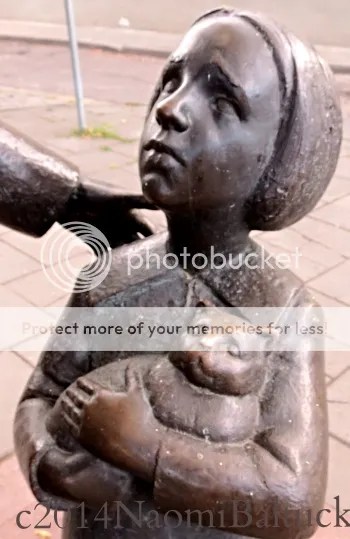
Near our place was a statue in memory of Dr. Tsemakh Shabad, a Jewish doctor in Vilnius.  A lovely young Lithuanian named Yrita gave us the inside story.

 The good doctor was loved by all, especially the children, and not only because he believed most childhood illnesses could be cured with a warm glass of milk and a bit of chocolate.

When a mother brought her little girl to him, that was what he prescribed.  They had no money for chocolate, so for a week he had the little girl come by every morning to take her medicine– a glass of warm milk and some chocolate.  Sure enough, she soon felt better.

When the little girl’s kitten fell ill, she knew just what to do.

She took her kitten to the doctor and asked him to cure it.

The doctor told her that in this case, they would forego the chocolate, and stick with the warm milk.  I’m glad to tell you the kitten recovered as well.

Though Dr. Shabad died in 1935, the children of Vilnius still visit him.  When they do, they rub the kitten’s nose and make a wish, certain it will come true.


 Yrita told us that for little wishes, you rub the kitten’s nose.  For very big wishes, you might need to rub the doctor’s nose.

 Sometimes wishes don’t come true, not even the little ones, and not all stories have a happy ending.

Sometimes the best we can do is to search for a little light in the darkness.  Sometimes you will find it in the most unexpected places.

Tiny miracles can be found everywhere– even in a bit of chocolate, especially when served with a cup of kindness.

 – Naomi Baltuck (Writing Between the Lines: Life from the Writer’s POV)

© 2014, words and images, Naomi Baltuck, All rights reserved

Conducive to Peace

I wanted to write something different on the theme of Peace, and my inspiration came last week. I was reminded of how easy it can be to get sucked into things like fear and anger, even downright hatred, on Social Media platforms like Facebook.

Image borrowed from http://hellenjc.wordpress.com

There can be no peace where there is fear and anger. Taoist teachings tell us that Fear, Anger and Hatred are inner demons which must be fought with Chi (which is a positive, inner life-force made stronger by Virtue). I was thinking about the idea of Social Media and how it can negatively impact us and was reminded of verse/chapter 24 of the Tao Te Ching:

“He who stands on tiptoe is not steady.
He who strides cannot maintain the pace.
He who makes a show is not enlightened.
He who is self-righteous is not respected.
He who boasts achieves nothing.
He who brags will not endure.
According to followers of the Tao,
“These are extra food and unnecessary luggage.”
They do not bring happiness.
Therefore followers of the Tao avoid them.”

Places like Facebook are prime examples of how easy it is to be manipulated into these kinds of emotions. Think about it, how often do you see people boasting, bragging, being self-righteous on Facebook? There is a lot of fear and hate-mongering, too; posts that are designed to inflame passions, create rifts and sow dissent.

Image borrowed from soulseeds.com

Keep in mind that there are plenty of things posted online that can be used to divide people — News, Social Media, Blogs, etc. All this “stirring up” is not conducive to Peace. Sometimes it is only when you step back from it that you can see the truth of exactly how you’re being used and manipulated and who is doing it. But you also have to remember that you allow it. Placing yourself in a situation where the inner demons will be provoked is not a good practice.


Image from http://img.photobucket.com/albums/v316/DragonKatet/peace2.jpg

So be mindful. Be aware of how the Media (of any sort) relies upon your emotional/intellectual participation for it to be effective and how that can affect your sense of well being and inner peace.

– Corina Ravenscraft (Dragon’s Dreams)

© 2014, feature, Corina Ravenscraft, All rights reserved; photos and illustrations as indicated above

Eye Before Flea

From the genius, Dan Piraro, and too funny not to share with other writers.
From the comic genius, Dan Piraro, and too funny not to share with other writers and grammarians.

Who Cries for Icarus?

IMG_0201
The Lament for Icarus by H. J. Draper

Spiral cloud mountains build in the sky, towering to 20,000 feet, I’d guess. Below, is the town of Douai, where we know Bloody Richtofen’s Jasta 11 calls home this month.

The golden disk to the west is setting and the Albatros scout planes rise to meet us. This is going to be a ripping scrap, I can tell. And then we are in a whirlwind of brown machines and red machines, red-white-blue cockades and black Iron Crosses all flashing by so fast that sometimes you can hardly keep your bearings. Like so many of these recent fights, everyone gets scattered across the sky. But I can’t look out for everyone when I have to do my other job, kill Germans and come home to Flora.

A red aeroplane with a yellow nose and tail whips past Cecil Lewis, and I take chase. I will get to 50 victories. I will get to 50. I must get to 50. He twists and dives and heads into the clouds and I know he can’t shake me. My attention is solely on his tail. I recognize the flash of the setting sun on his goggles as he glances fearfully over his shoulder at me, as I’ve seen that look hundreds of times before. I know it as sure as I know the booming of my own heartbeat in times like this.

I fire burst after burst into him, a drum of bullets from the Lewis on the top wing and 60 or 70 rounds from the Vickers gun in front of me.

I see him drop below me and I know he’s done. I see it all so plainly. The craziness and blood lust that overtakes me at such times ebbs away. And I think of my Flora, my Bobs again.

Then I break through the clouds, seeing from my altimeter that we’ve dove to only 200 feet. But the clouds are in the wrong place.
“Flora,” I cough, “why are the clouds below me and the church steeple above me?”

“Rest, Albert, lay back and rest.”

I fight the urge to rest, I have to get back to the squadron, get back to England, get back to Bobbsy. The glowing disk in front of me fades away. It’s not the disk of the sun, or my identity badge, it’s my spinning propeller. It stops and then I only see its top, hanging vertically like that stalactite church steeple in front of me.

And then that great noise.

“What’s going on, Bobs? Can I come home to you now? General Trenchard promised me I could come home now.”

“Yes, Albert, you can come home. You don’t have to hurry, though. We’re waiting.”

I see her face above me again, so beautiful, so young. Even now when I see her I can barely catch my breath. Yet her eyes are so very sad as I lay my head back in her lap. I feel raindrops on my face.

“Don’t cry Bobs,” I say.

****

Fifteen year old Cecille Deloffre had lived amid the sounds of war for a quarter of her life. She’d learned to sleep to the thunder of the big guns as if they were a summer rainstorm. She ignored the buzzing drone of the aeroplanes as they flew west-to-east and east-to-west each day, often punctuating their passage with the very unmilitary staccato drumbeat of their machine guns.

Cecille had seen some of these machines fall from the sky, glowing and tumbling like a cigarette tossed by one of those German soldiers hidden in the steeple of the nearby church in the village of Annoeulin.

This evening during dinner she had heard the fight above her home, sounding so much like someone had struck a hornet nest and the swarms spreading across the sky.

Then Cecille heard the sound of what could have been two aeroplanes directly above. Her mother crossed herself and tried dragging Cecille from the table to the root cellar beneath the kitchen floor.
She broke from her mother’s grasp and ran into the small fenced yard in front of their farmhouse just as one machine spit a tongue of fire back from its yellow shark-like nose, engine sputtering, gliding to a crash landing on the other side of the village.

She heard another aeroplane’s engine sputter and stop, just as it whooshed, upside-down, from the low storm clouds not 300 metres up the road. Its pilot wore no helmet and she could see his eyes but not his face in the growing dark.

Then the aeroplane just fell, like a an old leather-bound book dropped from a table.

Cecille stood frozen for a second to see if this machine would catch fire. But it only lay crushed on its side like a coffee-colored bird knocked from the sky by a kestrel. The pilot’s head move and she ran toward the aeroplane, unsure why, with her mother screaming after her.

As she came up to the crash site, the young man within the broken machine released his buckle and fell from the cockpit with a thud, a moan, and a faint rasping wheeze.

Cecille reached for the boy and pulled him a few metres away from his machine. She rested his head in her lap and he slowly opened his eyes, looking up at her with such longing that she couldn’t keep from crying.

“Don’t cry Bobs, Bobs, Bosshh…” she heard him barely whisper. Then stillness.

From behind them came the pounding sound of the jackbooted German soldiers from the steeple. They jabbered with delight, so sure they shot down a British flyer. But they hadn’t. Cecille noticed the boy had no wounds on his body.

Her eyes red with tears, Cecille looked down at the boy again and saw but a small bruise beneath his eye where his goggles had been. In her lap, the face of 20 year-old Capt. Albert Ball, MC, DSO, VC lay in silent repose. The sooty stain on it was variegated in white by the tracks of tears, like the half-smiling black marble bust of a saint. They were his tears and that of a beautiful young girl he briefly saw and was sure was the one he loved.

Cecille looked up at the surrounding soldiers and spat out, “Il est mort, Boche. C’est fini.”

But Albert couldn’t hear her. He had just won his 50th victory and he was flying home.

I guess this story shows when even a “hero” dies in war, he dies alone just like any other soldier. And who cries for him?

Joseph Hesch (A Think for Words)

© 2014, story, Joseph Hesch, All rights reserved