No weak Came
She’s blood out
Where do they
Call us for the
Muscles RAM
Signing you as
Anything but tag
There’s no.
Bio
Is this a story
or is it a letter
It truth because
How do you know
that Nika has that
short day as goddess
She’s been preforming
Ever since she succeeded
Which link searchable,
…writes for the news, and has been published in TheFashionSpot, The Faster Times, TheAtlantic.com, Racked.com, Sugarhigh Berlin, Blinkist, CESTA blog, Cultural Analytics, The Decadent Review, and is forthcoming in The AutoEthnographer.
Behind us, one tree flares up
a second-hand memory of Hiroshima.
Behind us, one solitary tree is Hiroshima, the blast-moment city.
We break our breads, sweet, too dolce,
with a promise of the cherries on top
in the middle, but not quite the real ones.
We suck those sugar-glazed red globes.
We have inherited the faux world,
and we feed the bird because life
feels like a taut skin at any moment
it can be singed, peeled away.
We should kiss—we think together.
The air in between us plays a refrain.
The notes scattered all over the park
to the applause of the pigeons.
One moment they are here; in the next not.
Bees
Without the bees
the world as we know it
will be stung to nullity.

I tell my daughter.
Her hand guards her eyes
as the buzz flares in

its sun-like buzz
spiking the ovulating breeze.
Music Left Me
The butter knife I strike against
the dish and the plate with
a soggy biscuit
spills some music.

The newspaper states that there
should be no note left
in my head.
The flash is—the music

has been last seen standing
holding the mast of a bridge
the authority forgot to build.
…an author, journalist, father, and editor of ‘Words Surfacing’, authored eight books, the latest being Postmarked Quarantine. His works have been translated into eleven languages.
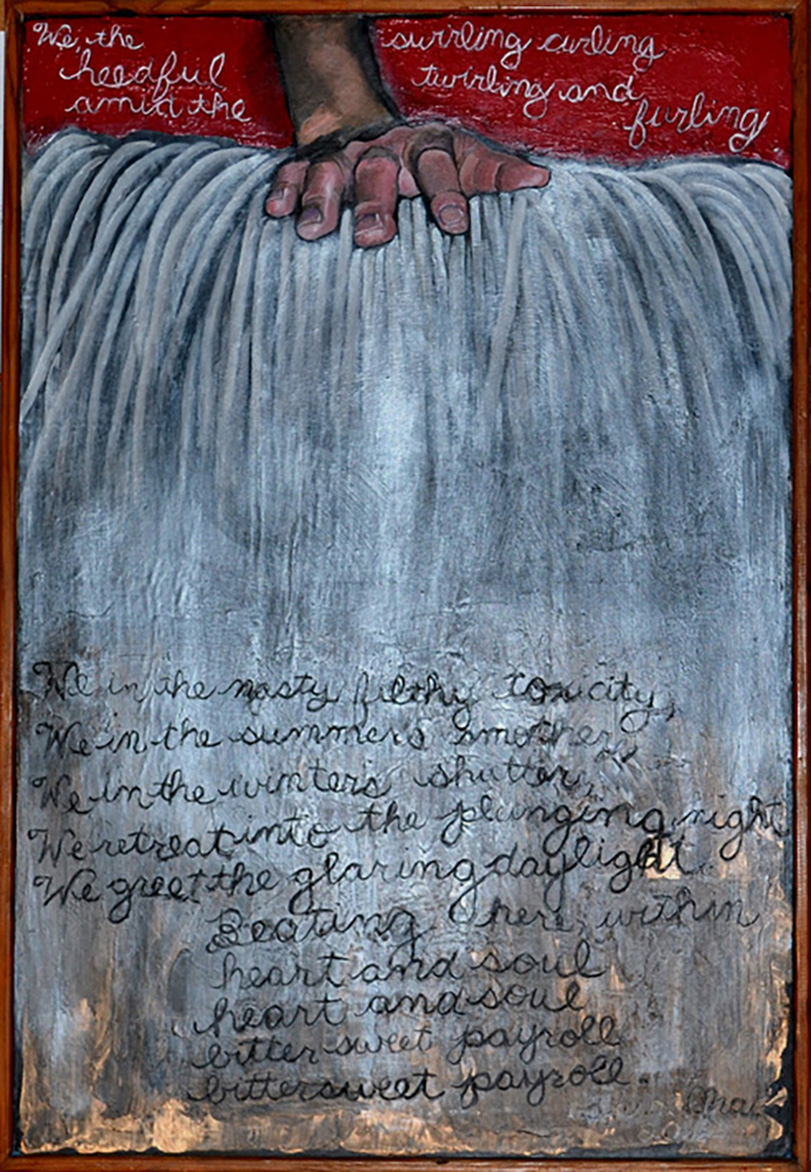
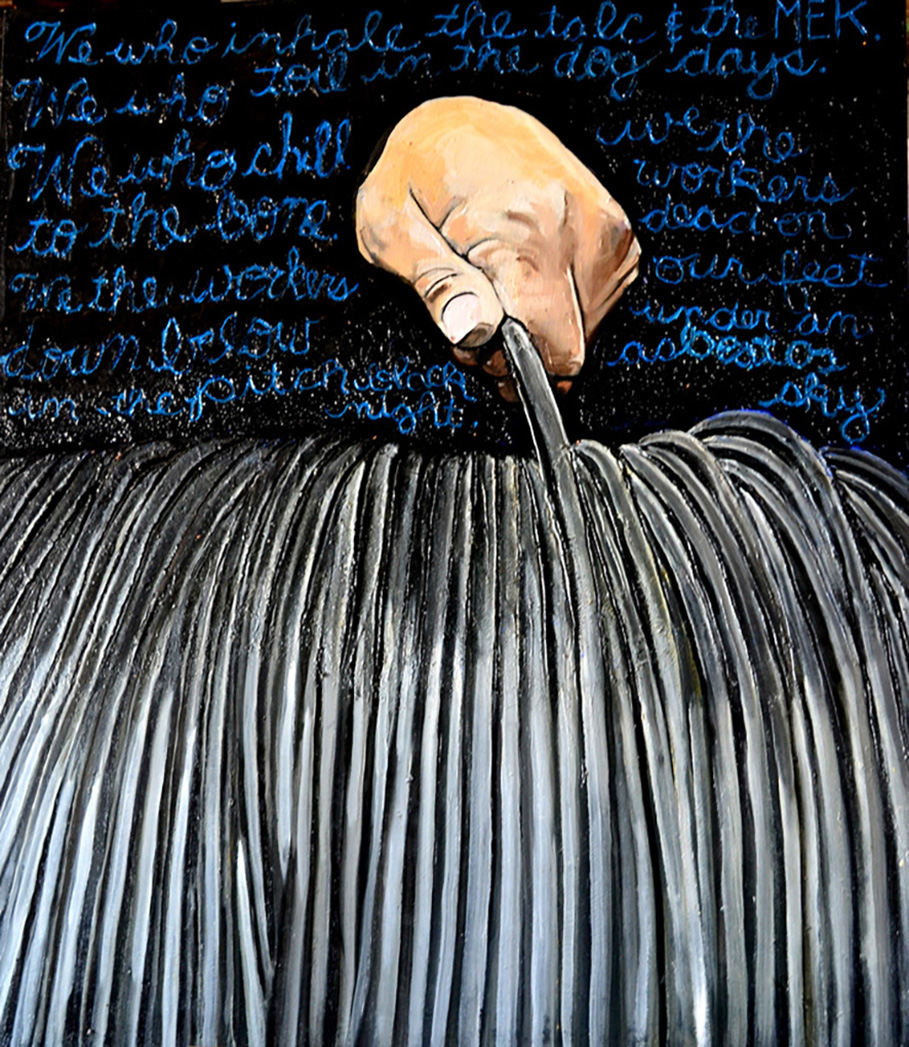
“We, the heedful between the swirling twirling and furling.
We, in the nasty filthy toxicity.
We, in the summers smother.
We, in the winters shutter.
We retreat into the plunging night.
We greet the glaring daylight.

Beating here within: Heart and soul, Heart and soul,
Bittersweet payroll Bittersweet payroll.
We, who inhale the talc and the MEK.
We, who toil in the dog days.
We, who chill to the bone.
We, the workers down below in the pitch-black night.
We, the workers dead on our feet an under asbestos sky.
Beating here within: Heart and soul, Heart and soul,
Bittersweet payroll Bittersweet payroll.”
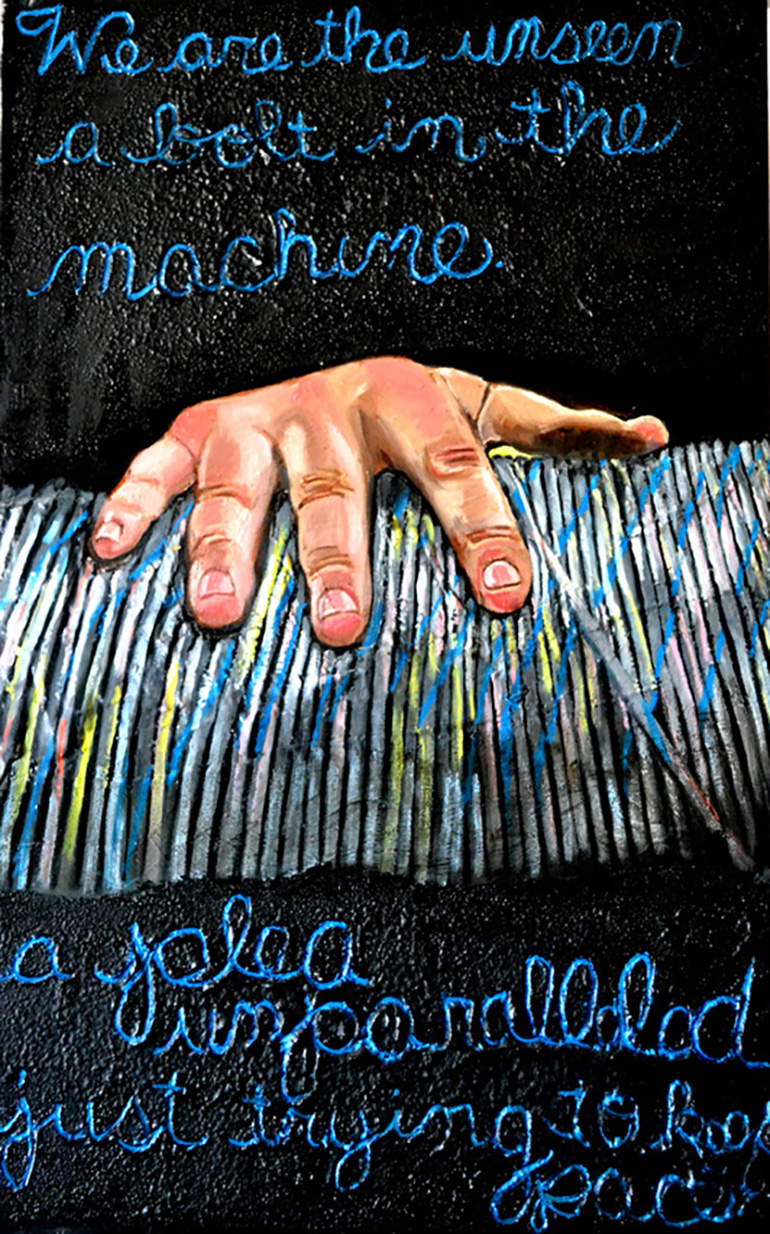
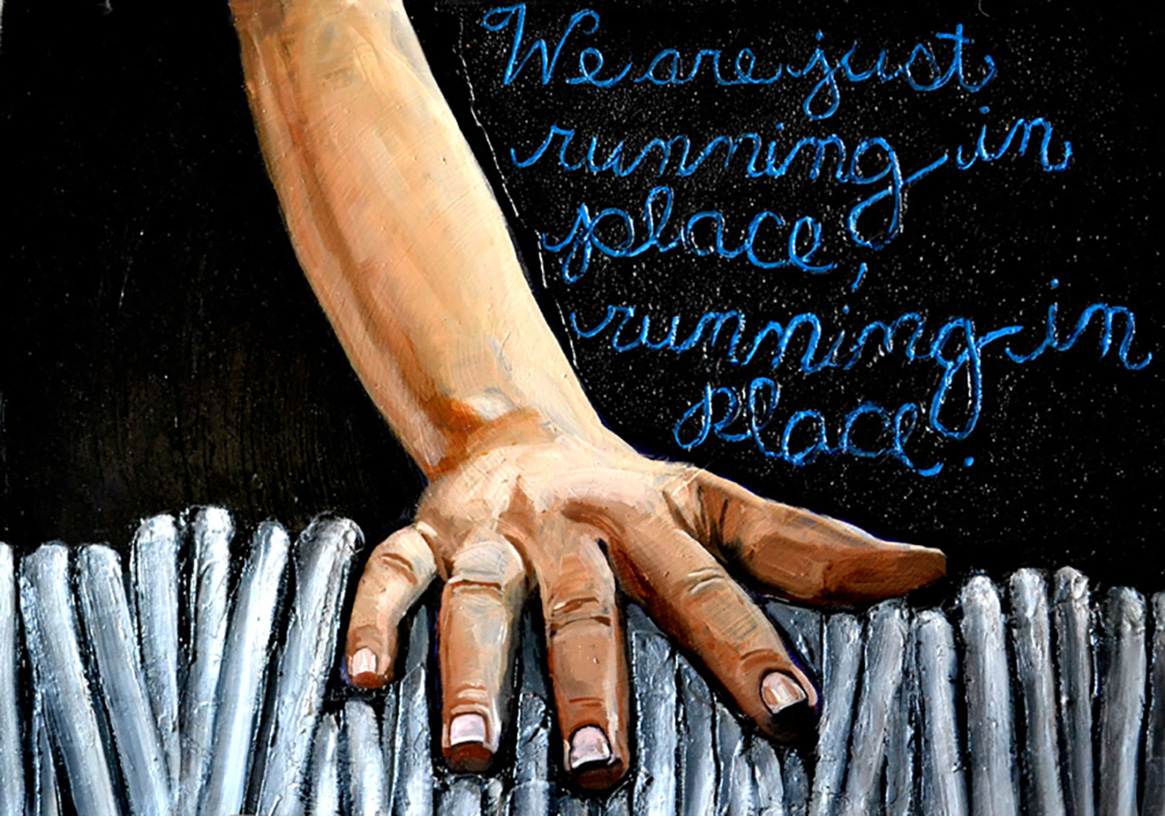
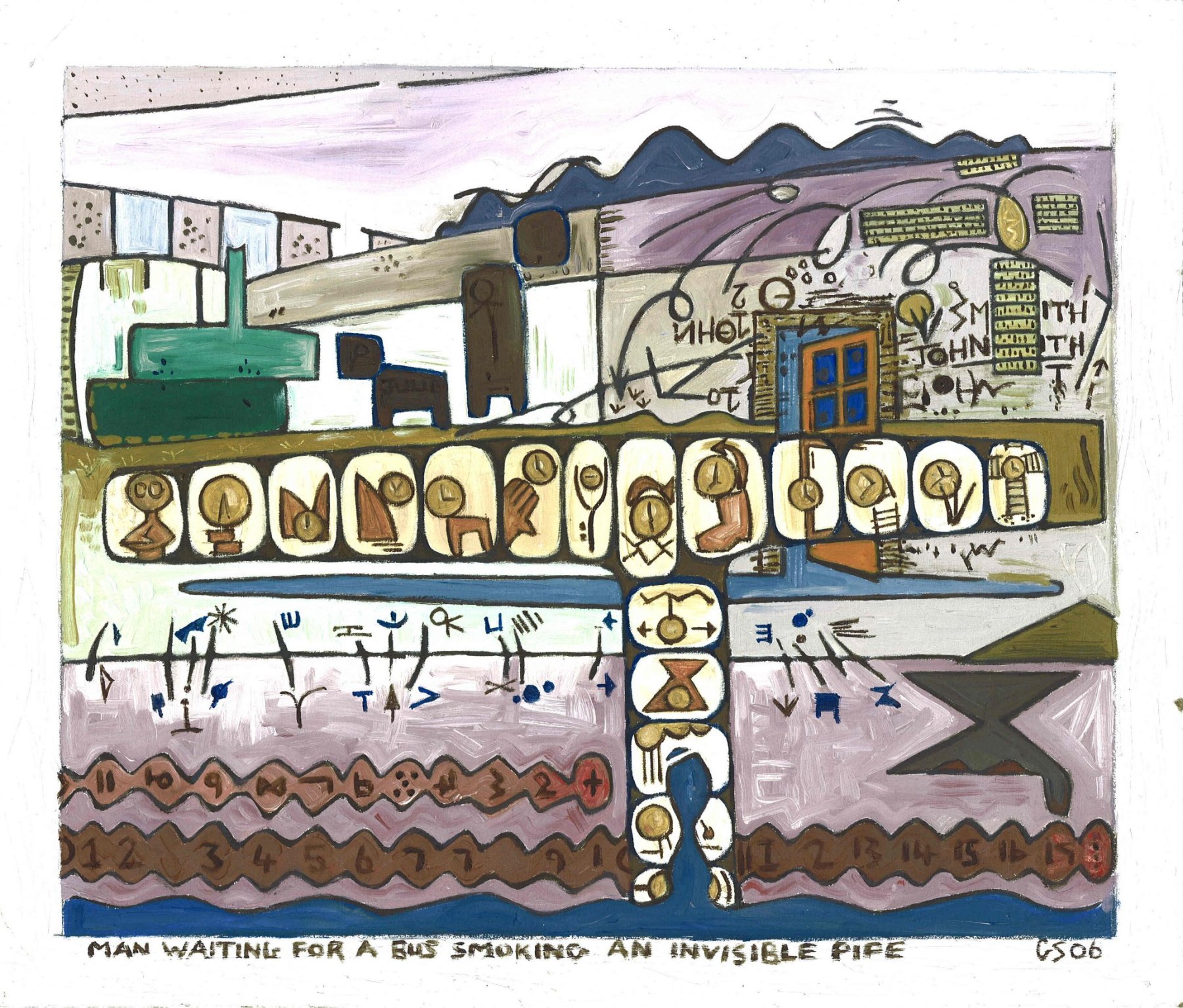
Artist's Note: Here is a series of five paintings with poems about folks (like me) who toil on a factory line. Every operator on the production floor is simply a pair of hands. His welfare is secondary as long as the quotas are met. Thus I focused on the hands of each employee. It makes no difference their ethnicity, Arab, Russian or Jewish. Their hands are all remarkably similar. All are hard working under harsh conditions for minimum wage. Let us also keep in mind that each seeks a decent home, health, a good education and better life for their children.
…is a painter, teacher and artist who writes poetry. From an early age she began journaling. The words soon became poetry and part of her paintings. She embosses the words into the paint. Ms. Chai has exhibited in Detroit, New York, Tel Aviv and various Kibbutzim, in group and solo exhibitions. Shira has been a member of Kibbutz Ein Dor since 1983. She has recently published poetry in ARC 25 and 26, journals of IAWE (Israeli Association of Writers in English).
Bigots have no spigots of charity
They burn bias with threaded needles
As a way of catching and trapping us
God save all our souls from this evil contamination
Of such wickedness and sadness.

Let us stand on the streets together
Tall and proud
And read poetry with each other
Hug and love with all our muster
To share a shining nuance of the wonderful
While this untenable world circumnavigates around
in crippling blindness
Life Could Be A Weapon for Change
Life could be a weapon for us to change, to live even,
To spread peach plenty about the shade,
To drink frozen oleanders,
To soften the pain of drone death and safe words.
Say your speech to wake us from wanton laziness
When in the near distance
People implode in pain and panic,
Sting entrenched pale in pus and puke.
If half the world is jerking like that,
We must not tell ourselves Christmas stories.
Drink drunken words that crash shields

Let your comfortable life quiver and unsettle.
We may all then might maybe come together
in a vast epic colloquy,
as in Odysseus with Telemachus
two great forces affirming the inchoate shape of
that uncertainly love.
How we face the world
Quote here—add return / line break
only if more than half-way across page.
Make regular block when adding this.
—Attribution (source)
Whenever tides spun avid
Wherever it was inevitably dark
Annie sang soft whisper memories,
of what was said quiet in her parents
bed.
At first glance she was a small circumference
in others views—
one gentle cell dreaming.

Her mind waters welled
like the tides blood
and Annie without knowing
why searched in her gentle blue
for Caleb a man all strenuous!
he of the mind’s rough face

His voice a rocket to Annie’s
stillness   Sometimes she even
thought quiet like a night star,
sometimes calm dreaming
her intransitive wonders running.

Caleb he burned too hot for her cool
she felt in this soft black cave the souls,
spirits of the balmy present, turning and turning
Annie could not reach the off switch
to silence restless Caleb burning.
She tried turning off that switch
To unwriggle his wrestling
ongoing transitive chaos.

And Annie bless her she said
I want to slide
not to possess
to roam not to own
Red periwinkles and blue hyenas
The best.
Palm Sunday Passover
This great tide of solar beginnings
Growth indivisible—beyond words
Such reawakenings
When we green ourselves
Sun spices everything stronger
A triumphant glare shows you
and her and the world wallows with us
all in now when life wells to a head.
Plant blooms bloom more
In a plethora of themselves
A grand annual rejoicing
When our faith strengthens
In silent joy that all is what it is
That we can be blooming now together.
How I Miss Him on Labor Day
My indomitable father was a man of unseen dreams
In all his grey garb he looked so gentle
Like a philosopher assembling life drifts.

Life and injustice forced him to get rock taut
Like those Herbeden’s nodes
Marking his knuckles so beady.

As a girl, to grow I had to challenge
That certainty he held so tight
Fear quiet there in his feeling And between us we gained
Mutual lifelong soul respect.

He would come to Grand Rapids and
walk with his beret and cane in the Labor Day parade
in honor of workers, of you and we, dignity
and of his daughter, perennially late sleeping me.
…is a poet professor musician who now lives in Michigan although her past is coastal and international: Spain and California. Author of four books of poems and finishing her next book, Sunfishing, Linda is a life-long activist, sun-lover and dreamer. She was raised in an activist family from the start. A hopeless romantic, sometimes inequities everywhere drive her to despair and to writing action.
The fear just really never went away of
someone different but the same,
whose passions are equivalent
but aimed at something opposite
to preferences my own body
will allow.

I work at understanding every day:
my family, friends, and strangers,
my father, passed away these
three years now. I think I understood
him decently but still, I hide my eyes
from photos of his naked boyfriends.
Dad’s computer was a minefield
and I wish he’d had a better way to label files but
I wish he hadn’t died in discreet steps as well.
I wish I understood the human heart, libido, soul,
all the bits which can get us
into so much trouble.

At twelve a man’s hand cupped my face
as I, an unaccompanied minor flew
to visit somewhere I’d been sent. He told me he
was helping with my cabin pressure headache
but I knew
what inappropriate meant.

At sixteen I was in my bed asleep,
a man was visiting from overseas-
some candidate for PHD, someone that
my father once had met.
My room contained the only bed for guests.
I told my Dad and Mom and later on, that man had left.

Standing in the concourse of Grand Central
once when I was seventeen
a gentleman approached, so interested in me
naive and parent free, his curiosity
was evident in how he followed
when I tried to leave.

At twenty-one I kissed a pretty girl
who had no interest in my kiss,
and turned away as I continued
to insist and hold her close to me
and told her she, mis-understood
her own desires.

When I started my own business I brushed the arms of
female hires as I spoke to them.
I told myself it had to do
with my communication skills and not
some psychosexual power thrill.
But maybe I know better now.

I hate the men who used me in and for my youth.
Their addled bodies changing them
into alarming brutes, reinforcing bias
towards a group attacked with bigotry, and I
learning to find pleasure in dislike of something unlike me;
ignorant of my own truths.

I wonder if my sins have caused
damage lasting over years,
irrational and complex fears or hatred aimed
at innocence, past
anytime it might have made
any kind of sense.

And here’s a man who’s speaking of his husband,
and it makes me feel uneasy
placing words in places that
they didn’t used to be, instead of maybe
wondering if someone else can try to have a try
to crack the code of trying
to be happy.
…lives in Connecticut and writes poetry to supplement his income as a commercial artist. He has been published in 30+ journals and anthologies and has made over $100.
You can find his work in Humanist Magazine, The Penwood Review, The Orchards Poetry Journal, Constellate Magazine, Caesura, Northwest Indiana Literary Journal, The Avenue, Meetinghouse, Newtown Literary, and many other
Chilly the room
the white walls

audible only
the echo of loneliness.

Not a tender word anymore
no warm embrace

just the time,
a leaking tap,
ticking.

None knocking at the door
nobody you expect,
no one, except death.
…is an internationally known poet, translator, publisher and promoter of modern international poetry. He writes short stories and literary reviews, but mainly poetry, so far 14 poetry books, published in 19 countries. As founder of the Belgian publishing house POINT Editions he published more than eighty collections of mainly modern, international poetry, he organised and co-organised several international poetry festivals in Spain. He is vice president of the Academy Mihai Eminescu, in Romania, and organizer of the Mihai Eminescu Internaional Poetry Festival. He also set up the internationally greatly appreciated project Poetry without Borders, publishing every week a poem from all over the world in 33 languages.
They’re there;
hollowed into make-shift sponge-foam beds,
tight-curled into malodorous rag-blankets
and plastic of dubious origin.

They’re there;
the shadow-ghost people
of no fixed abode,
gathered loosely together
in cohesive misery.

They’re there;
existing on society’s fringe,
sustained by the government’s pandering promises;
sharing glue-highs and garbage rot.

They’re there;
old children, dying people,
together in perpetual poverty.

They’re there;
trampled contours on grass verges,
silhouettes on street corners,
robotic vendors with nothing to sell
but themselves.

They’re there;
the street-people of forgotten causes,
unified in the rainbow nation
of lost hopes.
…was born in Johannesburg, lived in Durban, and now lives in Port Elizabeth. She won of the “Hilde Slinger” cup for poetry in 2009 and again in 2013, and the “Fay Goldie” cup for General Success in the World of Publishing in 2011, both from the South African Writers” Circle. Nine of her poems were published in “Signatures” an anthology of Women’s poetry (2008), and shre represented “Live Poets’ Society” in “Poetry Africa” that same year. In 2006, “A Scorpion Sings,” her first anthology, appeared. Other anthologies published between 2006 and 2015 are: “Count Catula of Shadoland & Friends,” “A Peace of Me.” and “A Scorpion Sings Again.”
Who cleaned The Capitol of the mess the mob left behind:
bagged spent spray cans and empty water bottles, body
armor and cigarette butts, hauled them to the dumpsters?

Who swept the littered floors of the Rotunda and Statuary,
Crypt and Speaker’s Office, collected into dustpans the
splinters of broken benches, shards of smashed windows?

Who scrubbed down the marble surfaces, wiped the scuff
marks of shoes from the patterned tile floors, removed
the smears of blood and feces from the sandstone walls?

Who draped plastic film over Madison and Adams, traces
of chemicals present on their portraits, a bust of Zachary
Taylor, too, his nose and lips still streaked with blood?

Who rechecked the chambers and offices, locked up, then
cleared out for the night, the secular sanctuary back safe
in their care, yet indelibly stained by a disorderly horde?
An American Tradition
On July 9th, 1776, upon hearing The Declaration of Independence read
aloud for the first time, General Washington and his troops charged
the Bowling Green. Those patriots, moved by Jefferson’s
words to remove every gilded symbol of their oppression,
hoisted ropes around the 4,0000-pound effigy of George III,
mounted on horseback, robed like the Romans, as they chanted:
Tear him down! Tear him down!
They then tore from its base that garish likeness of lead which had long
stood above them, smashed that cruel Crown to pieces, and, in
a most fitting reuse of that malleable material into matériel,
melted His Majesty into 42,088 musket balls. Then,
through volleys of musket fire, they returned the lead
from that loathed likeness and won their independence.
Kentucky as Usual
At the Derby, the thoroughbreds,
chestnut and palomino, brown
and gray, roan and black, each
bridled in bit and headstall, take
off at the shot of a starter pistol in
a race that lasts around 2 minutes.


Authentic gets off to a slow start, yet
in the stretch catches up with Tiz
the Law, goes head-to-head with
the bay stallion, yet overtakes
him in the end, wins by a length
and a quarter, with a time of 2:00.61


The first-place racehorse pays out to
his bettors: 1.8 million in all, and
though he’s awarded none of the
purse, all of which totals 3 million,
the public will remember his name,
more so than the owner’s or jockey’s.
On the hallway floor, Breonna Taylor lives well past 2 minutes, possibly 5 or 6,
coughs as she struggles to breathe,
after 7 officers draw their pistols,
then fire into her apartment, 32
times in all, trample down the front door.


For more than 20 minutes, in a pool of blood on the hallway floor, Breonna lies unresponsive, and with no medical attention, the emergency room technician dies at the age of 26, the time of death approximate,
listed on the certificate: 12:48 am.


To Breonna’s family, Louisville awards 12 million, none of which will bring her back, but like the bay colt who won the Derby, mostly unknown until Kentucky, she, too, leaves a legacy, rightfully remembered and honored, more than the winner of any race.
…,originally from San Antonio, Texas, currently resides in New York City, where he is pursuing a Master of Fine Arts in Creative Writing in Poetry at Columbia University’s School of the Arts. He has been published in Arts Alive San Antonio, Clips and Pages, Door is a Jar, DoubleSpeak, FlowerSong Press, Lone Stars, OneBlackBoyLikeThat Review, riverSedge, Synkroniciti, The Thing Itself, TEJASCOVIDO, Unlikely Stories Mark V, Voices de la Luna, Waco WordFest. His work has also been featured at the Briscoe Western Art Museum.
Can we compensate?

               Settle accounts
                             with the Black man
                             living in the ghetto?
               Recoup
                             the self-worth of the Muslim
                             woman who was spit at?
               Atone
                             for the slights in the communities
                             who banished the Irish?
               Indemnify
                             the Navaho for his beaten
                             and murdered grandfather?
               Make amends
                             to women who were denied
                             opportunities to be heard?

Probably not,
but we can support justice.

               Fairness
                             in our hiring practices.
               Due Process
                             in our renting policies.
               Equity
                             in our laws.
               Impartiality
                             in our judgements.

Still, it’s not enough.

               Eyes
                             have to see.

               Hearts
                             have to care.

               Arms
                             have to open.
On the Subway
Do you see me,
sitting next to you?
You push up your glasses,
and look past me,
seeking a mirror to talk to.

Your voice is soft,
kind perhaps,
as you smile and nod
discuss children and
slow transportation.

Being brown,
I don’t reflect you,
but she isn’t really a
copy either.
She’s taller,
like me
and she’s younger—
unlike you and me.

I speak English,
was born in California,
raised in Illinois,
have two children,
probably work in a building
near yours. Is there
nothing you can say to me?

I reflect sameness—
but not enough?
Maybe, I should speak,
but would you hear
if
you don’t see?
We hold these truths,
          Do we?
To be self-evident
          Not through much of history.
That all men
          Define men.
          No women though, right?
Are created equal,
          Whoa! Not Blacks—
          three-fifths of a person
          no property ownership
          no votes
          no signed contracts?
          Oh yeah!
          Property—
          not people.
…has won prizes in state and national contests and published over a hundred poems in journals including Clockhouse, Kindred, Halcyone, Canary, Ibbetson Street, Rockhurst Review, Naugatuck River Review, Orchard Street Press, Healing Muse and Bacopa Press. Her first book is titled When the Universe Brings Us Back, 2022.
I see your kind eyes shining out of those pictures
with your brothers and  sister
journeying from Africa to America
you came here because you wanted your mother to relax into old age
you wanted so much for your family
your hope, not forgotten after all these years

my breath is captured for a moment
I stare at the tv screen flickering out at me
I look at the holes where the gun shots poured in
just looking at those spaces, I want them filled back in
wanting the gun shots to disappear
wanting something, anything to take them away

I was imagining the policemen outside your door
the fear on your face, in your gentle hands
as they reached for their guns before reaching for thought
they were on automatic, aiming at a target
they didn’t ask your name or address
they didn’t ask anything of you

what happened to their feeling?
did it get lost as the gun fire let loose
did it get lost as your body splayed out in front of them
what happened to your humanity, your wisdom
your spirit that caught fire?

how could a wallet be mistaken for a weapon?
how could your beautiful face be mistaken for a killer’s?
as you stood and then fell down
blues fell with blood in that hallway


that blood stain could be seen for days years afterwards
even though they tried their best to cover it up

how treacherous is the journey to silence?
how treacherous is the journey to silence?

I wanted to tell you Amadou
the police were set free
but we will not let them forget
we will not let them forget the murder
because after killing, the blood can never be washed off their hands

and now, I imagine your mother
shaking in the night she was told her oldest son died
her whole body shakes in the blue night
her whole body shakes in blues
she carries that grief on her shoulders
In her chest, it stays inside her eyes
such sadness

what it must feel to lose a child?
to lose her oldest son
to never be able to look in his eyes again
to never be able to hold him
never be able to hold -   Amadou
she holds her head - Amadou
she says his name over and over again

she is sinking
she is sinking Amadou
she is lost in her memory of birthing you
of bringing you into this life
yet somehow she stays standing
she doesn’t surrender

and I too am remembering
I wish you the peace that comes with still, cool water
the peace that comes with the African sun rising over your tender hands
rising and wrapping cloth around your bullet wounds with love
and singing you home to your resting place
and singing you home
just singing you home with love
Dedicated to John Trudell (February 15, 1946 – December 8, 2015)
Santee Dakota Activist,  Actor, Musician, Writer and Poet
The great lie is that it is civilization, it is not civilized.
—John Trudell
When Black Elk, Heȟáka Sápa, the Lakota spirit man dreamed
He said that Indians moved in a circle
They did not move in straight lines

And you too danced in your own way
Never direct
Honoring the footsteps of your ancestors

You were a modern seeker
Standing firm on Alcatraz island as part of the Red Power Movement
It was a two year occupation, you demanded recognition for broken treaties that were strewn across open highways

Broken papers, broken ink that was swept over or swept away
By place names called Custer after the great American hero who was highlighted in official history books
By lies of a murderer who bulleted Indian bodies into the cold frozen snow

Oneday a line of fire flickered out across your family roof
Trapped inside the house were your pregnant wife, your mother-in-law and three of your children
They were killed in the fire
Even though the official word was that the fire's origins were unknown
You knew it was set, deliberate, the pattern on the roof was too direct

'I died then, I had to die, in order to get through it' you wrote
Your writing came to you as a gift at that time
Your poetry became your “hanging on lines”
Your writing came with such force that you could not refuse it
It overtook your spirit, it was your way to survive

Once you said that Indian people did not need to wait for a nuclear war
It was already happening on the land from the mining of Uranium

You loved the grasses, the high sacred Black Hills, the sunrise moving within you
You would not let their lies quieten you
You would not put down your weapons
Arrows flowing over your fingers

You opened your hands up
Seeking wisdom from the North
Your words fearless as they spun out in circles across the night sky
…is a poet, social worker, and activist who lives in New York City. She received a B.A. in creative writing from New School University and an M.F.A in creative writing from Sarah Lawrence College. Dorothy also works as a music journalist with a passion in African music. She has published journalism AfroPop with and Music Central, among others.
Recent poetry has been published with The BeZine and Fresh Words Magazine. More of Dorothy’s poetry can be found on her FaceBook page.
Behold this diverse
assembly of white, ghost
white, baby powder, smoke, snow,
ivory, floral white, seashell, cream and beige.

They have gathered
here today to navel gaze
and commandeer the concept
of diversity, to ascribe to their wide
array of whiteness a vast variety of virtues
which serve to separate white sheep from the goats
of many colors oblivious to the fact that they can only be
distinguished by the kind of melanin they have in their skin.

They are a most
heterogeneous throng of
parchment, antique white, bone,
eggshell, vanilla, alabaster, chiffon,
merino wool, rose white, and half and half.

Listen as whitesplainers
whitesplain their whitecentric
theology of a white God created in
their white image who miraculously sires
a white antisemitic Jesus from a Jewish peasant
woman to call white people to spread a white gospel of
white makes right to a white world washed white as snow.

Take a sober look
at this mutual admiration
society of coconut, frost, linen,
rice, powder, pearl, titan white, white
dove, white diamond and dazzling winter white.

Listen to the white whispers
of a white-skewed world view of
white supremacy reining supreme, white
politics and white socioeconomic policies as
the way to make America great again, “replacement
theory” as the replacement theory for critical race theory,
and nothing at all about black history long ago whitewashed
from the American history textbooks they read as school children.

What we have here
is a rainbow coalition of
simply white, oyster white, milk,
natural white, vivid white, cascading
white, cotton ball, whitewash, bright white,
and brilliant white. There must be 50 shades of white –
swan white, polar bear, paper white, delicate white, cake batter,
white sand, stone white, retro white, white chocolate and white on white.

They vow to own the libs,
this diverse assembly of white
alt-right, white radical right, white
far-right, white ultra-right, and white
extreme right, now mainstreamed alongside
the silent and complicit white conservative right.
Watch as their blizzard of whiteness ushers them into
a whiteout and they go snow-blind, unaware that a new ice age
has begun in their frozen hearts now entombed by the glaciers within.

Listen as they sing
“Jesus Loves the Little
Children” with not a red,
yellow, black or brown child to
be found among them. Span the rainbow.
Behold the children. All of their colors are white.
Change the Subject to Race
Change the subject to race in a room
of white faces in a deep red state
and watch blank faces with
glassy eyes take over a
tension-filled room.

Listen as the quiet speaks
and grows louder and louder
until the silence itself is deafening.

False equivalencies begin to drop like rain.
No dog whistle interpreter necessary.
The surreal is the new real for
anyone wearing blinders.

“The white cop may have
been trigger happy, but look at the
checkered past of the unarmed black man.”

“Maybe if the unarmed black man wouldn’t
have been struggling to breathe, the white
cop wouldn’t have believed he was
resisting arrest or kept his knee
on his neck for 9 minutes
and 29 seconds.”

“We wouldn’t need
more restrictive voting laws
which we call election integrity, and
others call voter suppression, if black voters
weren’t committing so damn much voter fraud.”

So it goes.

Blue Lives Matter eclipses Black Lives Matter
as if a job is equivalent to a human life.
As if a job equals a human life.

White Lives Matter
steals the stage as if white folks
have ever doubted that white lives matter.

Not to be outdone, All Lives Matter grabs
the mic, glosses over black lives with
all lives even though black lives
have never really mattered to
so many who have never
lived black lives.

Read the room.

The tension can be cut
with a knife.  Discomfort reaches
critical mass.  Artful redirection is on
deck.  Comic relief is waiting in the wings.

So it goes.  And so it goes.

I don’t want to say this.  I naively believed
we were becoming a post-racial society.
I was wrong.  We are becoming an
Orwellian post-truth society.

Where is the courage
to love those who don’t look
like us?  Let the vulnerability hangover
come.  I am white.  Take my heart.  Break it.

Paint it black.
A poker face will
not hide you forever,
and you can’t just co-opt a
moment of silence as an alibi for
donning an invisibility cloak every time
you feel uncomfortable. We are no longer
toddlers playing hide-and-seek, believing we can
hide in plain sight by placing our hands over eyes, as
if you can’t see me if I can’t see you. There you are. I see you.

The truth about how
we come to know and be
known is self-evident and eternal.
We cannot NOT communicate. We are
all responsible for our own communication.

Everything we say,
everything we don’t say,
everything we do, everything
we don’t do communicates something.

When our neighbor
is profiled, stereotyped,
slandered because of how he
looks, or who she loves, and you
say nothing, your reticence outs you,
gives you away. Your silence is deafening.

When decency calls for
something to be done, nobody
gets to say, “Why are you looking at
me? I didn’t do anything!” As if not doing
anything when something needs to be done serves as a
not guilty plea. Inactions, like actions, speak louder than words.

Do you honestly
believe that your sins
of omission will not find
you out? Didn’t you get the
memo? It’s not just the bad things
we do. It’s the good things we don’t.

Complicity masquerading
as innocence is cowardice placing
personal privilege above the needs of those
who are marginalized, disenfranchised, oppressed,
dehumanized, ostracized as “other,” brutalized, erased.

You may say with sincerity,
“I went into fight-flight-freeze,”
and I froze. There is no shame in fear.
We just can’t establish permanent residence there.

It comes
down to this:
Define or be defined.
The power of self-definition
is our first and last power. Our very
lives can be taken from us. The power to
define ourselves must be given away to be lost.
Who will define you? Who will define your legacy?

Ghost me
again, the next
time I am counting
hearts, and I might get the
impression that you don’t have one.
…is a Licensed Marriage and Family Therapist in North Carolina. He has written poetry for The Journal of Pastoral Care & Counseling, Soul-Lit: A Journal of Spiritual Poetry, and his short stories have been published in Ariel Chart International Literary Journal and Faith, Hope and Fiction. He has also written lyrics for songs recorded by a number of contemporary Christian music artists, including Brent Lamb, Connie Scott and The Gaither Vocal Band.
City Walgreens, plate glass, sunshine. Single clerk, single line.
            Customer’s wig: white peaks of frosting against blue-black skin,
            clerk’s brown cheek and close-cropped Afro.
They chat—smile, unload, check out—
            cart piled high.

Off to the side, I rehearse in my head
            quick question (razor blades? I must be blind )

Did I sigh?  Shift my weight?

The customer glares    growls
            The   line   forms
            behind  me

I jump into place a good ten feet back    cheeks surge red
            Stand there     feels like an hour
can’t bear it
            bolt from the store

Pound down the street.  Never get it right, thought I was polite
            off to the side, measured my distance. Looked twice down the aisles.
Never said a word!

I thread under skyscrapers.
Stop dead, mid-stride.
It wasn’t just me in that line, sun pouring in.
It was my skin,
my Puritan white skin.

No wonder I jumped out of mine—
turned inside out, back of the line.

Skin, I must remember to see you
though I’ve lived long in your pale veneer. Trail of DNA,
America since 1639. Cousin here, cousin there,
look-alikes everywhere.
That shiver when other skin colors show up.

Remember Harlem, ‘64 after the riots,
men jeered Whitey at you clutching
your welfare-worker casebook on Lennox Avenue.

Three years in Kingston, Jamaica, the epithet Pawk
after the white meat of the pig.
Bus ride, straphanging teens snicker.
Smell of their armpits, rank, over you.

Sure you’ve grown callous
but I’m appealing to your soft side.
Tender when I smooth sunscreen
on you every morning.  I love you
all age-spotted, all you’ve been through.

No blame for carrying this DNA.
But let’s tell the truth.
Not ashamed or blind.

We did plant our skinflag at the head of the line.
Used to that spot. Used to getting what we want
and be loved at the same time.

Bet you thought of pulling the ghost trick: hover invisible by
the clerk, whisper your question in the split
second before she rings up the next bottle of shampoo.

Or did you hope the charcoal-toned woman
would slip into the 400 year dance—
step to the side, bow to your whiteness?

Did she peel out of the store,
exhausted by skin, too?
Or furious, exhilarated?    I can’t know.

White skin, sit still with me
on this bench. Feel the rupture—
white and black. How deep
the wound. Its raggedy lips.
Let’s start here.
Mel called himself mulatto,
so I did too. Thought
it simply named the fact: two
white grandparents, two black.

Not the word for “mule,”
for what comes
of a horse and donkey fucking.

I think he absorbed it below
the skin, whiplashed by
doors that opened
to his white-appearing face:
slammed against an indelible smear.

Summers as a porter
on the Canadian Railroad,
Sir, may I shine your shoes?
Earning college tuition.

Now I hear the slurs I missed:

Dirty   Sterile     Hybrid  Half-Caste

Swallow the barbed “mulatto.” Say
mixed, mixed race. I don’t know
If I’m fooling myself, that removing
this tiny splinter will ease any pain.
I do know my ribcage expands and
I feel safer that I will cause less harm.
February 1783: Thursday my husband and I up toMr. Arams’ at Muddy Brook. He a seventh son—we took Phillis with us—think she has a Kings evil.
—Elizabeth Porter Phelps
my 8th great grandmother
Elizabeth, biographers name your kindness
to baby Phillis;
despite enslaving her;

                                                            kind to bring her up
                                                            from the freezing cellar;
                                                            build a chest to keep her warm;
            up to Mr. Aram
            for laying on of hands;


after her funeral; held in your Long Room;
you write: a very prety Child,
I hope she sleeps in Jesus;

                                                your pious words rile me;
                                                I stomp about, berating you;


                        self-serving, blind;
                        how easily we split in two—


                                                                       until I stop and think:

I over tip the $3 an hour server;
share cutie oranges with the condo
staff;

                                                            hand down computers
                                                            and winter coats; once,
                                                            a piano;
our two homes will go
to our children;


                        college funds for all the grandkids;

            my undocumented trainer
            cannot get Obamacare;

                                                kindness without equality
                                                will not do.
…she, her, hers: Avid cyclist, End of Life Counselor, grandmother of five. Nancy lives in the San Francisco Bay Area. Her work may be found in many journals including: Colorado Review, Tupelo Quarterly, Bitterzoet, Indolent Press,The Centrifugal Eye, The Sand Hill Review, Caesura, Snapdragon, Passager, Ageless Authors, The Asexual, The Writer’s Cafe. Published in eight anthologies, most recently Open Hands Tupelo Press and Crossing Class by Wising Up Press.
They say through any season
All our people can thrive
But they are out of touch with those
Trying to survive

Working through a crisis
While nursing wind-chapped palms
Too much labor encourages
Dying to survive

A secret garden forming
One covered by the webs
The truth will catch us while we are
Lying to survive

Too much consumption breeding
The Joneses, status high
Bankruptcy will result in one
Buying to survive

This moral inventory
Is filled with shadow selves
They force us to face demons while we’re
Crying to survive

Emerging are the mushrooms
And herbs and weeds and berries
We don’t always need wings when we are
Flying to survive

We try to be ourselves
Second to our masks
To normalize the traits we are
Denying to survive

Religion predatory
Our worth reduced to wealth
Selective faith upon which we’re
Relying to survive

Addition of a trauma
Subtracts a will to live
Divisions asexual
Multiplying to survive

This world is too damn frustrating
And we’re losing our minds
Society screws us whether
We’re dead or we’re alive
Wilderness
The memory remains
of seeing her descent
down the rabbit hole

Prayed that one day
I could see the soul
That once entranced me

Her thoughts
were knots
on a rope
containing
messages
no human
could ever
decipher

She was a skeleton
disjointed and stripped
of skin and marrow

She was a sage
whose mind
was corrupted

But even if she
walked through
the door I’d
leave open…

I’d still miss her
In The Dust… (Bop)
As cluster bombs and daisy cutters soar
This globe stands by as our damnation starts
Demonic or divine - not sure which side
Will we ascend as virtue trumps our sins?
Upon this hostile ground, we pray for peace
Although ill-timed, for we currently cry

In the dust that was a city

A war within our minds is what we fight
To cast aside our grudges and our gripes
No longer will incite chaotic coups
Against the wall, we face just one boundary
Sometimes under the desk is where we’d hide
Now paranoia dictates liberty
Democracy in peril as we lay
Our laurels now cremated and now lie

In the dust that was a city

I may look down and kiss my ass goodbye
Society dissolves humanity
A legacy of disenfranchisement
Rich men will reign this racist republic
Fighting against other leaders and yet
Our armies fight their battles and will die

In the dust that was a city
…is a poet and spoken word artist from Staten Island, NY. He is the author of the full-length poetry book, Grimoire (iiPublishing, 2021). Currently, he is pursuing a Masters in English and Creative Writing from Southern New Hampshire University.
2 prominent Italians are returning their legion of dis honor awards—France's highest—
in protest at president Macron’s decision to give the award to his friend the Egyptian president al-Sisi
a good friend closes his eyes to
kidnapping\torture\killing
of
students\researchers\protesters
and other human rights violations
the 2 Italians accuse al-Sisi of being
objectively complicit
as head of state
in the criminal behavior committed by his men
I turn the page and the rage.
Think of Giulio Regeni
and read on

a woman assistant professor in US has been called by colleagues
miss missy
honey hon
sugar pumpkin
cutie darling
girl ma’am
student secretary
sweetheart sweetie
I turn the rage

UK pm Johnson is increasing Britain’s investment in defense to its highest level
since the Cold War
this is our chance to end the era of retreat
transform our armed forces
bolster our global influence
defend our people
and way of life
a woman in her late 20s suffering from severe ME\chronic fatigue
has lost her benefits while looking for a flat to share with her fiancée in England
1 year quest and no penny from the state
her fiancée has lost her job – due to the management of the pandemic
can’t find one
and of course no penny from the state that imposed the lockdowns

the young woman keeps being rejected
we don’t accept tenants on benefits
only professionals are accepted by the mortgage company
and the lit mag is asking me to write a poem about my hopes for the new year
#EnglishFreeSchoolMeals
a bag for 10 days:

2 jacket potatoes

1 Heinz beans
(Beans, Tomatoes, Water, Modified Cornflour, Spirit Vinegar, Salt, Natural Flavoring, Spice Extracts, Sweetener—Steviol Glycosides, Herb Extract)

8 single cheese sandwiches

2 carrots
3 apples

2 soreen
(Fortified Wheat Flour, Raisins, Partially Inverted Sugar Syrup, Color: E150c, Barley Malt Extract, Maize Starch, Rice Starch, Vegetable Fat (Rapeseed, Palm), Salt, Preservative)

2 bananas
1 loaf of bread

3 frubes
(Yogurt, Skimmed Milk Powder, Lactic Cultures, Sugar 7.1%, Modified Manioc and Maize Starch)

spare pasta
1 tomato
—
your children will either starve
or die of a diet related disease
—
the bag is issued instead of £30 vouchers
the bag of capitalism
—
this is not poetry
this is poverty
violet
Quote here—add return / line break
only if more than half-way across page.
Make regular block when adding this.
—Attribution (source)
rushing\working\clicking
we’re too busy to notice
the purple\yellow violet
sprouting from cement
in our spring

compulsive saving
bingeing on telly
over here

while over there
she sees and speaks
about mass protests
against petrol prices

cos silence is treason
she says
and gets sentenced to
76 months

though far away from that spring
I’m busy thinking
of the purple\yellow violet
sprouting from jail cement

loudly tossing its head
in our defense
…(she/her) is an Italian poet, photographer and playwright. Her poems and photos have been featured in magazines and galleries worldwide. Her forthcoming book gulp\gasp will be out in September 2022 published by Moria Poetry (USA). Her chapbook silviotrump (http://www.moriapoetry.com/piccoliebook.pdf) was also published by Moria Poetry. Serena writes both in English and Italian about social political issues.
Sixty years ago
I traded a year of my life
To save the life of a friend.

It was not nobility.
At the time
I could not imagine myself
Without him.  You know
How kids at that age are.
Every month is an eon,
Every friend an eternal adventure.

Growing up
Is what the girl two doors down
Did.

There was an available magic:
I took an altruistic opportunity.
Eighteen months later
The friend’s father
Accepted a job in Georgia,
The lot of them moved,
Promised to call and never did.
It happens all the time.

Since my debt was still
Unconditional, as best I could
I kept track of my friend.

He has two daughters,
Served twelve years for armed robbery,
Is trying to make a life
With his third wife,
Though she is becoming tired of the beatings.
He does not know this.
He does not know this
Is my hobby, this
Is my life’s work.  I scan
Public records, have his social security number,
Know his credit card balances,
Log every discoverable indiscretion.

If he remembers me at all, it is only
As an intrusion in the navigable narrows of his being:
A dim, half considered half circumstance
That gave him one bearable nudge towards his present.
Long nights I sit at my computer screen
Gathering the tatters of his existence,
Breathing in, breathing out,
My heart a mechanical beat, a machine
Keeping time, keeping time:
Nothing more.
I see a man, waiting
For a train at a station,
Of no particular import, no
Embarrassment of architecture.
His gray clothes barely stand
Away from the wall and he moves
As one long process, as though
Rail to rail, bolt to bolt,
And back to the beginning again.
It would be too iconic
If he spoke to no one:  he smiles,
He mutters to passers by, he avoids
Eye contact.  His hands crossed
Can’t be seen clearly enough
To be distinguished as workman’s hands
Or a financier’s hands or the broken
Appendages of the bare-knuckles boxer.
You can make any story you want of him.

Trains pass, but he is waiting
For his ticketed one.  To catch
His breathing the light must be perfectly poised.
He settles like pounding rain.

You will grow tired of watching him:
He does not do enough.  He waits.
He seems to be looking for
Something in particular that he knows well.
He could be anyone.  Resident.
Citizen.  Out-of-towner.  Neighbor.

The man who made suggestions
About lunch on your last train.

He could be me.
I could be lingering at the edge
Of your world, someone
With something to say, lost in thought,
Missing my chance to whisper it to you.
But this time at this station it is you.

You wait to no good purpose
On an unremarkable, senseless, but watched platform
And the train just now slowing
Is yours.  Your feet move
Like quicklime in water and happily
I hear the silly rhythm of your breathing.
…after years of impersonating a Systems Engineer,has retired to watch his wife continue to break national and world raw powerlifting records. They travel lazily between sites of powerlifting or literary interest. Ken’s four current poetry and four short fiction collections are available from Amazon and just about everywhere else. He has appeared in “Analog”, “The Iowa Review”, “Furious Gazelle” and many other places.
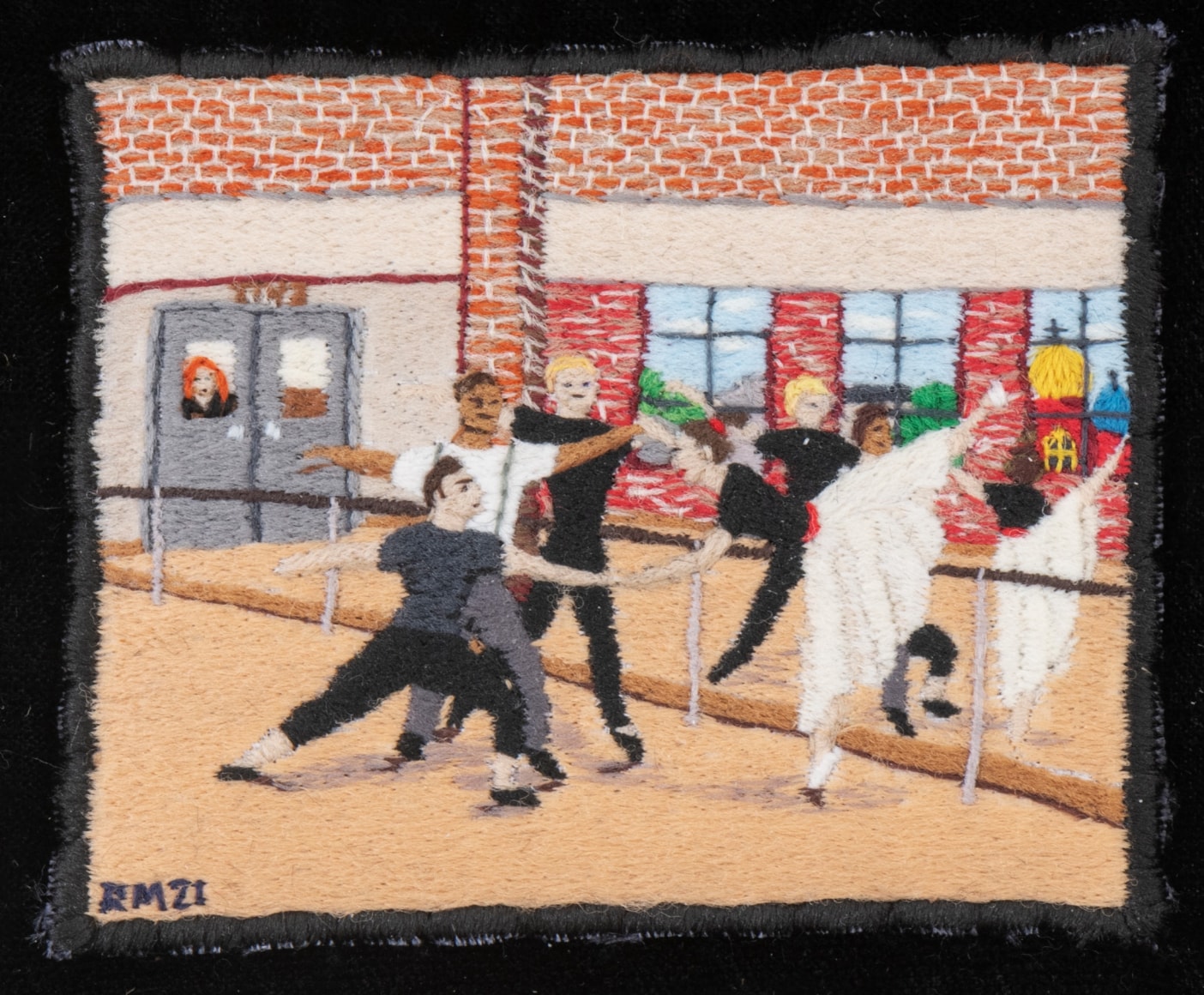
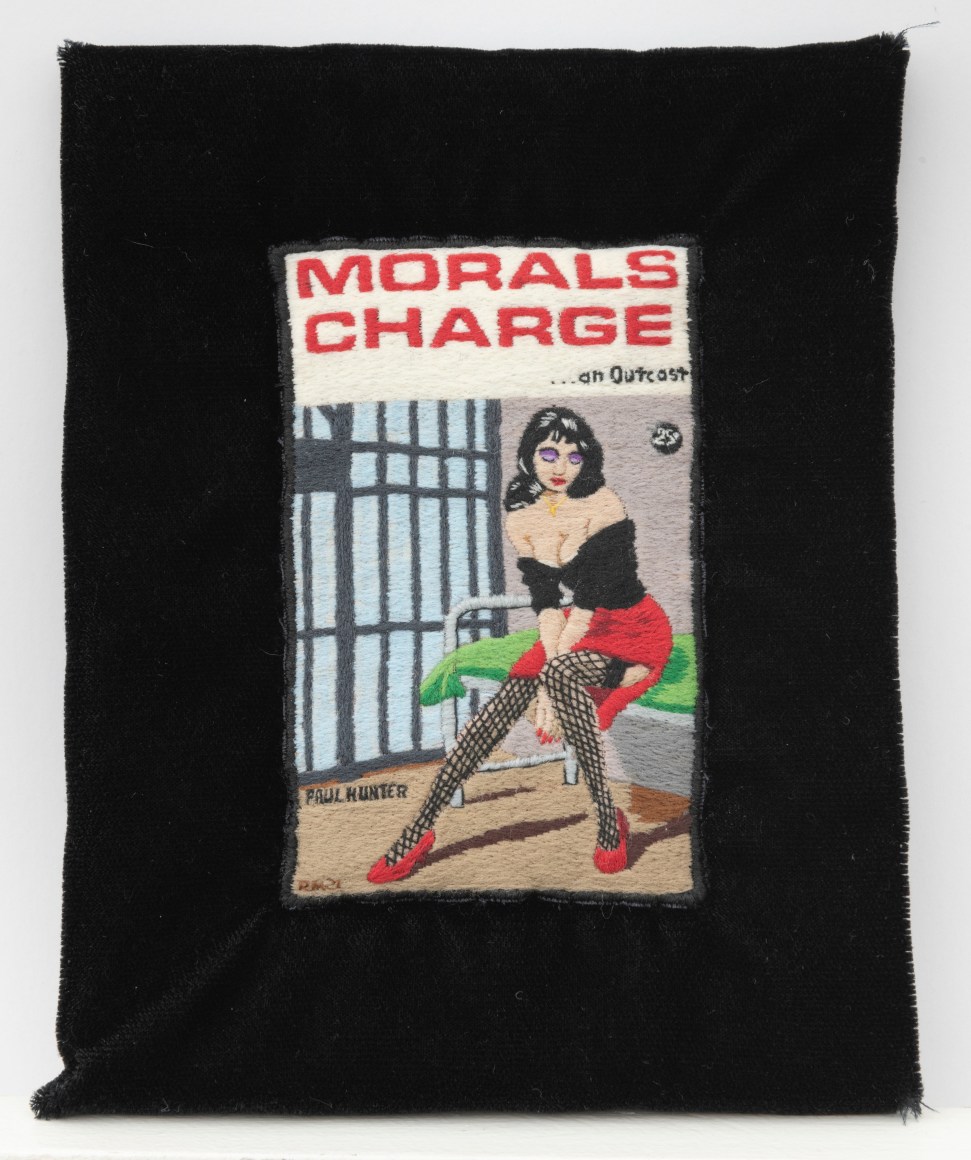
He unraveled worn out socks
to make thread, begged a needle
from a guard, embroidered life
outside these walls.
Five thousand stitches to sew
a Mickey Mantle baseball card
from memory, five thousand stitches
to shrink his mother’s parlor down,
make it playing card size. In his palm
he holds the portrait
of a seagull attempting flight,
wing-tips gray as stone,
one claw caught in barbed wire.
My father-in-law’s brain was down to its last trick—comatose for days, but his throat still knew to swallow. We argued with the cardiologist. A nun explained that the doctor’s religion precluded him from letting the body die, and this was a Catholic hospital. The ventilator rose and fell. I studied my father-in-law, the growing stubble, greasy hair, ragged mustache. A hospice center finally took him in, turned off the machines. There, the nurse washed his hair, shaved his cheeks, his chin. He would have been grateful, we told her. He'd always kept himself neat. She said it would be awhile, that we should go eat at the diner around the corner. Before the burgers came, we got the call.

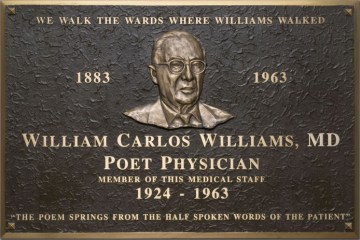
brass plaque, the poet
William Carlos Williams
treated patients here
The future Justice sits at a paneled desk,
spits into the mic about beer, about
being young and summer, his surprise
anyone would ruin him like this.

The room tilts. It has the paneled walls
of my parents’ house.
Are those my brothers’ muted voices
or have I muted CNN?

They are thirteen and eight,
watching horror movies again,
our mother in the kitchen, unpacking
videotapes and groceries.

I ask my brother,
“How can you want to see this?”
He shrugs. “It’s not as if
we’re watching a snuff film.”

Which are illegal, he tells me,
but you can get the tapes
if you want them bad enough.
I peer into the room. Is there a third boy,

a kid from the neighborhood,
from the country club? He nods
at my brother. If you want it bad enough
you can get a girl upstairs,

on the floor, on the bed. And years later,
when you’re called on the carpet,
you can say she might have been assaulted,
at some point, by someone,

but unless it’s on film, it wasn’t you.
it must be hard to be a man
no, wait—what am I saying?
that’s the old story
from the other half of the sky
the thunder clouds and tornadoes

laughter at the unclothed emperors
exposure of their weakness:
how is that harder to take
than the centuries of servitude,
social cages, sub-human status,
eons of denied personhood?

they say: not all men
as if that meant anything to us
we say: me too, all women
finally, we use our voices
finally, someone is listening
we listen to ourselves
children's eyes open wider
see more possibilities
colours brightest
shapes malleable
flavours pungent
textures novel
music expansive
every sensation honed
to its finest peak

children create their own rituals
find meaning in small things
until adults, institutions
constrain, crush them
insist they conform to some norm
unperceivable by open eyes
paths leading only to darkness
constricted ways of thinking
opportunities forever lost

what could the world be
if we loosened those bounds
guided with kindness
steered gently, by example
fostered knowledge, understanding
in place of indoctrination
ignorance, lies-to-children?

a better place, I think
a discovery worth making
To The Max
Maximillian had a million maxims
He was full of aphorisms,
a proverb for every occasion
It was axiomatic that,
if someone asked a question,
Maximillian would provide
a truism, by way of answer.

It happened that, one day,
Maximillian stumbled upon
a question for which
he could find no ready answer:
What is truth? He pondered long
in search of the magic formula
that would satisfy.

Finally, Maximillian sought
help from others, a revolution
in his narrow world.
Observed fact, said the scientist.
Received wisdom, said the preacher.
Error's opposite, said the teacher.
Whatever I say, said his mother.

Maximillian found
none of these solutions
satisfactory -- today's facts
could be modified by new
discoveries, doctrine was merely
hearsay, he could avoid error
and oppose one saying with another.

Perhaps, he concluded, the best
way to define truth
would be the absence of lies.
It was much easier to spot
someone lying than discern
innate truthfulness. A negative
view but a practical one.

Maximillian dumped all
million maxims into the well
of oblivion, where they sank
unnoticed and unregretted.
He determined to think
for himself, rather than
let others think for him.
…(she/her) lives in Ottawa, Ontario. A retired forensic scientist and Pushcart-nominated poet, she writes in many genres. Her poetry has appeared in more than forty print and online journals and anthologies in Canada, the USA, the UK, and Australia. When not writing, Adrienne tends a large garden, reads voraciously, and procrastinates playing several musical instruments.




















 The BeZine