One Sky, One Earth

The land is not just earth
But one ploughed into existence.
As one removes each layer
Sweat, dreams, and streams will flow.
Wherever the war is,
Our heart walls are hurt.
Whichever field is burning,
Yours or your neighbour’s,
It is life that starves.
It is the earth’s womb that turns barren.
When can we ever build a dream
that all can see together…?
When can we all join in one prayer
Under the same tree…?
As birds fly beyond borders,
I dream of a nationality
Where I am not a foreigner,
A dream of a singular Nationality.

© 2020, Ambily Omanakuttan 


AMBILY OMANAKUTTAN is fom Kerala, India. She is a writer , poet and activist. She is writing continually articles in news papers and magazines. Her poem published in so many Magazines , weekly and news medias.She has participated in numerous national and international literary events.She was a bank employee but she resigned it for     her social work. She working in more national organization for human rights , environment and nature.her activities were centered on tribals. While working for their welfare, she also involved herself in struggles against their exploitation and for their rights. She, who is raising her voice constantly through essays and poems against the injustices meted out to them by the society and the political system.She also uses her word power against the attacks on women and children. She  is saying ,Poetry is her soul but more than it like a weapon for her activities.

Tread Softly

Tread softly on Earth,
Its semblance fools us
into believing that it is indestructible.
Ecosystems of growth and grandeur
hide within tunnels
formed eons ago,
based on assumptions that
man would tread softly on Earth.

Tread softly on Earth,
Its resilience
veils its core of tenderness;
its need for nurturing love
of the abundant bounty within.

Give thought to preserving
all the wondrous revelations
still hopefully waiting,
with infinite trust, that man will
tread softly on Earth.

© 2020, Irene Emanuel

IRENE EMANUEL is from South Africa. She is the winner of the “Hilde Slinger” cup for poetry in 2009 and again in 2013, winner of the “Fay Goldie” cup for General Success in the World of Publishing in 2011.  Both these awards are presented by the South African Writers” Circle. In 2008, Irene represented Live Poets’ Society  at “Poetry Africa, an International Poetry Festival” held annually, in Durban, South Africa.

Irene tells us that, “Poetry allows me to get my message across with rhythmic speed and clarity and is the written word that I like best.  My passions are music, reading, movies and cats”

Her poems are published widely and – among others – are included in: “World Anthology of Journeys”; In  “Unbreaking The Rainbow, Voices of Protest”;  “A Hudson View” and “The Speech and Drama Association of S A.”  She has four published collections of poetry. In 2008, Nine of her poems were published in “Signatures” an anthology of women’s poetry.

Tomorrow’s Question

My heart feels heavy today.
Peace seems so far away.
My own, my inner peace
And yours, dear Earth, so triste.

The spring rain, meant to be
Awakening and warm to me,
Comes cold and harsh upon my head
And fails to wash away my dread.

Is my pain a fantasy
Or does it have its roots in me
That reach unto my very soul
And show it to be a lump of coal

Black as the moonless sky above.
Or is it more a sign of love
Whose color is as white as snow
That melts in the sun’s soft glow

That gives each day its early start
And, reaching the chambers of my heart,
Warms tomorrow’s blood.
To live another day is good.

© 2020, John Ehrenfeld


DR. JOHN EHRENFELD returned to his alma mater, MIT, in 1985 after a long career in the environmental field, and retired in 2000 as the Director of the MIT Program on Technology, Business, and Environment. Since retiring, he has authored The Right Way to Flourish: Reconnecting with the Real World (2019); Sustainability by Design: A Subversive Strategy for Transforming our Consumer Culture (2008); and Flourish: A Frank Conversion about Sustainability (2013, with Andrew Hoffman).

In October 1999, the World Resources Institute honored him with their first lifetime achievement award for his academic accomplishments in the field of business and environment. He received the Founders’ Award for Distinguished Service from the Academy of Management’s Organization and Natural Environment Division in August 2000. He holds a B. S. and Sc. D. in Chemical Engineering from MIT, and is author or co-author of over 200 papers, books, reports, and other publications. He has been writing poetry for the last few years. He is 89 years old.

creatures today

shadow-tailed squirrel
swift then still
inquisitive

house sparrow alights
on sunlit sidewalk
softly sounding

American lindens
touch heart-shaped leaves
clumped together

another sparrow
tricolored trilling
Lake Erie’s eastern shore

at my window
I consider
their unjust absence

© 2020, Connor Orrico


CONNOR ORRICO is a medical student with interests in global health, mental health, and how we make meaning from the stories of person and place we share with each other, themes that were explored in his publications in Headline Poetry & Press and Dreich Magazine.

Nature We Failed

It’s late at night, I can hear nature cry,
along with the coyote’s howl, and the
brambles soft quiver.

Late at night, I can see a world without
greed, death, and destruction, a world
without forest lines that retreat to the
point of annihilation.

Creatures of remaining forest are
scattered, dwellers of the sea fished
into oblivion.

The carcass of nature is covered by a
a harsh blanket of concrete, asphalt,
and steel.

While we as a civilized human species,
turn a blind eye to the carnage we reap.

While climbing ladders to ascend to the
top of the pile, pat-on-the-back world
conqueror.

How’s the view?

© 2020, Wayne Russell

WAYNE RUSSELL is or has been many things in his time upon this planet, he has been a creative writer, world traveler, graphic designer, former soldier, and former sailor. Wayne has been widely published in both online and hard copy creative writing magazines. From 2016-17 he also founded and edited Degenerate Literature. In late 2018, the editors at Ariel Chart nominated Wayne for his first Pushcart Prize for the poem Stranger in a Strange Town. “Where Angels Fear” is his debut poetry book published by Guerrilla Genesis Press.

Three Poems by Shoko Cosmas

Our voices!

The echoes of your voice are light,
My voice is my freedom.
Our voices should be alive,
I, you, and us, we have our own narratives.
Inclusion is the linchpin to sustainability,
I have a role to tell my story,
A story for my community.
I can no longer let others speak for the needs of my community,
I know the needs of my community.
I want to care for my environment.

Your voice should speak out,
You must act and work for your community.
Your community is in desperate need for your ideas,
Why let others leave you behind?

Our society needs our voices,
Our voices and actions will lead to inclusive societies,
Societies that leave no one behind.
We need the voices of the marginalized,
We need the voices of power to plan for tomorrow.
Inclusion is the ultimate key to sustainability.


Care for our planet

Feel the endless need
Of caring for our planet,
Remember the future generations.

The world we live,
History records the stories—
Environmental degradation.

Every year we lose
Natural resources due to:
Veld fires, climate change and catastrophic disasters.
Industrial pollution is taking over,
Resource depletion engendering a new crisis,
Oceans, seas, rivers facing the blow,
Nuclear issues triggering conflicts.
Maybe we need collaborative planning,
Environmental management for all, by all.
No, No, many big No’s top-down approaches—
They have not worked!


AFRICA

In the land of Africa times of plenty—come.
Harvests of good seeds—strive.
The lands are fertile yet some starve,
Mama Africa conflict lives—stop the war.
Tears are crying as guns blaze in many villages,
The cost is high as most flee to safer zones.

In the land of Africa the days are uncertain
For the streets still sing songs of freedom.
North, South, East and West children cry,
Africa, Africa are you dying from within or what?

Across the forests of Africa vegetation once stood manifold,
But now fires spread and decimate flora and fauna.
Pangolins, rhinoceros and elephants are crying,
And the future of our friends is on the demise.

As years fly the future for the unborn child remains thin;
Smoke erodes the fresh air,
Our once rich soils are phasing out and river basins wilting.
Hills and mountains stand defenseless.

© 2020, Shoko Cosmas


SHOKO COSMAS  is a Zimbabwean poet. He has published works in Zimbolicious Volume 1 and Volume 2 anthologies, Paragon Journal, Centum Press, Basho Haiku Festival, Brave Voices Poetry: Journal 58: Griots of Tuku Samanyanga as well as in other several anthologies in different parts of the world . He is a Midlands State University Masters Alumni graduate.

A Series of Haikus

I

Quiet waves of earth
Tilled to receive the seed
Again and again.

II

There is no gate
only the path
One foot before the other.

III

Grasses wave
near the stone path
No gate opens
No gate closes.

IV

Walleye
On the hook
The fire is lit

© 2020, Chris Northrop

CHRIS NORTHROP is a poet from the Northeast, writing free verse and currently experimenting with haiku.  She has a degree in Creative Writing and several publications.

rootes in solide erthe & 2 other poems

Le Meschacèbè (Palmer in the Pocket)

                                                              For Jo Beth Britton

The river pours out of the Peabody Hotel
through a lobby fountain full of ducks
cotton floats on barges through the air
sky sweeps down to the sea
cloud wind bellows across the oxbow lakes
abandoned by the river where it turned
away in its elegant course
le Meschacébé

& the Corps of Engineers can’t do nothin’ about it
when the river changes course again
when the flood waters rise whole villages move
when the flood waters rise above the natural levee
delta sea-foam spreads humus across the valley
rich oleaginous loam
fish swept between trees slipt through houses in outer
space and hid in the clouds of stars
rivertopped houses soaked in nutrients at roots
pike crushed to fish meal beneath their feet
pushed south from lakes up north
downriver by floodwaters cold
to a Delta visible from Mars
& when the waters receded
the first mounds appeared

Eros is possibility
& the most erotic unleashes the most possibility
Le Meschacébé flicks its tongue into the moon

mother out of which flows
tap water ice car washes
the senseless articulated by a migrant thrush
jays squawking in the fields below the crescent
gulls swirl across the grass, sweep and return
sweep and return
searching for seeds

& all the water in the world rushes down, the people
crushed atop their houses
one hundred miles above the river’s mouth
or 300, where Monroe now stands & Sonny Boy
broadcast blues
live over mythic radio
in the valley known as the Delta
Ouragan stroke
when the Corps blew the levee
the world disappeared
and Houston Stackhouse levied the blues

“The first time I heard Muddy’s “Flood,”
wrote Robert Palmer
“I remembered
an afternoon, years before, when I felt
an overcast sky
dropping lower and lower, increasing
a peculiarly disturbing
pressure I could feel
physically
in my blood. I was sure
the heavens were going to pour down
rain and lightning bolts at any moment.
But the storm never came—
it was inside me, a perception of a gathering
emotional storm
that I’d unconsciously projected
into the cloudy skies.”

I didn’t know it was history
I just thought it was great music
poetry pushed through a guitar’s neck
blasted out of a sound hole
a taste of the best basting
a drum ever took
roasted pearls of twilight
scratched into the sky

Night Notes, an Email

                                              to Kathleen Kraus

Patricia's birthday is tomorrow &
I guess we're going to have to find a way
to celebrate after all.   I mean,
for better or worse, the day of her birth
brought some joy into my life.
 
We got it bad.
We're in Memphis. Our neighborhood
is probably under water. Our house
might not be standing. Patricia's school
might be the one we heard
had been destroyed. We'd just gone
into her studio to make sure
a particular photograph was
off the floor. Our lives have been changed,
 "changed utterly," as Yeats put it
"a terrible beauty is born"
 
The city is 80% under water.
Our town, across a very large lake,
is also under water.
We had just bought the house in April.
It is also possibly
under water. It might have been reduced
to a foundation slab. We don't know
and won't for a few days
 
We think we'll probably stay near the Delta
until martial law is lifted in Slidell.
Our house is in one of the worst hit
neighborhoods. But I was thinking about the little house
on Jourdan
and my dear friend Kathleen...
we're using wifi at a coffeeshop here.
 
Red Roof Inn rocks.
They let us bring in our dogs & parakeets!
 
Oh, you know the score,
our whole town
was built on what used to be wetland,
used to be lagoon, used to be water.
now water wants it all back.
 
The storm they said could happen has happened,
and please let there NOT be another one next week.
 
No matter what happens to the physical city,
the spirit that created the second line will never die.
 
We'll be ok even if our house is totaled.
I wasn't ready to let go yet. We'd only been there four months—
 
with no New Orleans across the lake,
there is little in St. Tam, even for Patricia,
who has spent most of her life there—
 
As refugees we're not doing too badly,
 
You are a joy. Don't forget that.
 
Don't lose touch.
 
            8-30-2005
            in the wake of Hurricane Katrina

rootes in solide erthe

feet bare padding soil
last week, I paid
last insult to hip and thigh
now an early spring and narcissus
all coming up: late planted arugula
spinach lettuce and Chinese cabbage
& I hope we get a good crop before
the summer heat arrives
         and it all dies

the blueberry out of its tub has rootes in solide erthe
leafing a bit and the new citrus too
I’m trying to remember what I told them all this morning
& what was that song I sang

                   “so come all ye rolling minstrels
                   and together we will try
                   to rouse the spirit of the earth
                   and move the rolling sky”

                            (“Come All Ye,” by Sandy Denny & Fairport Convention)

©2020 Dennis Formento

Côte-Nord

After Constantine Cavafy’s Ithaca

paired, as clasped hands,
girl & woman are acquainted
with such spaces

a white clenching outrage,
a burrowing for warmth,
how joints settle in rest

mythology unfolds
on this rock, brackish night
ringed with fireflies

woman & girl follow water
cook over a blue flame,
pray that the road is long

© 2020, poem and illustration, Candice O’Grady


CANDICE O’GRADY is a writer and poet who cut her teeth as a crime reporter in the Yukon. She lives near the water in Toronto and sometimes tweets from @candiceogrady.

Daylighting

lost yellow stream
lost boggy ravine
where the boy with
dinner roll legs toppled
in & vanished

lost doughy boy
lost straying creek
buried now beneath
potholes, sooty floors
& children’s feet

lost boys & girls
lost woods, lost water
changeable earth
sown with towers of
borrowed light

© 2020, poem and illustration, Candice O’Grady


CANDICE O’GRADY is a writer and poet who cut her teeth as a crime reporter in the Yukon. She lives near the water in Toronto and sometimes tweets from @candiceogrady.

Migration

You came in small pieces,
a spine of light, the burnished
colour of water in August.

Sailor heart—this swallow
stitched to the ribs, weary song,
abeyant treatise of longing.

I watch the northern shore,
for the migration of birds,
to bring you home.

© 2020, Candice O’Grady


CANDICE O’GRADY is a writer and poet who cut her teeth as a crime reporter in the Yukon. She lives near the water in Toronto and sometimes tweets from @candiceogrady.

World’s End or World Without End

“It’s the end of the world as we know it,
It’s the end of the world as we know it,
and I feel fine (time I had some time alone)”

~ It’s The End Of The World As We Know It, by R.E.M.

It sure has felt that way for the last few months, hasn’t it? We’ve had plenty of time to “have some time alone” and our routines have been turned upside down, though if I hear the phrase “New Normal” one more time, I think I might scream.

It’s been bad here in the U.S.A., but can you imagine how much worse it has been in so many of the other places on the planet? Can you empathize with those people who are already living day-to-day trying to scrape up enough food or water to survive and then to have to deal with this pandemic on TOP of that?

Image credit – credit Anumeha Yadav, Al Jazeera

In many ways, it seems that COVID-19 has been like a giant RESET button by Mother Nature. The real question is: can we, as humans, learn any lessons about how to treat the planet better because of it? Perhaps, more importantly, WILL we take this golden opportunity to at least and at last become more sustainable?

Merriam-Webster defines “Sustainable” as:
1 : capable of being sustained
2
a
: of, relating to, or being a method of harvesting or using a resource so that the resource is not depleted or permanently damaged. See sustainable techniques, sustainable agriculture
b : of or relating to a lifestyle involving the use of sustainable methods, sustainable society

Did you know that there are three “pillars” of Sustainability? They are:

  • Environmental (Planet) ——————–\
  • Economic (Profit) —————————- SUSTAINABILITY
  • Social (People) ——————————–/

Figure 1.1. Interplay of the environmental, economic, and social aspects of sustainable development.
Credit: Mark Fedkin. Adopted from the University of Michigan Sustainability Assessment [Rodriguez et al., 2002]
In trying to develop goals towards true sustainability, all three of these pillars must be considered and brought together. Here’s a good video that describes how these definitions fit and work together to create a sustainable future.

In 2015, a group of 193 countries at The United Nations came up with 17 SDGs (Sustainable Development Goals). These “17 Goals to Transform Our World” were first implemented in 2016, with the hopes of meeting all or most of these aims by the year 2030. “The seventeen Sustainable Development Goals (SDGs) are our shared vision of humanity and a social contract between the world’s leaders and the people,” UN Secretary-General Ban Ki-moon said of the 2030 Agenda for Sustainable Development adopted unanimously by 193 Heads of State and other top leaders at a summit at UN Headquarters in New York in September. “They are a to-do list for people and planet, and a blueprint for success,” he added of the 17 goals and 169 targets to wipe out poverty, fight inequality and tackle climate change over the next 15 years.”

UN SDGs from 2015
Image credit: https://www.un-page.org/files/public/

So, we’re 4 years into the initiative. How are we doing? Overall, not that great, but where there is room for improvement, there is also the hope and willpower to make it happen. Some countries are making better efforts than others, and some are actually on track to meet their nation’s goals even before 2030. If you want to see the good, the bad and the ugly about how well (or not) we’re doing, this Ted Talk from last year shows specific numbers.

We’re a good species when it comes to adapting, but there are some things we won’t be able to adapt to quickly enough, like rising global temperatures (on land and in the oceans) caused by climate change.

PNAS (Proceedings of the National Academy of Sciences of the United States of America) recently published an article that suggests “…depending on scenarios of population growth and warming, over the coming 50 y, 1 to 3 billion people are projected to be left outside the climate conditions that have served humanity well over the past 6,000 y. Absent climate mitigation or migration, a substantial part of humanity will be exposed to mean annual temperatures warmer than nearly anywhere today.”

By 2070, they predict that (bolding mine) “…in the absence of migration, one third of the global population is projected to experience a MAT (Mean Annual Temperature) >29 °C currently found in only 0.8% of the Earth’s land surface, mostly concentrated in the Sahara. As the potentially most affected regions are among the poorest in the world, where adaptive capacity is low, enhancing human development in those areas should be a priority alongside climate mitigation.”
~ Source

Rolling Stone did a wonderful article about the coming heat waves due to climate change, asking the important question, Can We Survive Extreme Heat?. “As temperatures soar in the coming years, the real question is not whether super-heated cities are sustainable. With enough money and engineering skill, you can sustain life on Mars. The issue is, sustainable for whom?”

Image borrowed from https://live.staticflickr.com

Humans still aren’t trying hard enough to live sustainably. According to Overshootday.org, we currently consume global resources at a rate where (bolding mine) “…we’d need 1.75 planets to support our demand on Earth’s ecosystem. The calculations include resources such as the amount of water, land, fish and forests we use as well as how much CO2 we’re pumping into the atmosphere – basically a measure of our ecological footprint. Our carbon footprint specifically is now 60 percent of our total global ecological footprint – with a massive 33 days of our budget overshoot used up due to CO2 emissions alone.” You can learn more about that and see some interesting graphs and pictures about that here.

For us here in America, the COVID pandemic has meant temporary shortages on things like toilet paper (Here’s a fun history of how we came to have this “necessity”), which requires millions of felled trees per year to create. We’ve also witnessed a break down in the supply chain for foods like dairy, vegetables, and meats. Why? Because we’re not farming sustainably and rely heavily on large, corporate farming aggregates (whose number one concern is not feeding the world, or even the USA, but making as much profit as they possibly can – using the Economic ‘pillar’ to excess and at the expense of the other two pillars) and partly because we are a country who not only resists giving up eating meat, but who leads the world in meat consumption. ~ Source

Despite everything I’ve posted here, it’s not ALL Gloom and Doom. As societies become more conscious and responsible about their own roles in sustainability, and consumers demand that companies and corporations become sustainable, there is hope that we can still come out the other side of this with a “win” for the Earth and its inhabitants. At the very least, maybe now you’re seriously thinking about what you can do as an individual to help save us all, now and in the future.

IF it helps us make meaningful, lasting change, then maybe…the end of the world “as we know it” can turn out to be a good thing, after all.

Image credit – Screenshot/Twitter/Greenpeace India

Clothing Production for a Sustainable Earth

Is it possible to develop a sustainable fashion industry? I think it is. But it will take some radical, dare I say revolutionary, change to make this happen.

As one, who is about as far removed from being ‘fashion conscious’ as it is possible to be, I may not be the best judge. With the possibility of my having little or no credibility in the fashion business, I’m fully prepared to be shot down in flames.

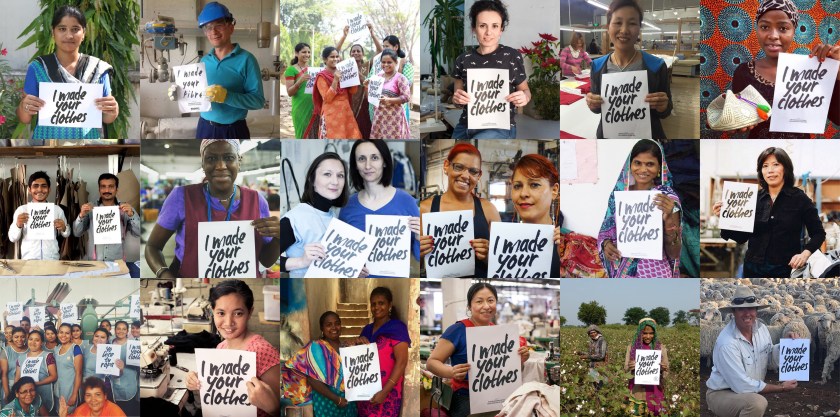
First source and evidence for the prosecution of the fashion industry as it is now, or was before the lockdown, is an article by ‘Fashion Revolution’, which immediately raises my (well their) credibility by a lot of points, I would say. 

It has been apparent for a long time that the fashion industry has gone too far. Its plundering of every last drop of blood from the clothes ‘factories’ in Bangladesh and elsewhere in the Third World, has not gone unnoticed in recent years, at least amongst those who care. The conditions of some if not all of these factories have been brought to the mainstream news, by an increased awareness of the appalling conditions in which the slave labour employed by ruthless middle men, who are in turn engaged by the equally ruthless procurement policies of the big name retailers in the West.

We cannot forget the particularly disastrous fire that ripped through one such Bangladeshi clothing factory, just outside the capitol Dhaka, killing 117 people in 2012. A year later, the eight storey Rana Plaza building collapsed in the Savar Upazila district of Dhaka, the final death toll was an utterly horrifying 1,134 people. A further 2,500 people were rescued from the building but injured, and heaven knows how many of those were unable to work again. 

It turns out that the bank and shops on the ground floor of the Rana Plaza had immediately been shut when cracks appeared the day before the disaster. The owners ignored the warnings and the clothing workers were ordered to return to work. The building collapsed the following morning. 

This is a price being paid by those desperate to earn a living in a country with no welfare or other benefits enjoyed by us in the West; all in aid of making clothes for a Western clientele, who have become addicted to the utterly futile pursuit of the latest ‘affordable’ fashions. This so called fashion is promoted by clever marketing and advertising that woos susceptible minds into believing their lives will be forever enhanced. These minds are being fed a compelling mix of subliminal messages by latter day drug peddlers, who weave a storyline that represents a kind of commercial pornography; of enhancement of desirability; competitive sexual attraction. 

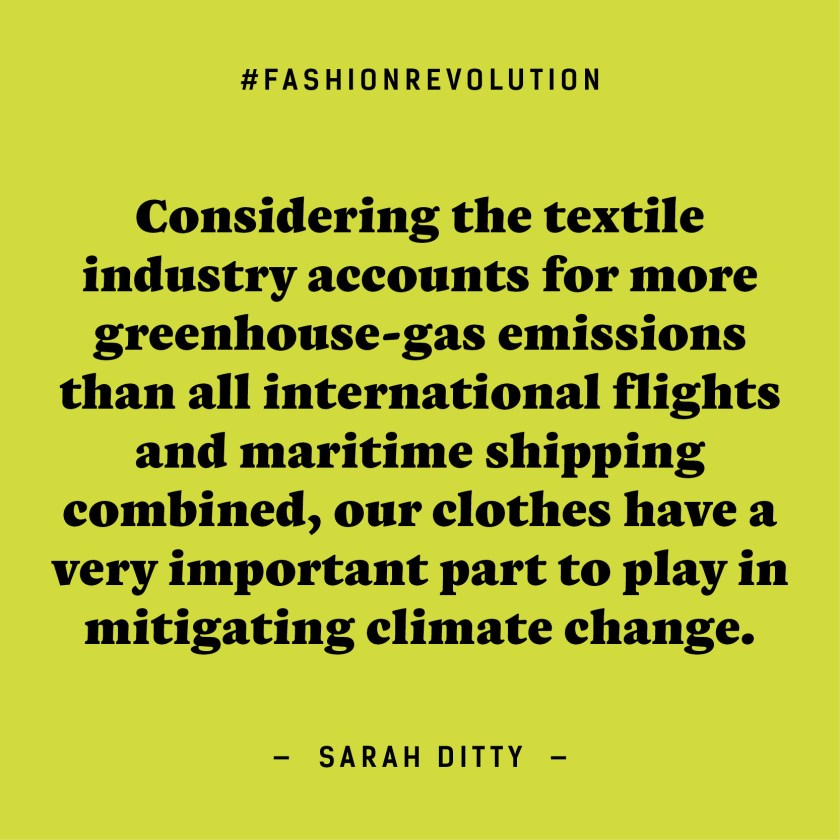
As if this weren’t bad enough, we have to add to the damning list, the effects on the environment of the unchecked spillages of dies and other chemicals into the rivers that snake their way through huge townships in Indonesia and many parts of the Third World,  where cloth-making factories respond to an insatiable Western demand. The fashion industry as a whole is one of the most polluting industries in the World and has an annual carbon footprint of 3.3 billion tonnes of CO2. 

Elsewhere, even in the Western World, as retailers cancel orders and payments for existing or completed orders are not made, there is suffering from those who are becoming unemployed, who are not able to get unemployment benefit as a result of the fact that, because of the ruthlessly cut-throat nature of the supply chain, they may not be engaged to work under the control of regular registered employment contracts.

In the meantime, major retailers, like many corporates, claim hardship under the exigencies of COVID-19 and stick out their hands for government bailouts, to which they may in principal be entitled – e.g. furlough payments – whilst they withhold payments to their supply chain, which in turn kicks back up the line to the little man, who cannot compete with the shear buying power of their ultimate corporate customers. The whole system has become corrupted beyond the bounds of acceptable trading standards. 

The ‘need’ for new fashion is promoted by a variety of vested interests, not least of which are the major retailers, but included in which are countless smaller businesses. The major fashion houses cannot stand blameless, because, whilst they may not wish for their exclusive and expensive couture to be copied and sold cheaply, they cannot help themselves from pandering to their affluent middle class clientele, envy of whom is readily created by the seductive imagery of the advertisers. I suspect the fashion houses will indirectly benefit from the increasing frequency of the ‘fashion cycle’ from seasons to months … even to as little as one week. 

This shortening fashion cycle has been enabled by prices that are so cheap and materials – that wear out too fast – sewn together by ‘sweat shop’ labour that makes it impossible economically to make your own clothes at anywhere near the same cost as you can buy  them in some shops (usually the ones with the lowest ethical standards). My wife, who used to enjoy making her own things, including clothes and curtains, discovered this many years ago.

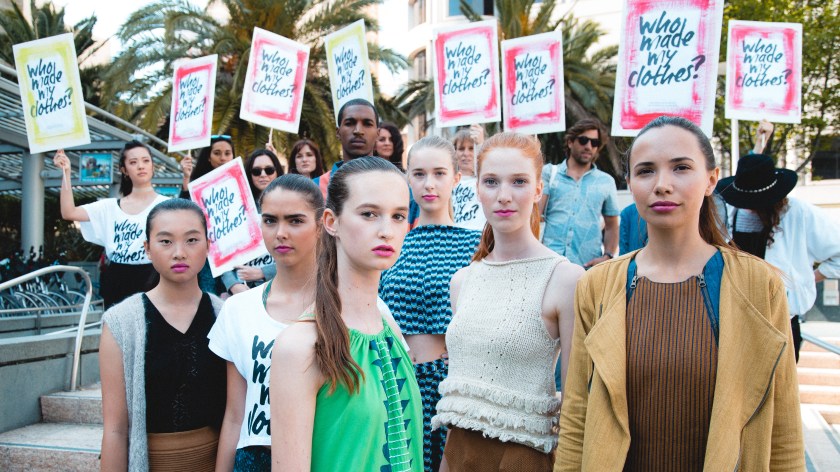
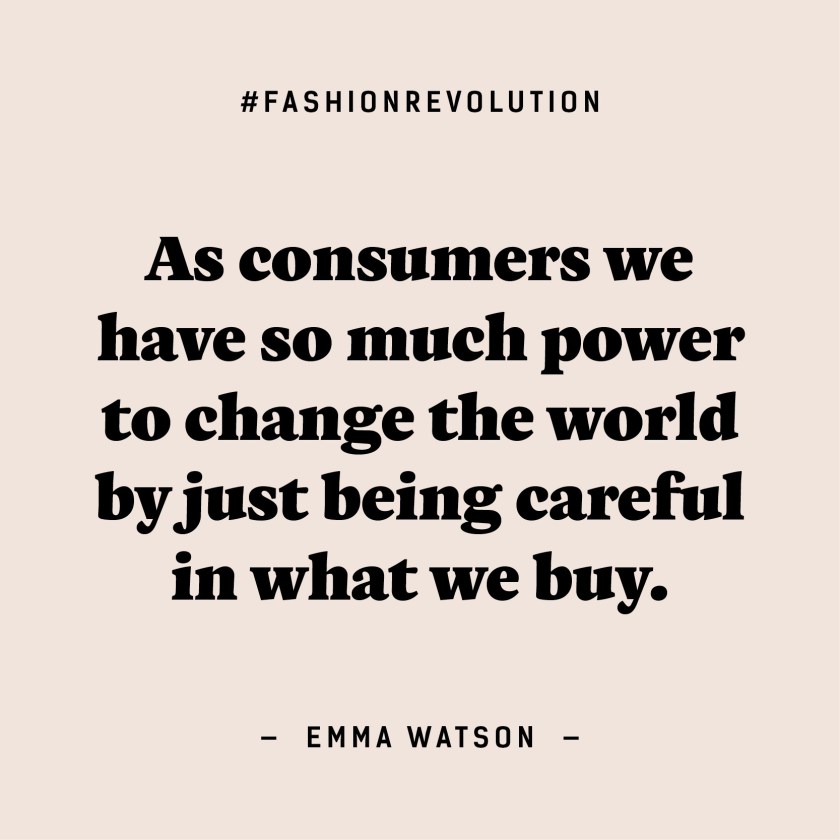
Whilst Extinction Rebellion continue to highlight the bad side of the fashion industry, with some graphic demonstrations, particularly at London Fashion Week in September of last year, Fashion Revolution have a mission that will encourage a mindset to ‘make do and mend’, to recycle and redesign, to up-cycle and, dare I suggest, perhaps even create the opportunity for a new industry that makes new from old. Their agenda is to make fashion sustainable and ethical. Their objective is to make fashions last longer, so the industry is sustainable and those who do love to buy a fashionable new outfit can continue to do so, without fear of playing a part in  raping the environment and without a threat to the lives of the poor and vulnerable in society, enabling them to secure sustainable jobs, in all parts of the World. 

To make change happen, those marketing managers, advertising executives and their corporate employers must begin to adopt a real ethical stance, one that does not simply window dress and pay lip service to a ‘green’ and ‘sustainable’ future, but one that is genuinely revolutionary. This cannot be made to happen without us, the customers. We must stop allowing ourselves to be driven by desires, created by the fashion industry’s powerful imagery, inducing a dependency on the drug of fashion, under the control of those unscrupulous dope peddlers. Crucially, as with so many consumer goods and even our food, we have to be prepared to pay more. Greed by the few, must be driven out of the supply chain by the many to enable far greater equity, otherwise we can only consider ourselves to be the beneficiaries of a modern slave trade.

It is we, the masses, who must be the drivers of change, the driving force behind a revolution. We must be the change we want to see.

[All images courtesy Fashion Revolution]

© 2020, John Anstie

In Your Hands

A young man once thought to confound the elder of his village.  The old man was exceedingly wise.  But the young man was certain his own wisdom exceeded that of the frail old man.  He caught a little bird and carried it, hidden in his cupped hands, to the old man. “Here is a riddle for you, old man.  I have in my hands a bird.  Is it alive or is it dead?” There was no way the old man could win.  If he guessed “dead,” the boy would open his hands and release the living bird.  But if he guessed ”alive,” the young man would crush the bird in his hands.  When he opened them, there would be a dead bird. But the old man looked into the young man’s eyes and said, “The answer, my son, is in your hands.”

This is a folktale From India, retold by Dr. Margaret Read MacDonald in her excellent book Earth Care, published by August House, 2005.  “Earth Care is a collection of traditional folktales and proverbs from over twenty countries or ethnic groups, touching upon both human and ecological themes such as environmental protection, the care of other creatures, and the connection of all things in nature.”

Accepting Adversity, A Fable

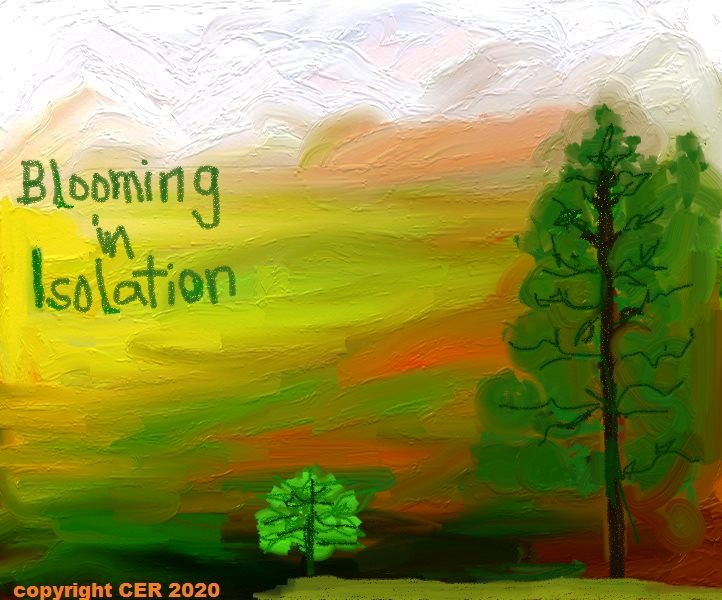
blooming
“Moaning again? You are being ungrateful! When will you ever realize?” said Pine, standing tall and graceful, swaying just a bit from side to side. “Stop please, dear Hedge, your moaning is disturbing everyone. If one plant is grieving, it affects all, keep in leaves the environment. It is vital for the well-being of all living here,” explained Pine.

“I try to, I am trying to, but see I have no color, no flowers, no one looks at me; me the green, green hedge, and I am so short. Oh! It so hurts my small twigs,” complained Hedge.

“Ah, listen to what the Great Persian Writer Sheikh Saadi wrote in a short story about a king and his son,” said Pine.

“Bah! What story? Don’t tell me about kings and princes and fairies and…,” mumbled Hedge in contempt.

Pine continued anyway saying, “The king would think that his son was short and ugly so no princess would marry him. But, the son was sharp and intelligent; he asked his father, “Isn’t a short intelligent person better than a tall but stupid one? The goat can be eaten but not the elephant.” The king was shaken and immediately regretted his unreasonable thoughts. “So, being sensible is the key. I cannot bend, but you can see the earth and be with so many friends, and if you feel happy about yourself, the way nature has made you, you will bloom and develop a strong fragrance. So bloom you will, even in isolation. Only you can make yourself happy”, concluded Pine.

Together the Hedge and the Pine swayed with the light breeze, as music filled the air, making it strangely fragrant.

©2020, story and artwork, Anjum Wasim Dar

The Virus of Reason and Fear, A Fable

c 19

King Corona Virus adjusted his golden red crown, swept the purple robe around, holding it close, he placed himself elegantly, on the royal throne. For a few suspenseful seconds he cast his spiky eyes around, satisfied with what he saw he then raised himself a bit and addressed the gathering thus:

“O invisible flyers, poisonous strikers of the new generation ! Our agenda is well prepared for our most important mission. We start from the East, facing West we move from land to land, remember your target is a crowd, if you move away you are dead.Hit the person hard on impact. Keep in mind the greater good of this planet, the grandeur, the magnificence, the purity must return.’

“Colleagues, it’s time, let’s go”. The second Courtier called aloud.

“Just a split second Sire, let me recheck the Agenda”.  “OK, done”.

“A precious contract, materialized after thousands of negotiations, needs us to stay focused. Move by the Order of the Great Master”.

A thick red cloud began to ascend into the yellow space.

“Hey partner, keep guiding me”.

“Stay close, we treat all equally but there are some priorities according to the Agenda”.

“Priority one is the Environment. For this, first we meet the owners of all types of vehicles, who are deaf to the demands of  air protection”.

“Then we meet owners of airlines who release engine gas in the sky, poisoning many flying creatures. Next, the  war  vehicles , all must be stopped. Our second field of operation is the  Oil and Coal  Industry. At third place is the Food Industry which  cooks  and bakes  and grills in the open uncovered areas and pollutes the air every night, plus uses rotten stuff  unsuitable for people’s health.”

Partner One, kept marking the targets. The whole world was under attack.

Corona Virus , serious in demeanor, blank in expression but red in color and so circular in shape  soared  forward with considerable  speed. Soon the myriad contingent followed and in proper sequence, spread in their particular planned  routes.

“No animals or insects to be hurt, touched,  injured or made sick in any way”.

“Yes, Grand  King Corona”.

Meanwhile  on the Politicians Planet in the East, one place reflected hectic activity. Humanity was  terrified as the  attack came.  Breathing systems  being affected, began to collapse. Hospitals started to fill up, hardly any more space for more breathless bodies brought in.What was the cause of that illness? Doctors soon found out and gave it a name, “Covid-19”.

Corona Virus  gave a loud call, “Gather ye All, let us regroup and focus on the target.I want you to recall the reason why we have been sent here. See how humanity is locked down in their own homes?. The people are led astray, they forgot who they were,  spoke falsehood, and destroyed the purity of so many things. There are lessons in the coming of illnesses and plagues, if only people would understand. See how they wash their hands now, disinfect their streets offices and markets, why did they make such a mess in the first place?. To stay away at a distance, even between married couples is the rule, if one suffers our attack, both have to maintain distance and be alone till they are clean and  have recovered”.

The Virus Group was now closer to the target.

“The Hands the Hands, it is the Hands, The Hands, The Hands are to blame. Control them before they touch private property, before they take  illegal possession of things belonging to others, or reach out for pleasure, the most dangerous move of all. Look how they jump and shake and roll and scream with joy, drink  and  swear and waste precious life time.”

“Attack ! Attack ! .

Thirteen days now and still much land needs to be covered. King Corona Virus, again adjusted his crown. “From the East,  across the Middle Spaces, now onward  across the oceans. All air planes are on the ground,  we can travel with ease “.

Off they flew.

As they approached a large gathering,  someone remarked,

“And what are these long handles in the hands of, er, youth, they should be holding  books and notebooks.”

“After our attack they will, they should”.

“All the evil cannot go but surely a lot will”.

“Come, now towards the South, no place to be left behind”.

King Corona Virus led the pink fog and touching block by block, made way across the seas, across islands,  through the forests  but stopped at the foothills of the high mountains. “We shall take a respite here”.

“Turn around and look, see how the air is clear as no smoke emitting vehicles are running around, no oil throwing air machines in the air. See how the  hills look green and fresh, see how the streets are clean-no coke cans no shopping bags, no empty chips packets. How dirty can humanity become,  I am confused. Now look,  how the animals are happy,  roaming  freely on land which truly belongs to them”.

“Yes, peaceful coexistence must prevail.This planet belongs to all living beings.We need to use the natural resources with care.Everyone needs food water and clean air to breathe, make it sustainable, share with all, save for other’s needs”.

“Fear the Grand Master, find the right path, feel sympathetic, be human. Ah! humans are forgetful”.

Sometimes death is the only solution left.

© 2020, story and artwork, Anjum Wasim Dar

On a Palm Leaf

One day in the climate-changed near-future, the sea turtle came to see the human Chief. The Chief lived in a modest house at the top of a steep hill and the visitor made slow progress to the front gate. The Chief’s intention was to remain flood-proof. The turtle would have preferred to visit the old dwelling of the Chief’s long-lived mother, which had been a palace by the now-risen Great River.

Being Chief really wasn’t all it was cracked up to be. He had expected to be waited on hand and foot by a coterie of diligent servants. Instead, most of the time he was simply waiting for someone to attend to his needs. The servants spent their time hunched over their individual palm leaves which were linked to the great vine. They seemed to be coaxing some sort of reaction out of the smooth surfaces, their fingers busy and their hands transfixed.

The Chief had passed many years anticipating his opportunity to rule and had thought long and hard about his approach and style. “Guide and listen, shall be my watchwords,” he was recorded as saying. “Listen and guide.”

The turtle was out of breath after the steep climb. The Chief waited patiently—he had developed this quality during his mother’s seemingly endless reign.

“Can I get you anything?” the Chief asked. “Water? Um, shrimps? Crayfish? I don’t believe we have any aquatic weeds.”

“A slice of lettuce would be kind,” said the turtle.

Later, the Chief settled them both on waterproof polystyrene cushions and prompted, “What brings you here?”

“I have some items to return to you. I have left them at the foot of this hill, Apart from these few around my back flipper.”

“Let me see. Oh, these are plastic wrappings and packaging. Part of our world.”

“And so they should stay, sire, your majesty… Despite their lightness, they do not assist with our buoyancy and have been known to constrict our growing youngsters.”

“Yes, I can see how they would function like a corset. Although those were whalebone, of course. Thank you for returning these items to me. I shall initiate some action.”

Later, as the turtle swam back along the swollen river heading for the wide and muddy estuary, the Chief found a space for the gifts in an easily accessible corner near the front of his overflowing warehouse. He decided to sleep on the solution and deal with possible disposal early on the next overheated day.

*****

Which came. And brought a new visitor to court.

This was a female polar bear. The Chief opened his door to its widest extent and the giant creature squeezed rather than sauntered in. The Chief hoped that his face showed no fear. He should be accommodating and gracious towards all his subjects and neighbours. Besides which, he had no guns about the place and suspected also that his breadknife and carving knife would be insufficient in the event of an attack. Just a risk of the job. His mother would have kept a stony face and so should he.

Really his indolent, palm-leaf addicted guards should have stopped the bear’s progress somewhere down the command chain. But it was nice to have a visitor, someone to while away the hot day with. Habitually, the chief rose and dined alone in the cool moments of the morning then usually spent the rest of the overheated day lounging and pondering.

“My one surviving cub is now fully grown,” began the polar bear. “I myself am beyond the fertile seasons so I have travelled further south than previously.”

“Absolutely,” agreed the Chief. “I have only ever seen your kind before in a z–  in zoological documentaries. To talk face to face is an honour, ma’am. What brings you here?”

“Outside I have a caravan of flat containers. I am bringing you the last gift from my home. You may find a function for it.”

“That’s very kind, madam. What is it?”

“Ice.”

“Ice? Ah…”

The Chief could certainly put it to good use. He had drunk only warm beer for the past half a decade but he remembered the sharp sweet tang of chilled lager. Food didn’t keep like it used to. So—

“I ask nothing for this gift.”

“That’s very kind.”

“Expedient. You humans have taken the rest of it away whilst you heat up the planet; you might as well have the remainder gratis.”

The Chief followed his ursine visitor down the hill to where several uneven blocks were stacked as a riposte to the sun. He called over to a handful of lounging servants, imploring them to put down their palm leaves and make haste to obtain the maximum benefits from the huge, cool offcuts.

Turning back towards the polar bear, he enquired, “And what will you do now that there are no glaciers or ice floes? Swim?”

“We have chosen to adapt. We will compete with our cousins the brown, the black and the grizzly. Develop a taste for reindeer, salmon, nuts and honey. And whatever garbage we find appetising. Goodbye.”

*****

On the following day the Chief had another new visitor. This time it was a bird about a metre high, grey-brown in plumage, yellow-beaked and with a somewhat chubby and evidently flightless aspect. By now, the Chief was becoming used to both the holes in his personal protection system and the unexpected guests who made their way through.

“I thought you were long gone,” the Chief said.

The dodo managed something of a crooked smile and answered, “I lived on as a simile, a reference point. It is good to talk to an informed human to whom I don’t need to explain myself and my background.”

“If my subjects would look up from the leaves on their laps they would witness a true marvel. So be it. What do you have to teach me?”

“Only the lessons you have already had.”

The Chief remembered his manners and offered the dodo some fruit and some water and a cushion upon which to sit; glad to note that it was one filled with foam rather than down. After a few minutes, the dodo stretched and bade the Chief accompany it to the residence’s store room.

He followed the bird. Its gait was slow and something of a waddle and left no surprise that the explorers in Mauritius had found it so easy to catch. The dodo stopped outside the store house, unguarded despite regulations, and waited for the Chief to open the great doors.

As expected, the front shelves were replete with provisions to comfortably feed the Chief and his court for the rest of the week.

“Dig deeper,” said the dodo. “You will find the shelves empty. Bare and arid like you have left so much of the Earth’s environment.”

The Chief checked the bird’s proposition and saw that the bulk of this large warehouse was as unused and void as the dodo had suggested. But then maybe there would be a delivery tomorrow or the next day bringing fresh produce… from where? From which climate-changed, sand-blasted, infertile farm, ex-woodland or freeholding?

The Chief returned to the entrance. But his visitor had already departed to cultural myth.

*****

The Chief ate frugally that evening and barely slept that night. In the morning, he decided to try to call his subjects to action but they were all too busy on their palm leaves to pay him any due attention.

He gently touched one of the younger ones—Johnno—on the shoulder. “What is the fascination?” the Chief asked when the man’s eyes refocused his way.

“It’s a whole lot of things, Chief. The leaves are all linked via the vines so we are all connected in a way. But the key element is Palmarovia…”

“Is that a game? A function?”

“It’s a place. A secondary world. I suppose you might call it Paradise. It’s somewhere we lost or were kicked out of and the object of the game is to get back there and restore it to its original glory.”

“Like Eden, Atlantis, Camelot, Shangri-La…” the chief mused.

“Yeah, whatever. I might take a break, sir. Look – you run your fingers over the leaf like this.”

The leaf felt too shiny, too solid to be real. The Chief pulled gently at it so that the connecting vine extended and he could find a comfortable spot. Somewhere with a bit of shade. He was feeling peckish and a little thirsty but those needs could wait. It was important to know what so fascinated his subjects. He would let his fingers do the walking, let his eyes wander and marvel.

Of course he would eventually educate them away from this obsession and form work parties to start fixing the damaged climate and the broken world. But for now he had five gold holo-coins and three game wishes to deploy as he saw fit.

He recalled a tale about the Emperor Nero fiddling while Rome burned. But that was nonsense—the violin hadn’t even been invented then.

He settled into the game and, for several hours at least, didn’t notice the heat, the dryness, the hunger…

© 2020, Allen Ashley


ALLEN ASHLEY (AllenAshley.com) is an award-winning editor, writer and poet who lives in north London UK and works as a critical reader and creative writing tutor. He is the founder of the advanced science fiction writing group Clockhouse London Writers. As an editor, he has published work by authors including Brian W. Aldiss, Storm Constantine, Dennis Etchison, Nina Allan and Adam Roberts. As a writer he has been published in journals and webzines including “Interzone”, “Postscripts”, “The Third Alternative”, “Orbis”, “Words for the Wild”, “Shoreline of Infinity”, “Brittle Star”, “Bonnie’s Crew” and “The Poetry Shed”. For many years he wrote for “Time Out London”. Pre-lockdown, Allen has also been a regular host of and guest reader at spoken word events. From 2013 to 2016, he co-hosted – with Sarah Doyle – Rhyme & Rhythm Jazz Poetry at the Dugdale Theatre, Enfield, north London. Allen’s most recent books are: as editor of “The Once and Future Moon” (Eibonvale Press, UK, 2019) – an anthology of Moon-themed science fiction and fantasy stories; and his debut solo poetry collection “Echoes from an Expired Earth” (Demain Publishing, UK, 2020). Allen is President Elect of the British Fantasy Society.

Soul Searching

“Oh, look! A shooting star!” Jess squeals with giddiness.

“Jess,” I begin to laugh, the good kind of laugh that’s fueled by tequila and comes from deep down in your belly. “We’re in Boston and you’re drunk. That’s an airplane.”

I join my friend and roll over onto my back to stare up at the night sky. It’s nearly eleven but the light from the skyscrapers makes it seem like dusk is just settling in for the night. I can’t tell if I find the never ending brightness exhilarating or a waste of an electricity bill.

The two of us are laying down in a small patch of grass that could only be ever called a “park” by urban standards. It’s a humid mid-August night and the alcohol is making my blood simmer. I can’t tell if the beads of sweat on my forehead are from the former or the latter, but the salty seaport breeze gives my skin the slightest reprieve from the summer heat.

If we were back home instead of Boston, we’d be laying in a real park, the kind that has a playground and baseball field. Instead we’re surrounded by concrete and chaos. In the land of suburbia, laying down in the grass would result in a symphony of peeper frogs engulfing us on all sides rather than a cacophony of clashing voices. And when we look up at the sky, it would be clear and pure so we could easily find the Big and Little Dippers.

But this is Boston, and trying to find a single star is more difficult than any Where’s Waldo picture book.

***

Until then, I didn’t realize how much I missed seeing the stars. After living here for four years, you start to forget the sky in most places is not solely dark, blank, and sad. Most places have constellations or the northern lights or maybe a real shooting star if you’re really lucky. When I was younger my mother used to tell me that every star in the sky was the soul of someone who passed away. But only the brightest stars were the souls of our family—only the most radiant ones belonged to us.

“One day,” my mom would tell me. “One day, I’ll become your North Star. You’ll always know where I’ll be, all you’ll have to do is look up.”

We could spend hours in the front yard, sitting on the stone wall and staring into the glimmering abyss, appointing stars. Over the years, the glistening collection grew. Searching for souls in the sky became easy. That one belongs to Grammy, this one to Grampy. That one over there? Belongs to Nana. One for Aunt Laurie and Jimmy and even one for the old family dog. Everyone that has ever loved me is a star.

It’s hard to tell if they’re still watching over me when disguised by the city lights.

Do they miss me? I miss them.

***

The city always makes me feel energized, but never quite reassured. Leaving the suffocating confines of my hometown has always been what I wanted. I don’t regret any of it. I love the bonds I’ve shared and the connections I’ve made. But Boston has never completely felt like home.

Home is the cul de sac where Grampy taught me to ride a bike and the gardens where Nana would play hide and seek with me. I can’t help but think about the strangers surrounding me and how sad the souls in the sky probably are because they are blinded by pollution, unable to watch the ones they love. A thin layer of smog wafts over the city, hiding us in plain sight.

I’d like to be somewhere with an open sky when finality comes for those closest to me. I want to be able to have the best view of my people up there. I like to think they want that, too.

I don’t want to miss out on the North Star.

“Okay I swear I found one this time, look.”

The sound of Jess’s voice snaps me back into reality. Cocking my head to the left, I tilt my chin up to meet the direction of her finger. I stare up into the sky. Nothing. Nothing. Nothing… oh wait! Something! I squint as hard as I can and when my gaze focuses there is the slightest sparkle of a star attempting to outshine its artificial rivals.

“Who do you think it is?” I ask.

Jess pauses before saying, “What the hell are you talking about?”

I laugh and explain it the same way my mom did to me all those years ago. She looks at the sky inquisitively before confidently affirming that the star is in fact her beloved pet tortoise.

She turns to look at me, softly this time, as though all the alcohol has evaporated from her bloodstream.

“That one over there though,” she says. “I think that one’s my grandfather. We called him Bumpy and he was pretty great.”

We continue naming the stars, each one harder to find than the next, until we are absolutely completely positive there are just no more stars left in Boston.

© 2020, Riley Simmons


RILEY SIMMONS is a recent graduate from Emmanuel College in Boston, MA. At Emmanuel, she studied writing, editing, and publishing as well as communications and media studies. Riley has been writing since she was a child, with her first story being a thrilling tale of how she lost her first tooth. Today, she tends to draw inspiration from wherever she can, whether that be exploring foreign places, navigating adulthood, or reflecting on the past. When she’s not writing or reading, you can find Riley drinking coffee and avoiding her responsibilities from the comfort of her favorite cafe.