Other people’s hunger should hurt us all, physically. We should feel it deep in our stomach, in our viscera, it should make our flesh crawl with horror simply when seeing its fangs piercing their ribs, simply when hearing their own bowels shrieking, simply when thinking how a body is able to self-devour. We should taste the tears of a hungry child not understanding the agony of his mother when being unable to feed him. We should feel the stigma of shame burning our guts for allowing another human being, ONE OF OURS, to starve, to beg for food. Then, the saying “love goes through the stomach” would gain a higher valence. “Hunger” should be just a word in a dictionary. A dictionary of archaisms. And not even that.
.
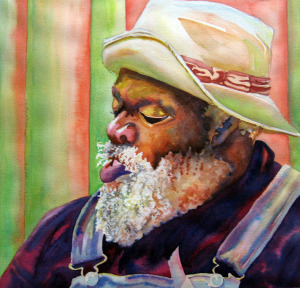
I could not believe my good fortune when I found a photo of Grandpa Elliot posted to the wet canvas photo reference library for artists. It was a must-do for me..Several bloggers have made mention of underpaintings; the most recent being Amy from Souldipper found here. She asked me about an artist’s use of an underpainting. I responded something like it is the foundation that we build our final work on. That made me think more on the subject as we were also talking about underpainting our lives with love and kindness. Then I came across the photo of Grandpa Elliot who has actually underpainted his life with sharing music to millions in New Orleans and becoming part of the project, “Playing for Change”, a CD whose proceeds go to helping others.The other connection I can make about an underpainting is that it always, for me, sets the tone for where the light will fall in it. BINGO! I see the same in life with passing on kindness. Light is passed on through our kindness to others. The above stage of my painting illustrates how I carved out areas where I wanted the light to fall.
The above image is the finished result.
I can not think of a better way to start the weekend than this:
LESLIE WHITE (lesliepaints) ~ is a guest writer here and an artist, teacher, book illustrator, and blogger. She’s been blogging since March 2009 and appreciated for the skill and beauty she shares. Her gifts to us are mini-lessons in a artistic technique. Often there is value added with life lessons, such as the one presented here. Leslie shares information on new art products and techniques and enriches our understanding of and appreciation for art. Her blog-posts go a long way toward encouraging others. She often enchantes us by sharing the work of her granddaughter and her students.
“Brother, Can You Spare a Dime?, also sung as Buddy, Can You Spare a Dime?, is one of the best-known American songs of the Great Depression. Written in 1930 by lyricist E. Y. “Yip” Harburg and composer Jay Gorney, “Brother, Can You Spare a Dime?” was part of the 1932 musical Americana; the melody is based on a Russian-Jewish lullaby Gorney’s mother had sung to him as a child. It was considered by Republicans to be anti-capitalist propaganda, and almost dropped from the show; attempts were made to ban it from the radio. The song became best known, however, through recordings by Bing Crosby, Al Jolson and Rudy Vallee. They were released right before Franklin Delano Roosevelt’s election to the presidency and both became number one hits on the charts. The Brunswick Crosby recording became the best-selling record of its period, and came to be viewed as an anthem to the shattered dreams of the era.” Wikipedia
Not wounded for me
But using your healing to heal my wounds
Why do you offer your pain as a balm to soothe others?
You could focus on your own depths that you know well
Instead of seeking to understand the hearts of others
Why so unselfish?
Who are you?
I come to offer my pain as a balm
I come to show you healing exists.
Here are my scars. They are proof of healed pain.
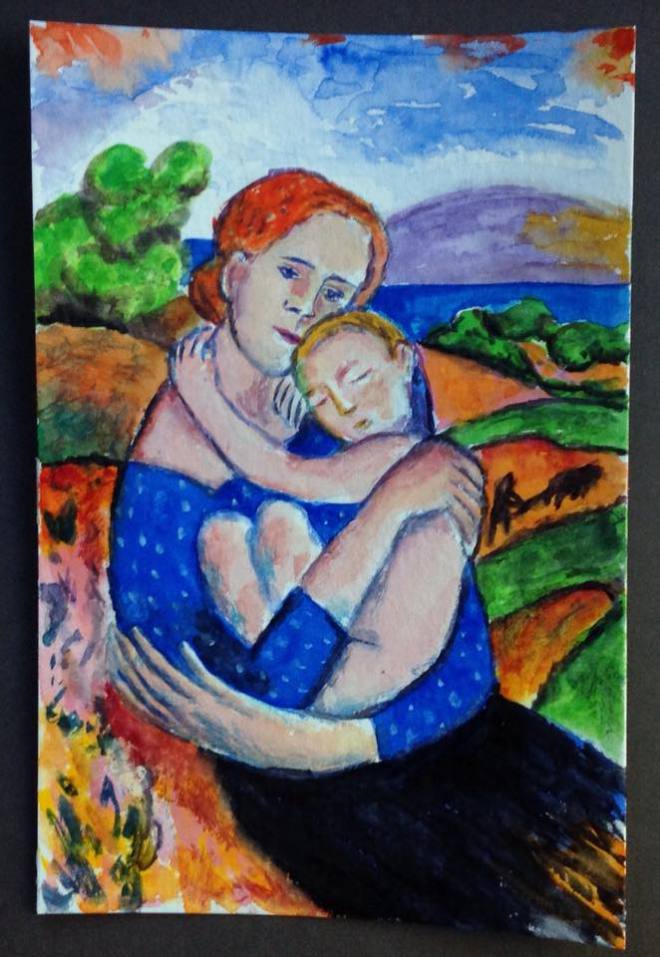
I am a sucker for Mother and Child images, so why I chose this one was a no brainer. I copied it from a Picasso. It’s 4-inch x 6-inch.
And it breaks my heart to see stats like “4 children die every minute from hunger.” That’s a child (5 years old or younger) every 15 seconds. Every one or two breaths, a child dies hungry.
A biographical note and a translation of lyrics are below.
Translation:
All I ask God
Is that injustice won’t make me uncaring
That death will not find me
Empty and alone, without having done enough
All I ask God
Is that I won’t be indifferent to injustice
That I won’t turn my other cheek to the enemy
After the mauling that is my fate
All I ask God
Is that I won’t be indifferent to war
That monstrous horror that crushes
Blameless poor people
All I ask God
Is that I won’t be indifferent to deceit
That if the traitor does more than the many
The many won’t easily forget him
All I ask God
Is that I won’t be indifferent to the future
That of those who are forced into diaspora
To live in a different culture
All I ask God
Is that I won’t be indifferent to war
That monstrous horror that crushes
Blameless poor people
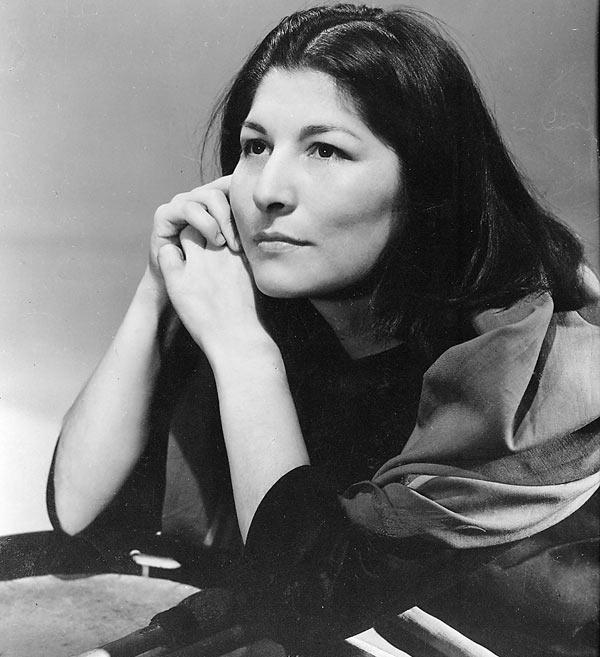
Mercedes Sosa (1935-2009)
Mercedes Sosa was an Argentine contadora (singer), popular around the world and considered the voice of Latin America. She wrote her music in the style of nueva canción, the socially committed music of Latin America and the Iberian Peninsula.
Señora Sosa was also know as an interpreter of the music of the Chilean singer, composer and folklorist, Violeta Parra (1917-1967) and of the Argentinian singer, songwriter and guitarist, Atahualpa Yupanqui (1908-1993).
If her work is new to you, Mercedes Sosa: The Voice of Latin America is a decent documentary on her life and what she and her work meant to the people of Latin America in the context of the tumultuous times in which she lived.
– Jamie Dedes (with apologies for the deficiencies in the translation and the hope that I captured the spirit of the work nonetheless)
What do you say when you don’t know what to say?
What do you do when you don’t know what to do?
Where do you go when you don’t know where to turn anymore?
You’ve used up all your chances. No one wants to know you.
They say pull yourself up by your bootstraps, but the straps keep breaking.
People turn away when you try to meet their eyes because they’re afraid
Afraid you’re going to ask them for something that’s just too damn hard to give.
How can you find your way out of this mess?
There is no fairy godmother,
You won’t win the Publisher’s Clearing House Sweepstakes
You won’t win the Powerball or the State Lottery
All you want is something like a normal life.
With friends who want to spend time with you
Where you can spend money on things that make you feel good sometimes.
But somehow or other, it feels like you’ve fallen on the side of the undeserving.
On Poverty—Spiritual Lessons From Nature series by Priscilla Galasso
Raising a child is not rocket science. It is more complex than that. Rocket science is merely complicated. What’s the difference? The Latin root for complicated “folded,” like pleats. There are hidden surfaces, but you can unfold them and draw an iron straight across it. Rocket science requires a long series of problems to solve, but with enough time and effort, you can get through them all and even repeat the entire process with very similar and predictable results. (Any one with more than one kid knows this is not the case in parenting!) In the same way, you can determine which peak is the tallest one in the Appalachian Mountains. You probably can’t guess correctly just by looking out over the landscape from a single overview, but get enough people with GPS tools to climb the hundreds of peaks on the horizon and take measurements, and eventually, you can figure out which one is the tallest. Complicated, but do-able.
Complex is a whole different story. The root of that word means “inter-woven,” like a spider’s web, where each fine thread is connected to another. And they’re all sticky except for the ones the spider uses to climb directly over to her stuck prey. But can you tell which is which? Can you tell that the one you just stepped into is sending a ripple right over to where the spider is sitting? She now knows exactly where you’re stuck, but she doesn’t know that you harbor a parasite that will kill her and make its way to yet another host when yonder sparrow snaps up her dead carcass. That’s complex.
Raising a child is complex. Trying to tell which peak in the Appalachian range is the tallest is complex, too, if the landscape is dancing: changing in an unpredictable pattern , moving to the rhythm of an imperceptible music. Which peak is tallest now? And NOW? And why are we even trying to find the answer to that question while watching this mysterious dance?
Poverty is complex. It is not something that is solved by simply devoting more time and effort to the problem. If it were, we would not be looking at thousands of years of history on the subject. We give in to the temptation to simplify poverty into a matter of dollars over time, reducing it to something measurable, predictable, and controlled, a mere graphic—the poverty line. But poverty is an inter-woven network of relationships and concepts—self worth, social justice, resources and their extraction, economic policies and global politics. It is as complex as our planet’s environment.
So how do you engage with a complex issue like poverty?
Aldo Leopold arrived at a Land Ethic after years of developing and recording a relationship to a particular place in Wisconsin. In the book A Sand County Almanac, he writes: “A thing is right when it tends to preserve the integrity, stability and beauty of the biotic community. It is wrong when it tends otherwise.” Making personal decisions about right and wrong based on your relationship to the community is the responsibility of every individual. Applying that ethic rigorously and non-dogmatically is the work of love. How do you love your neighbor? How do you preserve the integrity, stability and beauty of the biotic community on this planet of inestimable and finite resources? How do you alleviate the suffering caused by poverty? These are complex questions.
“We shall never achieve harmony with land, any more than we shall achieve absolute justice or liberty for people. In these higher aspirations the important thing is not to achieve, but to strive.” —Aldo Leopold
Maybe a more accessible question is this: How shall we strive to end poverty? To that question, I can imagine simple answers. Start early in your learning. Teach children about sharing and portion, not dogmatically, but in relationship. Strive toward understanding basic needs and toward a sense of what is enough. Build trust and hope and compassion. Be flexible, changing with the land and its resources. Be present with the multiple factors involved; do not look away, diminish or dismiss what is real. Be authentic and honest and diligent, and finally, believe that even on a dancing landscape, food is growing underfoot.
[This photo taken by Mark Tipple for an article published in ‘Demotix‘ in February 2009]
He was muttering as if
he was trying to describe
a vision he couldn’t share
with her; with anyone.
It was of something he’d never
seen before this moment;
a moment when she saw a look
on his face that carried away
all her fears; all her tears.
She felt no longer worried,
no longer afraid of the future;
only afraid that she could not
see what he could see;
this apparition, the vision
that transformed his face
to serenity, to happiness,
that even they in all their life
together, had never seen.
Something beautiful that
he could clearly see,
but not she.
Then, she, involuntarily
felt angry, full of rage
a sudden torrent of emotion
filled and puffed her tear-strewn face
As if he’d been unfaithful;
as if he would desert her;
after all these years.
How could he do that!
As if…
…something changed,
not in him, but her;
she felt what he was seeing,
that illuminated his face as if…
…and now she was incredulous.
She could not now believe
what he was thinking, seeing…
could not, would not entertain
the thoughts that entered her;
thoughts she could not fight;
that flowed so unexpectedly
like snow drifts in a storm
a snow filled wind
of blinding light;
of cool refreshing crystals
looking like white flowers;
a sea, an ocean of stocks.
And out of this there grew
the tallest trees of evergreen
protecting all beneath
their heavenly canopy.
As if.
Then he fell very still
relieved of his exertions,
of trying to tell her
all that he could see
and it was very quiet.
They’d dreamt for all their days
of this idea of heaven
a screen to pull down over
their lifelong view..
This poem was prompted firstly by the slightly surreal photograph above it, and is, in one sense, ‘Ekphrastic’. Secondly, it was inspired mostly strongly by a programme I watched some time ago on BBC television, entitled “The Toughest Place to Be.” It was a programme, which for me was well worth watching, if for no other reason than that it reminded me of how fortunate I am, living as I do, in the affluent west.
If ever I think that I have any complaints about the effect on my finances of austerity and the economic downturn or, on the other hand, I have some boxes to tick before I depart this mortal coil, as I make my plans, I think about these ‘workers’ who are as good as destitute and trapped in poverty, in the kind of stomach churning stench that this environment presents; trapped not only for their own lifetime, but also the future for their children…
Bantar Gebang – Courtesy Mark Tipple
I’ve read about organisations that are working to change things. No doubt the major ones, like UNICEF, who are concerned particularly about the plight of children in these conditions, and like the International Labour Organisation trying to set up schools for the children, who have to live and start working in these places at all too young an age. If there’s anything at all that I can do, at the very least, it is to raise the consciousness of anyone and everyone, who should care about the inhuman effects of economic ‘growth’ and exploitation.
“As If” is a poem that describes the death of the head of a family that scrapes—in the most literal sense—a sparse living off a massive waste landfill site just outside Jakarta, Indonesia. They have no sick pay, no minimum wage, no pension, no allowance for their children’s education. They live a life devoid of human dignity…even in death.
oh for the love of god
i need to get packing
i heard some folks
in washington
are gonna
repeal medical coverage
to help pay the bills
and then the 13th amendment
something about needing
cheap labor
so i need to get
my things in order
but where will i go
i can’t head for reservations
cause they’re checking
lineage if there’s a casino
and if there’s no casino
the 13th has
already been repealed
i could go to france
since i’m not a gypsy
i’d be okay in israel
since i only have one
or two arab friends
but on second thought
they have army draft
and i couldn’t shoot
anyone who looked like me
you know having
eyes, mouth, nose, etc.
i’m not japanese
so i could go china
but not germany
germany’s already said
diversity’s dead
england’s out
our rules came
from there first
maybe I could
just hitch a ride
on one of those
space shuttles
death does not have one face but many some hidden behind corporate logos where money the antipsychotic drug reduces the side effects of moral responsibility while others faces parade in public agencies the second line of social injustice holding high parasols of indifference to block out the light of morality and justice they’re the kind of reapers whose scythes are laws laws with razor-sharp rules bleeding any hope from those seeking to be free from the social roles prescribed to them those seeking to be free battle an army of reapers reapers who bring death and those who bring death do not value life no matter what the color