Cinque Terra

We’ve just returned from a two week sojourn in Italy. In the coming weeks I hope to share some of those experiences with you.

In October 2011, just weeks after Hurricane Irene devastated Vermont, severe flooding struck Cinque Terra, the five village national park on the Italian Riviera, devastating some of the villages and most of the hiking trails. Today the good people of the region continue to rebuild, as do many Vermonters. Maybe this shared experience contributed more than we knew to our love of the people and landscape of Cinque Terra.

Jennie and I spent three days in the largest of the villages, Monterosso. We chose Monterosso largely because it is relatively flat, a real boon for me. We had been advised against visiting Cinque Terra on the grounds it is too touristy and has too many stairs for my Polio legs. Sure enough, when we climbed down from the train in Monterosso, we were greeted by wall-to-wall people. It turned out that Italy’s largest and most prestigious bicycle race was passing through the village the next day. Then, as if a piper had passed through the village, by noon the next day they were gone.

Monterosso
Monterosso

Monterosso turned out to be mostly quite accessible, and we encountered a few people in wheelchairs there. The physical layout of the other villages were much less disability friendly, as they arise more or less vertically from the sea. This verticality, very much as it did here in Vermont, contributed to the severity of the floods; mountains have enormously more ground surface than do flat areas, and water flows downhill, gathering force and speed as it does so. When several inches of rain fall in a relatively brief period of time, flooding can be catastrophic.

Everywhere we went in Cinque Terra there are signs of repair. In Vernazza, arguably the most beautiful and most damaged of the villages, much remains under construction, even as the villagers truly welcome the grateful tourist. Vernazza was the site of one of our most memorable meals, and a lovely, post swim in the Mediterranean, gelato. (No, I did not swim but Jennie did!). Yes, the water was still quite chilly, although there were reportedly warm pockets.

Vernazza
Vernazza

Our second day was spent on a small boat, touring the park from the ocean side. As there is no way I could manage the remaining trails, this allowed me to get a feel for this magical place. The captain, Angelo, took us, and two other couples, for an afternoon on the water. Maybe fifteen minutes out of port, he opened a bottle of prosecco, passed out glasses, and began to serenade us with arias. As we motored along the cliff face, he told us about the flooding, about his falling in love with, and marrying a California woman, their happiness, and his former life as a park ranger. He explained to us that with the rise of tourism, many families no longer do the back breaking work of tending their grapevines, nor maintaining the terraces on which they grow. This contributed greatly to the washing away of the hillsides when the flooding came.

Our Captain
Our Captain

One of the highlights of the afternoon was a stop at his friends’ cafe in Manarola. The meal was magical, the wine local and good, and the company memorable. It turned out the family grows most of the food they serve, and makes their own wine. Maybe it was no coincidence that our two favorite meals of the trip were in Cinque Terra. Slow food, indeed!

First Course
First Course

© 2015, essay and photographs, Michael Watson, All rights reserved

Three Poems (Italian and English)

Donatella D’Angelo

(Translations by Michael Dickel with Donatella D’Angelo)

Incoscienza

il ricordo nell’ascolto
e nella bellezza sottile
di una veglia forzata

laddove il destino lascia
il sogno scoperto
e una curva dolce
di sangue e latte materno
agli angoli della bocca

è nell’incontro tra labbro e ciglio
la verità sospesa

——

Unconsciousness

memory lies in listening
and in the subtle beauty
of a forced vigil

where fate leaves
the dream uncovered
and a gentle curve
of blood and breast milk
in the corners of the mouth

it is the encounter between the lip and brow
the truth suspended

orange circle

quale strada restituisce intatto
il sapore delle fragole?

dalle mani un filo rosso
e sangue
della passione di Cristo
tra i resti di un’altra fame.

——

which path brings back intact
the taste of strawberries?

a red thread spins from hands
and blood
the Passion of Christ
among the remains of another hunger.

orange circle

come scorre veloce il silenzio
mentre i colori del diluvio
riposano sulla pelle


geografia dell’assenza
e pulsazione del tempo
sono i miei stessi lividi

——

how fast the silence flows
while the colors of the downpour
rest on the skin

geography of absence
and pulse of time
I am my own bruising

————————————————

Poetry ©2015 Donatella D’Angelo
Translations ©2015 Donatella D’Angelo and Michael Dickel

On Regretting Its Death by Drowning

It is always interesting to me, this business of feeding – of inspiring – one another with our art and poetry . . . 

Buddhist artist Paula Kuitenbrouwer (Mindful Drawing) tells a sweet tale of the near-death of a beetle at her home in the Netherlands.

The tranquil garden-drawing Paula completed to commemorate the day is lovely and the first line of her post is both an homage to her unutterable respect for life and absolute poetry filled with the promise of story.

“I found a Carabidae beetle in a bucket with water and regretted its death by drowning… “

The line put me in mind of Isak Dinesen‘s unforgettable opening for Out of Africa,

“I had a farm in Africa, at the foot of the Ngong Hills . . . “

Something about those evocative sentences lets you know there’s a good story to come. And there is.

“It lay there for at least an hour and I hoped so much it would give a sign of life. Then I did the most crazy thing imaginable; I turned it on its back, squeezed it gently, and gave it heart massage (don’t ask). Three drops of water came out. I have no clue why I did such a weird thing. Would somebody tell me he or she had given cardiac massage to a beetle, I would have laughed out loud.” MORE [Paula Kuitenbrouwer]

And so the inspiration for my poem ~

the garden floating in violet and ruby hues,
by the side of the house, a beetle floats too,
so jewel-like, amethyst and brilliant against
the dull gray water, it does not move

it lies there still as the dead of noon across
a bone-colored desert, and her hand so white,
wing-like flutters against its rigor, laying it
on the table, by a pad to sketch with pencils

that minuscule life, no will to release it
into whatever beetle heaven there might be,
laying tender finger to knead a tube-like heart
holding her breath, willing air into spiracles

wishful thinking? a flicker from the antennae?
slight movement of a leg? perhaps, perhaps
some healing pressure, one gentle push,
three drops of water, success in late hours

to heal a beetle, to sketch in varied colors
with time to hug the child and sip hot tea …
a creature saved from death by drowning and
cherish the mindful drawing for a memory

– Jamie Dedes

© 2012, Jamie Dedes, All rights reserved; Photo credit ~ David Wagner, Public Domain Pictures.net

war’s cold night

war's cold night

in a darkened room
peace sits silently waiting
for sanity’s rise

© 2015, poem and digital art, Charles W. Martin, All rights reserved

Two Subjects (and one important thing to remember)

While traveling in Argentina, we visited La Recoleta Cemetery in Buenos Aires.   Since 1822, nearly 5,000 mausoleums have been constructed  in the highest fashion of the times, from Baroque and Neo-Gothic to Art Deco and Art Nouveau.   La Recoleta is a city for the dead, with elegant marble tombs neatly laid out in blocks over fourteen acres.

Some are maintained, for love or pride.  Others, like the poet Shelley’s statue of Ozymandias, have fallen into disrepair, covered with spider webs and graffiti, littered with broken glass and faded plastic flowers.  Feral cats stare warily from their marble perches and skulk away sideways if approached.

We saw the grave of Eva Peron, and other statesmen, poets, generals, and presidents.

More interesting to me was the final resting place for a mother and her infant.  They were not famous, but clearly they were loved.  Did she and the child die in childbirth or perhaps swept away by an epidemic?  In any case, a grieving husband and father was left behind to erect this memorial.   Was he able to pick up the pieces of his broken life to find happiness again?

Wherever we go, we will find reminders of all the stories in this world that will never be told.  When I photographed this memorial, I could be certain of only two things.  Both mother and child were subject to an early and tragic demise.  And, as seen by the lush green fern sprouting from the dust collecting in the cracks in the stone, life goes on.

All images and words copyright Naomi Baltuck

Parallel Worlds

“How Green is My Valley” in Ewden Valley

My world is parallel to yours.
I see what you see,
I comprehend
what you understand, but
the pace of my soul,
my mind’s chicanery,
the pattern of my life,
defeats you.
It is perhaps the magic
of the spectacles I wear
you know, the ones
that only a child can use
…effectively.

The varying spectral sensitivity
of which my eyes are capable,
sometimes miss a step
in your logic.
It’s like a missed beat
in the heart, that leads
to moistened eyes,
to anger or pain,
or simple awe at sight
of beauty,
that makes me fear
to show you how I feel,
because of how you think…

Like a garden full
of vibrant colours,
arranged according
to their botany,
not their beauty.
Like lying in a field of grass
watching a sky full of stars,
defined by astrophysics
and not by your dreams.

When I am in
a hypnopompic state,
I tarry not with reason.
I see why your reality
is not what makes me tick.
What turns me on is
an alternative view
of sights and sounds
that sing to me,
in harmony
with Mother Nature’s Earth.
That is, the earth,
the other worldly earth,
of which we are a part.
Try to understand it,
as I do you.

© 2015, poem and photograph (“How Green, How Blue”), John Anstie, All rights reserved

Framed

Crooked picture?
Crooked picture? (Photo credit: L. Marie)

Through the doorway, across the room,
look out the window, focussing behind
these glasses, I see so much of existence
bound within frames, a life waged
within four corners or, at best,
an odd oval of confinement. Of course,
that could just be Monday talking,
that second small frame from the left
in this third long cluster down
from where it says March,
hanging here on the green wall.

Maybe we all exist within some grand
cosmic gallery, each in our own painting,
our own Rembrandt, Gauguin, Van Gogh,
Caravaggio, Dali, or Bosch. We provide
some kind of aesthetic entertainment
for ethereal patrons of the art of being.
I’m not sure I wish to just be, though.
So today I’m rocking back and forth
on my wall to become unplumb, off-center,
just to piss off those posh Olympian suits.
If you grab hold, we can slip these hooks
altogether.

© 2015, poem, Joseph Hesch, All rights reserved; photograph as indicated above

~ A Dragon’s Day ~

October’s theme at the BeZine is “Visual Arts: Color, Shape, Movement and Meaning”. I hope that it is okay to share this dusty old post with all of you.  I think this story incorporates all of the elements mentioned above (Color, Shape, Movement and Meaning) and it doesn’t use one word, so it’s all strictly “visual”.

((I don’t often post my artwork, and since I haven’t been super inspired to write much lately, I thought it might be nice for this to see the light of day again. This was a project for a 2-D art class that my ex-husband was in, over 20 years ago. I kept the original project because he did not want it. He drew the people (I still suck at drawing people) and I drew the rest. We both colored it with Prismacolors and markers and the cover was a combination of fabric, paper, paint and other stuff. The project was to make a picture book by hand. No words were allowed and it had to tell a complete story. We called it “A Dragon’s Day” and “he” (we) got an A+ on it. Enjoy. 🙂 ))

* * * * * * * * *

© Michael and Corina Ravenscraft 1994

An “Autumn” Photo from Spring

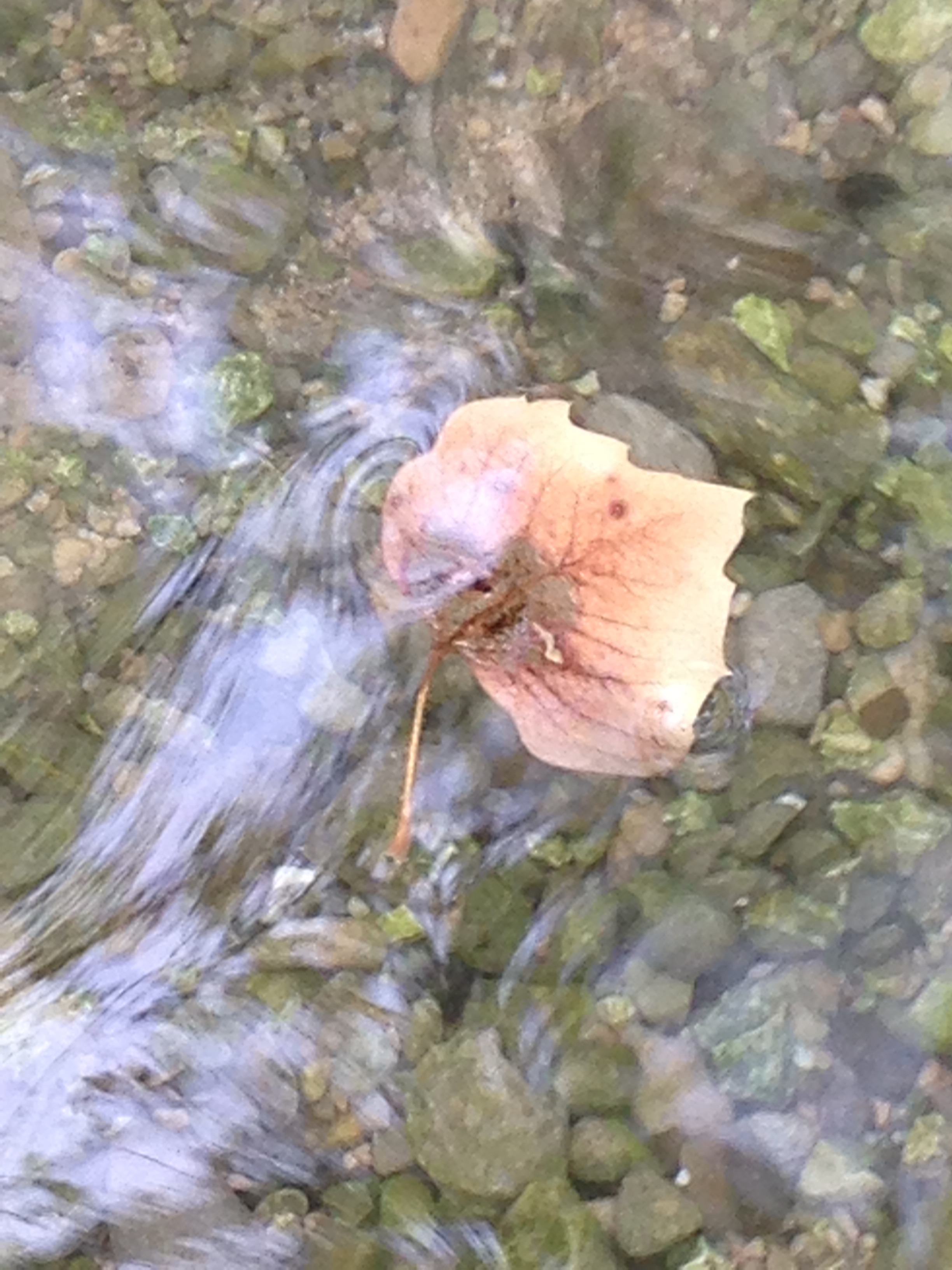
A fallen leaf drifts in a stream, an autumn icon…although this was in April, and the stream was En Faschia, fresh water springs that flow over the heavy salt water of the Salt Sea (Dead Sea) groundwater. This fresh water stream is within walking distance of the shore of the Salt Sea (the literal meaning of the Hebrew / Biblical name for what is better-known in English as the Dead Sea).

Floating Leaf in Fresh Water near the Salt Sea (Dead Sea), Israel ©2015 Michael Dickel
Floating Leaf in Fresh Water
near the Salt Sea (Dead Sea), Israel
©2015 Michael Dickel

Cassandra

 ♥

our Cassandra’s agony

torments

in poems of prophecy

and breaks our hearts

upon the stone of her insanity

she calls on death to visit one self-appointed night

and we, her guardian angels, wearied by the fight

still

we soldier on with all our might


©2012,poem,Jamie Dedes,All rights reserved * Painting/Cassandra by Evelyn De Morgan (1885-1919), U.S. public domain.

Imagine the Beats – Readings, Photography, Music – Munich, Germany, 24 September 2015

Editor’s Note: The photographs are by Dr. Zank and were exhibited at the Beat Poetry Festival.

unnamed-2When in July 2015 I was asked by Yvon Cornier and Colin Haskins to be the host for Germany to the National Beat Poetry Festival initiated and coordinated in Connecticut, USA, I could hardly imagine that the time I had at my disposal would be enough for the extensive preparations such an event implied, all the more so as I knew I would be travelling the whole of August. But back to Munich at the beginning of September, I started dealing with this fascinating issue which encompassed poets hosting readings or events in their respective states and for other countries as well. The organisers described the event as follows:

“The National Beat Poetry Festival, as a non-profit organization, is dedicated to hosting, collaborating, and fostering joint partnerships for Beat themed poetry readings, workshops, plays, radio shows and much more locally and across America – and even internationally at times. […] The Beat Generation’s significant writings and history of its original prime movers lives on from its inception in the early 1940’s, and its legacy continues today by way of new writers, poets and artists of disparate influences and means of expression.”

unnamed-1A challenging description, indeed, and of special significance to me since my own involvement with the Beat movement had started as early as my student time in Bucharest which I finished with a diploma paper on “The American Poetry in Romanian Periodicals in the 1960s and 1970s”. For a communist country like Romania was at that time, the amount of American poetry translated was tremendous and the Beats were duly represented. But then don’t forget that President Nixon visited Romania in 1969, and the bilateral collaboration with America had reached an unparalleled level.

The vision of what the Beats have been for their time but also for the years to follow generated the title of our event “Imagine the Beats”. It was meant to be a complex tribute to this generation of multifaceted poets and writers in an interplay of readings, music and photography, all in the Beat spirit, of which this short film is just a sample.

unnamed

The event took place on September 24th in Gasteig, a renowned cultural centre in Munich, with the participation of further two poets, a singer and composer and myself as poet and photographer. We aimed at and were glad to be successful in motivating the audience to actively join us during the performance.

© 2015, feature, photographs and video, Aprilia Zank, Ph.D., Lecturer for Creative Writing and Translation in the Department of Languages at the Ludwig Maximilian University of Munich, Germany; All rights reserved

White Angel Feathers

three ekphrastic poems

after photographs by Donatella D’Angelo

White

White. Don’t mistake this for blank.
She hides in it. The black forest
rises from snow, curving down
a hill. Don’t mistake this for shape.
It masks her true form. The hints
erase. Don’t mistake this for absence.
Her image emerges from between—

a suggestion of emptiness and lines—

I can’t see her there. Her shadow
evades understanding. The empty
line holds all of the meaning. Drops
of water splash beyond the frame
of the window. Someone calls her
name. She hides in it. It masks
her true form. White erases a hill.

—Michael Dickel

hiding in the bush L’erotismo è dare al corpo le suggestioni della mente. (Georges Perros, Papier collés, 1960)
Lavoro autobiografico ©Donatella D’Angelo 2011
hiding in the bush
L’erotismo è dare al corpo le suggestioni della mente. (Georges Perros, Papier collés, 1960)

Lavoro autobiografico ©Donatella D’Angelo 2011


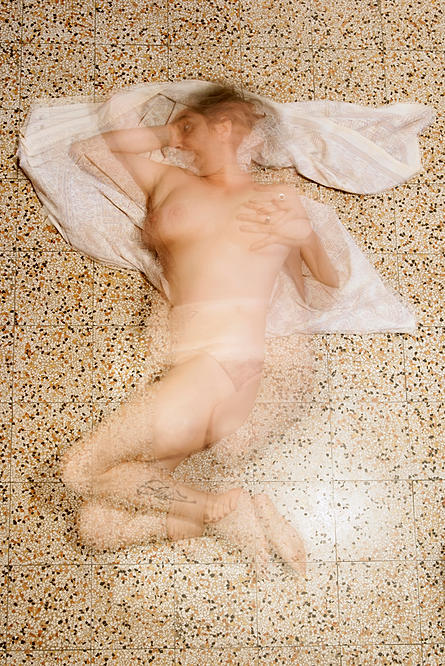
Angel

Photo of woman lying on the floor with white cloth
Sintesi Degli Opposti B1
©Donatella D’Angelo

A ghost angel flutters across
the image—naked truth,
an acceptance of time, place.
Absence gains shape from breath,
a beating heart that sings songs

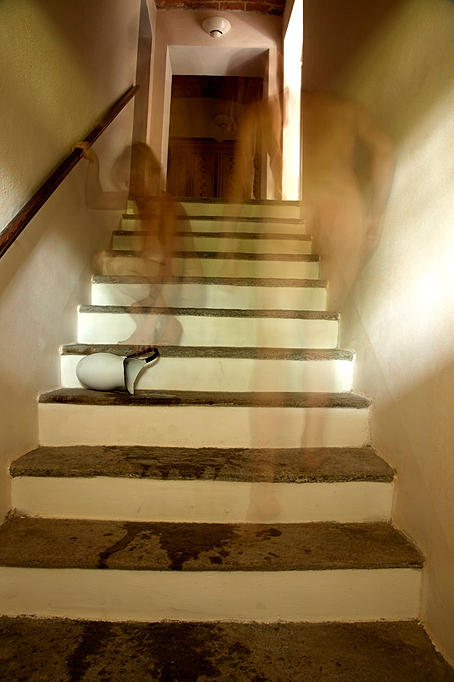
ghostly images of a woman and man climbing stairs
from Los respiros del alma
Doppio autoscatto
Lavoro autobiografico in collaborazione con José Lascerai @2013

from overexposed light, transparent
while form begins in color as
a hint of the person emerges,
more solid than any pretense
of carved stone or identity.

The photographer floats
across her page—possibility,
a moment, a promise to herself—
flowing like water, revealed in a brush
of skin tones blushed across canvass.

Her spirit glimmers, a bit of mystery.

—Michael Dickel

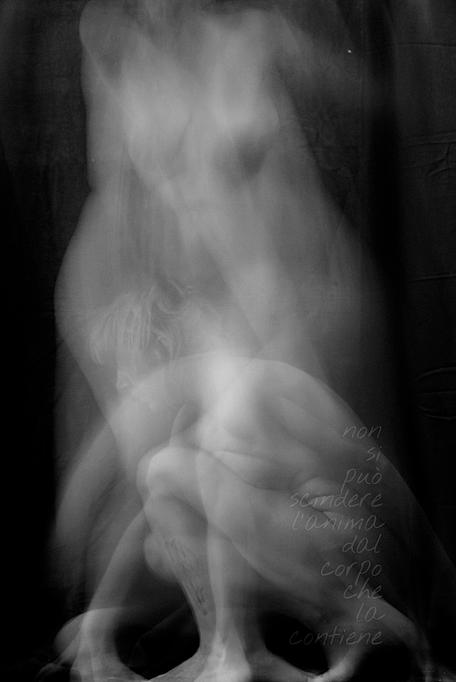
Self portrait Non si può scindere l’anima dal corpo che la contiene Lavoro autobiografico ©Donatella D’Angelo 2013
Self portrait
Non si può scindere l’anima dal corpo che la contiene
Lavoro autobiografico ©Donatella D’Angelo 2013


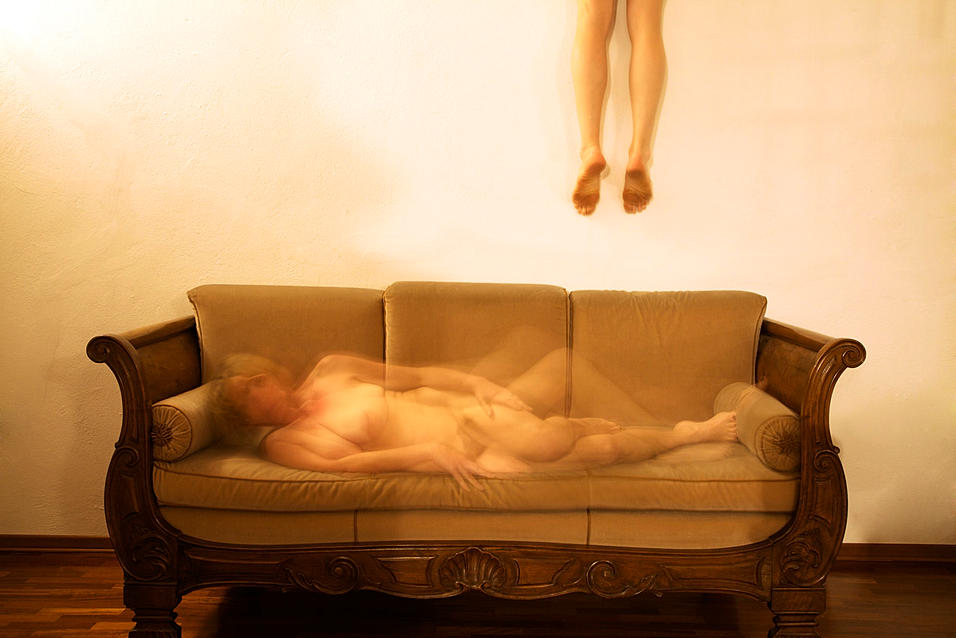
Feathers

I want to write you as feathers,
the way you paint yourself in light—
as though you could reduce self to a
transparent tone of skin caught
in a patch of sun falling across
a sofa while you lay there naked.

I want you to paint me as words
erased from a photograph before
taking the picture, like a breeze
that whispers through the room
and touches your skin when
you start to dance into the image.

What I want doesn’t matter, as you know.
Such wishes merely reflect in water—
imitations of sky, cloud, and tree—
they shimmer and vibrate without
substance or form. They project
a you and me that we cannot touch.

—Michael Dickel

Los respiros del alma Doppio autoscatto Lavoro autobiografico in collaborazione con José Lascerai @2013
from Los respiros del alma
Doppio autoscatto
Lavoro autobiografico in collaborazione con José Lasheras @2013

Decline

Ekphrastic Poetry Prompt

When you have given all, then lost,
is this the colour of blame?
The love that drips from your sweet lips
and drowns someone in shame.

When young, their hue was vestal white,
their innocence on view.
As you would vanquish suitors all,
just one will conquer you.

The age of love, engorged with red,
this procreative flower
would then attract them and their charm
laid helpless in your bower.

But summer’s heat and light turned blue
in autumn’s lengthened shade
and, as the scented bloom decays,
a nation’s colours fade.

When you have given all and lost,
is this the colour of blame?
The love that drips from your sweet lips
and drowns someone in shame.

[This was originally the first of a series of picture prompts, which produced some searing poems from the Grass Roots Poetry Group, all of which can be seen here]

© 2012, poem, John Anstie, All rights reserved; photograph courtesy of Jessie J Daily.

Fields of Lavender

Lavender Fields

These fields of lavender stretch
like bolts of corduroy from where we bask
in this soleil d’été, imaginary
Theo and I. Their perfume sweet
and intoxicating, when we need not
their breath, for we are living a dream.
A breeze combs the wales this way
and that. They sway like tiny willows
to the aeolian flute come up from the sea,
that brilliant reflector of the Sun’s face
and never to be my own.

For I am heir to the darkness,
yang to shining yin of this Arles light.
I shall record my impressions of it for you,
because I shall not see you again.
I am leaving soon, dark dawn drawing me
in its charcoal-covered hands, drawing me
as a stick man of two-dimensions, drawing me
smaller and smaller as I approach
that distant vanishing point out there
on these fields of lavender.

© 2015, poem and photograph, Joseph Hosch, All rights reserved

Ice and Stone

Two Ekphratic Poems

In January 2015, my friend, the artist Judith Appleton, exhibited her work in a nice gallery in Jerusalem. For the opening, another friend, the poet Orna Silverman, and I read poems based on paintings in the exhibit. Orna writes in Hebrew; I, in English. A short while after the opening, I posted images of the artwork and the two poems I read on my blog. Here they are for BeZine. Images of the paintings are used with permission of the artist.

Greenland by Judith Appleton ©2014 Judith Appleton
Greenland by Judith Appleton
©2014 Judith Appleton


Land of Ice

Hyperborean form—frosted
by pastels, disturbed by shadow
strands—calls unending dusk-dawn
in sacred colors. An indeterminate
matrimony desires fire inside
a wood cabin, order restored
where upheaval emerges
from swells against the sky.
Yet, the stroked shape and
blended palette structure
a syntax of blood, a semantics
of nerves inflaming lonely
twilit-snow, liminal moments
of memory with promises of
maize-tinted nourishment,
hope from the midnight sun.

—Michael Dickel


Dead Sea Cave by Judith Appleton ©2014 Judith Appleton


A Philosophy of Stone

Aleph-tav—alpha-omega—as an inception
of mud swells along architectonic vaults
and girdles a basalt grotto-door that swivels
from a face adumbrated by place. Luster
and umbra texture worlds, lambent reality
perceived as words over matter. Perhaps
here we contrive Plato’s trace, a slight hint
of volcanic certainty steaming out of grasp.

—Michael Dickel

© 2015, poems, Michael Dickel, All rights reserved; illustration by Judith Appleton: a write-up on Ms. Appleton’s showing at the Jerusalem Artists’ House can be read HERE.

Battle Horse

Lonely_by_Sylwiaa
[I’ve heard Ekphrasis* described as one of the ugliest words in the English language. In writing this poem, I would like to try and make it ironic]

In this, another war poem, at the same time I both celebrate and mourn the destiny of millions of horses in the front lines on World War 1. Here, I may talk about a strong stallion with great heritage from the same lines as purebred battle horses that served knights of old before war became so mechanised.  The first world war was the turning point between the old and new ages of war, in which the military cavalry masters of the old order clashed with the new; and the result was an unmitigated armageddon, an unprecedented tragedy of slaughter in blood and mud … there is no undue irony in this great stallion’s story, insofar as its consequences, though its life is spared, its mental health is not, like so many human members of the armed forces who serve on or near to the front lines, who physically survive but who are consumed, through trauma, by some degree of mental illness.

Her gentle hand enwrapped his nose
and pulled it to her face.
Behind his nostril, where there is
the very softest place,
she kissed him tenderly and smelt
the scent of peerless blood
that coursed his veins and caused his mane
to tremble with a power
that came from generations of
highbred aristocracy.
This kind of power was visible,
it rippled like a lake
that caught a sudden gust of wind,
and shimmered, glistening.

He’d knightly strength for greater things
and so it proved to be.
A friend of friends, an officer,
had visited to see
and beamed at his magnificence
there was no doubt for him
that this beast was set to ride
for glorious history…

…until his inglorious return,
a sight that broke her heart.

His eyes had depth of understanding
she knew too well. Their look,
injected as they were with fear,
but not the normal kind
– the kind that came from healthy gallops
over his favourite fell.

No. This fear, its source was made …
(what she saw then choked her eyes)
… made from inner visions of
an unspeakable kind of hell;
mud-filled craters’ stench of death,
through endless shock of shell, but
unshakeable loyalty to his charge
despite his spirit’s knell.

In time the empty frame that stood
motionless in the field,
with timeless care she tended him,
though never fully healed
the scars that stiffened weary spirit
that caused him so much pain,
but filled with love and trust once more
the noble steed regained
a hint of what he used to feel:
excitement for the day,
security in his domain,
where once he held full sway;
desire that burned in his dark eyes
to lead her in his way
back to the stable where he’d sink
his nose in soft sweet hay.

– John Anstie

© 2012,2013 introduction and poem, John Anstie, All rights reserved
Illustration ~ Lonely by SylwiaS Digital Art / Photomanipulation / Surreal©2009-2013 SylwiaS

Not That I Really Know

not that i really know

the brown bag prophet
said
i ain’t no
philosophy
barely finished
high school
but
i’ve been reading
different things
bout’
the critical spirit
how it can
hold back
religious enlightenment
you know
by asking
too many questions
trying to get to the bottom
of things
rather than
accepting the rituals
place before you
as
others have done
but
i was wondering
why anyone
would want to plant
a seed
that
cannot grow

© 2015, poem and digital art, Charles W Martin, All rights reserved

In the expansive mist of morning, when my soul takes time and room to breathe and stretch, I gaze around my room and wonder what I might do with myself.  My eyes light on the top shelf of a bookcase, where stands a handmade paper album.  Pages of rough texture wait to absorb something well-constructed, like a bed of rice made to nestle a complicated curry.  What poem or drawing or photograph would be worthy to lie in those lush furrows?  Surely nothing as lowly as what I would create.  Yet I long to put my time, my love, my hands to work, to make something.  I want to slowly blend my life into some material.  The satisfaction is exquisite.  I felt it once, birthing and raising children.  The medium responds, reacts, engages, resists.  It is not a work of power; it is a work of love.

josh baby shoe

I have begun to notice an impatient annoyance building up in me when I look at photography sites.  I am enamored of the images, but so often the captions leave me irritated.  I do want to know what I’m looking at and where it was found.  I don’t like the flavor of language that suggests violence.  “I captured”, “I shot”, “I took”, “I caught”.  Why not just say that you were there?  It was there.  You made a photograph of it at that place and in time.  Doesn’t that sound more respectful somehow?  It does to me.

NM road

I like art that shows that respect.  An artist is generous with time, patient, slow, allowing something to unfold, gently.  There is a generosity of presence in art.  An artist gives herself – body, consciousness, energy, and loveinto a relationship with her work and medium.  That’s what feels so rich, pleasing and compelling in a well-made piece.   Whatever it is.  I am often so task-oriented that I don’t think of that.  I was taught to be efficient, neat and accurate.  In preparing a meal, for instance.   When I began cooking for Steve, he’d ask me about supper, and I’d tell him the steps I planned to take and ask for his input on decisions.  He’d respond with something like, “Just make it with love.”  I wasn’t sure what that meant.  I think I have a better idea now. My photographs have since become more care-full: close-ups attending to focus, light and color turn out differently than snapshots.  I want my life to be like that, too. (click on the photos below to see them in a full size slideshow)

© 2015, essay and photographs, Priscilla Galasso, All rights reserved


Art, Time and Love