~ Under ~

((September is an extra special month here at the BeZine. We are celebrating 100TPC (100 Thousand Poets for Change) in an effort to call awareness to global poverty. In the words of one of the Co-founders for 100TPC, Michael Rothenberg II, “500 events in over 100 countries, 100 Thousand Poets for Change Global Day, September 26, 2015. Thank you for keeping the initiative alive. 5 years of community building. Peace, Sustainability and Justice!”

Below is my humble offering to the movement. Please come share your own work with us on September 26 and check out some of the others as we dare to make a real difference for those in need.))

*********

Matthew 25:40 by Cameron John Robbins

“And the King shall answer and say unto them, Verily I say unto you, Inasmuch as ye have done it unto one of the least of these my brethren, ye have done it unto me.” ~ Matthew 25:40 KJV Bible

*********

~ Under ~

Homeless Joe, has nowhere
to go. He lives under a bridge;
not a troll, just poor.

(Not in some third-world country, no).

Crazy Jane lives under
a delusion—from voices
of people not here anymore.

(In the land of the free and the home of the brave).

Carmen, a single mother of five,
lives under the stigma
of using food stamps to eat.

(In America, the poor are victimized, you know).

Speed-freak Charlie lives under
the influence of the drugs
which keep him wandering the streets.

(How many poor would that daily latte save?)

All of them, under poverty’s yoke.
Under society’s up-turned nose.
Homeless, hungry and in many ways “broke,”
Do you really think this is the life that they chose?

(How about walking a mile in their…feet?)

What they truly need is understanding,
To help them get back to dignity’s door.
Out from under all the senseless branding,
Back to being visible people once more.

(Please help the less fortunate people you meet!)

~ C.L.R. © 2015

*********

Photo © 2013 Corina L. Ravenscraft Quote by Ram Dass

I Am Not Alone

hello poverty
my old friend
I knew you’d find me again

but you can’t touch me this time
I am no longer helpless and without help

I will find ways to sustain us when things get low
I will face challenges with peace and love

I am learning that God and the Universe will help
take care of all our needs
I am learning that sometimes our wants might have to wait
but God and the Universe might help us figure that out too.

I don’t feel so alone anymore.
That’s the thing about poverty.
You don’t talk about it
except when you’re being interviewed
to show you deserve help.
It sets you apart
It keeps you alone.

—Lana Phillips

© 2015, poem, Lana Phillips, All rights reserved

Homeless

homelessRagged Clothes. Need sewn. I haven’t a home.
Dark night. No sight. I cower in fright.

Confused. Misused. A life of Abuse.
Sought help. Refused. Beaten and Bruised.

Starvation. Malnutrition. I have no real food.
Recession. Deep Depression. A sorrowful mood.

Cold rain. Disdain. Nowhere to retreat.
My pain. In vain. No shoes on my feet.

Angry people. Stare at me. They see me as dead.
Desparation. Condemnation. I only want bread.

Apprehension. Foreboding. Danger is near.
Exposure. No closure. I tremble in Fear.

I’m freezing. They’re teasing. They punch me and kick.
They leave. I grieve. Wish death would come quick.

—Brian Crandall

© 2015,  poem, Brian Crandall, All rights reserved; photo courtesy of Peter Griffin, Public Domain Pictures.net

Le Mendicant

Le Mendicant
A Narrative Poem/Flash Fiction

I make my way slowly toward la Gare du Nord, pass la Rue Phillipe de Girard. I lumber along at a slow pace. The ache in my feet shoots up my legs. The night was cold last night and us seventy-something’s have poor circulation, especially when we sleep in alleys.

At the entry to la Boulangerie, I pause, take in a deep breath and dream. The smell of bread, just coming out of the oven, fills me with pain. A young woman, dressed in a tweed business suit, three-piece, and three-inch heels, exits. She turns abruptly and walks hurriedly away from me. The scent of the baguette lingers like an expensive perfume. Its rough texture and golden color remind me of better days. Today I haven’t a sou in the pocket of my tattered jacket.

When I reach the station, I take my seat on the rough concrete of the steps leading to departures. The chill penetrates, creeps up my spine. As I extend my callused hand, I know what they think, but they don’t know my story. It hurts to look into their eyes and see them avert their own in embarrassment as they rush by. A few drop a coin or two, not enough for a loaf.

Counting them at the end of an hour, I think I may have enough for a small, day-old roll and a cup of black coffee. I stand, stomp my feet in hopes of regaining some sensation, and straighten my old back a bit at a time. Grasping the railing, I climb back to street level and make my way back to the bakery.

Maybe someday, someone will stop to listen and offer me the bread of understanding.

Written as narrative poetry/flash fiction, from a first person perspective, this is a fictional collage from a few images that linger with me from the time I lived in Paris. The reality is true world-wide.

– Victoria C. Slotto

© 2015, narrative poetry/flash fiction, Victoria C. Slotto, All rights reserved

The Roots of Institutionalized Poverty in the Compromise of 1877

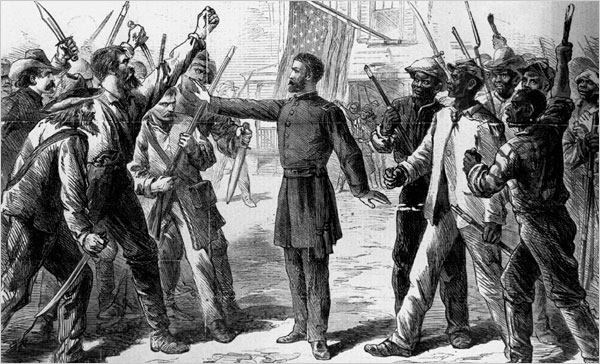
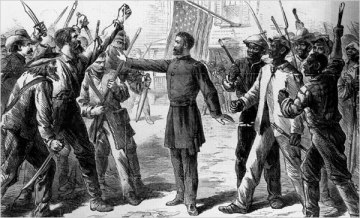
skepticThe Reconstruction Era immediately following the surrender of the Confederacy and the end of the Civil War extends from 1865 until 1877. Reconstruction began with great promise but ended in tragedy. At the very beginning of the Reconstruction Era, three Constitutional Amendments were passed, still collectively known as the “Reconstruction Amendments”: the 13th, which ended slavery; the 14th, which made all people born on American soil immediately and unconditionally Americans with equal rights across the breadth of the entire Nation (and also effectively revoked the Dred Scott v. Sandford decision of 1857, in which the Taney Supreme Court had ruled that slaves were not, and never could be, citizens); and the 15th, which prohibits deprivation of voting rights “by the United States or by any State on account of race, color, or previous condition of servitude” (in other words, all former slaves could vote). For all practical purposes, however, all three of the Reconstruction Amendments, even in a de facto sense the 13th, were rendered null and void by the collapse of Reconstruction, beginning with the Compromise of 1877. The year 1877 and the inception of the Compromise also mark the beginning of the process of the institutionalization of poverty in the United States.
american-reconstruction-600

The Compromise of 1877 is difficult to write about, because, unlike the other great Compromises in the first half of the 19th century, e.g., the Compromises of 1820 (Missouri Compromise) and 1850, the Kansas-Nebraska Act, etc., there is almost no documentation recording who agreed to what and why…and I am very tempted to remove the “almost” qualifier. Furthermore, the Compromise is difficult to write about, not only because of the lack of unambiguous documentation, but also because the events that caused it, and that transpired because of it, are of such complexity that any thorough and accurate account would rapidly expand and displace the subject of institutionalized poverty. Based on what little we do know for certain, it is evident that the leadership of the Confederate States, having decisively lost the Civil War militarily and returned to the Union, elected to attempt to accomplish politically what they could not achieve through the violence of battle: the perpetuation of some form of slavery in the South. In this, Southern leaders were successful to a degree that perhaps even they, in their wildest imaginings, could never have conceived. Their victory began with the election of 1876.

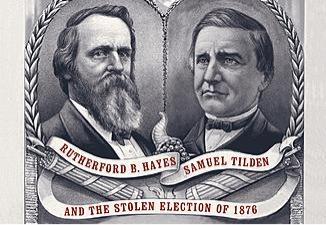
In November of 1876, the presidential election to replace Ulysses S. Grant pitted Republican Rutherford B. Hayes against Democrat Samuel J. Tilden. The outcome of the election – of which the following is a Reader’s Digest-condensed account – precipitated an even greater Constitutional crisis than the election of 1800. I say “an even greater constitutional crisis” because the presidential election of 1800 involved a simple tie in electoral votes between candidates Thomas Jefferson and Aaron Burr. (The incumbent President, John Adams, was a respectable but distinct second.) There is a very explicit, and very simple, Constitutional procedure to resolve such an impasse: voting by each State represented in the House, with each State having a single vote. The House of Representatives had to take 36 votes to elect Thomas Jefferson, but in the end the impasse, harrowing though it was, was resolved through “plain-vanilla” Constitutional procedure.
cardimage_5579358_1467602891361565862518

But in the election of 1876, a situation arose that none of the Framers could have foreseen: competing slates of presidential electors were elected from the States of South Carolina, Florida, Louisiana, and Oregon. (Rival slates of electors were commissioned because South Carolina, Florida, and Louisiana all had self-appointed rival State governments of the other party. In Oregon, there was a controversy about the eligibility of one elector from Oregon.) In each case, one group of electors was committed to Hayes and the other to Tilden, reflecting the rival parties vying for control of the State governments. With time running out and no president yet elected – just as in 1800, only more so – the Congress was forced to grapple with the extra-Constitutional issue of which electors to count and how to validate their votes.

Congress ended up passing a law creating an ad hoc Election Commission for this purpose. The only thing certain at this point was that Samuel J. Tilden had won the popular vote. At issue was which candidate – Hayes or Tilden – had prevailed in terms of electoral votes. (There was and is no Constitutional obligation for any elector to vote for the candidate that won the popular vote in the elector’s State.) Just as Jeffersonian States threatened military action in 1800 if a Federalist interim president were somehow appointed, pro-Tilden Democratic States in 1876 threatened military action if Republican Hayes ended up in office. The slogan of the day was “Tilden or blood.” Commission deliberations began on February 1, 1877 – about six weeks before the inauguration date. During the run-up to the Commission proceedings, it gradually became clear that, in a straight up-or-down vote, Hayes would win. So the Democrats began a desperate filibuster – actually, a series of such – in hopes of buying time and trying to turn the electoral-vote situation in Tilden’s favor. Meanwhile, the clock was ticking: all parties were driving down on the date for the inauguration. The general consensus – remember: there is almost no documentation of this, and no documentation of any kind that could serve as a “smoking gun” – is that Democrats conferred with Republicans and agreed to refrain from a final filibuster, provided that Rutherford B. Hayes, upon assuming the presidency, would end Reconstruction and withdraw Federal troops from the States of the former Confederacy, thus ending protection of the recently freed slaves and terminating enforcement of the Reconstruction Amendments, especially the 14th and 15th. This “corrupt bargain,” as it was called by Republicans at the time, set the stage for the institutionalization of poverty in the South … and eventually across the entire Union. The South lost the Civil War militarily, but won it socially.

 There were three broad categories of consequences that issued from the Compromise of 1877: the de jure triumph of the “black codes” and “Jim Crow”; the extinguishing of the nascent practice of electing African-Americans to public office; and the withdrawal of Federal occupying troops and the consequent unleashing of white-supremacist organizations.

o “Black codes” and “Jim Crow”

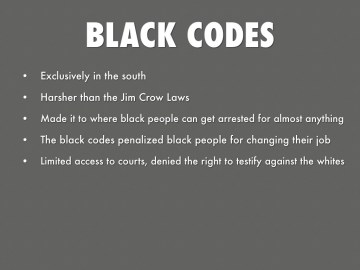
The black codes were enacted in the South a year or so following the end of the Civil War in order to regulate the behavior of black slaves that had been freed, first, by the Emancipation Proclamation of January, 1863, and then by passage of the 13th Amendment to the US Constitution in 1865. The codes did contain some “fig leaf” protections for former slaves, e.g., owners were de jure prohibited from murdering their former slaves, but the black codes – basically extensions and modifications of the “slave codes” of colonial times – prohibited former slaves from moving from one plantation to another, or even visiting another plantation without written permission from the owner. (Of course, in a formal sense, the former slaves were now ostensibly paid employees of the plantation.) The black codes continued to make it illegal for slaves to learn to read and write – and also for anyone to teach them these skills. Federal troops occupying former Confederate States were able to mitigate these laws somewhat under the terms of the 14th Amendment’s “equal protection” and “due process” clauses. But after the Compromise of 1877 and the subsequent withdrawal of occupying Union troops, the black codes were allowed to take full effect. Perhaps of greatest importance vis a vis the institutionalization of poverty is that under both the slave and black codes, slaves were explicitly prohibited from learning any other useful, marketable skill: slaves de facto remained slaves even after their de jure legal status changed.
black-codes-26

Similar remarks apply to “Jim Crow,” except that “Jim Crow” laid even greater emphasis on racial segregation than had the “slave” and “black codes.” All public facilities—rest rooms, train stations, schools, etc., etc.—were explicitly segregated by race. Nor was the trend to racial segregation restricted to the South. Fearing an influx of freed slaves to Union territory, most Northern States instituted some cognate of “Jim Crow.” For example, the 39th Congress, which passed the 14th Amendment and sent it to the States for ratification in 1865, is the same Congress that mandated racial segregation in the District of Columbia public-school system. In fact, the passage of the 14th Amendment is one of the vanishingly few cases where it is possible to be virtually certain of “original intent”: the Congress that passed the 14th could not have had the racial integration of public schools in mind when it wrote the “equal protection” clause of Section 1. (One of the ironies of history is that the Warren Court cited the “equal protection” clause of the 14th Amendment to support the historic Brown v. Board of Education decision of 1954.) Again, this was yet another case in which the occupation of the former Confederacy by Federal troops ameliorated the effects of race laws, and gave some effect to the 14th and 15th Amendments.

o The extinguishing of the nascent practice of electing African-Americans to public office

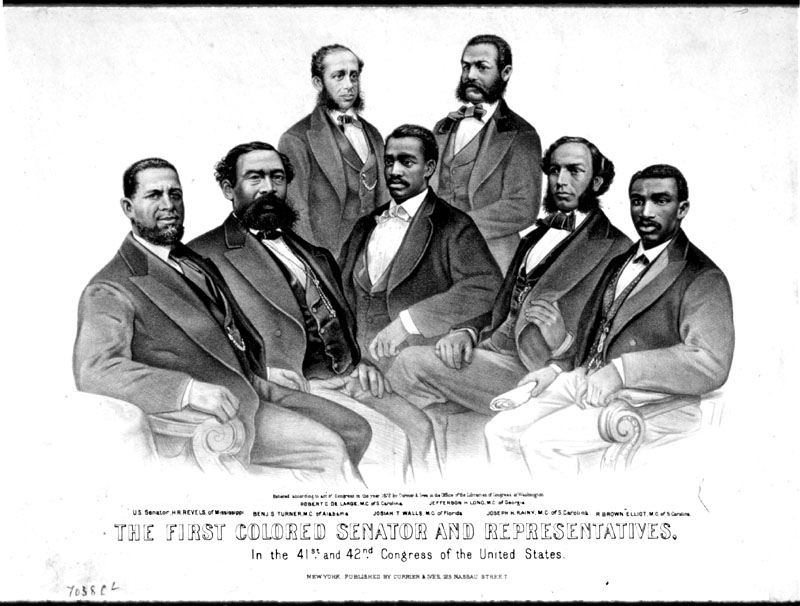
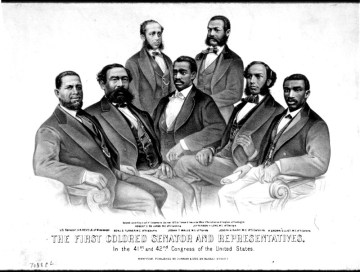
Perhaps the most bitter disappointment associated with the Compromise of 1877, however, was the subsequent lack of enforcement of the voting rights promised under the 15th Amendment. This included the sudden and calamitous choking-off of the election of African-American office-holders. One of the most consistently overlooked effects of the early Reconstruction period—the late 1860s and early 1870s—was that, in large measure because of the extension of the franchise under the 15th Amendment, African-Americans began to be voted into elective office. In retrospect, this was a golden age for African-Americans in the post-Civil-War South. The most conspicuous example, though by no means the only one, was that the junior senator from the State of Mississippi, Albert G. Brown, was succeeded by a free African-American originally from Ohio, Hiram Rhodes Revels – who was also a distinguished African Methodist Episcopal minister. (Even more remarkable about Sen. Revels is that he was elected, as were all senators at this time and prior to the 17th Amendment, by the Mississippi State legislature by a vote of 81-15.) Sen. Revels was followed by Blanche Bruce, who was the first African-American senator to serve a full term. (Sen. Revels resigned his Senate seat after serving for about 18 months in order to become a college president.) Many scholars count over 1500 African-American officeholders at various levels of government during Reconstruction, among them, in addition to Sens. Revels and Bruce, are: Rep. Benjamin S. Turner (R-AL)Robert DeLarge (R-SC)Josiah Walls (R-FL)Jefferson Long (R-GA)Joseph Rainey (R-SC) and Robert B. Elliott (R-SC). Speaking of irony…Mississippi, the home State of Confederate president Jefferson Davis, the State he represented as a US Senator, and the location of his huge plantation, ended up being represented by the first African-American senator and the first African-American senator to serve a full term; Alabama, the location of the first Confederate capital of Birmingham, elected an African-American to the House; and South Carolina, the State with the greatest population of black slaves on the eve of the Civil War (by many counts greater than the white population!) , sent three African-Americans to the House of Representatives.  And the crowning irony: except for  Mr. Elliott, who was born in England, all the above-named Reconstruction Representatives were born slaves. All across the South, at various levels of government, other examples could be cited.  Their name was “Legion,” for they were many.
reconstruction_congresso The withdrawal of Federal occupying troops and the consequent unleashing of white-supremacist organizations

But the Compromise of 1877, the withdrawal of Federal troops, and the consequent rise of white-supremacist organizations like the Klan, the Knights of the White Camellia, the Red Shirts, and the White League, all founded either following the Civil War or in the early days of the Reconstruction, all conspired to render the act of voting, let alone running for public office, lethal for African-Americans. The bright and shining moment was abruptly closed, during whose brief years men like the ones alluded to above—many former slaves, all born to modest, often poor, circumstances—could be elected to office and serve as living fulfillments of the initial promise of Reconstruction. Small wonder, then, that in the wake of the Compromise of 1877, African-American Republicans, many of whom had served in the Union army, felt betrayed by the very Nation whose integrity they had fought to preserve.

Finally, from the standpoint of economic justice and poverty, the Compromise of 1877, the withdrawal of the Federal occupation, and the consequent monopoly on politics subsequently enjoyed in the Southern State legislatures by die-hard segregationists, racists, and “Redeemer” Democrats, the results could hardly have been more severe or disastrous. With the “slave” / “black” codes and “Jim Crow” now in full effect, with no means of coercively enforcing the 14th and 15th Amendments, with former black slaves prohibited from learning a new trade or even how to read and write, and with overtly and militantly white-supremacist organizations now openly enforcing what only amounted to a new version of the old, antebellum social order, the inability to enforce the 14th and 15th Amendments resulted in the “hollowing out” of the 13th. The poverty that slaves had known in the past became a present reality, rendered explicitly legal once more and – once more – subject to coercive enforcement.

Blacks remained poor, and were forced to remain poor, literally, on pain of death. Southern planters and capitalists now had access to a vast, vast pool of free, or almost-free, labor—again, in a manner and to an extent virtually indistinguishable from the slavery of the 1850s. Slavery had not been abolished, merely changed in form. Instead of a given slave belonging to or on a particular plantation as the chattel property of a particular, specific, individual slave-owner, the slaves of the 1870s and 1880s were now, as it were, “slaves at large,” in no way whatsoever essentially different from the vast pool of free labor into which the targeted populations of 1940s Europe were transformed at gun—and bayonet-point by the armies of National Socialist Germany. The form of slavery had changed. The substance had not. Nor would this state of affairs begin to change, even in tectonic-plate increments, until the Second Reconstruction, better known as the American Civil-Rights Movement, which began a century later.

– James R. Cowles

© 2015, essay, James R. Cowles, All rights reserved; illustration, public domain

The Realm of the Unimaginable

BridgeIt is summer and we are busier than we expected; this leaves us eager for time to play and create. Here in Vermont, summer is short, even with climate change, so there is an imperative to use these warm days well. Now that we are a couple of weeks past the solstice, the evenings are noticeably shorter, and although the days grow warmer, we know winter is not that far off.

I spend most of my days with people who have survived The Unimaginable, looking for words and images that communicate something of the experiences that have driven folks to me. Often enough, I find myself in conversations about the ways The Unimaginable makes even the simplest human task daunting, the most everyday experience, other.

Take feeling. Most of the time most of us know what we are feeling, along with our dreams and desires. The Unimaginable frequently replaces dreams, aspirations, and yes, feelings, with numbness and unknowing. In its wake, simply choosing something to eat for lunch can seem a daunting task. The Unimaginable also makes violence mundane, everyday, ubiquitous; too often, it is multigenerational, touching lives across across long stretches of time.

There is now an enormous clinical literature that addresses The Unimaginable. Usually writers describe the process of recovering from its effects as either dreadfully mundane or heroic, a dialectic that names two sides of living in its aftermath, but which obscures the complexity of the experience. Confusion, despair, rage, and a host of other emotions, feelings, and desires break through the numbing, threatening to destroy relationships, careers, and aspirations, to consume one’s life, then retreat as numbing and routine regain control. It can seem as though one lives life midway up the beach, always subject to the whims of the ocean and the ever shifting boundaries of the shore. No footing is firm, no resting place safe.

Much work that seeks to aid people in their search to wrest their lives from the grasp of The Unimaginable is itself, from the outside, mundane. The first task is to establish a sense of relative safety in the present. Then we work together to slowly, sometimes imperceptibly, make room for feeling and knowing, for meaningful daily activities and rewarding relationships. Of course, stages are just a convenient construct, for healing is a complex endeavor. Yet throughout the process, whether it be months or years, we are alert for moments when The Unimaginable becomes something we can imagine, know, and find meaning in, for these are the moments that open the way for deep healing.

It is the transition from the realms of The Unknowable to the place where we are free to imagine, feel, and fully engage life that offers the possibility of renewal; it is frequently a hard won relocation, and it is this that gives rise to narratives of the heroic. Yet, the journey may well not be experienced by the pilgrim as heroic. Surprisingly often, it is simply a long, hazardous walk taken in response to some deep, insistent impulse, some demand of the mind and soul. More often than not the journey is memorable more for its everyday discomforts and revelations, than for deeds of courage, although much courage is demanded along the way.

At some point on that healing journey one must wrestle creativity from the grasp of the Unimaginable, must find ways to express that which maintains its hold on our lives by refusing expression. The arts, ritual, and simple conversation are all avenues for both imagining The Unimaginable, and giving it solidity and form. The Unimaginable is a lot like Chaos, a close ally perhaps, and, like Chaos, when it is given form it becomes something else. The urge to give shape and form to The Unimaginable is, ultimately, the impulse that guides the healing journey.

– Michael Watson, M.A., Ph.D., LCMHC

© 2015, essay and photograph, Michael Watson, All rights reserved

Pulling Myself Up

disabled
disenfranchised
out in the cold
wanting to find a way up
a way out

this wasn’t how my life was supposed to be
I lost my balance and fell
now no one wants to help me up

I am not the person I once was
but I am not the person people think I am
I can stretch
I can move
I can help myself up

I just have to figure out how to make something
of what I have
and who I am
and what sense I can make of the world.

If I have to do that alone, so be it.
if I can find someone who has walked that path
and will show me how, so be it.
But I will do it.

—Lana Phillips

© 2015, poem, Lana Phillips, All rights reserved

Homeless Man

Walking down the road I saw a man in tattered clothes.
I couldn’t help but wonder what had led to his defeat.
Tell me, if you would, about this life that you have chosen,
or did you have no choice except this life, upon the street?

I handed him a buck or two and said, Here, take a seat.
Upon a rusted old park bench we hunkered in to meet.
You’re curious, my boy, he said, why do you want to know?
I want to understand you, sir, to see what makes you so.

That money that I gave to you, I know you’ll give to others.
I wonder, how do you survive while giving to your brothers?
A smile broke across the wrinkled landscape of his face,
the pain I’d seen inside his eyes seemed suddenly erased.

You may not really want to hear the story I will tell,
it happened many years ago—a place not far from hell.
The name, you’ve heard—‘twas Auschwitz, a camp they took us Jews
the horrors that surrounded me tempted me to choose

to take my life before they could subject me to a death
without the grace of dignity. I wanted to be free.
But then some words came tumbling from the darkness of my mind
Words spoken by a holy man I heard in years behind.

The teacher’s voice was strong, it traveled straight into my core
of all I understand of God, of what we’re living for.
Such good there that can be done in Auschwitz late at night—
your hope can be a gift to those who tremble in their fright.

And what I learned back then—the truths that saved me from despair—
I carry them within my soul, there’s so much need to care.
So I refuse to see my life a symbol of defeat.
Much good there is, my son, that now awaits me in that street.

The old man stood and shook my hand and left me with his smile
I sat, transfixed, upon that bench, alone, for quite a while.
Now I withhold my judgment when I see another homeless guy
and wonder still at wealth, within, that money cannot buy.

—Victoria C Slotto

The anecdote related in this poem is derived from a story related by Rabbi Schlomo Carlebach. I read it in “The Oracle of Kabbalah” by Richard Seidman. This book deals with the hidden meaning underlying the Hebrew Aleph Beit.

I Understand

I understand the homeless man
Confusion in his eyes
Tries to survive the best he can
There is sorrow, in his sigh

Life dealt him a deck of cards
With no Kings, Queens, or pairs
Day to day life is really hard
Especially when nobody cares

He tried to reach a peaceful state
Accidental over-medicate
Cannot shake a dark affliction
Desparation leads to drug addiction

Society, it makes no sense
Within a foggy mind
A victim of poor circumstance
Let’s find a reason to be kind

– Brian Crandall

© 2015, poem, Brian Crandall, All rights reserved

Rumor

51WAdCuzIpL._SX372_BO1,204,203,200_Editorial note: Two of the following poems are from Silva Merjanian’s poetry collection, Rumor (Cold River Press, 2015). The final poem is a new one.  Proceeds from the sale of Rumor go to the Syrian-Armenian Relief Fun.

Refugee

Outside, desert air licks tents with an icy tongue
creeping under pegs unto the sand floor
where she waits morning, legs squeezed, trembling tight
her mother’s warm breath with a hint of onion and lentil smell
brushes on her face, calms tremor of awake nightmares
her sister’s knees dig into small of her back

she tucks her cold feet under her aunt’s ample buttocks
finds comfort and safety in the call of unwashed bodies
familiar, earthy, sweat of family in deep disturbed sleep
on worn beige mattresses pressed side by side

a limb resting on her distended bladder feels heavy
she knows she has to hold it in, till light leaks
from between clouds bearing down, birthing morning relief
over a tense night battling more than a winter’s wrath

it is not safe to walk at night to the makeshift bathroom outside
her father had said, not even holding mother’s hand
she remembers the stars as they faded one by one with each thrust
when strange men tore into her that night, their moans mocking whimpers
escaping through large fingers pressing on her mouth

she feels the sting first, between her bruised thighs
before the wet warmth soaks through her pink pajamas
darkening with yellow and red princess patterns
into the coarse mattress, where her siblings lie
entangled in fading dreams of home

She couldn’t hold, she is after all only eight years old

Collateral Damage

Morning arrives charred
served on a disassembled night
its curled edges, ashes on waking eyes
no smoke in sight, no trace
where old mistakes aspirate donated lungs
burked storms under soft pillows
plump with the geese not the feather

as if a night could not satiate viscera of dreams with its cant
as if doubt drains into power pipelines as tear ducts dry
and conscience blazes in defiance fueled bonfires

had you not heard panting in medicated doldrums of their minds
had their stuttered remorse turned the soft soil of tomorrow
had you not loved only to stay alive
morning would have arrived perky and bright
and you too would have heard the finch outside
instead of the crackling of the fire

Second Change

There’s a lone seabird pacing the seashore
there’s a nursery rhyme curdling sullied sand
there’s a woman sobbing beneath my ribs
a wolf negotiating a truce with its tails
there’s a poet with a voice low and gentle
his words macerate in spit of death

it is not pomegranate bleeding from their lips
but pleas soiling the seas licking lacerated waves
Damascus festers in a shallow grave
dogs digging bones, prayers and jasmine sprigs

it is 3 am in California and my room is lit soft yellow
by a moon I befriended with no strings attached
and lullaby of the Pacific falls on my covers
yet the woman beneath my ribs still weeps

there’s an empty crib among olive trees
a distance I cross on a seabird’s dream
there’s a traumatized moon lying in my lap
a feral woman fracturing my ribs
pleading deities for a second chance

– Silva Merjanian

© 2015, poems and book cover art, Silva Merjanian, All rights reserved

Out In the World

Forgive my absence from the blogosphere, friends.  I have been out in the world.

Of all the stories of our recent travels that come to mind, one stands out.  In Sighosora, Romania…

…we stayed in the Old Town.

In the passage to the courtyard we found a nest, with two baby birds huddled nearby.

There had been a fierce windstorm the previous night that had blown the nest from its nook in the wall, our Romanian host told us when delivering the key to our flat.  My husband Thom replaced the nest, but when he tried to return the birds to the nest….

…he discovered two of their legs were tightly bound together by a long blond hair–nesting material gone terribly wrong.

We had a knife, our tiny blunt-nosed travel scissors, and a larger pair of scissors scrounged from the kitchen.  Thom and our son Eli hoped to separate the birds with a quick snip.  But the hair had been there for a long time, the legs were swollen around it, and every effort set the birds fluttering in a panic, which we feared would cause further damage.  Our host wished us good luck, and left for work.

We felt helpless.  We were there for only one night.  To whom could we hand off these birds? We could return them to the nest and let nature take its course–a slow and painful death by starvation, if not infection.  Or should we put them out of their misery?  The only other possible solution was harsh.  If we did nothing, both birds would surely die.  By amputating one leg, one bird would likely die, but the other might have a fighting chance.  One delicate leg was unresponsive to the touch, probably already broken.  Eli braced himself and severed the mangled leg, cutting through the hair.  Immediately both birds were free and fluttered off.

The one-legged bird landed on the ground nearby.

The stronger one fluttered all the way to the far side of the courtyard.

We heard a cackling overhead.  Even without the family resemblance, we recognized an anxious mother, calling to her babies from the rooftop.  We felt a glimmer of hope–their mother might yet take them back under her wing!

But our presence made her nervous, so we watched from inside, then left to explore the area.

By suppertime, the stronger bird had flown up to a perch in the courtyard…

…high enough to be safe from hungry cats.

The other remained quietly earthbound, suffering in silence.  We wondered what the morning would bring.

The next day, the stronger of the two was gone, as was its mother.  The injured bird remained, probably abandoned as a lost cause by its family.  We checked back only moments later to discover the one-legged bird was now gone as well, without a trace.  In a laundry room off the courtyard were two domestic workers.  Could they have removed the bird like a piece of litter?  Or perhaps a crow had carried it off to feed to its babies.

Out in the world, we often catch glimpses of a story, or a life.  Sometimes they are as sweet as a single drop of honey.

Others are stories of sorrow and want.

Too many will be lived out in the shadows in quiet desperation.

As with the baby birds, sometimes we are helpless to help, sometimes we can offer only a bandaid, and most times we will never know how the story ends.

What makes the difference between a happy ending and a tragedy?  Is it survival of the fittest?  An accident of birth?  An ill wind, perhaps.  But sometimes it falls into our power to make a difference.  When that happens, even for one tiny being, it can make all the difference in the world.

All images and words copyright 2015 Naomi Baltuck.

Some Kind of Hell to Pay

Breadline
Breadline

the unconscionable dance in the canyons of power,
lined with megalithic buildings, the edifice complex
of the spin-meister’s lie, that the demigods can do
anything – anything – walking this asphalt valley

a parade, flailing lemmings trussed and trusting their
die-cut dreams to the pitiless whim of the military/
industrial/medical alliance, whose war-cries are of
greed and arrogance, believing they’ll live forever,
today’s sovereignty, tomorrow’s guarantee. But it’s

all delusion – cultures die and the hope-crushing
architects of cuts and austerity measures are like
the rich man in the Lazarus story, there’ll be
some kind of backlash, some kind of hell to pay …

“I believe terrorism cannot be won by the military action. Terrorism must be condemned in the strongest possible language. We must stand solidly against it and find all the means to end it. We must address the root cause of terrorism to end terrorism for all time to come. I believe that putting resources into improving the lives of the poor is a better strategy than spending it on guns.
Peace should be understood in a human way, in a broad social, political and economic way. Peace is threatened by unjust economic, social and political order, absence of democracy, environmental degradation and absence of human rights.

Poverty is the absence of all human rights. The frustrations, hostility and anger generated by abject poverty cannot sustain peace in any society. For building stable peace, we must find ways to provide opportunities for people to live decent lives..” Excerpt from Poverty is a Threat to Peace, Muhammad Yunus, Noble Peace Prize speech, 2006

© 2013, poem, Jamie Dedes, All rights reserved; photo credit, 1930 breadine sculpture at the FDR memorial courtesy of Peter Griffin, Public Domain Pictures.net

Jacob’s Ladder

unnamed

Everyday he climbs
white ladders of snow
to get higher and higher.
He half‐slips between daylight and dreams,
wonders if any swirl remains on his fingerprint
or if his god‐mark has faded
like a vending machine tattoo.
Just days before
he blocked his mother’s
slamming door with his foot.
He’d hoped for a hot shower
clean cotton sheets that had billowed on the breeze, maybe snatch
a cookie from the old owl jar,
but his father Abram rose
and pushed him back in the night.
Now, he stands outside himself
looking in mirrors of sun‐glassed eyes,
people walking by his lifeless body.
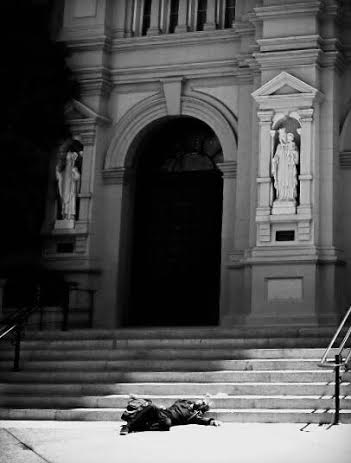
He’s splayed across Cathedral steps posture of the Pieta,
Jesus laying limp on Mary’s lap,
when all was done
and the angels watched.

—Sharon Frye

© 2015, poem and photograph, Sharon Frye, All rights reserved

The Search

WalmartMan

The search begins and ends
in this same spot every day,
where the concrete beneath me
is as hard as a cold-blooded heart
but as giving of daylong warmth
as a full bottle.

The seeking is much better at night,
when you can’t see the memories
in the face of the sun.
Those are the ones that hurt
if you stare too long at them.
And faces are meant to be ignored.

Illumination and clarity
are overrated anyway when
what you’re trying to remember
is how to forget, and the memory
is as rough as this concrete upon
which the search begins and ends.

I prefer the hard and warm
of this perch, and the comfort
of that bottle, to the soft
and cold arms that won’t let me go,
chill and flaccid as the lips
they drew to mine.

—Joseph Hesch

© 2015, poem, Joseph Hesch; Photo, Walmart Man, ©Kellie Elmore

Why Do You Judge Me?

I come to this school
I’m just the same as you
You want to learn science
You know I want to learn too

I live in a shelter
I once lived out on the streets
You laugh at my clothing, and
The worn out shoes on my feet

Why Do You Judge Me?
Will you ever accept me?

They shut down my job
And now I can’t find another
I’m looking for work
Can you help me out, brother?

You walk by with Disgust
The expression on your face
Do you have any Trust?
Is there even a trace?

Why Do You Judge Me?
I Wish you would Help Me

I worked hard all my life
Got no retirement pension
I made enough to get by
My body writhing with tension

My bones are all aching
I no longer have my good health
Some people work hard
Never receive any wealth

—Brian Crandall

Cold Comfort

Ruddy-faced, the ragged wanderer wraps his
coffee cup and his smoke in one hand.
His other he keeps in the pocket
of his third-hand Mets jacket.

Whether he’s grasping something within
or he’s just trying to keep it warm
is a mystery. Odds are 4-to-1 no cash
shares those five fingers’ holey berth.

Joyous, head high, the urban drifter
throws smiles like sunbeams right into the
faces of these straight-life, shivering souls
with whom he coasts starkly bright morning streets.

Their eyes are up, too, but they focus
past the no one that walks near them,
seeing instead only the faces in the
steamed-up coffee-shop window.

That’s the one framing their same
familiar frowning reflections as yesterday.

—Joseph Hesch

Who Am I to Judge?

IMG_1180Rainstorms remind me to be more thankful
When caught in this disappointed handful
For the time that I spent alone on the streets
Now inside my home when it snows or sleets
Grateful to God giving praise when I pray
Behind locked doors where the wolves are at bay
Having a new roof and a warm cozy bed
With good hot meals and a place for my head

Some are still standing in the long soup line
Smelling like wet dogs and cheap screw cap wine
It’s choices they made of their own choosing
Most are smart men who’d rather be boozing
There are new families with kids in soup lines
Victims of lost jobs or the banks some combined
With a clean conscience, not judging, only examine
Is it a lack of faith, sin, trials or predetermined

We are the instruments of His ordained works
If we don’t help who’ll do the framework?
Offer aid and assistance when you can
We are all saved by grace and His plan

– Michael Yost

©2012, poem, Michael Yost, All rights reserved; photograph, Jamie Dedes, All rights reserved

Georgre Enescu: “Carillons nocturnes”, Cristian Petrescu, piano

Georgre Enescu is the greatest Romanian composer and Cristian Petrescu received the Prix du Disque de l’academia Charles Cross in 2000 for recording all of Enescu’s piano works, which are many.

– Liliana Negoi