# Harmonic Chanson #

A chanson ,
A clinking harmonic tune is fluxing through my genie ,
Like a melodious chant of the monks in a cloister ,
Like a fluty ode of a shepherd in a green meadow ,
Like a rhythmic carol of a venerator in a church ,
It’s waving through the windy cascade ,
Ringing the bells of the churches and temples ,
Nodding the polite petunias,
Conquering the Thames and the Nile .

Dancing on the stages of the Eastern and Western Ghats ,
Kissing the bluish veil of the  Nilgiri ,
It has adored my land ,
Bewitching  the four
grooves of my heart ;
O -the  melodious harmony !
How placid you are !
Capering from a clandestine place ,
Fluttering your wings like a migratory bird ,
Never leave me desolate ;
Lock me in your embrace
Alike folded  feathers of a swan for her brood of ducklings ,
Plunge me into your gleeful high tide ,
Let me repose my eyes to an unknown galaxy beyond the Orion ,
Let me submerge into your authentic sustainability ,
Let me endue the star studded garment of the murky sky ,
Smearing the flood of the watery moonbeam ,
Let me fill my costrel -my pale bosom with your rich wine of musical justice ,
Until my last breath ,
Until the dernier particle of my entity resides on the argil ,
Of this fairy globe .

© 2017, Kakali Das Ghosh

The Music of the Conch Shell

The conch sea shell is a reminder always
of where it is she really belongs

of small hands holding the beauty
of ocean waves within its’ confines
hugging her ear & she in awe and wonder

even now when she cradles it closely
and listens longingly and intently

she can see the waves building high
coming to crash along the sandy shore
where seabirds add calls to the score

to a music with a wondrous crescendo
the color of sea salt spraying her skin

the wind picking up the string section
with soprano highs & contralto lows
& a sky of variegated blues the backdrop

connecting the ocean stage to the horizon
unseeing of the stage hands hidden below

but bringing memories of dolphins dancing
upon the ocean stage & the magic of whale song
whose singing plays the melody all the while

she knows with utmost certainty she will return
to the place where she really belongs

© 2017 Renee Espriu

The Music of Prowess

The sound resonated deep and loud
like a bull moose announcing
his prowess in a distant forest
under tall aromatic evergreens

for each time it reached her ears
she realized how close the notes
of music came from the bedroom
of her oldest daughter playing

the oboe she toted home of a day
whose length was as tall as she
that the teacher announced to her
no one really wanted to play

so her pondering how it happened
a tiny girl could have enough air
evaporated as she balanced the oboe
on the floor when she sat to exhale

© 2017, Renee Espriu

Intrusion

I wake up in the mornings
relishing my quiet time

Then my partner wakes
and insists on blaring
his music through the
computer speakers

He is my personal deejay
Nothing like loud vibes
to get your blood circulating

2017, Denise Fletcher

“Music rearranges your molecular structure.” ~ Carlos Santana

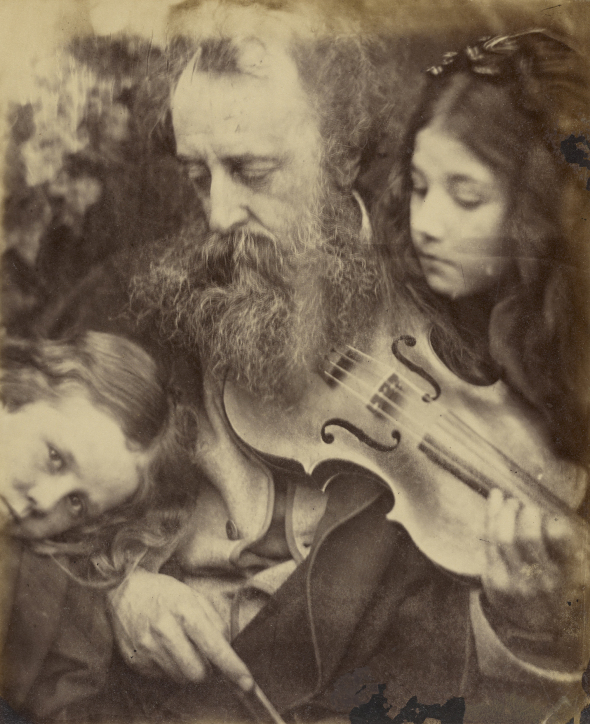
The Whisper of the Muse

The Whisper of the Muse / Portrait of G.F. Watts; Julia Margaret Cameron, British, born India, 1815 – 1879; Freshwater, England, Europe; April 1865; Albumen silver print; Image: 26 x 21.4 cm (10 1/4 x 8 7/16 in.), Mount: 33.8 x 28.2 cm (13 5/16 x 11 1/8 in.); 84.XZ.186.96


With his violin bow in hand, the man plays
Then stops, listens to his whispering muse.
Where others were entranced, he breaks and weighs.
His face solemn in thought; much less enthuse
Resembling a wilting flower head drooped
For all the world looks a man who’s been, duped.

He’s old, and he has passed this way before,
He knows off by heart, the music his soul-
Has sealed inside, and like green Hellebore
In winter time, his head will rise and roll
And the blood of Christ, a clap of thunder
Makes all bolt up straight in awe, and wonder.

© 2017, Mark Heathcote

The Whisper of the Muse, photograph of the portrait courtesy of University of Oxford, History of Art at Oxford University

three notes

and still the music plays…

throughout history
one billion lives lost to war
and still hope’s song sung

eternal hymn…

if i could but sing
songs that made love and peace real
forever i’d sing

extinction-level event…

if the music stops
the human heart will not beat
for hope will have died


 © 2017, poems and photographs, Charles W. Martin

as we go together

:: as if we go together::

a different lane.
dialogue hints.

slower train or off
the rail. go driving.

out into the only world we know.

i assumed she is your mother, i watched you both so kind to each other.
my mind is set & so unaccomplished
that I have no desires for other than those places
close. those places that sooth and
pass. time.
pleasantly.

watch a cloud floating high. reinvent our lives.

will you watch the world treading.

water floats my heart high .reflected red below, sky above.

will you hold me up when i am failing, no longer floating . will you play soft music?

© 2017, Sonja Benskin Mesher

string quartet

Halfway between the listener and the song,
the music happens, bounces off the stars
and starlight, clustered trees and passing cars,
touches the worlds of meat and mind along
the trembling strings that glide and shift through bars
that hold, like stationary partners, strong
and still, support the sinuous and long
body of hunger, feeding on what is ours
to give to us a joyful and complete
portion of nourishment, a feast of all
that we can touch through sound, a being that
can walk through each sensation somehow full
of what beyond sensation gives to it,
and show us all’s resounding festival.
© 2017, JB Mulligan

Consolation #3 in D Flat by Liszt

Music hath charms to soothe the exhausted beast,
but consolation in sound?… The warmth of a breast
against your ear, your hair casually mussed

by the hand that strokes it smooth… that is where
what consolation there is, is… although the pure
and lucid flow of song like prisms of water

thaw-thrown down the river in early spring,
can give, not warmth, but a hint of lessening
cold, imprisonment broken, a loosening…

the eternity of joy is brief, is gone
downriver; still there comes the consolation
that loss left something here, some fumbled coin.

© 2017, JB Mulligan

canon

Music, strung between the world and mind
vibrates. We’re thus bound
by space and movement
along a string of glittering moment.

Is this where to find the word for god?
If there is a need
for a god to be,
then song can reflect necessity.

Caught between the mind and feeble tongue,
little can be done
that moves as it should.
In song made flesh, we could find a god.

Will it pass the god that was before?
What can we adore
beyond the icon
of plump or hungry man or woman?

© 2017, JB Mulligan

song for Agriope

sounds were rising –

chrysalides for the yet unborn

crystalline shivers…

still were the waters,

undead the moonlight –

and aerial was the calling

of the sound-bender…

and all were silent…

Elysium bowed

under salty heaviness

and doubled up with pain,

unallowed to rebirth the lost

yet sounds kept rising –

chrysalides breaking

tracing furrows

in the molten souls that were

listening…

unshed fire caressed

crimson and black and golden

and hearts were born

where there had been none

and all were crying…

rocks blossomed under

the taming ether

exposing the bones of

ancient rainbows

and sounds kept rising –

chrysalides blooming

mourning the morning

never to come…

*Author’s note: for those not knowing it, Agriope is the other name of Euridice, Orfeu’s beloved wife :).

© 2017, Liliana Negoi

Feathery Song

1. The story I’m about to tell,
is much like that of Beast and Belle,
except in mine she was the bête
who made all those who saw her sweat.
So take your drinks and gather round,
and hush – make not another sound
but listen to the tale of old
remained, until tonight, untold.
***
2. Lang syne, in some forgotten land,
under a mighty king’s command,
up on a mountain, close to skies,
there lived a hermit, old and wise.
He spoke to animals and trees,
to stars and to the evening breeze,
he fed on berries, mushrooms, nuts,
and slept in leafage-woven huts.

3. One morning, in a glade, he found
a stranded hamper, small and round.
Within it, to his own surprise,
he heard a newborn baby’s cries,
so shyly he approached the creel
to hush the little baby’s squeal,
but when he looked inside, he winced
dismayed by what he saw, convinced

4. that only hell itself could birth
such horror on the face of earth:
a shapeless face, with just one eye…
an askew mouth…and limbs so wry
that one could hardly deem them arms…
or legs…not one of infants’ charms…
The hermit wished to run away
but felt within that he should stay –

5. the cries had stopped. The little freak
just stared at him, so small and weak,
and suddenly the hermit’s heart
was thawed, his fears were torn apart.
He leaned over the baby’s nest,
he looked at her, her face caressed
and took her in his arms – next thing
a bird above began to sing.

6. The hermit took the child along
and nursed her, taught her right and wrong,
he fed her, dressed her, raised her well
forgetting of her ugly shell.
The girl grew up, became mature,
her heart so wonderfully pure,
her singing voice unearthly fair,
but looking worse than devil’s heir.

7. One day, aware his end was near,
the hermit called his daughter dear
and told her all: how she’d been found
within that basket on the ground,
how wrongfully afraid he’d been
‘cause of the ugliness he’d seen,
and how his whole life had been graced
by her existence, soft and chaste.

8. He also told her he would die,
and that the scythe of death was nigh,
that she should leave the mountain side
and find a convent where to hide –
you see, the hermit knew too well
that only nuns would not expel
a being such as her, and hence
he wished to shield her from offence.

9. But lassie here was also wise,
and past the hermit’s swift demise
she sewed herself a feathered mask,
determined, should the people ask,
to tell them she would not expose
her face but to the one who chose
to see her soul and not her face,
her heart, and not her earthly case.

10. So down the mountain then she went
and many days indeed she spent
well hidden by the mask she’d made,
but found that people were afraid
to look behind it. Not just once
they acted like some worthless dunce
and sneered at her in vicious ways,
harassing her for nights and days.

11. She kept on trying for a while
despite them being crude and vile,
she hoped they’d change and understand,
but saw she wasted precious sand
on bootless actions. By and by,
too disappointed by her try,
she chose to shut herself within
an old abandoned wooden inn.

12. She locked the gates behind her, cried
and swore to never go outside
again, as long as she would live –
to not forget, and not forgive.
Her heartache slowly grew, and grew,
her faith grew weak, her hope did too,
and only sometimes, in the night,
she sang again, to soothe her blight.

13. Through years, the people from around
bore rumors of the charming sound
that flew, sometimes, towards the skies,
but no one knew who sang, surmis-
ing that there really must have been
some angel from above, unseen,
and oft, the people all night long
stood up, to listen to the song.
***
14. Along the river shores, back then,
there used to walk a blind young man
aside a dog. The folk he passed
by pitied him, sometimes they cast
an eye over the clothes he wore,
for he seemed noble to the core
when talking, but was dressed in tat –
so what could someone make of that?!

15. He heard, like any other chuff,
that song, and one time was enough
for him to wish to find the one
whose voice was like a midnight sun.
So every night the voice would sing
he drew up closer to its spring,
helped by his dog – and whereupon
before the inn he stood one dawn.

16. He knocked, and called, and begged, and prayed,
and at those gates he waited, stayed,
he listened, doubted, hoped and feared,
until one day the girl appeared,
the mask upon her face again.
She looked at him all silent, then
she asked him what he wished to speak.
He said: “It’s you the one I seek.

17. I know it’s you who sings at night,
though, as you see, I have no sight.
I have no knowledge of your name
it wouldn’t matter all the same
if I knew that. I also won’t
attempt to lie to you – I don’t
have money, riches, treasures, gold.
I had them once, but then I sold

18. entirely my wealth, and spent
up to the last dime when I went
all blind. So, as you see, I’m poor.
The only blessing and, for sure,
the only friend I have as yet,
is this old dog. So please, don’t fret!
The only thing I want would be
for you to let me stay with thee!

19. I only need a nook to sleep
and that the dog you let me keep.
You need not worry ‘bout my bread
or anything at all. Instead,
I want to listen to your voice
whenever singing is your choice –
because, you see, it’s in your sound
that I my bliss in life have found!”

20. She let him say his say, all still,
while he appealed for her goodwill,
and when he finished she replied:
“Do you, at least, know why I hide?!
I’ve been rejected by the folk.
In front of me they simply choke
because I’m ugly. I’m a freak!
They fear so much they cannot speak

21. a word to me. So after tries
and tries while being in disguise,
I realized I couldn’t live
‘mongst ones who’ve nothing else to give
than hate and scorn and wickedness.
They value much the face and dress
and I have none of those. So why
should I believe that you don’t lie?!”

22. “Some can be sly – but don’t you see
How beautiful you are to me?!
Cannot you tell, from all you’ve seen,
That I’m as true as they are mean?
I have no eyes to view your face.
To me your song’s the only grace
I need to deem you queen of mine,
as bright as all the stars that shine.

23. I do not care what people say.
You’re ugly?! How much fairer they?!
You’re poor?! How rich their empty souls?
How maggoty their social roles?
You’re free to cast me out, I know.
I have no other way to show
that what I say to you’s sincere.
I can but hope you’ll keep me near.”

24. Persuaded by his strong resolve
she thought that things may not evolve
as badly as she held first glance,
and brought herself to take her chance.
A while it all unfolded well,
at least from what they both could tell –
they ate together, talked and laughed
she sang, he knit the words with craft,

25. they seemed to dovetail, all in all.
But one day, something did befall:
at dawn, when getting up from bed
upon his eyes a warm light spread,
and suddenly he came aware
that he could see again quite fair,
and ran to her without delay.
Alas though! to his own dismay,

26. she wore no mask when he came in.
He felt the earth around him spin
and though he feigned detachment, she
could feel his nausea flowing free.
She smiled a bitter smile to him,
aware his love was growing dim,
then turned and left him in that room
and walked away. Despite the gloom,

27. she somehow felt she’d been released,
freed from the bane to be a beast.
A sudden calm laid hold of her
and all the prior acrid stir
dissolved within a moment’s flight.
She sensed that things were setting right,
and then a little voice inside
spoke soft that no more she should hide.

28. She donned her mask and hat and coat
and on a piece of paper wrote
a line or two, to let him know
the vicinage where she might go.
Then out the door she went, aware
that people all around would stare
with awkward eyes – for how could they
ignore her presence in their way?

29. They could, to say the very least,
refer to “beauty and the beast”
when whispering of “him” and “her” –
how could they not?…A subtle blur
wrapped up her gaze…She felt the sting
of doubt…but more than anything,
she knew she had to face her fears
and take that step. Too many years

30. had passed since she had hid behind
those walls, so that no one could find
the path towards her wounded core…
But she won’t hide there anymore.
So, hoping he would understand,
she firmly took herself in hand
and slowly walked outside the door –
so says the tale from times of yore.

31. She paced with measured steps the trail
that led to people in that vale,
ignoring bushes, shrubs and trees,
the birds, the sun and morning’s breeze.
Her heartbeats knotted in her throat,
she wrapped up better in her coat,
pretending that the thrills she sensed
were just her flesh’s thrust against

32. the early hour’s frost. Quite soon
the path with painful flashbacks strewn
enwidened at the hamlet’s gate.
Another step…the seconds’ weight
felt like a rock upon her chest.
The memories she had repressed
were coming back to life again –
the people’s horror and disdain

33. though passed, kept harrowing her soul.
She stepped again…her body whole
refused to move ahead. She sighed,
she blinked to push the haze aside
and stepped inside the village. Then,
in front of her, a few old men
put down their work and raised their eyes
to look at her with raw surprise.

34. Around her, space began to form.
Just like the calm before a storm
the people fixed her, silent, cold,
since there was nothing to be told
to hide how they could not but feel.
Each glance of theirs – a new ordeal…
She slowly walked amidst the crowd,
their glares as sombre as a shroud,

35. and then she wanted to discard
the mask. Her figure, sorely marred,
appeared then in the morning’s light,
but thrilled with horror at her sight,
the peasants cringed away from her
and in the middle of the stir
they tried to knock her down. Appalled,
she ebbed away, then fell and crawled

36. unable to resist their thrust.
But when her blood caressed the dust
she turned her gaze towards the sky
and mutely prayed that she would die
thus being spared the slashing pain.
And lo! Her plea was not in vain,
for in the very eyes of men
she changed into a bird, and then

37. she flew into the forest’s shade.
The people, suddenly afraid
of what they did, fled from the place
and ran towards their homes apace.
An awkward silence grew instead,
and on the ground, now stained with red,
as if to mark the very spot,
remained the mask as bloody blot.
***
38. Back at the inn, and later on,
our lad, when seeing she’d been gone,
felt guilty and ashamed again
when grasping the amount of pain
he’d brought on her. Abashed and bleak
he quickly went outside to seek
her out, he searched the place around,
but she was nowhere to be found.

39. Aggrieved about her having left,
among the trees he rushed bereft
and shortly reached inside the vill.
Along his spine an icy thrill
crept snakishly and made him twirl
and all his thoughts began to swirl
when finding fallen on the ground
the feathered mask she’d worn around.

40. That moment knowledge came to him
that something violently grim
must have occurred.. He looked about
and saw that people didn’t flout
the way they usually did.
Behind each wooden window grid
he noticed eyes that mirrored fear,
and what had passed was all too clear.

41. He threw a silent awful glare
and turned his back on them, aware
that if he were to find her trace
into the woods he’d have to pace.
So wasting not another blink
he parted and began to sink
into the thicket. Off and on
he peered at heavens, pale and wan,

42. foreboding that by even fall
she would be lost for good and all.
Eventually in a glade
he ceased his wandering and stayed,
he looked around again, he sighed
and on his face the mask he tied
to feel her closer. Then, with woe,
he voiced his overwhelming throe:

43. “I know I failed you! I was wrong
to put my fears above your song!
I erred – but now I want to mend!
From now my faith no more will bend!
So please, forgive me and return!
I know your trust I’ll have to earn,
so one more chance I ask of you
to prove myself as being true!”

44. But nothing happened…not a sound
among the trees or on the ground.
A heavy silence shrouded him
and sorrow filled him to the brim,
for time was passing, hope was frail,
his efforts seemed of no avail,
and night was almost there. Resigned,
he wished he could again go blind

45. for although now his eyes could see
his heart was left without its glee
and life seemed hollow, mean and bare,
so to the sky he raised his prayer
to be with her, whatever cost
he’d have to pay, for he felt lost
without her being to the fore –
his heart was bleak, his soul was sore.

46. All of a sudden, in an oak
a small bird perched whereas he spoke.
While he beheld it there aloft
a tender feeling, warm and soft,
took hold of him, and he inferred
that what he saw as tiny bird
could only be his lady fair
who called his presence in the air.

47. He started humming low, arose
and felt a tingling in his toes,
but wouldn’t let her out of sight
for fear she’d vanish in the night.
While moving closer to the tree
the tingling spread within one knee
and then the other one, and soon
amazement made his murmur swoon:

48. a pair of wings, quite small but strong,
replaced his arms. As for his song,
it turned into a splendid lay
that spoke of love fallen astray.
The forest hadn’t heard before
a trill so moving to the core,
and nature hushed to lend its ears
to yonder sound of woe and tears.

49. As night grew deeper, through the gloom
the only thing that bode in bloom
remained that ever richer song,
which filled the forest all night long.
At dawn the sun caressed the trees.
The morning wind – a playful tease –
found not one trace of man or bird
and no more song could there be heard.

50. Since then, the people from that site
could only hear the song at night.
The tale was wiped out from their mind –
the ugly girl and young man blind
remained just “dreams within a dream”
both real and fake, as it may seem.
As for the bird within our tale,
we call it simply “nightingale”.

© 2017, Liliana Negoi

Mr. Bluesman

The simple strings draw me in.

Hearing the low drawl of the everyman,

settled behind the microphone.

Sitting there, high in stature.

Telling the story we all understand.


There is a dark smoke all around,

filling the air with stark emotion.

Liquid fire to douse the pain

of living what we see

are lined all over Mr. Bluesman’s face.


Words resonate to all of us

from his mouth and stringed instrument.

A bourbon adds to the confessional

about the pain and sorrow

that needs healing in the sermon.


Honesty and sincerity in his voice

knows all of our feelings

and we rejoice in his words

as Mr. Bluesman plays our story.


© 2014  Andrew Scott – Just a Maritime Boy 2014

Understanding the Flautist (Meditation on a Peace Painting)

The woman with the flute

is barefoot. She is black

but her features are white

and the colors on her skirt

clash like a patchwork quilt.

She dances on grass.

The notes from her flute

must be the raindrops beyond

my kitchen. My teachers

said rain brings life,

but that is symbol talk,

for the rain drops outside

gather tangibly into grass

blades to soak my shoes,

and the flautist,

though she is flat

and bordered by

symbols of peace,

need represent no more

than the beauty of dance.

© 2017, poem and art, Phillip T. Stephens

Llano Estacado

“I’m so sleepy and lonely.
Both of them.”
        Frank Stanford

Wake up, Isis, wake up, see
how the Wormwood Star casts its dicey
shadow across our mother-road, how this
ghost-moon glows in our belly like
yellowcake, wake up, make that motion,
Isis, make the move that makes us fly
above, makes us dive deeper, dive way
under, Isis, witchin’ on each other
while boss-wolf lopes across the Llano Estacado,
pace for pace against the thwap-thwap-thwap
of our tires, chases down the paw
he left all lonely on our dash

Jericho, Vega, Willaree: his
ghost, the ghosts of his buildings
that boss-wolf paw glistens on the dash
glistens like a gun on the dash

Wake up, Isis, wake up hear how this
wind across the Llano Estacado
blows a drunk song our throats sing
back, blood answers lonely, beat
for beat for beat, how I wake up, how
I think: Ima’ warm now, naked, full
of us, ‘til a wolf comes, ‘til a star,
‘til we wake up haunted, you scream: O this
bruise we wash and feed and carry
20 years ahead, O whistle cut
me open, cut me

dead, I reckon: yellowcake moon’s got
boss-wolf by the throat, shakes him pretty
hard: in true night lingo this dark with no
bottom is a skin of fevers we don’t want to kick

Wake up, Isis, wake up, you say: still
there, square, you say: where the hell
am I, your thigh against my thigh,
steering wheel against our story gone
dark as Texas, miles and miles and
miles of nothing but blur, erase, and
no tears left for mama, dancing to the
old drunk song, too drunk, too old to
dream against it, wake up, Isis, wake
up, there’s another nest, somewhere,
beautiful or not-so or, at least,
there’s always that same wind

like the conjure works,
or it just doesn’t
like a star, or a wolf or the wind

© 2017,  John Sullivan

Originally published in OVS

True Emergency

Because you make heaven blue, Koko Taylor,
tomorrow, so goes the whole sad world.
But I need a beat right now to stay even
with this night I carry on my back, inside
my chest it all shines back at me, back at me,
like an old fist up against a loud bare light.
And I keep my radio on loud, too.
And it talks at me and sings up a background, and it
needs no attention like a friend does, or a bad joke
needs its chain of stupid lips to breathe.
Hey radio, I just inhabit here.
I inherit nothing I can use but my own skin
and your tunes. So you, radio, pray with me we got
to pray like a pair of funky sadhus. I’m moody
for a blow of spirit an de riddem too, hey I want
a beat to slap me upside, bounce me back to lost
now, mama. Radio, you can call it plain talking
or just a groove, whatever you need is OK fine with me.
You are heart to me, radio, bet you didn’t know
that one. You are sea and heart to me.

So I twist a tuning knob by this reflex
in my finger, tune the whole band down, ear cocked
for some gentle, for some fine slowhand and a wail –
nothing else works that good – and listen,
There it is: my blues queen, Koko Taylor, spreads
me out there with her big grim song, again,
spreads me wide and sails through my skin, eight
bars and again, she owns me so she thinks, and she
pushes me way out there close to heaven.
Close to the apogee of my sea and my heart.

Well, I think your own tongue ought to bleed, Koko Taylor.
What made you queen of the pain song, anyway?
And the sin song, too, what about that one?
I suppose you’d say it’s your own kind of reflex.
Or provocation buried in your skin, or a beam
come from heaven tattooed with your own name.
Well for me, the same thing makes my sea dark
and my heart burn this night down all night long,
for me it’s some kind of altar, a true emergency,
‘til light and morning crack the world’s blue skin
away: into nothing, into need, it’s loud engine, need.

And I can’t duck it either. All at once the slow light
rolls me over, too, and Koko, she gets all scarce
again, because I know she won’t let low-rent light
scar up that foxy jewel a-quiver in her throat.
So I call down a redbird, a stray angel,
to my windowsill. I holler at him, redbird, this
is an emergency hop on down here dance
for me on your red sticklegs, hurry up.
I’ll open up to you, redbird.
I know I’m nothing but a stiff too-gone, but I’ll
giggle if you’ll dance right here, right now, maybe
sing up just a little.

And will you look at that.
This redbird lands on my windowsill, and he
dances, and he sings three times just for me.
Three times on his red sticklegs, Tripitaka
dances three figures each, and sings up
the triple form of refuge:

Budam saranam gakchi
Darnam saranam gakchi
Sangam saranam gakchi

For my own heart, and my dark sea, I bow
to you, redbird. Your song’s the only wine
I got this morning, and your dance makes
this new light matter just for me.

Then my lips let go of their own song, all
at once, my sea flexes, and my heart, this harsh
love becomes a true emergency,
all at once.

© 2017, John Sullivan

Originally published in Hayden’s Ferry Review

Aubade on Royal Street

“Lady Francis, there’s just not enough kindness
in this world.”
     Dexter Gordon

What night’s left, locks down hard. You’ve got to
love this slow blue hour, mon beb, this mood cuts
light, cuts straight across the Lady’s ache with no
sun’s weight to stick it home, deep, and twist it off.

You blow the notes too raw, work each riff
against the next, until it flows like blood
inside the moon, that smooth, and torques
the reed tighter, for kindness’ sake, for mercy
as it fails, again, and sweetly

burns stone back to holy elements, burns an echo
in the charged air over Back-a-Town. And the parkways turn like orchids, big-eyed, sloppy with dew, toward
the sky, all swollen, wired for a last taste,

or the risk of a kiss. But each note spends its edge. The air gets still again. The hot seed settles, and dries. As Lady tunes a cigarette and opens her sad wound to dawn, so-so sha, catch the Lady on your lips.
Lift her tongue beyond this ache that lingers

in your own throats. How the ache burns, how it echoes in your own breath. How your own ache and its echo

burns the Lady into light, that simple, and her night-
time life-time “lays to jest” the damage of each day.

© 2017, John Sullivan

Chill

I close my eyes

and listen

to the birds.

I can’t name them,

but it doesn’t matter,

I can still feast on their song.

Song,

well some sing beautifully,

others need to learn.

I sympathise with them,

I can’t sing either,

but there’s no shame

It doesn’t matter.

There’s no one to hear me

if I join in.

© 2017, Lynn White

First published in The Moon, August 2017