Last month I took a road trip with my kids Elijah and Beatrice, my sister Constance and her daughter Jane.
All roads lead to Grand Teton National Park, or they ought to.
We’d heard that Teton Pass might be closed due to wintry weather, and that temperatures were dropping below zero at night. We decided to try and squeak in a quick visit before winter arrived, and were so glad we did.
The National Parks are among this country’s greatest treasures, but Grand Teton is the jewel in the crown.
It teems with history…
…and more history.
Wildlife…
…and more wildlife.
And beauty.
So much beauty.
Like my four sisters before me, I studied geology in Jackson Hole at the University of Michigan’s Rocky Mountain Field Station. I became a dedicated pedestrian, and spent a season hiking the trails in the park while waiting on tables in Colter Bay. For more than fifty years it has been a place of pilgrimage for our celebrations and family reunions, as it has surely been for others.
Some things never change.
The town of Jackson has mushroomed, with strip malls and box stores everywhere. Its old-fashioned drug store soda fountain has been turned into an overpriced rug store. But Grand Teton National Park is as pristine as ever.
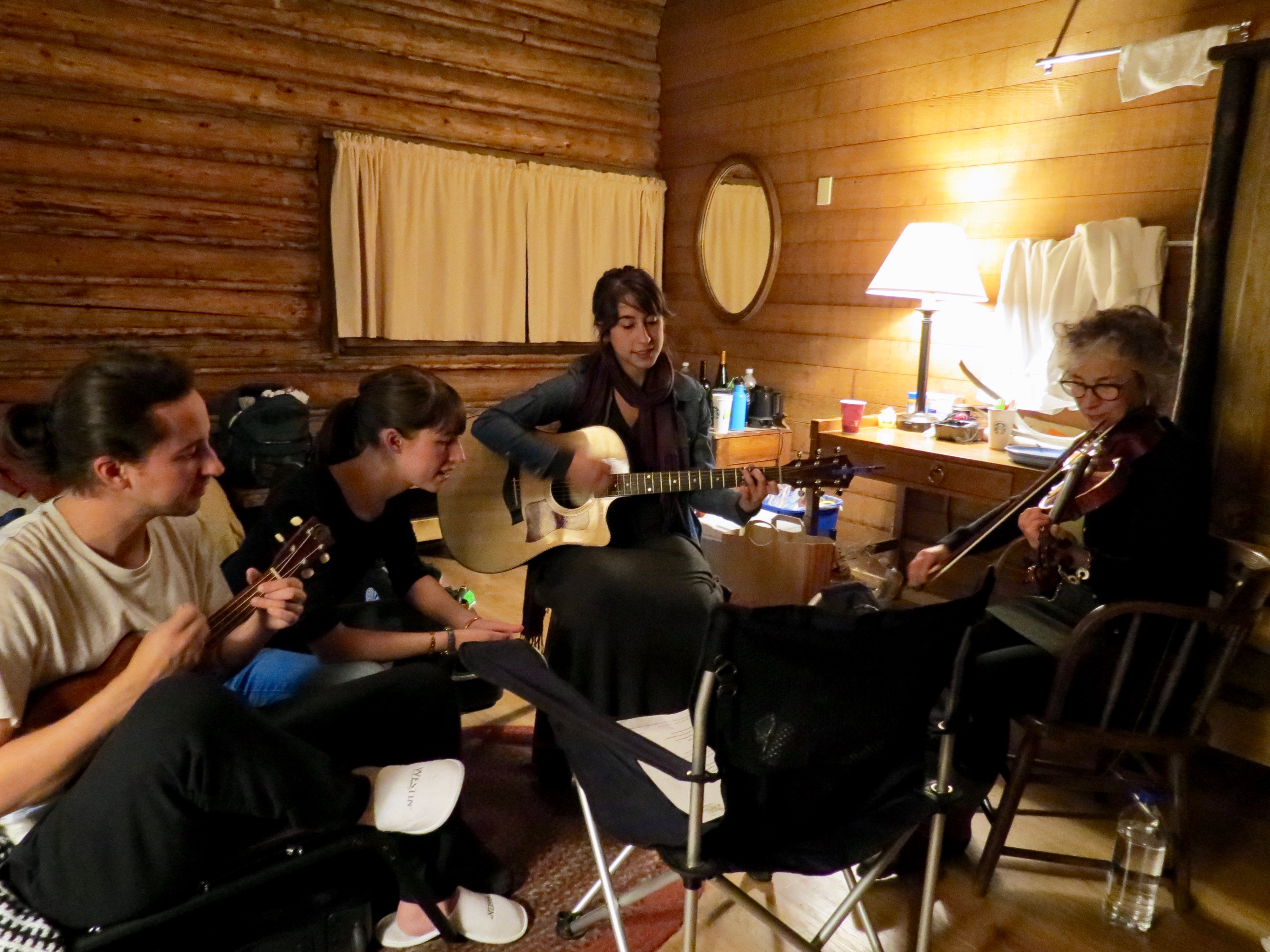
Every day, as we drove to a new trailhead, we popped a CD into the player and sang along, practicing our yodeling with Roy Rogers, Bill Staines, and Ranger Doug. Every night after dinner, out came a bottle of wine and the musical instruments, usually in that order. Back in the Saddle, Don’t Fence Me In, and My Sweet Wyoming Home were at the top of our playlist. When we sang about a home where the buffalo roam…
…and the deer and the antelope play…
…we were really feeling it.
It had been years since the cousins had met up. They were a little shy at first, but there’s nothing like making music to break the ice.
Music, for many of us, has come to mean the pre-recorded tracks on CD, iTunes, or the radio. We experienced the joy of playing music, however imperfect, and being part of a creative endeavor larger than just ourselves. It helped us tune into the soundscape all around us, ever changing and shifting…
The Concert
In 1980 Hawkwind was a revelation to a seventeen year-old. Dynamic. Enticing. Lyrical ideas from places I had never heard linking me to authors and artists I still enjoy. They were the first band I saw live.
It was the first time I had been to Sheffield, never mind a concert. I worried about what to wear. It was Winter but I wanted to look cool. My mum, as mums do, was ‘Take a coat with you. Here’s some money. Take it.’ My hair was shoulder length, but I didn’t feel cool. I took it. No way was I dressing in Burton’s and M and S that mum insisted I wear. I fancied lasses in Goth wear because they seemed intelligent, sexy and wanted to dress Goth. My mum was ‘When you get your own house, you can wear whatever you like.’ As a teenager you want to taste the extreme, get out of the ordinary, boring everyday but still be accepted by your peers.
Hawklords album had a lass in bandages on the back of it.
Space Ritual was a double album with a brilliant fold out sleeve. Photos of the band playing live with blurred pictures of Stacy their naked dancer in action.
Astounding Sounds Amazing Music was on Charisma, the same label as Genesis. It’s label was an illustration of the Mad Hatter singing in an oversized Victorian collar, bright green jacket, yellow bowtie with black spots and brown Top Hat. A green White Rabbit was running off in the background, with the face of the Cheshire Cat looking on and smiling.
You were very careful with your LPs. I would wipe clean the record, both sides with a cloth, getting into the grooves, feeling the static, before laying it on the turntable.
When we arrived everybody was in denims and leather, proudly displaying their sewn on Hawkwind badges and other bands they liked. The scent of patchouli oil, sweet and rich calming and relaxing.
It always seems to take ages when you do not know where you are going. The return is always quicker, somehow. The only seats we could afford were in the Gods so the band were tiny figures on the stage below.
I had expected the light show to cover the whole auditorium. It was only green lasers. Also, the sound of the band did not fill the space. It seemed lost. I preferred the albums where you could get lost. Reverie
From Middle French ‘rever’, to wander, delirious.
‘Orgone Accumulator’ Jane Fonda, `Barbarella’, Orgasmatron. I didn’t have a clue what an orgasm was. William Burroughs, The Naked Lunch, The Ticket that Exploded. Weird science of Wilhelm Reich. Supernature by Lyall Watson.
On the album ‘Spirit of the Age’, ‘Damnation Alley’ from the novel about a journey through post nuclear disaster landscape by Roger Zelazny segued into ‘Hassan I Saba’, Album ‘Warrior At The End of Time ‘ featured ‘Magnu’ segued with ‘Golden Void’. Simon House on violin, changed key of song as it switched up a gear, minor to major into extended solos. The long instrumental passages, encouraged good feeling that you wanted to last. An abstracted state of absorption, absent minded dreaming while aware. Lucid daydreaming.
Michael Moorcocks marvellous multiverse and Elric of Melniborn. Psychogeographer. Lost in thought, but not lost, not panicking because you do not know where you were. Calm in a place you do not know but wish to.
‘Steppenwolf’, from Astounding Sounds, Amazing Music introduced Hermann Hesse. His novel ‘Steppenwolf’ is about a man who thinks himself a wolf, or wolf who thinks himself a man. It appealed to my feelings as an outsider having moved to Barnsley when I was eleven with a posh accent.
Art Leads to Art
Like another one of my favourite Seventies programmes Burkes ‘Connections’, there is seam of linked music , literature, art. As the movie ’2001: a space odyssey’ at age twelve led me to the brillant compositions of Ligeti. Intuitively, I explore the relationships between these outstanding beauties.
Disappointed by the concert I am still enjoying the albums and achieving a sense of reverie. A sense I try to achieve for the reader in my own writing.
An old cowboy went a riding on one dark and windy day … Riders in the Sky: a Cowboy Legend (1948), Stan Jones (1914-1963), American actor and songwriter
When he was twelve, Stan Jones heard a tale from an old cowboy. It was the inspiration for Ghost Riders. This version by Johnny Cash and Willie Nelson sounds to my fancy a bit like something of the Old West (1865-1895), not that I would really know.
I was born and educated in the Eastern U.S. about half-a-century after the Old West died. One day, I landed in the Western U.S., California, and stayed. Like most Americans of my time, I was reared on accounts (fiction and nonfiction) of the romanticized and reprehensible wild wild West. After having been fed on everything from Bret Harte’s short stories to cowboy songs and poetry to cowboy shows and movies, I was anxious upon arrival in California to explore the places that were legendary like San Francisco, Sacramento and Stockton.
A cowboy posing on a horse with a lasso and rifle visibly attached to the saddle, a quintessential Old West image. Public domain photograph courtesy of United States Library of Congress’s Prints and Photographs division under the digital ID cph.3a15520
For me part of the mystique of the Old American West and its music, poetry and culture was that so many of the famous and infamous characters were actually not all that long dead when I was born. Buffalo Bill Cody died in 1917. Annie Oakley died in 1926, just ten years before my sister was born. Bat Masterson (lawman, marshal, buffalo hunter, gambler, and army scout) had retired from one of the most violent and lawless eras in the West to work as an East Coast sports editor and writer at my hometown paper, The New York Morning Telegraph (now defunct).He held that job in 1914, the year my mom was born. He died in 1921, after several more of her siblings came into this world. Although I very much doubt that my grandfather read about sports, it’s not unlikely that my mom’s older brother, Daher, read Masterson’s columns.
Ghost Riders was one of those songs thatmade me feel connected to the colorful characters of the Wild West who’d so recently tread this earth. It also made me feel connected to the wider world. It’s probable that the story that inspired Stan Jones was some version of the almost universal tale of “the hunt,” which predates Christianity in Europe and arrived in the States with settlers from Europe, perhaps especially Germany and the Scandinavian countries. It’s a lyrical version of a lost soul caught in a never-ending hunt lead by a devil, shape shifter or psychopomp. Think of Gabriel Hounds or Woden’s Hunt. The German folklorist Jacob Grimm wrote about the hunt.
“Another class of spectres will prove more fruitful for our investigation: they, like the ignes fatui, include unchristened babes, but instead of straggling singly on the earth as fires, they sweep through forest and air in whole companies with a horrible din. This is the widely spread legend of the furious host, the furious hunt, which is of high antiquity, and interweaves itself, now with gods, and now with heroes. Look where you will, it betrays its connexion with heathenism.”
.
Music has such a wonderful way of linking personal history and shared history. For me, Ghost Riders is just one example of this decidedly satisfying interconnection.
An old cowboy went riding out one dark and windy day
Upon a ridge he rested as he went along his way
When all at once a mighty herd of red eyed cows he saw
A-plowing through the ragged sky and up the cloudy draw
Their brands were still on fire and their hooves were made of steel
Their horns were black and shiny and their hot breath he could feel
A bolt of fear went through him as they thundered through the sky
For he saw the Riders coming hard and he heard their mournful cry
Yippie yi Ohhhhh
Yippie yi yaaaaay
Ghost Riders in the sky
Their faces gaunt, their eyes were blurred, their shirts all soaked with sweat
He’s riding hard to catch that herd, but he ain’t caught ’em yet
‘Cause they’ve got to ride forever on that range up in the sky
On horses snorting fire
As they ride on hear their cry
As the riders loped on by him he heard one call his name
If you want to save your soul from Hell a-riding on our range
Then cowboy change your ways today or with us you will ride
Trying to catch the Devil’s herd, across these endless skies
Yippie yi Ohhhhh
Yippie yi Yaaaaay
Ghost Riders in the sky
Ghost Riders in the sky
Ghost Riders in the sky
“The British ParaOrchestra, based in London, is an orchestra consisting entirely of musicians with disabilities—the first ever orchestra of its kind in the United Kingdom. The ParaOrchestra was formed by conductor Charles Hazlewood in 2011 as a project to create a platform for the top disabled musicians, with the hope that its success would lead to better integration of the disabled into music and performing arts. The orchestra performed its first live show at Glastonbury Abbey in July 2012 , and received international attention when it played alongside Coldplay during the closing ceremony of the 2012 Summer Paralympics in London in September 2012.
“Charles Hazlewood was inspired by his youngest daughter Eliza to form the ParaOrchestra; Eliza suffers from cerebral palsy, but Hazlewood believed that she was still an “outstanding” singer. Being the father of a child with a disability, he realized that throughout his career as an orchestral conductor, he had seen few disabled performers as members of orchestras. Hazlewood felt that since music is ‘universal’, an orchestra should represent all members of a community—comparing this ordeal to the time when only men performed in orchestras. He felt that an orchestra consisting only of disabled performers could spread awareness of this issue and help achieve greater integration for the disabled in music and the performing arts.
“Hazlewood officially announced the formation of the British ParaOrchestra in July 2011 at a TED conference in Edinburgh. He did not intend the ParaOrchestra to be a therapeutic or ‘warm and fuzzy’ project, but rather a platform to showcase disabled musicians with virtuosic qualities. When holding auditions, he aimed to find musicians who were ‘at the top of their game, technically, and with a spirit behind the virtuosity.’ The orchestra’s first 17 members come from a variety of backgrounds and use a variety of instruments, including conventional instruments and electronic devices such as tablet computers and other assistive technology developed by Rolf Gehlhaar, Professor in Experimental Music at Coventry University and the technical director of the orchestra. After failing to partner with the BBC, Hazlewood successfully commissioned British broadcaster Channel 4 to produce a documentary following the formation of the ParaOrchestra and its first performance, which aired on 9 September 2012. He felt airing its documentary on Channel 4 was a “no-brainer”, as it was also the official broadcaster of the 2012 Summer Paralympics.
“The ParaOrchestra made its first public appearance on 1 July 2012 during Hazlewood’s music festiva Orchestra in a Field at Glastonbury Abbey; the performance included its versions of Greensleeves and Maurice Ravel’s Boléro. The orchestra’s style incorporates a large amount of improvisation, intended to allow the orchestra to feel a sense of “collective ownership” of their performances.” courtesy of Wikipedia
HERE is the link to Charles Hazelwood’s TED presentation Trusting the Ensemble, which includes discussion of the ParaOrchestra and a delightful performance of the Scottish Ensemble. It’s twenty-minutes and recommended.
And now the British ParaOrchestra in performance supporting Cold Play at the 2012 ParaOlympics … you may want to grab a tissue …
My trip to the Country Music Association Fan Fair Festival in Nashville is one of the highlights of my life. I attended the festival with a friend of mine, who is also a huge country music fan. I was thrilled and excited when Connie asked me to go along with her on the five-day travel tour.
Connie and I joined up with the tour at the Greyhound Bus Station. I was taken by surprise to see such a large group of people of all ages. The chartered bus ride took some getting used to, as it was jam-packed with adults and children carrying lots of excess baggage. We had plenty of time to get acquainted with some wonderful people. We departed from Minneapolis and traveled to Chicago where the bus driver made a preliminary stop.
The travel guides had a well-planned itinerary, which included an overnight stay in Indianapolis, Indiana. The guides were well versed in history and elocution, filling us in with interesting tidbits along the way. One spectacle to see was the showroom of superior racecars at the Indianapolis 500 raceway. This was just the beginning of a fun-filled week of exciting events. Leaving Indianapolis, we headed south through Kentucky to arrive in Nashville, Tennessee.
The scenes and sounds of Nashville astounded me from the moment that I stepped off the tour bus. Our first stop was the Old Ryman Auditorium where I could almost hear the resonance of great preachers. The Old Ryman is steeped in history and was once a Church. The building resounds with echoes of the people’s past. It’s halls ring out with the sounds of sermons and song.
Standing in front of the podium on the stage of the historic Grand Ole Opry was a Kodak moment. The polished boards under my feet once held the legends of Gospel and country music. There is no telling all those who have stood on its platform. The Grand Ole Opry has since moved on to bigger and brighter pastures, but it’s nostalgia lives on.
The weeklong festival was filled with a menagerie of stars and activities. The big event at Nashville Fan Fair was getting up close and personal with the country music stars. Connie and I waited anxiously for hours in long lines to meet and get our pictures taken with our favorite performers. The musicians signed autographs and were friendly and receptive to their fans. We met Marie Osmond, The Judds, Kathy Mattea and others.
The living legends and the up-and-coming newcomers to country music would later go on to perform at concerts all week long. The music ranged from bluegrass to Cajun to country and Gospel acts. Connie and I attended Lee Greenwood’s fan member’s club concert, where Connie awarded him with a bouquet of roses. We experienced the famous WSM radio show at Opryland and were privileged to hear Loretta Lynn sing her famous song, “Coal Miner’s Daughter” live and out of doors.
There were so many consecutive concerts going on day and night, that no tourist could see and hear everything that was planned. A Special Olympics fundraiser was another way the stars came out in full force. The sounds of rhythm and blues resonate from the joints of Nashville’s famous music row into all hours of the night. It was not just the music that intrigued us.
Strolling through the opulent Opryland Hotel we viewed huge hand-painted murals on the walls, which brought the old Southern Plantations back to life. The carpet was an unusual shade of green with a pattern of plants and vines. Connie and I also visited the Country Music Hall of Fame where we observed Elvis’ pink Cadillac and Dolly Parton’s “Coat of Many Colors”. Minnie Pearl’s famous price tag on her hat was displayed at the Minnie Pearl Museum. What was most astounding of all was a real-life replica of the Greek Parthenon right smack-dab in Nashville, Tennessee, U.S.A.
The culmination of my trip was on the bus ride back to Minnesota. While heading north on the tour bus, I had no idea what Connie was up to and no clue of what was in store for me. Earlier in the week Connie had encouraged me to make a demo tape in Nashville. I had gone to the Barbara Mandrell “You Can Be a Star” Studios to have a cassette tape made as a gift for my parents. My voice had been dubbed in as I sang Karoake-style to my favorite song, “Amazing Grace”. Connie secretly found my demo tape and passed it to the bus driver. He listened to it and decided to broadcast it over the loudspeaker for everyone on the bus to hear! When I heard my own voice being played over the intercom, I was so embarrassed that I not only turned a few shades of red, but I shrank a foot in my seat. I never expected the reaction that I received.
I got swarms of cheers! The whole bus was clapping and whooping, and people were patting me on the back. Several others were hollering accolades at me and telling me that this was going to be the start of my musical career. Connie and I minced a few words, but afterwards, I had to be thankful. Personally, I have always suffered from painful shyness and considered any situation where I received attention rather emotionally distressing. The rest of the trip remained uneventful and Connie and I returned home to Minnesota safe and sound, along with some newfound friendships.
Connie and I have grown apart over the years, but there are some things that I will never forget. The images and sounds of Nashville that are etched in my mind will remain treasured memories. Next stop? Bristol, TN-VA, heart of the Appalachian country and the birthplace of country music.
I think Music is the deepest language of our species.
Sound is the merest breeze on the surface, like the ringtone that tells me someone is calling.
A melody is a simple sentence. Happy Birthday To You is as common and understandable as “Where are my car keys?”
When rhythm and tone color make my feet move, my hips sway, and my mood change, I’m swimming in poetry, soaked in a Rhapsody in Blue.
When I am engulfed by a Wagner opera or a Mahler symphony, I’ve gone down in a diving bell, and my world shifts completely. I can feel the weight and complexity of the ideology communicated through these grand works; they move me and change me, physically.
Knowledge adds something to the experience of any language, but it is not the experience. Even though I can read musical notation, though I’ve learned a chronology of musical styles and composers, and I can identify a hundred compositions at the drop of a needle, I still haven’t experienced all there is to music. Even when I make music, the transformative power of the language can be illusive. My body is involved. My mind is involved. I feel my soul is involved. A community may be involved. Having all those elements involved at a level that reaches past the musicians’ egos, beyond continental shelves and cultures, and touches the deepest purity of global communication is a real phenomenon. It is powerful and rare, but it can and does happen when I am open to the possibility.
I know I’ve felt the transcendence of musical language. Perhaps you have, too. I now look for its icons everywhere. Even a glimpse is enough to move me. I get chills watching flash mob performances sometimes. What is that about? Why would I be moved by that kind of cheesy marketing for an upcoming production? Maybe it’s just my soul longing for a spontaneous communal acclamation of life. Why do I select clips of talent shows to watch a nervous young singer connect with an audience through the tremulous wagging of vocal folds? Maybe it’s because I relate to her yearning for a physical experience of expression and belonging.
But these are mere snapshots. Being present with live music is the gateway to the oceanic realm of the language. In the concert hall, I sit in the dark, in the center of an acoustic grotto. I let the waves roll over my tympanic membrane. I breathe with the phrasing of the melody, and feel my heart come into rhythm with the pulse of its message. Emotions rise to the surface. Memories and intuition swim in my consciousness. I am sent on a voyage to a new shore, a new experience, a new knowledge.
When I am one of the performers, I may be standing in the light of the rising sun, with the spray crashing over the deck, sounding the call to sail on through the storm. I may be rocking in the moonlight, sending my lonely thoughts over the still, open horizon. The language within me spills out in long waves, rising and falling, on and on, until my breath is spent, my message complete. When I am silent, the music continues.
I am the rest between two notes,which are somehow always in discordbecause Death’s note wants to climb over --but in the dark interval, reconciled,they stay there trembling.And the song goes on, beautiful.
---Rainer Marie Rilke
excerpt from The Selected Poetry of Rainer Marie Rilke by Rainer Marie Rilke translated by Stephen Mitchell
Benny is subtle. Stray notes skip in and out of aural focus like fleeting shafts of light on a driven avenue. Only gradually do you become aware of a pattern as he moves off the lower register and challenges the bar’s steadfast din. Next to him a guitarist, ear askance, catches the key and marks the beaten track.
Pat strolls into this, still lazy path, all dark curled bonhomie. Tree-limbs and gnarled fingers belie a tender deftness of touch on bow and bridge. A couple of banjos loiter with intent, indolently picking, impatient for the inevitable onslaught. Conlon’s flute is comfortably mellow in this quiet Bluehill glade. A long-necked heretic purrs easily in the background. Bodhrans and bones hibernate, awaiting the call.
It comes with a yelp from Pat, a slam from Benny. Lightning fingers accelerate over invisible black keys as he leads the gallop through the foothills. Pat takes up the chase, his Moses all benign smiles and guttural urgings. He leads his people across gurgling pools; guides them through magical fairy groves; drives them up hill and down dale. Now his bow angles across his cheek, its top end doing a mad St. Vitas dance, hoppin’, leppin’, trippin’, slidin’ over imagined river rocks. Then in the high ground, it is erect, plunging, lunging, forcing, demanding. Around him, Benny piles triplet on gilded triplet, leaps and bounds, draws and pushes, pushes and draws, tingling fingers cascading over pliant keys. The guitarist’s easy strum races into frenetic, frenzied slashings, a devarnished, abstract patch above his fret the victim of a deranged plectrum. The flute scurries in and out, goaded by the surrounding swirling, whirling madness. Banjos, free at last from restricting melody, race hither and thither, grace notes bounding off grace notes, driving, diving, delving, thrusting. Bodhrans and bones, frolicsome scamps, explore, explode, subside, rattle in exuberance. Electric renegade, no longer purring, growls, barks, snarls resentment.
The bar, thrashed, abandons its chattering nonsense and submits to the pagan music’s adrenalin howl, carried on the churning wave to a crazed crescendo.
‘What did I do to be so black and blue?’
– Fats Waller song.
Racism remains endemic to twenty-first-century America. Its origins can be traced back to the days of slavery. Its repercussions reverberate throughout today’s society with African-American people today earning less than white people on average, and the increasing militancy of the police towards black citizens.
Both American and international public were appalled by the black church shooting in June 2015 in Charleston, South Carolina, where nine people were shot and killed in a hate crime. Once a bustling seventeenth-century slave port with its ruling plantation aristocracy, it seems that little in the way of race relations in Charleston has changed except that slavery is now illegal. Though none of the 73 lynchings that took place in the state of South Carolina between 1882 and 1900 happened in Charleston, this is not to say that the city was not and is not segregated and unequal.
Yet during the 1890s Charleston was the home of a band of young African-American musicians, led by a black Minister, whose lives were not limited by racism in the repressive and violent Jim Crow South. Many of these musicians are big names in the Jazz world today – Cat Anderson, Freddie Green, Jabbo Smith, and Julian Dash, to name just a few. Race relations and music are inextricably interlinked in the US South and many powerful links between the two are to be found if you look beneath the surface of racism.
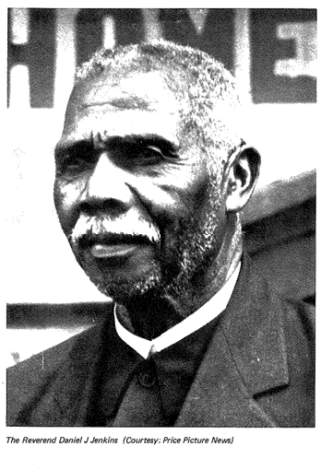
Reverend Daniel Jenkins was the Pastor of the New Tabernacle Fourth Baptists church, and owned a timber business in Charleston. One evening in December 1891, Jenkins was stacking wood when he discovered four black orphans huddled underneath, hiding from the cold bitter weather. Jenkins took them into his home, despite having four children of his own and his wife to feed. As more black orphans, boys and girls, arrived at his home, he wished to establish something more permanent.
Jenkins rented 600 King Street for a short time as a makeshift orphanage, and the state granted him a charter to start the Orphan Aid society in July 1892. The city of Charleston had donated to the white Charleston Orphan House, the first municipal orphanage in the US opened in 1790, for over a century, and Jenkins hoped they would assist him. Yet the council only donated a meagre one-off $50 donation.
Unsurprisingly, the orphanage remained underfunded by the city, while the two white orphanages were supported generously. In 1900 the state spent five times more on white education than it did on blacks, and by 1915 this spending difference had increased to 12:1 in favour of white education. Reverend Jenkins had to find the money to look after his ‘black lambs’, as he referred to them, in a more creative way.
His response was to appeal to the people of Charleston to send unwanted instruments to the orphanage, with the aim of hiring musicians to teach the children how to play so they could earn money by busking. The children’s ill-fitting uniforms were castoffs from the South Carolina Military College taken out of a rubbish bin. Jenkins himself described how ‘little fellows are swallowed up in large coats, and large boys squeezed into small ones.’
Jenkins hired ‘Hatsie’ Logan and Francis Eugene Mikell to teach music. Over time Jenkins and these teachers came to use the musical training of the children to self-fund the Orphanage, lessening their reliance on charitable donations and white sympathies.
Jenkins was greatly influenced by the racial uplift views of Booker T. Washington and his Tuskegee Institute, and wanted his orphans to have similar practical skills that would give them a chance of earning a career. One Jenkins graduate, Tommy Bedford, recalled how the orphans learnt shoe-making and tailoring in the fashion of Washington, but were taught how to read music before anything else. Orphanage resident Elizabeth Carter revealed:
We really used to enjoy being around each other at Jenkins Orphanage, especially playing music. When the teachers were around, we would play the music as it was written on the board, just like they had taught us. But at night, we would have a jam session like you wouldn’t believe!
Orphanage life was not easy. William ‘Cat’ Anderson, who went on to play trumpet with Duke Ellington’s Orchestra in the 1940s, recalls how one teacher brought a brick into class and said he would throw it at the first boy who made a mistake.
Yet the orphans that Jenkins raised were saved from a life on the streets that might well have included crime and violence, and they took on a new identity that was both African and American. Throughout his lifetime, Reverend Daniel Jenkins moved his society and his orphans towards progress and self-help. The Jenkins Orphanage Band encouraged white people’s interest in black music, and formed intimacies between the races even during an age of segregation. As a black man playing to the white supremacist system, in the face of racism Jenkins successfully used the social uplift philosophies of Washington and new black leaders to create an institute which gave young black children a future to live for. He used the fear of black crime to encourage white donations, utilised the musical training of the children to largely self-fund the orphanage, and helped create an innovative musical style through the African traits of syncopation and improvisation inherent in the children’s genes. No other southern black American orphanage of its time produced as many outstanding musicians. This has been sadly overlooked in the wake of New Orleans’ Jazz recording industry. The band’s popularity ensured black music was heard and not dismissed in a white world.
Charleston hangs onto its past, its antebellum days as the most important southern seaport. It has a terrible history of slavery, of great pain and racial repression, yet the musical and social legacy of the Jenkins Orphanage and its director gives them something to be very proud of. Found hiding in Charleston’s dusty archives and amongst the memories of its charming backstreets is its great history of music and hope. Burton Peretti is correct in asserting ‘the story of Jazz’s rise in African-American culture [is] a triumph within an unexpected tragedy.’ Daniel Jenkins’ triumph for the good of black society against the tragic backdrop of the Jim Crow South should not be forgotten in the wake of today’s tragedies.
And to round things off, please enjoy this delightful piece from the band in 1928 …
Emily graduated with a Bachelor of Arts degree in History in July 2016 from Newcastle University. Her main interest lies in American social and cultural history, in particular how themes of music and race intersected in the Southern States of nineteenth-century USA. During the summer of 2015, Emily travelled down the East coast of America, researching the Jenkins Orphanage Band, the core of which formed her undergraduate dissertation. Also a member of and volunteer with the human rights organisation Journey to Justice, Emily sings in the chamber choir, Fox Valley Voices, and in a mixed voice barbershop quartet, Needle & Fred. She has a love of music and theatre.
Outside it’s raining (it’s been raining a lot around here lately actually) and my fingers run on the computer keyboard while in the background Yo-Yo Ma is performing miracles on his cello with Bach’s suites. I cannot hold back a melancholic smile, remembering a part of my youth which I put aside for the past ten years, but which lately keeps bugging me to revive it – some of you may know that I used to play the piano years ago, but few know also that at some point I decided to give up music and literally sold my piano.
However, I can’t help missing the flow of feelings through my being while my fingers used to play fragments of the souls of Bach, Debussy, Rachmaninoff, Mozart, Beethoven, Prokofiev and so many others. As I told a friend of mine at some point, there are moments when the vibration of a piano chord is enough to bring tears into my eyes.
Therefore, today I’m talking to you about music, about this splendid, but still far from being completely understood, part of our life. For what is music, after all? What happens to us when we listen, almost as in trance, to the organized sounds played or sung by someone? Be it classic or modern, vocal or instrumental, music always fascinated people, and they never ceased to strive to comprehend and conquer its amazing language, without realizing that it was the language that was conquering them, and not the other way around. Men tried to subdue this world of the sound, tried to impose rules to it, tried to fit it into shapes, forms, organized it in systems based on various criteria, but in the end, no matter if the rules are respected, if the form is an old or a new one, music transcends all the artificial organization and we find ourselves completely ecstatic in the presence of sounds. Music conquers us, and once it does so, it owns us for life, whether we’re aware of that or not. Why? I don’t know. Some say it’s because music is the language of God. Others say it’s because the frequencies of music resonate with our own frequencies. But does it really matter? The truth is, no, it doesn’t. Music simply governs our hearts, in one of the most splendid ways possible.
Yes, music owns me. It always did. It always will. And I’m grateful for that :).
Musical notation from a Catholic Missal, c. 1310–1320 * This beautiful Missal made from parchment originates from East Anglia. It is considered a very important manuscript as it is one of the earliest examples of a Missal of an English source. Sarum Missals were books produced by the Church during the Middle Ages for celebrating Mass throughout the year – uncopyrighted/CC0
“Any discussion of modernity’s mainstream in music would be incomplete without a serious reflection on the spiritual values, belief and practice in composer’s minds.” – James Macmillan (2013)
Western music throughout its history has undoubtedly been shaped enormously by religious and/or philosophical beliefs. One can only vaguely attempt to imagine the plethora of alternative courses of development which may have unfolded if it were not for the original patronage of the church and the influence this had, particularly in terms of the composition and performance of music. The last two centuries however saw a change in the way religion is perceived and practiced in many parts of the world and this had an inevitable effect on music. As part of a lecture held at the University of Notre Dame in September 2013, the Scottish composer James MacMillan highlighted some very important points about how faith and music have co-existed in the past and furthermore how they are allied now. He states that ‘there are some forms of art where the connections with the numinous are more difficult to discern than others. In the case of music, there seems to be a veritable umbilical link with the sacred.’ He goes on to say that ’composers have always responded to society’s need for spiritual and religious feeling’ and examples of this attitude can be seen from Bach to Stockhausen, from Lutheran Chorales to Sternklang (Park Music), 1971. The former were essential to the churchgoer’s daily experience in prayer and ritual, whilst the latter had a similar impact on the public wherever Sternklang was performed in attempting to lift their spirits into a realm above our own. This evidently affirms the ‘umbilical’ link furthermore.
Stockhausen said that ‘a creative person is always most excited when something happens that he cannot explain, something mysterious or miraculous.’ And similarly Michael Tippett with his remark that ‘it is a great responsibility: to try to transfigure the everyday by a touch of the everlasting.’ Macmillan in his lecture poses the question ’can a religious artist still be understood and affirmed in our own time?’ The answer to this is not as simple as yes or no but just as important is the notion of non-belief, realism or atheism and how composers who fall into this category fit in on the spectrum of philosophy in music composition and performance. A similar question could be asked of composers who base their reasoning on science and a more skeptical view of the world around them as inspiration for composition. Are their ideas valid and as fruitful as those inspired by faith?
Kenan Malik in an article entitled What Is Sacred About Sacred Music? explores notions of how transcendence itself can be defined by humans as physical and social beings. For religious believers, the sacred of course is that which is associated with divinity and holiness, but as shown below it can have a meaning beyond divinity:
Transcendence does not, however, necessarily have to be understood in a religious fashion; that is solely in relation to some concept of the divine. It is rather a recognition that our humanness is invested not simply in our existence as individuals or as physical beings, but also in our collective existence as social beings and in our ability to rise above our individual physical selves and to see ourselves as part of a larger project, to project onto the world, and onto human life, a meaning or purpose that exists only because we as human beings create it.
Turning to the question of composers’ personal beliefs and how it may or may not affect the music they compose, it is certainly true that what composers do and indeed that which they create is not necessarily what they believe. Composers have to make a living and keep their ‘head above water’ and even with the wealth of material and knowledge available to musicologists at the present time the option to know the true thoughts and beliefs of composers from the early centuries in matters of faith cannot be readily available. Much of the information pertaining to these artists’ real personal beliefs have to remain shrouded in the realm of speculation. The most accurate piece of information would most likely be their confidential diaries and not letters that could contain bias towards certain ideas for reasons of personal circumstance. This applies much more to composers from the centuries past and less so to artists closer to the present day who could be vocal about their beliefs and, with the advent of new technologies, in the cases of living composers, still are.
The more interesting strand to emerge from this line of enquiry however is how a composer’s personal belief or faith feeds into the compositional process and the musical product thereafter, if at all. One could be argued that the key question to be asked is whether or not an artist whose convictions are so deeply rooted within themselves could possibly have produced the same music without their beliefs that they hold so dearly. Kevin Malone is an academic lecturer and composer at the University of Manchester. He refers to himself as a ‘realist’ and refutes the more common label of ‘atheism’ because of its tendency to ‘suggest there is theism in the first place’ which is an interesting idea in and of itself. In 2016 his new work Mysterious 44 was given its world premiere at the University, an opera that used the well-known Mark Twain story as its basis. In the story three young boys learn to read and thus begin to think for themselves, which angers a village priest and leads to consequences. The opera has a cast of fifteen live singers They interact with two invisible characters, video animation and a surround-sound electronic score. The ‘Richard Dawkins Foundation for Reason and Science’ funded the production of the opera twice and a voice recording of Richard Dawkins himself begins the opera with a reading from the Mark Twain text.
It is clear from this that religious texts and philosophical ideas nevertheless provide strong catalysts and even entire frameworks for composers who are not believers themselves. The twentieth century in particular has seen a wide range of composers from varying stylistic inclinations choose to write music which references the rich teachings and legacy of doctrinal liturgy, whether it is performed in actual services or not is irrelevant. As well as this composers have used a large amount of symbolism from faith as material, as did Kevin Malone in his opera where he comments that ‘just as religious composers may use tri-partite structures to symbolize what they see as a trinity of spirits, I too use some numerical devices.’ He also suggests that the use of structures relating to numbers are ‘composer’s conceits’ and nothing more:
‘Mysterious 44 is an entertainment. Good entertainment should also be educational and not just ear and eye titillation. By writing Mysterious 44 I strive to promote clear and individual thinking, self-determination and hopefully an expanded use of the musical arts to not beguile listeners into perpetuating group thinking but to stimulate the natural curiosity for truth of which each of us is capable.’
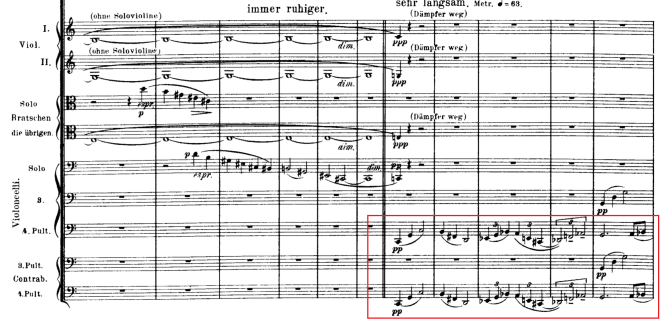
The example below (Ex. 1) from earlier in the canon (Richard Strauss’ Also Sprach Zarathustra) shows a use of all the 12 pitches to represent science, which was written in response to Friedrich Nietzsche’s (1844-1900) ideas which would contend the ideas of Stockhausen in particular and suggest instead that our physical reality is all that exists and all that we are able to know. It becomes more difficult to associate musical composition and performance with a reach to the beyond as Stockhausen would with this model in mind. Again, here we can see that this manipulation of pitches in order to make a personal statement about the progress of science is a composer’s conceit and the effect is only achieved successfully because the music in itself is so sublime.
Ex.1 …
One of the most influential composers and atheists of the twentieth century, chose to use part of the liturgical doctrine in a composition which brought about an entirely new style of composition in the middle of the 1960s.
György Sándor Ligeti was born on 28th May 1923 in a small town of only five thousand inhabitants which is now Transylvania. Despite not having any particular religious upbringing as a child, the young Ligeti had an interesting fantasy life and a strong grasp of the world around him simultaneously. He invented his own utopian society called Kylwiria in which there would be no suffering or death, and even created a whole new language for such a place also. These sorts of fantasies of course are very common amongst young children but Ligeti was an exception in that they persisted into his teens and the ideas which had formed in his mind from this cemented themselves into kernels of artistic vision which would go on to inspire even some of the last pieces he composed in his last years. Interestingly one of Ligeti’s first attempts at composition at the age of sixteen was a large symphony in A minor based on elements from Also Sprach Zarathustra which he worked on over two summers in a cemetery near to his home. As previously noted Ligeti was not a practicing Jew and became Jewish ‘only through persecution’ at the hands of the Nazi regime in World War II. His family suffered horrendously as the hands of the same forces, with his father and brother both being murdered in the concentration camps. For many years he believed his mother had died too in Auschwitz, but her medical training saved her as she was skilled as a doctor in the camp. Throughout much of this time Ligeti ‘stayed alive by coincidence.’ He fled Hungary in 1956 and began a new life in the West, earning his place as one of the key figures of the new musical establishment alongside those such as Boulez and Stockhausen.
In a radio interview broadcast on July 2006 with John Tusa (the managing director of the Barbican Centre at the time), Ligeti discussed in great detail various aspects of both his socio-political and religious beliefs. Ligeti was described as being ‘the great atheist composer’ by Tusa and this poses further questions on Ligeti’s personal relationship or lack thereof with the mysterious and miraculous, which Stockhausen refers to. It seems to suggest that in conversation with his colleagues both publicly and privately, he may have been very open about his lack of any true religious conviction of one kind or another. Thomas May (a contributing writer to the San Francisco symphony’s program book) explains that ‘Ligeti had developed an immunity to all ideologies’, and a strong case can be made that his lack of adherence to any of the major monotheistic religions is not surprising, having suffered both directly and indirectly at the hands of two severe dictatorships from the beginning of the twentieth century. Ligeti’s father was certainly considered to be ‘an atheist and socialist’and whether these characteristics would have been passed on without the tragedies in his life is of course unknowable but does branch outward into an interesting line of enquiry. Ligeti taught his students to be non-believers but at the same time he was fully aware that a certain naivety was necessary as a creative artist and particularly as a composer. This idea was most likely one of the key components of the elevation of Messiaen in Ligeti’s admiration, whose faith permeated into all areas of his life and not just the art of his music.
One of the pinnacles of the composer’s achievements which gained him international status in the avant-garde circles was his Requiem, a prime example of the textural style of his early output begun in the spring of 1963 and completed in January 1965. It is also a fine example of how religious themes and ideas can be used and translated into a secular non-doctrinal context as compositional material. Interestingly Ligeti chose to set the Lux Aeterna as a separate piece slightly later in 1966. Only a year after the completion of the Requiem, the text and the sound world was still clearly fresh in his mind. The requiem as a form of composition has had a long and rich history in the canon of Western classical music. James Macmillan emphasises that as time has passed and the relationship between sacred music and its intended specific use in liturgical services has changed, ‘the liturgical forms have found their place in the concert halls of today’ and the Requiem is certainly no exception to this observation. The Ligeti requiem is intended to be a concert work and as he explains:
‘My Requiem is not liturgical. I am not Catholic, I am of Jewish origin, but I do not follow any religion. I took the text of the requiem for its image of the anguish, the fear of the end of the world.’
Paul Griffiths refers to this piece as ‘the most overwhelmingly impressive product of Ligeti’s cluster style’ and the effect on the listener is certainly warranted a similar description. As the composer himself said, his work is principally inspired by and revolves around the day of judgements and a primeval fear of the end of the world. It is essential a funeral mass for the whole of humanity, a personal statement about death which does not rely on its creator being a practicing believer of Catholicism or indeed any belief system to be able to relate to it.
The instrumentation of the orchestra at the start of the work reflects Ligeti’s natural instinct for extremes in the exploration of texture and timbre. It is scored for trombones, bass trombone, horns, contrabassoon bass tuba, contrabass clarinet, double bassoon, bass clarinet and double basses. For much of the piece Ligeti splits the chorus into four-part groupings of sopranos, altos, tenors and basses. Using this twenty-part texture to weave dense patterns of what Ligeti liked to call ‘micro-polyphony’. The clustered, harsh brass tones combined with the urgency of the vocal line both within solos and in unison throughout the piece provide the perfect response to the liturgical text. It has an overriding sense of desperation and helplessness which is inherent in the Dies Irae text. This piece is most certainly one of the finest examples of a religious work by a non-believer to have entered the repertoire so far.
Attitudes towards music and religious belief/philosophy have certainly changed dramatically over time as has been shown. A deep sense of religious conviction merely serves as a vehicle by which he/she is able to express him/herself. Performers and indeed listeners may benefit in some way from knowing the inspiration and/ compositional processes behind the music. However a composer in the most general sense is a creator who concerns him or herself with the sound as the building block materials of their art. The priority of any composer first and foremost therefore should be the creation of sound. Just as Ligeti was adamant that ‘the experience of terror does not lead to the creation of art’, nor necessarily does a personal experience of the divine for that matter.
Extra-musical inspiration is essential in the composition of music, whilst the relevance and transparency of the personal motivation of the composer within a piece itself is limiting and questionable at best. Although impossible to prove of course, it could be argued that Ligeti (because of the strong commitments to his new and particular musical language at the time in the 1960’s) would have written a similar Requiem if he had been a Catholic for instance. Similarly, a case could be made that Stockhausen’s experiments for most of his life in the electronic studio in Cologne would have been undertaken without his inclinations towards the mystic and otherworldly domains. Experimentation with sounds is the key factor here which draws composers to creating their work. Music as an art form is not a language although it can be treated as one in a variety of ways. Its syntax is that of a young child who can speak few words but is able to express an indeterminate amount more depending on the perceptiveness of the listener. Personal faith and music therefore are inextricably linked to varying degrees in the minds of composer, performer and listener.
Books:
Duchesneau, Louise, György Ligeti: Of Foreign Lands and Strange Sounds
Griffiths, Paul, György Ligeti. London: Robson Books, 1983
Harvey, Jonathan, Music and Inspiration, London: Faber and Faber, 1999
Stienitz, Richard, György Ligeti: Music of the Imagination, London: Faber and Faber, 2003
Toop, Richard, György Ligeti, London: Phaidon, 1999
Scores:
Ligeti, György. Requiem, for SMez soli, 2 choruses and orchestra. Folio score, London: Peters, 1965
Recordings:
Ligeti, György. Works, for orchestra. Selection. Compact disc , The Ligeti project IV, Hamburg: Teldec, 2003, 8573 88263-2
~~~~~~~
Joseph Shaw – composer, bass guitarist and arranger:
Joseph Shaw is a composer, performer and arranger based in Sheffield. He has had music performed and/or recorded in the UK and across Europe by ensembles including theAber:ri Duo, Absolution Saxophone Quartet, Angeli Che Cantano, BBC Singers, Deventer Wind Quintet, Fox Valley Voices, Inyerface Arts, Jabeliah Saxophone Quartet, Manchester Camerata, Psappha, Meraki Duo, RNCM Brand New Orchestra, RNCM Contemporary Music Society, the RNCM New Music Ensemble, Sheffield Music Academy Chamber Orchestra
Joseph Alen Shaw
As a bass guitarist, he has been active on the music scene in Sheffield for over a decade and continues to perform with several bands as well as freelancing regularly for school productions and recording sessions.
Joseph holds a Bachelor with Honours degree from the Royal Northern College of Music, where he studied under the tutelage of Dr Larry Goves.
“Want the man singing! I want the man singing!” She pushed her small, sticky finger against my laptop screen. Heeding my two-year-old’s demands, I scrolled down. I passed Rosemary Clooney, scrolled beyond Bette Midler until “right there!” was barked from my lap. We found him. After a thirty-second auto insurance ad, the music began.
“A boy went back to Napoli, because he missed the scenery…” Daniel Boaventura, looking dapper in a suit, croons into a handheld, wireless, black microphone. The lights are low, and the instrumentation sparse as he describes what else the boy from Napoli was returning to. “….but wait a minute, something’s wrong!” A dramatic pause follows this revelation.
Liza took the cue, hopped down, and began bouncing with her microphone in hand. The ball of foil duct-taped to a toilet paper tube flailed around as she sang, “Hey mambo, mambo di-telly-ano!”
I sat back and enjoyed the show. While I was pregnant, my husband and I struggled with a name for the tiny performer singing in front of me. I was playing lots of Harry Belafonte in the house. His rendition of Come Back Liza spoke to me; he sang the name “Liza” so beautifully. We both loved it, and I think its incredibly romantic to be named after a song.
Soon she’ll start asking for Daniel Boaventura, the Brazilian actor and performer, by name. She’ll begin requesting his other covers, such as ABBA’s Dancing Queen and Sinatra’s New York, New York. Each time a video ends and the next song starts on auto-play, it carries potential to be our new favorite.
She babbled along until the final “That’s ah nice-ah.” I managed to convince her to give Mambo a break and let me get dinner started.
Experiencing the rabbit hole of music through a child’s eyes (and ears) has proved to be an winding journey for our family. Mr. Boaventura, who played Juan Peron in Evita, led us to show tunes and Broadway hits. Mambo Italiano gave way to Tell Me on a Sunday. Who else has sung “Baby I’m in the Mood for You,” as a lullaby to their toddler after finding Miley Cyrus’s cover of Odetta covering Dylan?
This year, we are asking Santa to bring Liza a real microphone. She’s going to be over the moon to have one just like our favorite Mambo Man. We can get a spotlight next year.
Desert Island Discs is a weekly BBC Radio 4 programme, which has been running for 75 years. Devised and originally presented by Roy Plomley and now presented by Kirsty Young, it is just one of those programmes that transports you to another place. It is an escape, just like music can be, enabling the ‘castaway’ of the week to imagine they are stuck on a desert island with nothing else but eight of their favourite pieces of music, one book and a luxury to sustain them. Above is a link to one of the latest episodes. I don’t think the Castaway here will need any introduction.
So, here are five of what would be my ‘Desert Island Discs’ …
For personal reasons, the first piece I’ve chosen was a commission that came from someone, who I am pleased to call a friend, as well a talented composer, Joseph Alen Shaw, who is featured elsewhere in this edition of the BeZine. He asked me a year ago to write a brief lyric, in the form of a haiku triplet. He wanted it to be on the theme of Autumn, his favourite season. Alongside Spring, it is also my favourite season, in equal measure. He had also, for some time, wanted to write a piece specifically for his and Emily’s close friend, Soprano Jenny Whittaker. They all started their musical journeys, together at the Sheffield Music Academy. This is the result.
” Rainbow hues turning
chill air low sun (but) warm hearts
beauteous day-long dawn
pink light (on) timeless trees
yield a golden fleece and warmth
(for) aching Mother Earth
sleeping beauties wake
from enduring frozen night
in Spring refreshing ”
~~~
My second choice, which the chamber choir, Fox Valley Voices, in which I sing bass, also has in their repertoire, is the stunning piece of music, which is both atonal and without time signature! It was written by the late Sir John Tavener to the words of William Blake’s poem of the same name. A few years ago, I also wrote a devotional haiku triplet, based on my own emotional response to his music. Hence it is very special to me …
” Little Lamb, who made thee?
Dost thou know who made thee?
Gave thee life, and bid thee feed,
By the stream and o’er the mead;
Gave thee clothing of delight,
Softest clothing, woolly, bright;
Gave thee such a tender voice,
Making all the vales rejoice?
Little Lamb, who made thee?
Dost thou know who made thee?
Little Lamb, I’ll tell thee,
Little Lamb, I’ll tell thee.
He is called by thy name,
For He calls Himself a Lamb.
He is meek, and He is mild;
He became a little child.
I a child, and thou a lamb,
We are called by His name.
Little Lamb, God bless thee!
Little Lamb, God bless thee! ”
William Blake
~~~
The third piece I’ve chosen, which Fox Valley Voices is newly adding to its repertoire, and one which we shall sing at our Autumn Concert on 3rd November. It has qualities, to which I have referred in the introduction to this month’s The BeZine, which are visceral to its core. The words, written by Mary E Coleridge (great grand niece of the famous poet, Samuel Taylor Coleridge) are themselves poetic and full of imagery; the music, by Charles Villiers Stanford is gloriously, movingly beautiful. The combination of lyrics and music transport me to a place that cannot be accessed by rational thought alone …
“ The lake lay blue, below the hill
The lake lay blue, below the hill, below the hill
As I looked, there flew across the waters cold and still
A bird whose wings were palest blue
The sky above was blue at last
The sky beneath me blue in blue, was blue in blue
A moment ere the bird had passed
It called, as if in a trance he flew
The lake lay blue below the hill “
~~~
My fourth choice, another piece of self indulgence, but one that I Can’t leave out, because this group of singers has had such a powerful influence on my singing and on the elevation of my spirit and simply the joy of singing together. It is of course one of the UK’s top Barbershop choruses, who, as 2014 UK Gold Medal Champions, came to Pittsburgh for the BHS International Chorus Contest to represent the UK. Here’s one of the songs we sang …
~~~
My final choice, for now at least, is a song that first struck me, way back in 1976, when I bought a classic album, Stevie Wonder’s “Songs in The Key of Life”, and it has stuck with me ever since. It is the opening track, the words of which speak for themselves. I think they also speak to the core purpose of this publication, The BeZine …
Good morn or evening friends
Here’s your friendly announcer
I have serious news to pass on to every-body
What I’m about to say
Could mean the world’s disaster
Could change your joy and laughter to tears and pain
It’s that
Love’s in need of love today
Don’t delay
Send yours in right away
Hate’s goin’ round
Breaking many hearts
Stop it please
Before it’s gone too far
The force of evil plans
To make you its possession
And it will if we let it
Destroy ev-er-y-body
We all must take
Precautionary measures
If love and peace you treasure
Then you’ll hear me when I say
Oh that
Love’s in need of love today
love’s in need of love today
Don’t delay
don’t delay
Send yours in right away
right a-way
Hate’s goin’ round
hate’s goin’ round
Breaking many hearts
break-ing hearts
Stop it please
stop it please
Before it’s gone too far
gone too far …
…
… Well, please stop it
Um L-O-V-E love Oh, L-O-V-E lo———ve
love’s in need
of love today
don’t delay
right away
Just give the world LOVE.
I‘ve missed out a significant chunk of, albeit mostly repeated, lyrics in its middle, but the essence is here. A great song, not only because of the lyrics and their sentiment, but also because of the way Stevie Wonder delivers it. His performance is magnificent, carrying us on a wave of pleading for a World that is so riddled with hate and is so in need of love.
I was very excited and proud to be involved in a concert twelve months ago, with local volunteers, in celebration of a very beautiful landscape and its design.
Inside the Conservatory, after the performance Photo: Brian Parkhurst
I was commissioned by Peter Clegg, the Learning & Community Engagement Officer of Wentworth Castle Gardens Heritage Trust, to produce this piece, Wentworth Cantata. The commission was supported by the Heritage Lottery Fund as part of the CB300 festival. It had its premiere in the newly restored Victorian Conservatory at Wentworth Castle Gardens on the 16th October 2017, as part of the Voices of the Landscape project in collaboration with the Barnsley Writers and Penistone Poets.
The concert itself featured a storyboard of wonderful poetry and narrations, punctuated by extracts of my score for bass guitar and bass voice.
Mapping the score and the six-string bass guitar Photo: John Anstie
My ideas for Wentworth Cantata began as visual sketches rather than musical notation. An interest in the Capability Brown inspired modelling of the landscape and the architecture of the building itself led me to an alternative way of displaying material for the performers.
The score consists of lines and shapes traced directly from large scale maps of the area surrounding Wentworth Castle. The performer is free to create their own journey through the hypothetical landscape using the 14 ‘micro’ pieces which can be manipulated in various ways and played in any order.
Just as the architecture of the building is made up of multiple wings which were built at different times over recent centuries, several of the sections are taken from musical works of the past which correspond to the dates of the buildings. The voice part consists of both spoken and sung material in ballad form which gives a narrative consistency to the work. I commissioned the text from John Anstie, who was also the vocalist for this project. The ballad, originally titled “Underneath The Stairs”, which runs through the whole performance is HERE.
You can see the individual fragments from the various compositions labelled adjacent to each module on the score, as well as an example of how the landscape is abstractly translated onto the page.
Photo: Joseph Shaw
Future extensions of Voices of the Landscape will hopefully include more performances at Wentworth Castle itself (perhaps in the gardens… weather permitting!) a published book containing poems from the project along with my score and finally, a project involving the software ‘Google Maps’ to pin audio to areas of landscape for the public to explore digitally.
This project was hugely rewarding and being able to stand beside my work, included in the exhibition after the concert, rounded off the achievement.
Here is Joe Shaw’s edit, a brief extract, from the full recording of the Wentworth Cantata: –
Photo: Emily Needle
(This article was originally published in Joe’s own blog on December 14, 2016)
Joseph Shaw – composer, bass guitarist and arranger:
Joseph Shaw is a composer, performer and arranger based in Sheffield. He has had music performed and/or recorded in the UK and across Europe by ensembles including theAber:ri Duo, Absolution Saxophone Quartet, Angeli Che Cantano, BBC Singers, Deventer Wind Quintet, Fox Valley Voices, Inyerface Arts, Jabeliah Saxophone Quartet, Manchester Camerata, Psappha, Meraki Duo, RNCM Brand New Orchestra, RNCM Contemporary Music Society, the RNCM New Music Ensemble, Sheffield Music Academy Chamber Orchestra.
As a bass guitarist, he has been active on the music scene in Sheffield for over a decade and continues to perform with several bands as well as freelancing regularly for school productions and recording sessions.
Joseph holds a Bachelor with Honours degree from the Royal Northern College of Music, where he studied under the tutelage of Dr Larry Goves.
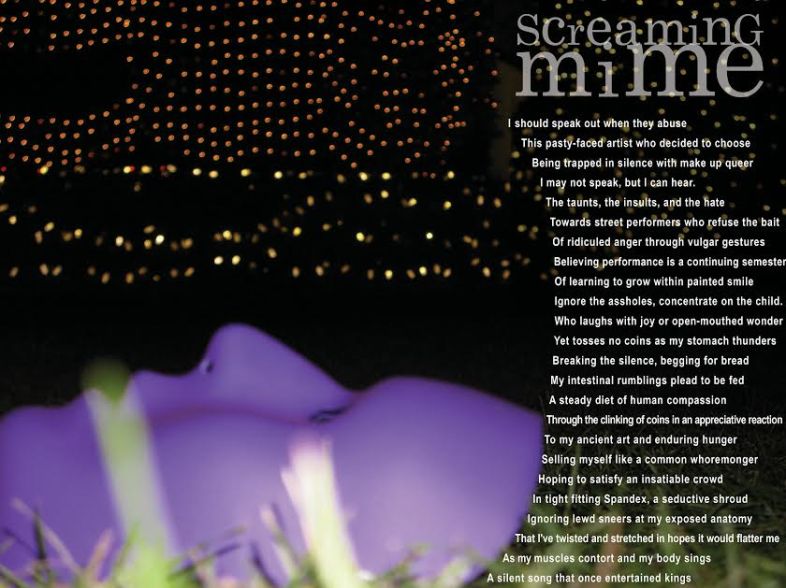
New York fine arts photographer Amy Bassin and writer Mark Blickley work together on text based art collaborations and videos. Their collaboration, Dream Streams, was featured as an art installation at the 5th Annual NYC Poetry Festival. Their video, ‘Speaking In Bootongue,’ was recently selected for the London Experimental Film Festival. They just published a text based art chapbook,’Weathered Reports: Trump Surrogate Quotes From the Underground’ (Moria Books, Chicago). The publisher has sent their resistance book to the White House and members of Congress. Screaming Mime is inspired by John Cage’s conceptual composition, “4′ 33″ as music.
The church where I rehearse with Fox Valley Voices, and which is the centre of a certain amount of community, particularly musical community in my home town, is where this project took place three years ago at the beginning of the First World War Centenary commemorations. A culmination of the project was the ‘Bard of Barnsley’, poet Ian McMillan, writing and reading his poem for us, “The Bridge”. It resonates with the artistic and musical traditions of this valley, but most important of all, it engaged both children and adults of Stocksbridge to ensure we don’t forget the men of this town, who gave their lives in the Great War, whose centenary we are still commemorating three years after this short film was made.
This post is actually an experiment. In my work as a translator there is something done sometimes called “back-translation”, which means that you translate a text from a language into another, and then the text is translated back into the original language, in order to see the degree of change suffered by the message due to the process of translating it.
In the following lines, what I did was to take the “translation” into music of Louis Bertrand’s “Scarbo” from his amazing “Gaspard de la nuit”, done by Ravel, and I translated it back from the language of music into that of words, using for that my own perception of Ravel’s splendid fantasy. The original text is this:
SCARBO.
Il regarda sous le lit, dans la
cheminée, dans le bahut;–personne.
Il ne put comprendre par où il s’était
introduit, par où il s’était évadé.
HOFFMANN.–_Contes nocturnes_.
Oh! que de fois je l’ai entendu et vu, Scarbo, lorsqu’à minuit la lune
brille dans le ciel comme un écu d’argent sur une bannière d’azur semée
d’abeilles d’or!
Que de fois j’ai entendu bourdonner son rire dans l’ombre de mon alcôve,
et grincer son ongle sur la soie des courtines de mon lit!
Que de fois je l’ai vu descendre du plancher, pirouetter sur un pied et
rouler par la chambre comme le fuseau tombé de la quenouille d’une
sorcière.
Le croyais-je alors évanoui? le nain grandissait entre la lune et moi,
comme le clocher d’une cathédrale gothique, un grelot d’or en branle à
son bonnet pointu!
Mais bientôt son corps bleuissait, diaphane comme la cire d’une bougie,
son visage blémissait comme la cire d’un lumignon,–et soudain il
s’éteignait.
The piece of music into which it was “translated” and from which I translated it back is the following, in the exquisite interpretation of Valentina Lisitsa.
Scarbo
keys
wake up
slowly,
moving like
zombie puppets –
don’t you see? –
they tremble, shiver,
your prancing hurts
their silence,
your laughter bursts much
too heavy for them –
they crash,
commanded to insanity by your frenzy,
fiend jumping – cavorting –
pinching night’s folds and knitting braids from breaths of wind
only to snap with them against sweating walls –
it’s black where you come from –
twisted, mind grabs bits of reality and
shoves them all together
in a bucket of tenebrae –
grim is your touch, swirling within night’s guts,
caustic – your whisper chars the shadows –
it’s dark and slimy where you come from –
your name cloaks inside it
the same slur and vertigo as that
from inside the heart of fear –
strings vomit sounds contorted just like your limbs,
you toss and turn the coins of fate
and upside down the room spins,
keys scream, sounds twitch
and uncontrollable bursts of hysteria erase
the purity of darkness –
sounds freezing their way up to the ears
lash the very shell
meant to shelter their terror,
shades of your grin bend,
like darkling tentacles,
all over the mesh of phantasms
and flesh shudders under the whip of your wicked games –
it’s gloomy and frightful where you come from,
black gnome,
Scarbo, you, who hold on the ring of your name
the keys of fears…





 history, in particular how themes of music and race intersected in the Southern States of nineteenth-century USA. During the summer of 2015, Emily travelled down the East coast of America, researching the Jenkins Orphanage Band, the core of which formed her undergraduate dissertation. Also a member of and volunteer with the human rights organisation Journey to Justice, Emily sings in the chamber choir, Fox Valley Voices, and in a mixed voice barbershop quartet, Needle & Fred. She has a love of music and theatre.


 The BeZine