Volume 9 Social Justice Issue 3
listening, learning, reaching out


Volume 9 Social Justice Issue 3
listening, learning, reaching out
Volume 9 Fall 2022 Issue 3

Waging Peace
listening, learning, reaching out
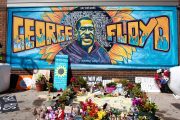
Cover art: George Floyd Memorial, August 17 2020 | Photo via flickr | CC BY 2.0 Fibonacci Blue
social
(in)
justice
in
society
in
social
contract
social
just
us

just
is
just
ice
justice
socially
just
us
just
is
just
right
but who’s right?
whose rights?
Read the words
in this issue of
The BeZine
see the art
just us
just is just
justice

we
not I
we together
to gather
justness
social
in
justice
not injustice
but done in
justice
justice done in
justice done
—Michael Dickel
Editor, The BeZine
Your Portfolio Archive currently has no entries. You can start creating them on your dashboard.

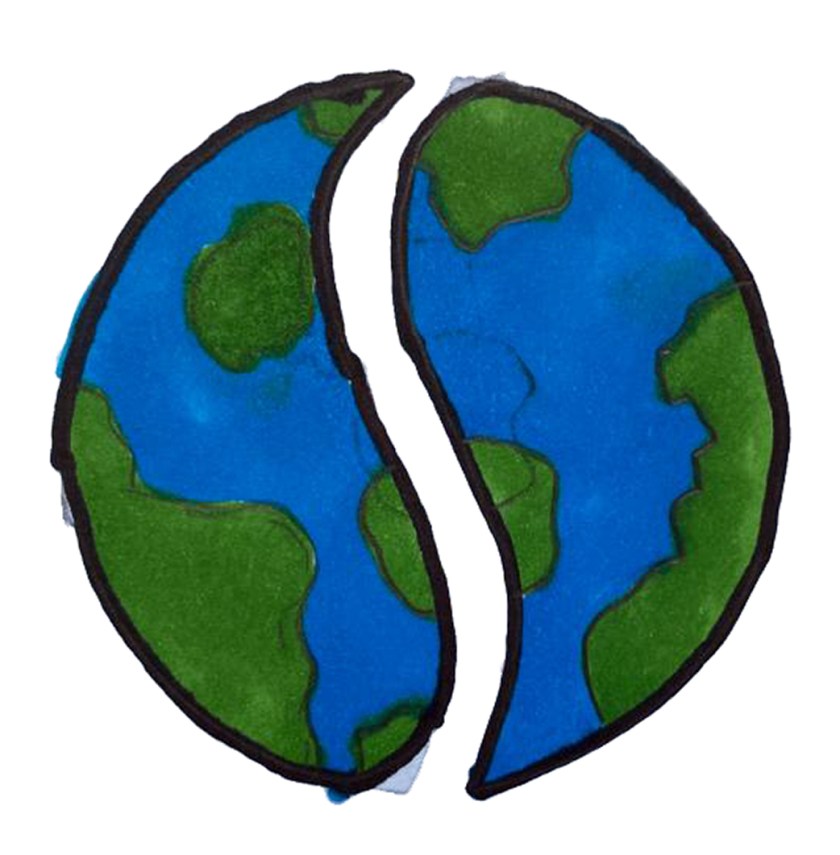
Art: Yin Yang Earth, Isaac Wilfond (age 11) ©2022
In the folds of thick fog, down by the curved Bay of Moon, a stillness descended on the ocean after a swift storm had passed. As the fog slowly lifted, a boat was unveiled; it was adrift. It swerved off course. I was right under, singing a primordial tune—a blue song. A man slid off the deck and fell into the ocean. It was a leaking boat.
I watched him plop. Into the ocean, he plunged that very moment like a dollop of cream into a coffee cup—floundering. I surfaced and wagged my fin in front of him. He caught it. It slipped first, then he held it firmly in a grip. I sailed in the current’s slipstream some nautical lengths until sunset in search of land. Was there any land nearby? Any show of land at all, in all the world, besides these vast stretches of the seawaters? Hope piqued, a sandy shore emerged along the Emerald Bay. I rushed towards it and reached its sandy shores within minutes. I rolled him over onto the beach in the midst of knotted weeds, oyster shells, and ponded waters cupped in footprints.
The tired man looked at me. I expelled a fountain of delight and saw how he curled up in a fetal position. In the meantime, his vessel nose-dived into the ocean as the ocean swallowed its parts in bits until all was galvanised under. His mates on the vessel were scattered on the waves like little debris as though they didn’t matter.
Fate had it that I rescued this dunking man from a sunken vessel. He looked at me, and he wondered how such a miracle ride was even possible? What are you—God? Who are you? He mumbled. I smiled, somersaulted in the air, and submarined, like a vanishing blink from the stars. I resumed singing; he heard it far from the ocean’s depth. Exotic to him, the tune haunted him for days on end—the blue song, he called it. Mysterious it sure was.
But the mysteries of the universe were locked in the layers of the lyrics which were decipherable through the Aboriginal dreamtime—inter-relation of all people and things—workings of nature and humanity—land and spirit. The deep connections which elude the eye—spirits more powerful which connected every life on earth such as the creatures of this blue soul.
The man waited for the saviour dolphin to return. But it never did. But it continued to convey the existential connections through its lyrics. Connections of abstraction communicated through the senses alone—through dreamtime—far beyond any human language.
©2022 Mehreen Ahmed
All rights reserved
…is an Australian novelist born in Bangladesh. Her historical fiction,The Pacifist, is a Drunken Druid’s Editor’s Choice and an Amazon Audible bestseller. Gatherings,is nominated for the James Tait Black Prize for fiction. Her short fiction has won in The Waterloo Festival Competition, Academy of the Heart and Mind contest, A Cabinet-Of-Heed Stream-Of-Consciousness Challenge, shortlisted, finalist, nominated for the 3xbotN, Pushcart, Publication of the Month, and Honourable Mention. Also, critically acclaimed by Midwest Book Review, DD Magazine, The Wild Atlantic Book Club to name a few. She is a juror to the KM Anthru Award, Litterateur RW Magazine, and featured writer on Flash Fiction North and Connotation Press. She has published books, articles, essays, and short fiction in international magazines, online, and in anthologies. Her works have been translated into German, Greek and Bangla.
On my bedroom shelf, three bottles of perfume are ready for a new home. One lost its top, the second is clogged, and the third—if you ask me—is just being stubborn! Yet, I look at them sitting there and it’s as if they are saying, “Yeah we are here. Whatcha gonna do about it?”
Okay, that’s only the sassy one. The other two can’t figure out why I haven’t used them in over a year.
Inaccurate! I’ve attempted to use them. Every once in a while—in my rush to leave the house—I forget the difficulty this trio poses, pick them up, and attempt to spray. Annoyed, I think to myself…okay what am I doing wrong? These “should” be able to work. There must be another way!
For the clogged bottle I try to loosen the top, hoping that I’ll just dab the fragrance on my wrist. Surely, that’ll work! NOPE… In a moment of weakness, I try my teeth (don’t judge). Not. Even. Budging. You get the idea.
After much trial and error, today’s the day. I’m ready to relinquish them to my apartment’s “free” community table. I know they have a lot to offer… (but, as I write this, I realize that might be a lie). All I can hope for is that someone comes along ready to help and give them new life. But, if they stay the way they are—in their dysfunctional state—they will continue to fall short of the lives they were meant to live. And, offer continued frustration.
Oh boy. And suddenly, we’re not just talking about body spray anymore. *Gulp*
Suffering from heart amnesia, I have at least one “clogged” loved one I keep returning to. I reach for them– longing for a spray of that sweetness I know they have on the inside. Instead, over and over and over, I’m met with inaccessibility. Each time, I ask myself- Why did you think it would be different, dear Bekah? I cling to their words claiming to care and rationalize– if they could just…
But isn’t this on me? I never want to give up on anyone; especially a family member! But how do I train myself to not reach for them with any expectations?
Do you have someone in your life who’s consistently unable to meet you where you need them? Perhaps they offered goodness in the past and you were able to reciprocate, but now the unhealthy dynamic won’t budge?
I encourage you (and myself) to offer them up in a way that doesn’t leave you in inevitable disappointment and frustration. And if you figure out that best way, will you please let me know?
I find that the serenity prayer often helps me find clarity, maybe it’ll grant you the same solace:
God grant me the serenity
To accept the things I cannot change;
Courage to change the things I can;
And wisdom to know the difference.
©2022 Rebekah Manley
All rights reserved

runs the Texas Center for the Book. She has an MFA in Children’s Literature from Hollins University and her first book, Alexandra and the Awful, Awkward, No Fun, Truly Bad Dates: A Picture Book Parody for Adults debuted in 2020. This fall marks the 7th birthday for her blog, Brave Tutu! This September, she’s launching her company, Love, Bekah LLC. Its mission is to create witty and heartful products for women navigating heartbreak.
One, two, buckle my shoe
Three, four, shut the door
Five, six, pick up sticks
Seven, eight, lay them straight
Nine, ten, big fat hen!
Circa my age three, my Great Grandmother Lucille taught me this rhyme and how to pump my legs to use our backyard swingset. This Thanksgiving offered a full-circle moment to that earliest memory, as thoughts of her, my Papa and Great Aunt Rosalie surrounded me in their Iowa hometown.
Macedonia boasts one restaurant, a bird museum and a pottery shop (both open by appointment only). In the company of dear cousins, corn and cows, I had a lot of space to simply rest and reflect. Naturally, I spent hours at the historic park just down the street from the yellow farmhouse our family built in 1911.
Channeling Grandma Lucille, I pumped my legs and rose up and down– gaining perspective and peace. With gratitude, I contemplated the last year– and how I wanted to step forward into another. I released pieces no longer serving me; letting them fall as the trees surrendered their leaves to the wind.
Before my last day, I noticed the word “miracle” imprinted in the faded blue rubber of the swing’s seat. I know this brand was not a coincidence. Precious family time mixed with quiet moments of thought and palpable memories of early learning gave me strength. Just the strength I needed to surrender what I can’t control and feel loved and assured on this journey.
I love the steady elevation gain that comes from leaning back and whooshing my legs through the air:
Up.
Down.
And up again.
The breeze brushes my hair.
And perspective grants liberation.
Repeatedly, I’ve gained simple freedom by putting Grandma Lucille’s skills to use throughout my life. Undoubtedly, my Smith family’s stubborn strength pushes me to the higher places I want to live.
My mini-Macedonia miracle offered catharsis. Therefore, I keep these swing-set stories close as we enter the highs and lows of this next season. My inclusive faith drives who I am, my writing and how I see the world. I often enjoy considering the fuzzy farm animals present for Christ’s birth and the unconditional love he represents in my life. Unknowingly, a baby lamb might have sat in the same hay that kept him warm. I relish the simplicity and take that in as– much of life simply doesn’t make sense. And perspective won’t be rushed. I’m grateful for moments like the Macedonia park that help me remember, through the rise and fall of it all, odds are, we are sitting on some kind of miraculous.
What about you? What ways are you sitting on a miracle of sorts during this season? I encourage you to pump your legs and “three, four, shut the door” in order to fly free and greet fresh ups and, even, downs. Know you are not alone and I wish we could sit side by side on swings and discuss how you are feeling pushed onward into this next season.
©2022 Rebekah Manley
All rights reserved
runs the Texas Center for the Book. She has an MFA in Children’s Literature from Hollins University and her first book, Alexandra and the Awful, Awkward, No Fun, Truly Bad Dates: A Picture Book Parody for Adults debuted in 2020. This fall marks the 7th birthday for her blog, Brave Tutu! This September, she’s launching her company, Love, Bekah LLC. Its mission is to create witty and heartful products for women navigating heartbreak.
This writer can’t bake but they do
Eat with brains
Don’t thoughts

How many days
Can we hope in
Comes back to

Well no where is
You more than
Hos

Each ray makes
Us They teachin
Okay well, another peace
Comes from the box of
O

No weak Came
She’s blood out
Where do they
Call us for the
Muscles RAM
Signing you as
Anything but tag
There’s no.
Is this a story
or is it a letter
It truth because
How do you know
that Nika has that
short day as goddess
She’s been preforming
Ever since she succeeded
Which link searchable,

Poems ©2022 Nika Mavrody
All rights reserved

…writes for the news, and has been published in TheFashionSpot, The Faster Times, TheAtlantic.com, Racked.com, Sugarhigh Berlin, Blinkist, CESTA blog, Cultural Analytics, The Decadent Review, and is forthcoming in The AutoEthnographer.
Behind us, one tree flares up
a second-hand memory of Hiroshima.
Behind us, one solitary tree is Hiroshima, the blast-moment city.
We break our breads, sweet, too dolce,
with a promise of the cherries on top
in the middle, but not quite the real ones.
We suck those sugar-glazed red globes.
We have inherited the faux world,
and we feed the bird because life
feels like a taut skin at any moment
it can be singed, peeled away.
We should kiss—we think together.
The air in between us plays a refrain.
The notes scattered all over the park
to the applause of the pigeons.
One moment they are here; in the next not.
Without the bees
the world as we know it
will be stung to nullity.

I tell my daughter.
Her hand guards her eyes
as the buzz flares in

its sun-like buzz
spiking the ovulating breeze.
The butter knife I strike against
the dish and the plate with
a soggy biscuit
spills some music.

The newspaper states that there
should be no note left
in my head.
The flash is—the music

has been last seen standing
holding the mast of a bridge
the authority forgot to build.
©2022 Kushal Poddar
All rights reserved
…an author, journalist, father, and editor of ‘Words Surfacing’, authored eight books, the latest being Postmarked Quarantine. His works have been translated into eleven languages.
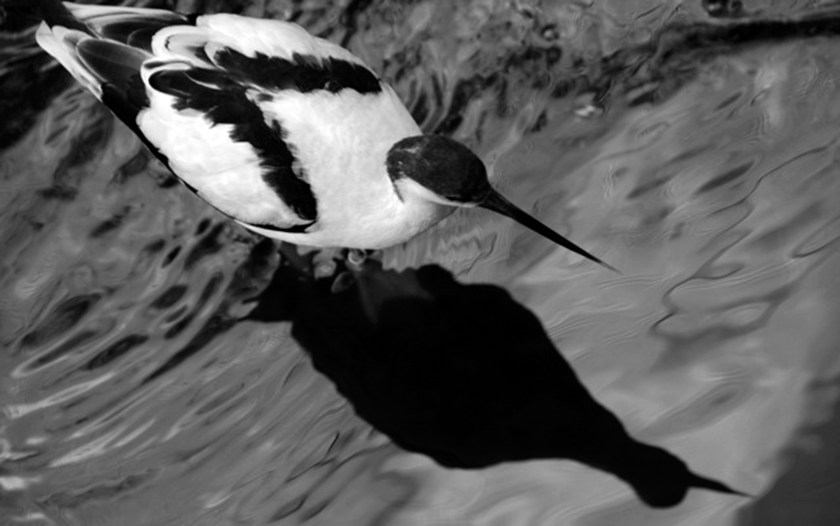
Photograph: Waterbird, Michael Dickel ©2017
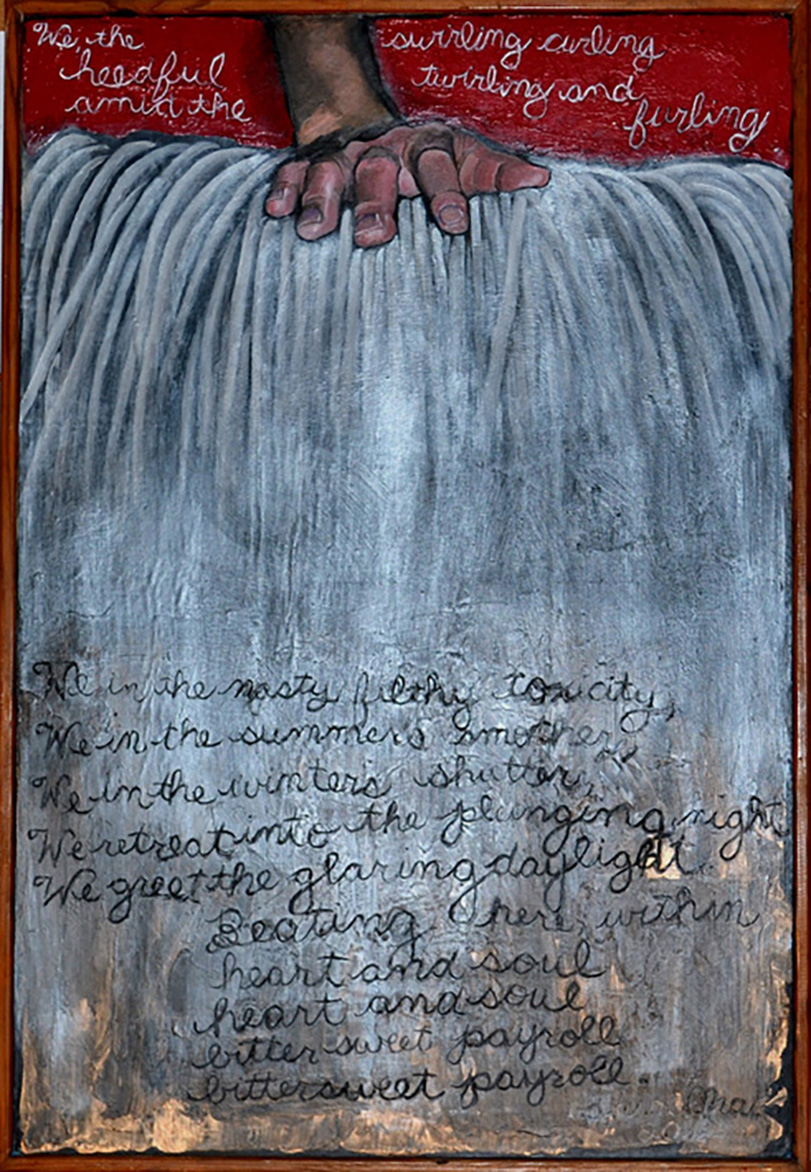
“We, the heedful between the swirling twirling and furling.
We, in the nasty filthy toxicity.
We, in the summers smother.
We, in the winters shutter.
We retreat into the plunging night.
We greet the glaring daylight.

Beating here within: Heart and soul, Heart and soul,
Bittersweet payroll Bittersweet payroll.
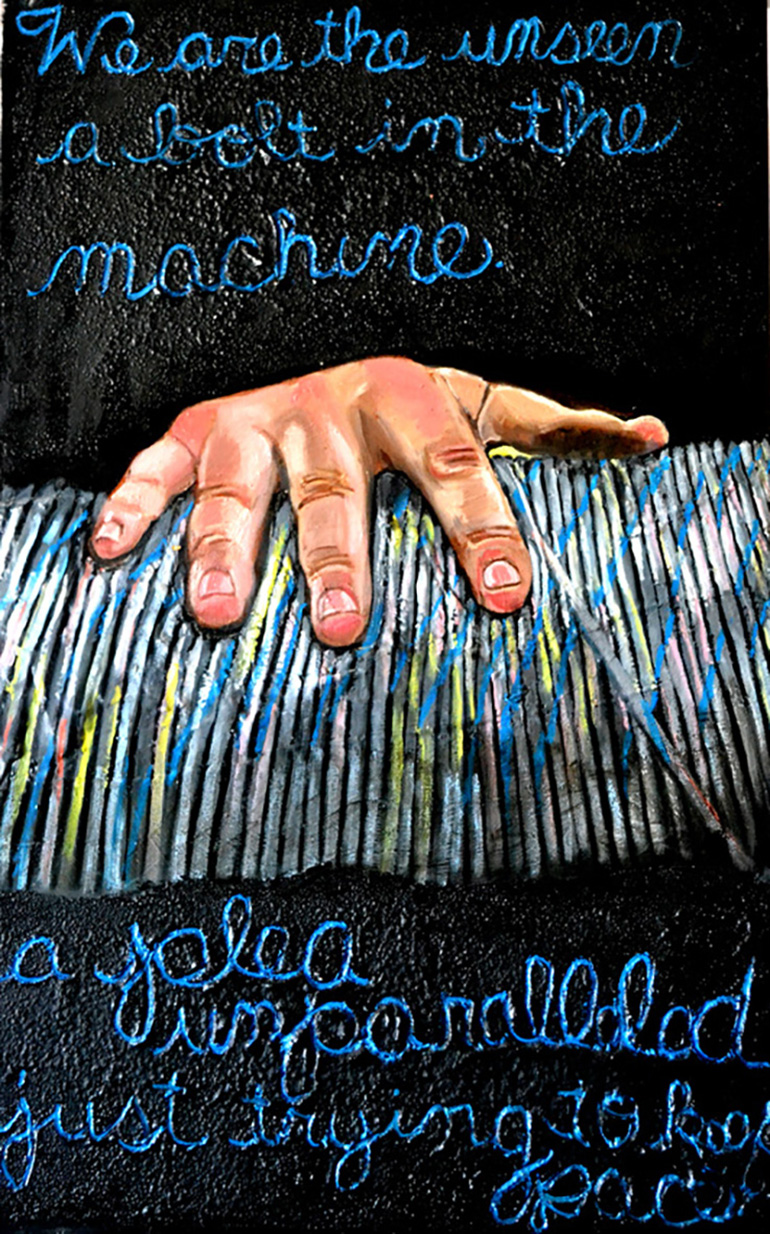
We are the unseen a bolt in the machine.
A plea unparalleled just trying to keep pace.
We are just running in place running in place.
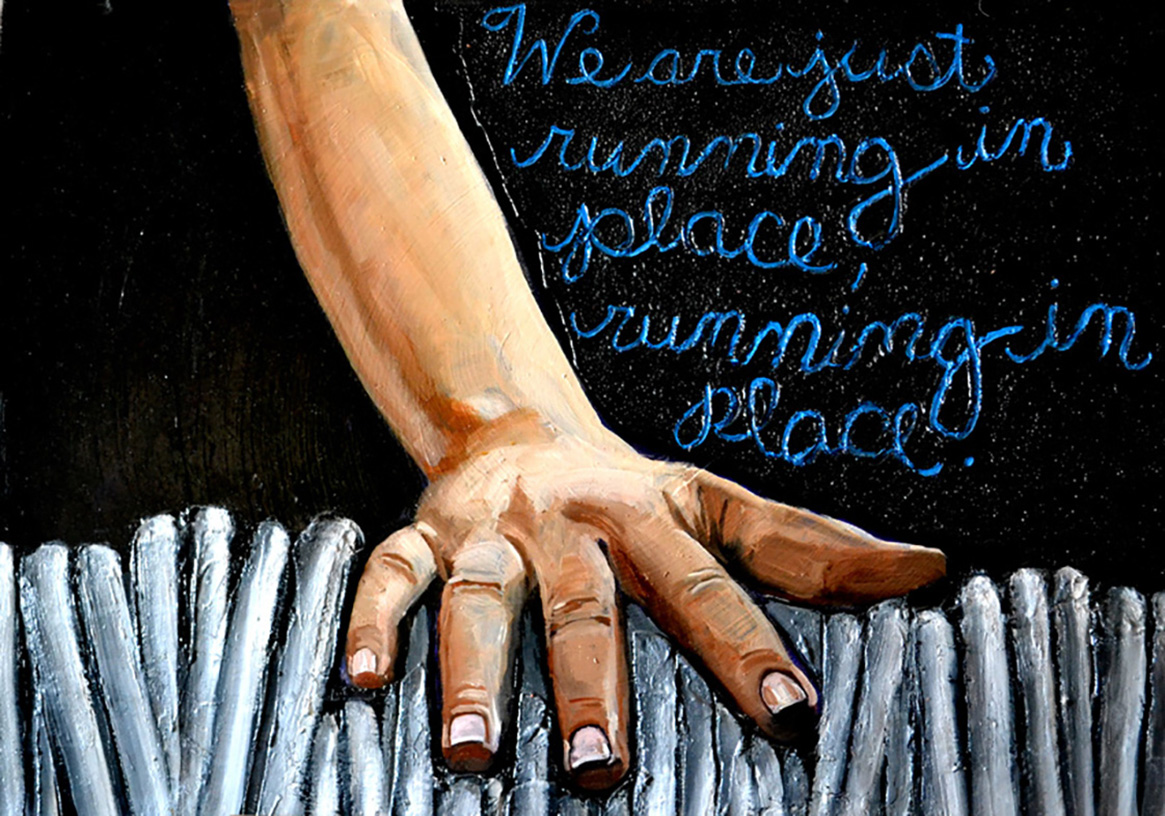
Observe our hands.
They shake.
The scars the calluses the sparse paralysis.

We, who inhale the talc and the MEK.
We, who toil in the dog days.
We, who chill to the bone.
We, the workers down below in the pitch-black night.
We, the workers dead on our feet an under asbestos sky.
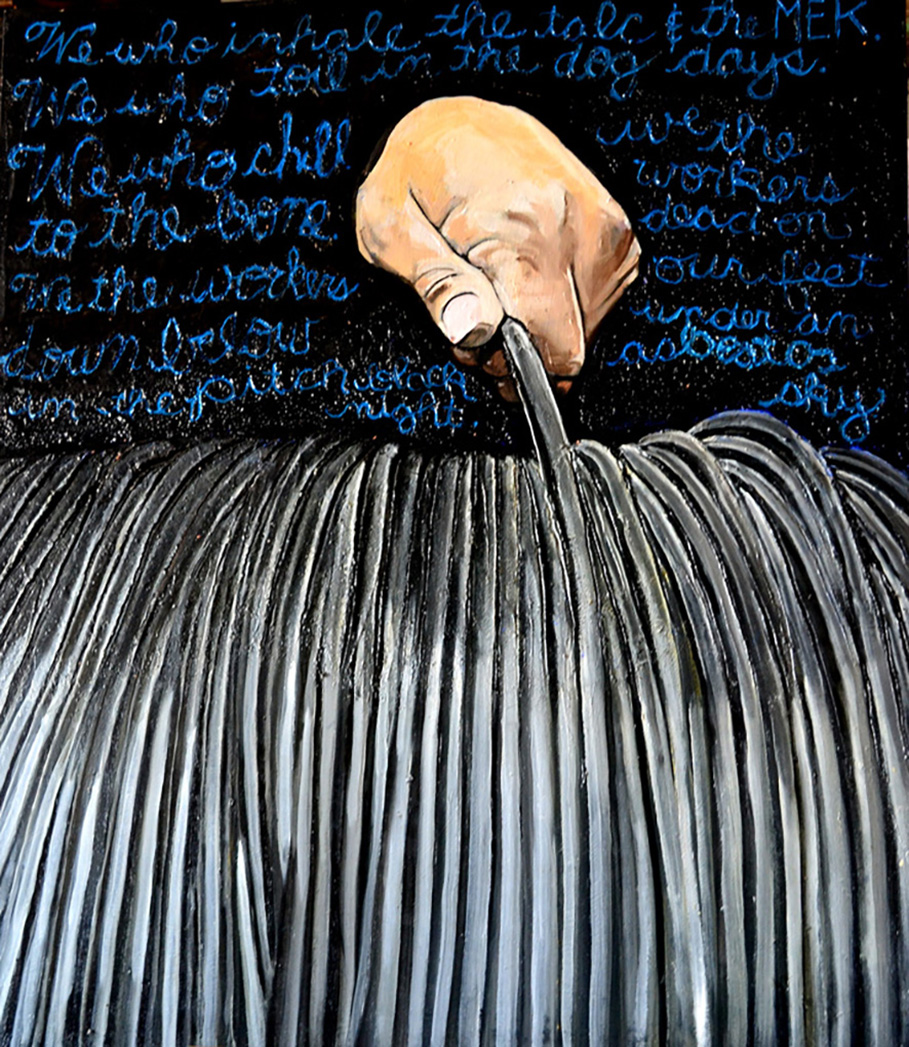
Beating here within: Heart and soul, Heart and soul,
Bittersweet payroll Bittersweet payroll.”
Artist's Note: Here is a series of five paintings with poems about folks (like me) who toil on a factory line. Every operator on the production floor is simply a pair of hands. His welfare is secondary as long as the quotas are met. Thus I focused on the hands of each employee. It makes no difference their ethnicity, Arab, Russian or Jewish. Their hands are all remarkably similar. All are hard working under harsh conditions for minimum wage. Let us also keep in mind that each seeks a decent home, health, a good education and better life for their children.
Poem ©2012 Shira Chai
Paintings ©2014 Shira Chai
This presentation ©2022 Shira Chai
All rights reserved

…is a painter, teacher and artist who writes poetry. From an early age she began journaling. The words soon became poetry and part of her paintings. She embosses the words into the paint. Ms. Chai has exhibited in Detroit, New York, Tel Aviv and various Kibbutzim, in group and solo exhibitions. Shira has been a member of Kibbutz Ein Dor since 1983. She has recently published poetry in ARC 25 and 26, journals of IAWE (Israeli Association of Writers in English).
Bigots have no spigots of charity
They burn bias with threaded needles
As a way of catching and trapping us
God save all our souls from this evil contamination
Of such wickedness and sadness.

Let us stand on the streets together
Tall and proud
And read poetry with each other
Hug and love with all our muster
To share a shining nuance of the wonderful
While this untenable world circumnavigates around
in crippling blindness
Life could be a weapon for us to change, to live even,
To spread peach plenty about the shade,
To drink frozen oleanders,
To soften the pain of drone death and safe words.
Say your speech to wake us from wanton laziness
When in the near distance
People implode in pain and panic,
Sting entrenched pale in pus and puke.
If half the world is jerking like that,
We must not tell ourselves Christmas stories.
Drink drunken words that crash shields

Let your comfortable life quiver and unsettle.
We may all then might maybe come together
in a vast epic colloquy,
as in Odysseus with Telemachus
two great forces affirming the inchoate shape of
that uncertainly love.
Quote here—add return / line break
only if more than half-way across page.
Make regular block when adding this.
—Attribution (source)
Whenever tides spun avid
Wherever it was inevitably dark
Annie sang soft whisper memories,
of what was said quiet in her parents
bed.
At first glance she was a small circumference
in others views—
one gentle cell dreaming.

Her mind waters welled
like the tides blood
and Annie without knowing
why searched in her gentle blue
for Caleb a man all strenuous!
he of the mind’s rough face

His voice a rocket to Annie’s
stillness   Sometimes she even
thought quiet like a night star,
sometimes calm dreaming
her intransitive wonders running.

Caleb he burned too hot for her cool
she felt in this soft black cave the souls,
spirits of the balmy present, turning and turning
Annie could not reach the off switch
to silence restless Caleb burning.
She tried turning off that switch
To unwriggle his wrestling
ongoing transitive chaos.

And Annie bless her she said
I want to slide
not to possess
to roam not to own
Red periwinkles and blue hyenas
The best.
This great tide of solar beginnings
Growth indivisible—beyond words
Such reawakenings
When we green ourselves
Sun spices everything stronger
A triumphant glare shows you
and her and the world wallows with us
all in now when life wells to a head.
Plant blooms bloom more
In a plethora of themselves
A grand annual rejoicing
When our faith strengthens
In silent joy that all is what it is
That we can be blooming now together.
My indomitable father was a man of unseen dreams
In all his grey garb he looked so gentle
Like a philosopher assembling life drifts.

Life and injustice forced him to get rock taut
Like those Herbeden’s nodes
Marking his knuckles so beady.

As a girl, to grow I had to challenge
That certainty he held so tight
Fear quiet there in his feeling And between us we gained
Mutual lifelong soul respect.

He would come to Grand Rapids and
walk with his beret and cane in the Labor Day parade
in honor of workers, of you and we, dignity
and of his daughter, perennially late sleeping me.
©2022 Linda Chown
All rights reserved
…is a poet professor musician who now lives in Michigan although her past is coastal and international: Spain and California. Author of four books of poems and finishing her next book, Sunfishing, Linda is a life-long activist, sun-lover and dreamer. She was raised in an activist family from the start. A hopeless romantic, sometimes inequities everywhere drive her to despair and to writing action.

The fear just really never went away of
someone different but the same,
whose passions are equivalent
but aimed at something opposite
to preferences my own body
will allow.

I work at understanding every day:
my family, friends, and strangers,
my father, passed away these
three years now. I think I understood
him decently but still, I hide my eyes
from photos of his naked boyfriends.
Dad’s computer was a minefield
and I wish he’d had a better way to label files but
I wish he hadn’t died in discreet steps as well.
I wish I understood the human heart, libido, soul,
all the bits which can get us
into so much trouble.

At twelve a man’s hand cupped my face
as I, an unaccompanied minor flew
to visit somewhere I’d been sent. He told me he
was helping with my cabin pressure headache
but I knew
what inappropriate meant.

At sixteen I was in my bed asleep,
a man was visiting from overseas-
some candidate for PHD, someone that
my father once had met.
My room contained the only bed for guests.
I told my Dad and Mom and later on, that man had left.

Standing in the concourse of Grand Central
once when I was seventeen
a gentleman approached, so interested in me
naive and parent free, his curiosity
was evident in how he followed
when I tried to leave.

At twenty-one I kissed a pretty girl
who had no interest in my kiss,
and turned away as I continued
to insist and hold her close to me
and told her she, mis-understood
her own desires.

When I started my own business I brushed the arms of
female hires as I spoke to them.
I told myself it had to do
with my communication skills and not
some psychosexual power thrill.
But maybe I know better now.

I hate the men who used me in and for my youth.
Their addled bodies changing them
into alarming brutes, reinforcing bias
towards a group attacked with bigotry, and I
learning to find pleasure in dislike of something unlike me;
ignorant of my own truths.

I wonder if my sins have caused
damage lasting over years,
irrational and complex fears or hatred aimed
at innocence, past
anytime it might have made
any kind of sense.

And here’s a man who’s speaking of his husband,
and it makes me feel uneasy
placing words in places that
they didn’t used to be, instead of maybe
wondering if someone else can try to have a try
to crack the code of trying
to be happy.
©2022 Morgan Driscoll
All rights reserved

…lives in Connecticut and writes poetry to supplement his income as a commercial artist. He has been published in 30+ journals and anthologies and has made over $100.
You can find his work in Humanist Magazine, The Penwood Review, The Orchards Poetry Journal, Constellate Magazine, Caesura, Northwest Indiana Literary Journal, The Avenue, Meetinghouse, Newtown Literary, and many other
for those who, wherever, have to die lonely

Chilly the room
the white walls

audible only
the echo of loneliness.

Not a tender word anymore
no warm embrace

just the time,
a leaking tap,
ticking.

None knocking at the door
nobody you expect,
no one, except death.
©2022 Germain Droogenbroodt
All rights reserved
…is an internationally known poet, translator, publisher and promoter of modern international poetry. He writes short stories and literary reviews, but mainly poetry, so far 14 poetry books, published in 19 countries. As founder of the Belgian publishing house POINT Editions he published more than eighty collections of mainly modern, international poetry, he organised and co-organised several international poetry festivals in Spain. He is vice president of the Academy Mihai Eminescu, in Romania, and organizer of the Mihai Eminescu Internaional Poetry Festival. He also set up the internationally greatly appreciated project Poetry without Borders, publishing every week a poem from all over the world in 33 languages.
They’re there;
hollowed into make-shift sponge-foam beds,
tight-curled into malodorous rag-blankets
and plastic of dubious origin.

They’re there;
the shadow-ghost people
of no fixed abode,
gathered loosely together
in cohesive misery.

They’re there;
existing on society’s fringe,
sustained by the government’s pandering promises;
sharing glue-highs and garbage rot.

They’re there;
old children, dying people,
together in perpetual poverty.

They’re there;
trampled contours on grass verges,
silhouettes on street corners,
robotic vendors with nothing to sell
but themselves.

They’re there;
the street-people of forgotten causes,
unified in the rainbow nation
of lost hopes.
©2022 Irene Emanuel
All rights reserved
…was born in Johannesburg, lived in Durban, and now lives in Port Elizabeth. She won of the “Hilde Slinger” cup for poetry in 2009 and again in 2013, and the “Fay Goldie” cup for General Success in the World of Publishing in 2011, both from the South African Writers” Circle. Nine of her poems were published in “Signatures” an anthology of Women’s poetry (2008), and shre represented “Live Poets’ Society” in “Poetry Africa” that same year. In 2006, “A Scorpion Sings,” her first anthology, appeared. Other anthologies published between 2006 and 2015 are: “Count Catula of Shadoland & Friends,” “A Peace of Me.” and “A Scorpion Sings Again.”

Who cleaned The Capitol of the mess the mob left behind:
bagged spent spray cans and empty water bottles, body
armor and cigarette butts, hauled them to the dumpsters?

Who swept the littered floors of the Rotunda and Statuary,
Crypt and Speaker’s Office, collected into dustpans the
splinters of broken benches, shards of smashed windows?

Who scrubbed down the marble surfaces, wiped the scuff
marks of shoes from the patterned tile floors, removed
the smears of blood and feces from the sandstone walls?

Who draped plastic film over Madison and Adams, traces
of chemicals present on their portraits, a bust of Zachary
Taylor, too, his nose and lips still streaked with blood?

Who rechecked the chambers and offices, locked up, then
cleared out for the night, the secular sanctuary back safe
in their care, yet indelibly stained by a disorderly horde?
On July 9th, 1776, upon hearing The Declaration of Independence read
aloud for the first time, General Washington and his troops charged
the Bowling Green. Those patriots, moved by Jefferson’s
words to remove every gilded symbol of their oppression,
hoisted ropes around the 4,0000-pound effigy of George III,
mounted on horseback, robed like the Romans, as they chanted:
Tear him down! Tear him down!
They then tore from its base that garish likeness of lead which had long
stood above them, smashed that cruel Crown to pieces, and, in
a most fitting reuse of that malleable material into matériel,
melted His Majesty into 42,088 musket balls. Then,
through volleys of musket fire, they returned the lead
from that loathed likeness and won their independence.
At the Derby, the thoroughbreds,
chestnut and palomino, brown
and gray, roan and black, each
bridled in bit and headstall, take
off at the shot of a starter pistol in
a race that lasts around 2 minutes.


Authentic gets off to a slow start, yet
in the stretch catches up with Tiz
the Law, goes head-to-head with
the bay stallion, yet overtakes
him in the end, wins by a length
and a quarter, with a time of 2:00.61


The first-place racehorse pays out to
his bettors: 1.8 million in all, and
though he’s awarded none of the
purse, all of which totals 3 million,
the public will remember his name,
more so than the owner’s or jockey’s.
On the hallway floor, Breonna Taylor lives well past 2 minutes, possibly 5 or 6,
coughs as she struggles to breathe,
after 7 officers draw their pistols,
then fire into her apartment, 32
times in all, trample down the front door.


For more than 20 minutes, in a pool of blood on the hallway floor, Breonna lies unresponsive, and with no medical attention, the emergency room technician dies at the age of 26, the time of death approximate,
listed on the certificate: 12:48 am.


To Breonna’s family, Louisville awards 12 million, none of which will bring her back, but like the bay colt who won the Derby, mostly unknown until Kentucky, she, too, leaves a legacy, rightfully remembered and honored, more than the winner of any race.
©2022 Jonathan Fletcher
All rights reserved
These poems originally appeared in Boundless 2021: The Anthology of the Rio Grande Valley International Poetry Festival (FlowerSong Press)
…,originally from San Antonio, Texas, currently resides in New York City, where he is pursuing a Master of Fine Arts in Creative Writing in Poetry at Columbia University’s School of the Arts. He has been published in Arts Alive San Antonio, Clips and Pages, Door is a Jar, DoubleSpeak, FlowerSong Press, Lone Stars, OneBlackBoyLikeThat Review, riverSedge, Synkroniciti, The Thing Itself, TEJASCOVIDO, Unlikely Stories Mark V, Voices de la Luna, Waco WordFest. His work has also been featured at the Briscoe Western Art Museum.
Can we compensate?

               Settle accounts
                             with the Black man
                             living in the ghetto?
               Recoup
                             the self-worth of the Muslim
                             woman who was spit at?
               Atone
                             for the slights in the communities
                             who banished the Irish?
               Indemnify
                             the Navaho for his beaten
                             and murdered grandfather?
               Make amends
                             to women who were denied
                             opportunities to be heard?

Probably not,
but we can support justice.

               Fairness
                             in our hiring practices.
               Due Process
                             in our renting policies.
               Equity
                             in our laws.
               Impartiality
                             in our judgements.

Still, it’s not enough.

               Eyes
                             have to see.

               Hearts
                             have to care.

               Arms
                             have to open.
Do you see me,
sitting next to you?
You push up your glasses,
and look past me,
seeking a mirror to talk to.

Your voice is soft,
kind perhaps,
as you smile and nod
discuss children and
slow transportation.

Being brown,
I don’t reflect you,
but she isn’t really a
copy either.
She’s taller,
like me
and she’s younger—
unlike you and me.

I speak English,
was born in California,
raised in Illinois,
have two children,
probably work in a building
near yours. Is there
nothing you can say to me?

I reflect sameness—
but not enough?
Maybe, I should speak,
but would you hear
if
you don’t see?

We hold these truths,
          Do we?
To be self-evident
          Not through much of history.
That all men
          Define men.
          No women though, right?
Are created equal,
          Whoa! Not Blacks—
          three-fifths of a person
          no property ownership
          no votes
          no signed contracts?
          Oh yeah!
          Property—
          not people.
©2022 Lorraine Jeffery
All rights reserved
…has won prizes in state and national contests and published over a hundred poems in journals including Clockhouse, Kindred, Halcyone, Canary, Ibbetson Street, Rockhurst Review, Naugatuck River Review, Orchard Street Press, Healing Muse and Bacopa Press. Her first book is titled When the Universe Brings Us Back, 2022.
Website / Blog Linked
Dedicated to the memory of Amadou Diallo
I see your kind eyes shining out of those pictures
with your brothers and  sister
journeying from Africa to America
you came here because you wanted your mother to relax into old age
you wanted so much for your family
your hope, not forgotten after all these years

my breath is captured for a moment
I stare at the tv screen flickering out at me
I look at the holes where the gun shots poured in
just looking at those spaces, I want them filled back in
wanting the gun shots to disappear
wanting something, anything to take them away

I was imagining the policemen outside your door
the fear on your face, in your gentle hands
as they reached for their guns before reaching for thought
they were on automatic, aiming at a target
they didn’t ask your name or address
they didn’t ask anything of you

what happened to their feeling?
did it get lost as the gun fire let loose
did it get lost as your body splayed out in front of them
what happened to your humanity, your wisdom
your spirit that caught fire?

how could a wallet be mistaken for a weapon?
how could your beautiful face be mistaken for a killer’s?
as you stood and then fell down
blues fell with blood in that hallway


that blood stain could be seen for days years afterwards
even though they tried their best to cover it up

how treacherous is the journey to silence?
how treacherous is the journey to silence?

I wanted to tell you Amadou
the police were set free
but we will not let them forget
we will not let them forget the murder
because after killing, the blood can never be washed off their hands

and now, I imagine your mother
shaking in the night she was told her oldest son died
her whole body shakes in the blue night
her whole body shakes in blues
she carries that grief on her shoulders
In her chest, it stays inside her eyes
such sadness

what it must feel to lose a child?
to lose her oldest son
to never be able to look in his eyes again
to never be able to hold him
never be able to hold -   Amadou
she holds her head - Amadou
she says his name over and over again

she is sinking
she is sinking Amadou
she is lost in her memory of birthing you
of bringing you into this life
yet somehow she stays standing
she doesn’t surrender

and I too am remembering
I wish you the peace that comes with still, cool water
the peace that comes with the African sun rising over your tender hands
rising and wrapping cloth around your bullet wounds with love
and singing you home to your resting place
and singing you home
just singing you home with love

Dedicated to John Trudell (February 15, 1946 – December 8, 2015)
Santee Dakota Activist,  Actor, Musician, Writer and Poet
The great lie is that it is civilization, it is not civilized.
—John Trudell
When Black Elk, Heȟáka Sápa, the Lakota spirit man dreamed
He said that Indians moved in a circle
They did not move in straight lines

And you too danced in your own way
Never direct
Honoring the footsteps of your ancestors

You were a modern seeker
Standing firm on Alcatraz island as part of the Red Power Movement
It was a two year occupation, you demanded recognition for broken treaties that were strewn across open highways

Broken papers, broken ink that was swept over or swept away
By place names called Custer after the great American hero who was highlighted in official history books
By lies of a murderer who bulleted Indian bodies into the cold frozen snow

Oneday a line of fire flickered out across your family roof
Trapped inside the house were your pregnant wife, your mother-in-law and three of your children
They were killed in the fire
Even though the official word was that the fire's origins were unknown
You knew it was set, deliberate, the pattern on the roof was too direct

'I died then, I had to die, in order to get through it' you wrote
Your writing came to you as a gift at that time
Your poetry became your “hanging on lines”
Your writing came with such force that you could not refuse it
It overtook your spirit, it was your way to survive

Once you said that Indian people did not need to wait for a nuclear war
It was already happening on the land from the mining of Uranium

You loved the grasses, the high sacred Black Hills, the sunrise moving within you
You would not let their lies quieten you
You would not put down your weapons
Arrows flowing over your fingers

You opened your hands up
Seeking wisdom from the North
Your words fearless as they spun out in circles across the night sky
©2022 Dorothy Johnson-Laird
All rights reserved
…is a poet, social worker, and activist who lives in New York City. She received a B.A. in creative writing from New School University and an M.F.A in creative writing from Sarah Lawrence College. Dorothy also works as a music journalist with a passion in African music. She has published journalism AfroPop with and Music Central, among others.
Recent poetry has been published with The BeZine and Fresh Words Magazine. More of Dorothy’s poetry can be found on her FaceBook page.
Behold this diverse
assembly of white, ghost
white, baby powder, smoke, snow,
ivory, floral white, seashell, cream and beige.

They have gathered
here today to navel gaze
and commandeer the concept
of diversity, to ascribe to their wide
array of whiteness a vast variety of virtues
which serve to separate white sheep from the goats
of many colors oblivious to the fact that they can only be
distinguished by the kind of melanin they have in their skin.

They are a most
heterogeneous throng of
parchment, antique white, bone,
eggshell, vanilla, alabaster, chiffon,
merino wool, rose white, and half and half.

Listen as whitesplainers
whitesplain their whitecentric
theology of a white God created in
their white image who miraculously sires
a white antisemitic Jesus from a Jewish peasant
woman to call white people to spread a white gospel of
white makes right to a white world washed white as snow.

Take a sober look
at this mutual admiration
society of coconut, frost, linen,
rice, powder, pearl, titan white, white
dove, white diamond and dazzling winter white.

Listen to the white whispers
of a white-skewed world view of
white supremacy reining supreme, white
politics and white socioeconomic policies as
the way to make America great again, “replacement
theory” as the replacement theory for critical race theory,
and nothing at all about black history long ago whitewashed
from the American history textbooks they read as school children.

What we have here
is a rainbow coalition of
simply white, oyster white, milk,
natural white, vivid white, cascading
white, cotton ball, whitewash, bright white,
and brilliant white. There must be 50 shades of white –
swan white, polar bear, paper white, delicate white, cake batter,
white sand, stone white, retro white, white chocolate and white on white.

They vow to own the libs,
this diverse assembly of white
alt-right, white radical right, white
far-right, white ultra-right, and white
extreme right, now mainstreamed alongside
the silent and complicit white conservative right.
Watch as their blizzard of whiteness ushers them into
a whiteout and they go snow-blind, unaware that a new ice age
has begun in their frozen hearts now entombed by the glaciers within.

Listen as they sing
“Jesus Loves the Little
Children” with not a red,
yellow, black or brown child to
be found among them. Span the rainbow.
Behold the children. All of their colors are white.
Change the subject to race in a room
of white faces in a deep red state
and watch blank faces with
glassy eyes take over a
tension-filled room.

Listen as the quiet speaks
and grows louder and louder
until the silence itself is deafening.

False equivalencies begin to drop like rain.
No dog whistle interpreter necessary.
The surreal is the new real for
anyone wearing blinders.

“The white cop may have
been trigger happy, but look at the
checkered past of the unarmed black man.”

“Maybe if the unarmed black man wouldn’t
have been struggling to breathe, the white
cop wouldn’t have believed he was
resisting arrest or kept his knee
on his neck for 9 minutes
and 29 seconds.”

“We wouldn’t need
more restrictive voting laws
which we call election integrity, and
others call voter suppression, if black voters
weren’t committing so damn much voter fraud.”

So it goes.

Blue Lives Matter eclipses Black Lives Matter
as if a job is equivalent to a human life.
As if a job equals a human life.

White Lives Matter
steals the stage as if white folks
have ever doubted that white lives matter.

Not to be outdone, All Lives Matter grabs
the mic, glosses over black lives with
all lives even though black lives
have never really mattered to
so many who have never
lived black lives.

Read the room.

The tension can be cut
with a knife.  Discomfort reaches
critical mass.  Artful redirection is on
deck.  Comic relief is waiting in the wings.

So it goes.  And so it goes.

I don’t want to say this.  I naively believed
we were becoming a post-racial society.
I was wrong.  We are becoming an
Orwellian post-truth society.

Where is the courage
to love those who don’t look
like us?  Let the vulnerability hangover
come.  I am white.  Take my heart.  Break it.

Paint it black.

A poker face will
not hide you forever,
and you can’t just co-opt a
moment of silence as an alibi for
donning an invisibility cloak every time
you feel uncomfortable. We are no longer
toddlers playing hide-and-seek, believing we can
hide in plain sight by placing our hands over eyes, as
if you can’t see me if I can’t see you. There you are. I see you.

The truth about how
we come to know and be
known is self-evident and eternal.
We cannot NOT communicate. We are
all responsible for our own communication.

Everything we say,
everything we don’t say,
everything we do, everything
we don’t do communicates something.

When our neighbor
is profiled, stereotyped,
slandered because of how he
looks, or who she loves, and you
say nothing, your reticence outs you,
gives you away. Your silence is deafening.

When decency calls for
something to be done, nobody
gets to say, “Why are you looking at
me? I didn’t do anything!” As if not doing
anything when something needs to be done serves as a
not guilty plea. Inactions, like actions, speak louder than words.

Do you honestly
believe that your sins
of omission will not find
you out? Didn’t you get the
memo? It’s not just the bad things
we do. It’s the good things we don’t.

Complicity masquerading
as innocence is cowardice placing
personal privilege above the needs of those
who are marginalized, disenfranchised, oppressed,
dehumanized, ostracized as “other,” brutalized, erased.

You may say with sincerity,
“I went into fight-flight-freeze,”
and I froze. There is no shame in fear.
We just can’t establish permanent residence there.

It comes
down to this:
Define or be defined.
The power of self-definition
is our first and last power. Our very
lives can be taken from us. The power to
define ourselves must be given away to be lost.
Who will define you? Who will define your legacy?

Ghost me
again, the next
time I am counting
hearts, and I might get the
impression that you don’t have one.
©2022 Todd Matson
All rights reserved

…is a Licensed Marriage and Family Therapist in North Carolina. He has written poetry for The Journal of Pastoral Care & Counseling, Soul-Lit: A Journal of Spiritual Poetry, and his short stories have been published in Ariel Chart International Literary Journal and Faith, Hope and Fiction. He has also written lyrics for songs recorded by a number of contemporary Christian music artists, including Brent Lamb, Connie Scott and The Gaither Vocal Band.
After "Big Gay Ass Poem," B.C. Griffiths
City Walgreens, plate glass, sunshine. Single clerk, single line.
            Customer’s wig: white peaks of frosting against blue-black skin,
            clerk’s brown cheek and close-cropped Afro.
They chat—smile, unload, check out—
            cart piled high.

Off to the side, I rehearse in my head
            quick question (razor blades? I must be blind )

Did I sigh?  Shift my weight?

The customer glares    growls
            The   line   forms
            behind  me

I jump into place a good ten feet back    cheeks surge red
            Stand there     feels like an hour
can’t bear it
            bolt from the store

Pound down the street.  Never get it right, thought I was polite
            off to the side, measured my distance. Looked twice down the aisles.
Never said a word!

I thread under skyscrapers.
Stop dead, mid-stride.
It wasn’t just me in that line, sun pouring in.
It was my skin,
my Puritan white skin.

No wonder I jumped out of mine—
turned inside out, back of the line.

Skin, I must remember to see you
though I’ve lived long in your pale veneer. Trail of DNA,
America since 1639. Cousin here, cousin there,
look-alikes everywhere.
That shiver when other skin colors show up.

Remember Harlem, ‘64 after the riots,
men jeered Whitey at you clutching
your welfare-worker casebook on Lennox Avenue.

Three years in Kingston, Jamaica, the epithet Pawk
after the white meat of the pig.
Bus ride, straphanging teens snicker.
Smell of their armpits, rank, over you.

Sure you’ve grown callous
but I’m appealing to your soft side.
Tender when I smooth sunscreen
on you every morning.  I love you
all age-spotted, all you’ve been through.

No blame for carrying this DNA.
But let’s tell the truth.
Not ashamed or blind.

We did plant our skinflag at the head of the line.
Used to that spot. Used to getting what we want
and be loved at the same time.

Bet you thought of pulling the ghost trick: hover invisible by
the clerk, whisper your question in the split
second before she rings up the next bottle of shampoo.

Or did you hope the charcoal-toned woman
would slip into the 400 year dance—
step to the side, bow to your whiteness?

Did she peel out of the store,
exhausted by skin, too?
Or furious, exhilarated?    I can’t know.

White skin, sit still with me
on this bench. Feel the rupture—
white and black. How deep
the wound. Its raggedy lips.
Let’s start here.
Mel called himself mulatto,
so I did too. Thought
it simply named the fact: two
white grandparents, two black.

Not the word for “mule,”
for what comes
of a horse and donkey fucking.

I think he absorbed it below
the skin, whiplashed by
doors that opened
to his white-appearing face:
slammed against an indelible smear.

Summers as a porter
on the Canadian Railroad,
Sir, may I shine your shoes?
Earning college tuition.

Now I hear the slurs I missed:

Dirty   Sterile     Hybrid  Half-Caste

Swallow the barbed “mulatto.” Say
mixed, mixed race. I don’t know
If I’m fooling myself, that removing
this tiny splinter will ease any pain.
I do know my ribcage expands and
I feel safer that I will cause less harm.
February 1783: Thursday my husband and I up to
Mr. Arams’ at Muddy Brook. He a seventh son—
we took Phillis with us—think she has a Kings evil.
—Elizabeth Porter Phelps
my 8th great grandmother
Elizabeth, biographers name your kindness
to baby Phillis;
despite enslaving her;

                                                            kind to bring her up
                                                            from the freezing cellar;
                                                            build a chest to keep her warm;
            up to Mr. Aram
            for laying on of hands;


after her funeral; held in your Long Room;
you write: a very prety Child,
I hope she sleeps in Jesus;

                                                your pious words rile me;
                                                I stomp about, berating you;


                        self-serving, blind;
                        how easily we split in two—


                                                                       until I stop and think:

I over tip the $3 an hour server;
share cutie oranges with the condo
staff;

                                                            hand down computers
                                                            and winter coats; once,
                                                            a piano;
our two homes will go
to our children;


                        college funds for all the grandkids;

            my undocumented trainer
            cannot get Obamacare;

                                                kindness without equality
                                                will not do.
©2022 Nancy L. Meyer
All rights reserved
…she, her, hers: Avid cyclist, End of Life Counselor, grandmother of five. Nancy lives in the San Francisco Bay Area. Her work may be found in many journals including: Colorado Review, Tupelo Quarterly, Bitterzoet, Indolent Press, The Centrifugal Eye, The Sand Hill Review, Caesura, Snapdragon, Passager, Ageless Authors, The Asexual, The Writer’s Cafe. Published in eight anthologies, most recently Open Hands Tupelo Press and Crossing Class by Wising Up Press.

They say through any season
All our people can thrive
But they are out of touch with those
Trying to survive

Working through a crisis
While nursing wind-chapped palms
Too much labor encourages
Dying to survive

A secret garden forming
One covered by the webs
The truth will catch us while we are
Lying to survive

Too much consumption breeding
The Joneses, status high
Bankruptcy will result in one
Buying to survive

This moral inventory
Is filled with shadow selves
They force us to face demons while we’re
Crying to survive

Emerging are the mushrooms
And herbs and weeds and berries
We don’t always need wings when we are
Flying to survive

We try to be ourselves
Second to our masks
To normalize the traits we are
Denying to survive

Religion predatory
Our worth reduced to wealth
Selective faith upon which we’re
Relying to survive

Addition of a trauma
Subtracts a will to live
Divisions asexual
Multiplying to survive

This world is too damn frustrating
And we’re losing our minds
Society screws us whether
We’re dead or we’re alive
The memory remains
of seeing her descent
down the rabbit hole

Prayed that one day
I could see the soul
That once entranced me

Her thoughts
were knots
on a rope
containing
messages
no human
could ever
decipher

She was a skeleton
disjointed and stripped
of skin and marrow

She was a sage
whose mind
was corrupted

But even if she
walked through
the door I’d
leave open…

I’d still miss her
As cluster bombs and daisy cutters soar
This globe stands by as our damnation starts
Demonic or divine - not sure which side
Will we ascend as virtue trumps our sins?
Upon this hostile ground, we pray for peace
Although ill-timed, for we currently cry

In the dust that was a city

A war within our minds is what we fight
To cast aside our grudges and our gripes
No longer will incite chaotic coups
Against the wall, we face just one boundary
Sometimes under the desk is where we’d hide
Now paranoia dictates liberty
Democracy in peril as we lay
Our laurels now cremated and now lie

In the dust that was a city

I may look down and kiss my ass goodbye
Society dissolves humanity
A legacy of disenfranchisement
Rich men will reign this racist republic
Fighting against other leaders and yet
Our armies fight their battles and will die

In the dust that was a city
©2022 Jacob R. Moses
All rights reserved
…is a poet and spoken word artist from Staten Island, NY. He is the author of the full-length poetry book, Grimoire (iiPublishing, 2021). Currently, he is pursuing a Masters in English and Creative Writing from Southern New Hampshire University.
2 prominent Italians are returning their legion of dis honor awards—France's highest—
in protest at president Macron’s decision to give the award to his friend the Egyptian president al-Sisi
a good friend closes his eyes to
kidnapping\torture\killing
of
students\researchers\protesters
and other human rights violations
the 2 Italians accuse al-Sisi of being
objectively complicit
as head of state
in the criminal behavior committed by his men
I turn the page and the rage.
Think of Giulio Regeni
and read on

a woman assistant professor in US has been called by colleagues
miss missy
honey hon
sugar pumpkin
cutie darling
girl ma’am
student secretary
sweetheart sweetie
I turn the rage

UK pm Johnson is increasing Britain’s investment in defense to its highest level
since the Cold War
this is our chance to end the era of retreat
transform our armed forces
bolster our global influence
defend our people
and way of life
a woman in her late 20s suffering from severe ME\chronic fatigue
has lost her benefits while looking for a flat to share with her fiancée in England
1 year quest and no penny from the state
her fiancée has lost her job – due to the management of the pandemic
can’t find one
and of course no penny from the state that imposed the lockdowns

the young woman keeps being rejected
we don’t accept tenants on benefits
only professionals are accepted by the mortgage company
and the lit mag is asking me to write a poem about my hopes for the new year
a bag for 10 days:

2 jacket potatoes

1 Heinz beans
(Beans, Tomatoes, Water, Modified Cornflour, Spirit Vinegar, Salt, Natural Flavoring, Spice Extracts, Sweetener—Steviol Glycosides, Herb Extract)

8 single cheese sandwiches

2 carrots
3 apples

2 soreen
(Fortified Wheat Flour, Raisins, Partially Inverted Sugar Syrup, Color: E150c, Barley Malt Extract, Maize Starch, Rice Starch, Vegetable Fat (Rapeseed, Palm), Salt, Preservative)

2 bananas
1 loaf of bread

3 frubes
(Yogurt, Skimmed Milk Powder, Lactic Cultures, Sugar 7.1%, Modified Manioc and Maize Starch)

spare pasta
1 tomato
—
your children will either starve
or die of a diet related disease
—
the bag is issued instead of £30 vouchers
the bag of capitalism
—
this is not poetry
this is poverty
Quote here—add return / line break
only if more than half-way across page.
Make regular block when adding this.
—Attribution (source)
rushing\working\clicking
we’re too busy to notice
the purple\yellow violet
sprouting from cement
in our spring

compulsive saving
bingeing on telly
over here

while over there
she sees and speaks
about mass protests
against petrol prices

cos silence is treason
she says
and gets sentenced to
76 months

though far away from that spring
I’m busy thinking
of the purple\yellow violet
sprouting from jail cement

loudly tossing its head
in our defense

Poems ©2022 Serena Piccoli
All rights reserved

…(she/her) is an Italian poet, photographer and playwright. Her poems and photos have been featured in magazines and galleries worldwide. Her forthcoming book gulp\gasp will be out in September 2022 published by Moria Poetry (USA). Her chapbook silviotrump (http://www.moriapoetry.com/piccoliebook.pdf) was also published by Moria Poetry. Serena writes both in English and Italian about social political issues.
Sixty years ago
I traded a year of my life
To save the life of a friend.

It was not nobility.
At the time
I could not imagine myself
Without him.  You know
How kids at that age are.
Every month is an eon,
Every friend an eternal adventure.

Growing up
Is what the girl two doors down
Did.

There was an available magic:
I took an altruistic opportunity.
Eighteen months later
The friend’s father
Accepted a job in Georgia,
The lot of them moved,
Promised to call and never did.
It happens all the time.

Since my debt was still
Unconditional, as best I could
I kept track of my friend.

He has two daughters,
Served twelve years for armed robbery,
Is trying to make a life
With his third wife,
Though she is becoming tired of the beatings.
He does not know this.
He does not know this
Is my hobby, this
Is my life’s work.  I scan
Public records, have his social security number,
Know his credit card balances,
Log every discoverable indiscretion.

If he remembers me at all, it is only
As an intrusion in the navigable narrows of his being:
A dim, half considered half circumstance
That gave him one bearable nudge towards his present.
Long nights I sit at my computer screen
Gathering the tatters of his existence,
Breathing in, breathing out,
My heart a mechanical beat, a machine
Keeping time, keeping time:
Nothing more.

I see a man, waiting
For a train at a station,
Of no particular import, no
Embarrassment of architecture.
His gray clothes barely stand
Away from the wall and he moves
As one long process, as though
Rail to rail, bolt to bolt,
And back to the beginning again.
It would be too iconic
If he spoke to no one:  he smiles,
He mutters to passers by, he avoids
Eye contact.  His hands crossed
Can’t be seen clearly enough
To be distinguished as workman’s hands
Or a financier’s hands or the broken
Appendages of the bare-knuckles boxer.
You can make any story you want of him.

Trains pass, but he is waiting
For his ticketed one.  To catch
His breathing the light must be perfectly poised.
He settles like pounding rain.

You will grow tired of watching him:
He does not do enough.  He waits.
He seems to be looking for
Something in particular that he knows well.
He could be anyone.  Resident.
Citizen.  Out-of-towner.  Neighbor.

The man who made suggestions
About lunch on your last train.

He could be me.
I could be lingering at the edge
Of your world, someone
With something to say, lost in thought,
Missing my chance to whisper it to you.
But this time at this station it is you.

You wait to no good purpose
On an unremarkable, senseless, but watched platform
And the train just now slowing
Is yours.  Your feet move
Like quicklime in water and happily
I hear the silly rhythm of your breathing.
©2022 Ken Poyner
All rights reserved
…after years of impersonating a Systems Engineer,has retired to watch his wife continue to break national and world raw powerlifting records. They travel lazily between sites of powerlifting or literary interest. Ken’s four current poetry and four short fiction collections are available from Amazon and just about everywhere else. He has appeared in “Analog”, “The Iowa Review”, “Furious Gazelle” and many other places.
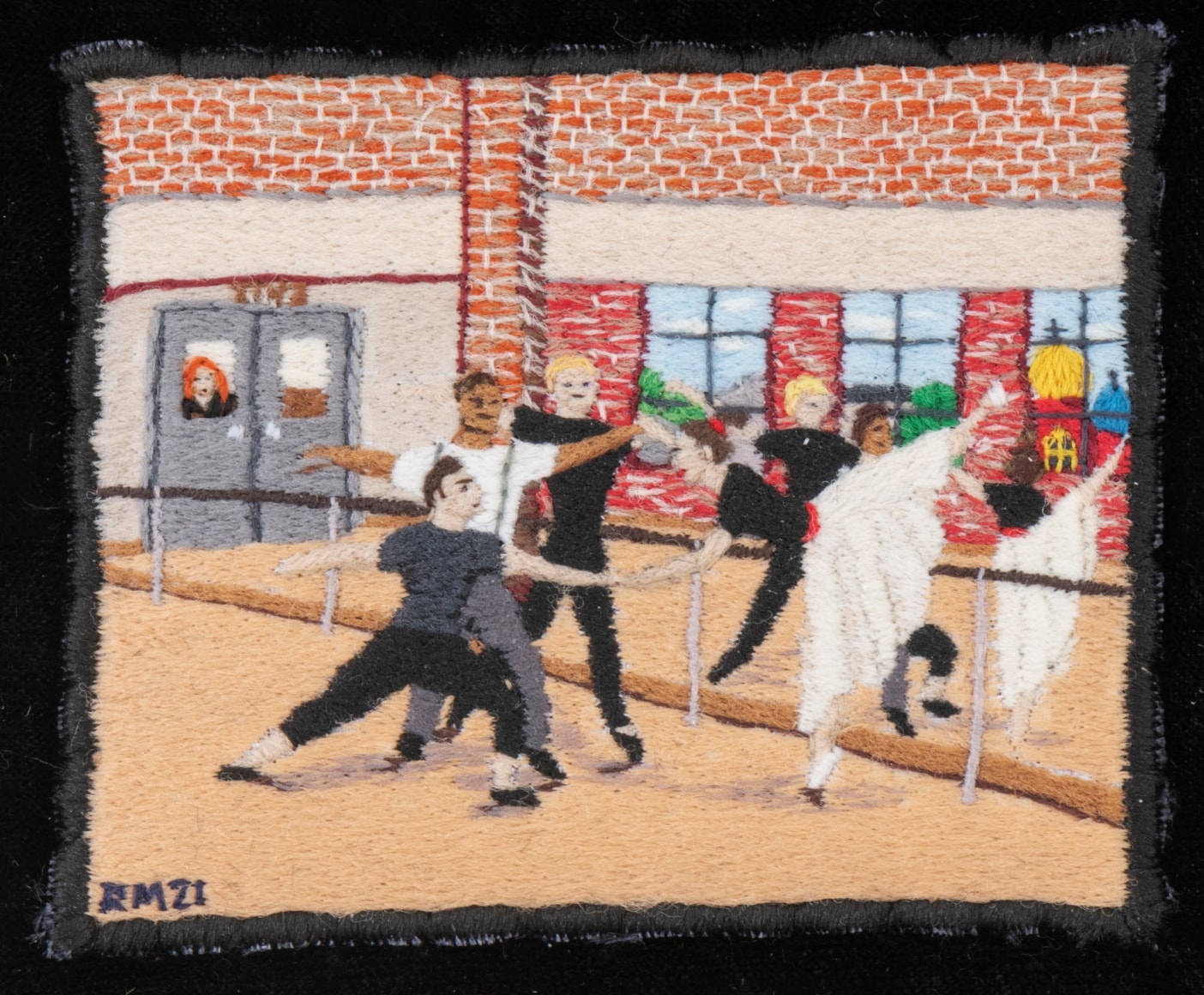
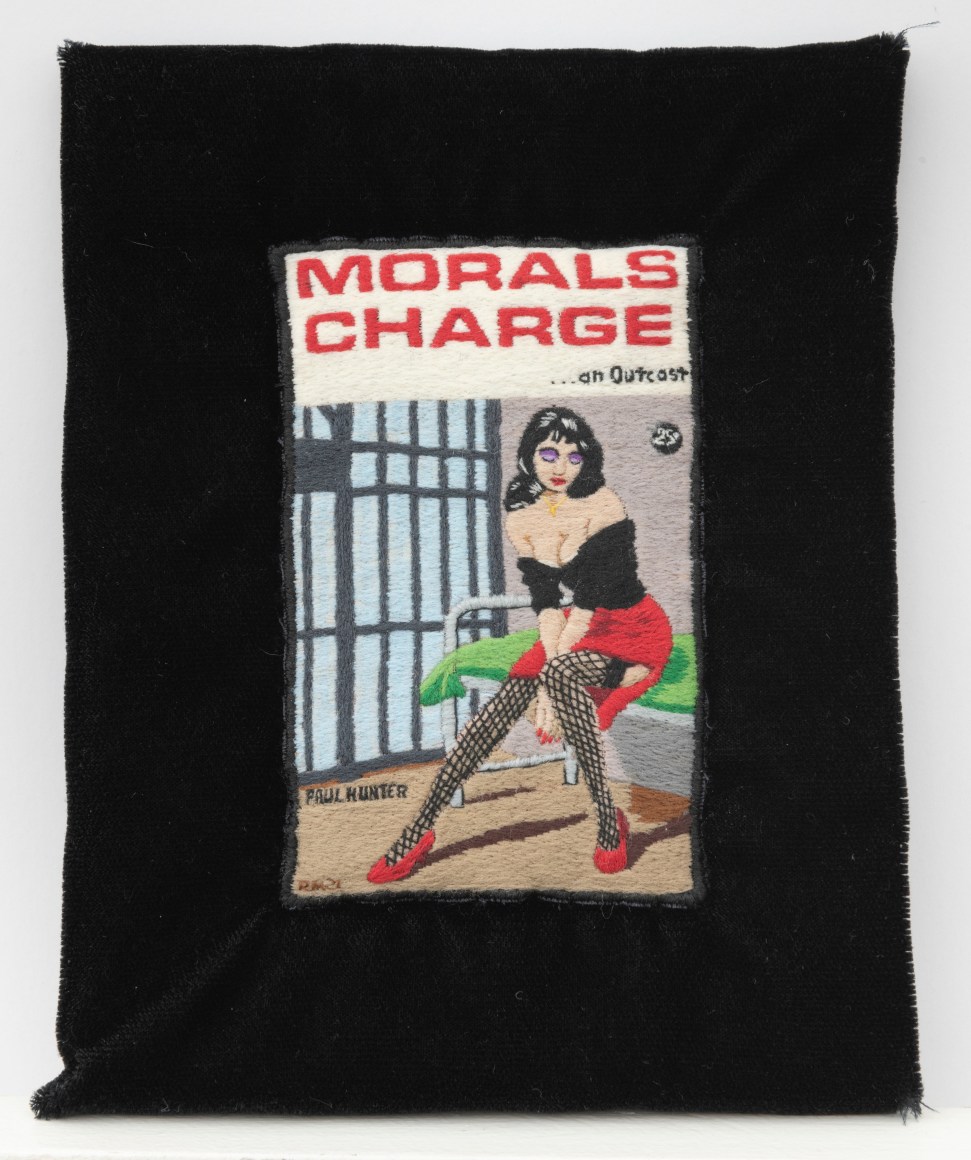
After Ray Materson

He unraveled worn out socks
to make thread, begged a needle
from a guard, embroidered life
outside these walls.
Five thousand stitches to sew
a Mickey Mantle baseball card
from memory, five thousand stitches
to shrink his mother’s parlor down,
make it playing card size. In his palm
he holds the portrait
of a seagull attempting flight,
wing-tips gray as stone,
one claw caught in barbed wire.
My father-in-law’s brain was down to its last trick—comatose for days, but his throat still knew to swallow. We argued with the cardiologist. A nun explained that the doctor’s religion precluded him from letting the body die, and this was a Catholic hospital. The ventilator rose and fell. I studied my father-in-law, the growing stubble, greasy hair, ragged mustache. A hospice center finally took him in, turned off the machines. There, the nurse washed his hair, shaved his cheeks, his chin. He would have been grateful, we told her. He'd always kept himself neat. She said it would be awhile, that we should go eat at the diner around the corner. Before the burgers came, we got the call.

brass plaque, the poet
William Carlos Williams
treated patients here

The future Justice sits at a paneled desk,
spits into the mic about beer, about
being young and summer, his surprise
anyone would ruin him like this.

The room tilts. It has the paneled walls
of my parents’ house.
Are those my brothers’ muted voices
or have I muted CNN?

They are thirteen and eight,
watching horror movies again,
our mother in the kitchen, unpacking
videotapes and groceries.

I ask my brother,
“How can you want to see this?”
He shrugs. “It’s not as if
we’re watching a snuff film.”

Which are illegal, he tells me,
but you can get the tapes
if you want them bad enough.
I peer into the room. Is there a third boy,

a kid from the neighborhood,
from the country club? He nods
at my brother. If you want it bad enough
you can get a girl upstairs,

on the floor, on the bed. And years later,
when you’re called on the carpet,
you can say she might have been assaulted,
at some point, by someone,

but unless it’s on film, it wasn’t you.

Poems ©2022 Laura Shovan
All rights reserved
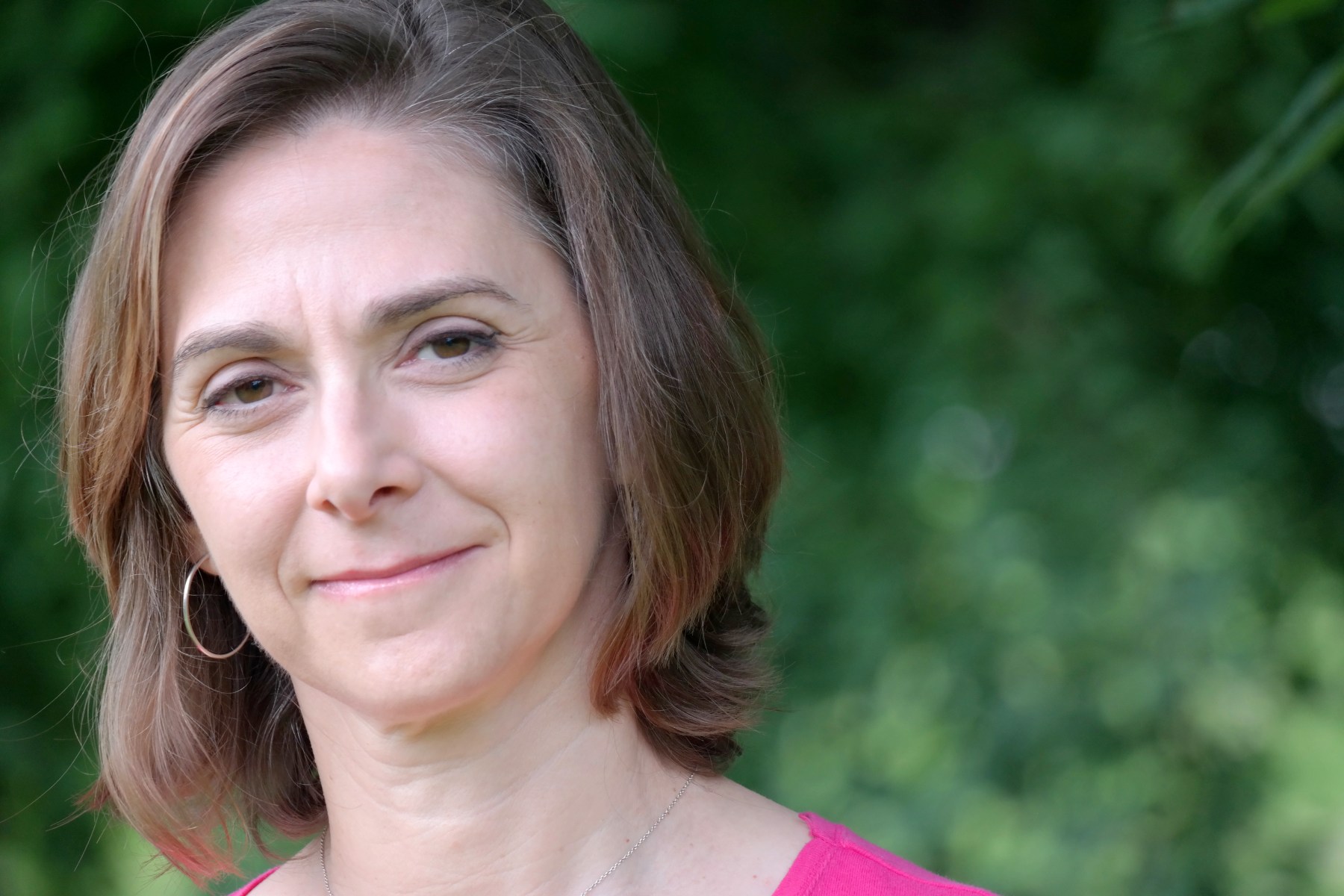
…is a children’s author, educator, and Pushcart Prize-nominated poet whose chapbook, Mountain, Log, Salt, and Stone, won the inaugural Harriss Poetry Prize. Laura has written several award-winning middle grade novels, including The Last Fifth Grade of Emerson Elementary, Takedown, and the Sydney Taylor Notable A Place at the Table, co-written with Saadia Faruqi. She teaches for Vermont College of Fine Arts’ MFA in Writing for Children and Young Adults.
it must be hard to be a man
no, wait—what am I saying?
that’s the old story
from the other half of the sky
the thunder clouds and tornadoes

laughter at the unclothed emperors
exposure of their weakness:
how is that harder to take
than the centuries of servitude,
social cages, sub-human status,
eons of denied personhood?

they say: not all men
as if that meant anything to us
we say: me too, all women
finally, we use our voices
finally, someone is listening
we listen to ourselves

children's eyes open wider
see more possibilities
colours brightest
shapes malleable
flavours pungent
textures novel
music expansive
every sensation honed
to its finest peak

children create their own rituals
find meaning in small things
until adults, institutions
constrain, crush them
insist they conform to some norm
unperceivable by open eyes
paths leading only to darkness
constricted ways of thinking
opportunities forever lost

what could the world be
if we loosened those bounds
guided with kindness
steered gently, by example
fostered knowledge, understanding
in place of indoctrination
ignorance, lies-to-children?

a better place, I think
a discovery worth making
Maximillian had a million maxims
He was full of aphorisms,
a proverb for every occasion
It was axiomatic that,
if someone asked a question,
Maximillian would provide
a truism, by way of answer.

It happened that, one day,
Maximillian stumbled upon
a question for which
he could find no ready answer:
What is truth? He pondered long
in search of the magic formula
that would satisfy.

Finally, Maximillian sought
help from others, a revolution
in his narrow world.
Observed fact, said the scientist.
Received wisdom, said the preacher.
Error's opposite, said the teacher.
Whatever I say, said his mother.

Maximillian found
none of these solutions
satisfactory -- today's facts
could be modified by new
discoveries, doctrine was merely
hearsay, he could avoid error
and oppose one saying with another.

Perhaps, he concluded, the best
way to define truth
would be the absence of lies.
It was much easier to spot
someone lying than discern
innate truthfulness. A negative
view but a practical one.

Maximillian dumped all
million maxims into the well
of oblivion, where they sank
unnoticed and unregretted.
He determined to think
for himself, rather than
let others think for him.
©2022 Adrienne Stevenson
All rights reserved
…(she/her) lives in Ottawa, Ontario. A retired forensic scientist and Pushcart-nominated poet, she writes in many genres. Her poetry has appeared in more than forty print and online journals and anthologies in Canada, the USA, the UK, and Australia. When not writing, Adrienne tends a large garden, reads voraciously, and procrastinates playing several musical instruments.
Words aren’t swords, or bombs,
gunpowder, rifles, dragons.
Not a scaffold with a waiting noose.
Words aren’t religion, airplanes,
torn-out panic buttons,
flagpoles or fire extinguishers.
Not a zip tie. Not a wick.
Just the flame.

          *
Rioters climb through the broken glass.
Just one bullet, roses blooming
from the hole in one white throat.
          *

From mad rush to single-file
when they see the velvet ropes -- some instinct
or manners turns the mob obedient,
gives the prey essential
seconds to escape.

          *

A rioter brags his sharpened flagpole
is for “someone special.”
Others yell for Pence, Pelosi, AOC,
their “hidden” offices
circled on maps.

          *
Praise to the officers, outnumbered and battered.
Praise to the clerk who thought to grab the votes.
Praise to the selfie-posting killers’ desire for fame.
Praise to crews who soap the shit-stained halls.

          *

Woman with a Don’t Tread on Me banner
trampled to death.
Rioter tasers himself in the groin.
Though reporters mock the fur-clad people
as cosplayers, my daughter corrects,
That’s live-action role play.

          *
Blood and feces scrubbed away,
already the story’s changing.
Lies fester in the aftermath.
Rage-filled gun buyers prepare for the next round.
The horned one eats organic food in jail.

Say, mind on your new job, you change lanes, don’t signal,
And a cop sees you, his skin white and thin,
N-words stashed in his heart the way a perp hides
Drugs. Asked to snuff your smoke, you know your
Rights. Question history about how far that gets you.
Ask the holstered gun.

Because there are no witnesses, we’ll never
Learn exactly when or how
A plastic bag that shouldn’t be there finds your
Neck. A tragedy but not a crime, they say. You can’t
Disagree or finger anyone.
Skittles, iced tea, unarmed. Seventeen years
old. Looks like he’s up to no good…he’s just star-
ing at me. Though cops tell Zimmerman to stay
in his truck, he gets out to find a stre-
et sign.      Fox News anchors rave
about gold teeth, suspension, drugs. Show Trayv-
on pose tough, blow smoke. Never vary
the message. Mock Rachel Jeantel, her tart
tongue mumbling, That’s real reta-
rded, sir. Dangerous. Dumb. Thug. The strate-
gy works. The dead kid’s guilty. The defense can rest.
©2022 Alison Stone
All rights reserved

…has published seven full-length collections, Zombies at the Disco (Jacar Press, 2020), Caught in the Myth (NYQ Books, 2019), Dazzle (Jacar Press, 2017), Masterplan, collaborative poems with Eric Greinke (Presa Press, 2018), Ordinary Magic, (NYQ Books, 2016), Dangerous Enough (Presa Press 2014), and They Sing at Midnight, which won the 2003 Many Mountains Moving Poetry Award; as well as three chapbooks. She has been awarded Poetry’s Frederick Bock Prize and New York Quarterly’s Madeline Sadin Award.

One day, on our way, we saw the Abjected.
The Man, the downtrodden, suspicion subjected.
In the inner city, in the alleyway, in the park and on the street,
His eye is always on the beat.

Widespread panic, universal appeal,
A few hucksters capitalizing their spiel.
Empathy given, souls being sold,
Power arrangements annulled.

Visions of justice, without redress,
Undermined by the darker side of the human spirit.
The Man, the Abjected gazed at each other,
And couldn’t tell the difference between one another.
I began a journey one fine day.
A village appeared on my way.
As I approached, the guardian told me I needed a blouse,
Handed me the garment and told me to enter the house.
But my garment wasn’t exactly fitting,
So, I was told when I was sitting,
I wasn’t one of them.

Accordingly, I continued on with my quest so dear.
A town emerged on the horizon so near,
The guardian told me I needed a cup made of clay,
Handed me the cup and told me to stay.
But my cup wasn’t quite right,
So, I was told with all their might,
I wasn’t one of them.

Thence, I wended my way.
A city centered on my route the map did say.
The guardian told me I needed a nose made of paper,
Handed me a paper nose and told me to enter.
But my nose was fastened loosely,
So, I was told profusely,
I wasn’t one of them.
I descended again upon a valley,
The number of which I could not tally,
A simple gathering in the center,
Which I was told I could enter,
Without condition or a certain term,
I could stay awhile they affirm.
Little boys running with gun toys, boys will be boys.
Bang, boom, burst, whatever their thirst.
Fire as the purge, now easily available at an urge.
Fire, thusly urged, hidden, concealed and obscured.

The King, the Warrior, the Magician, the Lover,
Quintessence of supremacy, confronting the new heresy.
A Force of Nature gone amuck, barely concealing its agitation.
A Force awaiting its transformation.

Archetype of the Sun,
Elucidate, explicate, exuding, the mushroom cloud is looming.
Bomb, blast, bash, dark fog descends upon the cash.
When Crude becomes the new Golden Calf.

The art of manliness, gone array.
Splintering into esoteric groups like shattered glass.
Alas, the King, the Warrior, the Magician, the Lover are still running with toys,
And all we can say is: ‘boys will be boys.’
©2022 Daniel Weiss
All rights reserved

…born in Hollywood, CA, studied psychology at the University of California, Santa Cruz. Received his PhD from the Christian-Albrechts-Universitaet, KIel, Germany. Lived in Germany from 1982-2003 and was in Germany during the Cold War, the Reunification of Germany and the uniting of Europe. He was a community organizer for the new Jewish Communities in Schleswig-Holstein in Germany as well as an interviewer for the Survivors of the Shoah Visual History Foundation. He was also a klezmer musician in Germany, taught at Waldorf Schools in Germany, and worked in speech recognition for 18 years.

Art: The Gate You Only Go through Once to the Path that Leads Nowhere, Gerry Shepherd ©2022

I stand at the sink in the restroom and stare into the mirror. I’m red-faced and sweating profusely. After two hours of grueling work, my display is up and ready for my private showing and selling of my handmade art jewelry at the Sarasota Yacht and Country Club.

A feeling of relief covers my face after I ask the club committee director if there is a place I can change and freshen up. She takes me to a well-equipped bathroom where I can shower and dress before the ladies arrive for the luncheon and lecture. The chatty director informs me the club’s women use the restroom after their golf games, especially if they stay for lunch.
I felt relieved to be able to shower and invigorate. It was incredible to see fluffy white towels folded and waiting for the next person to come in and use them. After a refreshing shower and a new outfit, I am ready to enter the country club to begin my lecture.

As I gather my things, an elegantly well-dressed woman enters the restroom. I turn and smile as the woman goes into one of the stalls, only to find her stepping back out rather quickly. She approaches me.
“There’s no toilet tissue in that second stall container,” she says. “Can you put some in there?”
She grumbles in an annoyed tone as she hurries off into another bathroom stall. Under her breath, she mutters, “I declare there’s no good hired help anymore?”
Flabbergasted, I ruminate on what I’ve just heard.
‘Can it be possible that she has just asked me to replace the toilet paper in an empty toilet paper holder?’
‘Yes, without a doubt, she has’.
A cold chill overtakes my body as my mind goes to places I do not want it to go. Emotions rise in me.
Why has this woman assumed I’m the hired help?
Eventually, she’s standing beside me at the bathroom sink.
Grimacing, she says disapprovingly, “Did you get the toilet tissue for that stall yet?”

Taken aback by the incredulous words she’s saying, I manage to tell her I’m not an employee at the country club. Although I’m overwhelmed by this insulting woman, I gather myself together enough to put into words that I’m the featured artist/lecturer for the luncheon.
The embarrassed woman stammers to find words to express herself. None seem to come her way. She blows a not-so-sincere apology and exits the bathroom as quickly as possible.
I stand frozen for what seems like a lifetime. Reflections of how far in the world we’ve progressed disappear in one moment. My thought keeps repeating, I am still in the days of repressive domination. This moment brought to light that nationality, color, ethnicities, and biases are still prevalent in the minds of some upper-class white people.
Unfortunately, this is a harsh reality that I did not expect on this very auspicious day. I was selected from a great many artistic jewelers to give this lecture at the country club luncheon. It was an invitation my peers had let me know they coveted.
With my shoulders back and a deep cleansing breath inhaled, I leave the restroom and head to the lecture hall. I will engage the women at the luncheon with my art form knowledge.

On shaky legs, I approached the podium after my introduction. The applause made me smile. I could see the rude woman in the group. Fidgeting in her seat allowed me to know she was uncomfortable. I felt my strength of self-worth stirring in me. She was going to remember me. I’m sure.
I finish my task of lecturing on the role of designer jewelry in the art world. Numerous women stopped by to let me know they enjoyed the lecture. Many of them gazed at and admired my one-of-a-kind jewelry designs purchasing some for their collections. Ironically, the arrogant woman bought quite a few pieces too. Perhaps, to heal her guilt.
I left that day with melancholy. Regardless of what others’ thoughts might be, I reassured myself that I will always stand proud of the power of my place in the world as a Latina woman.
Hopefully, on this day, I was be able to educate her on the proper way to treat people of any kind, even hired help.

©2022 Isadora De La Vega
All rights reserved

…is president, co-founder, and designer of Copper Whimsea’s by Al, a copper wall design company, and Isadora Art Jewelry. She has been married for 57 years as of last August, and is the mother of 3 daughters, grandmother of 8, and great-grandmother of 3. In 2011, she started her blog to hone her writing skills. She never thought I=she would touch people in so many ways with her writing and images. She is grateful that she has been able to accomplish the goal she set up for herself: “Touching people’s hearts with my words.”
There is immense silent agony in the world, and the task of man is to be a voice for the plundered poor, to prevent the desecration of the soul and the violation of our dream of honesty.
The more deeply immersed I became in the thinking of the prophets, the more powerfully it became clear to me what the lives of the Prophets sought to convey: that morally speaking, there is no limit to the concern one must feel for the suffering of human beings, that indifference to evil is worse than evil itself, that in a free society, some are guilty, but all are responsible.
—Abraham Joshua Heschel
“The Reasons for My Involvement in the Peace Movement” (1972)
later included in Moral Grandeur and Spiritual Audacity (1996)
The prophet knew that religion could distort what the Lord demanded of man, that priests themselves had committed perjury by bearing false witness, condoning violence, tolerating hatred, calling for ceremonies instead of bursting forth with wrath and indignation at cruelty, deceit, idolatry, and violence.
To the people, religion was Temple, priesthood, incense: “This is the Temple of the Lord, the Temple of the Lord, the Temple of the Lord” (Jer. 7:4). Such piety Jeremiah brands as fraud and illusion. “Behold you trust in deceptive words to no avail,” he calls (Jer. 7: 8). Worship preceded or followed by evil acts becomes an absurdity. The holy place is doomed when people indulge in unholy deeds.
―Abraham Joshua Heschel
The Prophets
These words, the teaching of the famous Jewish philosopher and rabbi quoted above, have inspired rabbis like me to get involved in work for justice and peace, and to confront injustice in the real world in which we live. Some of the founders of our small community of activist rabbis studied with Heschel and knew him personally in their common activism against racist injustice in the USA and in their opposition to the terrible Vietnam war. I believe all of us, including those too young to have met him, were inspired by his example and by his moral religious teaching.
His comment about the experience in Selma Alabama, on returning from a dramatic and dangerous march with his friend and fellow clergyman, the pastor Dr. Martin Luther King, protesting the institutionalized racism there, is well known. “I felt my legs were praying,” he said. Many of us feel the same about our involvement in the Palestinian olive harvest under Israeli occupation each year—we feel our presence is more than an attempt to help physically, to intervene for justice, that it is an act of faith, a religious statement.
I have retired in recent years, though I am still a member of Rabbis for Human Rights (RHR) and I sit on its Board of Directors; in other words, I remain involved. My involvement over the years in the activity in the Palestinian Occupied territories both as a volunteer, then as a field worker and coordinator of volunteers for RHR, and now again as a volunteer, has impacted on how I see the Palestinian-Israeli conflict here and the role of religions in that conflict. In this short essay I will try to explain what it has meant for me as a committed observant Jew and as a rabbi.
In order to go out into the territories controlled by the Israeli army, where there is a great deal of tension and real danger from extremists on both sides of the conflict, and an ongoing repression of the civilian population there, I had to overcome preconceived ideas about Palestinians, break through suspicion and fear on my part and theirs, and work against an ongoing injustice of my own people against the indigenous population. This required courage both in facing dangers from Palestinian terrorists, confronting the hatred of some my own people and of some of the Arab population, and taking an unpopular, controversial position supporting their rights within the conflict situation here. It also led me into contact with people from other religious traditions, sometimes challenging my own faith.
The first time I went out into Palestinian occupied areas with Rabbis Arik Aschermann and Jeremy Milgrom, I was shocked by the reality I met there. I will always remember the bitter tears of a Palestinian farmer we accompanied to his olive trees that had been cut down, the site of Bethlehem alleyways in which buildings had been severely damaged by Israeli tanks in the first Intifada, and many times witnessing, unable to do much to stop it, the brutality of home demolitions by the Israeli army. It challenged my Zionist education and narrative. Although I was aware of “the refugee problem” and was a supporter of the two-state solution at the time, I was not aware of the degree of displacement, destruction and constant repressive surveillance of the Palestinian population it entailed. The abrogation of basic human rights of that population is daily and continuous. It is not just a matter of local abuse but fundamental to the reality of military occupation and the ongoing siege of Gaza. Of course, the right to life is the most fundamental of human rights and a justification for Israeli action to protect its population from the very real threat of terrorism. Palestinians have the same right.
Like many Israelis and despite army service and living in Jerusalem where Palestinians are about 40% of the population, I had never really come into close contact with Palestinians, seeing them, though praying for peace, as the threatening “other” not as real human beings with whom we share this tiny country. Through Rabbis for Human Rights, which I joined close to the time of it’s formation in 1989, and, in particular because of my participation in the Palestinian olive harvest in area C every autumn for two decades, 12 years of them as coordinator of volunteers, that attitude changed. I emerged from my protective bubble, both ideological and physical, to meet the other people in their fields and in their homes.
What would happen in the olive groves annually was what we called “the dialogue of the olive harvest.” It was there that Israeli and foreign volunteers, both Jewish and Christian (for instance the Eappi groups), and sometimes also Muslim, and even Buddhist, volunteers met Palestinian farmers and their families, harvested with them, listened to them and reflected together on the reality in which they lived under Israeli military occupation. We took coffee and ate together as well in the breaks, and the dialogue continued under the olive trees. For those of us leading these groups and coordinating them this was not a one-time event but a continuous interaction, week after week, year after year.
There is a Talmudic teaching that describes a famous rabbi called Akiva, before he became a Torah scholar but was still a simple shepherd, who had fallen in love with a woman called Rachel from an educated and wealthy family. Rachel told Akiva that she would marry him if he learned Torah, but he could not read. Sitting by a stream, frustrated at his inability to learn, he spotted water penetrating a rock as it flowed by. He told himself, just as the water which is soft can penetrate and overcome that hard rock, so I too can overcome this hard obstacle. He did so and became a famous scholar and leader of his people. I told this parable to many participants in the olive harvest over the years who expressed frustration and pessimism at the possibility of change, that the Israeli army and the intransigent settlers seemed so powerful.
One of the most humanizing and inspiring experiences I had during the years I worked on the ground for RHR was my involvement in the building of a school in a Bedouin community called Khan Al Akhmar in the Judean desert. The project was initiated by the local Bedouin themselves after a couple of kids were killed on the roads in car accidents trying to reach the school in Jericho. They contacted a Catholic group—the Comboni Sisters—who had been providing humanitarian aid to Bedouin in the area, and who in turn engaged an Italian NGO (Vento de Terra) to help design a school. RHR got involved in providing volunteers for help with the physical project and subsequently we funded and helped with protective summer camps together with the nuns to prevent demolition and continue the children’s activities into the summer. We also took groups of children to the sea for the first time in their lives.
My contact with the Jahalin Bedouin tribe started much earlier than this, as I had accompanied Jeremy and Arik in protesting the expulsion of members of the tribe from the area of the urban settlement Maalei Adumim when that settlement was expanded. At that protest we prayed together, Jews and Muslims, which made the news and was unique. However, the involvement in Khan Al Akhmar was even more unique and inspiring as it involved working together with Christians and Muslims to help one of the most neglected and poverty-stricken communities in the West Bank. It soon became a political “hot potato” as the settlers demanded the destruction of the eco-friendly tire school which had been built without permission (which was anyway impossible to get in area C) from the army. The army was reluctant to carry out the demolition order because of international protest, and the elementary school still stands today. There, hundreds of Bedouin children who were not previously given real access to education—particularly the girls—have now completed their primary education and have learned to read and write. Some have continued to high school and one of the local women is herself now a teacher in the school.
Regarding my thoughts about the future and what I have learned from all of this: to quote Professor David Shulman, interviewed when he was honoured with the Israel Prize for his research into Indian cultures, and who is also an activist in the South Hebron hills for the Taayush (a group working for justice in Jewish-Arab cooperation)—“it is hard to be optimistic about the situation, but one must always have hope.”
My religious faith gives me that, as I referred to in the Talmudic story above about Rabbi Akiva. My experiences deepened that faith and strengthened my Jewish identity while challenging my Zionist worldview. I remain a loyal Israeli who loves his country and continues to believe in the importance of a homeland for the Jewish people, but my views have changed:
I now understand that the conflict is not only about land—it is religious, but religion is also a possible antidote to the poison of extremist religious positions in which nationalism and racism play a big role. Rabbis for Human Rights has a unique contribution to make to this in their role of presenting a humanist alternative to religious-nationalist triumphalism and self-righteousness. Differences of religion and alternative narratives are to be respected and honoured in order to make coexistence here possible…
Perhaps there is no “solution” in the immediate future, but the situation must be “humanized” for us to conceive of any solution at all. Outside aid and support can also contribute to that.
We are all human, all created in God’s image, as it says in the Book of Genesis.
©2022 Rabbi Yehiel Grenimann
All rights reserved

…is a member of the Rabbis for Human Rights (RHR) Board of Directors. He was the Director of Activities in the Occupied Palestinian Territories for RHR between 2006 and 2015. Prior to joining the staff he had been an executive board member and served on a volunteer basis as Treasurer (2003-6) and Chairperson (2000-3). From June 2015 until March 2018 he was director of Organizational Development for RHR, continuing to work on the Jahalin Bedouin project, and focused on educational activities for the rabbinic membership, staff and volunteers. He is also active in the executive committee of the “Tag Meir Forum,” a coalition combating hate crimes and racism in Israeli society.
Social Justice, in my view, requires a certain acceptance and understanding of what life is all about and, at its heart, why we are here. My experience within The Erasmus Foundation has given me an understanding of how individual we all are and that within each one of us is a spirit that has had many lives before this one, and may have many more in the future. In other words, everything of greatest value is within us, and eternal, and lives on at the end of a life. Imagine a pearl necklace with each life a pearl that is added to the strand when we depart this world; separate and unique and yet a part of our own individual experience, giving us a memory to draw upon forever more. An older spirit that has had many more lives than a younger spirit will have more resources to draw upon to deal with life’s challenges; but, then again, I believe that each life, whatever our spiritual age, must have certain tests and challenges in order to learn and make progress as a spirit.
So, what I am saying here is that reincarnation of our spirit over centuries and civilisations on the Earth and into different physical bodies that will experience many different things, gives meaning and purpose to all life and helps us to perhaps be a little more tolerant of others. So, if we have any negative, stressful, destructive reactions to what happens to us or to those around us, or to our world in general this understanding of the meaning of life can temper these emotions. This does not mean we stand by, we don’t speak, we don’t act; on the contrary, I believe it is important to stand up for the truth, as we see and believe it, but any engagement should be gracious, with tolerance and acceptance, and an understanding that might come with good, open communication with others in a dignified and quiet way. And it is the quiet word that is often heard.
But we have to make judgements in life, sometimes for security, sometimes for very practical reasons, sometimes to judge whether this is a person we would like to know better, and first impressions are good to hold onto whilst reserving more thought for when we perhaps know someone a little more; judgement should not come with condemnation, however, but rather with understanding and acceptance that each life has a purpose, and with everything there is a reason. Perhaps we don’t ask the simple question ‘why?’ enough. So this, too, I believe would help people consider social justice and how we might react to people and situations.
So, how do we find that peace and quiet? How do we get to that stage where we can be dignified and gracious in the face of something or someone who is quite aggressive or intolerant, or where we are responding to something that has happened? It’s easy to say these things and hard to do, you might say; and I would agree with you, especially in a world that is out of balance and where people’s lives, as a consequence, are more desperate and extreme and where the noise of the physical and material world can often drown out the truth, logic and reason that I believe is there within our minds, which I would say is our spirit (the brain being a part of the physical body).
By the essential exercise of coming to know ourselves, through self-inspection and then self-analysis we gain the ability to know ourselves very well and by this means find our weaknesses and our strengths which we can then identify with other people. This process enables us to gain self-confidence and peace of mind, having come to a fuller appreciation of our entirety. We gain quietude, we fear less and as we come to round off those sharp corners in our personality, we become more comfortable to be with and more pleasantly appreciated by others. It also allows us the space to think more about others rather than ourselves; and being true to who we are brings with it a greater sensitivity that enables us to identify more with other people and to help those who may be struggling or going through difficulties.
Meditation is one of the best tools that I have learnt at The Erasmus Foundation to help get to know ourselves because the aim is to quieten the brain and allow the mind to surface. From the mind we find clarity, we may find answers to questions that are troubling us, we may learn a little more about ourselves but we will always come out of a meditation a little more peaceful than when we went into it, which can only help us in our endeavours to find peace of mind.
And peace is really what I believe we are all searching for, so if we could accept that it is within us and there are ways to discover and feel it through the exercise of finding true self knowledge, then perhaps the world would not be so out of balance. Inequalities are more common and extreme because we have lost touch with our spiritual self and raised up to great heights and importance the physical part of life. Greed has taken hold and falsehood is commonplace, and we see the consequences of such priorities and actions in the response from nature and our natural world.
In a world that is healthy and in balance there would not be the need to discuss social justice because everyone would be seen as equal and given equal value. To get to this point it would seem that there is much to be learnt and understood, and perhaps the greatest way to learn is through experience that might be difficult and testing. If times are going to get even tougher than they already are, what better way to face these changes than with the belief in ourselves through true self-knowledge and understanding, with an acceptance that with everything and everyone there is a reason and a purpose.

©2022 Julia Griffin
All rights reserved

…having attended as a student of the The Erasmus Foundation since 1982, a spiritual teaching and healing centre in the UK, has had a number of articles published in their magazine. She has also acted as proof reader and editor for DangerSpot Books and Ancient Publishing. Julia continues to write using the unique spiritual knowledge and experience she has gained over the years from the Foundation.
I needed a car for my new job as managing editor of a weekly newspaper covering murders, drugs, schools, and communities in the Bronx. My father suggested my granny’s 1968 Dodge Coronet, a long white boat of a car that she no longer used. He drove it back from Nebraska and handed it over to me. It was the early 1990s and I was newly separated and living in a studio apartment in wealthy Larchmont, not far from the Bronx. I took over renting the apartment from my college best friend who moved back to Manhattan. I parked in the public spaces on the street but police marked my tires and ticketed me if I stayed too long. I paid hundreds in fines while living there. The police seemed especially aggressive in Larchmont, as if trying to prevent crime from the nearby Bronx from spilling over. You couldn’t even go to the beach without a local resident permit. To do my job as a reporter, I tried to blend in with a baseball cap, long ponytail, and cigarette smoking. The cigarettes dulled the stress from covering gang attacks, shootings, and rapes. I was very thin but I regularly ordered a Quarter Pounder with cheese from the McDonald’s drive-through. The brown paper bags filled up in my car. One night, on my way back from reporting in the Bronx, the police pulled me over, not far from my apartment. The officer asked for my license and registration but never explained why I was stopped. I read that police must suspect that a crime is being committed or going to be committed to stop you. My vintage Dodge Coronet heading into upscale Larchmont must have set off alarms. But the officers let me go on home. The transmission died a few months later. I got an almost new Mercury Sable and the Larchmont police never bothered me again.
©2022 Karol Nielsen
All rights reserved
…is the author of the memoirs Black Elephants (Bison Books, 2011) and Walking A&P (Mascot Books, 2018) and the chapbooks This Woman I Thought I’d Be (Finishing Line Press, 2012) and Vietnam Made Me Who I Am (Finishing Line Press, 2020). Her first memoir was shortlisted for the William Saroyan International Prize for Writing in nonfiction in 2012. Excerpts were honored as notable essays in The Best American Essays in 2010 and 2005. Her full poetry collection was longlisted for the Terry J. Cox Poetry Award in 2021 and was a finalist for the Colorado Prize for Poetry in 2007. One of her poems was a finalist for the Ruth Stone Poetry Prize in 2021. Her work has appeared in Epiphany, Guernica, Lumina, North Dakota Quarterly, Permafrost, RiverSedge, and elsewhere.

A woman’s body lies in a ditch by a British Columbia road. Torn and bloodied clothing flaps in the breeze. A cracked cellphone rings in vain. Again and again. Where are you?
In Ukraine, a woman talks to the camera. My husband is out there among the tomatoes. He was weeding when the bombers flew over. Find him if you can.
A child looks up with haunted eyes at a residential school. The backyard with its markers waits; it is hungry.
We have lived with pterodactyls for years. They flap across our skies unchecked and patrol in squadrons of thousands. They prey on the weak, watching for stumbles or telltale chatter. Their hunger is exponential. Their shadows darken our land.
Their passage defiles school properties, gardens and northern roads. We grab our rosaries, tend to our plots, and look the other way.

In a dusty western outpost, Sunday service radiates love. The greasy smile of the preacher smooths the impossible work of forgiveness. AR-15s complete one’s Sunday best. Open carry, open road. Open minds have vanished. Hearts open and close.
Bullets whistle in nearby gullies. The railway tracks attract bodies.
This small hamlet was always gunslinger heaven. Shattered windows fracture the sun and moon. Claw marks leave a signature on a door that will not open. I see half your face smiling back. My brother is my foe. My sister knows her place.
Rare torrential downpours mourn the loss of so many sinners. But all rain is welcome in the west. A world away, in a desert cave, sacred texts crumble to dust. The constellations wheel overhead.

Let’s shed crocodile tears and write billets doux to lost lovers.
Let’s fold florid prose into paper planes. We’ll call them concords, messengers of peace.
Let’s launch these ephemera, freighted with tears, over forest fires on the western ranges.
Or let’s release our missives from the International Space Station to float down home, bearing the kiss of God, to choose land over ocean by instinct. Zigzagging through the turbulent weight of air. Consider the letter “Z” and Ground Zero.
Let’s switch to a mirror image of our alphabet. Let’s choose compassion.
Let’s flash Morse code with mirrors. We have gone mute.
Let’s tend to our own gardens. Let’s abandon our gardens and work the widow’s plot for her till justice comes.
Let us work relentlessly, blind with tears, till justice comes.
©2022 Art Jeffrey Lipsky, ©2022 Text Heather Ferguson, ©2022 Petrichor ArtLab combined
All rights reserved
…Petrichor ArtLab is Boston-area artist Jeffrey Lipsky and Ottawa poet Heather Ferguson. Their collaborations have appeared in Experiment-O, and Ygdrasil: A Journal of the Poetic Arts.


Jeffrey creates abstract narratives that are found in galleries, museums and private collections worldwide. He was featured in the New York Times Magazine (Portrait of an Artist as an Avatar – Filthy Fluno – The New York Times (nytimes.com). He recently held an online art exhibit at the Metaverse Art Museum.
Heather is the author of A Mouse in a Top Hat (chapbook, Rideau Review Press) and The Lapidary (special issue, Ygdrasil, A Journal of the Poetic Arts). The Lapidary was later translated into Spanish (four broadsheets) and French (The Lapidary / Le Lapidaire, Vermillon).
This quarter’s issue of the BeZine is focused on Social Justice: listening, learning, reaching out. What do others tell us about their experience? How do we listen and learn? How do racial, economic and social inequalities affect people we know? What do we say to our children and who else do they hear? What do you have to say about your experiences with social (in)justice?
I’ve worked in both public and academic libraries for many years, and I have come to see them as equalizers, especially when it comes to Social Injustices. When one thinks about Social Injustices, things like poverty, food insecurity, homelessness, racism and bigotry may come to mind. So how can libraries help with those things? Read on.

These hallowed halls store and provide so much more than just books! For people who live in poverty every day, who pinch pennies for all they’re worth, libraries can provide access to free books, movies, music and more for entertainment and education. More importantly, they can provide computer access to programs which can help people find jobs, and government or local financial help to pay for basics like rent and utilities. That access makes a huge difference. Computers have become as important to everyday life as having a telephone, but not everyone can afford them. Most libraries today provide access to computers, and those act as a bridge of service for the users who need connection to important social programs. That particular freedom of access and connection to broader, available help is what we librarians consider spanning the “Digital Divide”; poor communities, especially minority communities, do not have as many resources for computers or computer access. Libraries provide a bridge.

That bridge opens the way to help hungry people, too. While libraries cannot physically feed those who are hungry, they can often connect food insecure people with missions and food banks, where they might find at least one free meal, probably more. They also have books on growing your own garden, your own food. Some libraries host gardening club meetings, where people can learn about such things, or even have a “Seed Bank“, where people can “check out” seeds to grow as long as they in turn bring other seeds back to the Seed Bank, where other users may borrow and return their own seeds, keeping it going in perpetuity!

On the issue of homelessness, consider that there are not a lot of places for homeless people to go to escape the streets. In the summer, the temperatures might be boiling hot, or freezing cold in the winter. Most libraries are temperature-controlled buildings which homeless people find bastions of relief in extreme weather, and as long as they obey the rules, they are usually tolerated and left alone, from opening to closing time. Libraries have restrooms and also usually have at least one water fountain, which can fill a water bottle or canteen, or simply quench a person’s thirst. If the homeless person wants help finding lodging or shelter, or a job, once again the computers can connect them with social programs that can help.

Speaking of programs that can help, lots of libraries provide programs like Summer Reading and/or After School Programs, which can keep kids busy and engaged in reading, rather than running the streets and/or getting into trouble. There are also literacy programs at many libraries, which can help anyone learn to read, whether young or old. This is extra important for immigrants or minority ESL (English as a Second Language) speakers, who need to be able to read signs, applications, etc. in order to live, work and become productive members of society here in America (or wherever in the world they happen to be! There are libraries all over the world!).
Libraries can also provide a safe place for people to gather and discuss sensitive or socially volatile subjects. They often offer private meeting rooms or safe spaces where people can get together and discuss important social (in) justice topics, and perhaps mobilize or create ideas about how to find real solutions together.

One of the best things about libraries is that they do not discriminate. There (usually) is no racism or bigotry allowed. I say (usually), because patrons/library users come in all different shapes, ages, colors, sizes and social beliefs. There may be other library users who are racists or bigots, but the librarians will remove problem patrons and they are happy to welcome everyone to the library equally. Of course, there are plenty of books about those subjects, if people should be inclined to read about the differences in opinions, or history behind racism and bigotry, but the best examples are the people who don’t practice either one.

The buildings may be great, but let’s not forget the librarians! They are the keepers of the knowledge, and they will do their best to find answers, whatever the problem or question may be. That knowledge is the key. It can open doors and remedy all manners of social injustice. Librarians are trained in Information Sciences. That’s what they DO. However, aside from being intelligent, most tend to also be pretty compassionate people who want to help in any way they can. Remember that, if you should ever find yourself in a position of social injustice. And if you’re ever asked about whether or not to continue to FUND libraries, I hope you’ll unequivocally say, “YES!” They are the great equalizers of our time. Perhaps they always have been, but it is especially true now.

©2022 C.L.R.
As a new immigrant to the USA, I am deeply disturbed by the magnitude of gun incidents, in which 100,000 Americans are killed or maimed every year. Coming from Europe, where guns are not a major problem, I wonder why there is not more moral outrage in the States.

Context is crucial, whether we’re examining the ideals of the Founding Fathers of the US Constitution or the Torah in deciding what is useful to us today in addressing ethical issues. In the West, our established ways of thinking about ethics are very much based in Greek, Christian and Enlightenment thought, which means Jewish perspectives can introduce alternative modes of exploring current issues, particularly in relation to collective responsibility, the value of human life, resisting oppression, the will towards a more just and peaceful society, compassion and care and the avoidance of harm.
In preparation for the Days of Awe this September, when Jews endeavor to attend to the most important spiritual matters of our lives—our relationships with each other and with the divine—I am advocating for a necessary return to greater collective responsibility. It is both intrinsic to Jewish values and, I argue, to the intentions of the Founding Fathers.
Gun deaths in the US feel all the more tragic because they are largely avoidable. The root of the problem lies in easy access to firearms. There is a direct correlation between ease of access to weapons and the high numbers of gun-related deaths.
Countries with the lowest rates of gun violence have legislation to decrease the number of firearms in circulation.[1] The United States desperately needs such measures but is prevented from instituting them by the gun industry and its supporters in politics and government.
Compared with other high-income countries with populations over 10 million, the US has the highest number of firearm homicides in the world.[2] Already this year, there have been 30,000 gun deaths, of which 1,100 were children.[3] Many tens of thousands more are suffering the physiological and psychological consequences of gun-related injuries.
Anyone would have thought these horrifying statistics would be enough to galvanize a sea-change in American attitudes towards stricter controls. It seems nearly every American I speak with is just as appalled but there is despair and a sense of impotence in the face of the power of the gun lobby.
Deaths by guns are often blamed on those at the margins, on criminals and the mentally ill, and on ineffective security measures. The conversation tends to focus on how to better defend ourselves (often entailing more guns), rather than looking at where the problem originates.
According to many legal and health experts, we should be examining the role of the firearms industry rather than focusing on a criminal justice or mental health angle.[4] Professor Timothy Lytton, an expert on tort law and firearms at Georgia State University says, “The real problem in gun violence we should focus on is the firearm industry’s sales, marketing and distribution practices.”[5]
Just a handful of companies dominate the $19.5 billion firearms market and encourage the glorification of guns as a symbol of supposed empowerment by a culture that is increasingly insecure. Gun purchasing is exponentially on the rise[6] with Americans purchasing more than 20 million guns every year[7] and the industry profits massively each time a mass shooting hits public consciousness. Within hours of the Uvalde, Texas, school shooting, shares in gun companies were up by as much as 8%.[8]
The industry capitalizes on fearful Americans who lack trust in public institutions to keep them safe[9] and are now navigating mass anxiety generated by social, health and economic pressures.[10] In the last decade, buyers cited security as their primary reason for purchase rather than hunting or recreation.[11]
Fear also fuels the market for services and products aimed to protect us against guns, such as: security guards and trainings, domestic and school security measures, alarm and door locking systems, bullet-proof paraphernalia and more. A Forbes article published in 2018 pointed out that the security industry is worth many times more than the firearms one.[12] Both industries employ hundreds of thousands of people and contribute billions in tax revenues.
The gun lobby’s reach into politics and government is deep and it is wide. A recent survey by the New York Times shows that 49 of the current 50 Republican Senators have received money from the NRA over the course of their careers, many of them receiving millions of dollars each—up to $13.6 million in the case of Mitt Romney. In 2016, the NRA donated a record $30 million to Trump’s campaign[13] and last year, according to OpenSecrets, five gun lobbying organizations donated almost $16 million to Republican politicians.[14]
The NRA claims to advocate for the rights of ordinary gun owners[15] but, in reality, it is a trade association whose sacred cow is the industry’s profit margins. According to Josh Sugarmann, Executive Director of the Violence Policy Center, “it’s very important to understand the political battle in terms of the interests of the industry and in terms of marketing.”[16]

Parents of school shooting victims are challenging the industry’s irresponsible marketing practices. They argue gun companies have targeted young, at-risk males with ads such as “Consider Your Man Card Reissued”[17] and that they produce ads resembling video games appealing to young men attracted to thrill-seeking behavior.[18]
In the course of writing this article, algorithms detected that I was researching firearms and a plethora of advertisements for guns started popping up on my screen. It seems purchasing a gun these days is as easy as ordering household items from Amazon.
Since 2004, there has been a proliferation of semi-automatic weapons and other types of firearms that are more deadly and those that are easier to conceal.[19][20] Lytton has compared trends in the market with the type and volume of firearms recovered in crime and has found a clear connection.[21]
Yet gun companies adopt a willfully blind approach to the supply chain, denying evidence linking the industry to gun deaths, lobbying to remove obstacles to easy purchase and persisting in mass production of ever deadlier weapons.[22] Dealers often engage in practices that facilitate diversion of gun products into the illegal market by selling guns off the books and failing to prevent illegal sales to buyers acting on behalf of others.
Clearly, in American culture today, the pendulum has swung in the direction of extreme individualist defenses of ‘freedoms’ overriding the notion of collective ‘responsibilities.’ Such individualistic thinking and its exploitation by the gun lobby have given rise to a situation of widespread loss of life, injury and moral harm to American society, which flies in the face of Jewish ethics as well as other faith and secular ethics traditions.
The gun lobby presents individual rights and collective responsibilities as if they are mutually exclusive, that a right to have a gun overrules our collective responsibility to ensure gun safety for all. There is also the implied suggestion that the individual right to have guns is Constitutional while a collective right to safety arising from gun control is not. But both perspectives—individual and collective—must be balanced for the common good, an idea in fact enshrined in the Constitution.
Both individualistic and collective priorities can be found in the original spirit and purpose of the Second Amendment, which was to provide for the security and the right of citizens to resist a tyrannical government. The Supreme Court’s recent interpretations of the Second Amendment divorce individual and collective needs so that the debate becomes an either/or discussion—either we look after our own needs or we band together as a society. This was never the intention of the Founding Fathers.[23]
Jewish values seek to look after individual needs through collective responsibility. From a Jewish ethical standpoint, we must take responsibility for each other’s wellbeing. We should try to love our neighbor as our self because it is our moral duty.[24] We must work towards a peaceful and orderly society in which human life is protected.
We have a right to personally defend ourselves,[25] however we must not go out and cause harm to others directly or indirectly. If we cause one life to be lost, it is as if we have destroyed the entire world, and if we save one life, it is as if we have preserved an entire world.[26]
In fact, saving life (pikuach nefesh) supersedes all other obligations, and laws can be overruled or interpreted anew if they incur harm between human beings.[27] Each generation reinterprets Jewish teachings according to context and circumstance. It is not a fixed, didactic system but a discussion with multiple voices and opinions and we can add our own as new issues arise. So too, the American legal system must evolve to serve current needs.[28]
Upon closer inspection, extreme American individualism appears at odds with any genuine concern for the wellbeing of actual individuals. Whilst writing this, I met Dr Michael Wolf, an MD from Tennessee specializing in pediatric critical injuries. He said that one of the saddest parts of his job is treating children with catastrophic gun injuries whose parents originally believed that keeping guns in the home was a good thing but, after their child was hurt, expressed immense regret for not having understood the risks.
Gun-related suffering is widespread in the US but suppressed in the American psyche. When horrific mass shootings occur, short-term outrage arises but soon sinks below consciousness again, whilst gun usage is an intrinsic part of film and video game fantasy. The parents of Dr Wolf’s patients were not fully awake to the real and devastating experiences of other victims’ families who turn out to be just like them. The lack of visibility of the suffering is a major problem—its hiddenness exploited by the gun industry in treating humans as tools for its own ends.
Ancient Jewish texts as well as modern Jewish thinkers speak of the importance of acknowledging the full humanness of others. Philosopher and Holocaust survivor Emmanuel Levinas wrote that responsibility towards each other follows from ‘face-to-face’ encounters. Meaningful social change requires consciousness-raising about people’s suffering.
In many ways, the Torah provided the basis for modern ethics of the social contract.[29] The idea that we must relinquish some aspects of personal autonomy in exchange for the protection of our rights by the governing body is found in the laws accepted by the people at Sinai.
In the Mishna there is a discussion of laws of the social contract between people and their neighbors, and of laws that link a person to the divine. The only path to God is through keeping our ethical obligations towards other human beings.[30]
We are not allowed to put a stumbling block before the blind nor cause another person to transgress, meaning gun manufacturers and dealers are accountable even if indirectly.[31] They must not profit by the blood of others or engage in corporate sponsorship of politicians as to do so is tantamount to bribes and perverting justice.[32]
The Rabbis said we must put safety measures in place so as to avoid potential harm.[33] In this spirit, legislation could be enacted to force the firearms industry to put monitoring systems in place to prevent firearms from being diverted into illegal markets and to require credit companies to track firearms sales.[34]
Guns are idolized in American culture, yet Jews are warned not to worship idols. The Rabbis considered weapons to be an indignity, a disgrace even.[35]

The free rein given to the gun industry flies in the face of our collective responsibility not to stand idly by while our neighbor’s blood is shed.[36] Every life is sacred, each one of us being made in the image of the divine. When a person dies, holiness in our world is diminished so we are compelled to act against a system that trivializes human life and results in its wanton destruction.[37] We must act to counter the dehumanization inherent in prioritizing profits at the expense of human life.
Ironically, the tyranny that the Second Amendment was designed to resist appears to have been re-created in new forms. As Jews we are particularly sensitive to oppression and must work to free society of systemic abuses—from political corruption to judicial decisions that are unrepresentative of the views of the majority of Americans. We must speak up about the Supreme Court eroding the powers of local governments to regulate firearms.[38]
Many of us feel overwhelmed at taking on the gun industry but we must not allow ourselves to be paralyzed. We can take heart from progress being made whilst engaging more at both grassroots and policy levels.
The US can learn a lot from successes abroad, such as Australia’s firearms amnesty and corporate manslaughter penalties in various countries. International measures taken against the tobacco industry have been effective at reducing smoking-related deaths and a similar strategy could be applied to firearms with the goal of making guns less socially acceptable.
Supporting campaigns and lawsuits brought by organizations such as Everytown, Brady and Giffords will prompt insurers and financial backers to pressure the industry. Just a few gun manufacturing companies wield enormous power in driving market practices so if one or two are made to act more responsibly, it will reap dramatic benefits.
We can raise consciousness about the risks of guns, teach our children about civic values, democracy and about healthy constructions of strength and masculinity. As individuals we can sign petitions, vote, write to members of Congress and Senators about gun industry practices, and examine our pensions and investments to ensure that we do not hold shares in firearms companies unwittingly.
It is incumbent upon us to pursue justice for our ourselves, our children and the whole of society.[39] We need more transparency about the extent of the interests of the firearms industry and the reach of its power. We need to tackle its economic might through a longterm strategy in governance, law and the financial sector. And we need to vote and choose leaders who represent all of our views.
Rabbi Hillel taught: “If I am not for myself, then who will be for me? If I am only for myself, then what am I? And if not now, when?”[40]
If each of us takes action, we can face the collective challenge together. In taking action, we support each other as holy reflections of the divine in trying to stem the flow of unnecessary bloodshed of our brothers, sisters and children.
Here are actions you can take to help
rein in guns and prevent gun violence.
©2022 Deborah Wilfond
All rights reserved

…grew up in London and earned a Bachelor’s degree in English Literature from Edinburgh University in Scotland. After completing legal training at the University of Law, she worked in family law in London for a few years. During this time, Deborah went to Jerusalem on a ten-day trip where she met and fell in love with her husband, who happens to be a Rabbi. They got married and Deborah moved to Jerusalem. There she worked as a yoga and mindfulness teacher while mothering their three rambunctious children. Since 2020, Deborah has been living in New York. She is currently teaching mindfulness and pursuing graduate Jewish Studies with Spertus Institute.
[1] The Australian National Firearms Agreement restricts the use of firearms by civilians. This legislation has been credited with ending mass shootings and reducing firearm suicides in Australia according to a study published by JAMA. In South Africa, rates of violent deaths decreased after the enactment of the Firearms Control Act of 2000 according to The South African Medical Journal. See www.healthdata.org/acting-data/gun-violence-united-states-outler
[2] According to www.healthdata.org/acting-data/gun-violence-united-states-outlier.
See also statistics on https://worldpopulationreview.com/country-rankings/gun-deaths-by-country
[3] https://www.gunviolencearchive.org
[4] https://www.aamc.org/news-insights/crossroads-addressing-gun-violence-public-health-crisis
Also see www.psychiatrictimes.com/couch-crisis/moving-beyond-motives-mass-shootings “There is no credible evidence that most mass shootings are carried out by “deranged individuals with identifiable mental illness.” Scapegoating people with mental illness is an easy evasion of the underlying problem in the US—namely, the unconscionable ease with which rage-filled, alienated young men can acquire weapons of mass killing.” Dr Ronald W.Pies, MD 8/8/2019
[5] https://www.nytimes.com/2016/10/15/nyregion/judge-dismisses-suit-against-gun-maker-by-newtown-victims-families.html
[6]https://www.bloomberg.com/news/articles/2022-05-25/how-many-guns-in-the-us-buying-spree-bolsters-lead-as-most-armed-country
[7] http://www.zippia.com/advice/largest-gun-brands/
[8] https://www.bloomberg.com/news/articles/2022-05-25/how-many-guns-in-the-us-buying-spree-bolsters-lead-as-most-armed-country
[9] According to Scott Bach, board member of the NRA, on June 27, 2016 in a statement to the Asbury Park Press: “In an emergency, you’re on your own. Some of us have made the decision to be lawfully armed to own firearms for the purpose of self-protection in the gravest extreme.” He also stated to WKXW-FM on May 9, 2016 that “the [State] government has abandoned its obligation” to protect citizens and provide for their safety in certain jurisdictions in New Jersey.
[10] Americans went on a frenzy of gun purchasing at the height of the pandemic https://www.bloomberg.com/news/articles/2022-05-25/how-many-guns-in-the-us-buying-spree-bolsters-lead-as-most-armed-country
[11] In 2021, 88% of gun owners reported self-defense as their primary motivation. news.gallup.com/poll/357329/gun-owners-increasingly-cite-crime-reason-ownership.aspx
Recent increases in purchases of firearms are also a result of the widespread introduction of ‘stand your ground’ laws, permitting people to shoot as a first resort if they perceive a physical threat. These laws have been adopted across more than half of the US after intense lobbying by the NRA (National Rifle Association). They have assisted in normalizing the ownership of firearms for self-defense.
[12] www.forbes.com/sites/elizabethmacbride/2018/11/25/americas-gun-violence-business-is-bigger/?sh+2b0d9fd23ae8
[13] https://www.theguardian.com/us-news/2019/mar/01/nra-russia-investigations-gun-lobby
[14] https://www.opensecrets.org/industries/indus.php?ind=Q13 OpenSecrets is a non-partisan, independent and non-profit research group tracking money in US politics.
[15]www.npr.org/2018/03/13/593255356/how-americas-gun-industry-is-tied-to-the-nra
[16] www.npr.org/2018/03/13/593255356/how-americas-gun-industry-is-tied-to-the-nra
[17] https://apnews.com/article/sandy-hook-school-shooting-remington-settlement-e53b95d398ee9b838afc06275a4df403
[18] https://everytownlaw.org/case/everytown-calls-on-the-ftc-to-investigate-smith-wessons-dangerous-assault-rifle-marketing-practices/
[19] https://www.ajpmonline.org/article/S0749-3797(17)30258-1/fulltext quoting NYT articlewww.nytimes.com/2016/10/15/nyregion/judge-dismisses-suit-against-gun-maker-by-newtown-victims-families.html?_r=0
[20] https://www.pbs.org/newshour/nation/analysis-how-firearm-manufacturers-influence-american-gun-culture-in-6-charts
[21] Increased production and retail in a given year equate with larger numbers of gun homicides in subsequent years—the same types of weapons reach illegal circulation within a year or two of being sold ‘legally’.
https://www.ajpmonline.org/article/S0749-3797(17)30258-1/fulltext
[22] in the civil action case of National Shooting Sports Foundation Inc v. Leticia James NY AG giffords.org/wp-content/uploads/2022/03/NSSF-v.-Leticia-James-1.pdf
[23] District of Columbia v. Heller (2008) which overturned 200 years of jurisprudence in 2008 by a slim majority that interpreted the Second Amendment as an absolute individual right to arms. That decision was, and is, highly controversial, contested by anti-gun activists, lawyers, constitutional scholars and many others. It prioritizes individual rights over collective responsibility. It should have balanced the individual right with the ‘well-regulated militia’ clause, which was supposed to guarantee the safety of all through a well-regulated, collective system. The previous stance agreed by SCOTUS in United States v. Miller 1939 was that “the Second Amendment guarantees no right to keep and bear a firearm that does not have ‘some reasonable relationship to the preservation or efficiency of a well regulated militia’.” https://www.britannica.com/topic/Second-Amendment/Origins-and-historical-antecedents
[24] Leviticus 19:18
[25] Rashi Bereshit 32:3-14
[26] Bavli Sanhedrin 37a
[27] Yoma 84b and 85b
[28] The Second Amendment was adopted at a time when the tyranny of the British monarchy was a recent memory and there were no well-trained, disciplined State-run security forces. It was based on an English law that protected Parliament from a tyrannical crown and was never designed to allow private individuals to arm themselves for personal self-defense. Its convoluted language is confusing and has been exploited by the gun lobby to serve its own vested interests at the expense of ordinary citizens.
[29] see Locke and Rousseau www.britannica.com/topic/social-contract/The-social-contract-in-Rousseau
[30] Yoma 8
[31] Leviticus 19:14 “You shall not insult the deaf, or place a stumbling block before the blind. You shall fear your God: I am יהוה.” This is a consequentialist approach; its aim is to avoid a situation resulting in harm.
[32] Exodus 23:2, Leviticus 19:15, Deuteronomy 16:19
[33] Shulkhan Arukh (Joseph Caro 16th C): Choshen Mishpat 427
[34] Rambam: Mishneh Torah: “Murderer and the Preservation of Life” Chap 11 on Deuteronomy 22:8
[35] Exodus 20:4. Also see the Talmudic discussion in Shabbat 63a
[36] Leviticus 19:16
[37] “It is not up to you to finish the task, but you are not free to avoid it” Pirkei Avot 2:16
[38] The approach of the current Supreme Court is out of step with democratic principles. Governor Kathy Hochul called the recent decision to overturn a one-hundred year old New York law restricting concealed firearms “reckless” pointing out that it puts the people of New York in greater danger and that the ruling goes directly against the wishes of the majority of New Yorkers. According to a Siena College Research Institute poll in June 2022, 79% of New Yorkers favored upholding the New York law restricting concealed carry www.politico.com/amp/news/2022/06/23/new-york-hochul-supreme-court-gun-00041715
[39] “Justice, justice you shall pursue” Deuteronomy 16:20
[40] in Mishnah Avot 1:14
The American Problem with Gun Violence through a Jewish Ethical Lens
National organizations such as Everytown, Bradyunited.org, Giffords, donotstandidlyby.org and Jewish organizations such as the Religious Action Center and Rabbis Against Gun Violence do valuable work.
If you contribute to a private pension or investments, make sure your money is not being invested in firearms companies (whether American or importing to the US). The largest brands are:
Asset managers and mutual funds sometimes enable customers to screen for stocks they do not wish to invest in. If they do not comply with your wishes, move your investments elsewhere.
It is not up to you to finish the task, but neither are you free to avoid it.
Pirkei Avot 2:16
©2022 Deborah Wilfond
All rights reserved