Posted in Art, Beauty, Essay, Paula Kuitenbrouwer, Spiritual Practice

Empty Space as an Aesthetic Significance

I’ve read an intriguing quote in Japanese Women Don’t Get Old or Fat by Naomi Moriyama;

‘The importance of ‘empty’ space in the presentation of Japanese cuisine can scarcely be exaggerated. Receptacles are never filled to the brim, but are left with a certain margin of emptiness- emptiness of an aesthetic significance comparable to that in a Zen ink painting‘.

(Chef Masaru Yammamoto).

Considering the importance of empty space is what I do when I draw or paint. Often an empty space is needed to guide the viewer to the place that needs his attention. Other times, empty space is filled with suspense. Because empty space can create guidance, tension and calm contemplation, it is full of possibility.

Isn’t possibility what emptiness is? The emptiness or absence of sound means a bird can fill it with its song. Emptiness as possibility works in compositions exactly the same. An empty place can be filled in or left open.

It is important to notice what exists in an empty space. If I paint a bird on the left side of my drawing looking at the right, what is the bird looking at? The empty space isn’t empty at all. It is full of possibilities. Is the bird looking at a mate? Or a prowling cat? Not filling up an empty space often works well; it adds more possibility, tension or imagination to a painting. Other times a large empty space is too dominating or too much a void, in that case, doing something with it is better. It is a place that offers calm contemplation, leave it open.

If you are a home educator, don’t teach you child that the whole page or canvas needs to be filled in. (The only reason why you should offer an art assignment in which nobody is allowed to leave the class room before his paper is completely covered, is when your students need to overcome shyness, self restrained, or inhibition).

If you are a creative therapist or an understanding friend, sit down with your client or friend, and analyse his doodle or drawing by asking what is going on in its empty space. Talk, investigate, and dream together. You will be surprised how many possibilities or interpretations will emerge.

If you are a parent and your young child is proudly showing you a painting, play with your child. Ask what is going on with the objects that are drawn, and what is happening within the empty space. Then built a story on what the child tells you. Your child will charm and entertain you with pure child fantasies. Empty spaces are full possibilities.

You thought empty space is boring or shows a lack of imagination? Or a bad composition? Certainly not always, often quite the opposite.

Returning to the book on Japanese food; I always dread the moment when I have to stop drawing in order to prepare a dinner. From now on, I will plan to continue my mindful meditation by bringing aesthetic principles into my kitchen.

– Paula Kuitenbrouwer

© 2013, essay and photographs and artwork (above and below), Paula Kuitenbrouwer, All rights reserved
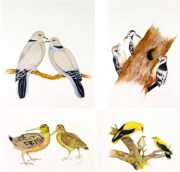
birdcardsPAULA KUITENBROUWER ~ is a regular contributor to Into the Bardo and a Dutch nature artist living in The Netherlands and sharing her work with us on her blog, Mindful Drawing and on her website.   In addition to art, Paula’s main interest is philosophy. She studied at the University of Utrecht and Amsterdam. She has lived in Eastern Europe and in Asia. Paula says that in Korea, “my family lived next to a Buddhist temple. In the early morning we would hear the monks chanting. During my hours of sauntering with my daughter through the beautiful temple gardens, I felt a blissful happiness that I try to capture in my drawings.” Paula sometimes teaches children’s art classes. She lives with her husband and daughter and close to her father. You can view her portfolio of mindful drawings HERE.
Posted in Art, Essay, Imen Benyoub, memoir

very private thoughts

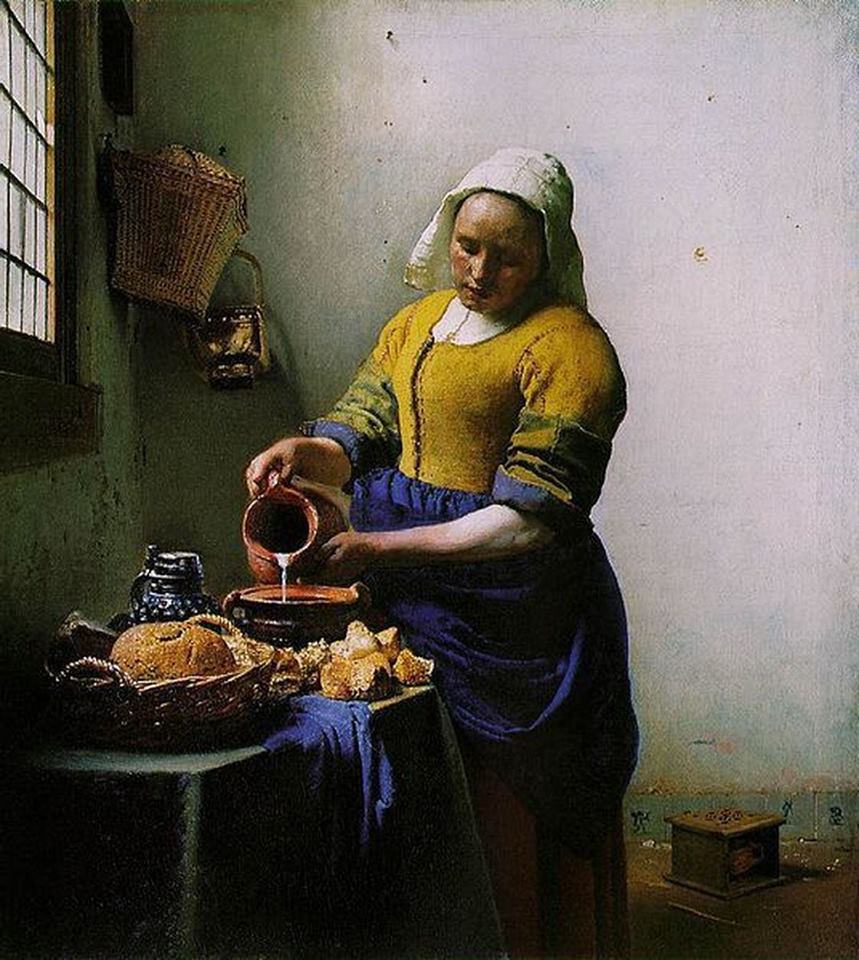
The Milkmaid, oil-on-canvas painting by Johannes Vermeer (1632-1675), Dutch

My first memory of art was in a dictionary, when I used to gaze dreamily at a portrait by Johannes Vermeer, The Milkmaid, a woman wearing a white cap, standing by a table covered with a blue cloth pouring milk…I was so fascinated by the painting, by the humble tranquil atmosphere and the basket of bread that resembled ours…and the dancing light on the maid’s face and arm. I knew nothing about this Vermeer but the few lines in the dictionary that never satisfied my curiosity: “a Dutch painter, born in Delft, his paintings, mostly about everyday life and domestic scenes were characterized by use of subtle light ”

Johannes Vermeer was my first inspiration, even his name had poetry or so I thought. After The Milkmaid I started a notebook and wrote about every painter I discovered. I made sure I kept it well hidden from my family.

My mother never understood why I spent most of my day holding that heavy dictionary just staring at paintings, I was a mercurial child and a picture could easily define and change my mood!! So my discoveries continued with Dutch art, some paintings by a mysterious looking guy called Rembrandt and another with an ironic look called Van Gogh.

My friends outside were so far from my world as a million star years. I remember their looks, half sarcastic half pitiful on a girl always lost in reverie, befriending ghostly figures in a dictionary and talking about places they never heard of.
I was always asking: how can this famous Van Gogh paint such a naïve painting like les douze tournesols? I can do it better!! What was le jeune homme au gilet rouge of Cézanne thinking?

Of course my childish mind always separated and catalogued them: the cheerful ones like the only painting by Rénoir that made me so fond of Paris le Moulin de la galette and those beautiful ballerinas in la classe de dance by Degas. The sad ones like femmes de Tahiti by Gauguin. Eespite the suggestive earthy colours of those exotic women I couldn’t miss the touch of melancholy on their faces. Géricault frightened me with his méduse so did the painting of Goya el tres de Mai that reminded me of my history classes about the Algerian revolution. Les mendiants made me cry and have nightmares (with all respect to Bruegel l’ancien). I hated the dismembered people and the cruelty of the act, but those who evoked me the most were those that made my fertile imagination drift even more.

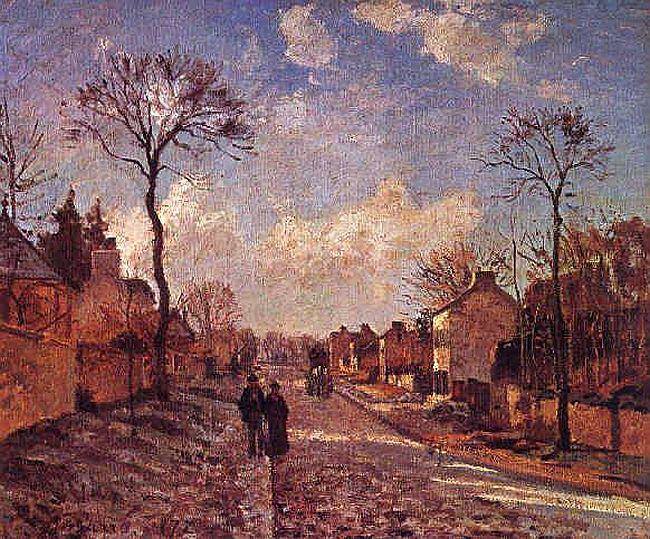
La route de Louveciennes,  oil on canvas by Camille Pissarro (1830-1903), French
La route de Louveciennes, oil on canvas by Camille Pissarro (1830-1903), French

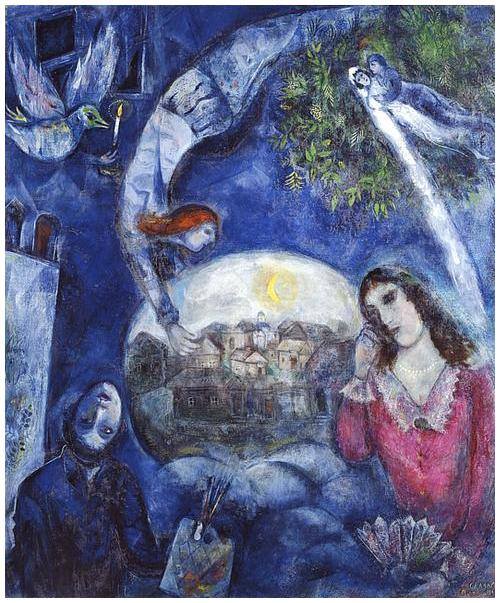
When I walk back home from school I close my eyes and imagine myself walking with the couple in la route de Louveciennes despite the difference between Pissaro’s perfect painting and my village disappointed me, it gave me extreme pleasure, only equaled by floating with Chagal.’s women in autour d’elle a name I found extremely romantic. Nothing matched that serene blue bathed in moonlight and those strange looking women I wanted so bad to look like.

I loved the fantasy in autour d’elle but another painting made me laugh and cemented the impression that this Picasso used squares and triangles only!! Because I always loved the light sprinkled on Rénoir’s canvas…Musiciens aux masques was as funny as humorous, because I never knew any instrument but the guitar, or who those three men were and never saw the dog under the table until recently.

I was drowning bit-by-bit in this world of colours, I knew Kandinsky, Caravaggio, Durer and Poussin and their names had a sensual sonority for my Arabic ear, not that I could pronounce them correctly because I could only manage the French ones. I continued to dream about the Louvre and cities I can visit when I become older. I continued to have my nocturnal conversations with Vermeer, Cézanne and Rénoir and make my own versions of la route de louveciennes and

Autour d'elle, oil on fabric by Marc Chagall (1887-1985), French artisit, Belarusian ethnic
Autour d’elle, oil on fabric by Marc Chagall (1887-1985), French artisit,

Vlaminck’s nature morte, this widened the gap between me and my friends who thought that I was weird and treated me suspiciously, my mother still couldn’t understand my attachment to this dictionary I wasn’t using to explain difficult words.

These memories came rushing back the moment I finished reading Tracy Chevalier’s novel Girl With a Pearl Earing, a gift from my beloved uncle who lives in Italy.I am still faithful to my Vermeer but through another equally mesmerizing painting la Joconde du Nord, and I know more about the art world now, my childish impressions and convictions are dramatically changed now. I can pronounce those names perfectly and I have wonderful friends who share my enthusiasm and passion.

But…despite internet and the thick art catalogues of le Figaro in my aunt’s library, despite the documentaries, TV shows and the long biographies I can read for hours, that dictionary still has the favour and a dear place in my heart, heavy, torn in places with its red cover and a single Arabic word written in black…

that was my first art class.

– Imen Benyoub

© 2013, essay and photograph(below), Imen Benyoub, All rights reserved
Illustrations courtesy of Imen Benyoub

pictureIMEN BENYOUB ~ is a milti-lingual, multi-talented essayist, poet, and artist living in Guelma, Algeria. She is a regular contributor to Into the Bardo.