Posted in Jamie Dedes, Poems/Poetry, Poets/Writers

January Is On the Wane

file000592821988with a nod to Juana Inés de la Cruz

January is on the wane
leaving behind early dark and champagne hopes
for the genus Rosa. Wild or tame, they’re lovely.

Garden roses need pruning, solicitous cultivation ~
Layer shorter under taller, drape on trellises
and over pergolas, the promise of color and fragrance,
climbers retelling their stories in ballet up stone walls,
an heirloom lace of tea roses, a voluptuous panorama
rhymed with shrubs and rock roses in poetic repetition.
Feminine pulchritude: their majesties in royal reds
or sometimes subdued in pink or purple gentility,
a cadmium-yellow civil sensibility, their haute couture.

Is it the thorned rose we love or the way it mirrors us
in our own beauty and flaw and our flow into decrepitude?
They remind of our mortality with blooms, ebbs, and bows
to fate, a noble death to rise again in season, after Lazarus.
Divinely fulsome, the genus Rosa, sun-lighted reflexed ~
And January? January is ever on the wane.

© 2013, poem, Jamie Dedes, All rights reserved
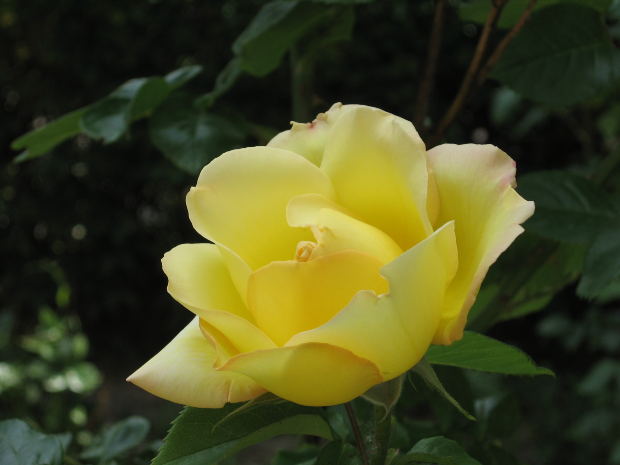
Photo courtesy of morgueFile

Portrait by Fray Miguel de Herrera (1700-1789)

The work that was the jumping off point for my poem is one by the Mexican nun, Sor Juana Inés de la Cruz (1551-1695), who lived during the time when Mexico was a part of the Spanish empire. Sor Juana was an ambitious writer, self-taught, and a Baroque poet. She belonged to the Order of St. Jerome. I am enamored of her work and find her life interesting. She was brilliant, independent and nonconforming.

Sor Juana was a writer, playwright and a Baroque poet. She was hungry for learning and was self-educated. From childhood, she set her own demanding educational goals. These three famous quotes of hers are telling:

“I don’t study to know more, but to ignore less.”

“One can perfectly well philosophize while cooking supper.”

“…for there seemed to be no cause for a head to be adorned with hair and naked of learning…”

For those who might be interested, here is her poem Rosa in Spanish and in English.

Rosa divina que en gentil cultura
eres, con tu fragrante sutileza,
magisterio purpureo en la belleza,
enseñanza nevada a la hermosura.
Amago de la humana arquitectura,
ejemplo de la vana gentileza,
en cuyo ser unió naturaleza
la cuna alegre y triste sepultura.
¡Cuán altiva en tu pompa, presumida,
soberbia, el riesgo de morir desdeñas,
y luego desmayada y encogida
de tu caduco ser das mustias señas,
con que con docta muerte y necia vida,
viviendo engañas y muriendo enseñas!

Rose, heaven’s flower versed in grace,
from your subtle censers you dispense
on beauty, scarlet homilies,
snowy lessons in loveliness.
Frail emblem of our human framing,
prophetess of cultivation’s ruin,
in whose chambers nature beds
the cradle’s joys in sepulchral gloom.
So haughty in your youth, presumptuous bloom,
so archly death’s approaches you disdained.
Yet even as blossoms soon fade and fray
to the tattered copes of our noon’s collapse –
so through life’s low masquerades and death’s high craft,
your living veils all your dying unmasks.

– Juana Inés de la Cruz

Illustration and poem in the public domain. Source of translation unknown.

photo-on-2012-09-19-at-19-541JAMIE DEDES (The Poet by Day)~ I am a mom and a medically retired (disabled) elder. The graces of poetry, art, music, writing and reading continue to evolve as a sources of wonder and solace, as a creative outlet, and as a part of my spiritual practice.

Posted in folk tale, General Interest, Naomi Baltuck, Photography/Photographer, story, Story Telling, Photo Story

The Most Noble Story

There was once a widow who had three sons, Alberto, Eduardo, an Ernesto. She had spent a lifetime trying to teach them the meaning of charity and compassion.

The day came when she knew she was dying, and would no longer be there to guide them.  She called her sons to her bedside.

“My sons, the only thing of value I have to leave you is my diamond ring. It was given to me by my mother, who had it from her mother, whose mother handed it down to her. It cannot be divided and it must not be sold, for one day, it shall go to one of your daughters.  Now I must decide which of you is most worthy of this treasure. Go, my sons, and do good in the world.  Come back in one week’s time and tell me your stories. The one who has performed the most noble deed shall inherit the diamond.”

By the time the three young men gathered again at her bedside, their poor mother was near death.

She said to her firstborn, “Alberto, tell me your story.”
“Well, Mother,” said the eldest, “after much thought, I gave half of everything I owned to the poor.”
“My son,” said the old woman, “no one can tell you that you haven’t performed a good deed. But it is not a noble deed, for have I not taught you that it is everyone’s responsibility to care for the needy?”


She said to her secondborn son, “Eduardo, tell me your story.”
He said, “Mama, I was passing the river when I saw a small child swept away in the current. I can hardly swim, but I jumped into the water and pulled the child out to safety.  It was only by the grace of God that I didn’t drown myself.”


“My son, you too have performed a good deed, but not a noble deed. Have I not taught you that everyone should be willing to lay down his life for that of a helpless child?”


The old woman said to her youngest son, “Eduardo, come tell me your story.”
Ernesto hesitated before taking her hand. “Mamacito,” he confessed, “I haven’t much to tell. As you know, I’ve no earthly goods, and I cannot swim a stroke. But I’ll tell you something that happened to me this week. Very early one morning I was walking in the mountains.

I came upon a man sleeping at the edge of a cliff. If he were to stir in his sleep, he would surely fall to his death on the rocks below. I determined to prevent this tragedy. I crept over, so as not to startle him awake. Then I saw that it was my bitter enemy, Juan Miguel. At first, I thought to leave him there, for the last time we met, Juan Miguel threatened to kill me if he ever got the chance. But deep down I knew what I had to do.
“As I put my arms around him, Juan awoke and I could see the fear in his eyes as he recognized me.
“’Don’t be afraid,’ I told him. I quickly rolled him away from the precipice to safety, and helped him to his feet. When Juan Miguel came toward me, I was sure he meant to kill me. But then he threw open his arms to embrace me.
“Juan said, ‘Last night darkness fell before I could get home. Rather than chance a misstep in the dark, I decided to spend the night where I was. I had no idea I was so close to the cliff edge. You saved my life, Ernesto, and after I treated you so poorly!’
“To make a long story short, Mamacita, Juan and I are no longer enemies, but have sworn to be friends forever.”

The old woman shed tears of joy. “My son, I have taught you well. That was truly a noble deed, and you are a noble man, for you risked your life to save a man sworn to kill you. With one act of kindness, you have transformed hatred into love and made the world a better place.” With her dying breath she told her sons, “The diamond shall go to Ernesto, but you must all remember that with each noble deed you perform, you shall add to the treasure that awaits you in Heaven.”


All three sons married and had children of their own. They, like their mother, taught their children the meaning of charity and compassion. When the time came, Ernesto left his mother’s diamond to one of his daughters.

But Alberto and Eduardo left their children a gem worth as much as any diamond, for their children held in their hearts their grandmother’s precious legacy, the story of the most noble story.

All photos copyright 2013 Naomi Baltuck

The Most Noble Story is from Apples From Heaven, copyright 1995 Naomi Baltuck, and retold from a folk tale of Mexico.

NaomiPHOTO1-300ppi51kAqFGEesL._SY300_NAOMI BALTUCK ~ is a Contributing Editor and Resident Storyteller here410xuqmD74L._SY300_ at Bardo. She is a world-traveler and an award-winning writer, photographer, and story-teller whose works of fiction and nonfiction are available through Amazon HERE. Naomi presents her wonderful photo-stories – always interesting and rich with meaning and humor – at Writing Between the Lines, Life from the Writer’s POV. She also conducts workshops such as Peace Porridge (multicultural stories to promote cooperation, goodwill, and peaceful coexistence), Whispers in the Graveyard (a spellbinding array of haunting and mysterious stories), Tandem Tales, Traveling Light Around the World, and others. For more on her programs visit Naomi Baltuck.com

Posted in memoir, Naomi Baltuck, Photography/Photographer, story, Story Telling, Photo Story

THE EMPTY NEST PART I: You Can’t Change That

Like a brilliant sunset, it’s here and then gone.

As fleet as a bird on the wing…

Passing as unnoticed as the morning dew…

…even as it goes speeding down the track of no return.

From here.

To here.

Like a river, it flows, with its twists and turns, its highs and lows.

But mostly highs.

But it’s just as they say.

 Time…

…and tides wait for no one.

Childhood, theirs–not ours–slips away like water through our fingers.


Or a kite caught up in a strong wind.

As warm and wonderful as a hug, but just as fleeting.

Suddenly they’re all grown up; intelligent, creative, compassionate human beings, ready to make their contributions to the world.  Which is the whole point, isn’t it?

Their childhood is a gift…

…we gave to each other.

It has its season, and then it’s gone…

Off they go to seek their fortunes.

Dang!  And just when they learned how to cook!

But here’s something they won’t know until they have children of their own.  Long after our kids are parents, long after they’ve gone gray, long after they are elderly orphans…they will still be our babies.

 photo e44fa7f6-b8ce-4182-b007-8bfc3bce5a47_zpsee121352.jpg
Neither time nor tides can ever change that.

All words and images copyright 2013 Naomi Baltuck

NaomiPHOTO1-300ppi51kAqFGEesL._SY300_NAOMI BALTUCK ~ is a Contributing Editor and Resident Storyteller here at Bardo. She is a world-traveler and an award-winning writer, photographer, and story-teller whose works of fiction and nonfiction are available through Amazon HERE. Naomi presents her wonderful photo-stories – always interesting and rich with meaning and humor – at Writing Between the Lines, Life from the Writer’s POV. She also conducts workshops such as Peace Porridge (multicultural stories to promote cooperation, goodwill, and peaceful coexistence), Whispers in the Graveyard (a spellbinding array of haunting and mysterious stories), Tandem Tales, Traveling Light Around the World, and others. For more on her programs visit Naomi Baltuck.com