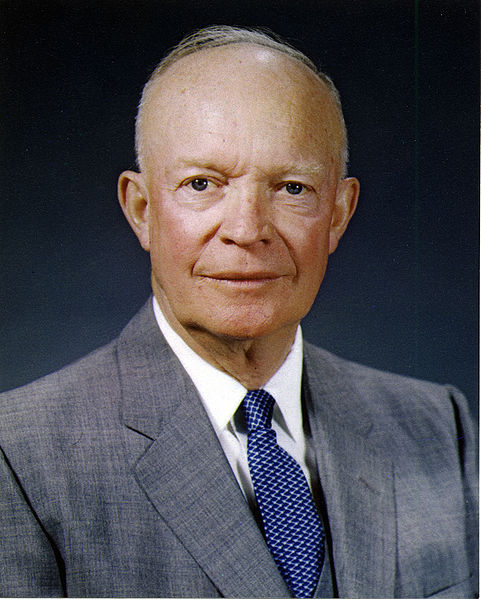
 DWIGHT D. EISENHOWER (1890-1969)
34TH PRESIDENT OF THE UNITED STATES
In office 1953 -1961
TIMES OF WAR, CHANCE FOR PEACE
by
Jamie Dedes
“Every gun that is made, every warship launched, every rocket fired, signifies in the final sense a theft from those who hunger and are not fed, those who are cold and not clothed … “ Dwight D. Eisenhower, 34th President of the United States of American (1953-1961)
That quote is from Eisenhower’s speech, A Chance for Peace, delivered in 1953 three months after he took office and on the occasion of the death of Joseph Stalin, Premier of the Soviet Union (1941 to 1953). The “just peace” that the world hoped for in 1945 at the end of World War II had not materialized. While the Korean War was coming to a close, the Cold War-era military conflicts in Indochina (Vietnam, Laos, and Cambodia) were slowly escalating. The United States would have advisory troops in Vietnam in 1954. The armed conflict in that region of the world would continue long past Eisenhower’s administration with U.S. involvement escalating in the 1960s and continuing until the Fall of Saigon in 1975.
Since the end of the Second World War and the Korean War, violent conflict continues unabated with thirteen wars (defined as 1,000 or more deaths per year) currently, including the War in Afghanistan and the Yemeni and Syrian uprisings of 2011. Smaller scale conflicts resulting in fewer than 1,000 deaths per year have been rife and in 2011 include the Sudan-SPLM-N conflict, the Yemeni al-Qaeda crackdown, and the 2011 clashes in Southern Sudan. Genocides didn’t end either. We’ve had eight genocides since the Holocaust of WWII. The number of rebel groups is now over one-hundred, which probably errs on the light side. Conflicts rise from economic and social instability, which could be addressed if we invested in butter, not guns. Even in 1953, Eisenhower pointed out that war isn’t sustainable:
This world in arms is not spending money alone.
It is spending the sweat of its laborers, the genius of its scientists, the hopes of its children.
The cost of one modern heavy bomber is this: a modern brick school in more than 30 cities.
It is two electric power plants, each serving a town of 60,000 population. It is two fine, fully equipped hospitals.
It is some fifty miles of concrete pavement.
We pay for a single fighter plane with a half million bushels of wheat.
We pay for a single destroyer with new homes that could have housed more than 8,000 people.
If governments don’t recognize that Earth and her people cannot be sustained by war, many of their citizens do. One modern peaceful protest for a sustainable world is of interest to all of us who read, write, and love both poetry and peace. It is 100 Thousand Poets for Change, which held its first world-wide rally on September 24, 2011 with 700 events in 550 cities representing 95 participating countries united to promote peaceful environmental, social, and political change. Poets, writers, artists, musicians, and photographers the world over demonstrated in solidarity. The next global event is scheduled for September 29, 2012. Throughout the year small, local events are delivered at a various venues. By invitation, 100 Thousand Poets for Change was at the Sharjah (an Arab Emirate) International Book Fair, which ran through November 27. MujeebJaihoon reports, “From time immemorial, poetry has built better bridges between people than those with bricks and stones. And these bridges do not get old or obsolete…” [Change Is Born in the Womb of Poetry]
In A Chance for Peace Eisenhower pointed out, “No people on earth can be held, as a people, to be an enemy, for all humanity shares the common hunger for peace and fellowship and justice.” We do hunger, individually and collectively. Perhaps our chance for peace starts with you and me. Poem on …
© 2011 essay, Jamie Dedes All rights reserved
The photograph of Eisenhower is in the public domain
Thank you for sharing the beauty and inspiration:

 Luke Prater’s (Word Salad) poetry is ever fascinating. Luke will often tackle the same subject in more than one poetic form. Dedication, patience, and a singular irreverence are the hallmarks of this thirty-five year old English poet who took a degree in English lit with creative writing and performance and subsequently went to SOAS, London to study ethnomusicology at the master’s level. At twenty-seven he took up poetry, which he says saved his life – a thing it has done for many of us. J.D.
 The BeZine