Posted in Essay, Guest Writer

THE ACT OF INVISIBILITY

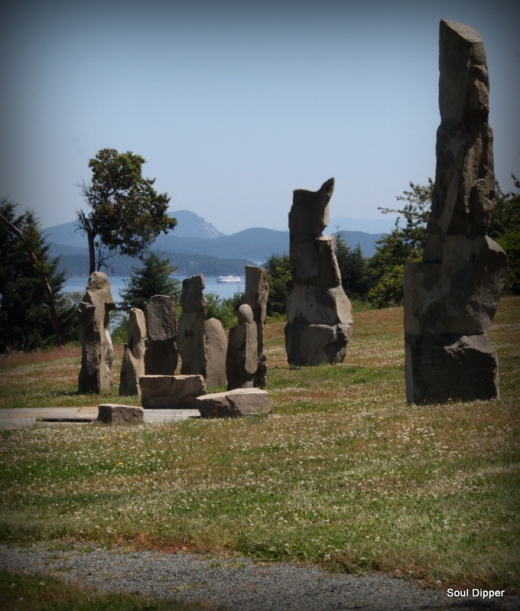
Stones, balanced with mortar-less perfection, stand on the hillside and silently watch the ferry slip through its island laden path.

THE ACT OF INVISIBILITY

by

AMY NORA DOYLE (SoulDipper)

Into the Bardo Contributing Writer

Yesterday, a professional musician read aloud The Prayer of St. Francis.  The man wasn’t performing for the crowd.  He was reading as though the prayer had been written for him.

The intonations and musicality of his voice lured me into loving the words.  I questioned the opposites contained in the prayer.   Are they better served verbally?  Or silently?

Does an effective “channel” speak love or just show it somehow?  How is it easiest to receive vibes of pardon, faith, hope, light, and joy?  Is it best to transmit consolation, understanding and love with an act of invisibility?

People who personify the virtues listed in St. Francis’ prayer are rare, but Susan Boyle came to mind.  Did she have years of invisibility?  Did it magnify her beauty?

The prayer says, “It is in dying that we are born…”  Being, instead of being seen, disciplines the ego and makes room for giving.

I wanted to know:  How can I construct my own invisibility?

This question first arose in the early 1970s in London, Ontario.  I joined the London Little Theater Group and was given the role of a seductive secretary in a murder mystery.  I was overjoyed until I realized my character was murdered in the first minute of the first act.  My only lines were repeats of phrases spoken by my lover/boss.  I was taking shorthand while he dictated a letter.  I didn’t even have to do a dying scene.  The lights went out, a shot was fired and when the stage was lit again, weeks had passed.

That kind of invisibility was easy.  The mystery revolved around my character and I didn’t have to do a thing.  I sat bored and impatient backstage, waiting for the end of the performance so I could do curtain call with the rest of the cast.

Stan, a professional actor who had retired in London, was a small, quiet man with powerful stage presence.  His role in the play suited him – a quiet, polite, detective who matched the cunning of a yet-to-be-famous Columbo.  His role required a deftness that caused players, and certainly audiences to forget he was on stage.

“How will Stan ever be invisible on stage?” I asked the director.

“It’s one of the most challenging roles for any actor,” he said.  “It’ll be especially tough for Stan because everyone likes to watch him.”

“Does that mean the other players have to do a good job of distracting the audience?”

“That’s important, but Stan can’t count on that.  What if the other players don’t pull that off?  The story relies on his shadowy observations and impeccably timed responses.”

During rehearsals, I popped in, did my one minute on stage and left.  I didn’t have a chance to ask Stan about invisibility.  He was continuously engaged with fellow cast members.

We had a packed house each night of both weekends.  I wanted to watch Stan in action, but had to stay backstage.  It wasn’t until the cast party that I finally had a chance to pose my question.

“Stan, apparently you mastered invisibility every night.  I’d love to know how to do it.  Is it the opposite of acting?”

“It’s a wonderful and artful challenge.  It’s customized with each play, each cast and each setting.”

“But how do you do it?” I asked.

“I think myself into a state of not being available.  I’m absolutely still.  I don’t draw attention to my character in any way.  I work with the timing of the other actors as I blend in with the scenery, the movements, and the mood.  I imagine myself small until it’s time to step back into the spotlight – big as life.”

“So…you are turning your visibility off and on in accordance with what’s around you?”

“Yes.  For me, being invisible requires more acting than being center stage.  It’s draining.  It is the most intense, yet rewarding, acting I have done. It’s terrifically fulfilling.”

Here I was, yesterday, listening to a professional musician invisibly read a prayer.  I listened to Susan Boyle sing the St. Francis prayer with the power of coming out “big”.  I remembered a gifted actor teaching the art of invisibility.

Am I any closer to knowing how to channel the virtues named as opposites in the prayer?

I’ll have to see how invisible I can be.  However,I’ve learned one thing.  An act of invisibility is a supreme act of giving.  Self-willed or not.  Both have purpose.

Can you become invisible?

© 2012, photograph and essay, Amy Nora Doyle, All rights reserved

AMY NORA DOYLE ( souldipper) ~ has been blogging since 2010, always write-on-target with the topics she chooses to address and her not insignificant gift of story. She is appreciated as much for her insightful comments on blogs as she is for her indefatigable efforts applied consistently to the subject and spirit of the sacred. Amy is also an intuitive. Amy’s work in the ground of the sacred derives from “a life-changing trip to an incredible country, South Africa, the longing in my soul to release concepts about the magnificence of ordinary life has blown the typical writing blocks, corks and stoppers.” The inspired and inspiring Amy lives with her cat in a house on an island in Canada. Be sure to stop and visit her on your trips around the blogospher.

Posted in Essay, Guest Writer, Spiritual Practice

KAREN ARMSTRONG – A CHARTER FOR COMPASSION GROWS

KAREN ARMSTRONG (b. 1944), British Author, Commentator, Academic

Charter for Compassion

“Karen Armstrong is a former Catholic nun who left the convent to study literature, becoming one of the most provocative and original thinkers on the role of religion in the modern world, and a leading international authority on faiths, religious fundamentalism and monotheism.

Her poignant and captivating talks have sparked worldwide debate and healthy discussion. Her bestselling books, including Twelve Steps to a Compassionate Life and A History of God, examine the differences and the profound similarities between Christianity, Islam, and Judaism, and their impact on world events.

In 2008, she was awarded the TED Prize in recognition and support of her call for a council of religious and spiritual leaders to draw up a “Charter for Compassion” that applies shared moral priorities to foster greater global understanding based on the principles of justice and respect. The project has grown to a considerable international following, and a network of Compassionate Cities is emerging that endorse the Charter and find ways to implement it practically, realistically and creatively.

As a speaker and writer, she asserts that all major religions embrace the core principle of compassion and the Golden Rule, and also emphasizes that many of today’s religions bear similar strains of fundamentalism borne of frustration with contemporary life and current events.”     ( –  Official Biography of Karen Armstrong.)

KAREN ARMSTRONG – A CHARTER FOR COMPASSION GROWS

by

Amy Nora Doyle (souldipper)

Contribution Writer, Into the Bardo

On our tiny island, a group recently finished its study of Karen’s book,“Twelve Steps to A Compassionate Life”.  The same group seized an opportunity, on March 22, to share a live video of Ms. Armstrong accepting a prestigious award from the Simon  Fraser University in Vancouver.  In recognition of her exceptional work with Compassion, Vancouver dedicated 12 days in which to dialogue about compassion, in a variety of ways, throughout the city.

The Charter for Compassion begins:

“The principle of compassion lies at the heart of all religious, ethical and spiritual traditions, calling us always to treat all others as we wish to be treated ourselves. Compassion impels us to work tirelessly to alleviate the suffering of our fellow creatures, to dethrone ourselves from the centre of our world and put another there, and to honour the inviolable sanctity of every single human being, treating everybody, without exception, with absolute justice, equity and respect.”

(The complete Charter is available here.)

.

Karen Armstrong – Simon Fraser University – March 22, 2012

.

Those of us who watched Ms. Armstrong’s acceptance of the SFU award, discussed, at its completion, how we envisioned enhancing compassion in our community.   Though time may provide a more profound conclusion, most of us agreed that Compassion is an inner condition through which each of us may filter our actions and exchanges throughout the community.  In support of this commitment, the local book club, one of 500 worldwide, will again offer a study of Karen’s 12 steps to compassion.

Our group may have been influenced by the Rev. Alisdair Smith, Deacon and Business Chaplain for Christ Church Cathedral in Vancouver.  As he introduced Karen, he shared a phenomenal story about a dear friend – a woman who suffers from severe bouts of depression.  She gave Alisdair permission to share her story with us.

In my words:

The depression became severe enough that the woman knew she had to go to the hospital.  With all the courage, will and determination she could muster, she called an ambulance.

A male attendant rode quietly beside her in the back of the ambulance.  As the vehicle wound its way through traffic, the man remained silent, but dutifully attended to any concern for comfort or safety.

After some time, he turned to face her.  He held her hand and looked into her eyes.  He said, “We are almost at the hospital. I want to tell you that while I have been in your presence, I have discerned that you are a very creative, kind  and intelligent woman.

Therefore, when we arrive, I will step out of this ambulance and wait for you to take my hand so you may step down on your own.  We will walk together to Emergency and you will hold your head high with the dignity that is yours to claim.  There is no reason or need to be or feel embarrassed.

Are you willing?”

The woman did exactly as he suggested.  Her life was transformed.

Though she is still plagued with depression, it only takes a moment to reflect on this incredible act of compassion, performed by a stranger, that dispelled and diminished the degree of debilitating power that depression would otherwise demand.

I watched Karen Armstrong’s Ted Talk in 2008.  I became a member of the Charter for Compassion in 2009.  I committed to being a compassionate person.

Big deal, I thought.  That’s not doing much for the Charter.

I found out it is.

Especially if we each do our best with every opportunity that inevitably comes our way.

I keep forgetting about the hummingbird and the forest fire.

© 2012, essay – Amy Nora Doyle, All rights reserved

© photos ~ courtesy of A Charter for Compassion, all rights reserved, used here under fair use

♥ ♥ ♥ ♥

If you have the time for this 22 minute video, you might find it gratifying to hear Ms. Armstrong’s TED award acceptance. J.D.

Posted in Essay, Guest Writer

THE TILTH OF THE EARTH

Tilth of the Skin

TILTH OF THE EARTH
·
by
·
Amy Nora Doyle  (SoulDipper)
·

Dirt.  Black, soft, moist, cool clumps of sensuous-feeling prairie dirt tumbled through my memory like tumbleweeds bouncing across an open field.

Jamie Dedes wrote about Dirt and conjured memories of pawing hands, wiggly fingers and big noses.  Visions of prairie farmers grabbing fistfuls of healthy humus, fingering it thoroughly, smelling it, working it through rubbed palms, and even tasting it, came back to me with the clarity of a close-up video.

Why did they do this routine?  As a child, I had watched them, riveted and serious, working handfuls of soil as if preparing for surgery.  The world stopped.  Their full attention was on the response of the soil to its handling.  What were those farmers doing?

Nagged by ignorance, I decided to visit an octagenarian who farmed most of her adult life in Manitoba.  Rose is the 88 year old mother of a departed friend.

Driving to Rose’s house, Jamie Dedes was on my mind.  She started this.  She published a post, “Ultimately Dirt”, on her blog titled Into the Bardo.  If you peek at the link, you’ll see there’s a book and a film about the soil of this planet.

Bill Logan wrote “Dirt: The Ecstatic Skin of the Earth”.  He wrote it while living in New York City.  Jamie just happens to come from Brooklyn.  What irony that two urban New Yorkers wake up this prairie person to the phenomenal aliveness of dirt.  It is precious.  We all know we need it to grow anything worth eating, but there’s more to it.  It’s teeming with life.  It’s a full, living organism.  It is home to microscopic life that creates the healthy properties we need in our soil.

I’ve been taking dirt for granted.  I hadn’t thought about how many layers and years of leaves, grasses, manure, and other flora it takes to create the soil that I kicked away and swept off my walkway with impunity.   I hadn’t fully considered the effect of the world’s greed on soil.

When I arrived at Rose’s home, she was sitting outside enjoying her small garden.

Tilth of the Soil

“Rose, this may seem like a dumb question, but I want to ask you about farmers.  When they grabbed a handful of dirt and started doing all those machinations, what were they doing?”

“You mean when they’d squeeze it in their hands?”  I nodded.  “And when they’d rub it between their fingers…sometimes smell it?”

“Yes! That’s what I remember.  Some even tasted it.  I saw some put their tongues on it.  Why?”

“Testing it.” Rose said.

“For what?”

Rose looked at me as though I was a bit simple. “To see if it was okay.”

“Rose, I know they were testing it.  Okay for what?”

“Well, to see if it was ready for planting.”  Her tone indicated that anyone would know this fact.  Obviously this was like asking her to describe looking through blue eyes.

“Okay.  What were they looking for in the soil to know it was ready for planting?”

“Let’s see…moisture.  It shouldn’t be too dry.  If it was, they prayed for a bit of rain.  If it was too wet, they prayed for hot, sunny days.”  She grinned as she paused.  “What else?  It shouldn’t be too sandy.”

“If it was, what would they do about it?”

“Add some good manure probably.”  More silence.  “The soil had to have a good balance of acid and alkaline.   Willows love alkaline.  Where willows grow, you know the soil is too alkaline.  Clay has a lot of alkaline.  Wheat likes a bit of acid.”  She began to rhyme off which crops preferred acid and which prefer alkaline.

“So that tiny gesture told them all they needed to know about planting.  When to plant, what to plant…it even told them if they had to roll out the manure wagons.”  Rose nodded as she listened.

Suddenly she threw up her arms, “Tilth!”

“What?”

“Tilth of the soil.  That’s the word!  They test the tilth of the soil*!”

“Spell that, Rose.  I’ve never heard the word.”

The well-being of our nation depends upon the tilth of the soil. 

No… the well-being of the world depends upon it.

The tilth of our skin has been too much of a big deal – 

Now it’s time to concentrate on the tilth of our planet’s skin.

Tilth of the Earth

* From Wikipedia:

Tilth can refer to two things:

Tillage and a measure of the health of soil.

Good tilth is a term referring to soil that has the proper structure and nutrients to grow healthy crops. Soil in good tilth is loamy, nutrient-rich soil that can also be said to be friable because optimal soil has a mixture of sand, clay and organic matter that prevents severe compaction.

Photo credits ~ Google.ca/search