The focus of "The BeZine," a publication of The Bardo Group Beguines, is on sacred space (common ground) as it is expressed through the arts. Our work covers a range of topics: spirituality, life, death, personal experience, culture, current events, history, art, and photography and film. We share work here that is representative of universal human values however differently they might be expressed in our varied religions and cultures. We feel that our art and our Internet-facilitated social connection offer a means to see one another in our simple humanity, as brothers and sisters, and not as “other.” This is a space where we hope you’ll delight in learning how much you have in common with “other” peoples. We hope that your visits here will help you to love (respect) not fear. For more see our Info/Mission Statement Page.
In 2011, researchers at the University of Chicago conducted a simple experiment to ascertain whether a rat would release another rat from a cage without being given a reward. The answer was yes. After several sessions, the rats learned intentionally and quickly to open the restrainer and release the caged rats. The rats also repeated the behaviour even when they were denied the reward of reunion. Even more astonishing, when the rats were presented with two cages, one containing a rat, the other chocolate, they chose to open both cages and “typically shared the chocolate”.
For the researchers, the conclusion was inescapable: the rats were displaying empathy. Announcing the results in Science the lead researcher, Peggy Mason, explained: “There is nothing in it except whatever feeling they get from helping another individual.”
This is the opening of an article I was reading recently,(read it HERE if you like) it was about Barack Obama, Republicans, gun control, rich people and poor people. I don’t really want to go into the whole political aspect of it. Everyone to their own. Personally I believe all sides of politics, Left or Right, Independent or Green will screw us all over without the slightest hesitation. But I am a cynic.
But what I found interesting about this is not the experiment but the subjects. Rats. How many times have we heard the term Rat Race or the expression: even if you win the race you are still a rat? Quite a lot I bet. Buy why rats? Is it this perception that they are lowly and dirty, poisonous, dangerous. Even in school (I don’t know about other places but here in Ireland) if someone called you a rat it was the worst insult you could receive, it meant you told on someone to a teacher, you ratted on them.
You squealed was another popular expression in the schoolyard, again it implied the same thing and again conjured up the image of the rat. A coward. The lowest of the low.
So the experiment was interesting in that it showed rats in a better light, and yet how strange it is that when rats help each other for little or no reward we call it empathy and when humans do it we call it socialism or communism and it is frowned upon, socialism is one of the worst insults you can throw at a politician in the Western world, it implies weakness.
J.D. Gallager is a: “Writer. Avid reader. Type 1 diabetic. Irish” and “A struggling author … struggling to convince people he is an author.” His blog is HERE and his Amazon author’s page is HERE. Mr. Gallager writes fiction for adults and young adults. (Book cover art is property of the author.)
A simple and simply wonderful post from writer and positive thinker, Eva Tenter (Power of Postive Thoughts: Positive Thoughts, Inspirational Stories & Mental Health Advocacy). Nicely done, Eva~ Jamie
The WordPress.com stats helper monkeys prepared a 2012 annual report for this blog. Thanks to all for your support, contributions, comments, and reading.
Here’s an excerpt:
4,329 films were submitted to the 2012 Cannes Film Festival. This blog had 28,000 views in 2012. If each view were a film, this blog would power 6 Film Festivals
“When the power of love overcomes the love of power the world will know peace.
– Jimi Hendrix (1942-1970), American musician/singer-songwriter
Whether you celebrate the holiday season religiously spiritually in a secular fashion or not at all Best Wishes as we close one year and open another Thank you for reading, sharing your work and being the best possible you that you can be
David F. Barker(DF Barker – Restless Art)is an independent poet, writer and artist. He paints mainly in oil, but also occasionally uses acrylics and watercolour. He often experiments with digital art. You can see some of his art work HERE. David writes articles, usually about artistic, local, political or timely themes, as well as short stories and longer fiction. He is a professional poet and his collection Anonymous Lines is available at amazon.co.uk and amazon.com David has had a life-long love of history. He has a large collection of books spanning various epochs, but his consuming passion is English history. He makes music, too. Guitars and sounds of all sorts have been his friends, his solace for years. Very much in line with the Into the Bardo philosophy, he feels that all creativity is the same, it springs from the same source of mystery. He has no idea where it is, he only knows he must answer the call. J.D.
Luke Prater’s (Word Salad) poetry is ever fascinating. Luke will often tackle the same subject in more than one poetic form. Dedication, patience, and a singular irreverence are the hallmarks of this thirty-five year old English poet who took a degree in English lit with creative writing and performance and subsequently went to SOAS, London to study ethnomusicology at the master’s level. At twenty-seven he took up poetry, which he says saved his life – a thing it has done for many of us. J.D.
A few days ago, I read in a newspaper about a Dutch politician questioning the future existence of libraries. Kindle was mentioned as well as the Internet, so why have libraries? I stopped reading the article because there is only so much flap-doodle one can stomach. One might hope that our politician will start reading T.S. Eliot and stumbles upon Eliot’s quote: ‘The very existence of libraries afford the best evidence that we may yet have hope for the future of man’.
Imagine a few philistines standing in front of the burning library of Alexandria, in estimate 48 BC, indifferently saying to each other; ‘A well…who cares?’ I care, and that is what I commented at Jamie Dedes’ discussion Times Change on The Writer by Day.
You could object and point out that we can store all books digitally, something that wasn’t possible in ancient times. That isn’t a very convincing argument to me, because at ancient and medieval times copies were produced too, in order to preserve knowledge and to make knowledge widely available. The problem, to me, is that digital copies are clean and sterile presentations. They do not enchant, hold no smell, sensation nor touchable illustrations. Many of us need to experience these qualities hands-on.
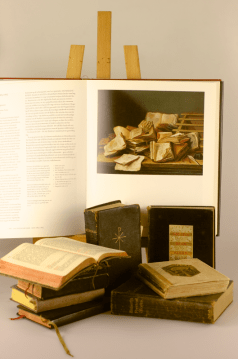
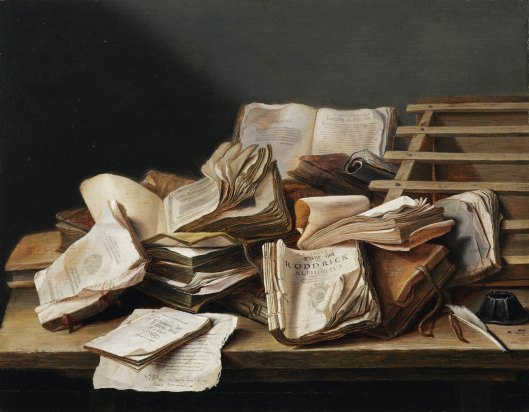
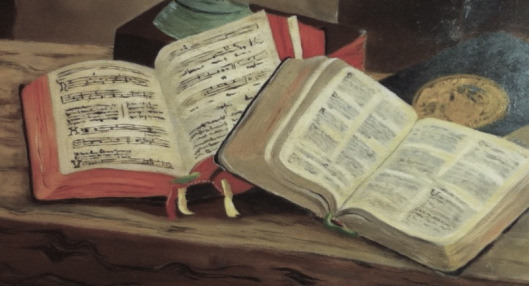
I also love painting old books. Books offer a wonderful theme, showing off a collection that represents a specific time, a layer of the society, telling a story about the writer, reader, and publisher.
Jan Davidz de Heem (1606-1683/84), Still-life with Books
A painting like this communicates ‘Look that my books’, and ‘Look what I read and store in my head’. See the ink-pot and feather-pen, stating; ‘I write too’ or ‘I’m a scholar’.
Detail oil painting Paula Kuitenbrouwer
Do you also like the little extra treasures old books sometimes offer? They can be underlined sentences that ones held significant meaning to the former owner of the book. Or they can be a handwritten old name on a pretty Ex Libris.
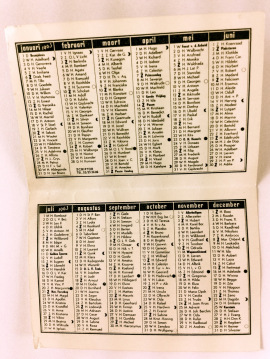
A few year ago I bought an old book. At home a small calendar of my year of birth dropped out (now how amazing is that?), showing a year long list of -to my generation- forgotten saints as well as a moon calendar.
The Saint and Moon Calendar of my birth-year.
Last, have a look at this beauty: an old Dutch book on Percival, with the name of the former owner in the right upper corner in ink. The Art-Nouveau illustration, in relief gold, offers enough reason to buy the book. There is even a treat inside: a small, printed prayer card, showing St. Martin by Michelina da Besozzo, 1410.
Will we ever enjoy a relief print, golden illustration on a Kindle? If we ‘open’ our E-reader, will we ever experience a pleasurable surprise of a little wink or glimpse back in time, falling out? I’m afraid not. Books provide us with all sort of inspiration; we therefore need old books, stored in libraries (and available in second hand bookshops).
OUR INTENTIONS — noticed or unnoticed, gross or subtle – contribute either to our suffering or to our happiness. Intentions are sometimes called seeds. The garden you grow depends on the seeds you plant and water. Long after a deed is done, the trace or momentum of the intention behind it remains as a seed, condition our future happiness or unhappiness.” Gil Frondsdal, Teacher, Insight Meditation Center, Redwood City, CA
Her fate was set when she fell under the spell of the American’s kind eyes and bigger than life personality. For his part, he loved her gentle ways, the fluid dance of her hands at work, the sensual swing of her hips as she walked to the market with basket in hand. And so it happened that in 1948, with her father’s permission and her mother’s tears, they were wed in the old adobe iglesias where uncounted generations of her family had been married before her. Not many months after the wedding, she kissed her parents and siblings goodbye, took a long loving look at her village, and followed her new husband north to losEstados Unidos de América. She was already pregnant with Clarita.
****
As the days and years passed, they settled into their routines. Sunday mornings were her husband’s quiet time. He stayed at home while Señora Ortega and Clarita were at Mass. In their absence he would occasionally put down his newspaper and stir his wife’s frijoles simmering fragrant with pork, a few bay leaves, onions and garlic. Last night: their Saturday ritual, she and Clarita had sorted and then washed the dried beans in cold water and left them to soak until morning. The child – fast becoming a young woman – took the time and care to do a good job of this. El trabajo es vertud. Work is virtue, Señora Ortega encouraged.
In the tradition of Señora Ortega’s own madre, la cocina was a place of teaching – about food, about life, about being a woman, about being human. “!Ten cuidado, hija!” Be careful, she would say as she demonstrated her almost sacramental sorting of the dry beans. It was an opportunity to teach Clarita the dichos, the proverbs, of her mother and grandmother and all the grandmothers before.
“Los frijoles son nuestra fuerza.” We get our strength from losfrijoles, she taught Clarita just as her own mother taught her. Certainly the beans give the strength to our bodies, but also the strength to our character. There are lessons. “¡Aqui!” Remove these. Remove the wrinkled, the broken, the discolored or malformed. Remove them as you should remove flaws from your character. One bad frijole will ruin the whole pot. Taparse con la misma cobija.* … You will be judged by the company you keep. Be cautious in your choice of friends. Even the Norte Americanos have such a saying: one bad apple spoils the bunch.
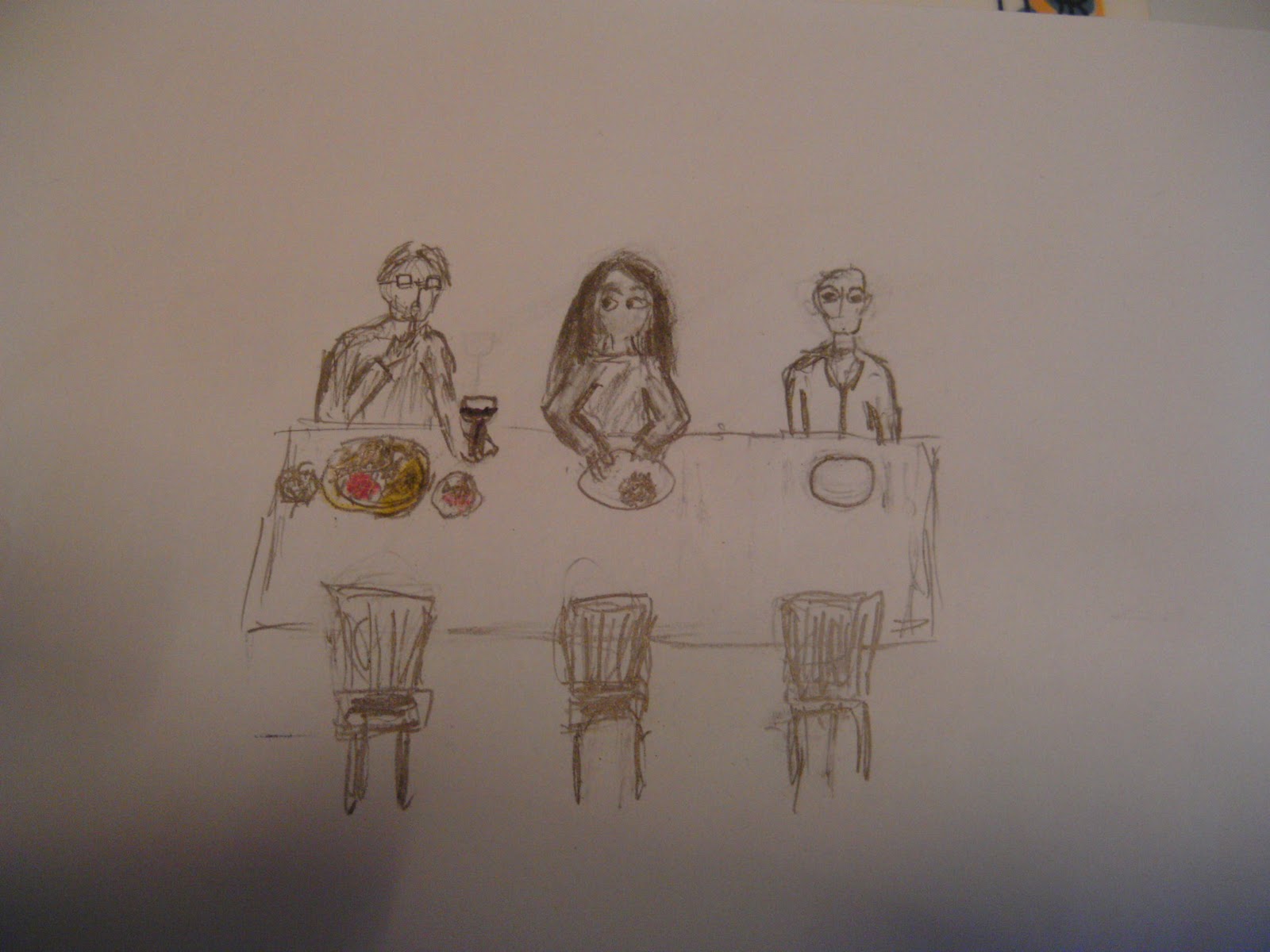
“Mama,” said Clarita, rolling her eyes after her mother’s latest speech. We are North Americans.” Señora Ortega’s brow furrowed when she heard this. She was given to worry about such reactions from her daughter. What of the child’s values? It is true after all. My daughter is American. What does this mean for her future, for our relations, and for us as la familia?
****
Soon Señora Ortega had to put her concerns aside. It was springtime. Easter was upon them and with it a visit from her husband’s sister with her two small children. Señora Ortega and Clarita were busy with preparations. The air in her house smelled of poblanos roasting and cookies baking. They put fresh linens on the beds in the guest rooms. They picked flowers from her garden and set them in vases around the house. She gave in and bought chocolate Easter bunnies too, the silly convention of this country, but the children loved them and looked forward to them each year.
Finally the honored guests arrived and the house was filled with the cheerful noises oflos niños. The boy and girl were now old enough to learn to prepare beans and, on the eve of Easter Sunday, Señora Ortega gave Clarita the task of showing the children how to sort los frijoles for cooking. She looked on as Clarita explained the process. “!Ten cuidado, mis primos. Aqui! Remove these. Remove the wrinkled, the broken, the discolored or malformed. Remove them as you should remove flaws from your character. Remember one bad frijole will ruin the whole pot. Be cautious in your choice of friends. Taparse con la misma cobija. You will be judged by the company you keep. “Los frijoles son nuestra fuerza.” Los frijoles are our strength.
****
At some point, Señora Ortega’s husband had come to stand by her side. She realized he was watching her as intently as she watched their daughter. He put his arm around her and held her close. “You see, mi querida, she is a good girl and you are a good mother. It’s gonna be okay …”
“Am I that transparent,” thought Señora Ortega, but she sighed gratefully. All will be well. My mother was right. “Los frijoles son nuestra fuerza.”
.
* Taparse con la misma cobija – literally: to cover yourself with the same blanket, i.e. likely the same meaning as our expression “birds of a feather.”
MARLENE G. McNEW ~ began exhibiting symptoms of Parkinson’s Disease (P.D.) eight years ago. Her blog (Strange Gift) is a vehicle for sharing her experiences with P.D. and her many, many interests.
Marlene is a master skier and athlete. Her most recent athletic triumph involved successfully completing the Might Mermaid Triathlon, a fund raiser for the Leukemia Lymphoma Society.
For the past several years Marlene’s been able to incorporate into her life increasing involvement in the arts. She expresses her beautiful spirit through poetry, painting, and poetry videos.Her YouTube channel is SkiDisiple. She has designed and uploaded 21 videos at the time of this writing.
Here is Marlene’s latest poetry video. This one is on her experience with the triathlon. Jamie Dedes
Mei Rozavian posts as the spirit moves her … and it always seems to move her to share beauty, insight, and inspiration. Every post of hers is just as sweet as this one. Jamie Dedes
I wish I’d written this. Though, being the product of a convent education, I would not have expressed myself in the colorful way that Señor Steve has. In my case, my parents did not encourage me to read nor did they ignore my reading. They thought my love affair with books written by crazy Americans, dark Russian nobleman, and childless English women was unhinged … and it is. Now it’s late in the game of life and I have no more hope of getting out from under “the reading curse” than Steve does. Enjoy his sideways rant. I did. Jamie Dedes
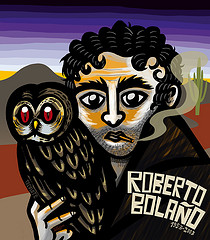
I am a reader, not a writer. Nonetheless, I did write the following profane rumination on the deleterious effects of reading, specifically reading the wrong things, in late January 2010. The particular novel at hand then was 2666 by Roberto Bolaño.
* * * * * * * * * * * *
At page 803 of this novel, something occurred to me. It was an idea with the same beautiful simplicity and clarity of the little bell that I used to hear inside my head at cocktail hour. When I have finished this novel, there will be no point in reading any other novel for the rest of my life. I will finally be done with all of that. I have had this vague feeling for some time that there was something else that I needed to correct, some further, last little personal adjustment. Clearly, this is it.
The ways in which novels have tricked up my head throughout my life to this point make the ways that liquor and women tricked up my head look like paltry, harmless eccentricities. First of all, I had no business ever undertaking great novels in the first place. I do not have the intellectual wherewithal to properly metabolize the best of them. And of course, I always tried to read the best. Why fuck around smoking kid’s stuff when you can mainline a freight train?
Given that simple fact, to think that I chose English literature as my major at university! That is illustrative on several levels. It never crossed my mind to do my undergraduate work in a field in which one could earn money. Never crossed my mind.
Later, I practiced law–in the sense of the pure work, relatively successfully by the way. But there was never any time, energy, or inclination left over to think about money or care about money. No, all of my quality time, energy, and inclination was devoted to reading goddamned novels, when I was not talking about novels in a bar, that is. Pissing away my time on dreams that I was not mentally equipped to dream.
Second, I had no capability for keeping a proper emotional distance from these bastards. These novelists. Bellow, Dostoyevsky,
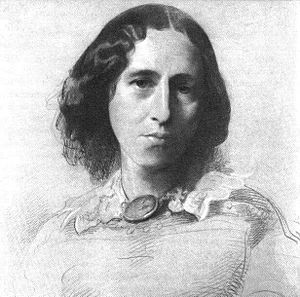
George Eliot by Samuel Laurence via Wikipedia
Tolstoy, Flaubert, Hemingway, Camus, and that too clever Updike, to name a few. The females are just as bad or worse. George Eliot. Austen. Those damned Brontë strumpets. I could not read novels for a little harmless escape and relaxation like a normal person not afflicted with this nameless disease. No, I made those novelists’ problems my own problems, and let me assure you that their problems are all of the first order of complexity no matter how much some of them may make you laugh.
Perhaps I should have tried to start a conversation with one of those women to whom I was married, but I was too busy with Faulkner or Melville. I was more enamored with Eula Varner of Yoknapatawpha County (downright hot for her in fact) than I was with any of that crowd of real women. God, I feel sorry for them in retrospect.
This has been a bane of my existence. A plague upon my house, when I had a house. A plague upon my apartment, when I had an apartment. Clichés those, but I am too upset thinking about this to come up with anything original. I am not upset about myself. I have survived it after all and in a manner of speaking. Those novelists’ problems are not going to be my problems any more.
I am upset thinking about those few young people out there starting to read novels. Not only do their parents do nothing to stop it, many times they encourage those young people in this incredibly dangerous endeavor. As for the proper authorities, they seem perfectly oblivious.
My own parents, God bless them, could have done something to save me. But not being readers themselves, they paid no attention whatsoever to what my young self was reading. Furthermore, they were utterly lax about enforcing lights out in my bedroom. They were too preoccupied with whatever was going on in their bedroom. So there I was at the age of thirteen, fourteen, or fifteen sitting up until 3:00 a.m. reading The Naked and the Dead by Norman Mailer or some other such mind rot. (I do remember that the word “naked” in that title caught my attention at the time.) I did not even have to hide under a blanket with the book and a flashlight.
The way that I see it, we could lose some of the best and brightest of another generation in just that way. Young people who might otherwise accumulate capital and invest it for the general benefit of mankind. Where would we be, for example, if Bill Gates had been screwing around reading novels and staring off into space instead of devoting every bit of his time, energy, and inclinations to devising MS-DOS and contractually fucking IBM? Now he is applying a chunk of the capital that he accumulated in an effort to help feed the world. (Is that the nature of his philanthropy, or is it some other wonderful thing that he and his bride are doing? I cannot remember.)
So this is Roberto Bolaño’s posthumous personal gift to me, this novel entitled 2666. It is as if he handed this to me and said, “Señor Steve, when you finish this novel, you need not read another. It will all be over, you can put it all behind you, and you can truly breathe easily at last.”
If I get the urge to read a novel in the future, if I flirt with a relapse, I will simply reread this one. The book actually consists of five different novels, each of which will be entirely new to me every time I read it. That will do no further harm. In other words, I will never be done with this one and on to another novel with a whole new set of problems. That is the thing to be avoided here.
So that’s it. No more. It’s all over. I mean it. Don’t laugh. I am serious.
* * * * * * * * * * * *
Malcolm Lowery via Wikipedia
So much for that resolution so quickly abandoned along with a myriad others. I am now well into my second reading of Under the Volcano by Malcolm Lowry hard upon my first reading of it.–13 June 2012.
“Professor Robert Thurman of Columbia University draws attention to the treasonous behavior of congress persons who have made pledges to Grover Norquist that contradict their pledges made to the United States as congress persons.” Jason Dunbar who uploaded this video to YouTube.
Robert Thurman holds the first endowed chair in Buddhist Studies in the West, the Jey Tsong Khapa Chair in Indo-Tibetan Buddhist Studies. After education at Philips Exeter and Harvard, he studied Tibet and Tibetan Buddhism for almost thirty years as a personal student of His Holiness the Dalai Lama. He has written both scholarly and popular books, and has lectured widely all over the world. His special interest is the exploration of the Indo-Tibetan philosophical and psychological traditions with a view to their relevance to parallel currents of contemporary thought and science. Columbia University, Department of Religion.
This is posted as information and is not meant as a representation of the views of the many contributors to Into the Bardo who may or may not agree with Professor Thurman. Jamie Dedes
A valuable post that I know will interest readers here on “Into the Bardo.” Both traditional and modern technologies for repair are harbingers of hope whether your concern is personal spirit or the global challenges among cultures and their current expression as warfare and genocide. Jamie Dedes
Yesterday the snows came in the form of persistent flurries that left 1/2 inch of powder on the ground, then largely melted off when the sun came out in the afternoon. Overnight they returned, and continue this morning. The cold has settled in; we had a fire in the wood stove most of the weekend. Very seasonable!
Now the leaves are down we can see areas in the woods where some of the more invasive shrubs have taken hold. One of our naturalist friends believes they will not be able to thrive in more dense woodland, but here they are doing quite well, at least along the margins. Some of them are undoubtedly escapes from our yard. We inherited Burning Bush when we purchased our home. Neighbors also have the plant, which has striking red leaves in Autumn. It also is quite invasive, defying all our efforts to eradicate it…
The phoenix mythology is one of my favorites. I was delighted when California artist, Gretchen Del Rio, recently shared her visual interpretation. With her permission, I present it here. Enjoy, but please be respectful of this copyrighted work. Jamie Dedes
On Thanksgiving Day in 2010, Awyn (The Jottings of an AmeriQuebeckianand Salamander Cove) wrote this piece. It has remained with me since then and this year I asked Awyn for permission to reblog it here. Awyn and I met thanks to Poets Against War. She was kind enough to include two of my anti-war poems in her online poetry magazine, Salamander Cove. Awyn is an accomplished poet and writer of conscience. JAMIE DEDES
.
This is also the perfect post to add to Amy Nora Doyle’s (SoulDipper) Occupy the Blogospher effort.
♥
MAY WE HAVE MANY REASONS TO GIVE THANKS
AND HEARTS BIG ENOUGH TO INCLUDE STRANGERS IN OUR CIRCLE OF CONCERN
♥
Here’s Awyn:
Happy Thanksgiving! — to all those who celebrate this special holiday.
Last year on Thanksgiving, I itemized all the things for which I was thankful. Here it is that time again, one year later and that still all holds true but no special dinner has been planned. Canada celebrated its Thanksgiving Day in October and it’s nowhere near as big a holiday here as it is in the U.S.
In the U.S., for many Thanksgiving means not only a big family dinner but watching the annual parade or football game on TV, big sales on Black Friday the day after, and the horrendous traffic back for those who came in from out of town. All part of the tradition.
We have plenty of big, sit-down dinners here with my mate’s family, but my fondly remembered American Thanksgivings are now a thing of the past. I don’t know any Americans here, my mate’s not that crazy about pumpkin pie, and I’m a vegetarian, so there’d be no turkey. Turkey is traditional but I’ve had many an untraditional version, with calamari or tofu or soup. It was still a thanks-giving. My kids are hundreds of miles away and none of us can afford to visit at this time. Hence no big family Thanksgiving get-together celebration this year. We will share our good wishes over the telephone. As for spectator parade-watching or sports broadcasts or Black Friday shopping, none of that interests me. In that, I guess you could say I’m untraditional. Pumpkin pie, however, is non-negotiable. You absolutely cannot have Thanksgiving without pumpkin pie. It just doesn’t compute.
The most interesting Thanksgiving I ever heard about was from the wife of a former colleague who volunteered at a local soup kitchen. She told me that one Thanksgiving, to raise awareness of all the people who were starving in the world, some organization whose name I can no longer remember invited people to attend a big sit-down Thanksgiving dinner, for $15 per person, proceeds to go towards world hunger.
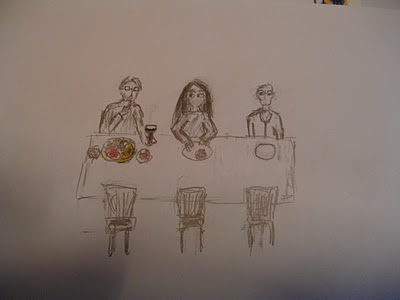
When you arrived, you were asked to pick your entry ticket out of a box. There were three kinds of tickets.
If you got a green ticket, you would be served the full dinner, with all the trimmings–and be allowed seconds on desert.
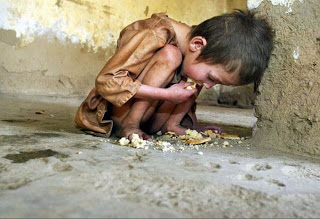
If you got a yellow ticket, you would be served what starving people in third-world countries sometimes get to eat–a child-sized helping of rice or thin, watery soup–and nothing else.
And if you got a white ticket–you’d get nothing at all.
So imagine you’re at this banquet and you get the full meal, with all the trimmings, and you’re sitting next to someone who got nothing. Would you turn and give half of what you have to that person? What if you’re one of the unlucky ones who got the thin, watery soup? Or worse, the empty plate. Would you quietly sip your water and listen to your stomach growl, hoping the people next to you might offer to give you some of theirs?
I’m sure a lot of sharing went around, probably immediately, after the initial surprise (and perhaps discomfort) wore off. Giving money to a charity, for which you get a sit-down dinner, is one thing; being invited to dinner and served an empty plate and having it suddenly sink in what real deprivation is like, is quite another. (Well, the invitation did say the theme was Awareness.) But how uncomfortable to have to sit in front of an empty plate all evening long while others are eating. That glass of water can only go so far.
I went without lunch yesterday–not by choice. I simply forgot. I was working on something and the hours flew and I suddenly realized it was getting dark outside and all I’d had to eat the whole day long was a cup of coffee at 6 a.m. My stomach began reminding me it hadn’t been fed. Loudly. No problem. I could open my refrigerator or reach for something in the cupboard and solve the problem, instantly.
But what if I couldn’t? What if, for whatever reason,there was none to be had and no more food would be forthcoming for another day. Another two days. Maybe even a whole week. How would I deal with that? Certainly, after a day or two, lack of food would make me woozy, lightheaded … lethargic, even. I’d probably lose weight. Temporarily fasting is one thing. Starvation, however, is quite another.
I think that’s what the organizers of that unusual Thanksgiving dinner wanted to convey–that life is not fair. Some of us get to sit down every evening to a good meal, Every Single Night. Some can only afford to buy food meant for animals. Some get somebody else‘s leftovers, fished out of a trash can. And some get nothing at all.
So many things to be thankful for this holiday. Awareness–however received–is one of them.
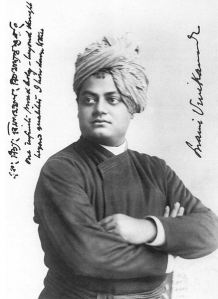
“ I will tell you a little story. You have heard the eloquent speaker who has just finished saying, ‘Let us cease from abusing each other,’ and he was very sorry that there should be always so much variance. But I think I should tell you a story which would illustrate the cause of this variance.
“A frog lived in a well. It had lived there for a long time. It was born there and brought up there, and yet was a little, small frog. Of course, the evolutionists were not there then to tell us whether the frog lost its eyes or not, but, for our story’s sake, we must take it for granted that it had its eyes, and that it every day cleansed the water of all the worms and bacilli that lived in it with an energy that would do credit to our modern bacteriologists. In this way it went on and became a little sleek and fat. Well, one day another frog that lived in the sea came and fell into the well.
“‘Where are you from?’ ‘I am from the sea.’ ‘The sea! How big is that? Is it as big as my well?’ and he took a leap from one side of the well to the other. ‘My friend,’ said the frog of the sea, ‘how do you compare the sea with your little well?’ Then the frog took another leap and asked, ‘Is your sea so big?’ ‘What nonsense you speak, to compare the sea with your well!’ ‘Well then,’ said the frog of the well, ‘nothing can be bigger than my well; there can be nothing bigger than this; this fellow is a liar, so turn him out.’
“That has been the difficulty all the while.
“I am a Hindu, I am sitting in my own little well and thinking that the whole world is my little well. The Christian sits in his little well and thinks the whole world is his well. The Mohammedan sits in his little well and thinks that is the whole world. I have to thank you of America for this great attempt you are making to break down the barriers of this little world of ours, and hope that, in the future, the Lord will help you to accomplish your purpose.”
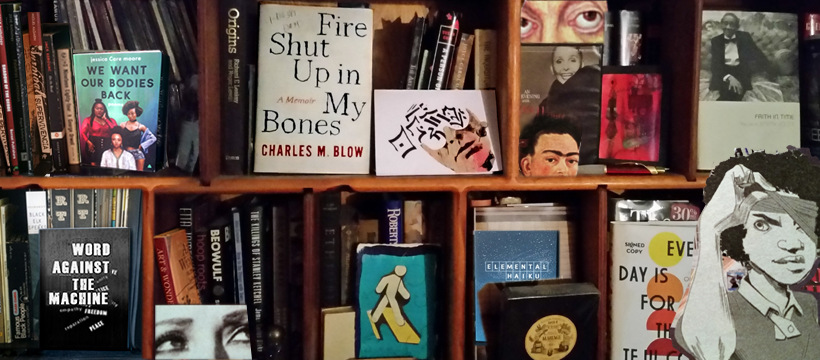

 J.D. Gallager is a: “Writer. Avid reader. Type 1 diabetic. Irish” and “A struggling author … struggling to convince people he is an author.” His blog is HERE and his Amazon author’s page is HERE. Mr. Gallager writes fiction for adults and young adults. (Book cover art is property of the author.)










 The BeZine