NAOMI BALTUCK ~ is a Contributing Editor and Resident Storyteller here at Bardo. She is a world-traveler and an award-winning writer, photographer, and story-teller whose works of fiction and nonfiction are available through Amazon HERE. Naomi presents her wonderful photo-stories – always interesting and rich with meaning and humor – at Writing Between the Lines, Life from the Writer’s POV. She also conducts workshops such as Peace Porridge (multicultural stories to promote cooperation, goodwill, and peaceful coexistence), Whispers in the Graveyard (a spellbinding array of haunting and mysterious stories), Tandem Tales, Traveling Light Around the World, and others. For more on her programs visit Naomi Baltuck.com
“The apricot throws itself on the ground. It is crushed and trampled for its next life.” Yang Mija “sees” while walking through an orchard and takes notes in her poetry notebook
This movie speaks quietly about life and art, devastation and redemption. Like the most refined poetry, it is nuanced, honest and dramatic without being melodramatic or manipulative. It is a spare work, whittled down to essentials. It whispers. It never shouts. Its pacing is leisurely and thoughtful. There is no suggestive music here to help you grasp the story’s progression. There are no stars who have been nipped, tucked, brushed, trussed and boosted. These people are real. They could be me or you or our next-door neighbor. The story could be anyone’s story anywhere in the world. Indeed, Director Lee Chang-dong got the basic idea for the screenplay from a news report..
“ … this story was finally born from a combination of different elements: the sexual assault case, the suicide of a girl, and the lady in her 60s writing a poem.” Lee Chang-dong in an interview HERE
Yoon Jeong-hee stars in the leading role (Yang Mija) and it is the lean script (though the movie is over two hours long) and Jeon-hee’s exquisitely understated acting that transfix us. Watch her face. Watch her body movements. These also are a kind of poetry.
“I’m quite a poet. I do like flowers and say odd things.” Yang Mija
Yang Mija is a sixty-six year-old grandmother charged with the care of a teenaged grandson, Jongwook – or Wook – whose mother is divorced and living in Busan. Wook is lazy and ungrateful and shows no respect for his grandmother or sensitivity to her age and her loneliness.
“You’re sprouting a mustache but acting like a child.” Yang Mija to Wook
Wook is part of a “gang” of male friends, fellow students, who over the course of six months repeatedly rape a young woman who subsequently drowns herself. News of this comes coincident with Yang Mija’s diagnosis of Alzheimer’s disease and her first poetry class. It is her poetry classes and effort to write a poem that provide the through-line for this story.
“The most important thing is seeing.” the poetry instructor to the class on the first day
We walk alongside Yang Mija as she struggles with these multiple challenges – not without some humor – and sorts through her emotions regarding her grandson’s actions, her sympathy for the drowned girl, and the desire of other parents to hide the boys’ culpability by buying off the drowned girl’s mother. While Yang Mija may be suffering the early stages of memory loss, she hasn’t lost her moral compass.
As she moves from one experience to the next, Yang Mija questions: How do you write a poem? Where does the poetry come from? When she decides how she is going to handle her grandson, she is finally able to write her poem.
Agnes’s Song
How is it over there?
How lonely is it?
Is it still glowing red at sunset?
Are the birds still singing on
the way to the forest?
Can you receive the letter
I dared not send?
Can I convey the confession
I dared not make?
Will time pass and roses fade?
Now it is time to say goodbye,
Like the wind that lingers
And then goes, just like shadows.
To promises that never came,
To the love sealed till the end,
To the grass kissing my weary ankles,
and to the tiny footsteps following me,
It is time to say goodbye.
Now as darkness falls
will a candle be lit again?
Here I pray nobody shall cry
and for you to know
how deeply I loved you.
The long wait in the middle
of a hot summer day.
An old path resembling my father’s face.
Even the lonesome wild flower
shyly turning away.
How deeply I loved.
How my heart fluttered at
hearing your faint song.
I bless you
before crossing the black river
with my soul’s last breath.
I am beginning to dream…
A bright sunny morning again I awake,
blinded by the light and meet you
standing by me.
– Yang Mija
“It is not difficult to write a poem. It is difficult to have the heart to write a poem.” the poetry instructor on the last day of class. Yang Meja is not in attendance but has left a bouquet of flowers and her poem
Both thumbs up on this one.
There are probably a lot of places you can go to rent or buy this, but I streamed it from Amazon.
JAMIE DEDES ~ My worldly tags are poet and writer. For the past five years I’ve blogged at The Poet by Day,the journey in poem, formerly titled Musing by Moonlight. Through the gift of poetry (mine and that of others), I enter sacred space.
Continuing along the theme of sacred space, I would like to offer a method of creating sacred group space-especially in places of conflict or tension. Previous posts on sacred space are on the personal labyrinth and personal prayer patterns styled upon praying with beads.
Creating Sacred Group Space
Have you ever been in a situation where you needed to facilitate group sharing (or participate in) around a sticky topic or situation? It is really difficult to get people to move beyond finger pointing, conflict, and blaming. Eric Law developed a method that facilitates sharing in a sticky environment that offers mutual respect and honor to the participants. It is commonly called Eric Law’s Method of Mutual Invitation. I love using it!
Rev. Eric H. F. Law (c) California-Pacific Conference of the UMC
One of the problems with most decision making settings is that a decision must be made! That necessitates a winner and a loser. It is rarely a win/win situation. Most often if one person wins, there is another person who loses or gives in. Eric Law’s Method of Mutual Invitation is not a decision making process, it is a listening process that can lead to deeper points and through long and hard work, lead to a consensus building model where every voice is heard and honored. It is at once simple and profound.
The Method
Mutual Invitation is a small group process designed to allow for inclusion and disciplined sharing in diverse settings, especially where there might be a variety of ages, ethnic backgrounds, different beliefs, or personality types present. The process allows for each person in the group to have an opportunity to share, as well as to participate in group dynamics. The process of Mutual Invitation can be adapted for different settings and purposes, e.g. family meal time, small group sharing, and office meetings.
Someone begins the sharing, related to the chosen topic.
The facilitator will set a time limit for each person.
No questions, responses, or interruptions are allowed during the process.
After the sharing there is a brief pause to allow the others to reflect upon what has been shared.
Responding begins after the pause. The pause should be stretched to a couple of minutes or longer if possible.
Responding is done by asking open ended questions designed to allow the person sharing to examine further her experience.
In a group sharing session, the person who is sharing invites the next person after others have responded to him/her.
Avoid inviting the person sitting next to you. This avoids the tendency to “go around in a circle.”
The goal of mutual invitation is to randomly invite the next person. This random invitation prevents distractions such as anticipating or worrying about what to share. Random invitation also helps keeps the focus on the person sharing.
The invited person may choose to share, to pass for now, or to pass.
Pass for now means she/he can share later when re-invited.
Pass indicates that she/he does not choose to share during this session.
Regardless of what the person chooses, she/he always invites the next person.
The process is repeated until everyone in the group has been invited. And every person has either responded or finished with a final pass.
Pattern sample:
Facilitator states the question being pondered and offers their own response.
Then silence is held for a couple minutes.
The group then asks questions-they must be either clarifying questions or open-ended questions. One person at a time.
The facilitator responds to questions as they come.
At the end of the questions, silence is held for a couple of minutes.
The facilitator invites the next person to share.
The next person responds with either their own sharing, a pass, or a pass for now.
Then silence is held for a couple of minutes.
The group then asks questions-they must be either clarifying questions or open-ended questions. One person at a time.
That person responds to questions as they come.
At the end of the questions, silence is held for a couple of minutes.
That person invites the next person to share.
And so on, until all have shared or responded with a final pass.
This sharing methodology, as simple as it is, has opened up sacred space. I love using it! Especially when confronted with sticky situations and group conflict. It keeps things calm, peaceful, and invites a sacred and healing quality to the space. You could even use it in a study environment! Imagine opening up a text and sharing responses in a group in this sacred, invitational manner! Beautiful.
The most profound time I have ever used this method involved a group in conflict. It was a group coming together after a major loss all with different ideas of how to move forward and very few ideas of how to sit in the loss. We used this method and brought out people’s fears, hopes, sorrows, and even some joys. It became a place of healing rather than a cantankerous committee meeting. It forced us to be still and to hold each other loosely and gently. Creating sacred space.
…
A bit about Rev. Eric Law: He is an Episcopalian priest, is the founder and executive director of the Kaleidoscope Institute, the mission of which is to create inclusive and sustainable churches and communities. He has been writing and practicing for more than 20 years. He can be found online at The Sustainist.
REV. TERRI STEWART is Into the Bardo’s Sunday chaplain, senior content editor, and site co-administrator. She comes from an eclectic background and considers herself to be grounded in contemplation and justice. She is the Director and Founder of the Youth Chaplaincy Coalition that serves youth affected by the justice system. As a graduate of Seattle University’s School of Theology and Ministry, she earned her Master’s of Divinity and a Post-Master’s Certificate in Spiritual Direction. She is a contributing author to the Abingdon Worship Annual. (The 2014 issue just released!)
Archetypal Gothic Lady of Sorrows from a triptych by the Master of the Stauffenberg Altarpiece, Alsace c. 1455
I had written a poem for Mothering Sunday, or Mother’s Day as it is commercially known, which was a few months ago, now. However, I somehow felt it an appropriate story to raise here on Into The Bardo. This is because of the meaning I understand the word ‘Bardo’ has; that is to say a ‘transitional state’ that the Stabat Mater must have entered whilst having to process the extreme emotions provoked by such a harrowing experience, perhaps not the transitional state intended by Buddhist groups, who conceived of this condition, but a transitional state that will, more likely, have provided a protective blanket to help her through the pain.
The poem A Ballad for Stabat Mater struck me on several levels. I had already previously written a poem for my son’s thirtieth birthday (The Fourth Age of Man), basing it on William Shakespeare’s Seven Ages of Man (a monologue, which he wrote to open his play, “As You Like It”). Incidentally, I found it particularly poignant to note that my son had almost reached the same age as Jesus Christ was alleged to be, when his own mortal life ended. So, the latter never had the chance to taste the next three ages; or, perhaps, he lived all seven in that short span of life?
This poem, written in the form of a ballad, was, once again, influenced by Shakespeare’s “Seven Ages of Man”, but this time includes all seven ages. Also, it was, perhaps not surprisingly, heavily influenced by the Stabat Mater, that unforgettable and extraordinarily moving image of this religious icon, Mary, the mother of all mothers, as she stood and watched her own son die, painfully. Stabat mater dolorosa, meaning the sorrowful mother stood, is a masterful understatement. How many mothers could submit themselves to such unbelievable pain! And yet all mothers do, albeit mostly to a lesser extreme, for as long as they live.
I salute all mothers, however good or bad a mother you may think you are, you have still had to suffer for your children.
JOHN ANSTIE (My Poetry Library and 42) ~ is a British poet and writer, a contributing editor here at Bardo, and multi-talented gentleman self-described as a “Family man, Grandfather, Oc casional Musician, Amateur photographer and Film-maker, Apple-MAC user, Implementation Manager, and Engineer. John participates in d’Verse Poet’s Pub and is a player in New World Creative Union. He’s been blogging since the beginning of 2011. John is also an active member of The Poetry Society (UK).
John has been involved in the recent publication of two anthologies that are the result of online collaborations among two international groups of amateur and professional poets. One of these is The Grass Roots Poetry Group, for which he produced and edited their anthology, “Petrichor* Rising“. The other group is d’Verse Poet Pub, in which John’s poetry also appears The d’Verse Anthology: Voices of Contemporary World Poetry, produced and edited by Frank Watson.
* Petrichor – from the Greek pɛtrɨkər, the scent of rain on the dry earth.
the work of Shakti Ghosal, posted again due to its popularity
Fluidity and discontinuity are central to the reality in which we live. (1990), Mary Catherine Bateson(b. 1939), American writer and cultural anthropologist
The other day, I sat leafing through the yellowing pages of that half a century old Peter Drucker classic, ‘The Age of Discontinuity’. This book never ceases to amaze me at the prescient feeling it can generate even after so many decades. Drucker of course could not have envisioned the internet and today’s information flows but his book does ask the question, “As technology becomes ubiquitous, how would we need to cope?” He also challenged us “to be prepared for the complexities”. Big discontinuities that he saw so many years back……. as yet unresolved.
Since the dawn of history, Mankind has experienced discontinuities brought in by adoption of learnt skills and technology. As the first human learnt how to seed and grow plants, Mankind did a makeover from a wandering lifestyle to that of settlers on land. Then with the successive arrivals of the steam engine and electricity, the agrarian lifestyle started morphing into industrial clusters and an associated urban way of life.
And so has been the cycle. A periodic massive disruption of the way we live, the way we work, the way we trade, all leading to a discontinuity. But always, Mankind returned back to stability. Adjusting back into the equilibrium of a new socio-economic format, till the next bout of discontinuity.
But methinks we now have reached a different arena. A space and time where technologies are no longer stabilizing. If at all, they seem to be changing at a faster and faster pace. One needs to just see what is happening to computing, information and communication to appreciate this.
As I reflect, I am left wondering if we are facing the mother of all discontinuities, a shift to a world without stability. A world in which extreme social and economic disruptions become the norm. Be it the ongoing financial turmoil in the global markets. Be it increasing volatility in commodity prices. Be it companies losing out their leadership positions at an increasing rate. Be it product life cycles becoming shorter and shorter. I wonder if these indeed be the symptoms of a world becoming increasingly unstable.
So how do we, the individuals, cope with such constant discontinuities and loss of stability? Wired as we are to cherish stability and continuity in life, how do we retain our balance and sanity?
I think of the Chinese concept of Shi. Simply put it signifies a propensity based on situation. So whenever there is the propensity to play out to an extreme, there also occurs the tendency to self correct and reverse course. And herein lies the magic of Shi- embodying the spirit of dancing in the moment.
Shi is a belief. It promotes lightness and a dynamic view of our world. In Shi, everything is in a state of becoming. So as we focus on the flows and the lightness of the moment, we lose our obsession with discrete people, objects or situations. Shi allows a holistic appreciation of the complex webs of relationships among people, objects and the broader environment.
In a world fast losing traditional reference points, the future may well belong to those who adopt a Shi mindset. Those who embrace the lightness of relationships and flows rather than the heaviness of resource ownership. I believe it would be these ‘dancers of the moment’ who would lead the world in this era of uncertainty and discontinuity.
Acknowledgements:
1 The Age of Discontinuity: Guidelines to our changing society
by Peter F Drucker,1969.
2. The Propensity of Things: Toward a History of Efficacy in China
Shakti Ghosal ~ has been blogging (ESGEE musgings) since September 30, 2011 and he is a Contributing Writer to Into the Bardo. He was born at New Delhi, India. Shakti is an Engineer and Management Post Graduate from IIM, Bangalore. Apart from Management theory, Shakti remains fascinated with diverse areas ranging from World History and Economic trends to Human Psychology and Development.
A senior management professional, Shakti has been professionally involved for over twenty-five years at both international and India centric levels spanning diverse business areas and verticals. With a strong bias towards action and results, Shakti remains passionate about team empowerment and process improvement.
Shakti currently resides in the beautiful city of Muscat in Oman with wife Sanchita, a doctorate and an educationist. They are blessed with two lovely daughters, Riya and Piya.
“All you need is a sense that there is no such thing as ‘no’ and everything is possible.” Moira Kelly
This shining face, this sweet spirit with reason to be bitter and yet he is not. He is a hero and pure inspiration. When our own Naomi Baltuck posted this video on Facebook, I was as touched as anyone would be. I had to wonder though about his mom. What kind of hero is she, I thought, remembering the heroes of my childhood: Josephine Baker and my spiritual mother, Pearl Buck. Each of these women grew their families in unique – and extraordinarily unselfish – ways.
“All my life, I have maintained that the people of the world can learn to live together in peace if they are not brought up in prejudice.” Josephine Baker (1906-1975)
Josephine Baker was born in America but became a French citizen. She was a dancer, singer, actress and civil-rights activist. As a child living in St. Louis, Missouri, she suffered from discrimination, abandonment, and poverty. As an adult she had one miscarriage. She adopted twelve children, two girls and ten boys. They were from diverse races and cultures because, in addition to caring for them, she wanted to show that people can get along despite their different backgrounds. In the early ’80s two of her sons went into business together. They started Chez Josephine, which is on Theatre Row (42nd Street) in Manhattan. They dedicated the restaurant to their adoptive mom’s memory and decorated it with her memorabilia.
“. . . the test of a civilization is the way that it cares for its helpless members.”Pearl Buck (1892-1973)
Pearl Buck was an American novelist, writer, humanitarian and the first woman to be awarded the Noble Prize in Literature (1938). She grew up in China and spent most of her life there until 1934. She had a deep affection for and knowledge of the countries of the East, not just China. She suffered through the Nanking Incident when the National Revolutionary Army captured Nanking (now Nanjing) in 1927. Many Westerners were killed, their homes destroyed, and their property stolen. Her only biological child, Carol, had phenylketonuria (PKU), which causes mental retardation and seizures. She adopted seven children. At a time when mixed-race children were considered unadoptable, Pearl Buck founded Welcome House, Inc., the first international, interracial adoption agency. Welcome House has placed some five thousand children since it was established 1949.
“The greatest act of kindness changes generations. Wherever there is the greatest evil, the greatest good can be achieved.” Moira Kelly (b. 1964)
This brings us to a contemporary hero: the mother of Emanuel Kelly, the young man in the video. Moira Kelly is an Australian humanitarian whose work has garnered her many awards and acknowledgements. When she was eight years old, after seeing a movie about Blessed Teresa of Calcutta (now Kolkata), Moira committed herself to working with disadvantaged children. She is the legal guardian of twins from Bangladesh, Trisha and Krishna. They are surgically separated but originally cranially conjoined twins. Moira Kelly also adopted the Iraqi-born Emmanuel and his brother Ahmet, both born with underdeveloped limbs. Among her efforts is Children First Foundation, formed to provide transportation and healthcare for children with urgent needs in developing countries.
These women are mothers in the best senses of that word. Their ideals are real and they stand by them. They have saved children from abandonment and loneliness, from poverty and hopelessness and, in some cases, from early death. They are goddess mothers and true heroes.
JAMIE DEDES ~ My worldly tags are poet and writer. For the past five years I’ve blogged at The Poet by Day,the journey in poem, formerly titled Musing by Moonlight. Through the gift of poetry (mine and that of others), I enter sacred space.
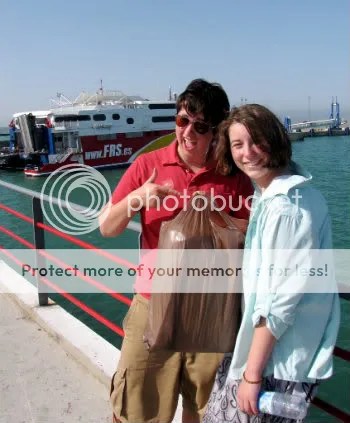
This sunrise was our reward for an early start on a big day. We were staying near Gibraltar, and taking the ferry over to Tangier in Morocco to spend the day. It was our first time ever in Africa, and we were a little nervous to step through that door.
Our driver Rashid was very helpful. Rashid was a good son, who lived with and cared for his elderly mother. His English was difficult to understand, so he and the kids communicated in Spanish. If I had a question, I could make myself understood in my rusty French, but his replies came too quickly for me comprehend. We worked out a system in which Rashid would reply to my French questions in Spanish, which the kids would then translate into English for me.
We were typical tourists. We went to the market.
And did what most of the day trippers do.
We felt grateful for just a quick peek into another world.
One glimpse down a dark alley shed light on another way of life.
We walked past little shops and businesses…
In Tangier we were given a taste of new flavors, colors, music, and customs.
I saw this cat in a narrow passageway, and it occurred to me that cats all over the world speak the same language. I wondered what would happen if people did too. Something would gained, but much would be lost as well.
Then it was time to cross back over the Straits. The kids will never let me live down the fact that I accidentally bought a rug, my only souvenir of that trip. I just wanted to bring home some of the warm vivid colors of a world so very different, and yet so much the same as ours.
Sunrise to sunset, long after the threads on my rug have faded, that day will stay with me.
Copyright 2012 Naomi Baltuck
NAOMI BALTUCK ~ is a Contributing Editor and Resident Storyteller here at Bardo. She is a world-traveler and an award-winning writer, photographer, and story-teller whose works of fiction and nonfiction are available through Amazon HERE. Naomi presents her wonderful photo-stories – always interesting and rich with meaning and humor – at Writing Between the Lines, Life from the Writer’s POV. She also conducts workshops such as Peace Porridge (multicultural stories to promote cooperation, goodwill, and peaceful coexistence), Whispers in the Graveyard (a spellbinding array of haunting and mysterious stories), Tandem Tales, Traveling Light Around the World, and others. For more on her programs visit Naomi Baltuck.com
we live on Turtle Island and turtle is my totem ~
she speaks in the easy way only turtle can,
as one who is at home in herself, at home between
her plastron and carapace, wisdom in her measured
gait, her introversion a model for freedom, for cutting
the nets spun of wars and deceptions . . .
she is the everyday re-enchantment of my solitary
cosmos, my solidarity with life, i read her pastoral
letters in green on green, the sweet grasses and seas,
she speaks of connectedness, the basic constituents
of enigma, wizardry; and in the insanity of the times,
how best to journey and retrieve this world’s soul . . .
she is the unrushed cure for nature-deficit,
that consuming affliction, the spawn of culture’s
back-lighted screens and advertising of every bilk
turtle healing is simple peace and master lessons in
self-containment, she draws me into my meditations
and back along the first path of Maka Ina, the forgotten
primal path of earth ways and feminine energies and
the rhythms of grandmother moon whirling me heavenward.
– Jamie Dedes
Turtle ~ totem or power animal representing earth in Native American tradition
Turtle Island ~ in Iroquois tradition, when the earth was covered over with water, sundry animals attempted to create land by swimming to the bottom of the ocean and hauling up dirt. Muskrat succeeded. He placed the dirt on the back of Turtle, which grew into the landmass known today as North America.
Maka Ina ~ Lakota (Sioux) ~ “maka” is earth and “ina” is mother, so Mother Earth. Earth teachings were/are considered a path to wholeness (heaven).
JAMIE DEDES ~ My worldly tags are poet and writer. For the past five years I’ve blogged at The Poet by Day,the journey in poem, formerly titled Musing by Moonlight. Through the gift of poetry (mine and that of others), I enter sacred space.
Recently, I published a post on creating your own labyrinth as a way of making sacred space in a place where you may not be able to find a way to retreat to your preferred sacred space. This is a continuation upon that theme-creating sacred space in the midst of everyday living.
One thing my Spiritual Director and I agree upon is that I MIGHT have spiritual ADHD. Meaning, I need a variety of spiritual practices to keep me grounded. This totally makes sense since on the unofficial adult ADHD test I recently took, on a scale of 1-6 (6 being the most ADHD), I scored a six. Oh, yes. This penchant to need change and to be easily distracted often must be hemmed in by being very grounded in my own spiritual path while allowing myself the freedom to choose exercises, patterns, or methods from beyond my immediate experience.
This led me to take a workshop on praying with beads! Now, when I signed up for the workshop I knew that it was sponsored by an ecumenical organization so I assumed that it would be somewhat wide-open in its approach. I was wrong. It was a class on praying the Rosary. I am not Roman Catholic, and this was an ecumenical retreat, so I was a bit taken aback by the specific nature of the workshop. However, I decided to simply enter into the spirit of the situation and puzzle out my response later.
I am very glad that I did!
One of My Bracelets
When I was able to reflect on the experience, I thought, “There must be a protestant version of this practice that would fulfill the tactile & prayerful longing that I have!” And I was right! Thank you search engine! I found a Unitarian Universalist Prayer Bead Practice. I cogitated on what I read there and then created my own practice. Now, I make prayer bead bracelets and use them to remind me to stay in touch with the sacred in my everyday living. It is one of the tools in my ADHD spiritual toolkit.
I adapted the main principle of the UUA prayer bead practice and utilized them for myself. I also make these for other folks selecting colors and images that I think will suit their spiritual journey. However, if you don’t have a bunch of beads lying around along with a crimper and all the stuff you need to make a bracelet, you can still do the prayer practice that I am about to outline by using your five fingers, starting at your thumb!
So here it is:
My Hand-Each Finger a Bead
See the “tail” on the bracelet? That is where you start or you can start with your thumb (lightly grasp the very end bead or the tip of your thumb) if you don’t have a bracelet or cannot make one. Sit still. Ground yourself. Rest gently with your eyes relaxed and gazing lightly or close your eyes, whatever is most comfortable to you. Here, focus on your image of the divine. Greet the divine and enter into the presence of holiness and join into a sacred moment. Hold this beloved image closely to your heart. Greetings of love, peace, serenity wash over you, through you, and into you. When you are ready, move up the tail of the bracelet or up your thumb to your hand. Feel each bead or feel each bend in your thumb.
As you go up the beads, breath in and breath out at each small bead. Soon you will land on the large bead (not the clasp) or your fore finger. Here take time to envision those things you want to celebrate! This is a time for adoration, celebration, joy, happiness! Give all of this to your image of the divine and receive the gift that comes back to you whatever that may be. When you are ready, move to the next large bead (or your next finger tip) traveling slowly, thoughtfully, and with divine joy.
At the next large bead, is the time to turn inward and look back at your day (or days before) and to offer a confession of where you have fallen short. For me, this is a time to admit where I have not been loving, peaceful, or justice seeking. Or a time to confess my lack of patience! This can be a time of sorrow, but it should not be a time of shame. We all fall short. Knowing we have, learning from it, and moving to the next bead is what this moment is for. When you are ready, move to the next large bead traveling slowly, thoughtfully, and with the knowledge that you can make mistakes and still return to a place of holiness and sacred healing.
At the next large bead, it is time to name the things, people, and beings in the world that you are thankful for. Let love for the other wash over you and let gratitude sink deeply into you. It may be as simple as a favorite stuffed bear that has traveled with you since childhood. Gratitude in itself is a spiritual practice. Let it flow here. When you are ready, move slowly to the next large bead, touching each smaller bead and breathing in – breathing out at each touch. Do this with the understanding that as you find gratefulness in those around you, others are grateful for you and for who you are.
At the final large bead, it is time to bring your concerns into sacred space. It could be concern for someone’s safety, for healing, for friends or family. Anything that is laying on your heart. Bring them into sacred, healing space. Here, depending on your space and time, you could do many things. You can talk with what is laying on your heart; hold it in love; offer it out to the world or the divine; or even do something creative with it.
Finally, as close this part of the prayer, you will travel back to your initial image. Return to your thumb or return down the tail of the bracelet or beads. Breathing in and out at each small bead or bump along the way. As you return to your image, hold it, sit with it and when you are ready, leave it in whatever manner you are comfortable with. That could be namaste, amen, or a simple good-bye. Whichever way speaks to your path. Return to your every day living, bringing the sacred space you have made with you. Let it travel with you as you go about your day. Remembering that each time you touch your thumb or grasp a bead, that sacredness walks with and in you.
REV. TERRI STEWART is Into the Bardo’s Sunday chaplain, senior content editor, and site co-administrator. She comes from an eclectic background and considers herself to be grounded in contemplation and justice. She is the Director and Founder of the Youth Chaplaincy Coalition that serves youth affected by the justice system. As a graduate of Seattle University’s School of Theology and Ministry, she earned her Master’s of Divinity and a Post-Master’s Certificate in Spiritual Direction. She is a contributing author to the Abingdon Worship Annual. (The 2014 issue just released!)
History hangs heavy in the ocean air, like breath moistened by a story.
In rough weather…
Or calm…
Whether watching intently…
Or only vaguely aware of it…
You can still smell the salt in the air…like a ghost.
You can feel it like a heartbeat…
And hear it like a lullabye…
Copyright 2012 text and photographs Naomi Baltuck
NAOMI BALTUCK ~ is a Contributing Editor and Resident Storyteller here at Bardo. She is a world-traveler and an award-winning writer, photographer, and story-teller whose works of fiction and nonfiction are available through Amazon HERE. Naomi presents her wonderful photo-stories – always interesting and rich with meaning and humor – at Writing Between the Lines, Life from the Writer’s POV. She also conducts workshops such as Peace Porridge (multicultural stories to promote cooperation, goodwill, and peaceful coexistence), Whispers in the Graveyard (a spellbinding array of haunting and mysterious stories), Tandem Tales, Traveling Light Around the World, and others. For more on her programs visit Naomi Baltuck.com
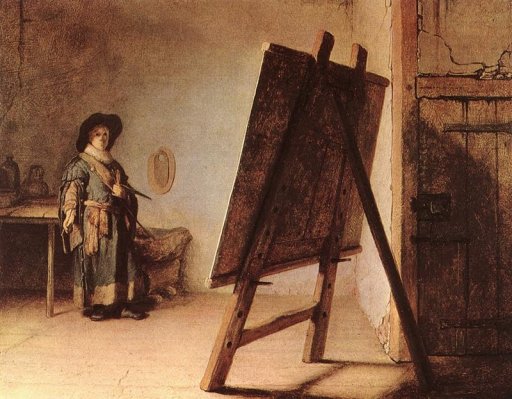
Rembrandt seems peaceful watching the canvas on his easel…
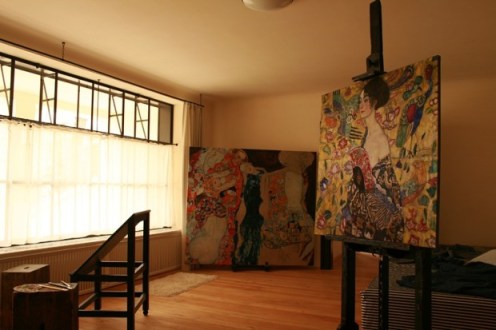
On the easel of Gustav Klimt are the paintings he dreamt…
The word ‘easel’ is an old Germanic synonym for donkey. In the Latin ‘Asinus’, we hear ‘ass’ (donkey).
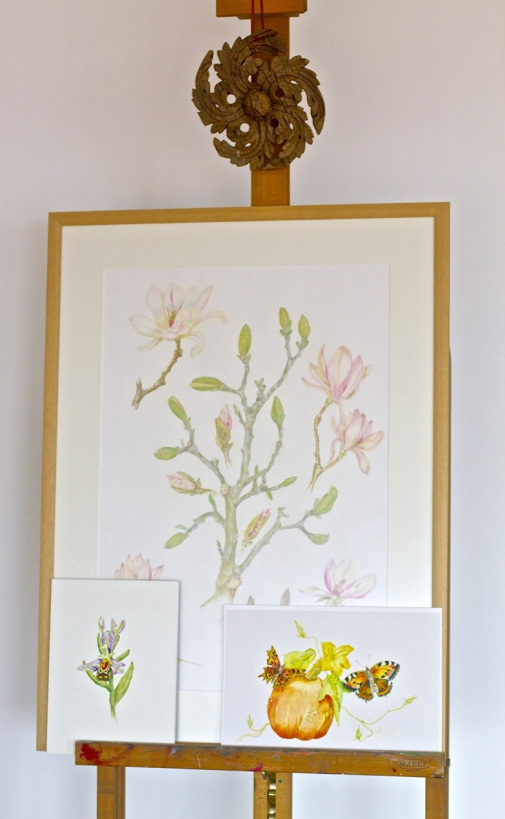
An easel supports a canvas or painting. It is a humble piece of furniture; a few horizontal and vertical pieces of wood nailed together. Its plainness and instrumentality earned it its name ‘easel’ (i.e. donkey). An easel isn’t pretty nor noble, it carries our stuff like a donkey carries our stuff too.
.
It is said the easel was used by Egyptians. It took a long time before frescos and murals lost their glamour and artists started to work with painting boards and canvasses. Fast forward to the Renaissance, we see mobile easels changing dramatically the way painters work. Artists abandon their studios to work in the open air, catching the light, movement of the water, the clouds and waving grasses like no one has done before. The easel helps to create individual artists and new painting styles. Despite its achievements, its name has never been upgraded. Easels never look proud. To me they look often a tiny bit tragic and tired, like overloaded donkeys.
PAULA KUITENBROUWER ~ is a Dutch nature artist living in The Netherlands and sharing her work with us on her blog, Mindful Drawing and on her website. In addition to art, Paula’s main interest is philosophy. She studied at the University of Utrecht and Amsterdam. She has lived in Eastern Europe and in Asia. Paula says that in Korea, “my family lived next to a Buddhist temple. In the early morning we would hear the monks chanting. During my hours of sauntering with my daughter through the beautiful temple gardens, I felt a blissful happiness that I try to capture in my drawings.” Paula sometimes teaches children’s art classes. She lives with her husband and daughter and close to her father. You can view her portfolio of mindful drawings HERE.
JAMIE DEDES ~ My worldly tags are poet and writer. For the past five years I’ve blogged at The Poet by Day,the journey in poem, formerly titled Musing by Moonlight. Through the gift of poetry (mine and that of others), I enter sacred space.
“Ha-ha!” I might hear you say, on seeing this headline, “I must read this… the secrets of life” or, more likely, “not another promise of everlasting joy, health and happiness… I don’t believe it!”
Well, maybe you should, but don’t get too excited, at least until I’ve told you what it’s about!
So, if I were to tell you that it takes some lessons from classical Greek mythology, a legendary Italian Poet, Dante Alighieri, who is, some say, the father of the Italian language; a knock on the door of our own Poet and Playwright, Mr William Shakespeare, by reference to that famous soliloquy in ‘Hamlet’, as well as from a little known South African, Eugene N Marais, who did some fascinating and revealing research on the social life of ants; and that it is a poem called… The Secrets of Life then will you have a different reaction? Or will you think it’s a bit overly preachy?
I hope not and trust you will give it a read and tell me what you think about it and, perhaps, give me your alternative views.
What it does come down to for me is the need for some contentment, a reduction in the stress induced in all of us by, on the one hand a fundamental, genetic and unconscious driving force and, on the other, a conscious material greed; one which can help us survive, the other can cause us to fail to find happiness. There is a balance, somewhere.
I’d like to invite you to read the poem that follows, and tell me where you think that balance is, for you.
Thank you for reading.
The Secrets of Life
The riptide pulled and weighed us down,
swimming in our shoals.
It bent us in our will to win,
oh weary, sorry souls.
Oh tiresome, terrifying days
when scholars moved to preach
that all of Christendom was ours,
but always out of reach.
Oh weary, sorry souls, I cried
for all of us, who’re driven,
wherein unconscious mind, so tuned,
lays bare the ego given.
Always, it seems, beyond our reach,
genetics never fail
to teach us how we must survive,
not how to trim the sail.
Ego’s given winds may blow,
but odysseys must end.
For quests beyond our human bounds,
Inferno may portend.
Just when this sea of troubles weighed
too much on mortal coil,
the magic of encircling arms
became the perfect foil.
So I reset the sails for home,
embracing Vesta’s heart;
discovered Marais’ secret strength:
in concert, ne’er apart.
JOHN ANSTIE (My Poetry Library and 42) ~ is a British poet and writer, a contributing editor here at Bardo, and multi-talented gentleman self-described as a “Family man, Grandfather, Oc casional Musician, Amateur photographer and Film-maker, Apple-MAC user, Implementation Manager, and Engineer. John participates in d’Verse Poet’s Pub and is a player in New World Creative Union. He’s been blogging since the beginning of 2011. John is also an active member of The Poetry Society (UK).
John has been involved in the recent publication of two anthologies that are the result of online collaborations among two international groups of amateur and professional poets. One of these is The Grass Roots Poetry Group, for which he produced and edited their anthology, “Petrichor* Rising“. The other group is d’Verse Poet Pub, in which John’s poetry also appears The d’Verse Anthology: Voices of Contemporary World Poetry, produced and edited by Frank Watson.
* Petrichor – from the Greek pɛtrɨkər, the scent of rain on the dry earth.
What can I tell you?
She loved the guy …
She even loved the
scent of whiskey and cigarettes
She took due note of the clues
warning of devises and vices
that she’d never acquired
She didn’t care He was charming
Coupled in delicate balance
a yin and yang of extremes
a second marriage of differences
Fog being the common denominator ~
though his drink didn’t mix well
with her off-in-the-clouds-somewhere being
The accountant of just-the-facts ma’am
and the dreamer of unlikely dreams She was a trial
The bear who liked to escape to the woods
nonetheless some comfort, a decent person,
a hero of the practicalities,
a maker of omelets and fixer of things,
a reader, a gardener, an angry man
Anger . . .
. . . read pain but you probably knew that
a pain that waltzed with Jack Daniels
lent itself to long diatribes
and Pilsner-invented pontifications
it skied through the veins
built road-blocks to his heart
and in the end,
in the end, in the end
the pain did him in that lost man
that well-meaning, decent
distant, funny, lost man
JAMIE DEDES ~ My worldly tags are poet and writer. For the past five years I’ve blogged at The Poet by Day,the journey in poem, formerly titled Musing by Moonlight. Through the gift of poetry (mine and that of others), I enter sacred space.
We’re bringing this to you several days late and apologies for that … but thanks to Michael Watson for sharing this generous celebration of connection and people by the folks at Lateral Love Australia. J.D.
Where is your light today? What is leading you? What is giving you hope? Joy?
“When I find myself in times of trouble, mother Mary comes to me,
speaking words of wisdom, let it be.
And in my hour of darkness she is standing right in front of me,
speaking words of wisdom, let it be.
Let it be, let it be, let it be, let it be.
Whisper words of wisdom, let it be.
And when the broken hearted people living in the world agree,
there will be an answer, let it be.
For though they may be parted there is still a chance that they will see,
there will be an answer. let it be.
Let it be, let it be, …..
And when the night is cloudy, there is still a light, that shines on me,
shine until tomorrow, let it be.
I wake up to the sound of music, mother Mary comes to me,
speaking words of wisdom, let it be.
Let it be, let it be, …..”
― Paul McCartney
…
…
A note about the light fixture:
I photographed this light at the Merchant’s Cafe in Seattle, Washington. It is the first cafe in Seattle and has seen several iterations of its business as it was built, burned down, and built again. The interesting thing is that it is in the oldest part of Seattle (of course!). It was built in a building near first avenue. The tidal flats used to flood in every day, twice a day, up to third avenue. This makes doing business quite difficult! Seattle then had businesses build their buildings at least two stories tall. Then they raised all the roads, surrounding the existing buildings with raised roads. For a while, they put ladders at the streets so people would go off of the road, down the ladder, into the businesses.
Finally, they built sidewalks that connected the streets to the second story level of the buildings. So today, in Pioneer Square, when you enter the buildings, you are, in fact, entering the second story of the buildings that were placed there. If you look down, you will notice odd glass squares in the sidewalk. Those were originally skylights so that the first story of the buildings were kind of like an inside shopping mall with a view to the sidewalk above. So even there, in the midst of a buried first floor of these buildings, the light was still able to shine!
REV. TERRI STEWART is Into the Bardo’s Sunday chaplain, senior content editor, and site co-administrator. She comes from an eclectic background and considers herself to be grounded in contemplation and justice. She is the Director and Founder of the Youth Chaplaincy Coalition that serves youth affected by the justice system. As a graduate of Seattle University’s School of Theology and Ministry, she earned her Master’s of Divinity and a Post-Master’s Certificate in Spiritual Direction. She is a contributing author to the Abingdon Worship Annual. (The 2014 issue just released!)
aunt bea was reading the sunday paper when i stopped by she said i’ve noticed that they have computer apps for just about everything here’s one that tutors students it even watches the student’s face so it knows if the student is getting upset and will provide some comforting words of encouragement guess we can soon expect that someone somewhere will walk into a confessional ask for father dave and hear dave dave’s not here i’m hal
. CHARLES W. MARTIN (Reading Between the Minds) — earned his Ph.D. in Speech and Language Pathology with an emphasis in statistics. Throughout Charlie’s career, he maintained a devotion to the arts (literature/poetry, the theater, music and photography). Since his retirement in 2010, he has turned his full attention to poetry and photography. He publishes a poem and a photographic art piece each day at Read Between the Minds, Poetry, Photograph and Random Thoughts of Life. He is noted as a poet of social conscience. Charlie has been blogging since January 31, 2010. He has self-published a book of poetry entitled The Hawk Chronicles and will soon publish another book called A Bea in Your Bonnet: First Sting, featuring the renown Aunt Bea. In The Hawk Chronicles, Charlie provides a personification of his resident hawk with poems and photos taken over a two-year period.
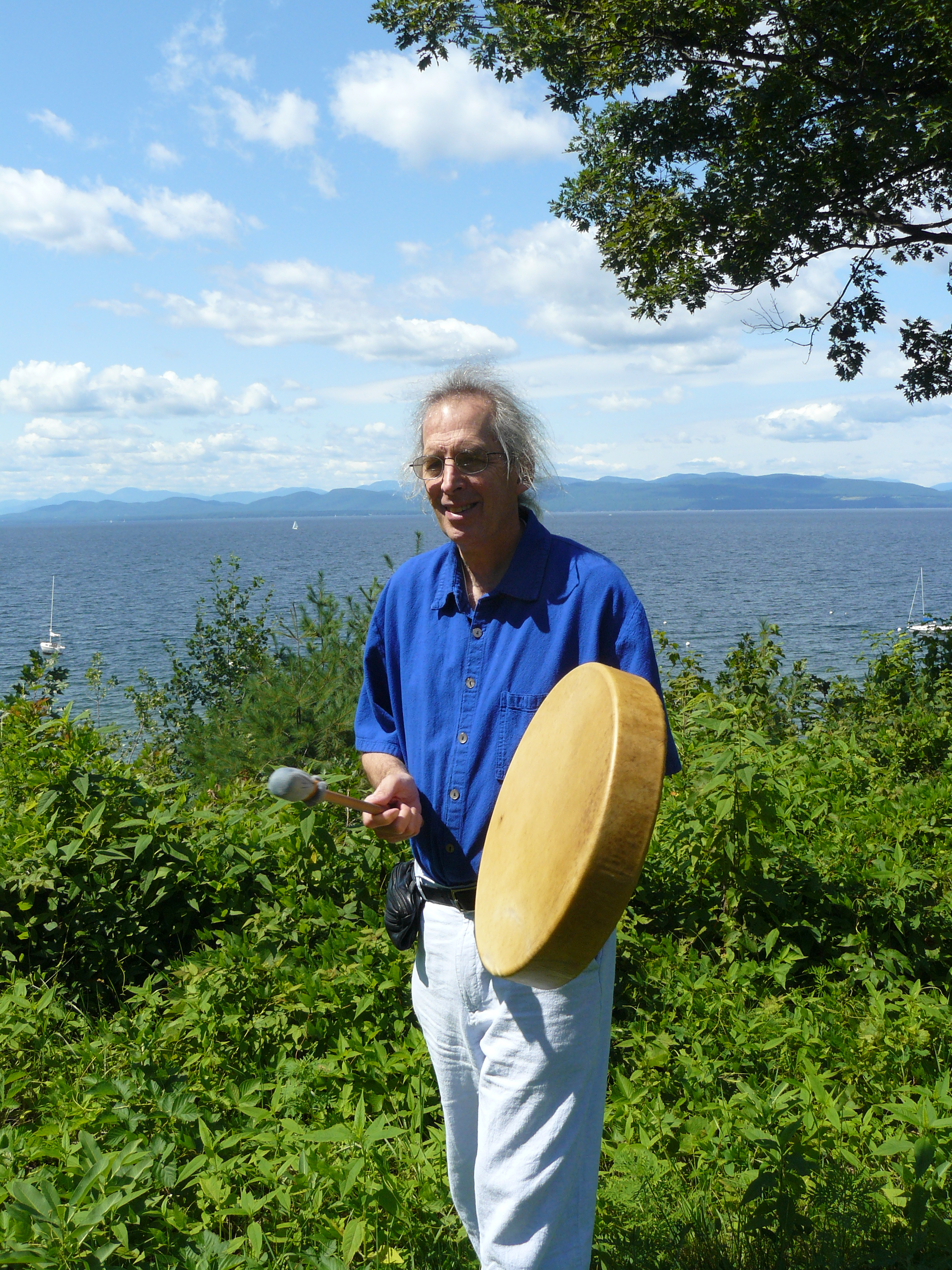
This morning we put aside our frustration and despair and spoke with the land and spirits. The mosquitoes, which had been fierce, quieted their attack, and even the birds calling stopped to listen. We like to open the altar outside whenever the weather allows, but of late have not had the heart to do so. The last time we opened the altar was the only time all summer we have heard the calls of the Hermit Thrush.
We awoke feeling sad and angry. The news on the racial, social, and climate fronts has been heartbreaking. We’ve been feeling overwhelmed, unable to see how we might contribute significantly to much-needed change. We’ve also been asked to aid others who are thinking they should do more than they possibly can. We remind others to do only what they are able. As we do so we remind our many selves to do the same, even as some selves feel frightened and desperate for change.
In the brief ceremony we spoke to the Creator, Pachamama, and the spirits about our gratitude for our lives and our concerns for the present and future. We acknowledged we humans are not caring for the futures of our grandchildren, let alone those of all species who will follow us in seven generations. This is a great sadness.
After the ceremony we came in to respond to e-mail and do other tasks. Online, we discovered a brief video posted to Facebook. In the video, a wild raven, perched on a fence, allows a woman to remove porcupine quills from its face. After each quill is removed, the raven squawks and complains, then allows the woman to soothe it and remove the next quill. How familiar! (Watch video.)
Watching the video, we were once again reminded that ravens are immensely intelligent creatures, that humans are not the only ones who seek aid from others, and that all life forms are profoundly interconnected, in life as in story. We were also reminded that small things, even removing quills from an injured animal, can be powerful ceremony, and profoundly healing to those in an ever-widening circle.
MICHAEL WATSON, M.A., Ph.D., LCMHC (Dreaming the World) ~ is a contributing editor to Into the Bardo, an essayist and a practitioner of the Shamanic arts, psychotherapist, educator and artist of Native American and European descent. He lives and works in Burlington, Vermont, where he teaches in undergraduate and graduate programs at Burlington College,. He was once Dean of Students there. Recently Michael has been teaching in India and Hong Kong. His experiences are documented on his blog. In childhood he had polio, an event that taught him much about challenge, struggle, isolation, and healing.


 NAOMI BALTUCK ~ is a Contributing Editor and Resident Storyteller here
 at Bardo. She is a world-traveler and an award-winning writer, photographer, and story-teller whose works of fiction and nonfiction are available through Amazon HERE. Naomi presents her wonderful photo-stories – always interesting and rich with meaning and humor – at Writing Between the Lines, Life from the Writer’s POV. She also conducts workshops such as Peace Porridge (multicultural stories to promote cooperation, goodwill, and peaceful coexistence), Whispers in the Graveyard (a spellbinding array of haunting and mysterious stories), Tandem Tales, Traveling Light Around the World, and others. For more on her programs visit Naomi Baltuck.com


,_oeuvre_du_Maître_du_retable_de_Stauffenberg,_actif_au_15ème_siècle_(Musée_d%27Unterlinden,_Colmar).jpg)




 This sunrise was our reward for an early start on a big day. We were staying near Gibraltar, and taking the ferry over to Tangier in Morocco to spend the day. It was our first time ever in Africa, and we were a little nervous to step through that door.










 The BeZine