The BeZine Blog

Posted in Uncategorized

Nostalgia

the work of Priscilla Galasso in response to the weekly photo challenge from WordPress

Oh, boy.  It’s a dangerous thing to invite a widow and empty-nester to post a blog on the theme Nostalgic!  Contemplating the past can lead to maudlin stretches and lots of used Kleenex™, even if I don’t have a glass or two of wine first.  I don’t think that would be at all edifying to the blogging community, so I’m going to try hard to steer away from that.  I hope to write and show something that is true about a time that has come and gone.

Life is characterized by impermanence.  Our kids don’t stay little; our loved ones don’t stay alive forever.  What we live is present moments.  If we try to hang on to them and make them more permanent or attach our happiness to them, we are in for a world of frustration.  As we get farther away from present moments, it’s hard to remember what they were really like.  We lose perspective.  That wonderful family outing…did I yell at the kids that day?  I don’t remember.  I probably lost patience at least once.  Did my kids remember that?  How did they feel?  How did they heal?  Or is it all, as my mother often puts it, ‘a merciful blur’?
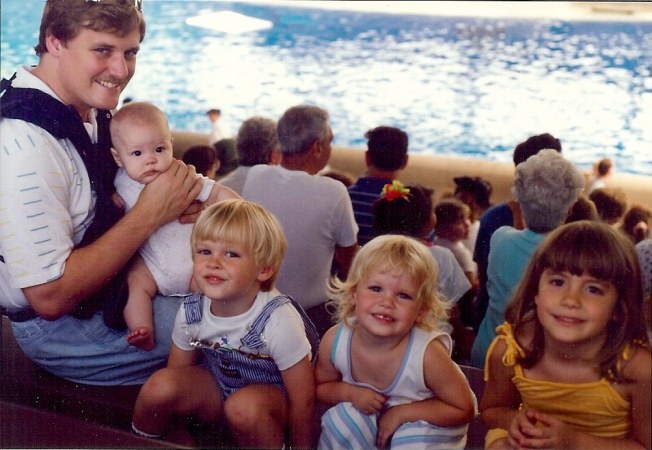
Brookfield Zool dolphin show, August 1991. Jim (RIP), Emily, Josh, Becca and Susan (who will be wed in less than three weeks).

In my current life, I see a lot of families on outings with their children, since I work at two different family museums.  Families interact in all sorts of ways.  I try to look at them with compassion and tolerance remembering what I can about how challenging it is to raise four kids at one time.  The important thing is to BE KIND in the present moment.  With your kids or someone else’s.  If the world is to be a good place to live, it’s important that all seven billion of us humans remember to BE KIND.  And this is not a glib solution.  If you think deeply about being kind, you’ll see that it is a profound power in the universe.   BE KIND to your fellow humans.  BE KIND to every living thing.  BE KIND to yourself first, and feel what that is like.  It is peace.  It is well-being and health.  It is life.  Don’t settle for feeling nostalgic about a time when you felt the world was a kinder place to live.  Make it a kinder place to live this very moment by acting kindly!

– Priscilla Galasso

© 2013, essay and photographs, Priscilla Galasso, All rights reserved
004PRISCILLA GALASSO ~ is a contributor to Into the Bardo. She started her blog at scillagrace.com to mark the beginning of her fiftieth year. Born to summer and given a name that means ‘ancient’, her travel through seasons of time and landscape has inspired her to create visual and verbal souvenirs of her journey.

“My courage is in the affirmation of my part in co-creation”, she wrote in her first published poem, composed on her thirtieth birthday and submitted alongside her seven-year-old daughter’s poem to Cricket magazine. Her spiritual evolution began in an Episcopal environment and changed in pivotal moments: as a teenager, her twenty-year-old sister died next to her in a car crash and, decades later, Priscilla’s husband and the father of her four children died of coronary artery disease and diabetes in his sleep at the age of forty-seven  Awakening to mindfulness and reconsidering established thought patterns continues to be an important part of her life work.

Currently living in Wisconsin, she considers herself a lifelong learner and educator. She gives private voice lessons, is employed by two different museums and runs a business (Scholar & Poet Books, via eBay and ABE Books) with her partner, Steve.

Posted in Essay, Music, Spiritual Practice, Terri Stewart, Uncategorized

Ubuntu

I began thinking of Ubuntu today because I love the music of Eric Whitacre! Eric Whitacre is a contemporary choral composer who excels at using social media to bring people together. I first encountered his music with my children’s choir – Seattle Children’s Choir. The mature choir – Camerata – performed his piece Lux Arumque and I just cried. (I often cry during choir music-especially when my children are/were performing!)

As I mentioned, Eric Whitacre excels at using social media. He has used social media and the internet to create four virtual choirs. His first virtual choir was in 2010. It was his piece, Lux Arumque. He had 243 videos from 12 countries.

His second piece was Sleep. It had over 2,000 videos from 58 countries and was published in 2011. 2012 brought Water Night with 3,746 videos from 73 countries. He is currently assembling Virtual Choir IV – Fly to Paradise – with 8,400 submitted videos from 101 countries.

What does this have to do with Ubuntu?

I first heard of Ubuntu at seminary. I learned it from my friend, Sr. Jane Frances of Uganda. It is encapsulated in the phrase, “I am because we are.”

Bishop Desmond Tutu speaks of Ubuntu in his 1999 book, No Future Without Forgiveness-

A person with Ubuntu is open and available to others, affirming of others, does not feel threatened that others are able and good, based from a proper self-assurance that comes from knowing that he or she belongs in a greater whole and is diminished when others are humiliated or diminished, when others are tortured or oppressed.

He further expands on Ubuntu-

One of the sayings in our country is Ubuntu – the essence of being human. Ubuntu speaks particularly about the fact that you can’t exist as a human being in isolation. It speaks about our interconnectedness. You can’t be human all by yourself, and when you have this quality – Ubuntu – you are known for your generosity. We think of ourselves far too frequently as just individuals, separated from one another, whereas you are connected and what you do affects the whole World. When you do well, it spreads out; it is for the whole of humanity.

We are connected; Eric Whitacre does it well and it spreads out for the whole of humanity.

…night brings its wetness to beaches in your soul (from Water Night)

Let your soul’s beach be made wet again with this offering from Eric Whitacre and Virtual Choir III- Water Night. Connect to Mr. Whitacre, the music, the thousands of artists from around the world, and ultimately, to something that is bigger than we are. This one piece of music is because we are. Ubuntu.

P.S. Half of the recording length is not the music – it is the list of the names of all of the participants.

You can find Eric Whitacre on Facebook. He is wickedly funny!

© 2013, post and poetry, Terri Stewart, All rights reserved

terriTERRI STEWART is Into the Bardo’s  Sunday chaplain, senior content editor, and site co-administrator. She comes from an eclectic background and considers herself to be grounded in contemplation and justice. She is the Director and Founder of the Youth Chaplaincy Coalition that serves youth affected by the justice system. As a graduate of Seattle University’s School of Theology and Ministry, she earned her Master’s of Divinity and a Post-Master’s Certificate in Spiritual Direction. She is a contributing author to the Abingdon Worship Annual. (The 2014 issue just released!)

Her online presence is “Cloaked Monk.” This speaks to her grounding in contemplative arts and the need to live it out in the world. The cloak is the disguise of normalcy as she advocates for justice and peace. You can find her at www.cloakedmonk.com, www.twitter.com/cloakedmonk, and www.facebook.com/cloakedmonk.  To reach her for conversation, send a note to cloakedmonk@outlook.com

Posted in Charles W Martin, Poems/Poetry

godot’s bus stop…

godot's bus stop

aunt bea
sat on the front porch
staring out into the night
watching as youths
made their way
into the city
there were tears
welling up
in her eyes
i asked
if she was alright
she said
for so many years
i worked just
to survive
raise my children
with honor
and
pride
i cleaned houses
washed
and
ironed laundry
i could never afford
for myself
and
prayed
that someday
these streets
would be safe
for
anyone to walk down
no gangs
no police
no
neighborhood watch robbery barons
just
someplace safe
i’m still
praying
but
i
survived

– Charles Martin

© 2013, poem and illustration, Charles Martin, All rights reserved

678ad505453d5a3ff2fcb744f13dedc7-1product_thumbnail.phpCHARLES MARTIN (Reading Between the Minds) — earned his Ph.D. in Speech and Language Pathology with an emphasis in statistics.  Throughout Charlie’s career, he maintained a devotion to the arts (literature/poetry, the theater, music and photography).  Since his retirement in 2010, he has turned his full attention to poetry and photography. He publishes a poem and a photographic art piece each day at Read Between the Minds, Poetry, Photograph and Random Thoughts of Life. He is noted as a poet of social conscience. Charlie has been blogging since January 31, 2010. He has self-published a book of poetry entitled The Hawk Chronicles  and will soon publish another book called A Bea in Your Bonnet: First Sting, featuring the renown Aunt Bea. In The Hawk Chronicles, Charlie provides a personification of his resident hawk with poems and photos taken over a two-year period.

Posted in Essay, Guest Writer, Music, Poems/Poetry, teacher

MY TRUMPET TEACHER IS A POET: Is that cool?

Trumpet_in_c_germanthe work of Kim Moore (Kim Moore, poetry), originally published in Artemis poetry and posted here with Ms. Moore’s permission and that of the publisher

When I was first asked to write an article exploring the links between being a poet and a trumpet teacher, my first reaction was panic. How could I possibly link my poetry life and my teaching/music life together? In my head they occupy two very separate spaces. Whilst pondering this, I grumpily thought of how often they seem to leech time and energy from each other, and it was this thought that made me realise they must be linked in some way and gave me the confidence to start writing.

I’ve only just started telling pupils that I write poetry – they often just look at me strangely. Then they ask what I write about – I usually change the subject and make them play a scale or something – because what poet likes to be asked what they write about? Especially when you are asked by a ten year old who is not going to be impressed by an airy flourish of my hand and a vague reference to gender politics.
.
At the beginning of 2012 I told one of my teenage pupils I’d got a job working as a poet in a men’s prison for ten weeks. He looked at me in disbelief, then did that clicking knuckles thing that’s all the rage with young people, before exclaiming with delight ‘You’re gonna get stabbed!’ followed by another click of his knuckles. When I appeared the next week with no puncture wounds, triumphant, he’d forgotten about the conversation already.
.
I’ve been working as a full time brass teacher for seven years – but in September 2012 I decided to reduce my contract down to four days a week to give myself more time to write. I teach in about 16 primary schools a week delivering a programme called ‘Wider Opportunities’ where every child in the class gets a brass instrument as well as the teacher and teaching assistants. I also run two brass bands and teach small groups of children as well.
.
I think the most important part of my job is to show both adults and children that music is for them. I can relate to thinking that it is not you see – being the only child in the school not allowed in the choir age eleven. The same thing happens in poetry – people think it is not for them – but it is surprising how many people in conversation will admit they have written a poem or ‘always wanted to learn to play a musical instrument’.
.
As I’m writing this article, I can see more and more connections. The role of peripatetic teacher is always that of an outsider – I’m not attached to any school and this loneliness is reminiscent of the work of being a poet, or a writer. My two worlds creep closer when I think of the way I had to learn as a new teacher, that my hope of guiding young players who spent every spare minute practising (as I did) off to music college was unlikely. I had to learn to let go of what I wanted, to understand that if my enjoyment of my job, my success, was measured by how much my pupils practised and whether they went off to music college, I would be a Very Miserable Teacher. I had to learn to listen to what my pupils wanted – and this transaction is often non-verbal because sometimes they don’t know either. Doesn’t this sound like poetry? The act of letting go, of relinquishing control is precisely what writing is to me. I learnt as a poet as well, that if I measured success by publication or prizes I would be a Very Miserable Poet.
.
Another part of my job is conducting a junior band. This is going to sound harsh, but conducting is all about imposing your will on the group. There is no room for anyone else to be creative. In fact, rehearsing is more like editing a poem – practising the same section over and over again, breaking the band down into parts so you can hear the weakest links – is exactly like reading your own poem over and over again, to find a line that will give way under scrutiny.
.
Teaching music and writing poetry are ultimately an act of balance – they both have that feeling of walking a tightrope, of words being vastly important. I often find myself using the same catchphrases when I’m teaching – they almost become your own personal clichés. I made a list of mine and turned it into a poem – it made it into my first pamphlet at the last minute and on the advice of my editor, Ann Sansom rather than any passion for it on my part – maybe it reminded me too much of work – but it is often the poem that people comment on – the most surprising people will confess they used to play a brass instrument or will say ‘I remember my trumpet teacher saying that to me when I was small’. And of course, the lines in my poem are not mine at all, really. They were given to me by my trumpet teacher and I remembered them, and repeated them to my pupils, like a poem, learnt by heart.
.
Teaching the Trumpet

I say: imagine you are drinking a glass of air.
Let the coldness hit the back of your throat.

Raise your shoulders to your ears, now let
them be. Get your cheeks to grip your teeth.
Imagine you are spitting tea leaves
from your tongue to start each note

so each one becomes the beginning of a word.
Sing the note inside your head then match it.

At home lie on the floor and pile books
on your stomach to check your breathing.

Or try and pin paper to the wall just by blowing.
I say: remember the man who played so loud

he burst a blood vessel in his eye? This was
because he was drunk, although I don’t tell

them that, I say it was because he was young,
and full of himself, and far away from home.

– Kim Moore

© 2013, essay and poem and portrait (below), Kim Moore, All rights reserved
Photo credit ~ trumpet by Benutzer:Achias under Creative Commons Attribution-ShareAlike 3.0 Unported license

Society of Authors Awards June 2011 Kim Moore  Eric Gregory AwardsKIM MOORE (Kim Moore, poetry) ~ works as a peripatetic brass teacher in Cumbria. In 2011kim-moore-if-we-could-speak-like-wolves_1 she won an Eric Gregory Award and the Geoffrey Dearmer Prize, and in 2012 her first pamphlet  If We Could Speak Like Wolves was a winner in the Poetry Business Pamphlet competition, judged by Carol Ann Duffy. It was selected as one of the Independent’s ‘Books of the Year’. Kim has been published in various magazines including The Rialto, Poetry Review, The TLS, Magma, and ARTEMISpoetry. She is currently working on her first collection. You can sample more of her poetry on her blog HERE.

,

artemis-1ARTEMIS poetry ~  the bi-annual journal (November and May) of the Second Light Network , a professional association of women poets. The journal is published under their Second Light Publications imprint. Members receive a copy as part of their membership benefits. Issues are available to non-members by subscription at £9 p.a. or as a one-off purchase at £5 a copy (plusp&p).

Posted in Culture/History, General Interest, Guest Writer, Karen Fayeth, memoir

For the Love of a Good Cuppa

A couple years ago, my husband and I had the chance to celebrate the Fourth of July with some good friends. There were six of us total (three couples), and we met at our friend’s house for a special treat.

One of our crew had just recently returned from a trip to Ethiopia. She and her husband are in process of adopting an adorable baby boy and she had to make a visit to work through the paperwork with the local courts.

While in country visiting her baby son and patiently working though the long process, she was treated on several occasions to the Ethiopian coffee ceremony.

On our Fourth of July holiday, she wanted to share this ceremony with us, her friends.

About the coffee ceremony, here’s a quote from Ethiopian ambassador Haile-Giros Gessesse:

“Coffee has social value in our society. It is deep rooted in our culture. The coffee ceremony in local areas is used mainly for social gatherings. In the mornings and evenings parents, especially mothers gather together for a coffee ceremony and also use it as a platform for exchanging information in their surroundings. It is a means of communication. When people sit down they usually spend three hours finalizing the ceremony, starting with the preparation, and then roasting to brewing it.”

Our friend had hauled home a big bag of green coffee beans, water hulled (the good stuff) not fire hulled, and we sat outside in the beautiful sun while she told us about the ceremony.

First, she roasted the beans on the grill. We watched as she shook and swirled the pan, much like a slow Jiffy pop motion.

When we all agreed that it looked like the beans were at a good medium roast each of us took in a whiff of the fantastic aroma from the pan.

Then we took turns using a mortar and pestle to smash the beans down to a nice grind. Every person took their turn and everyone contributed.

It was satisfying work to smash, smash, smash those crispy beans and release the beautiful scent and oils.

Once ready, the grinds were placed into a French press and once brewed, a round of coffee was poured into six cups.

This fresh roasted coffee was delicious! It had a floral aroma and tasted so light and mild. This coffee was perfect with just a touch of sugar and nothing else.

In keeping with tradition, we had three rounds of coffee while we discussed our lives, the news of the day, baseball, and got caught up with each other. This is an essential part of the ceremony, sharing community, support, and friendship.

Now, I love a great cup of coffee, but I rarely drink caffeinated coffee. After three cups I was ready to clean my house top to bottom, jog a thousand miles, and throw a 98mph fastball.

But it was a happy caffeinated high shared with dear friends.

I was honored to be a part of the ceremony and I can hardly wait until our friends bring home their baby boy. I hope to we can continue to give him a sense of community and family, maybe even over a cuppa or two…or three.

– Karen Fayeth

© 2013, essay, Karen Fayeth, All rights reserved
Photo and quote from a CRIEnglish.com article by Wei Tong.

webheadshotKAREN FAYETH ~ is one of our regular writers. She is our tech manager, site co-administrator along with Jamie and Terri, and fiction and creative nonfiction editor. She blogs at Oh Fair New Mexico. Born with the writer’s eye and the heart of a story-teller, Karen Fayeth’s work is colored by the Mexican, Native American, and Western influences of her roots in rural New Mexico complemented by a growing urban aesthetic. Karen now lives in the San Francisco Bay area. When she’s not spinning a tale, she works as a senior executive for science and technology research organization.

Karen has won awards for her writing, photography, and art. Recent publication credits include a series of three features in New Mexico magazine and an essay with the online magazine Wild Violet. Her latest short story “Quick, Quick Slow” was published in the May edition of Foliate Oak. Karen’s photography is garnering considerable attention, her photo titled “Bromance” (featuring Aubry Huff and Pat Burrell) was featured on MLB Network’s Intentional Talk hosted by Chris Rose and Kevin Millar.

Posted in Jamie Dedes, Poems/Poetry

It Was the Golden Light

800px-Dovedale_by_Moonlight_-_Oberlini awoke
it was the golden light
the moon camping out
casting my room in the
glow of its fire

i thought
for a moment
unsure of my place
forgetting
what city
what state
what day

seconds passed
soundless
slowly peeling away
the veil, the confusion
i melted into
the golden light
breathed myself
into sleep again
done

and done
as easily perhaps
as breathing into
eternal sleep
so frail and fragile
is this anchor
this silver thread
this castle of solitude
this just me
inside me
inside life

© 2013, poem, Jamie Dedes, All rights reserved,  
Illustration ~ from Allen Memorial Art Museum (Oberlin College) a photograph Joseph Wright of Derby’s (English Derby, 1734-1797) Dovedale by Moonlight (ca.1784-85). Description/details HERE.

Photo on 2012-09-19 at 20.00JAMIE DEDES ~ My worldly tags are poet and writer. For the past five years I’ve blogged at The Poet by Day,the journey in poem, formerly titled Musing by Moonlight.  Through the gift of poetry (mine and that of others), I enter sacred space.

Posted in Bardo News, John Anstie, Victoria C. Slotto

Welcome John Anstie and Victoria C. Slotto to Bardo’s Core Team

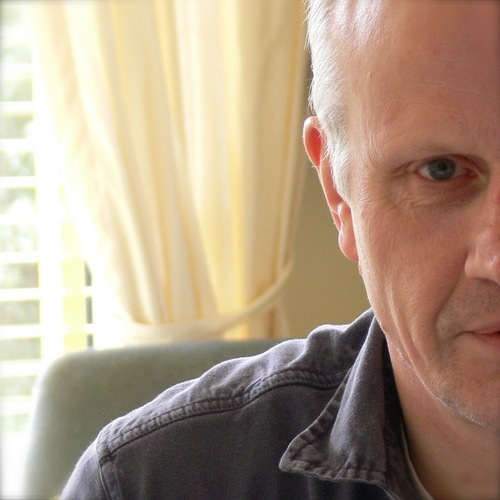
John_in_Pose_Half_Face3JOHN ANSTIE  (My Poetry Library and Forty Two) ~ As near as we can determine, John’s been blogging since early 2011.

For twenty years, he was a Rugby Union player with an ‘eight-pack’, which was helped in the early days by a school run on the same lines as Gordonstoun as well as by farming and working as a leather factory packer and security guard. The ‘eight pack’ was not helped, John admits, by becoming an ice cream seller. He’s also earned his keep as metallurgical engineer, marketing manager, export sales manager, and managing director of his own company. He’s a poet and blogger, a would-be musician with a piano and a forty-year-old Yamaha FG140 acoustic guitar. He is a singer in and chairman of a local amateur choir. He is also a would-be photographer with drawers full of his own history. John’s an occasional but lapsed ‘film’ maker. In his other life, he doubles as a husband, father, grandfather, uncle, cousin, friend and family man. In sort, it would seem John leads a well-rounded life and a rich one in terms of both arts and family. We’re wanting to call him a renaissance man, of which we have several in residence here along with a fine group of renaissance women.

John’s prose and poetry tells us everything else we need to know about him … or at least all that he’s currently prepared to tell us. He has just completed an anthology of the poetry of nine poets who met two years ago on Twitter. He produced and steered the book entitled  “Petrichor Rising.”  It’s publication will be announced shortly by Aquillrelle. The story of this project’s evolution and naming is interesting and enlightening. You can read it HERE. Among other things, it’s another thumbs-up for connecting to like-minded folks through social media.

Victoria and Dave Slotto

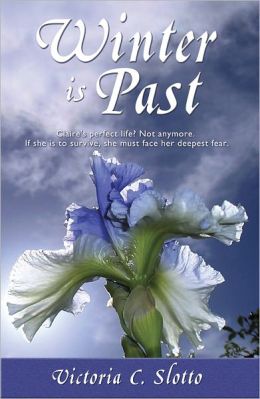
VICTORIA SLOTTO (Victoria C. Slotto, Author)had her first novel – 2940013445222_p0_v1_s260x420Winter is Past – published last year. Her second novel is in progress as is a poetry chapbook. Victoria is a gifted writer and poet, and we are proud and delighted to feature her here. It is gratifying to see how well Victoria incorporates important insights and ideals into the narrative flow of her novel, her flash fiction, and her poetry. If you have occasion to read her novel, you will not soon forget the spirit of her major protagonist, Claire.

Victoria attributes her writing influences to her spirituality, her dealings with grief and loss, and nature. Victoria spent twenty-eight years as a nun. When she left the convent, she continued to work as a nurse in the fields of death and dying and she has seen and experienced much. Because of her experience, Victoria is able to connect with her readers on an intimate level.

Victoria resides in Reno, Nevada, with her husband and two dogs and spends several months of the year in Palm Desert, California. Winter is Past, her first novel, was published by Lucky Bat Books. Victoria is also an accomplished blogger, sharing her fine poetry with us HERE and participating in a leadership role on d’Verse Poets Pub.

SOMETHING NEW AT INTO THE BARDO:  As part of her participation here, Victoria will be bring something quite new to Bardo, a reader-participation post once a month. The ETA to be announced. This participation will be in the form of a writing challenge. We’re doing this in acknowledgement of the many, many talented writers who are so kind and supportive, reading here, “liking,” and often commenting. Readers will be able to participate by entering their post link through MisterLinky, which most of you have used but further explanation will be forthcoming for newbies. Victoria and Jamie look forward to reading your entries and hope that you will also read one another’s work.

Posted in Essay, Meditation, meditative, Spiritual Practice, Terri Stewart, Uncategorized

Meditations of Our Hearts

I am saddened and deeply troubled by the Trayvon Martin case verdict. Mark Sandlin, a new Facebook friend of mine, offered the below. I have decided to add it to what I previously planned to publish. What I originally offered is a meditation based on a Psalm using very simple body prayer-a video that I put together. I thought about simply letting the video go for another day, but I think I, at least, need the reminder that there is something greater than the imperfection that we find in our daily living.

Questions?

Will anyone’s soul rest well tonight?
Will justice feel it was served?
Will a weary nation rest easy?
Can it believe its truths still hold true?
That all are created equal?
That truth is our nation’s highest good?
How can we sleep?
How can we slumber
when justice seems to be a game
and innocence has become relative?
Will we not grow restless?
Will our tears not matter?
Shall we continue our malaise?
Is our discontent so flaccid
that is ends in a Facebook post?
Is our will so weak that it is eased
with nothing more than words on a page?
Is the cost of our inconvenience
truly more valuable than a life…
our rights…
our jobs…
the hungry…
the sick…
the poor…
minorities…
?
Will our souls rest well tonight?
Should they?
Will our discontent respond?
Or will it slumber?
Will we drown out our malcontent
with the drone of a television…
the buzz of a beer…
the mindless escape of Candy Crush…
the busyness of our lives…
?
Will we simply get over it…
When there are parents who cannot,
When children are starving,
When there are families being buried,
While men make laws about women’s bodies,
As rights which were received
at the cost of lives
are made a mockery
for the sake of the few…
will we rest well tonight?
Will we rest?

Mark writes for Huffington Post, Sojourners, and his own blog at The God Article. This is reprinted with permission.

My fair warning before the video–this is in my living room, not professionally done! Bear with me as I learn these new skills.  Shalom.

© 2013, post and video, Terri Stewart, All rights reserved

MARK SANDLIN is an ordained PC(USA) minister currently serving at Vandalia Presbyterian Church in Greensboro, NC. Mark is a co-founder of The Christian Leftand blogs at The God Article. He has been featured on NPR’s The Story with Dick Gordon, PBS’s Religion & Ethics NewsWeekly, and the upcoming documentary filmAmendment One.

terriTERRI STEWART is Into the Bardo’s  Sunday chaplain, senior content editor, and site co-administrator. She comes from an eclectic background and considers herself to be grounded in contemplation and justice. She is the Director and Founder of the Youth Chaplaincy Coalition that serves youth affected by the justice system. As a graduate of Seattle University’s School of Theology and Ministry, she earned her Master’s of Divinity and a Post-Master’s Certificate in Spiritual Direction. She is a contributing author to the Abingdon Worship Annual. (The 2014 issue just released!)

Posted in Peace & Justice

Orhan Pamuk: The Fear of Being Left Outside, What Literature Needs to Address

Orhan Pamuk (b. 1952), Istanbul Turkey, Novelist
Orhan Pamuk (b. 1952), Istanbul Turkey, Novelist ~ photo courtesy of Mr. Pamuk

“What literature needs most to tell and investigate today are humanity’s basic fears: the fear of being left outside, and the fear of counting for nothing, and the feelings of worthlessness that come with such fears; the collective humiliations, vulnerabilities, slights, grievances, sensitivities, and imagined insults, and the nationalist boasts and inflations that are their next of kin … Whenever I am confronted by such sentiments, and by the irrational, overstated language in which they are usually expressed, I know they touch on a darkness inside me. We have often witnessed peoples, societies and nations outside the Western world–and I can identify with them easily–succumbing to fears that sometimes lead them to commit stupidities, all because of their fears of humiliation and their sensitivities. I also know that in the West–a world with which I can identify with the same ease–nations and peoples taking an excessive pride in their wealth, and in their having brought us the Renaissance, the Enlightenment, and Modernism, have, from time to time, succumbed to a self-satisfaction that is almost as stupid.”

—Orhan Pamuk, Nobel Lecture (translation by Maureen Freely), 2006
.
This seem the perfect piece to expand on Michael Watson’s post yesterday and his comment, “. . . we seem to be caught up in the Bardo, spinning endless fantasies derived from fear, greed, and anger” … and we would add “hubris.”  So just some thoughts for us as poets and writers, artists and musicians, therapists, clerics bloggers … and simply as humans beings.
.
Is Orhan Pamuk’s statement fair? How do you feel about it?.
Posted in Essay, Michael Watson, Peace & Justice, Uncategorized

Life in the Bardo

Waterbury, VT, ParadeI just returned from purchasing a new computer monitor. Last night, my two-year-old monitor suddenly malfunctioned. When I went to the store this morning, the associate with whom I spoke said she thought the life expectancy of new monitors might be about a year. Expensive and time-consuming.

Last week a colleague attended a national conference in Seattle. This gathering of psychotherapists moves about the country from year to year. The Seattle conference was immense, forming a forum for many hundreds of therapists. It also took place in a part of the country with a large and obvious Native presence, yet seemingly made no attempt to include, or even acknowledge, Seattle’s diverse Native community.

During a workshop towards the end of the conference my colleague spoke to the absence of a Native presence at the conference. After the workshop, a woman came up and thanked her for speaking up, explaining she was Native and had been deeply disturbed by the notable absence of her community. (Tibetan monks had been invited to build a sand painting during the conference.) She was also aware of her light skin color,and fearful her whiteness might disqualify her from speaking, at least in the eyes of her fellow conference participants.

Also, last week the latest film version of The Lone Ranger came out. As you may know, Johnny Depp stars as a very wise Tonto, who just happens to wear a stuffed bird on his hat, an oblique reference to the imagined Native. A couple of day’s ago a panel gathered to chat about the film on NPR’s On Point. A young Native woman who blogs at Native Appropriations was also invited on briefly critique the film. Sadly, the non-Native reviewers, even with a bit of Native guidance, simply failed to understand why the film might be offensive. I invite you to read Adrienne K.’s comments at Native Appropriations for a detailed critique of the stereotyping and racism inherent in the film.

Finally, Thursday was the Fourth of July. For me there are three highly problematic holidays in the U.S. calendar: July Fourth, Columbus Day, and Thanksgiving. Each celebrates, in some way, the theft of our land and the genocide, physical and cultural, against our people. On the Fourth our family usually attends a small town parade, and always we look forward to the evening fireworks. Small town celebrations are all about the local, although even here in Progressive Vermont, there may be no mention of the several Native tribes that lived here prior to the arrival of Europeans, descendents of who still call Vermont home. I guess acknowledging Native people opens up to many uncomfortable questions concerning genocide, appropriation, and land claims.

As a light-skinned Native person I wrestle with questions of identity. I also, in my elderhood, am likely to speak my mind about issues anyway, although most of the time no one seems to be truly listening. One of my friends, an aged Cree medicine woman who stands just about five feet tall, sometimes wanders around carrying a large hunting rifle, “To get people’s attention.” Sometimes I despair.

Locally we have developed what amounts to a Buddhist/Native dialog. We’ve discovered we agree about most things. For instance, there is a lovely idea in Pure Land Buddhism and in some Native thought that we are already in Paradise and simply don’t recognize it or act accordingly. Rather, we seem to be caught up in the Bardo, spinning endless fantasies derived from fear, greed, and anger.

Life in the Bardo is challenging. We seem to be sinking in a sea of expensive, poorly made, often essential, material goods that break all too often. We go about trying to find distraction or release and fail to notice or acknowledge the suffering created and continued by our actions and those of the folks who came before. In the process, we cause more harm even though we might wish otherwise. No wonder the Prophets from many traditions tell us to wake up. I imagine paying heed to our lives might in the end be less painful than the road we are collectively on now; maybe we could even create the conditions for fine lives and rebirths. Now that is a good Dreaming.

– Michael Watson, Ph.D.

© 2013, essay and photographs (includes portrait below), Michael Watson, All rights reserved

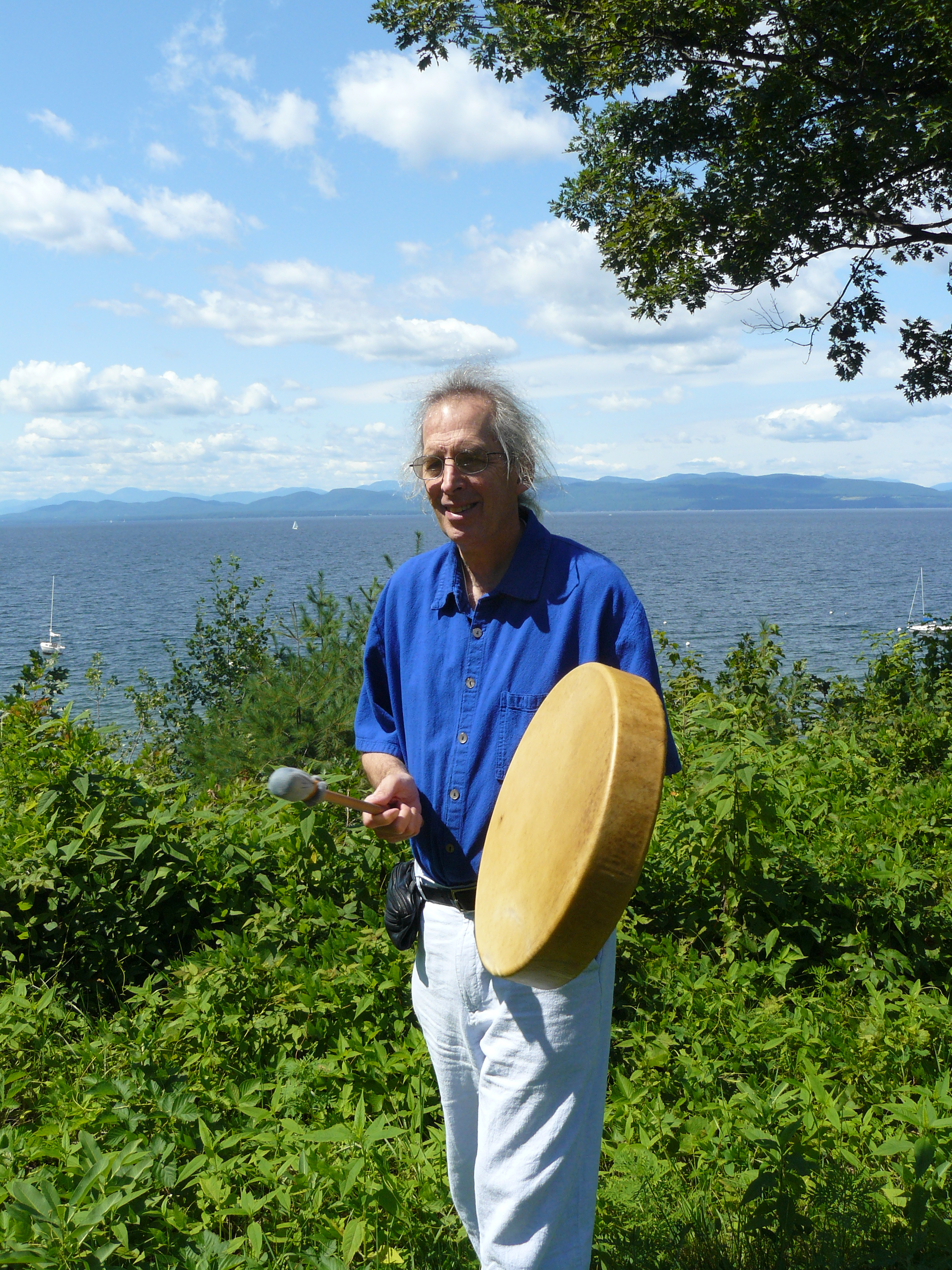
michael drumMICHAEL WATSON, M.A., Ph.D., LCMHC (Dreaming the World) ~ is a contributing editor to Into the Bardo, an essayist and a practitioner of the Shamanic arts, psychotherapist, educator and artist of Native American and European descent. He lives and works in Burlington, Vermont, where he teaches in undergraduate and graduate programs at Burlington College,. He was once Dean of Students there. Recently Michael has been teaching in India and Hong Kong. His experiences are documented on his blog. In childhood he had polio, an event that taught him much about challenge, struggle, isolation, and healing.

Posted in Naomi Baltuck, Photo Essay, Photography/Photographer, Story Telling, Photo Story

The Seed of Creativity

When my daughter Bea was a little girl, she found a seed in a seedless Satsuma, and was inspired to plant it in a paper cup.  Our little Satsuma tree has lived on our kitchen windowsill for years now, a reminder that unexpected marvels can come from a single seed.  Creativity is a seed that grows ideas.

It helps us to see beauty in the ordinary.

Or, upon reflection, to take the ordinary and transform it.

Sometimes inspiration comes to us in a flood.


Sometimes in a flash.

Or even in hindsight.

More often,  it comes in disguise.

Or as a creative response to something we feel passionate about.

Perhaps we are inspired by another artist…as in Bea’s sculpture, The Ice Scream.

I love working with a creative team…

Sometimes it’s a process.

…but the end result is worth it.

However it comes to you, wherever you find your inspiration, you are never too young…


Or too old….


To fly with it!

May all your ideas and inspirations be fruitful!

Copyright 2012 words and photographs, Naomi Baltuck.

All images and words copyright Naomi Baltuck

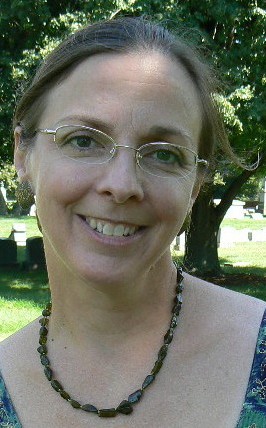
NaomiPHOTO1-300ppi51kAqFGEesL._SY300_NAOMI BALTUCK ~ is a Contributing Editor and Resident Storyteller here410xuqmD74L._SY300_ at Bardo. She is a world-traveler and an award-winning writer, photographer, and story-teller whose works of fiction and nonfiction are available through Amazon HERE. Naomi presents her wonderful photo-stories – always interesting and rich with meaning and humor – at Writing Between the Lines, Life from the Writer’s POV. She also conducts workshops such as Peace Porridge (multicultural stories to promote cooperation, goodwill, and peaceful coexistence), Whispers in the Graveyard (a spellbinding array of haunting and mysterious stories), Tandem Tales, Traveling Light Around the World, and others. For more on her programs visit Naomi Baltuck.com

Posted in Peace & Justice, Photography/Photographer, Poems/Poetry, Spiritual Practice, Terri Stewart

then the blaze

Then the Blaze
Then the Blaze

blaze dances wildly-
a tango of love
between earth and air

reaching a full roar-
a symphonic orchestration
of heat and wind

creating a searing heat-
a blistering of the senses
by forces of good and evil

be the blaze

dance passionately
roar completely
sear injustice.

© 2013, post and poetry, Terri Stewart, All rights reserved

terriTERRI STEWART is Into the Bardo’s  Sunday chaplain, senior content editor, and site co-administrator. She comes from an eclectic background and considers herself to be grounded in contemplation and justice. She is the Director and Founder of the Youth Chaplaincy Coalition that serves youth affected by the justice system. As a graduate of Seattle University’s School of Theology and Ministry, she earned her Master’s of Divinity and a Post-Master’s Certificate in Spiritual Direction. She is a contributing author to the Abingdon Worship Annual. (The 2014 issue just released!)

Her online presence is “Cloaked Monk.” This speaks to her grounding in contemplative arts and the need to live it out in the world. The cloak is the disguise of normalcy as she advocates for justice and peace. You can find her at www.cloakedmonk.com, www.twitter.com/cloakedmonk, and www.facebook.com/cloakedmonk.  To reach her for conversation, send a note to cloakedmonk@outlook.com

Posted in Essay, General Interest, Jamie Dedes, justice, Nature

The Wiyot of Eel River

I was at the Redwood Shores library the other day. They had a small display on the Ohlone Tribe. It made me think again of the Wiyot. They live in my dreams. Their name is pronounced Wee-yhot and it means Eel River. That was their home.

In the mid-eighties, for about a year-and-half, we lived near the Eel River in Humboldt County, an area about 200 miles north of San Francisco. It’s stunning and peaceful with dense redwood forests, wild rivers, and creeks that run dry in the summer and overflow in the winter. If you live in a rural area or grew up in one, you might take such things for granted. Having lived in cities all my life, it was magical to me. In the midst of that feral earth, in the stillness of leafy green days and velvet blue nights, it was easy for me to imagine the first peoples as they might have lived there in other times.

I fancied I could see them tending fires, boiling and drying acorns and then grinding them for flour, bathing in the river, raising their children, and hunting, gathering, and enjoying sacred ceremonies and tribal celebrations. I knew the same ancient sky-scrapping sequoias that watched over us had watched over them.

Our place was just short of four acres and rich with sequoia, madrone, oak, and some forty fruit trees. Blue jays flew in to feed in the morning and the quail marched down to visit at nightfall. Hawks and hummingbirds put on air shows. Rosemary thrived unattended. There was a beautiful lush 100-year-old rosebush. There were wild roses too. They gave us rose hips for cough syrup. Witches Broom lined our creek side with bright yellow. There were cascades of Japanese quince, which provided ample housing for the hummingbirds. Queen Ann’s lace* danced in the wind like ladies dressed for a ball. When they went to seed I collected the seeds for use in cooking. They have a taste somewhere between a carrot and caraway seed. The great bursts of blackberry bushes were a visual and edible delight.

I gathered fresh fruit almost every morning and every morning I thought of the people who preceded me more than a century ago and who picked berries there just like me. I did some research and found out that our property was once inhabited by the Wiyot peoples whose numbers were almost decimated in a genocide.

“Eureka newspapers of the time exulted at the night massacres conducted by the “good citizens of the area”. Good haul of Diggers and Tribe Exterminated! were 2 headlines from the Humboldt Times. Those who thought differently about it were shut up by force. Newspaper publisher and short story writer Bret Harte called it “cowardly butchery of sleeping women and children” — then had to flee ahead of a lynch mob that smashed his printing presses.” MORE [Wiyot Tribal Council Page]

* WARNING: If you are tempted to gather the seeds from Queen Ann’s lace, think twice. I didn’t know it at the time but it is hard to distinguish them from hemlock, which is poisonous. 

© 2012, Jamie Dedes, All rights reserved
Photo credit ~ Eel River by Jan Kronsell and released into the worldwide public domain.

Photo on 2012-09-19 at 20.00JAMIE DEDES ~ My worldly tags are poet and writer. For the past five years I’ve blogged at The Poet by Day,the journey in poem, formerly titled Musing by Moonlight.  Through the gift of poetry (mine and that of others), I enter sacred space.

Posted in Meditation, Spiritual Practice, Terri Stewart

Adrift

sweeping fog

caresses landscapes

cast adrift

Sometimes, we become unanchored from our family, friends, or traditions. Often unanchored means adrift and that is often associated with fear and the unknown.

I remember, when I was in college the first time at the age of 18. It was a time between my first and second semester at college. I felt adrift. I was away from home, away from friends – in fact losing friends as they moved away and grew into new lives – my future was unhinging from my past in good and bad ways. Instinctively, I sought home. I went to my heart-home in upstate New York and spent time absorbing the grounding there. In many ways, that geography anchored me in ways that my drifting family, friends, faith, and future could not.

By discovering my grounding, I was able to rediscover the ground of all being.

misty fog

dancing with day-break

new growth dawns

Although I felt adrift and alone at the time, looking back, I believe that being adrift deepened who I am and what I would become. Detaching from the known and reattaching to both the known and to something new became a way of being for me. This leads all the was to seminary which I describe as a continuous pattern of deconstruction and reconstruction. Each reconstruction creates something deeper, but also something more vulnerable. And the vulnerability ultimately leads to strength.

Fog, as crazy making as it may be (and we do have our foggy days here in the PacNW), has a purpose. Turns out that the Redwood trees in California get 30%-40% of their moisture needs from fog. So this misty, chilling, low-lying-cloud ultimately offers a gift to the world. It can be irritating to be in the fog, but sometimes, just sitting still and spreading your senses out to the surrounding areas that you may not clearly see can be a gift. And this gift can be translated to the world by cultivating a habit of sitting with ambiguity.

You may ask what has my head all fogged in today? My thoughts were launched by a stunning video from Simon Christen, artist. This is a meditation on the fog that he loves in San Francisco. He calls it a “love letter to the fog of the San Francisco Bay area.” It is quite wonderful.

I would encourage you to use it to launch your own meditation on fog and being adrift. What do you need to detach from? What is the beauty you will see while cast adrift? Ultimately, where will you land?

(Shared with Permission)

Shalom and Amen.

~Terri

© 2013, video, Simon Christen. All rights reserved.

© 2013, post and poetry, Terri Stewart, All rights reserved

terriTERRI STEWART is Into the Bardo’s  Sunday chaplain, senior content editor, and site co-administrator. She comes from an eclectic background and considers herself to be grounded in contemplation and justice. She is the Director and Founder of the Youth Chaplaincy Coalition that serves youth affected by the justice system. As a graduate of Seattle University’s School of Theology and Ministry, she earned her Master’s of Divinity and a Post-Master’s Certificate in Spiritual Direction with honors and is a rare United Methodist student in the Jesuit Honor Society, Alpha Sigma Nu. She is a contributing author to the Abingdon Worship Annual.

Her online presence is “Cloaked Monk.” This speaks to her grounding in contemplative arts and the need to live it out in the world. The cloak is the disguise of normalcy as she advocates for justice and peace. You can find her at www.cloakedmonk.com, www.twitter.com/cloakedmonk, and www.facebook.com/cloakedmonk.  To reach her for conversation, send a note to cloakedmonk@outlook.com

Posted in Essay, General Interest, justice, Terri Stewart

Moral Courage

This is a re-blog of my very first blog post ever from 2008! I have edited it a tiny bit.

Moral courage is a rarer commodity than bravery in battle or great intelligence. Yet it is the one essential, vital quality of those who seek to change a world which yields most painfully to change. Robert F. Kennedy, in a speech in Capetown, South Africa, June 6, 1966. (Source: Wikiquote )

What are our sources of moral courage? I can tell you that I find moral outrage easy, but where does moral courage come from? Relying on my Methodist heritage, The Wesleyan Quadrilateral would have us examine scripture, tradition, reason, and experience in making deliberations. What does this tell me?

What does scripture say?

In Hebrew Scriptures and in Christian Scriptures, we are taught to care for the alien, orphan, widow, and poor among us. In the story of the adulterous woman (John 8:1-11), we see a Jesus that stands between the accusers and the marginalized. This is what Christians are called to do. Take action in the face of injustice and stop pain from happening. Jesus teaches us repeatedly that we are to extend our hands to the hungry, the poor, the marginalized, and those outside of authority. This continues from the Jewish traditions. In Hebrew Scripture, we are told in Micah 6:8 that we are to “do justice, love kindness, and to walk humbly” with God (NRSV). These teachings can be encapsulated in the single commandment “love your neighbor as yourself” (Gal 5:14). Leviticus 19:34 tells us that our neighbor is the alien among us. Christ tells us that our neighbor is people outside of the power structure that he ministers too—the bleeding woman, the blind, the demon-possessed, or the widow. Those are the neighbors Jesus stands with.

What does tradition say?

In the Methodist tradition, John Wesley spoke out against many issues facing his generation. This included human rights, slavery, prison reform, labor rights, and education reform. Methodists also have the Social Principles and the Book of Resolutions to guide thoughts and deliberations in our present day. Wesley emphasized shaping public policies that would ensure equal and fair education for all children.

What does experience say?

It is very difficult to quantify experience across the board, but if I just examine one system, the education system, we know, through social sciences and the statistics they bring us, that poverty is the single most important factor in education. Poverty riddled areas simply do not have access to a great education system. And unfortunately, for many minority ethnicities in the U.S., poverty riddled areas are disproportionately filled with them. Why would that be? A good source for thought is this YouTube video from Tim Wise–

And we know that poverty is a world wide problem as the recent collapse of the factory in Bangladesh illustrates. The women who were lost there are typically impoverished, but they were considered the lucky ones. They were one step above abject poverty and simply impoverished. The literacy rate is 59%. Poverty and lack of education go hand-in-hand.

Bereaved mothers hold up pictures of their daughters who died in the factory collapse, but whose remains have yet to be identified. Photograph: Jason Burke for the Guardian

There is much to be outraged about. Let us find moral courage.

What does reason say?

Is it reasonable to expect there to be poverty in the world? Is it reasonable to expect there to be violence in the world? Is it reasonable that we hurt each other by action and inaction? I would say no. Jesus does say that the poor will always be with us (Matt 26:11), but that is after he has said that the world will be judged by its treatment of the poor, the hurting, and the hopeless (Matt 25:31-46). Why would Jesus say this bit about the poor being with us always? Perhaps he knew that the entirety of believers would not follow his command to visit the imprisoned, feed the hungry, and to clothe the naked. What would it look like if all of our faith communities fought against poverty by directly participating in feeding, clothing, and visiting? That is why it is unreasonable–we hurt each other by our actions and inactions because we are not doing the simple things that Jesus told us. It is unreasonable. Reasonably, we know that if we had a global will, hunger would be eradicated. God would be so pleased, I believe, to see all children fed.

And last, with these sources of moral courage available to us, what do we do with it? Issues in the world today are so complex and systems are so vast that it seems a hopeless exercise. We must remember that we are not called to fix the whole world, but we are called to be faithful. Be faithful and to keep moving forward one step at a time. Maybe even one meal at a time.

(c) 2013 post, Terri Stewart, all rights reserved

terriTERRI STEWART is Into the Bardo’s  Sunday chaplain, senior content editor, and site co-administrator. She comes from an eclectic background and considers herself to be grounded in contemplation and justice. She is the Director and Founder of the Youth Chaplaincy Coalition that serves youth affected by the justice system. As a graduate of Seattle University’s School of Theology and Ministry, she earned her Master’s of Divinity and a Post-Master’s Certificate in Spiritual Direction with honors and is a rare United Methodist student in the Jesuit Honor Society, Alpha Sigma Nu. She is a contributing author to the Abingdon Worship Annual.

Her online presence is “Cloaked Monk.” This speaks to her grounding in contemplative arts and the need to live it out in the world. The cloak is the disguise of normalcy as she advocates for justice and peace. You can find her at www.cloakedmonk.com, www.twitter.com/cloakedmonk, and www.facebook.com/cloakedmonk.  To reach her for conversation, send a note to cloakedmonk@outlook.com

Posted in Poems/Poetry

Reading Rilke’s Swan …

I think it was Borges who used to remind us that poetry began as an oral tradition and that in these days of print it is still meant to be read out loud. This hit home for me recently when a friend read one of my own poems at a funeral service and when British poet, John Anstie, recorded his reading of another of my poems. Even though I had written these poems and labored over their births, they gained a freshness and new perspective for me in the hands of these good poets who also happen to be good at oral delivery. On that note, I take special joy in the poetry of David Whyte and I particularly appreciate his skilled readings of his own work and that of other poets. In the video below David reads and interprets Rilke’s The Swan and Walcott’s Love After Love. I listen to his readings of these two renown poems several times a week and never tire of hearing them. Jamie Dedes

LoResPublicityPoet David Whyte grew up with a strong, imaginative influence from his Irish mother among the hills and valleys of his father’s Yorkshire. He now makes his home, with his family, in the Pacific Northwest of the United States.

The author of six books of poetry and three books of prose, David Whyte holds a degree in Marine Zoology and has traveled extensively, including living and working as a naturalist guide in the Galapagos Islands and leading anthropological and natural history expeditions in the Andes, the Amazon and the Himalaya. He brings this wealth of experience to his poetry, lectures and workshops.

His life as a poet has created a readership and listenership in three normally mutually exclusive areas: the literate world of readings that most poets inhabit, the psychological and theological worlds of philosophical enquiry and the world of vocation, work and organizational leadership.

An Associate Fellow at Templeton College and Said Business School at the University of Oxford, he is one of the few poets to take his perspectives on creativity into the field of organizational development, where he works with many European, American and international companies. In spring of 2008 he was awarded an honorary doctorate from Neumann College, Pennsylvania.

In organizational settings, using poetry and thoughtful commentary, he illustrates how we can foster qualities of courage and engagement; qualities needed if we are to respond to today’s call for increased creativity and adaptability in the workplace. He brings a unique and important contribution to our understanding of the nature of individual and organizational change particularly through his unique perspectives on Conversational Leadership.

portrait and bio courtesy of David Whyte


Video uploaded to YouTube by tjmjkm.

Posted in General Interest, Terri Stewart

Remembering What Came Before

As many know, today in the United States – July 4 – (I think it is already July 5 is some parts of the world) we celebrate our Independence Day, something that means a lot to us and may be greeted with mixed feelings if you live elsewhere in the world. Hence, I apprecate Terri’s handling of this occasion on her blog. I would also submit, that whatever good we reap in the world, whatever good this human race is able to accomplish, is done on the shoulders of those who came before us and laid the groundwork for equality and human rights. No matter our race or nationality, we all owe a debt to such diverse peacemakers as Martin Luther King, Thich Nhat Hanh, Nelson Mandla and Dennis Brutus and others on a list too long to share here. If you have someone whose work of peace and love is particularly meaningful to you, perhaps you will tell us who and why in the comment section. Thank you! Jamie Dedes

Posted in John Anstie, Poems/Poetry

Fortune

the work of John Anstie

They see our hard earned fortune there,
in marbled city suites,
floating on a silky sail,
the nap of leather seats.

We had the opportunity,
the pool of genes in code,
a secret reservation for
a public school and Spode.

We had the opportunity
to own the reason why,
that predicates no chance for those
unable to comply.

Our felony, was founded on
a life of common good,
to serve as flotsam in the sea
of guns and power and food.

Consuming guns and power and food,
an irony indeed
that helps the cause of those, who crave
a hope of being freed?

It’s more because they need the work
to feed their flesh and blood;
prevent starvation, declining health
and keep them from the flood.

But threats to blood will ensure
their easy motivation.
So much to recommend the source
of limitless privation.

They have much more, by way of help:
attention of the press;
the poets and the playwrights too,
but nothing of redress.

It’s irony to say ’twas fuelled,
on rapid growth by debt
who is to benefit thereby,
who is to win and, yet …

who is to say what fortune means
if nothing else but luck?
Should we condemn all those who have,
who wouldn’t give a buck

for those whose sad congenital crime,
their birthright, is to blame,
for them, their lot, their plight, their fight,
but who should feel the shame..?

– John Anstie

© 2013, poem and portrait (below), John Anstie, All rights reserved

John_in_Pose_Half_Face3JOHN ANSTIE (My Poetry Library and 42) ~ is a British poet and writer. We are happy to share this poem by way of a preliminary introduction to John and his work. John is joining us as part of the core team and will post under his own name.

Meanwhile, this multi-talented gentleman is self-described as a “Family man, Grandfather, Occasional Musician, Amateur photographer and Film-maker, Apple-MAC user, Implementation Manager, Engineer and general all-round good egg.” This he tells us with tongue firmly planted in cheek. Add grace and humor to the list.

John participates in d’Verse Poet’s Pub and is a primary player in New World Creative Union. He’s been blogging since 2009. John is also an active member of The Poetry Society (UK). He says of his work, “Much of my writing and my poetry focuses on the future and the important part that our children, and the way we treat them, play in this. It also spans a diversity of life’s experiences, some moving war poetry and particularly observations of life for a modern generation. I am in the process of steering a collaboration of grass roots poets to publication.” John’s poetry collection is about to hit the bookstores. More on that another day. Jamie Dedes