
I AM
THEREFORE I THANK
Cindy Lubar Bishop
American Writer and Singer

Cindy Lubar Bishop
American Writer and Singer

PEARL BUCK (1892 – 1973)
American Novelist and Humanitarian
Pulitzer Prize, 1932
Nobel Prize for Literature, 1938
I give you the books I’ve made,
Body and soul, bled and flayed.
Yet the essence they contain
In one poem is made plain,
In one poem is made clear:
On this earth, through far or near,
Without love there’s only fear.
Essence by Pearl Buck
GREAT ACTS OF LOVE
by
Jamie Dedes
I view Pearl Buck, whom I started reading when I was twelve, as a sort of spiritual mother. You can imagine my joy then to find a copy of her one book of poetry in a used bookstore. It is the only book she wrote that I had not read. It sat dusty and torn and – while clearly once well-loved by someone – it was now hidden in an out-of-the-way place, untouched and unrecognized for its simple beauty.
In brief, eloquent, deft strokes, Ms. Buck’s poems do indeed express the great message of both her work as a novelist and writer and as a humanitarian …
“WITHOUT LOVE THERE IS ONLY FEAR”

Born on June 28, 1892 in Virginia, Pearl Buck was the daughter of missionaries. She grew up in China and spoke Chinese before she ever spoke English. She was a prolific writer with most of her books inspired by her experiences in Asia. In the 1920s, before the publication of her books, her stories and essays began appearing in influential American and Chinese publications.
Of Ms. Buck’s novels, The Good Earth is the most well-known. It was her second novel and became a best seller. She also wrote a number of nonfiction books including memoir and a cookbook. Her poetry collection, Words of Love, was published in 1974, a year after her death. It is now out of print. It is gracefully illustrated by Jeanyee Wong and was published by The John Day Company, the publishing firm founded by Ms. Buck’s second husband, Richard Walsh.
Throughout her career, Ms. Buck wrote heroically, acutely, and compassionately of women’s rights, immigration issues, mixed-race children, adoption… and, of course, China. She was blacklisted in the 50s for her political and social views. But Ms. Buck’s life was not just about words of love. It was about great acts of love.
Most of Pearl Buck’s humanitarian work was toward mitigating the poverty and discrimination suffered by children.Ms. Buck founded Welcome House, Inc, which was the first international interracial adoption agency. She adopted – if I remember correctly – ten children herself. Her initial efforts to help mixed-race children were inspired by their rejection in Asia, especially in Korea. There mixed-race children fathered and left behind by American soldiers were barred from any social, educational, and civic privileges, as were the mothers of mixed-race children. Today Ms. Buck’s books still stand as ambassadors of her love and humanity and as introductions to China before Mao.
Here Anchee Min, Chinese-American author, discusses her reasons for writing Pearl of China, a fictionalized account of Pearl Buck’s life.
© 2012, essay, Jamie Dedes, All rights reserved
Ms. Buck’s photograph is in the public domain.
Video posted to YouTube by asiasociety .

This is just in from Br. David’s team at Gratefulness.org. I think it’s a wonderful opportunity and, since the event will be live-streamed by Sounds True, you can attend no matter where in the world you live and at no charge. J.D.
We have long wanted to host a summit at which world-class speakers – friends of Br. David’s through his decades of travels – could mutually envision fresh pathways for the global community to live in harmony and compassion. People from all walks of life could gather at this summit to find renewing insight desperately needed in chaotic times. Now this dream is coming to fruition:
David Whyte, Angeles Arrien, Chungliang Al Huang, Roshi Joan Halifax, Fritjof Capra, Chip Conley, and more than a dozen other extraordinary speakers, musicians, and dancers will be with us at “Pathways to Gratefulness” in San Francisco’s Palace of Fine Arts on Saturday, June 23rd. Your presence makes this event a vital catalyst! We cannot wait to see many of you in person. And no one need miss this opportunity, thanks to live-streaming:
Live, SoundsTrue: Celebrating Gratitude
Live-stream footage will be online free of cost until July 31st . Thank you so much to those of you who are offering donations to help make live-streaming available to all.
Please take a moment to forward this message to your friends. This helps us tremendously since, without your help, we cannot reach all the people who would benefit from this event. Your participation in “Pathways to Gratefulness” brings you further in touch with a groundswell of grassroots commitment to keep alive the true dignity and joy of being human.
© 2012, Gratefulness.org, A Network for Grateful Living
Photo credit ~ Verene Kessler via Wikipedia and generously released into the public domain with the caveat that the photographer be attributed.
Video uploaded to YouTube by meditativemoments
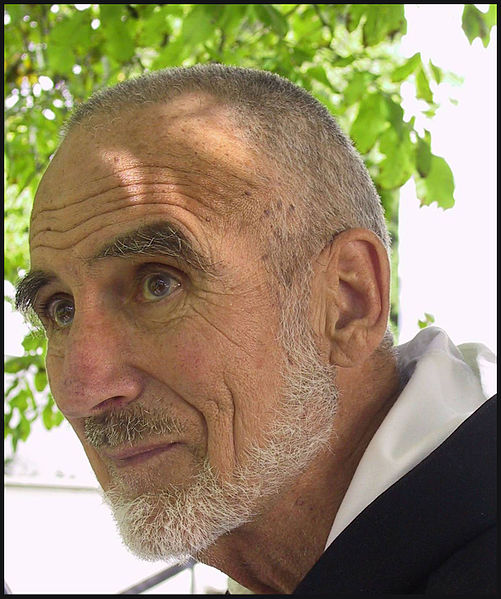 Br. David ~ is notable for his work fostering dialogue among the faiths and for exploring the congruence between science and spirituality. Early in his career he was officially designated by his abbot to pursue Catholic-Buddhist dialogue. He studied with several well-known Zen masters. He is the author of feature articles, chapter contributions to collections, and books. Among the most notable are Belonging to the Universe (with Frijof Capra) and The Music of Silence: A Sacred Journey Through the Hours of the Day (with Sharon Lebell). Br. David is the co-founder of A Network for Grateful Living, dedicated to the life-transforming character of gratitude.
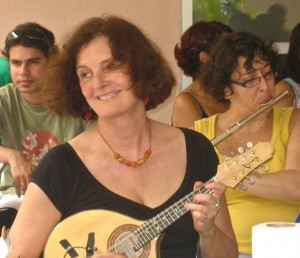
MARILYNN MAIR
American composer, mandolinist, professor, writer, and poet
Concert performer, recording artist, professor of music, mother of two musically talented kids, director of America’s pre-eminent summer school for mandolin and guitar — any one or two of these can be a full-time job, but Marilynn manages to do them all. MORE [MANDOZINE]
However untrained my ear may be, I immediately appreciated that there was something exciting and fresh in the audios Marilynn Mair uploaded to her blog Celebrating a Year. The reason for the freshness was that it was Brazilian jazz, called choro, something with which I was not familiar. I think the first audio might have been Isso, which was written by Marilynn and performed by her and Luiz Simas on Meu Bandolim, their CD released 2010. [Sample] I was hooked. I sent the link around to all my music-loving family and friends.
Choro (pronounced SHOH-roh) is best described in American terms as “the New Orleans jazz of Brazil.” It is a complex popular musical form based on improvisation, and like New Orleans jazz, blues, or ragtime, grew from a formalized musical structure and many worldly influences. But to the people of South America, choro is Brazil. It is life. MORE [Saint Paul Sunday]
As lutes go, I was most familiar with the oud of my Lebanese/Turkish background; but I also grew up among Brooklyn Italians and enjoyed their mandolino [The Serenade of Italy]. The European instruments have the oud as a common ancestor. Curious, I quieried Marilynn about choro and in response she gifted me with two of her seven CDs. That was my virgin venture into the delightful sounds of this distinctly Brazilian music. Now it’s an addiction.
Marilynn is professor of music at Roger Williams University at Bristol, Rhode Island. Each year, she travels to Brazil to continue research, study, and teaching. In fact, as I write this, she’s on her way to Rio to teach a class of mandolinists at the Universidade Federale and to write music. She always shares her adventures with us on Celebrating a Year, her blog.
The set of compositions that Marilyn is currently writing is a series of hybrid choro in which Marilynn uses themes from classical music and jazz to creat Brazilian music. She finished three: Um Quinto do Ludwig, a bossa nova based on the first movement of Beethoven’s 5th symphony; Farrapo (Rag) based on Scott Joplin’s The Entertainer, and Sonatinha based on Beethoven’s Sonatina in C for Mandoline. These trips may be a change of scenery for Marilynn, but they’re not a break from the work she loves. She’ll be hard at it on the next three compositions, one of which is to be based on Piazzola’s Milonga do Angel.
Next on her agenda is SummerKeys, a music camp providing students of mandolin and guitar with a week private lessons, plucked-string ensambles, concerts, new friends and mentors. SummerKeys is at Lubec, Maine. (Info and registration for that is HERE should you be interested.)
Marilynn’s newest book, available on Amazon, is Brazilian Choro – A Method for Mandolin. Her website [Maryilynn Mair Madolin] is a generous source of information on mandolin, choro, and Brazil including feature articles and her Brazil Log.
With all of her professional activities, it’s hard to believe that Marilynn also participated in the 2010 National Novel Writing Month (NaNo). She did this in solidarity with her equally talented brother – engineer and author – Ian Mair (Death in Mexico). Marilynn completed her 50,000 word commitment entirely in poem, writing to Edward Hopper paintings in décima joining the décima with free-verse as a narrative with the décima as soliloquies. This is much like Cuban musical décima, which were often interspersed with instrumental improvisation. I asked her why décima:
It was originally a Spanish poetry form first published in 1591. I was drawn to it because in the migration to the Americas the form survived and flourished as an improvisational song form. It has such a strict form and that’s surprising. No one improvises sonnets. As a song form, particularly in Cuba, it added four-line intros or outros, and improvised instrumental interludes between décimas. That worked for my manuscript because I could use the four-line piece to introduce or explain a décima’s connection to the plot line. And the interludes became free verse connectors dealing more specifically with the protagonist’s changing state of mind and emotions. But this all really developed in the process of writing all month.
I started writing décima earlier this year because I was intrigued by the form, and since no one seems to be writing them in English, or ever has, it seemed more “my” form to explore. I liked what I was coming up with so decided to go with that for NaNo rather than the more obvious villanelle or an iambic pentameter ballad.
Marilynn’s poetry is featured on her blog [Celebrating a Year] each Wednesday, where you can also catch up with her daily musings and photography. Marilynn is a contributing writer here at Into the Bardo. Her most recent contribution is Shred the Social Safety Nets.
By way of close, here’s Marilyn playing mandolin at a recording studio in Brazil with Grupo Água no Feijão Tocando Assanhado. They are recording the CD Meu Bandolim. Enjoy!
Marilynn Mair, mandolin, bandolim
Solo & Duo, Enigmatica, Água No Feijão
Author, The Complete Mandolinist- A Comprehensive Method
Co-author, Brazilian Choro – A Method for Mandolin
Director, The American Mandolin & Guitar Suitcase Seminars
http://www.marilynnmair.com/
“I sing of brooks, of blossoms, birds, and bowers
Of April, May, of June, and July flowers.” – Robert Herrick
– Jamie Dedes·
© 2012, essay, Jamie Dedes, All rights reserved
Photo credit ~ portrait by Romulo Aguiar (musician) and © 2012 Marilynn Mair
Video #1 uploaded to YouTube by thefeedRWU.
Video #2 uploaded to YouTube by EastBayNews. Link to HERE for a recent article about Marilynn by Jim McGraw.

We can run away from bombs, but not from hunger.” Sudan‘s refugees in South Sudan, report of Amnestyus.org 2012
·
I wrote this back in the 80s in response to an essay on the “black days” by someone from the Sudan.
·
Have you read about them –
“Black Days” in the Sudan?
They are hunger-and-thirst days
When the supply of water –
One liter per person for two weeks
. . . is gone
When their food, one meal a day
For fourteen days
. . . is gone,
and the waiting and wasting begins –
four, five, fifteen days
Until more food and water
then Black Days again –
They are days of laying-in.
Conserving energy.
Some survive.
·
If you want and are able, you can make a donation to the Fill the Cup of the World Food Programme. They say $1 fills four cups.
© 2012, poem, Jamie Dedes, All rights reserved
Photo credit ~ mother and malnurished child, Darfur, taken by USAID and in the public domain

“ONE’S-SELF I sing—a simple, separate Person.” Walt Whitman, Leaves of Grass
·
For Zabaida on her 98th birthday.
Maybe next time around …
NO-BALONEY SANDWICHES
by
Jamie Dedes
·
This is dedicated to all those fine beings . . .
Those who are blatantly themselves
You know the ones I mean –
Some, when seedlings, had folks
who jabbed a finger yelling: You! You! You!
accusing them of being quintessentially themselves
. . . as though that was wrong.
They are the YOUs who come from multi-colored places
and varied dreams
with hearts woven of wonderlush.
They are womanish or manish.
They are childlike and adultish.
They run from the gray streets to the green forest.
They take to long-lost roads and never-found pathways
with their song in a backpack and
a brown-bag lunch of no-baloney sandwiches.
When they elder they arrive back at the beginning
knowing who are they are
. . . and why.
·
© 2012, poem, Jamie Dedes, All rights reserved
Photo credit ~ Jon Sullivan’s “Woman on the Beach”

Our treasured Marlene is not to be undone by Parkinson’s Disease. A former professional accountant, she is a master-level skier, participates in marathons, is an award-winning dancer, paints, writes poetry, and . . . that’s just the short-story. J.D.

MARATHON
by
Marlene G. McNew (Strange Gift)
·
Decay’s process cannot be stopped.
In dark shadows of age, watch illness burn
all signs of pink that we treasure.
We become a residue of memory.
·
Ravaged, by the weight of the thought
we seek a path of the heart
lit by fire that burns within,
the will to endure anything,
a power to persist.
·
A marathon holds a promise of pain,
a challenge built upon reason, a test
for mind and body; a sacrifice
a vow of suffering in the name of hope.
·
A marriage of preparation and outcome,
of cooperation of heart with mind,
it is emergence from a cave,
the acceptance of help.
Is is a war against defeat
·
the making of a miracle.
·
© 2012, poem and video, Marlene’s and Carmen’s photographs, Marlene G. McNew, All rights reserved
Photo credit ~ Athletic Shoes, Vincent van der Heijden via Wikipedia and licensed under Creative Commons Attribution Generic 2.0

CARMEN McNEW
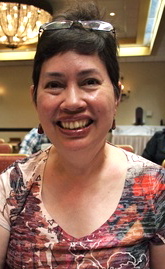 MARLENE G. McNEW ~ began exhibiting symptoms of Parkinson’s Disease (P.D.) eight years ago. Her blog (Strange Gift) is a vehicle for sharing her experiences with P.D. and her many, many interests. She maintains a lovely home in Northern California where she lives with her husband and a much-loved rescued golden retriever, Carmen.
Marlene is a master skier, but for the past several years she’s been able to incorporate into her life increasing involvement in the arts. She expresses her beautiful spirit through poems and paintings. She also has a strong interest in dance, having been a competition level ballroom dancer. Other interests include cooking.
She is currently preparing for a marathon and is registered for the Mighty Mermaid sprint triathlon (1/4 mile open water swim, 12 mile bike, 2 mile run/walk) through Team in Training with the Leukemia Lymphoma Society. Marlene originally started her blog when she was getting ready for the Nike Women’s Marathon (half marathon walk) and raising funds for the Leukemia Lymphoma Society. Her YouTube channel is SkiDisiple. J.D.
Not the easiest thing in the world to transition to an entirely plant-based diet, but it’s the ideal presented by many spiritual paths and advocated by increasing numbers of health providers. This “maven” tells the story of her transition. She signed up for a month, then went on to a second, then a third …… I’ve reblogged her story here because her sensible strategy might work for others who are caught between habit and ideal. J.D.

Joseph Campbell (1904-1987)
American mythologist, educator, writer

Joseph Campbell (1904-1987)
American mythologist, educator, writer
·
Photo credit ~ Zondor via Wikipedia under the Creative Commons Attribution-ShareAlike 3.0 unported license.
·

Mary MacRae (1942 – 2009), English poet
[Mary MacRae] wrote and published poetry the last ten years of her life, after ill-health forced her to take early retirement from teaching. She taught for fifteen years at the James Allen Girls School (JAGS), Dulwich, London. Her commitment to writing led to her deep involvement with the first years of the Poetry School under Mimi Khalvati, studying with Mimi and Myra Schneider, whose advanced poetry workshop she attended for eight years. In these groups her exceptional talent was quickly recognised, leading to publication in many magazines and anthologies. MORE [Second Light Live]

Elder
by
Mary MacRae
This poem is excerpted from Mary MacRae’s book, Inside the Brightness of Red.
Reprinted here with permission. All rights are reserved by the publisher, Second Light Network.
·
A breathing space:
the house expands around me,
·
unfolds elastic lungs
drowsing me back
·
to other times and rooms
where I’ve sat alone
writing, as I do now,
when syncope –
·
one two three one two –
breaks in;
·
birdcall’s stained
the half-glazed door with colour,
·
enamelled the elder tree
whose ebony drops
·
hang in rich clusters
on shining scarlet stalks
·
while with one swift stab
the fresh-as-paint
·
starlings get to the heart
of the matter
of matter
·
in a gulp of flesh
and clotted juice that leaves me
·
gasping for words transparent
as glass, as air.
♥ ♥ ♥ ♥
My profound gratitude to poet Myra Schneider for the introduction to a new-to-me poet, Mary MacRae, and to poet Dilys Wood of The Second Light Network (England) and editor of ARTEMIS Poetry for granting this interview. J. D.
JAMIE: Clearly, and as has been stated by others, Mary was profoundly inspired by art, nature (particularly flowers and gardens), and love. What can you tell us about her life and interests that would account for that?
DILYS: Mary writes tender and accurate poems about wild nature, creatures and landscape, drawing on her stays in a cottage on an untamed part of the coast in Kent, England and visits to her daughter living in remote West Wales. In her London home, it’s easy to guess from her poems about garden birds and flowers how much time she spent at the window. She almost always sees nature in flux, changing moment by moment, unpredictable, mysterious, a spiritual inspiration. One of her great strengths as a poet is catching movement.
Many of Mary’s poems focus on love between close family members. This may relate to a difficult relationship with her own father, which she sought to understand, and the relationships which compensated (with mother, sister, husband Lachlan, daughter and grandchild). A back problem prevented her from holding her baby daughter and she often refers in her poems to young children. She clearly has a yearning towards them.
JAMIE: She wrote poetry apparently only at the end of her life and for ten years. What were her creative outlets before that? How did she come to poetry?
DILYS: Mary was a dedicated teacher of English Literature and language in a leading girls’ secondary school. She was also deeply interested in music and painting (these are strongly reflected in her poetry). Though she had written as a young woman she followed the pattern of many women creative artists in becoming absorbed into her home life and her paid work, only turning to writing when her illness released her from the daily grind of intensive teaching. The remarkable, rapid development of her poetry shows how strong her latent powers really were.
JAMIE: Was writing poetry a part of her healing process when she was diagnosed with cancer? If so, how did it help her?
DILYS: I’m confident that Mary’s diagnosis with cancer enabled her to change her life-style and from then on concentrate on her poetry, urged by the sense that she might be short of time. There is no evidence that Mary wrote therapeutically to come to terms with her cancer. In fact she only ever addressed her illness in relation to the possible unkindness of fate in cutting her off from beloved people and life itself. The poems written in the last 2-3 years of her life give the impression that her dedication to writing, with the spiritual experiences which accompanied it, enabled her to bear terrible distress. She records this distress, using imaginative and metaphorical approaches to focus it, and these poems make heart-wrenching reading.
JAMIE: Can you tell us about her process? When did she write? Where? For how long?
DILYS: I have the impression that Mary’s life revolved around three things, people she loved, gathering experiences that would feed her poetry (travel, listening to music, visiting galleries) and very hard work in direct furtherance of her writing (extensive reading, attending workshops with other inspirational poets, writing, revising and submitting her poems to criticism from critics she respected). She used notebooks to make a full, accurate record of those experiences – landscapes, human encounters, thoughts – that would feed her work. There is an extract from one such entry in the section about keeping a journal in the resource bookWriting Your Self, Transforming Personal Material by Myra Schneider and John Killick. This book also includes a contribution in the chapter on spirituality which reveals much about Mary’s attitudes to life, nature and also her writing process.
JAMIE: Do you have any advice from her for other poets and aspiring poets?
DILYS: Mary was a dedicated writer, entirely sincere in her commitment to poetry as opposed to ‘career’ as a poet. She was always ready to enjoy and praise the widest range of subject-matter, approaches and styles from other poets, providing she thought they were ‘busting a gut’ to get their poems right, and not indulging in the trendy or superficial, which she despised (whether from well-knowns or unknowns). She put much emphasis on wide-reading of both past and contemporary poets and she herself had absorbed a huge amount of other poets’ work, always quoting fully and accurately. She liked using another’s work as a starting pont for her own (the Glose) and particularly admired the work in strict form (includingSonnet, Villanelle and Ghazal), which began to be more acceptable from the mid-1990s (eg from such poets as Marilyn Hacker and Mimi Khalvati).
JAMIE: Are any other collections of her poetry planned? If so, when might we look forward to them?
DILYS: When putting together ‘Inside the Brightness of Red’, Myra Schneider and I went through the whole of Mary’s unpublished work and selected all those poems we felt were both complete and would have satisfied her high standards. What remains unpublished would be mainly fragments and early versions of poems she did more work on. There will not, as far as we know, be a further book, but Mary did achieve her aim of being a significant lyric poet, whose work is very attractive, polished and, above all (as she would have wished) deeply moving and consolatory.

* The Second Light Network aims to promote women’s poetry and to help women poets, especially but not only older women, poets develop their work. It runs weekends of workshops and readings in London usually twice a year, a residential extended workshop with readings and discussions at least once every eighteen months and occasionally other events. It is nationwide (England). Dilys is the main editor of ARTEMIS Poetry, a major poetry magazine for women produced by Second Light twice a year. It includes a lot of reviews and some articles as well as poetry by Second Light members who receive it free as part of their subscription. An e-newsletter is sent out every few weeks. A few anthologies of poetry have been published by the network but now this magazine developes books under special circumstances only – such as Mary’s collections.
Thanks to Second Light Web Administrator, poet Ann Stewart, for the following: The books (Inside the Brightness of Red and As Birds Do) can be bought: via order form and cheque in post: http://www.secondlightlive.co.uk/books.shtml or here online: http://www.poetrypf.co.uk/shop.php (typing ‘ Mary MacRae collection ’ in the filter box will reduce the list to just those two books).
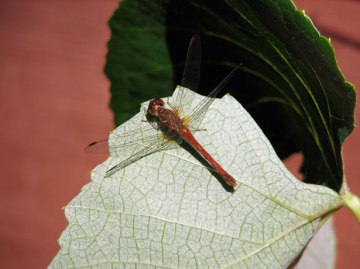
Deep in the sun-searched growth the dragon-fly
Hangs like a blue thread loosened from the sky ~
So this wing’d hour is dropt to us from above.
SILENCE AT NOON
by
Jamie Dedes
The days are filled with noise and moods
but silence lies here at noon
like stillness between heartbeats
and the Ever speaks
through dragonflies breathing vineyards
and a million bees humming the same tune
Caravans of monks and nuns
leave messages in dead languages
and encrypted ritual
as they walk their pathways across bridges
known for their span and silver beauty
Like a revered teacher’s stupa
or a gothic Cathedral
those bridges spin toward heaven
stop short
and trip to the other side
Nothing changes
The same whispered stories
fill your rattling lungs with grief
The only truth is in the silence at noon
doing duty as shawl, shield, and salvation
·
© 2012, poem, Jamie Dedes, All rights reserved
Photograph ~ Arcana Dea, Public Domain Pictures.net

Recently, while sorting through boxes, Sarah found an old journal with guidelines written long ago for her daughter. These guidelines (rules!) are well-considered and a valued contribution to the work we are collecting on Into the Bardo. We’ve taken them to heart and are pleased to have Sarah’s permission to share them with our valued readers and contributing writers. J.D.
SARAH’S RULES TO LIVE BY
by
Sarah Deen
© 2012, list, Sarah Deen, All rights reserved
Photo credit ~ Flower and bud of a yellow chamomile by Alvesgaspar via Wikipedia licensed under Creative Commons Attribution-Share Alike 3.0 unported
SARA DEEN ~ is a mother, grandmother, and artist living in the San Francisco Bay Area. She is a personal friend of ours and much admired for her spirit, humor, and wonderful home cooking.

I am pleased to welcome my friend Michael Watson, a shaman and gifted healer to Into the Bardo. He and I go back many years as friends, colleagues, and fellow therapists in Vermont. It is so nice to see that our minds continue to follow similar tracks. Shared here with gratitude, Rob.
A World of Difference:
ON SEEING AND BEING SEEN
by
Michael Watson (Dreaming the World)
The cold returned this past week, and many trees and flowers seem to have taken a deep breath and halted their rush into Spring. Were the maple sugaring season ongoing, these would have been perfect sugaring days and the sugar houses would be boiling madly. (The warmth of a couple of weeks ago stopped the sugar season short.) Now, there is an air of expectancy in the natural world, a quickening and watchfulness, for we are in April, and returning warmth and renewing rains become daily more likely.
The seasonal round brings comfort and a sense of belonging. Maple sugaring gear is cleaned and put away. A few people have made it into their gardens, preparing for the warm season to come. Neighbors, yard and garden tools in hand, wave to one another. “This sure is weird weather, ain’t it,” echoes down the block. A few daffodils have burst into bloom in south-facing flower gardens, some making their way indoors to adorn tables. Throughout the neighborhood there is shared business and meaning.
Last week, in class, I showed the Bill Moyers interview with Bill T. Jones, Still Here. The video, from 1994, follows the MacArthur Award winning choreographer as he morns the loss of his mate, faces mortality via an AIDS diagnosis, and creates his groundbreaking dance, Still/Here. The video addresses many topics our culture still finds difficult, and does so with refreshing directness: death, terminal illness, homosexuality, loss, and race, among others.
The real focus of the film is difference, a too-hot-to-handle concern in many cultures. Difference is a form of social glue, allowing us to identify ourselves in opposition to the other. It is also the source of creativity, innovation, and adventure, as well as some of our most threatening taboos. The tensions between these functions are played out daily in our cultures, our personal relationships, and our inner worlds. For many people around the world, accepting new technologies, no matter how socially disruptive, has become easier than accepting differences among human beings.
Of course, issues of difference demand attention in the therapy setting. Whether we sit with couples struggling with disagreements about how to manage daily life, young women critical of their body image, or youth and adults who carry labels of major mental illness and wrestle with unique experiences of the world, the underlying concerns are those of difference and acceptability. Always the questions held deep inside include, “Am I loveable as I am?” and “Am I safe?” These are not simple questions.
A walk in the forest offers the opportunity to see difference. No two plants of the same species are identical. Life history and microecology play an enormous role in the development of each individual. From the point of view of the forest, each is perfect. Only through the gaze of other organisms do individual plants acquire differentiated value. When humans are involved, value is most likely culturally ascribed. Persons of diverse cultures may well read the worth of an individual plant differently from one another, as may individuals of separate species.
Ideally, psychotherapy offers persons the opportunity to challenge internalized or culturally enacted views of difference in relationship to her or his life. In the process, it may place any number of subversive, liberatory tools at the disposal of those seeking help. Such therapy seeks to provide a space for the successful re-authoring of those stories that isolate and demean on the basis of rubrics of difference. In order to do so, patients are encouraged to challenge the authority of many voices, within and without. Yet, no one can successfully create a rewarding life alone; we each need others to witness and affirm our acts of courage and self authoring. The therapist is a necessary, yet usually insufficient witness.
Would you share with us your healing stories of seeing, and of being seen by others?
♥
 Michael Watson ~ has been blogging (Dreaming the World) since September of 2009. He is a shamanic practitioner, psychotherapist, educator, and artist of First Nations* (Mixed Eastern Woodlands, Cherokee, and Lakota Sioux) and European (British Isles) descent. He lives and works in Burlington, Vermont.
Michael’s teachers and his teachers teachers were shamans. His work is influenced by both the traditions of the First Nations* and contemporary Western traditions. It reflects a strong sense of “connection to the forces and processes of Nature.” The greater objective of his work is to “support others in developing intimate, transformative relationships with both Self, and the natural world.”
* First Nations – the indigineous peoples of the North America.

“If we perceived Life with reverence, we would stand in awe at the experience of physical Life and walk the Earth in a very deep sense of gratitude.”
♥
Photo credit ~ Peter Griffin, Public Domain Pictures.net

VESAK 2012
Remembering the Buddha and his teachings
with joy, gratitude, and generosity |
|
•
[I’m sorry that I could not share this letter with you in a more timely fashion. The Buddha’s birthday was on May 6 this year. Nonetheless, the message is an important one. We are committed to supporting this effort and hope to engage your support as well. Thank you for reading …. J.D.]
•
Dear Friend,
 The most important holiday in the Buddhist calendar, Vesak, is just around the corner. Starting on the full moon day of May, the month of Vesak celebrates the birth, enlightenment, and passing away of the Buddha. It is a day – and a month – not only for joy and gratitude but also for recollection: for remembering the Buddha’s teachings and making a more earnest effort to practice them.
The first step of Buddhist practice is giving, and the most basic gift is the gift of food. The importance of food can be gauged from the Buddha’s own life story. In the Middle Length Discourses, he tells us that before his enlightenment, he undertook long fasts that reduced his body to a tent of bones. When he saw that the true path to awakening requires deep meditation, he also realized: “It isn’t easy to meditate with an emaciated body.
 Let me eat sustaining food such as rice and porridge.” It was only after he regained his strength that he could reach his goal.
Not only is it hard to meditate with an emaciated body, but when one is malnourished it’s hard to do anything – except wait intently for the next meal. Yet close to a billion people around the world endure this fate. It’s to give such people a fresh chance at life that BGR came into being, and this purpose has inspired our work through the years.
We don’t just give handouts. Rather, we seek to make people productive and self-sufficient. We do so in diverse ways: by supporting the education of poor children, especially girls; by creating right livelihood opportunities for women; and by supporting ecologically sustainable small-scale agriculture. In just four years, we’ve already sponsored fifty projects around the world, in Asia, Africa, Haiti, and the U.S. Some of our recent projects include:

 Today BGR plays a major role in representing Buddhism on the stage of global giving. In fact, in late April we participated in a historical conference at the White House that brought representatives of the “Dharmic religions” into contact with government agencies in a common commitment to humanitarian service.
We hope to continue our mission long into the future, both in the U.S. and abroad. However, we can’t fulfill our goals without help from friends like you who share our ideals and resonate with our values. Your donations are the key to everything we do: to combating malnutrition, educating poor children, and helping those who cannot help themselves. And because we’re an all-volunteer organization, we use the funds we receive prudently, with care and discretion, to ensure that 85-90% of every dollar goes directly to finance projects.
So, remembering the great compassion the Buddha extended to us, let us extend compassion to others. This Vesak season please bring forth a heart of generosity and support the work of BGR. When you give, you become part of our mission, our partner in giving a helping hand to those who need help. And you experience the joy of knowing that you are truly making a positive difference in this world, a difference that’s transforming lives.
 May all blessings be with you and your family, on Vesak and beyond.
 Ven. Bhikkhu Bodhi
Founder and Chairperson Buddhist Global Relief is a 501(c)(3) organization. Gifts are deductible to the full extent allowable under IRS regulations. You can either donate online via PayPal on the BGR web site or send a check to:
Buddhist Global Relief
PO Box 1611 Sparta, New Jersey 07871 USA If your company has a Matching Gift Program, please enclose the necessary forms as well.
|

THREE YEARS TODAY
by
Renee Espriu (Renee Just Turtle Flight)
three years today not
tomorrow giving rise to
yesterdays filled with
sorrow and trepidation
angst beating against
us like rain drops to
pelt out songs of dismay
pain like no other
causing us to walk in
our own shadows trying
to keep the pain at
bay until another
day and still the rain
came down to wrap us
secure in the fashion
meant for bringing forth
life and love with
emotional passion
we wept in silence an
effort to be brave
standing fierce against
the onslaught of a
disease rending
you mute most days
covered in blankets
against the inner chill
freezing your blood
a prisoner your will
three years today not
tomorrow giving rise to
yesterdays filled with
sorrow and trepidation
we are unbelieving now
the sun doth shine an
unbridled warmth we
walk among the living
cautious to walk forth
secure in our hesitation
did it really ever
happen that cancer
took our lives now we
took them back again
© May 05, 2012 Renee Espriu
This is dedicated to a woman who, when diagnosed with Stage III Breast Cancer, took her faith and belief that all would be well and fought to overcome and now three years later is cancer free. Her faith and fierce determination carried her through.
Copyright 2012, Renee Espru, All rights reserved
RENEE ESPRU ~ is a creative prose writer and poet. She began delighting us with her work at Renee Just Turtle Flight in March 2011. The work she shares with us there includes short stories. Renee is a daughter, mother, grandmother, and seeker of spiritual peace and soul-filled freedom. She’s studied at the graduate level and has attended seminary. She describes her belief system as eclectic, encompassing many faiths. She believes “Nature is the basis of everything that is and everything that is is also a part of Nature.”

THICH NHAT HANH (IN BROWN) AT HUE CITY AIRPORT, VIETNAM (2007)
“The situation the Earth is in today has been created by unmindful production and unmindful consumption. We consme to forget our worries and our anxieties. Tranquilizing ourselves with over-consumption is not the way.” Thich Nhat Hanh, 2010, Tricycle Magazine
The Guardian UK posted an article in February that was written by Jo Confino and in which the dear Zen teacher, Thich Nhat Hahn, discusses his views on current environmental challenges and the need for a spiritual revolution to address them. I hope you will link through and read the article today or watch the interview video below in honor of our ultimate Mother, Earth. In Metta on Mothers Day, J.D.
“Zen master Thich Nhat Hanh has been practising meditation and mindfulness for 70 years and radiates an extraordinary sense of calm and peace. This is a man who on a fundamental level walks his talk, and whom Buddhists revere as a Bodhisattva; seeking the highest level of being in order to help others.
Ever since being caught up in the horrors of the Vietnam war, the 86-year-old monk has committed his life to reconciling conflict and in 1967 Martin Luther King nominated him for the Nobel Peace Prize, saying “his ideas for peace, if applied, would build a monument to ecumenism, to world brotherhood, to humanity.”
So it seems only natural that in recent years he has turned his attention towards not only addressing peoples’ disharmonious relationships with each other, but also with the planet on which all our lives depend.” MORE
And here is the video of the interview:
Photo credit ~ courtesy of Lu’u Ly via Wikipedia and generously released into the public domain.
Video ~ uploaded to YouTube by NiemPhatThanhPhat .
 The BeZine